누룩으로부터 분리된 전분대사 효모 Saccharomycopsis fibuligera 균주의 생육특성
최다혜, 박은희, 김명동*
강원대학교식품생명공학과
Received: September 25, 2014 / Revised: September 26, 2014 / Accepted: September 27, 2014
막걸리를비롯한우리나라전통주는쌀을주원료로하며 자연상태의곰팡이
,
효모및세균을이용하여제조한누룩을 발효에필요한효소및미생물원으로사용하여병행복발효방식으로제조되고있다
[20].
우리나라전통주인막걸리는탄수화물과단백질을풍부하게함유하고있으며원료곡물의 종류에따라차이가있지만
,
발효과정에서생성된각종유기 산,
아미노산,
비타민등을함유하고있어영양학적가치가 높다.
막걸리는발효에사용한균주,
원료곡물의종류및발 효환경에따라독특한풍미를나타내는것으로알려져있다[13].
막걸리의 발효과정에는 다양한 미생물이 관여하며Mucor
속, Rhizopus
속, Aspergillus
속 등의 곰팡이[11], Saccharomyces, Pichia, Candida, Hansenula, Troulopsis
속등의효모[29]
그리고Micrococcus, Bacillus, Lactobacillus, Leuconostoc,
속등의세균들이[23]
보고된바있다.
누룩은 밀이나보리,
쌀등곡류에물을첨가한후반죽하고성형하여자연적으로발효시켜서제조하는것이일반적이다
[17].
따라서당화제의역할을주로수행하는일본의코지와는달 리누룩제조과정동안주변환경으로부터유래된다양한 미생물이자연적으로생육하므로생산된지역의기후나풍 토
,
제조환경등에따라특색있는누룩이만들어지게된다
[2].
이러한누룩에존재하는다양한미생물은효소활성,
알코올발효력
,
유기산과유리아미노산생성능등에서차이 를나타내게되고결국막걸리의맛,
향기,
색등의품질특성에영향을미치게된다
[12, 28].
누룩의다양한미생물중에서도 효모는 대부분
GRAS (Generally Recognized As
Safe)
균주로서오래전부터주류,
장류등의전통발효식품제조에사용되고있으며
[31],
최근건강기능성식품소비의증가에따라효모에의해서생성되는
acetylcholinesterase
저해물질[16],
항고혈압성안지오텐신전환효소저해물질[10],
항통풍성xanthine oxidase
저해물질[8]
및 항치매성 β- secretase
저해물질[15]
과같은다양한기능성소재들이보 고된 바 있다.
최근 막걸리에서 항고혈압활성이 우수한Pichia burtonii
등이 분리 동정되었고[22], urease [18],
amylase [1]
등의유용효소생산균주가분리되어산업적이Characterization of Starch-Utilizing Yeast Saccharomycopsis fibuligera Isolated from Nuruk Da-Hye Choi, Eun-Hee Park, and Myoung-Dong Kim*
Department of Food Science and Biotechnology, Kangwon National University, Chuncheon 200-701, Republic of Korea A number of Saccharomycopsis fibuligera strains that can hydrolyse and utilize starch as a carbon source were isolated from nuruk, a traditional Korean starter for rice wine fermentation, and their specific growth rates on starch-containing medium were compared to choose the prominent strain. S. fibuligera strain MBY1320 showed a higher growth rate at 42
oC than that of strain S. fibuligera KCTC7806, indicating that S. fibuligera MBY1320 has more thermo-tolerant machinery for starch hydrolysis and utilization than KCTC7806. Although the activity of α-amylase at 30
oC was significantly lower for S. fibuligera MBY1320 than KCTC7806 (3,812.5 U vs. 14,878.5 U), S. fibuligera MBY1320 showed a much higher glucoamylase activity at 42
oC than S.
fibuligera KCTC7806 (5,048.9 U vs. 13,152.3 U). Thus, a new S. fibuligera strain, with a higher starch-hydrolysing activity at elevated temperatures than that of other types of strain, this study reports.
Keywords: Saccharomycopsis fibuligera, Nuruk, α-amylase, glucoamylase, starch hydrolysis
*Corresponding author
Tel: +82-33-250-6458, Fax: +82-33-259-5565 E-mail: [email protected]
© 2014, The Korean Society for Microbiology and Biotechnology
용가능성대한관심이고조되고있다
.
효모는토양,
수생환 경,
식물체,
곤충,
극한환경등의다양한환경에서생육하고 있으며,
식품,
의약품,
농업및산업에중요한영향을미치고 있다[9].
가장 많은 연구가 이루어진Saccharomyces
cerevisiae
의경우포도당이외의당을대사하는속도가느린 편이며
,
전분질을 분해할 수 없는 특징이 있다[30].
Saccharomycopsis fibuligera
는glucoamylase
뿐만아니라α
-amylase
를발현시켜전분을분해할수있는능력으로전분을에너지원과탄소원으로이용할수있는효모이다
[5]. S.
fibuligera
의α-amylase
유전자염기서열이보고되었으며,
유 전자변이를통하여효소의내열성증진및단백질분해활 성저감에대한연구결과[7]
와S. fibuligera
와S. cerevisiae
를혼합배양하여에탄올을생산한연구결과가보고된바있 다[27].
가용성전분과Saccharomycopsis
속미생물의발효 물은표피손상과염증성산화질소생산의억제[3]
연구결과 를활용하여화장품제조에이용하려는연구가최근보고되 고있다.
본연구에서는막걸리를비롯한전통주생산에사 용할수있는효모종균을탐색하기위하여다양한지역에서 수집된 누룩으로부터 전분을 분해할 수 있는 효모인S.
fibuligera
를분리하고이들균주의성장속도,
α-amylase
및glucoamylase
효소활성을비교하고내열성과전분분해활성이우수한균주를분리하고자하였다
.
진주
,
용인,
상주,
예산,
제주,
광주,
부산,
상주등8
개지 역의재래시장에서시판되는누룩과농가에서직접제조한 누룩11
점을수집하였다.
분쇄한누룩1 g
을펩톤수9 ml
에 현탁한 후,
적정 희석배수로 희석하여chloramphenicol (100 mg/l, Sigma-Aldrich, St. Louis, MO, USA)
이함유된YEPD (yeast extract 1%(w/v), peptone 2%(w/v), glucose 2%(w/v), BD, Franklin Lakes, NJ, USA)
평판배지에도말 하였다.
도말한배지는30
oC
에서48
시간동안배양한후현 미경관찰을통하여효모로추정되는집락을분리하였다.
대 조구균주로서S. fibuligera KCTC7806
균주를미생물자원 센터(KCTC, Daejeon, Korea)
로부터분양받아사용하였다. Internal transcribed spacer (ITS)
영역을증폭할수있 는프라이머인ITS1(5'-TCCGTAGGTGAACCTGCGG-3')
과ITS4(5'-TCCTCCGCTTATTGATATGC-3') [32]
를사용하여18S rRNA
단편을증폭하였고, NL1(5'-GCATATCAATAAGCG GAGGAAAAG-3')
및NL4(5'-GGTCCGTGTTTCAAGACGG- 3')
프라이머[31]
를사용하여26S rDNA
영역의D1/D2
단편 을증폭 후,
염기서열을분석하였다.
염기서열은National Center for Biotechnology Information (NCBI, Bethesda, MD, USA)
의BLAST
를사용하여18S rRNA
및26S rDNA
유전자단편의염기서열상동성을근거로동정하였다[26].
전분분해활성측정을위하여
1%
의가용성전분을함유한YEPS (yeast extract 1%(w/v), peptone 2%(w/v), soluble
starch 1%(w/v), BD)
고체배지를 사용하였다.
효모균주는YEPS
액체배지에서대수증식기로성장할때회수하여멸균수로희석하고동량을고체배지에분주한후세포의성장을 관찰하였다
. YEPS
고체배지에서효모에의한가용성전분 의분해를관찰하기위하여요오드-
전분반응법[14]
을사용 하였다.
요오드용액(I
22%(w/v), KI 0.5%(w/v), Sigma-Aldrich)
을평판배지에분주한후10
분동안실온에서반응하여생 성된투명환의크기를관찰하였다.
배양온도에따른효모균 주의비성장속도를측정하기위하여YEPS
액체배지에초기 세포흡광도(OD
600)
가0.1
이되도록접종한후각각30, 37, 42
oC
의진탕배양기를이용하여배양하면서각균주의대수 증식기에서비성장속도를측정하였다.
α
-Amylase
효소활성은Park
등[24]
의방법을수정하여측 정하였다. YEPS
액체배지에흡광도(OD
600)
가0.1
이되도록S. fibuligera
균주를접종하여30
oC
에서24
시간동안배양 하고균체를제거한상등액으로효소활성을측정하였다.
효 소반응은인산완충액(50 mM, pH 6)
에조효소액0.2 ml
과 기질용액인가용성전분(1% w/v) 1 ml
를첨가하고각반응 온도에서30
분동안 반응하였다.
반응액0.1 ml
를 취하여1 ml
의3,5-dinitrosalicylic acid (DNS, Sigma-aldrich)
용 액과100
oC
에서10
분간반응시킨후570 nm
에서흡광도를 측정하였다[21]. 1 unit (U)
의효소활성은1
분동안1
μmole
의환원당을생성하는효소의양으로정의하였다.
Glucoamylase
효소활성은Liu [19]
등의방법을수정하여 측정하였다. YEPS
액체배지에서흡광도가0.1
이되도록S.
fibuligera
균주를접종하여30
oC
에서24
시간동안배양한뒤 상등액으로효소활성을측정하였다.
아세트산완충액(10 mM, pH 5)
에조효소액0.7 ml
과기질용액인가용성전분(1%, w/v)
0.2 ml
를첨가하여각반응온도에서30
분동안반응시킨후100
oC
에서10
분동안가열하여반응을종결시켰다.
효소반응이 종결된 반응액은 포도당 정량키트
(YD Diagnostic,
Yongin, Korea)
를사용하여생성된포도당의양을측정하였다
. 1 unit(U)
의glucoamylase
효소활성은1
분동안1
μmole
의포도당을생성하는효소의양으로정의하였다.
Bradford Dye Reagent (Bio-Rad, Hercules, CA, USA)
를이용하여제조사가제시한조건에서단백질농도를측정하였으며 적정 농도로 희석된
bovine serum albumin
(Biosesang, Sungnam, Korea)
을이용하여검량선을작성하 였다.
균체농도는 흡광광도계(GE healthcare, Uppsala,
Sweden)
를사용하여600 nm
에서흡광도를측정하여결정하였다
.
에탄올 농도는Rezex ROA-Oranic Acid H+
(Phenomenex, Torrance, CA, USA)
컬럼이장착된HPLC
(Shimadzu, Kyoto, Japan)
로측정하였으며0.005 N
황산용 액을이동상(0.6 ml/min)
으로사용하였다. Analytic Profile
Index 20 C AUX kit (bioMérieux, Marcy-I'Etoile, France)
를제조사의사용방법에따라사용하여효모균주의탄소원 대사특성을조사하였다
.
모든측정은3
회수행하였으며평 균값과표준오차는SigmaPlot (Systat Software Inc., San Jose, CA, USA)
를사용하여분석하였다.
전국각지에서수집한누룩으로부터
60
점의효모를분리 하였으며평판배지에서배양하였다.
전분이함유된배지에 서 성장한MBY1276, 1280, 1320, 1322, 1323, 1324
및MBY1327
로명명된효모7
점을18S rRNA
유전자의ITS
염 기서열및26S rDNA
유전자의D1/D2
단편의염기서열을분 석한결과MBY1276
및MBY1280
균주는기존에보고된S.
fibuligera
와99%
의 상동성을 나타내었으며MBY1320, 1322, 1323, 1324
및MBY1327
균주는S. fibuligera
와100%
의상동성을나타내었다. API AUX 20
키트를사용하 여누룩에서분리된효모균주의탄소원대사특성을조사한결과
KCTC7806
균주와누룩에서분리된균주들은탄소원대사특징
[6, 25]
이유사하였다.
따라서누룩으로부터분리된전분분해활성을나타내는
7
점의효모균주는S. fibuligera
로최종동정하였다.
누룩에서분리한
7
점의S. fibuligera
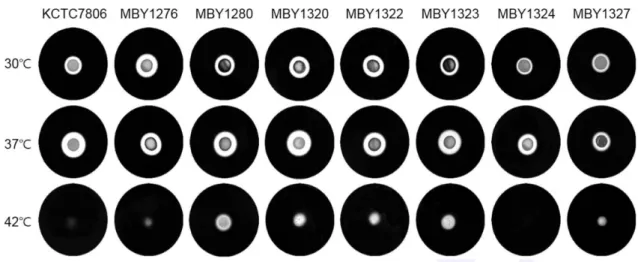
균주의전분분해활 성을 요오드 염색법으로 조사하였다(Fig. 1). MBY1276, 1280, 1320, 1322
및MBY1323
균주는37
oC
에서대조구인KCTC7806
균주와비슷한크기의전분분해환을나타냈으며
,
예산지역에서수집된누룩에서분리된MBY1327
균주 의 전분 분해환의 크기가 가장 작게 나타났다.
그러나KCTC7806
균주와MBY1324
균주는42
oC
에서전분분해환 이거의나타나지않았으며MBY1280, 1320, 1322, 1323
및MBY1327
균주는전분분해환을나타내었다.
배양온도에대한
S. fibuligera
의성장속도를조사하기위하여전분을함유한배지에서비성장속도를측정하였다
(Fig.
2).
대조구인KCTC7806
균주의 비성장속도는37
oC
에서0.25 h
-1로측정되었으며, 42
oC
에서는93.7%
감소한수준인0.016 h
-1로나타났다.
누룩에서분리한S. fibuligera
균주중 에서MBY1320
균주는37
oC
에서비성장속도가0.31 h
-1로 대조구보다높은비성장속도를나타냈으며42
oC
에서비성장 속도가0.28 h
-1로대조구인KCTC7806
균주의비성장속도보다약
94%
높은수준을나타내어대조구보다내열성이우수한것으로판단되었다
.
Fig. 1. Hydrolysis of starch by S. fibuligera strains incubated at different temperatures. S. fibuligera strains were grown overnight in YEPS and washed twice with sterile water to achieve an OD
600of 0.2. The cell suspension taken by five-fold serial dilutions were spotted onto a YEPS plate. The plates were incubated at the indicated temperature for 2 days and iodine reagent (KI) was added to flood the growth.
Fig. 2. Specific growth rates of S. fibuligera strains utilizing soluble starch (1%) as carbon source. Cells were grown in YEPS medium at an indicated temperature and specific growth rate determined at an exponential growth phase (■: 30°C, □: 37°C,
▧
: 42
oC). Different letters in indicate a significant difference
between means.
가용성전분이함유된배지에서균주를배양한후상등액 을회수하여
30, 37, 42
oC
에서전분분해효소활성을측정하 였다.
대조구인KCTC7806
균주는37
oC
에서가장우수한α-
amylase
효소활성을나타냈지만반응온도의증가에따라효소활성이급격히감소하였다
. MBY1320
균주는대조구인KCTC7806
균주보다낮은수준의α-amylase
효소활성을나 타내었지만반응온도가증가함에따라α-amylase
효소활성 이 유의적으로 증가하는 경향을 나타내었지만42
oC
에서KCTC7806
균주가나타낸α-amylase
효소활성의약38.8%
수준이었다
(Fig. 3A).
대조구인
KCTC7806
균주의glucoamylase
효소활성은30
oC
에서상대적으로높은효소활성을보이지만,
반응온도 가증가할수록효소활성이유의적으로감소하여42
oC
에서는 효소활성이 거의 나타나지 않았다(Fig. 3B). MBY1280, 1322, 1323
및MBY1324
균주는glucoamylase
효소활성이KCTC7806
균주에비해상대적으로낮았으며MBY1276
균 주는30
oC
에서583.0 U
으로 높은 효소활성을나타냈으나37
oC
이상으로반응온도가상승하면서활성이급격히감소하였다
.
그러나MBY1320
균주는 반응온도가증가할수록glucoamylase
효소활성이증가하였으며42
oC
에서1,006.9 U
로 가장 우수한 효소활성을 나타내었다.
이러한 결과는MBY1320
균주가대조구인KCTC7806
균주를비롯한다른S. fibuligera
균주에비해높은배양온도에서도상대적으로빠른비성장속도로성장하는것을부분적으로뒷받침하는 결과로판단되었다
.
가용성전분을탄소원으로사용하여
42
oC
에서S. fibuligera KCTC7806
및MBY1320
균주의균체성장속도와에탄올생 산속도를비교하였다(Fig. 4).
대조구인KCTC7806
균주는42
oC
에서에탄올생산량이배양36
시간경과후약0.25 g/l
이 었으나(Fig. 4A), MBY1320
균주는0.32 g/l
로상대적으로우 수한에탄올생산성을나타내었다(Fig. 4B).
또한가용성전 분을탄소원으로이용하여성장할때MBY1320
균주의비 성장속도가KCTC7806
균주보다유의적으로높은수준을 나타내었다.
이러한 결과는42
oC
에서MBY1320
균주의glucoamylase
의효소활성이상대적으로높은것과관련이있는것으로판단되었다
. Fig. 3. Enzyme activity of α-amylase (A) and glucoamylase (B)
for starch-degrading yeast S. fibuligera strains. Extracellular protein was harvested by incubating S. fibuligera strain in YEPS for 24 h at 30°C and culture broth obtained by centrifugation was used for an enzyme assay (■: 30°C, □: 37°C,
▧: 42°C). Different letters in indicate a significant difference between means.
Fig. 4. Shake flask cultivation of S. fibuligera strain KCTC
7806 (A), and MBY 1320 (B) at 42
oC. Soluble starch (1%) was
used as carbon source and initial medium acidity was adjusted to
pH 6. Agitation speed was maintained at 200 rpm throughout the
cultivation (●: OD
600, ○: ethanol).
전분의당화에필요한공정을생략또는축소할경우에 탄올생산경비를절감할수있으므로전분분해활성이우수 한효모를이용하여전분을직접에탄올로전환시키는방법 이개발되고있다
[4].
또한,
에탄올생산에적합한효모종균 으로서내열성,
에탄올내성,
전분발효능및응집성등이요 구되고있으므로[1]
기존의S. fibuligera
균주보다높은온 도에서전분분해활성및성장속도가우수한S. fibuligera
MBY1320
균주는육종및개량을통하여전통주및에탄올생산에사용할수있는후보균주로서사용할수있을것으 로판단된다
.
요 약
누룩으로부터
MBY1276, 1280, 1282, 1320, 1322, 1324
및
MBY 1327
로각각명명된전분을분해하는효모균주를분리하였다
.
이들 균주는18S rRNA
영역의ITS
단편 및26S rDNA
영역의D1/D2
단편의염기서열해석및탄소원 대사특성분석을통하여S. fibuligera
로동정하였다.
상주지 역에서수집된누룩으로부터분리된MBY1320
균주는대조 구균주인S. fibuligera KCTC7806
및누룩으로부터분리된 다른S. fibuligera
균주에비해고온에서상대적으로높은 비성장속도를나타내었다.
전분을분해하는데필요한효소 인 α-amylase
및glucoamylase
효소활성을 측정한 결과MBY1320
균주의α-amylase
효소활성은대조구균주보다낮지만
glucoamylase
효소활성은고온에서상대적으로우수한것으로나타났다
.
효소활성분석결과는MBY1320
균 주가표준균주및다른S. fibuligera
균주와비교하여고온 에서상대적으로높은비성장속도를나타내는것을뒷받침 하는결과로판단되었다.
가용성전분을이용한회분식배양 결과MBY1320
균주는표준균주보다42
oC
에서우수한성 장속도및에탄올생산속도를나타내었다.
본연구를통하여 기존에보고된S. fibuligera
균주보다고온에서glucoamylase
효소활성및비성장속도가우수한S. fibuligera
균주를보 고하는바이다.
Acknowledgments
This work was supported by “Cooperative Research Program for Agriculture Science & Technology Development (Project No.
PJ009993)”, Rural Development Administration Republic of Korea.
References