DSM-5 has proposed the use of the Clinician-Rated Di-mension of Psychosis Symptom Severity (CRDPSS) for eval-uating the various symptoms of schizophrenia.1 The 8-domain CRDPSS was developed from the perspective of deconstruct-ing the psychopathology of schizophrenia and would be ex-pected to provide baseline data for further advances in psychi-atric nosology.2 In considering trends in psychiatric nosology, Panas3 has suggested that phenomenological Gestalt has faded into oblivion in the diagnostic criteria for schizophrenia and that psychiatric nosology has regressed to a pre-Kraepelinian state. To our knowledge, despite these discussions, the di-mensional structure of the CRDPSS has hardly been studied. We therefore aimed to identify the factor solution of the CRDPSS. As described elsewhere,4 166 in patients with schizo-phrenia (diagnosed with the DSM-5),5 age ≥18 years and ≤65 years, and length of hospital stay ≥2 weeks were recruited in Korea. Half were men (51.5%). Their mean age and age at on-set were 46.5 (SD=11.2) and 25.2 (SD=13.2) years, respectively, and the mean chlorpromazine equivalent dose of antipsychot-ic prescriptions was 921.1 (SD=952.0) mg.
Mean scores on the hallucinations, delusions, disorganized speech, abnormal psychomotor behaviors, negative symp-toms, impaired cognition, depression and mania were 2.04 (SD=1.30), 2.27 (SD=1.16), 1.62 (SD=1.35), 1.16 (SD=1.16), 2.01 (SD=1.24), 1.22 (SD=1.22), 0.51 (SD=0.70) and 0.19 (SD= 0.48), respectively. An exploratory factor analysis (EFA) was conducted on the CRDPSS, with principle components
ex-Print ISSN 1738-3684 / On-line ISSN 1976-3026 OPEN ACCESS
Copyright © 2016 Korean Neuropsychiatric Association 253
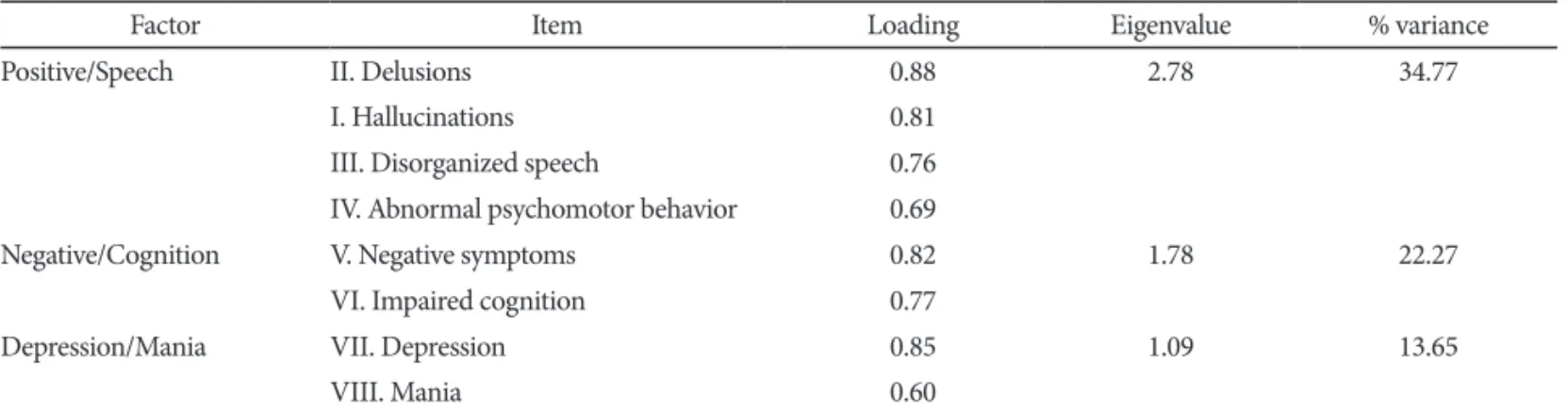
tracted by the varimax method. The number of factor in the solution was estimated on a scree plot, using eigenvalues >1.6 In addition, only a loading >0.40 was considered to reveal a clear factor structure and content. As a result, Bartlett’s test for sphericity was significant [χ2 (166)=468.72, p<0.001], and the total variance of the factor solution was 70.69%. Table 1 gives the factor loadings for a three-factor solution. The first factor consists of the domains for delusions, hallucinations, disorganized speech and abnormal psychomotor behavior, and is designated “positive/speech”. The second factor con-sists of the domains for negative symptoms and impaired cognition, and is named “negative/cognition”. The third fac-tor consists of the domains for depression and mania, and is designated “depression/mania”. In addition, Pearson’s corre-lations between the factor scores on the CRDPSS and the to-tal and subscale scores on other measurement tools were ob-tained. Scores on the positive/speech factor were significantly correlated with scores on the positive symptoms subscale [Brief Psychiatric Rating Scale (BPRS)]7 (r=0.81, p<0.01), negative symptoms subscale (BPRS)7 (r=0.62, p<0.01), resis-tance subscale (BPRS)7 (r=0.44, p<0.01), Scale for the Assess-ment of Thought, Language and Communication (TLC scale)8 (r=0.64, p<0.01), Calgary Depression Scale for Schizophrenia (CDSS)9 (r=-0.32, p<0.01), Young Mania Rating Scale (YMRS)10 (r=0.58, p<0.01) and Clinical Global Impression of severity (CGI-S)11 (r=0.85, p<0.01). Scores on the negative/cognition factor were correlated with scores on the negative symptoms subscale (BPRS) (r=0.35, p<0.01), resistance subscale (BPRS) (r=0.38, p<0.01), TLC scale (r=0.40, p<0.01) and CDSS (r= 0.17, p=0.03), and scores on the depression/mania factor were correlated with scores on the psychological discomfort sub-scale (BPRS)7 (r=0.25, p<0.01), the CDSS (r=0.17, p<0.01) and the YMRS (r=0.81, p<0.01).
Our investigation has the virtue of pioneering research into the evaluation of patients with schizophrenia using the CRDPSS.
LETTER TO THE EDITOR
Received: August 24, 2015 Revised: November 12, 2015
Accepted: November 12, 2015 Available online: November 18, 2015
Correspondence: Joonho Choi, MD, PhD
Department of Psychiatry, Hanyang University Guri Hospital, 153 Gyeongchun-ro, Guri 11923, Republic of Korea
Tel: +82-31-560-2273, Fax: +82-31-554-2599, E-mail: [email protected]
cc This is an Open Access article distributed under the terms of the Creative Commons
Attribution Non-Commercial License (http://creativecommons.org/licenses/by-nc/3.0) which permits unrestricted non-commercial use, distribution, and reproduc-tion in any medium, provided the original work is properly cited.
http://dx.doi.org/10.4306/pi.2016.13.2.253
Factor Structure of the Clinician-Rated Dimensions of Psychosis
Symptom Severity in Patients with Schizophrenia
Seon-Cheol Park1, Kang Uk Lee2, and Joonho Choi3,4
1Department of Psychiatry, Inje University Haeundae Paik Hospital, Busan, Republic of Korea 2Department of Psychiatry, Kangwon University School of Medicine, Chuncheon, Republic of Korea 3Department of Psychiatry, Hanyang University Guri Hospital, Guri, Republic of Korea
254 Psychiatry Investig 2016;13(2):253-254 Factor Structure of the CRPSS
In summary, it shows that the 8-domain CRDSS has a three-factor structure, consisting of positive/speech, negative/cog-nition and depression/mania factors. Pearson’s correlations indicate that all three factors have favorable concurrent and divergent validity. Hence, our findings shed light on the het-erogeneous symptom components of schizophrenia. Acknowledgments
This research was supported by the 2015 Research Fund of the Korean Society for Schizophrenia Research.
REFERENCES
1. Barch DM, Bustillo J, Gaebel W, Gur R, Hecker S, Malaspina D, et al. Logic and justification for dimensional assessment of symptoms and related clinical phenomena in psychosis: relevance to DSM-5. Schizophr Res 2013;150:15-20.
2. Heckers S, Barch DM, Bustillo J, Gaebel W, Gur R, Malaspina D, et al. Structure of the psychotic disorders classification in DSM-5. Schizophr Res 2013;150:11-14.
3. Parnas J. DSM-IV and the Founding Protype of Schizophrenia: Are We Regressing to a Pre-Kraepelinian Nosology? In: Kendler KS, Par-nas J, Editors. Philosophical Issues in Psychiatry II: Nosology. Oxford:
Oxford University Press, 2012, p.237-259.
4. Park SC, Jang EY, Lee KU, Lee K, Lee HY, Choi J. Reliability and valid-ity of the Korean version of the scale for the assessment of thought, language, and communication. Compr Psychiatry 2015;61:122-130. 5. American Psychiatric Association. Diagnostic and Statistical Manual
of Mental Disorders, 5th Edition. Washington, DC: American Psychi-atric Association; 2015.
6. Kaiser HE. The application of electronic computers to factor analysis. Educ Psychol Meas 1960;18:667-683.
7. Lachar D, Bailley SE, Rhoades HM, Espadas A, Aponte M, Cowan KA, et al. New subscales for an anchored version of the brief psychiatric rating scale: construction, reliability, and validity in acute psychiatric admission. Psychol Assess 2001;13:384-395.
8. Andreasen NC, Grove WM. Thought, language, and communication in schizophrenia: diagnosis and prognosis. Schizophr Bull 1986;12: 348-359.
9. Addington D, Addington J, Schissel B. A depression rating scale for schizophrenia. Schizophr Res 1990;3:247-251.
10. Young RC, Biggs T, Ziegler VE, Meyer DA. A rating scale for mania: reliability, validity, and sensitivity. Br J Psychiatry 1978;133:429-435. 11. Haro JM, Kamath SA, Ochoa S, Novick D, Rele K, Fargas A, et al. The
Clinical Global Impression-Schizophrenia scale: a simple instrument measure the diversity of symptoms present in schizophrenia. Acta Psy-chiatr Scand Suppl 2003;(416):16-23.
Table 1. Three-factor solution of the CRDPSS (N=166)
Factor Item Loading Eigenvalue % variance Positive/Speech II. Delusions 0.88 2.78 34.77
I. Hallucinations 0.81 III. Disorganized speech 0.76 IV. Abnormal psychomotor behavior 0.69
Negative/Cognition V. Negative symptoms 0.82 1.78 22.27 VI. Impaired cognition 0.77
Depression/Mania VII. Depression 0.85 1.09 13.65
VIII. Mania 0.60