캐드캠 시스템에서 사용되는 레진침투 지르코니아 블록의 접착양상과 파절강도
대한치과기공학회지 제38권 제4호 2016년
김사학, 김종견*, 김욱태**, 김재홍
경동대학교 치기공학과 경동대학교 호텔경영학과* 신한대학교 치기공학과**
Bonding performance and fracture strength of resin-infiltrated zirconia blocks for CAD/CAM systems
Sa-Hak Kim, Chong-Kyen Kim*, Wook-Tae Kim**, Jae-Hong Kim
Department of Dental Technology, School of Medical and Public Health, Kyungdong University Department of Hotel Management, School of Tourism, Kyungdong University*
Department of Dental Technology & Science, Shinhan University**
연구목적
:본 연구의 목적은 통상적으로 사용되는 글라스 세라믹과 고분자를 침투시킨 지르코니아 소재로 제작된 코어와 레진 시멘트의 굴곡강도 및 결합강도를 비교하여 하이브리드 기술이 치과 재료의 물리적인 성질에 미치는 영 향을 조사하기 위함이다.
연구방법: 본 두 가지의 통상적으로 사용되는 세라믹 소재[Vita PM9(GC) and I-JAM(ZC)] 와 다른 두 가지 하이 브리드 세라믹 소재 [CELTRA Duo(ZRC) and Vita Enamic(RIZ)] 를 평가하였다. 각 그룹의 소재를 선택하여 결합 강도와 굴곡강도, 그리고 scanning electron microscopy(SEM)을 이용하여 표면분석을 시행하였다. 도출된 결과 데 이터는 일원분산분석(One-way ANOVA)을 통해 분석되었으며, 제 1종 오류의 수준은 0.05로 하였다.
연구결과: RIZ 그룹에서 가장 높은 결합강도를 보였으며(p<0.05), ZC 그룹이 가장 낮은 결과를 보였다. 상대적으 로 굴곡강도는 ZC그룹이 가장 높은 수치를 나타내었으며, RIZ 그룹이 가장 취약했다.
연구결론: 하이브리드 기술로 제작된 소재(RIZ 그룹)는 우수한 레진 시멘트와의 결합강도를 보였지만, 그에 비해 굴곡강도는 상대적으로 통상적인 지르코니아 소재보다 비교적 취약한 결과를 보였다.
[Abstract]
273
?
주제어: 결합강도, 치과 캐드캠, 굴곡강도, 하이브리드 세라믹
https://doi.org/10.14347/kadt.2016.38.4.273
성 명 김 재 홍
강원도 원주시 문막읍 견훤로 815 경동대학교 메디컬캠퍼스 치기공학과
033-738-1634 [email protected] 주 소
전 화 E-mail
교신저자
03김재홍외3N 2016.12.30 3:57 PM 페이지273 mac2 가상 프린터 2438DPI 200LPI T
Ⅰ. Introduction
The CAD/CAM technology has been successfully introduced into dentistry during the last decade(Duret, 1993; Kim et al, 2014a; Kim et al, 2015; Amkhadova et al, 2011; Sasse et al, 2013).
Currently, many types of prefabricated ceramic blocks are available for milling using a CAD/CAM device(Schmitter et al, 2012; Pak et al, 2010;
Cehreli et al, 2009; Beuer et al, 2009; Helvey 2006).
One of the conventional ceramic blocks was made by zirconia(Moldovan et al, 2011; Chang 2004;
Luthardt et al, 2004), which has high fracture strength, favorable esthetics, and chemical stability. However, zirconia has a brittle nature because of its low tensile strength and fracture toughness, which can be influenced by the presence of intrinsic defects within the materials(Miskinis et al, 2008).
Despite the strength of the block material, cementation with the tooth is also important for the clinical success of a restoration. Because of cementation between a tooth and the ceramic restoration is encouraged for improving the retention, marginal adaptation and fracture resistance of restoration(Atsu et al, 2013).
Furthermore, zirconia crowns and bridges must be cemented using conventional resin cement recommended by the manufacturers because the bonding performance of zirconia with resin cements has been shown to be unsatisfactory(Dai et al, 2013; Sanohkan et al, 2013; Amaral et al, 2014; Kobes et al, 2013).
Few studies have evaluated the bond strength of zirconia to resin cement to confirm reliable bonding with surface treatments on zirconia restoration.
Hydrofluoric acid etching, which is essential for successful bonding of cement to zirconia veneering
ceramics(Chaiyabutr et al, 2008), does not improve the bond strength of resin cement to ceramics(Awliya et al, 1998). However, the addition of silane coupling agents to ceramic surfaces can be successful in improving their adhesion to resin cement(Oba et al, 2014; Matinlinna et al, 2013;
Lung et al, 2012). Zirconia blocks have high strength but lower wear resistance, fracture toughness, and bonding performance than composite resins blocks. These limitations show that there is a need for a material that combines the advantages of ceramics with those of composites with focus on the retention of enamel structure. Hybrid ceramic blocks infiltrated with resin were developed as another material suitable for CAD/CAM procedures. As introduced by the manufacturer, this material is called the resin- ceramic hybrid and is believed to have unique properties such as rigidity and hardness coupled with improved flexibility, fracture toughness, reduced brittleness, and better machinability compared with conventional ceramics. However, limited information is available on the bond strength between resin-ceramic hybrids and resin composite cements.
Therefore, the purposes of this study were (1) to investigate the bond strength of resin cements to CAD/CAM hybrid blocks compared with conventional ceramics containing PMMA and (2) to evaluate the flexural strength, employing shear bond strength and biaxial-flexural strength.
Ⅱ. Materials and methods
1. Specimen preparation
Three commercially available CAD/CAM blocks were used for sample preparation. The hybrid CAD/CAM materials were of two different types:
김사학·김종견·김욱태·김재홍
03김재홍외3N 2016.12.30 3:57 PM 페이지274 mac2 가상 프린터 2438DPI 200LPI T
캐드캠 시스템에서 사용되는 레진침투 지르코니아 블록의 접착양상과 파절강도 실험논문
resin-infiltrated zirconia(RIZ, Enamic, Vita, Germany), containing approximately 20% PMMA resin, and zirconium oxide-reinforced lithium silicate(ZLS, CELTRA Duo, DeguDent, Germany).
Partially yttria-stabilized zirconia(Y2O3 3 mol%) (PYZ, I-JAM, U&C, Korea) was used as the control material.
Specimens were fabricated(n=10) to perform bond strength and biaxial flexural strength analysis. RIZ blocks were sectioned with a precision cutting machine(Isomet 1000, Buehler, Lake Bluff, USA), polished with metallographic papers(600, 800, and 1200-grit SiC) into two final dimensions(15 mm ×
15 mm × 2 mm and ø16 mm × 1.2 mm), and finished with a 3-μm diamond suspension(METADI, Buehler, Lake Bluff, USA).
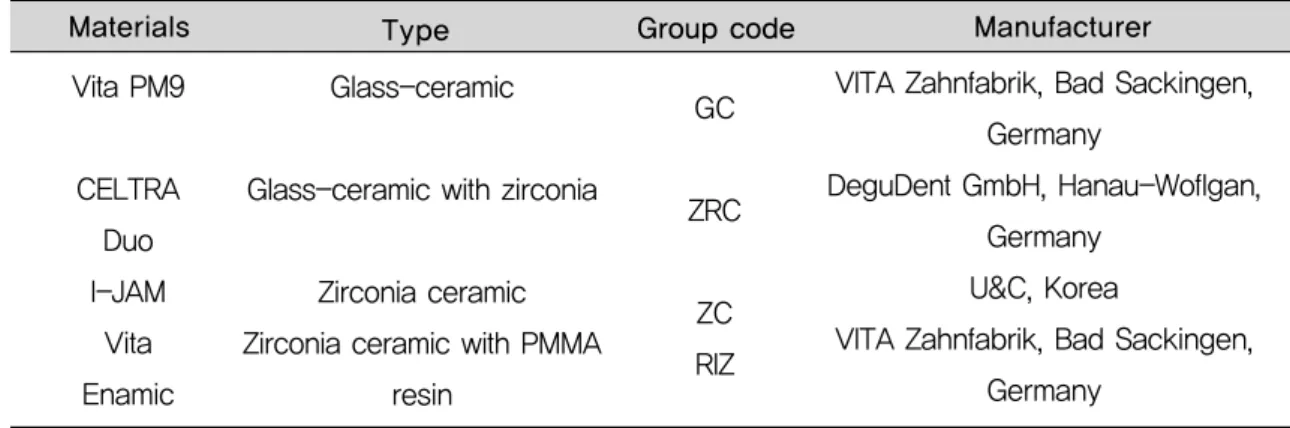
The ZRC block were cut to 15 mm × 15 mm × 2 mm and sintered at 820°C according to the manufacturer’s recommendations. PYZ green discs were cut to the same sizes as above, then sintered in a sintering oven at 25°C-1450°C using a rise time of 3 h and maintained at 1450°C for 2 h. Table 1 gives the detailed information of all tested materials and the manufacturer with the respective steps.
Table 1. CAD/CAM Blocks used in this Study
Manufacturer Group code
Materials Type
VITA Zahnfabrik, Bad Sackingen, Germany
DeguDent GmbH, Hanau-Woflgan, Germany
U&C, Korea
VITA Zahnfabrik, Bad Sackingen, Germany
GC ZRC
ZC RIZ Glass-ceramic
Glass-ceramic with zirconia
Zirconia ceramic Zirconia ceramic with PMMA
resin Vita PM9
CELTRA Duo I-JAM
Vita Enamic
2. Shear bond strength
A piece of double-stick tape with a circular hole, 5.0 mm in diameter, was positioned on the surface of the specimens to define the bonding area. The specimens were cleaned by sonication in a water bath for 5 min before the bonding test. The specimens were cemented using conventional resin composite cement(G-CEM LinkAce, GC, Japan).
The bonding procedures followed the manufacturer’s recommendations. For the light activated resins, the Optilux 400 system(Demetron, Danbury, USA) was used. A load of 5N was applied to secure the rods to the disks according to
manufacturer’s instruction and the excess cement was removed carefully. This load was kept constant for 8 min. Prior to testing, all bonded specimens were stored in distilled water at 37°C for 7 days.
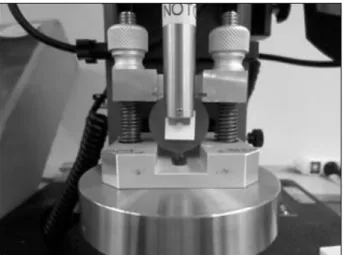
Finally, the specimens were placed in a jig for shear bond strength testing described in ISO/TR 11405 and loaded to failure with a crosshead speed of 0.8 mm/min(Fig. 1).
03김재홍외3N 2016.12.30 3:57 PM 페이지275 mac2 가상 프린터 2438DPI 200LPI T
3. Biaxial flexural strength
For the biaxial test, the thickness(1.2 mm) and diameter(16.0 mm) of all specimens were measured with a digital micrometer(Mitutoyo, Japan) before the flexural strength test. According to the ISO Standard 6872 recommendations, the biaxial bending test was used for determining the biaxial fracture strength values. The specimens were tested at room temperature with a universal testing machine(INSTRON 5255, Instron Co, USA) (Fig. 2).
Flexural strength, σ, in megapascals, was calculated using the following equation.
σ= -0,238 7P(X ? Y)/b2, where
σ is the maximum center tensile stress(in megapascals);
P is the total load causing fracture(in Newtons); and b is the specimen thickness at fracture origin(in millimeters).
X = (1 + ν ) ln (r2/r3)2 + [(1 ? ν )/2] (r2/r3)2
Y = (1 + ν ) [1+ln (r1/r3)2] + (1 ? ν ) (r1/r3)2, in which νis Poisson’ s ratio(use ν= 0.25);
r1 is the radius of the support circle(in millimeters);
r2 is the radius of the loaded area(in millimeters);
and
r3 is the radius of the specimen(in millimeters);
4. Statistical analysis
The data was calculated using one-way analysis of variance(ANOVA) followed by Tukey’s HSD test(p<0.05).
Ⅲ. Results
The mean and standard deviation values for the shear bond strength of the four CAD/CAM blocks to resin cement are shown in Table 2. In the glass?ceramic materials group, there was no significant difference between GC and ZRC bonding to resin cement. However, RIZ had a significantly higher bond strength than other groups(p<0.05).
ZC showed the lowest mean bond strength values(mean shear bond strength: 6.2 MPa). The predominant failure modes for all ceramic hybrids were cohesive failure in cement and mixed failure.
Seventy-two percent of the RIZ specimens
Fig. 1. Three millimeters of blade edge shear knife
place against a supported cement specimen
Fig. 2. A schematic illustration of the biaxial flexure test
using the piston-on-three-ball test
displaying mixed failures, including partial cohesive failure in cement. Predominant interfacial failure modes(i.e., adhesive failure between cement and ceramic interface) were found only with ZC.
The shear bond strength values of the ceramics were analyzed by Duncan’s multiple range test.
RIZ showed significantly higher bond strength values than other ceramics(p<0.05). GC showed no significantly different values from ZRC.
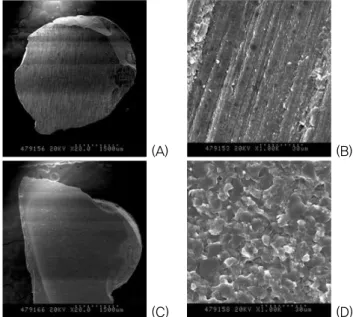
Figure 3 shows the scanning electron microscopy(SEM) micrographs of the interfaces between resin cements and two of the ceramic substrates. In Figure 3(a, b), the images represent the sand-blasted ZC surface, which has a clearly edge-shaped micro-roughness. In contrast, RIZ
showed an undulation because of the fracture of bodies of the substrate. Figure 3(c, d) shows a magnified image of the RIZ sample where homogeneously distributed micro-irregularities of the hybrid zirconia substrate can be seen.
The results and statistical analysis of flexural strength are shown in Table 3. The mean flexural strength ranged from 145.8 to 1412.0MPa when determined by the ISO 6872 biaxial bending method. The resistance to flexural loading of ZC was significantly higher than those of all other ceramics evaluated. The flexural strength of RIZ was significantly lower than those of GC, ZRC, and ZC, whereas no significant difference was observed between GC and ZRC.
캐드캠 시스템에서 사용되는 레진침투 지르코니아 블록의 접착양상과 파절강도 실험논문
Table 2. Means(Standard deviations) for Bond Strength and Distribution of Failure Modes
Premature Failure modes(%)
Bond strength(MPa*)
Interfacial Mixed Group code
GC ZRC
ZC RIZ
8.5 ± 1.6a 9.5 ± 1.3a 6.2 ± 0.4b 16.6 ± 1.3c
30 34 95 28
70 66 2 72
3**
* Means followed by distinct letters are significantly different at p<0.05.
**All specimens debonded prematurely for this group.
Table 3. Means(Standard deviations) for Flexural Strength Group code Flexural strength(MPa)
GC ZRC
ZC RIZ
218.9 ± 5.6a 256.1 ± 10.2a 1412.0 ± 17.7b 145.8 ± 5.7c
* Means followed by distinct letters are significantly different at p<0.05.
(A) (B)
(C) (D)
03김재홍외3N 2016.12.30 3:57 PM 페이지277 mac2 가상 프린터 2438DPI 200LPI T
Fig. 3. FE-SEM images of debonded resin cylinder from the ceramic surfaces. (A) Conventional zirconia ceramic surfaces, (B) high magnification of (A), (C) a cohesive fractured hybrid ceramic(RIZ, 20×; bar: 1,500 μm), and (D) high magnification of (C) (1,000×; bar: 30 μm).
Ⅳ. Discussion
All ceramics have been proven to resist fracture loads and show higher strength in CAD/CAM dentistry, although their use also requires a reliable bond with the various luting materials.
Many studies have investigated bonding to oxide ceramics; however, bonding to conventional ceramics remains unknown. Most research reports on bonding to zirconia ceramics are in agreement that achieving a reliable and predictable bond to this ceramic would be a major problem in dentistry or at least a limitation when performing restorations with materials having limited or no mechanical retention, such as occlusal veneers, partial coverage restorations, or resin-bonded fixed dental prostheses(Kim et al, 2014b). The hypothesis of this study was that the bond strength could be increased using a hybrid ceramic block compared with conventional zirconia. The results of this study confirm the hypothesis that a zirconia hybrid with PMMA increases the bond strength between a CAD/CAM block and dual-cure self-adhesive resin cement(G-CEM). The bond strength was found to be significantly higher in the RIZ group than in the GC, ZC, and ZRC groups, indicating that the hybrid with the PMMA system would improve the bonding of zirconium oxide ceramics. Moreover, the results partially confirm the hypothesis that PMMA in the hybrid blocks increases the bond strength. Although the slightly
high bond strength was obtained with the combination of glass-ceramics and zirconia(Group ZRC), no differences were found in the groups with a glass?ceramic(Group GC). These results may be attributable to the PMMA polymer chains creating a chemical interaction with resin cement, enhancing the mechanical and chemical bonding.
The cohesive failure rate of RIZ(75%) was irrespective of increment thickness or resin cement. The high percentage reflects the effectiveness of PMMA, although the body strength of RIZ may be weaker than that of a conventional ceramic. This result was fully supported by the biaxial flexural strength as obtained in the present investigation.
RIZ showed a biaxial flexural strength of 145.8±
5.7MPa, which is comparable to the value measured for ZC(1412.0±17.7MPa). GC and ZRC also had relatively low biaxial flexural strength values compared with conventional zirconia. To explain this effect, two aspects should be considered. The first is stress, which is built up during cooling after firing of the whole ceramic body such a ZC. In glass-ceramic systems, this stress may be at least partially relaxed by elastic or plastic deformation of the substructure. The zirconia substructure is rigid, which leads to higher stress formation in contrast to metal-ceramics or gold alloys with low sag resistance. Therefore, efforts to improve the veneering ceramics for zirconia should be directed toward optimal adjustment of the thermal expansion and increasing the mechanical strength.
The second aspect is the fact that the humid environment in the oral cavity may cause hydrolysis of the COO-H bonds(Gbureck et al, 2005), thus affecting the mechanical properties of the hybrid ceramic with PMMA. The increased failure rate of hybrid ceramics under humid
conditions in the oral cavity may be attributed to a different chemical composition, resulting in a higher susceptibility for hydrolytic attack.
Ⅴ. Summary
Within the limitations of this in vitro study, the following conclusions can be drawn. The shear bond strength values of hybrid ceramic with PMMA are higher than those of conventional glass- ceramics, glass-ceramics containing zirconia, and zirconia for dual cure resin cement. The biaxial flexural strength values of hybrid ceramics with PMMA were significantly lower than those obtained with conventional zirconia with the three-point flexure test. Therefore, the hypothesis that hybrid CAD/CAM ceramics would result in improved bond strength compared with conventional ceramics is accepted.
요약
제한된 조건하에서 진행된 실험결과, 다음과 같은 결론 을 얻을 수 있었다. PMMA가 함유된 하이브리드 세라믹 과 레진 시멘트간의 전단결합강도는 일반적으로 사용되 는 글라스 세라믹, 지르코니아가 함유된 글라스 세라믹, 지르코니아 소재보다 높은 결과를 보였다. PMMA가 함 유된 하이브리드 세라믹의 이축 굽힘강도는 통상적인 지 르코니아 소재의 3축 굽힘강도 시험값보다 확연히 낮은 결과를 보였다. 그러므로 하이브리드 CAD/CAM 세라믹 소재의 결합강도의 결과는 통상적인 세라믹 소재와 비교 하였을 때 우수할 것이라는 가설을 채택한다.
REFERENCES
Amaral M, Belli R, Cesar PF The potential of novel primers and universal adhesives to bond
to zirconia. J Dent 42, 90-98, 2014.
Amkhadova MA, Ignatov A. Computer planning of dental implantations with the use of navigational implantological sampler made by CAD/CAM technology. Stomatologiia, 90, 49- 52, 2011.
Atsu SS, Kilicarslan MA, Kucukesmen HC, Aka PS.
Effect of zirconium-oxide ceramic surface treatments on the bond strength to adhesive resin. J Prosthet Dent, 95, 430-436, 2006.
Awliya W, Oden A, Yaman P, Dennison JB, Razzoog ME. Shear bond strength of a resin cement to densely sintered high-purity alumina with various surface conditions. Acta Odontol Scand, 56, 9-13, 1998.
Beuer F, Schweiger J, Eichberger M High-strength CAD/CAM-fabricated veneering material sintered to zirconia copings--a new fabrication mode for all-ceramic restorations. Dent Mater, 25, 121-128, 2009.
Chaiyabutr Y, McGowan S, Phillips KM, Kois JC, Giordano R. The effect of hydrofluoric acid surface treatment and bond strength of a zirconia veneering ceramic. J Prosthet Dent, 100, 194-202, 2008.
Cehreli MC, Kokat AM, Akca K, CAD/CAM Zirconia vs. slip-cast glass-infiltrated Alumina /Zirconia all-ceramic crowns: 2-year results of a randomized controlled clinical trial. J Appl Oral Sci, 17, 49-55, 2009.
Chang J. CAD/CAM direct-designed zirconia abutments. J Mass Dent Soc, 58,40, 2009.
Dai W, Yin H, Chen C, Xie H, Zhang F. Effect of hot chemical etching on bond strength of zirconia to resin. Hua Xi Kou Qiang Yi Xue Za Zhi 231, 569-573, 2013.
Duret F. The practical dental CAD/CAM in 1993. J Can Dent Assoc, 59, 445-446, 448-453, 1993.
캐드캠 시스템에서 사용되는 레진침투 지르코니아 블록의 접착양상과 파절강도
실험논문
03김재홍외3N 2016.12.30 3:57 PM 페이지279 mac2 가상 프린터 2438DPI 200LPI TGbureck U, Grubel S, Thull R, Barralet JE.
Modified PMMA cements for a hydrolysis resistant metal-polymer interface in orthopedic applications. Acta Biomaterialia, 1, 671-676, 2005.
Helvey GA. Press-to-zirconia: a case study utilizing cad/cam technology and the wax injection method. Pract Proced Aesthet Dent, 18, 547-553, 2006.
A Kim KB, Kim JH. Evaluation of dimensional stability of digital dental model fabricated by impression scanning method. J Dent Hyg Sci, 14, 15-21, 2014.
B Kim KB, Kim JH. Influence of low temperature degradation on bond strength of yttria- stabilized tetragonal zirconia polycrystal core to veneering ceramic. J Dent Hyg Sci, 14, 29- 34, 2014.
Kim SH, Kim JH, Kim CK. Reliability and accuracy of digital impression obtained from CS-3500 intraoral scanner. J Dent Hyg Sci, 15, 673- 678, 2015.
Kobes KG, Vandewalle KS, Bond strength of resin cements to zirconia conditioned with primers.
Gen Dent, 61, 73-76, 2013.
Lung CY, Kukk E, Matinlinna JP. Shear bond strength between resin and zirconia with two different silane blends. Acta Odontol Scand, 70, 405-413, 2012.
Luthardt RG, Holzhuter MS, Rudolph H, Herold V, Walter MH. CAD/CAM-machining effects on Y-TZP zirconia. Dent Mater, 20, 655-662, 2004.
Matinlinna JP, Choi AH, Tsoi JK. Bonding promotion of resin composite to silica-coated zirconia implant surface using a novel silane system. Clin Oral Implants Res, 24, 290-296, 2013.
Miskinis SB, Snyder M, Sierraalta M, Billy E,
Razzoog ME. Effect of varying coping thickness on early load-to-fracture strength of Procera AllCeram copings cemented with 2 resin-modified glass-ionomer cements.
Quintessence Int, 39, 501-505, 2008
Moldovan O, Luthardt RG, Corcodel N, Rudolph H.
Three-dimensional fit of CAD/CAM-made zirconia copings. Dent Mater, 27, 1273-1278, 2011.
Oba Y, Koizumi H, Nakayama D Effect of silane and phosphate primers on the adhesive performance of a tri-n-butylborane initiated luting agent bonded to zirconia. Dent Mater J, 33, 226-232, 2014.
Pak HS, Han JS, Lee JB, Kim SH, Yang JH.
Influence of porcelain veneering on the marginal fit of Digident and Lava CAD/CAM zirconia ceramic crowns. J Adv Prosthodont, 2, 33-38, 2010.
Sasse M, Kern M, CAD/CAM single retainer zirconia-ceramic resin-bonded fixed dental prostheses: clinical outcome after 5 years. Int J Comput Dent, 16, 109-118, 2013.
Schmitter M, Mueller D, Rues S: Chipping behavior of all-ceramic crowns with zirconia framework and CAD/CAM manufactured veneer. J Dent, 40, 154-162, 2012.
Sanohkan S, Kukiattrakoon B, Larpboonphol N.
The effect of various primers on shear bond strength of zirconia ceramic and resin composite. J Conserv Dent, 16, 499-502, 2013.
‥