• 검색 결과가 없습니다.

Preparation of Ag Nanoparticles by Templating Poly(vinyl chloride)-g-poly(styrene sulfonic acid) Graft Copolymer Membrane

N/A
N/A
Protected

Academic year: 2021

Share "Preparation of Ag Nanoparticles by Templating Poly(vinyl chloride)-g-poly(styrene sulfonic acid) Graft Copolymer Membrane"

Copied!
7
0
0

로드 중.... (전체 텍스트 보기)

전체 글

(1)

Poly(vinyl chloride)-g-poly(styrene sulfonic acid) 가지형 공중합체막을 이용한 은 나노입자 제조

변 수 진ㆍ서 진 아ㆍ지 원 석ㆍ설 용 건ㆍ김 종 학

연세대학교 화공생명공학과

(2010년 12월 14일 접수, 2011년 3월 5일 수정, 2011년 3월 7일 채택)

Preparation of Ag Nanoparticles by Templating Poly(vinyl chloride)-g-poly(styrene sulfonic acid) Graft Copolymer Membrane

Su Jin Byun, Jin Ah Seo, Won Seok Chi, Yong Gun Shul, and Jong Hak Kim

Department of Chemical and Biomolecular Engineering, Yonsei University, Seoul 120-749, Korea (Received December 14, 2010, Revised March 5, 2011, Accepted March 7, 2011)

요 약: 원자전달 라디칼 중합(ATRP)에 의해 poly(vinyl chloride) (PVC) 주사슬과 poly(styrene sulfonic acid) (PSSA) 곁사슬로 되어있는 양쪽성 PVC-g-PSSA 가지형 공중합체를 합성하였다. 합성된 고분자 전해질막을 10 wt% AgNO

3

수용액 에 담가 은이온으로 이온교환을 하였으며, 환원제를 통하여 은 나노입자를 성장시켰다. UV분광학과 XRD 분석을 통해 은 나노입자 성장을 확인하였다. 투과전자현미경(TEM) 분석결과 NaBH

4

를 사용하였을 때 10∼20 nm 크기의 은 나노입자를 얻는데 가장 효과적임을 알 수 있었다. 또한 은 나노입자의 성장은 환원제의 농도와 환원 시간에 크게 영향을 받았다.

Abstract: An amphiphilic graft copolymer consisting of a poly(vinyl chloride) (PVC) backbone and poly(styrene sul- fonic acid) (PSSA) side chains (PVC-g-PSSA) was synthesized via atom transfer radical polymerization (ATRP). This poly- mer electrolyte membrane was ion-exchanged to Ag ions by immersing in 10 wt% AgNO

3

aqueous solution and templated the growth of Ag nanoparticles by a reducing agent. The formation of Ag nanoparticles was confirmed using UV-visible spectroscopy and X-ray diffraction (XRD). Transmission electron microscopy (TEM) revealed that utilization of NaBH

4

was the most effective in the formation of Ag nanoparticles with 10∼15 nm in size. The formation of Ag nanoparticles was al- so strongly affected by the concentration of reducing agent and reduction time.

Keywords: nanoparticles, silver, atom transfer radical polymerization (ATRP), nanomaterials graft copolymer

1. Introduction

1)

Polymer electrolytes include a polymer/salt complex and a polyelectrolyte. The former consists of a sol- vent-free polymer and a metal salt, which are prepared by dissolving salt in high molecular weight polymer host. The latter is a polymer whose repeating units bear ionically charged groups. Polymer electrolyte membranes have received much attention as their suc- cessful use in lithium secondary batteries [ 1], electro-

주저자(e-mail: [email protected])

chromic devices [ 2], polymer electrolyte membrane fuel cells [ 3], dye-sensitized solar cells [ 4] and facili- tated olefin transport membranes [ 5]. Solid polymer electrolyte membranes are advantageous over liq- uid-based counterparts in terms of good mechanical properties, ease of fabrication thin film fabrication with desirable sizes and proper electrode/electrolyte contact in various electrochemical devices.

Incorporation of metal nanoparticles into a polymer

matrix produces nanocomposite materials, which is an

effective method for enhancing the functions of neat

(2)

their capability for increasing electrical, mechanical and antibacterial properties of polymer [ 10-12]. Conventional method for synthesizing nanoparticles is based on the chemical reduction of metal ions in liquid medium.

Several synthetic methods using a template polymer membrane have been also reported recently, for exam- ple, H

2

gas [ 13], heat treatment [ 14], NaBH

4

solution [ 15], and ultraviolet irradiation [16] was utilized.

In this study, we report on the in-situ preparation of nanocomposite membranes in which silver nanoparti- cles are embedded. First, we synthesized a micro- phase-separated amphiphilic graft copolymerconsisting of a poly(vinyl chloride) (PVC) backbone and poly (styrene sulfonic acid) (PSSA) side chains (PVC-g- PSSA) via atom transfer radical polymerization (ATRP).

The graft copolymer matrix was selected because of its ability to form well-defined ordered nanostructures.

Silver ions within the graft copolymer were in-situ re- duced to form silver nanoparticles using various re- ducing agents. In particular, the kinetics for the for- mation of nanoparticles is reported here. The resulting PVC-g-PSSA/Ag nanocomposites were characterized using UVvisible spectroscopy and transmission electron microscopy (TEM).

2. Experimental

2.1. Material

PVC (M

n

= 55,000 g/mol, M

w

= 97,000 g/mol), 4-styrene sulfonic acid (SSA), copper (I) chloride (CuCl), 1,1,4,7,10,10-hexamethyl triethylene tetramine (HMTETA), silver nitrate (AgNO

3

, > 99%), sodium borohydride (NaBH

4

) and 1-methy-2-pyrrolidinone (NMP) were purchased from Aldrich. Methanol and dimethyl sulf- oxide (DMSO) were purchased from J. T. Baker. All

dissolved in 18 mL NMP in a round flask at 70°C.

Separately, 14 g of SSA was dissolved in 18 mL DMSO at 70°C and added to PVC solution. After pro- ducing homogeneous solution, 0.04 g of CuCl and 0.1 mL of HMTETA were added and the reaction flask was sealed with a rubber septum. After N

2

purging for 30 min, the reaction vessel was immersed in an oil bath at 90°C. The reaction was allowed to proceed for 24 h. After passing the solution through a column with activated Al

2

O

3

to remove the catalyst, it was pre- cipitated into methanol. The polymer was purified by redissolving in DMSO and reprecipitating in methanol.

Finally, the polymer was dried in a vacuum oven over- night at room temperature.

2.3. Formation of Silver Nanoparticles

First, 2 g of PVC-g-PSSA was dissolved in 20 mL of DMSO with stirring for 2 h. Then, the solution was cast on a slide glass by drop casting method and dried in an oven for a day at 80°C. After drying the solvent completely, the films were immersed into 10 wt%

AgNO

3

aqueous solution for 30 min and then dried in the hood for overnight. Three kinds of reducing agent, 0.2 M NaBH

4

(aq), 0.2 M formamide (HCONH

2

) (aq) and 0.2 M DMF (HCON(CH

3

)

2

) were utilized. The im- mersion time in 0.05 M NaBH

4

and the concentration of NaBH

4

were changed to investigate their effects on the formation of silver nanoparticles.

2.4. Characterization

TEM pictures were obtained from a Philips CM30

microscope operating at 300 kV to observe silver

nanoparticles resulting from the reduction of silver

ions. For TEM measurements, the dried films were dis-

solved in DMSO, and then a drop of this colloidal sil-

(3)

Scheme 1. Schematic process for the in-situ formation of silver nanoparticles created in a PVC-g-PSSA graft copoly- mer film.

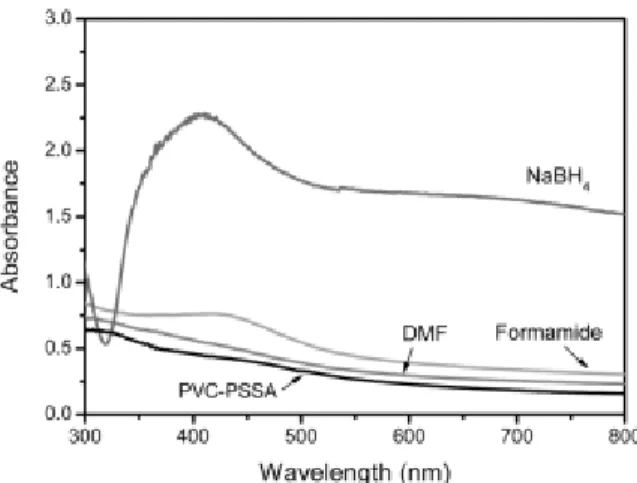
Fig. 1. UV-visible spectra for PVC-g-PSSA and PVC-g- PSSA/Ag film with different reducing agent. The concen- tration of reducing agent was fixed at 0.2 M.

ver dispersion was placed onto a standard copper grid.

UV-visible spectroscopy was measured with spec- trophotometer (Hewlett Packard) in the range of 300 to 800 nm. The XRD experiment was carried out on a Rigaku 18 kW rotating anode x-ray generator with CuK radiation ( λ = 1.5406 Å) operated at 40 kV and 300 mA. The 2 range was from 5 to 60° with a scan- ning speed of 3 °/min, and the distance from the sam- ple to detector was 185 mm.

3. Results and Discussion

The reaction scheme for the synthesis of silver nano- particles within the PVC-g-PSSA graft copolymer is il- lustrated in Scheme 1. PVC-g-PSSA polymer electro- lyte membrane was synthesized via one-step ATRP process [ 17]. This graft copolymer membrane isex- pected to molecularly self-assemble into continuous nanophase domains of semicrystalline PVC interweaved with hydrophilic domains of PSSA brush layer due to the chemical dissimilarity between the two polymer segments. The polymer electrolyte was ion exchanged to silver ions by immersing 10 wt% AgNO

3

aqueous solution and templated the growth of Ag nanoparticles by a reducing agent.

Fig. 1 shows the UV-visible absorption spectra for as-synthesized PVC-g-PSSA and PVC-g-PSSA/Ag films after reduction reaction. Three kinds of reducing agents were utilized and compared at the same concentration. In the Na

+

form without reduction proc- ess, there was no distinguishable UV absorption for

PVC-g-PSSA film. Upon ion exchange to silver ions and subsequent reduction process by NaBH

4

, a strong UV absorption peak centered at 415 nm was observed corresponding to the plasmon excitation of Ag nano- particles [ 18-20]. The absorption peak whose maximum occurs at around 410 ∼450 nm is related to the for- mation of silver metal nanoparticles [ 18-20]. Further- more, the magnitude of this peak is related to the con- centration of silver nanoparticles while the peak posi- tion relates to the size of the silver nanoparticles. In the formamide treated sample, the peak intensity was much smaller than NaBH

4

treated sample at the same concentration. In contrast, there was no significant ab- sorption for the DMF treated sample. As a result, it is found that the reducing power is arranged in the order:

NaBH

4

> formamide > DMF. Thus, the kinetics for the formation of silver nanoparticles was investigated on the NaBH

4

system by changing the concentration of reducing agent and reduction time.

Fig. 2(a) shows change in UV-visible spectra for

PVC-g-PSSA/Ag film depending on the NaBH

4

con-

centration. The absorbance at 415 nm was normalized

by considering the value at 330 nm for all the data

and presented in Fig. 2(b). The absorbance sharply in-

creased with NaBH

4

concentration up to 0.005 M,

above which it did not increase significantly. Thus, the

critical concentration of NaBH

4

was found to be near

(4)

Fig. 2. (a) Change in UV-visible spectra for PVC-g- PSSA/Ag film depending on the NaBH

4

concentration, (b) Change in absorbance at 415 nm by normalizing the value at 330 nm.

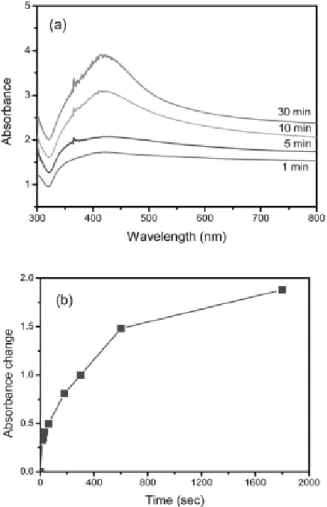
Fig. 3. (a) Change in UV-visible spectra for PVC-g- PSSA/Ag film depending on the contact time with 0.005 M NaBH

4

solution, (b) Change in absorbance at 415 nm by normalizing the value at 330 nm.

0.01 M in the PVC-g-PSSA graft copolymer membrane.

Change in UV-visible spectra for PVC-g-PSSA/Ag film was also monitored by changing the contact time with NaBH

4

solution and presented in Fig. 3. The ab- sorbance sharply and linearly increased with contact time with NaBH

4

solution up to 600 sec, above which it increased less sharply.

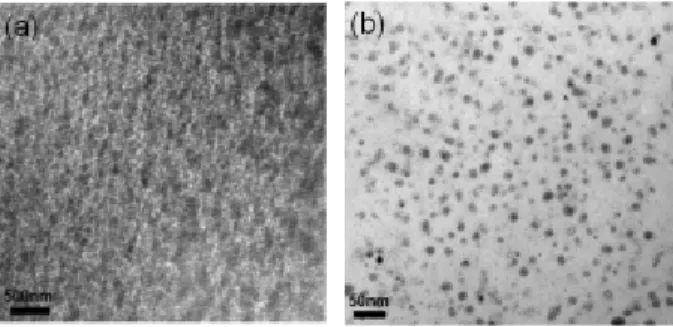
TEM analysis was carried out to characterize the morphology of PVC-g-PSSA graft copolymer and PVC-g-PSSA/Ag film after reduction. Fig. 4(a) pres- ents the TEM image of unstained PVC-g-PSSA graft copolymer. The difference of electron densities be- tween the PVC main chains and the PSSA side chains provides image contrast between two domains [17].

Dark regions represent the hydrophobic domains of PVC main chains whereas lighter regions do the PSSA side chains. Thus, the amphiphilic PVC-g-PSSA graft copolymer molecularly self-assembled into continuous nanophase domains of PVC interweaved with hydro- philic domains of PSSA brush layer.

The formation and size of silver nanoparticles cre-

ated in-situ in the PVC-g-PSSA graft copolymer film

were monitored using TEM micrograph, as shown in

Fig. 4(b). The concentration of NaBH

4

solution and

contact time were fixed at 0.005 M and 30 min,

respectively. It is because there was no peak shift in

UV-visible spectroscopy of Fig. 2, indicating no sig-

nificant change in particle sizes. TEM images of the

(5)

Fig. 4. TEM images of a) pristine PVC-g-PSSA graft co- polymer and b) Ag nanoparticles created in-situ in PVC-g-PSSA film by 0.005 M NaBH

4

solution for 30 min.

Fig. 5. XRD data of Ag nanoparticles created in-situ in PVC-g-PSSA film by 0.005 M NaBH

4

solution for 30 min.

samples showed that the silver nanoparticles created in the PVC-g-PSSA film were stabilized with 10 ∼15 nm in average size without agglomeration. It strongly rep- resentsthe effective control of graft copolymer film for the formation of silver nanoparticles [21].

XRD were measured for the silver nanoparticles cre- ated in the PVC-g-PSSA film to confirm the formation of silver nanoparticles. The results are shown in Fig. 5, where the intensity of X-ray scattering is plotted against the diffraction angle, 2 θ. Sharp crystalline peaks at 2 θ values of about 38 and 44° appeared, at- tributable to the (111) and (200) Bragg’s reflections of face-centered cubic structure of silver metal, re- spectively [22]. The amorphous halo at around 20° was also observed, indicating the presence of PVC-g-PSSA film without being perturbed by the presence of silver nanoparticles.

4. Conclusions

Amphiphilic PVC-g-PSSA graft copolymer was syn- thesized via ATRP technique using PVC backbone as a macroinitiator and used as a template film for the in-situ formation of silver nanoparticles in the solid state. Synthesis of microphase-separated PVC-g-PSSA graft copolymer was successful via “grafting from”

method using ATRP. The graft copolymer molecularly self-assembled into continuous nanophase domains of PVC interweaved with hydrophilic domains of PSSA brush layer, as revealed by TEM. Nanocomposite films

comprising the amphiphilic graft copolymer and the silver nanoparticles were prepared by reduction process.

UV-visible spectroscopy, XRD and TEM analys is re- vealed that the silver nanoparticles with 10 ∼15 nm in average size were in-situ grown from the silver ions in the templated graft copolymer film. NaBH

4

was more effective in the formation of Ag nanoparticles than for- mamide or DMF. The absorbance at 415 nm sharply increased with NaBH

4

concentration up to 0.005 M, above which it did not increase significantly. The ab- sorbance at 415 nm also sharply increased with contact time with NaBH

4

solution up to 600 sec, above which it increased less sharply. Thus, 0.005 M NaBH

4

con- centration and 600 sec contact time were found to be sufficient for the preparation of silver nanoparticles in the PVC-g-PSSA graft copolymer.

Acknowledgement

This work was supported by the Ministry of

Knowledge Economy through the Human Resources

Development of the Korea Institute of Energy Technology

Evaluation and Planning (KETEP) (No. 20104010100500)

and New & Renewable Energy R&D program (2009

T100100606). This work was also supported by the

Ministry of Knowledge Economy (MKE) and Korea

Institute for Advancement in Technology (KIAT)

(6)

polymeric electrolyte based on a copolymer con- taining self-assembled stearylate moiety for lith- ium-ion batteries”, Electrochem. Commun., 11, 481 (2009).

2. J. Reiter, O. Krejza, and M. Sedlarikova, “Electro- chromic devices employing methacrylate-based pol- ymer electrolytes”, Sol. Energy Mater. Sol. Cells., 93, 249 (2009).

3. H. Ko, J. Park, J. Choi, S. U. Kim, H. J. Kim, and Y. T. Hong, “Double-layered polymer electro- lyte membrane based on sulfonated poly(aryl ether sulfone)s for direct methanol fuel cells”, Membrane Journal, 19, 291 (2009).

4. S. H. Ahn, J. H. Koh, J. A. Seo, and J. H. Kim,

“Structure control of organized mesoporous TiO

2

films templated by graft copolymers for dye-sensi- tized solar cells”, Chem. Comm., 46, 1935 (2010).

5. J. H. Kim, B. R. Min, J. Won, S. H. Joo, H. S.

Kim, and Y. S. Kang, “Role of polymer matrix in polymer/silver complexes for structure, interactions, and facilitated olefin transport”, Macromolecules, 36, 6183 (2003).

6. J.-F. Berret, K. Yokota, M. Morvan, and R.

Schweins, “Polymer-nanoparticle complexes: From dilute solution to solid state”, J. Phys. Chem. B., 110, 19140 (2006).

7. S. U. Hong, “Effects of substrates on nanofiltration characteristics of multilayer polyelectrolyte mem- branes”, Membrane Journal, 18, 185 (2008).

8. J. G. Huang, I. Ichinose, and T. Kunitake, “Nano- coating of natural cellulose fibers with conjugated polymer: Hierarchical polypyrrole composite materi- als”, Chem. Commun., 1717 (2005).

9. H. Chung, K. Ohno, T. Fukuda, and R. J. Composto,

“Self-regulated structures in nanocomposites by di-

nanoparticles and nanocraters on silicon wafers”, Langmuir, 22, 7881 (2006).

12. J. H. He, T. Kunitake, and T. Watanabe, “Porous and nonporous Ag nanostructures fabricated using cellulose fiber as a template”, Chem. Commun., 795 (2005).

13. S. G. Boyes, B. Akgun, W. J. Brittain, and M. D.

Foster, “Synthesis, characterization, and properties of polyelectrolyte block copolymer brushes pre- pared by atom transfer radical polymerization and their use in the synthesis of metal nanoparticles”, Macromolecules, 36, 9539 (2003).

14. J. H. Kim, B. R. Min, H. S. Kim, J. Won, and Y.

S. Kang, “Facilitated transport of ethylene across polymer membranes containing silver salt: Effect of HBF on the photoreduction of silver ions”, J.

Membr. Sci., 212, 283 (2003).

15. C. J. Huang and T. C. Chang, “Studies on the electromagnetic interference shielding effectiveness of metallized PVAc-AgNO/PET conductive films”, J. Appl. Polym. Sci., 91, 270 (2004).

16. J. H. Kim, B. R. Min, J. Won, and Y. S. Kang,

“Effect of the polymer matrixon the formation of silver nanoparticles in polymer-silver salt complex membranes”, J. Polym. Sci. B: Polym. Phys., 44, 1168 (2006).

17. J. K. Choi, Y. W. Kim, J. H. Koh, and J. H. Kim,

“Proton Conducting Membranes Based on Poly(vi- nyl chloride) Graft Copolymer Electrolytes”, Polym. Adv. Tech., 19, 915 (2008).

18. N. Perkas, M. Shuster, G. Amirian, Y. Koltypin, and A. Gedanken, “Sonochemical immobilization of silver nanoparticles on porous polypropylene”, J. Polym. Sci. A: Polym. Chem., 46, 1719 (2008).

19. J. Gao, Y. Sun, J. Zhou, Z. Zheng, H. Chen, W.

(7)

Su, and Q. Zhang, “Preparation of Ag nano- particles termini-protected side-chain liquid crystal- line azobenzene polymers by RAFT polymer- ization”, J. Polym. Sci. A: Polym. Chem., 45, 5380 (2007).

20. S. Cle’menson, L. David, and E. Espuche, “Structure and morphology of nanocomposite films prepared from polyvinyl alcohol and silver nitrate: Influence of thermal treatment”, J. Polym. Sci., A: Polym.

Chem., 45, 2657 (2007).

21. J. A. Seo, J. T. Park, J. H. Koh, and J. H. Kim,

“Templated synthesis of AgAu bimetallic nano- particles by amphiphilic PVC-g-PSSA graft copoly- mer film”, Materials Letters, 62, 4492 (2008).

22. X. Jiang, Y. Xie, J. Lu, L. Zhu, W. He, and Y.

Qian, “Preparation, Characterization, and Catalytic

Effect of CS

2

-Stabilized Silver Nanoparticles in

Aqueous Solution”, Langmuir, 17, 3795 (2001).

수치

Fig. 1. UV-visible spectra for PVC-g-PSSA and PVC-g-  PSSA/Ag film with different reducing agent
Fig. 2. (a) Change in UV-visible spectra for PVC-g-  PSSA/Ag film depending on the NaBH 4  concentration, (b)  Change in absorbance at 415 nm by normalizing the value  at 330 nm
Fig. 5. XRD data of Ag nanoparticles created in-situ  in  PVC-g-PSSA film by 0.005 M NaBH 4  solution for 30 min.

참조

관련 문서

In 4-week group, the group filled with bone graft with decortication revealed larger new bone formation area than shown in the group that had a defect area

Chitosan/Carbopol ® 971NF (poly acrylic acid) interpolymer complexes were prepared in pH 3.0, 4.0 and 5.0 medium to control the ratio of chitosan and Carbopol ® 971NF in

A stress component is positive when it acts in the positive direction of the coordinate axes, and on a plane whose outer normal points in one of the positive coordinate

Perpendicular order of cylindrical domains of block copolymer can be obtained by tuning the interactions. Using Random Copolymer Brush to

Perpendicular order of cylindrical domains of block copolymer can be obtained by tuning the interactions. Using Random Copolymer Brush to

이 스케일억 제제들로는 Acrylic acid-hydroxypropyl acrylate copolymer, Styrene sulfonic acid-maleic acid copolymer, Acrylic acid-sulfonic acid copolymer

The result of using PLGA nanofiber membrane with bone graft material showed that the PLGA nanofiber membrane in the experimental group of 2 weeks were ten times more new

Effect of amino acid addition in culture media on the mycelial growth and g-aminobutyric acid (GABA) production of Sparassis latifolia..