INTRODUCTION
As the values in dietary habits changed (Kim HY et al., 2009), the pattern of food consumption rapidly changed to focus on con- venience, timesaving aspects and potentially healthier than cu- rrent products on the market (Kang SJ, 2008). These trends apply to sauces, which play an important role in food as they provide taste, color, form, moisture for texture, and act as an appetizer (Choi SG, 2008), and it has been reported that the market for ready- to-purchase premade sauces have increased sharply (Park SH, 2008). Therefore, developing high-quality sauces taking into acco- unt consumer taste is very important (Kim HD et al., 2002).
Among the premade sauces, the teriyaki sauce is a type of soy sauce with thick consistency, and is sweet, salty, and environ- mentally friendly, because it is made using discarded ingredients such as leftover bones, skin, head, or connective tissues of fish; the sauce was created in Japan and is popular worldwide (Park HN et al., 2006). Thus far, research on the teriyaki sauce include studies on soy sauce (Park WB, 2001), studies on using Korean soy sauce (O HS
& Park WB, 2003), product application of teriyaki sauce (Park HN et al., 2006), manufacturing conditions (Park ML et al., 2007) and quality characteristics of teriyaki sauce depending on the main ingredient (Song CR & Choi SK, 2009), heating time of teriyaki sauce (Song CR, 2009), heating time optimization of soy sauce and sugar through reaction surface analysis (Kim HA et al., 2011), and addition of sugar substitute sweeteners (Song CR et al., 2012).
Currently, as consumers are becoming more aware of food and health, and their demands for health-oriented foods, which in- volves the relationship between dietary habits and health (Choi W et al., 2009), trends of using natural ingredients and sauces to improve taste (Park GH et al., 2008), or replacing artificial additives with herbs or medicinal plants, have been very apparent. Recently, food containing Korean traditional medicinal herbs has been the center of attention (Kwon KD et al., 2007; Choi W et al., 2009). Re- cently, the development of sauces with health improving functions by using bioactive substances found in natural ingredients was attempted. Similar to the use of herbs in Western cuisine to in- crease fragrance, help body increase nutrient absorption, and reduce unwanted odor, in Eastern cultures, medicinal herbs have been used to increase the palatability and quality of foods (Choi EH et al., 2011).
Many consumers are interested in Korean traditional medicinal herbs and health are preferred. A lot of development using Korean traditional medicinal herbs in food companies, but it is applied to a situation without a lot of sauce.
Therefore, in this study, we aimed to develop teriyaki sauces containing Korean traditional medicinal herbs, preferred by Ko- reans, to satiate the taste and interest in health of Korean con- sumers.
EXPERIMENTALMATERIALANDMETHODS Sample Production
Quality Characteristics of Teriyaki Sauces containing Medicinal Herb Extracts
Hyun-Ah Kim1, Dong-Seok Kim2and Chung-Rak Song3,¶
1Dept. of Hotel Culinary Arts, Yeonsung University, Seongnam 461-711, Korea
2Dept. of Food Service Industry, Seowon University, Cheongju 362-742, Korea
3Dept. of Tourism Food Service Cuisine, Hallym Polytechnic College, Chuncheon 200-711, Korea
ABSTRACT: This study determined the effects of addition of medicinal herb extracts (Zanthoxylum piperitum extract(TZ), Acantho- panax sessiliflorus(TA), Panax ginseng(TP), Cinnamomum lureitri Nees(TC), Angelica gigantis radix(TAG) and Crataegii fructus ex- tract (TCF) to teriyaki sauce with regard to taste and health benefit. After adding the medicinal herb extracts to teriyaki sauce, moisture content was found to be inversely proportional to the viscosity. The sauce with Panax ginseng extract(TP) had lowest sweetness, but highest salinity. The results showed that the sauce with Korean herb extracts had lower salinity content. In terms of colour value, the sauce with Crataegii fructus extract(TCF) had much higher lightness, redness, and yellowness than sauce prepared with other herb extracts. It had the strongest acidic taste and lowest pH. Sensory evaluation test revealed that the sauce with Anthoxylum piperitum extract(TZ) was the most preferred sauce among all the sauces tested. The degree of brown color of teriyaki sauces was correlated positively with taste preference(r=.570, p<0.01) and overall preference(r=.505, p<0.01).
Keywords: Korean Herb Extracts, Teriyaki Sauce, Viscosity, Taste, Health Benefit
§ Corresponding Author: Chung-Rak Song, Dept. of Tourism Food Service Cuisine, Hallym Polytechnic College, 48 Janghak-gil, Dong-meon, Chuncheon 200-711, Gangwon, Korea, Tel. +82-10-3241-0267, Fax. +82-033-240-9119, E-mail: [email protected]
Received: 19 August, 2014, Revised: 23 September, 2014, Accepted: 20 October, 2014.
Extracts of Korean traditional medicinal herbs were made from first adding 1 L of water to 100 g of Zanthoxylum piperitum, Acan- thopanax sessiliflorus, Panax ginseng, Cinnamomum lureitri Nees, Angelica gigantis radix and Crataegii fructus extract in a flask, ex- tracting by reflux condensation extraction twice, and filtered using Whatman No. 2 paper (Nam SH & Kang MY, 2000; Park CS, 2005). In 3,000 mL of medicinal herb extracts, roasted chicken bone(1,000 g), onions(300 g) and green onions(180 g), 1,200 mL of soy sauce, 600 mL of clear rice wine, and 850 g of xylitol were added, and then boiled under high heat. After boiling, the sauce was reduced under low heat for 3 h, taken off the heat, filtered using cheesecloth, cooled with ice water, and using .
Experimental Methods
Moisture and viscosity measurements
Moisture was measured using a halogen-type moisture analyzer (MB-45, Ohaus, Switzland) at 120℃ and 60 A. Viscosity was mea- sured using a viscometer (DV-II+, Brookfield, USA) with the No. 3 spindle at 60 rpm and 60℃ (±2℃). All measurements were re- peated 5 times and the results were averaged.
Sugar content, salinity and pH measurements
The sugar content was measured using Atago digital refracto- meter (PAL-3, Japan). Salinity was measured using a salinity meter (Model TM-30, 0~30%, Takemura, Japan), after diluting 10 mL of the sample in 90 mL of distilled water. pH was measured using a pH meter (F-51, Horiba Navi pH), after diluting 10 mL of the sample in 90 mL of distilled water and stirring for homogeneity. All mea- surements were repeated 5 times and the results were averaged.
Color values
Color values was measured using a colorimeter (JC 801, Color Techno System Co. Ltd, Japan). The L value (lightness), a value (red- ness), and b value (yellowness) were measured 5 times and averaged. Further, the values for the standard used in this ex- periment, which was a white board, were L=93.87; a=–1.41; and b=1.62.
Sensory evaluation test
Sensory evaluation test for the teriyaki sauces were conducted by 47 trained to evaluate teriyaki sauces(graduate students), at 3 pm in the afternoon. The students were seated at examination tables with individual dividers, and they were asked to gargle their mouths using distilled water 5 times, before beginning the tests and between testing samples. The samples were marked using a 3- digit random number and provided in a plastic cup of identical shape. Sensory evaluation test for preference tests were scored for external appearance, smell, taste, viscosity, and overall preference, and quantitative descriptive analysis was scored on a 7-point scale(7 the best score and 1 the worst score) for degree of brown color, degree of glossiness, soy sauce odor, herb odor, sweetness, soy sauce taste, herb taste, and lingering aftertaste.
Statistical methods
The results of quality characteristics of moisture, viscosity, sugar content, salinity, pH, sensory evaluation test and correlation co-
efficients between sensory evaluation and mechanical characte- ristics of the teriyaki sauces containing medicinal herb extracts were analyzed using SPSS 16.0 statistical package and one-way ANOVA with the statistical significance threshold at p<0.05. Post- hoc analysis was done using Duncan’s multiple range test.
RESULTSANDDISCUSSION Moisture and Viscosity
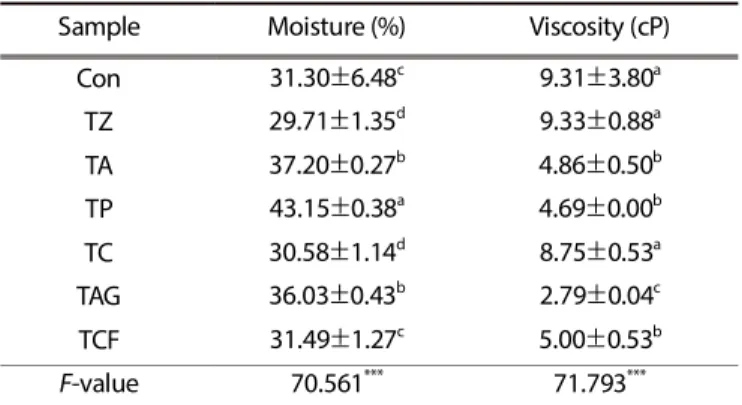
The results of moisture and viscosity measurements of teriyaki sauces containing medicinal herb extracts are listed in Table 1.
The moisture content of teriyaki sauces containing medicinal herb extracts was significantly higher (p<0.001) in TGE made using ginseng extracts at 43.15%, followed by TAE (37.20%), TAGE (36.03
%), TCFE (31.79%), control without medicinal herb extracts (31.30
%), TCE (30.58%), and TZE (29.71%).
Viscosity was higher in TZE (9.33 cP), followed by control (9.31 cP) and TAE (8.75 cP) samples than that in the others (p<0.001). The results obtained in this study is similar to those reported by Choi SG et al. (2006), where a demi-glace sauce containing basil (basil reduces the viscosity of the sauce). Shin MH & Nam SM (2006) re- ported that when preparing a soy sauce-based dressing, the moisture increases and viscosity decreases after the addition of soy sauce. In this study, the viscosity generally decreased with the addition of medicinal herbs, and this is believed to be due to the moisture content of the medicinal herb extracts. Therefore, in teriyaki sauce containing medicinal herb extracts, the moisture content and viscosity are closely related: high moisture content leads to low viscosity, and low moisture content leads to high viscosity.
Sugar Content, Salinity and pH
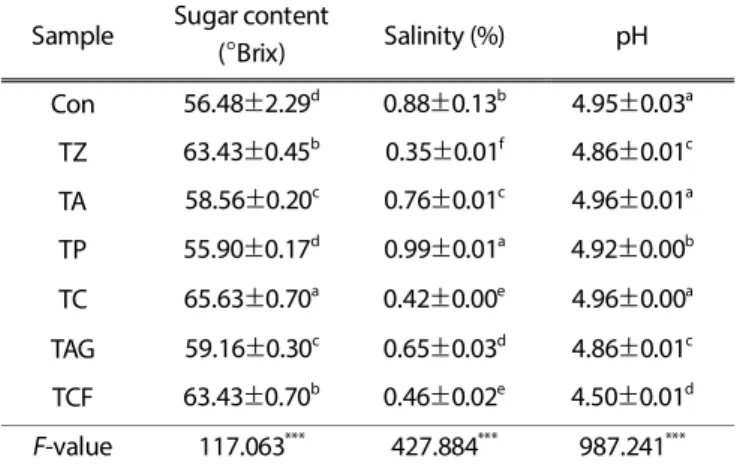
The results of sugar content, salinity, and pH measurements of teriyaki sauces containing medicinal herb extracts are listed in Table 2.
Table 1. Moisture contents and viscosity of teriyaki sauces made with various medicinal herb extracts
Sample Moisture (%) Viscosity (cP)
Con 31.30±6.48c 9.31±3.80a
TZ 29.71±1.35d 9.33±0.88a
TA 37.20±0.27b 4.86±0.50b
TP 43.15±0.38a 4.69±0.00b
TC 30.58±1.14d 8.75±0.53a
TAG 36.03±0.43b 2.79±0.04c
TCF 31.49±1.27c 5.00±0.53b
F-value 70.561*** 71.793***
Mean±SD; *** p<0.001.
a~d Means in a column by different superscripts are significantly different at p<0.05, by Duncan’s multiple range test.
Control: teriyaki sauce made using water.
TZ, TA, TP, TC, TAG, TCF : teriyaki sauce made using Zanthoxylum piperitum, Acanthopanax sessiliflorus, Panax ginseng, Cinnamomum loureirii Nees, Angelicae gigantis radix, Crataegi fructus extract.
Sugar content was significantly different between the samples: TC with 65.63 °Bx> TCF, 63.43 °Bx> TZ, 63.43 °Bx> TAG, 59.16
°Bx> TA, 58.56 °Bx> control, 56.48 °Bx> TP, 55.90 °Bx. The sugar content in TAG, TA, and TCF was higher than that in the control sauce without any extracts; this is believed to be due to the original sugar content of these ingredients are higher than that in other ingredients. Kim HD (2006) reported that an increase in sugar con- tent is observed with increasing amounts of Maximowiczia typica fruit in a demi-glace sauce. In this study, we believe that the high sugar content in the sauce is because of the high sugar content in the Korean medicinal herb ingredient.
Salinity decreased significantly in the following order: TP with 0.99 > control, 0.88 > TA, 0.76 > TAG, 0.65 > TCF, 0.46 > TC, 0.42 > TZ, 0.35 (p<0.001). The salinity of TP, control, and TA were high, and in contrast, the sugar contents of these samples were low. Sauces with low salinity tended to have high sugar content. Lee IJ. & Han JS (2009) reported that in soybean paste containing Korean tradi- tional medicinal herbs, no significant differences in sweetness were observed, but soybean paste containing Cinnamomum loureirii Nees or Angelicae gigantis radix had lesser saltiness than that in the control, showing a similar trend as that in our study. The TGE had the lowest sugar content and highest salinity, and sauces with other extracts had higher sugar content than that in the control and low salinity, indicating that the medicinal herb extracts help reduce the salinity of sauces.
The pH of the sauces was as follows: TC and TA, 4.96; control, 4.95;
TP, 4.92; TAG and TZ, 4.86; and TCF, 4.50, which was significantly lower than that of the others (p<0.001). The Crataegi fructus extract had the highest acidity at a pH of 3.08; however, when added to the teriyaki sauce, the pH was the lowest. Lower pH of all sauces, with the exception of TCE and TAE, than that in the control is due to the pH of the medicinal herb extracts.
Color Values
Table 2. Sugar content, salinity and pH of teriyaki sauces made with various medicinal herb extracts
Sample Sugar content
(°Brix) Salinity (%) pH
Con 56.48±2.29d 0.88±0.13b 4.95±0.03a TZ 63.43±0.45b 0.35±0.01f 4.86±0.01c TA 58.56±0.20c 0.76±0.01c 4.96±0.01a TP 55.90±0.17d 0.99±0.01a 4.92±0.00b TC 65.63±0.70a 0.42±0.00e 4.96±0.00a TAG 59.16±0.30c 0.65±0.03d 4.86±0.01c TCF 63.43±0.70b 0.46±0.02e 4.50±0.01d F-value 117.063*** 427.884*** 987.241***
Mean±SD; *** p<0.001.
a~e Means in a column by different superscripts are significantly different at p<0.05, by Duncan’s multiple range test.
Control: teriyaki sauce made using water.
TZ, TA, TP, TC, TAG, TCF : teriyaki sauce made using Zanthoxylum piperitum, Acanthopanax sessiliflorus, Panax ginseng, Cinnamomum loureirii Nees, Angelicae gigantis radix, Crataegi fructus extract.
Fig. 1. Color values of teriyaki sauces added with various medicinal herb extracts.
Mean±SD; *** p<0.001.
a~c Means in a column by different superscripts are significantly different at p<0.05 by Duncan’s multiple range test.
Control: Teriyaki sauce made using water.
TZ, TA, TP, TC, TAG, TCF : Teriyaki sauce made using Zanthoxylum piperitum, Acanthopanax sessiliflorus, Panax ginseng, Cinnamomum loureirii Nees, Angelicae gigantis radix, Crataegi fructus extract.
The color values results of teriyaki sauces containing traditional medicinal herbs are listed in Fig. 1. The lightness of TCFE at 7.30 was significantly higher than that in the other samples (p<0.001), followed by TZ(4.91), TA(3.10), TAG(2.43), control(1.95), TG(1.57), and TC(1.57). Redness was the highest in TCF and lowest in TC, and the difference was significant (p<0.001). The order of yellowness was as follows: TCF > TAG > TZ > TC > control > TA > TP and sh- owing a significant difference (p<0.001). The results of colorimetry show that TCF had significantly higher lightness, redness, and yellowness than those in the other samples. This is believed to be due to the Crataegi fructus being brighter and having more redness than the other medicinal herb extracts. While making the teriyaki sauce, the color was not significantly affected by that of the soy sauce, and the pattern of lightness, redness and yellowness re- flected those of the extracts.
Sensory Evaluation Test
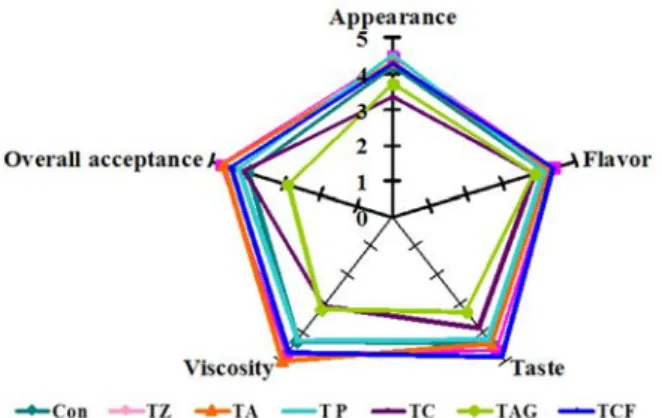
The quantitative descriptive analysis and Preference tests of teriyaki sauces made using extracts of Zanthoxylum piperitum, Acan- thopanax sessiliflorus, Panax ginseng, Cinnamomum lureitri Nees, An- gelica gigantis radix and Crataegii fructus are listed in Fig. 2 and Fig. 3.
The quantitative descriptive analysis shows that TZ had the darkest brown color with a score of 5.66 for brown color, and the differences were significant in all samples (p<0.001). Glossiness did not show a significant difference between the samples. Soy sauce odor 4.38 (p<0.05) was significantly high in the control sample without any extracts, and TZ had the lowest soy sauce odor (3.66).
Overall, sauces containing extracts had low soy sauce odor.
Medicinal herb odor was significantly lower in the control sample without any extracts (p<0.001), than that in the other samples.
Medicinal herb odor was the highest in TC at 5.61, and the odor was similar in TZ, TAG and TCF. Sweetness of the sauces was not significantly different, but it was the highest in the control (5.00
°Bx), and the sauces containing extracts had low sweetness. This is believed to be because sweetness is affected by the medicinal herb odor. Similarly, soy sauce taste was highest in the control at 5.04,
and in sauces containing Korean medicinal herb extracts was significantly low (p<0.05) in the soy sauce taste. Among sauces containing extracts, TC had the highest soy sauce taste at 4.95, indicating that the strong odor of Acanthopanax sessiliflorus See- man significantly affected the taste. The medicinal herb taste was the lowest in the control at 2.42, and was significantly lower than that in the other samples (p<0.001). Among the samples con- taining medicinal herb extracts, TAG and TCE had the strongest medicinal herb taste at 5.61 and 5.09, respectively, and TZ had the lowest medicinal herb taste at 3.42. Lingering aftertaste was the highest at 5.57 in TCE, which had the strongest medicinal herb taste, indicating the longest duration of aftertaste; further, this was the shortest in the control sample without any extracts. The aftertaste of TZ and TAG was similar (4.00). The lingering aftertaste was significantly different in all samples (p<0.001).
In the quantitative descriptive analysis of teriyaki sauces con- taining medicinal herb extracts, TG, with the highest brown color and glossiness, was the most preferred; however, no significant differences were observed between the samples. Regarding the odor and taste, TZE, with the weakest soy sauce and medicinal herb odors, was significantly preferred (p<0.05), and TC and TAG were less preferred than the control sample without extracts.
Texture preference was in the following order: TP > TZ > TCF >
control and TG > TAG > TCE. Overall palatability was in the fo- llowing order: TZ > TG > TCF > TG > control > TAG > TC, indicating that sauces containing Zanthoxylum piperitum, Angelicae gigantis radix, Crataegi fructus, and Panax ginseng were preferred more than the control without extracts, and sauces containing Cinnamomum- loureirii Nees and Acanthopanax sessiliflorus Seeman were rated at a lower preference than that for the control. Lee IJ. & Han JS (2009) reported a similar pattern in that soybean paste containing me- dicinal herb extracts with strong medicinal herb odor was not preferred. Lee SH & Bae JH (2010) reported that bread containing Eleutherococcus senticosus was preferred in terms of taste, odor, texture, and overall palatability. In a study of demi-glace sauce containing basil (Choi SG et al., 2006), the sauce containing basil was generally preferred than the control; further, Kim HD et al., (2006) reported that demi-glace sauce containing Maximowiczia typica fruit was preferred over the control. These results are similar to those in our study, in that the sauces containing extracts were preferred. The results were as cinnamon is preferred over other medicinal herbs in the study of Kim HA et al., (2008). And the results were as cinnamon is preferred over other medicinal herbs in the study of Park CS et al.(2005).
The results of the sensory evaluation test show that TZ had the darkest brown color, glossiness, less strong odor, and soy sauce taste than those in the other samples; this is believed to be because of the high ratings for odor, taste, and overall palatability of the sauce. TAG and TC were rated lower than that for the control, and the other sauces generally received a rating higher than that for the control.
Correlation Coefficients between Sensory Evaluation and Mecha- nical Characteristics of teriyaki Sauces
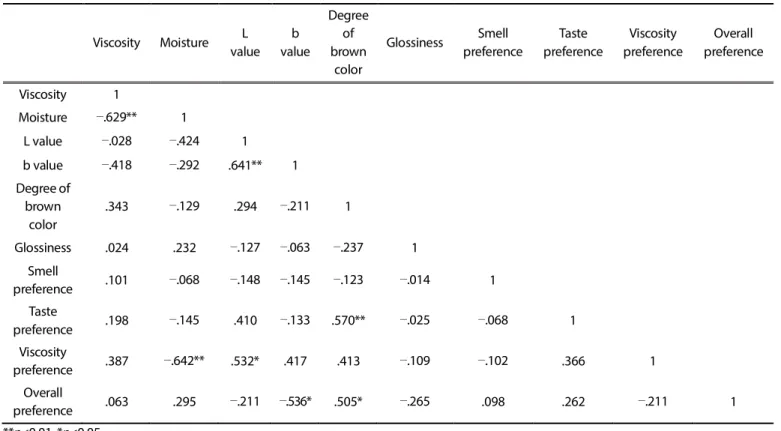
The viscosity of teriyaki sauces was correlated negatively with moisture(r=–.629, p<0.01) and moisture was correlated negatively viscosity preference(r=–.642 p<0.01). The L value of teriyaki sauces was correlated positively with b value(r=.641 p<0.01) and viscosity
Fig. 2. Preference test of teriyaki sauces added with different me- dicinal herbs extracts.
Control: Teriyaki sauce made using water.
TZ, TA, TP, TC, TAG, TCF : Teriyaki sauce made using Zanthoxylum piperitum, Acanthopanax sessiliflorus, Panax ginseng, Cinnamomum loureirii Nees, Angelicae gigantis radix, Crataegi fructus extract.
Fig. 3. Quantitative descriptive analysis of teriyaki sauces added with different medicinal herbs extracts.
Control: Teriyaki sauce made using water.
TZ, TA, TP, TC, TAG, TCF : Teriyaki sauce made using Zanthoxylum piperitum, Acanthopanax sessiliflorus, Panax ginseng, Cinnamomum loureirii Nees, Angelicae gigantis radix, Crataegi fructus extract.
preference(r=.532, p<0.01). The b value of teriyaki sauces was correlated negatively with overall preference(r=–.536, p<0.01). The degree of brown color of teriyaki sauces was correlated positively with taste preference(r=.570, p<0.01) and overall preference(r=.505, p<0.01). Therefore, it was found that there is a correlation between the degree of preference of brown teriyaki sauce taste and overall preference degree (Table 3).
CONCLUSION
In teriyaki sauces that contain traditional medicinal herb extracts (Cinnamomumloureirii Nees, Crataegi fructus, Angelicae gigantis radix, Acanthopanax sessiliflorus Seeman, Panax ginseng, and Zan- thoxylum piperitum), we observed a negative correlation between the moisture content and viscosity. The teriyaki sauce made using Panax ginseng extract had the lowest sugar content and highest salinity, but sauces containing other medicinal herb extracts had significantly lower salinity than that in the control. The sauce made using Crataegi fructus extract had the highest clarity, redness, and
**p<0.01, *p<0.05.
yellowness than that in the other samples, and the Crataegi fructus extract had the highest acidity, but resulted in creating a sauce with the lowest pH. The sensory test results show that the teriyaki sauce made using Zanthoxylum piperitum extract had the darkest brown color and glossiness, and the sauce had a less strong odor and taste of the medicinal herbs, resulting in its high preference in terms of odor, taste, Texture, and overall preference. The degree of brown color of teriyaki sauces was correlated positively with taste preference(r=.570, p<0.01) and overall preference(r=.505, p<0.01).
Therefore, we observed that the addition of medicinal herb ex- tracts improve the taste and fragrance of the sauces, thereby allowing the development of new teriyaki sauces.
REFERENCES
Choi, E. H., Kim, K. M., & Lee, Y. B. (2011). Quality evaluation of teriyaki sauce processed with shrimp remnants and its phy- sicochemical properties. Korean J. Culinary Res. 17(1), 184-196.
Choi, S. K. (2008). Sauce of Theory. Hyeongseol Publisher, Seoul.
pp.21-63.
Choi, S. K., Kim, D. S., & Lee, Y. J. (2006). A study on quality cha- racteristics of demi-glace sauce with added fresh basil. Korean J.
Food Culture, 21(1), 76-80.
Choi, W., Park, H. J., & Park, I. S. (2009). The effects of perceived valueon satisfaction and loyalty in Yaksun cuisine. Journal of Foodservice Management Society of Korea, 12(3), 149-169.
Kang, S. J., Kim, O. S., Son, S. H., Yoo, H. M., Lee, J. W., Jung, S. Y., Cho, A. Y., & Yoon, K. S. (2008). A study on consumer's recognition of frozen processed foods and contamination levels of frozen seafoods. J. East Asian Soc. Dietary Life, 18(6), 873-883.
Kim, H. A., Park, H. J., & Lee, K. H. (2008). Antioxidant effects of oriental herbs in the reheated pork meat wanjas. J. East Asian Soc Dietary Life, 18(2), 234-241.
Kim, H. A., Jung, H. A., & Song, C. R. (2011). A study on the op- timization of teriyaki sauce by RSM(Response surface metho- dology). Korean J. Culinary Res. 17(5), 206-217.
Kim, H. D. (2006). A study on quality characteristics of medicinal demi-glace sauce with added omija. Korean J. Culinary Res., 12(3), 119-133.
Kim, H. D., Lee, Y. J., & Han, J. S. (2002). An evaluation of the recognition, preferences and quality factors on sauces. J. East Asian Soc. Dietary Life, 12(3), 197-209.
Kim, H. Y., Ko, S. H., Lee, K. Y., & Part, H. Y. (2009). Evaluation of quality of glazed spanish mackerel in teriyaki sauce added lemon and ginger juice by sous vide cook-chill system -Focus on the physicochemical and sensory quality-. Korean J. Food &
Nutr. 22(3), 470-477.
Kwon, K. D., Park, W. J., & Kim, S. A. (2007). Research reports : Buy decision making factors and marketing strategies of Lyceum chinense: Focused on Cheongyang region. Korean J. Agricultural Management and Policy, 34(2), 422-443.
Lee, I. J., & Han, J. S. (2009). Physicochemical and sensory charac- teristics of traditional doenjang prepared using a meju con- taining components of Acanthopanax senticosus, Angelica gigas, and Corni fructus. Korean J. Food Cookery Sci., 25(1), 90-97.
Lee, S. H., & Bae, J. H. (2010). Quality characteristics of white breads containing various levels of Acanthopanax senticosus extracts.
Korean J. Food Preserv., 17(4), 487-493.
Nam, S. H., & Kang, M. Y. (2000). Screening of antioxidative activity of hot-water extracts from medicinal plants. J. Korean Soc. Agric.
Table 3. Correlation coefficients between sensory evaluation and mechanical characteristics of teriyaki sauces added with different me- dicinal herbs extracts
Viscosity Moisture L value
b value
Degree of brown
color
Glossiness Smell preference
Taste preference
Viscosity preference
Overall preference
Viscosity 1
Moisture –.629** 1
L value –.028 –.424 1
b value –.418 –.292 .641** 1
Degree of brown
color
.343 –.129 .294 –.211 1
Glossiness .024 .232 –.127 –.063 –.237 1
Smell
preference .101 –.068 –.148 –.145 –.123 –.014 1
Taste
preference .198 –.145 .410 –.133 .570** –.025 –.068 1
Viscosity
preference .387 –.642** .532* .417 .413 –.109 –.102 .366 1
Overall
preference .063 .295 –.211 –.536* .505* –.265 .098 .262 –.211 1
Chem. Biotechnol., 43(2), 141-147.
O, H. S., & Park, W. B. (2003). Studies on the making of teriyaki sauce using Korean soy sauce. J. East Asian Soc. Dietary Life, 9(3), 102- 113.
Park, C. S. (2005). Antioxidative and nitrite scavenging abilities of medicinal plant extracts. Korean J. Food Preserv., 12(6), 631-636.
Park, C. S., Park, C. J., & Jeon, G. H. (2005). Quality characteristics of kochujang added medicinal herbs. Korean J. Food Preserv.,12(6), 565-571.
Park, G. H., Park, H. J., & Jung, J. W. (2008). A study on the effects of well-being trend on menu selection behavior. Korean J. Culinary Res., 14(3), 45-57.
Park, H. N., Kang, O. K., & Moon, W. S. (2006). Ingredient pre- servation in the practical manufacture of teriyaki sauce. Korean J. Food Cookery Sci., 22(2), 111-121.
Park, M. L., Byun, G. I., & Choi, S. K. (2007). Quality characteristics of
pine mushroom teriyaki pickle prepared by teriyaki seasoning. J.
East Asian Soc. Dietary Life, 17(1), 72-80.
Park, W. B. (2001). Studies on the flavor of chicken teriyaki sauce with different soy sauces. Kyung Hee University, 41, Seoul.
Shin, M. H., & Nam, S. M. (2003). Physicochemical and sensory characteristics of salad dressing using gelatin extracted from chicken foot skin. Korean J. Culinary Res., 9(4), 123-145.
Song, C. R. (2009). The quality characteristics of teriyaki sauces according to the boiling time. Korean J. Culinary Res., 15(3), 236- 247.
Song, C. R., & Choi, S. K. (2009). The quality characteristics of teriyaki sauces according to the main ingredient. J. East AsinSoc Dietary Life 19(1), 25-31.
Song, C. R., Kim, E. S., Kim, H. A., Kim, Y. S., & Choi, S. K. (2012).
Quality characteristics of teriyaki sauce added with different sweeteners. Korean J. Culinary Res., 18(2), 197-205.