¶ Corresponding Author: Hak-Seon Kim, School of Hospitality & Tourism Management, Kyungsung University, 309 Suyeong-ro, Nam-gu, Busan 608-736, Republic of Korea, Tel. +82-51-663-4473, Fax. +82-51-627-6830, E-mail: [email protected]
Culinary Science & Hospitality Research. 2016;22(1):135-140.
https://cshr.jams.or.kr/ ISSN 2466‐0752 (Print) ISSN 2466‐1023 (Online)
Perceived Value, Importance of Nutrition Information, and Behavioral Intention for Food Tourism in Busan
Joung-Min Son
1, Eun-Jin Lee
2and Hak-Seon Kim
1¶1
School of Hospitality and Tourism Management, Kyungsung University
2
Dept. of Culinary Science and Foodservice Management, Sejong University
ABSTRACT: Food is widely accepted as very important factor in tourists’ experiences by researchers.
However, few studies revealed tourists’ importance of food for their travel. Therefore, through a case study in Busan (South Korea), this study aims to critically assess the importance of food tourism from domestic tourists’ perspectives. In particular, this study assess the relationship between food tourists’ val- ue, nutrition information, behavioral intention of tourists’ food experiences during their travel. Using SmarPLS program, a quantitative research methodology involving a structured questionnaire has been adopted. The results reveal that food tourists’ value and importance of nutrition information plays differ- ent roles in food tourism. Food tourism value and nutrition information has shown its importance for increasing revisit intention in Busan. In light of these findings, marketing strategies can be identified to accelerate the development of food tourism at a destination.
Keywords: food tourism, food tourists’ value, nutrition information, behavioral intention
INTRODUCTION
In recent years, food tourism has grown consi- de- rably and has become one of the most dynamic and creative segments of tourism. Furthermore, food tourism includes in its discourse ethical and sustain- able values based on the territory, the landscape, the sea, local culture, local products, authenticity, which is something it has in common with current trends of cultural consumption [1].
Today, travellers are more experienced and more leisure time to travel, and thus tourism allows them to escape the daily routine of their usual environ- ment and immerse themselves in a world of free- dom and novelty. Thus, more tourists are looking for concrete learning experiences, and in this endeavor the gastronomic experience, in highly diverse ways, is playing an increasingly prominent part [2,3].
Several studies have found that tourists travel to those destinations that have established a reputa- tion as a place to experiment with quality local pro- ducts. Brand image is connected, with varying levels of intensity, to gastronomic values [4-6]. With the growing importance and popularity of food tourism, recent years have witnessed a surge of research in- terest in food tourism [7]. Most studies firstly dis- covered in destination marketing, and have high- lighted the importance of food tourism and pro- posed marketing strategies for food tourism after re- searching the destination marketing materials [1,3,7].
However, very few attempts have been made from the demand side to justify the importance of food tourism value and nutritional information for food tourists [8].
Therefore, this study aims to critically assess the
importance of food tourism from domestic tourists’
perspectives. In particular, this study assess the rela- tionship between food tourists’ value, nutrition in- formation, behavioral intention of tourists’ food ex- periences during their travel using SmarPLS pro- gram.
LITERATURE REVIEW
Food Tourism
Food tourism is the exploration of food as the purpose of tourism. It is now considered a vital com- ponent of the tourism experience [9]. Dining out is common among tourists and importance to tourists.
Current research in food tourism is scarce and is mainly focused on wine and food festivals [1]. food tourism is an emerging phenomenon that is being developed as a new tourism product due to the fact that according to the specialized literature over a third of tourist spending is devoted to food [10].
Therefore, the cuisine of the destination is an aspect of utmost importance in the quality of the holiday experience. Previous studies proposed food tourism is an experiential trip to a tour region, for recrea- tional or entertainment purposes, which includes visits to primary and secondary producers of food, food festivals, food fairs, events, farmers’ markets, cooking shows and demonstrations, tastings of qual- ity food products or any tourism activity related to food [1,7,11]. In addition, this experiential journey is related to a particular lifestyle that includes ex- perimentation, learning from different cultures, the acquisition of knowledge and understanding of the qualities or attributes related to tourism products, as well as culinary specialities produced in that region through its consumption [2,3].
Tourism Destination Image
The tourist’s perceived value of a particular desti- nation is therefore multidimensional. The tourist’s satisfaction with the purchase depends on the prod- uct’s performance in relation to the tourist’s expec- tations [3,12]. It should be kept in mind that differ- ent cultures have different perceptions of satisfac- tion and evaluation of gastronomy and that high quality of service can result in dissatisfaction among consumers if their expectations had been too high, for example, due to exaggerated advertising [13].
Satisfaction with the destination leads to custom- er loyalty and this in turn gives a higher level of in tention to repeat the visit. Quality is a decisive factor in satisfaction, as it produces a lasting memory about the experience lived by the tourist[14]. Tou- rists revisit the destination due to its gastronomy.
food tourism is a local phenomenon of universal scope that is in a clear growth phase; it has a posi- tive impact on the economy, employment and local heritage, as tourists seek to get to know not only the local food but also to know its origin and pro- duction processes, making it an expression of cul- tural tourism [4,14].
Nutrition Information
The regulation of nutrition labeling has changed since it was introduced in South Korea in 1995.
Nutrition information was displayed on 18.7% of all food products in 2001. That percentage increased in 2005 by 24.1% and in 2007 by 79% [15]. As consum- er interest in health rises, their attention to nutrition information also increases [16]. However, there are still differences between nutrition label recognition and actual nutritional label use. It has been reported that consumers showed higher nutrition label recog- nition than the actual usage level and that they were mainly aware of calories [17]. According to past studies, many consumers recognized nutrition labels, but a few consumers only used them [18,19].
Motivation
A study found that, 67% of and obtain the desired outcomes, and the personal value of all outcomes associated with that activity [18]. Therefore, one can influence motivation by manipulating cues that de- fine an individual’s expectation concerning the con- sequences of action and the incentive value of the consequences produced by the action [20]. Thus, one can perceive the likely consequences of an ac- tion without being able to execute the action. A lot of studies regarding motivation follow a deliberate decision making process to explain choice among goals and action alternatives [6,21,22]. A person chooses a certain behavior for its expected results.
From this perspective, the motivational process re-
presents a prerequisite step to action. It can be ex-
plained as a cognitive elaboration with emotional components [20].
METHODS
A self-reported survey was adopted in this study.
The respondents were tourists who had experience dining when they travelled in Busan, Korea. Because Busan is one of the fastest growing tour areas in Korea, Busan was chosen. The survey questionnaire was divided into three major sections. Each section contained questions addressing the variables suit to the research objectives. Respondents’ perception were required to answer on a seven type Likert scale ranging from 1 with “totally disagree” to 7 “totally agree”. The information on the anonymity and con- fidentiality was provided through the information sheet attached to the questionnaire. This informa- tion sheet provided the details about the researcher, the aim of the study and the purpose of the survey to be conducted. With absent of obvious problems, a total of 260 usable questionnaires were obtained.
Data were compiled and analyzed using the sta- tistical analysis program SPSS 21.0 and SmartPLS.
Descriptive statistics described the respondents’ de- mographic profile in frequencies and percentages, independent t-test, and ANOVA were conducted to indicate the differences on demographics. Finally, multiple regression analysis was conducted in order to test causal relationships of nutritional information.
RESULTS
General Characteristics of Respondents
The importance of food tourism shows that 51.5 percent of the respondents answered “Important or very important”. Close to 26 percent of the re- spondents reported that they utilize nutrition facts label while they purchase food product, while 44.7 percent reported that they would not use nutrition facts label frequently.
Gender does matter when it comes to the in- tended use/importance of Nutrition Information(NI) and dining out more frequently if NI is available.
Meanwhile, women are significantly more order well- being (M=3.58, SD=1.52; t=2.06) and low calorie menu (M=3.77, SD=1.61; t=2.52) than men (M=3.12,
SD=1.51; M=3.16, SD=1.68) while dining out at a full-service restaurant. However women less believe (M=4.08, SD=1.11) they can order well-being menu from full-service restaurant than men (M=4.51, SD=
1.19; t=
—2.61) but the level is still close to “neutral”.
This is a noteworthy finding, as women have tradi- tionally made a conservative decision regarding the menu when they travel.
There is not a significant correlation between age and other items regarding NI usage. They may not see it as an occasional indulgence. In all likelihood, they are not looking for any incentives to eat out more often.
A significant differences were observed between the monthly income of the respondent and usage of NI if available (F=3.686, p<0.05). As income levels increase, so does the intended frequency of usage of the NI. This could present a business opportunity for full-service restaurants, as the income level also correlates to the frequency of dining out, and sa- tisfying these important consumers could build lo- yalty. Moreover, there were significant differences between income and dining frequency if NI was pro- vided in restaurants. High-income travellers are likely to dine out when restaurant provide NI. Dining out could be a necessity for them when they travel; they do not see it as an occasional indulgence.
Measurement Model Evaluation
This study used the SmartPLS [23] implementation of partial least squares (PLS) structural equation modeling to estimate our theoretical model. As a distribution-independent method, PLS has fewer con- straints and statistical conditions than covariance- based techniques, such as LISREL. The use of PLS path modeling is recommended in early stages of theoretical development to test and validate ex- ploratory models [24,25].
SmartPLS assesses the psychometric properties of the measurement model and estimates the pa- rameters of the structural model taking into ac- count the moderating latent constructs. The pa- rameters converged in fewer than 20 iterations, and both the measurement model and the struc- tural model parameters support our hypotheses.
We find these composite reliability scores highly
satisfactory. We estimated the Cronbach’s alphas
Items Number of items M SD α CR 1 2 3 4
1. Value 3 4.72 1.20 .75 .88 .62
2. Importance 2 4.63 1.25 .60 .82 .52 .80
3. Product 2 4.22 1.24 .68 .85 .52 .75 .71
4. Restaurant 2 4.15 1.33 .70 .83 .46 .43 .43 .75
Notes: All correlations are significant at: p< 0.001; the square root of the AVE is on the diagonal, as a test of discriminant validity; M - mean; SD - standard deviation; α - Cronbach's α ; CR - composite reliability.
Table 1. Descriptive statistics and correlations
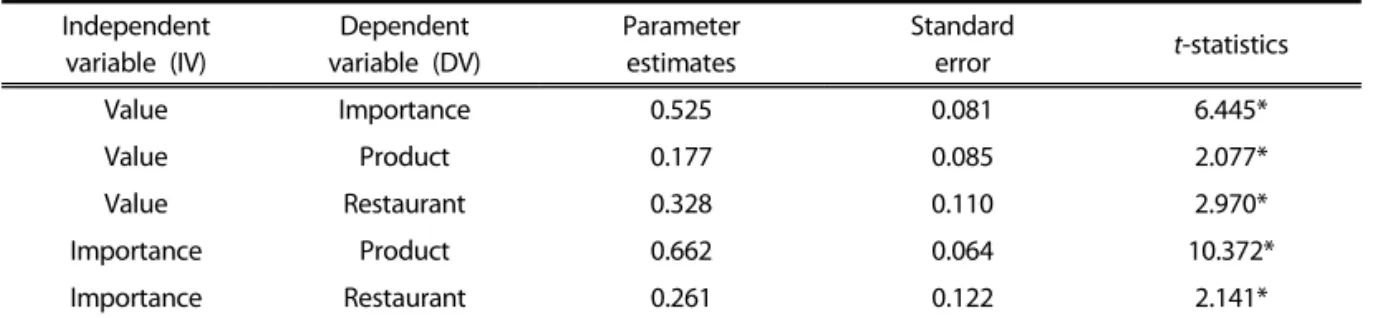
Independent variable (IV)
Dependent variable (DV)
Parameter estimates
Standard
error
t-statisticsValue Importance 0.525 0.081 6.445*
Value Product 0.177 0.085 2.077*
Value Restaurant 0.328 0.110 2.970*
Importance Product 0.662 0.064 10.372*
Importance Restaurant 0.261 0.122 2.141*
Notes: * Parameter is significant at p<0.05.
Table 2. Structural path estimates
shown in Table 1, which range from 0.60 to 0.75 for the four newly developed scale items–Value (0.75), Importance (0.60), Product (0.68), and Res- taurant (0.70). Additionally, we test for discriminant validity of the four latent variables in the PLS mo- del. A latent variable should share more variance with its assigned indicators than with any other la- tent variable [21]. The square root of the AVE of each latent variable should be greater than the la- tent variable’s highest correlation with any other latent variable. As acceptable reliability and dis- criminant validity were confirmed for the measu- res. Having established the soundness of the meas- ures, this study subsequently used them to test the hypothesized relationships. As noted by Ringle, Christian M.; Wende, Sven; Will, Alexander [23], once the measurement model is satisfactory, this study can proceed to evaluate the structural mo- del.
Direct Effects Tests
The explained variances (R
2values) for NI impor- tance, product, and restaurant are 27.5, 59.2, and 26.6, respectively. This study applied a bootstra-
pping procedure (200 subsamples; 247 cases) to as- sess the significance of the path coefficients [22].
The measurement model for value and the path esti- mates and relative t-values of the structural model appear in Figure 1. This study used the path coeffi- cients to test our hypotheses.
Hypothesis 1 postulates that higher levels of healthy eating value will each have positive effects on food-related behaviors. Standard er- rors of the parameter estimates are obtained by bootstrapping the sample 5,000 times [22].
The R
2for the structural model predicting im- portance is 0.27, and parameter estimates for the drivers of food-related behaviors are sig- nificant (p<0.05).
Hypothesis 2 posits that nutrition information importance affects travelers’ intentions to visit restaurants which provided nutrition infor- mation.
Mediation Effects Test
Hypotheses 3 theorize that NI importance mo-
Figure 1. Results of structural equation modeling.
Notes: Path coefficients and t-values (between brackets) are re- ported percentages are coefficients of determination (R²).
Hypotheses Dependent variable (DV)
a (Sa) Value → Importance
b (Sb) Importance → DV
C’
(Value → DV ; mediator controlled)
H3 Product 0.525* (0.0869) 0.662* (0.070) 0.339*
H4 Restaurant 0.525* (0.0869) 0.261* (0.109) 0.328*
Notes: Significant at: * p<0.001; all paths are b coefficients.
Sobel test statistic: 5.09124335.
One-tailed probability: 0.00000018.
Two-tailed probability: 0.00000036.
Sobel test statistic: 2.22602691.
One-tailed probability: 0.01300619.
Two-tailed probability: 0.02601238.
Table 3. Mediation tests
derates the relationship between healthy-eat- ing value and travelers’ food-related beha- viors. Hypothesis 4 predicts that NI impor- tance will moderate the impact of healthy- eating value on food-related behaviors such that the effect is lower at higher levels of nu- trition information importance. A significant estimate of parameter confirms that the rela- tionship between healthy eating value and food-related behaviors is moderated by NI importance.
While confirming the traditional view of higher healthy eating value leading to higher food-related behaviors, we extend this finding by identifying two key moderating variable (Importance) that affect this relationship between value and behaviors. Impor- tance of nutrition information has a positive main effect on food-related behaviors. More specifically, the higher the level of NI importance drives the gr- eater the food-related behaviors. Similarly, custom- ers who exhibit higher levels of NI importance are likely to be more loyal.
DISCUSSIONS AND CONCLUSIONS
The aim of this study is to explore the importance of food tourism to Busan, South Korea from domes- tic tourists’ perspectives. The results show that per- ceived value is great importance for tourists’ travel in Busan, which indicates that food tourism can be main role to Busan. In terms of the practical im- plications, this study enables the destination market- ers to access a more accurate understanding of the importance of food tourism. Limitations and future research although this research makes a contri- bution to the food tourism development and re- search in Busan, there still are certain limitations that should be taken into account and that constitute potential lines of research for the future. Firstly, re- garding the research instrument, questionnaire survey, as the only method, was adopted in the study.
However, in order to achieve the credibility of the research and minimize personal or methodological biases, various methods are suggested to be im- plemented in the research design. Secondly, review- ing the profile of the respondents in the research, it is noted that the age and the education level might have an influence on the results of the study.
Future studies should pay attention to balancing the number of respondents from different age groups to avoid this resulting deviation.
REFERENCES
[1] World Tourism Organization (2012). Global Report on Food Tourism, UNWTO, Madrid.
[2] An HY, Jeon HJ, Yang TS (2009) A study on the
customer behavior and recognition of Jeju re-
gional cuisine: Focusing on customer satisfaction, revisit intention, and word of mouth among the tourists in Jeju. The Korean Journal of Culinary Research 15(2):93-107.
[3] Kim JH (2012). A study on the current status and activation of food tourism festivals: Centering around Gwangju, Jeonnam province. The Korean Journal of Culinary Research 18(5):129-145.
[4] Kim JE, Lim ST, Han HS (2013). Investigating the impact of Busan convention-tour contents on im- age of Busan, expected value, and international- convention participation intention. Journal of Tourism and Leisure Research 25(2):213-230.
[5] Gedrich K (2003). Determinants of nutritional be- havior (sic): A multitude of levers for successful intervention. Appetite 41(3):231-238.
[6] Crompton J (1979). Motivation for pleasure vaca- tion. Annals of Tourism Research 6(4):408-24.
[7] Bessiere J (1998). Local development and herita- ge: Traditional food and cuisine as tourist attrac- tions in rural areas. Sociologia Ruralis 38(1): 21-34.
[8] Jang SO, Woo IS (2015). A study on consumer awareness, preference, and consumption beha- vior regarding local food: Focusing on Gyeongju area. The Korean Journal of Culinary Research 21 (2):154-170.
[9] Long LM (2004). Culinary Tourism. The University Press of Kentucky. USA.
[10] Quan S, Wang N (2004). Towards a structural model of the tourist experience: An illustration from food experience in tourism. Tourism Ma- nagement 25(3):297-305.
[11] Hall CM, Mitchell RD (2000). We are what we eat: Tourism, culture and the globalisation and localisation of cuisine. Tourism Culture and Co- mmunication 2(1):29-37.
[12] Chang RCY, Kivela J, Mak AHN (2010). Food preferences of Chinese tourists. Annals of Tou- rism Research 37(4):989-1011.
[13] Chang RCY, Kivela J, Mak AHN (2011). Attributes that influence the evaluation of travel dining ex- perience: When East meets West. Tourism Ma- nagement 32(2):307-316.
[14] Ahn J, Jun KY, Kim HS (2015). An exploration of the relationships among brand value, cus- tomer satisfaction and behavioral intention in
fast food restaurant visitors. Culinary Science and Hospitality Research 21(5):14-24.
[15] Kwon KI, Park SH, Lee JH, Kim JY, Yoo KS, Lee JS, et al (2007). Prevalence of nutrition labeling and claims on processed, and packaged foods.
Korean J Community Nutr 12:206-213.
[16] Borra S (2006). Consumer perspectives on food labels. Am J Clin Nutr 83:12-35.
[17] Kim HS, Oh CR, No JK (2016). Can nutrition label recognition or usage affect nutrition intake ac- cording to age? Nutrition 32(1):56-60.
[18] Jennings L (2008). Menu-labeling mandates meet industry's resistance nationwide. Nation’s Restaurants 42(12):1-41.
[19] Hwang J, Lorenzen CL (2008). Effective nutrition labeling of restaurant menu and pricing of heal- thy menu. Journal of Foodservice 19(5):270-276.
[20] Feather NT (1990). Bridging the gap between values and actions: Recent applications of the expectancy-value model. in Handbook of Moti- vation and Cognition: Foundation of Social Behavior, edited by Higgins ET and Sorrentino RM. New York: Guilford, 151-92.
[21] Boo YK, Noh JW, Kim YM, Kim SS, Rha YA (2015).
Perception of privacy and sensitivity of personal information among university students. Culinary Science and Hospitality Research 21(5):25-37.
[22] Joung HW, Choi EK, Lee DS, Kim HS (2010).
Exploring internal marketing mix and its appli- cations in the foodservice industry. Culinary Sci- ence and Hospitality Research 21(5):192-203.
[23] Ringle, CM, Wende S, Will A (2005). SmartPLS 2. Hamburg.
[24] Hair JF, Hult GTM, Ringle CM, Sarstedt M (2014).
A Primer on Partial Least Squares Structural Eq- uation Modeling (PLS-SEM). Thousand Oaks, CA:
Sage.
[25] Henseler J, Ringle CM, Sinkovics RR (2009). The use of partial least squares path modeling in in- ternational marketing. Advances in International Marketing 20:277-320.
Received: 12 JAN, 2016 Revised: 14 JAN, 2016 Accepted: 18 JAN, 2016