Abstract ― Using extracted sepia melanin powder by repeated treatments with aqueous sodium hydroxide and acetic acid solutions, vat dyeing of wool and cotton fabrics was carried out under various dyeing conditions including concentration of melanin, alkali, reducing agent and salt, as well as dyeing time and temperature. A K/S of 25.3 for wool fabrics was obtained at the optimal dyeing condition with 9% owf melanin, 0.5g/L NaOH and 56g/L Na
2S
2O
4without salt at 80
oC for 90minutes. The vat dyeing of sepia melanin was applicable to both cotton and wool fabrics but the wool showed higher dyeability. The color fastness properties of the dyed wool and cotton fabrics were excellent to washing, rubbing and light irradiation.
Keywords: squid ink, sepia melanin, polymeric dye, vat dyeing, color fastness
Vat dyeing of Wool and Cotton fabrics with Sepia Melanin
Su-jin Kim and Jinho Jang †
Dept. of Nano-Bio Textile Engineering, Kumoh National Institute of Technology, Gumi, Korea (Received: May 14, 2010/Revised: June 11, 2010/Accepted: June 15, 2010)
1. Introduction
Sepia melanin is a natural pigment derived from the ink sack of various species of cephalopoda, more commonly from cuttlefish. The study on application of melanin has been carried out in various fields such as textile coloration, food and cosmetics 1-3) . The most widely accepted function of melanin is the photoprotection of an animal body.
And several other functions have been proposed including free radical scavenging, photosensitizing, thermoregulation, metal-ion chelation, drug binding which may prevent cancer generation and block the reproduction of penicillium and staphylococcus 4-7) . With tyrosinase containing Cu secreted from ink sack of squid, tyrosine was oxidized to DOPA (3,4-Dihydroxyphenylalanine) and subsequently DOPA- quinine and DOPA-chrome were derived. Finally melanin is biosynthesized with DHI(Dihydroxyindole) and DHICA(Dihydroxyindole carboxylic acid) 2,8) . Sepia melanin is insoluble in neutral water or organic solvents but it can be dispersed in alkalis 9,10) . Vat dyeing is traditionally carried out for natural dyes such as indigo or Tyrian purple 11,12) . Melanin, a natural animal pigment, has similar carbonyl chromophores like synthetic vat dyes (Scheme 1) 13) . Most synthetic vat dyes contain
†
Corresponding author. Tel.: +82-54-478-7715; Fax.: +82-54-478-7710; e-mail: [email protected]
two or more carbonyl groups separated by a conjugated system of double bonds such as indigo or anthraquinone. The chemical constitution of the dye influences the dyeing properties of the leuco form such as chemical stability during vatting, absorption rate and leveling properties. It is also a key factor in determining the resultant dyeing characteristics including color and fastness properties.
Dyeing with vat dyes is based on the conversion
of a water-insoluble colorant to a water-soluble
leuco form by alkaline reduction, which can
penetrate into the fiber. Subsequently the original
form can be regenerated by oxidation. Close
control of vatting process requires because several
undesirable effects can be occurred. If there is
insufficient alkali, the dyes may form the
practically insoluble leuco compound. And the
leuco form of indigo has been reported to exist in
nonionic at pH 7, univalent ion at pH 10.8~11,
or bivalent ion above pH 11 14-16) . Higher reducing
agent concentration than optimum can cause
over-reduction while low reduction results in poor
adsorption due to insufficient formation of leuco
compound. Careful control of temperature is also
important; if the temperature is too low
reduction may be incomplete, and if too high the
reducing agent may react with the dye in other
NH Na N
NH N
H
H HOOC
H
COOH O O
HOOC
HO H
HOOC COOH
H
H
N NH
NH N
H
H NaOOC
H
COONa NaO ONa
NaOOC
O H
COONa NaOOC
H
H
Na
2S
2O
4, NaOH O
2Melanin Leuco melanin
Scheme 1. Formation of leuco melanin
ways to produce undesirable products. The leuco dyes can have good substantivity for wool and nylon as well as cotton 14,17,18) .
Acid dyeing of wool and cotton with sepia melanin has been previously investigated 3) . However in this study, the extracted melanin powder from squid ink was used to dye wool and cotton fabrics by vat dyeing technique under optimum dyeing conditions and the dyeability of melanin to both fabrics were also compared.
2. Experimental
2.1 Materials and chemicals
Sepia melanin was prepared by extracting raw squid (Todarodes pacificus) inks. Wool (65g/m 2 ) and cotton (98g/m 2 ) fabrics, supplied by Sombe, were used for the study. Sodium hydroxide (NaOH) and acetic acid (CH 3 COOH) were used for melanin preparation and dyeing.
Sodium hydrosulfite (Na 2 S 2 O 4 ), hydrogen peroxide (H 2 O 2 ) and sodium sulfate (Na 2 SO 4 ) were used as reducing agent, oxidizing agent and neutral salt respectively.
2.2 Extraction of melanin powder
Squid inks were extracted from squid’s ink sacs and 1% sodium hydroxide was added for dispersion with respect to the inks.
And squid ink was precipitated at pH 3 with 10% acetic acid solution. After washing with distilled water three times the melanin powder was extracted with acetone and subsequently was dried for 24 hours under vacuum.
2.3 Dyeing process
Optimal dyeing condition of melanin to wool and cotton were investigated in relation with melanin, alkali, reducing agent and salt concentrations, dyeing time and temperature. The fabrics were dyed at a liquor ratio of 25:1 using an IR dyeing testing machine (Daelim Engineering, Korea), and the dyeing liquor was oxidized by 1% aqueous H 2 O 2 solution. K/S values were calculated from reflectance at λ max (wool: 360nm, cotton: 440nm) measured with a reflectance spectrophotometer (Gretag Macbeth, Canada) and percent exhaustion of the remaining liquor was evaluated at 360nm with a UV/VIS spectrophotometer (Daelim Engineering).
2.4 Color fastness test
The colorfastness to laundering, rubbing and
light irradiation of dyed fabrics were carried out
with a Launder-O-meter (Daelim Engineering, Korea),
crock meter (Heungshin Engineering, Korea), and
Fade-O-meter (Korea Science, Korea) according to
KS K ISO 105-C01, KS K 0650 and KS K 0700
respectively.
3. Results and Discussion
3.1 Reducing agent concentration
The optimum concentrations of alkali and reduction agent should be obtained for vat dyeing. Wool and cotton fabrics were dyed with 1% owf melanin, 8g/L Na 2 S 2 O 4 , 15g/L Na 2 SO 4 at 50 o C for 50min.
The effect of alkali addition on the melanin dyeing was shown in Fig. 1. Higher alkali concentration than 0.5g/L NaOH decreased the dyeability of both fabrics. Thus, 0.5g/L was chosen as optimum alkali concentration. The addition of NaOH is required not only to disperse the extracted sepia melanin in water but also to enhance water solubility of the leuco form of melanin.
Fig. 2 showed the effect of reducing agent concentration on the coloration under 0.5g/L NaOH addition. The K/S of both fabrics increased with increasing reducing agent up to 8g/L, but it decreased above 8g/L of reducing agent. The amount of reducing agent more than optimum condition resulted in poor coloration and leveling.
The decreased dyeability of both fabrics may be due to over-reduction of the sepia melanin.
3.2 Salt concentration
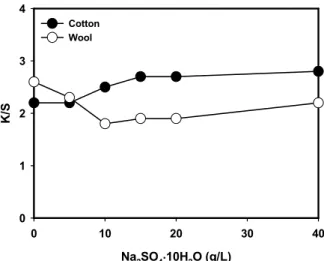
Fig. 3 showed the K/S of both fabrics dyeing with 1% owf melanin, 0.5g/L NaOH, 8g/L Na 2 S 2 O 4 at 50 o C for 50min. Dyeabiliy of cotton increased with increasing salt concentration up to 15g/L, but it decreased above 15g/L. However wool showed negative effect on the dyeability. Melanin has a low affinity to cotton fabrics because of charge repulsion between leuco form of melanin and negative charge on cotton under alkaline condition.
The repulsion may be reduced by neutral salt addition, where the optimum salt concentration was 15g/L.
Wool has positive charge at lower pH than isoelectric point(pH 4.9) and has negative charge above the pH 4.9. However because partial positive charge still exists under high pH condition, the partial positive charge of wool can exhaust the negative leuco form without neutral salt.
Also it is expected that the added salt up to 10g/L may interfere the ionic interaction between dyes and fiber.
NaOH (g/L)
0.0 0.5 1.0 1.5 2.0
K/S
0.0 0.5 1.0 1.5 2.0 2.5 3.0 3.5
Cotton Wool
Fig. 1. Effect of alkali concentration on K/S.
Na
2S
2O
4(g/L)
0 5 10 15 20 25 30
K/S
0.0 0.5 1.0 1.5 2.0 2.5 3.0 3.5
Cotton Wool
Fig. 2. Effect of reducing agent concentration on K/S.
Na
2SO
4.10H
2O (g/L)
0 10 20 30 40
K/S
0 1 2 3 4
Cotton Wool
Fig. 3. Effect of salt concentration on K/S.
3.3 Dyeing temperature and time
Wool and cotton fabrics were dyed for 50min at different dyeing temperatures with 1% owf melanin, 0.5g/L NaOH, 8g/L Na 2 S 2 O 4, 15g/L of Na 2 SO 4
was added in case of cotton fabrics. The K/S of wool increased with increasing temperature up to 100 o C, whereas that of cotton decreased above 50 o C as shown in Fig. 4. It is expected that dyeability of cotton decreased above 50 o C due to over-reduction of the sepia melanins. However wool may be capable of adsorbing the melanin in spite of over-reduction.
The optimum dyeing temperatures of cotton and wool were chosen to 50 o C and 80 o C respectively due to substantial felting shrinkage of the wool fabrics at the elevated temperature.
The effects of dyeing time was studied on 1%
owf melanin, 0.5g/L NaOH and 8g/L Na 2 S 2 O 4 . Cotton fabrics were dyed with 15g/L of Na 2 SO 4 at 50 o C and wool fabrics were dyed at 80 o C without salt. The optimum time of wool and cotton was obtained at 90min and 50min respectively as shown in Fig. 5. The dyeing times higher than the optimum dyeing times substantially decreased the dyeability of cotton due to over-reduction of the melanin or poor exhaustion.
3.4 Melanin concentration
The effect of melanin concentration was studied at 0.5g/L of NaOH, where the hydrosulfite con- centration was adjusted to twice of the melanin concentration. Cotton was dyed with 15g/L of
Dye conc.(% owf) K/S %E L* a* b* ∆E
Wool
1 5.0 53.8 49.5 5.1 15.9 40.8
3 10.0 51.6 40.4 5.9 18.0 50.1
5 18.5 42.3 29.0 6.8 15.6 61.3
7 21.6 34.4 24.5 6.5 12.1 65.6
9 25.3 20.2 22.0 6.6 9.8 68.1
Cotton
1 2.8 40.1 58.3 5.8 15.8 41.0
3 2.8 37.0 58.3 5.1 16.3 41.0
5 3.0 35.9 56.4 4.3 15.9 42.5
7 3.5 33.7 55.1 4.3 15.4 43.5
9 3.3 12.2 52.7 4.7 17.1 46.4
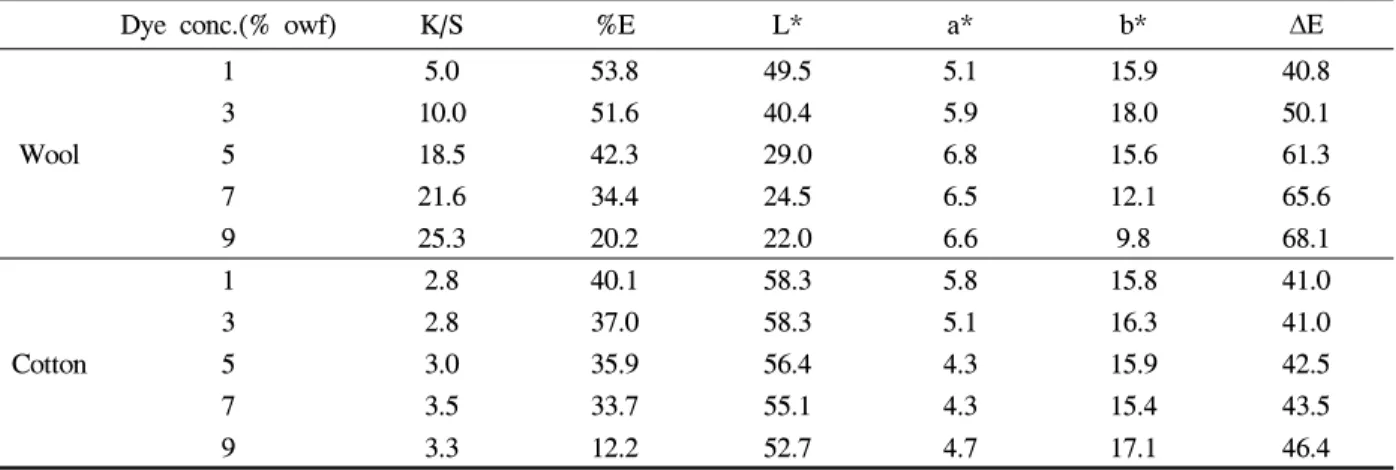
Table 1. Effect of dye concentration on color characteristics
Na 2 SO 4 at 50 o C for 50min and wool was dyed without salt at 80 o C for 90min. With increasing melanin concentration, the K/S values of wool increased proportionally but cotton did not change substantially as indicated in Table 1. Wool has larger adsorption capability of the dyes because of the relaxed molecular structure, while cotton is
Dyeing temperature (
oC)
40 50 60 70 80 90 100
K/S
0 2 4 6 8 10
Cotton Wool
Fig. 4. Effect of dyeing temperature on K/S.
Dyeing time (min)
0 10 20 30 40 50 60 70 80 90 100 110 120
K/S
0 1 2 3 4 5 6
Cotton Wool
Fig. 5. Effect of dyeing time on K/S.
Fabrics K/S
Laundering Rubbing
Light
Shade Stain
Dry Wet
Wool Acrylic PET Nylon Cotton Acetate
Wool
5.0 4-5 5 5 4-5 4-5 4-5 4-5 5 5 6
11.5 5 4-5 5 4 4 3-4 5 5 4-5 6
14.3 4-5 4 4-5 4-5 3-4 3 4-5 5 4-5 6
Cotton
2.8 1 4 5 5 5 4 5 4-5 4-5 4
3.0 3 4-5 5 5 5 3-4 4-5 5 4-5 6
3.3 2 4-5 5 4-5 5 3 4-5 4-5 4 6
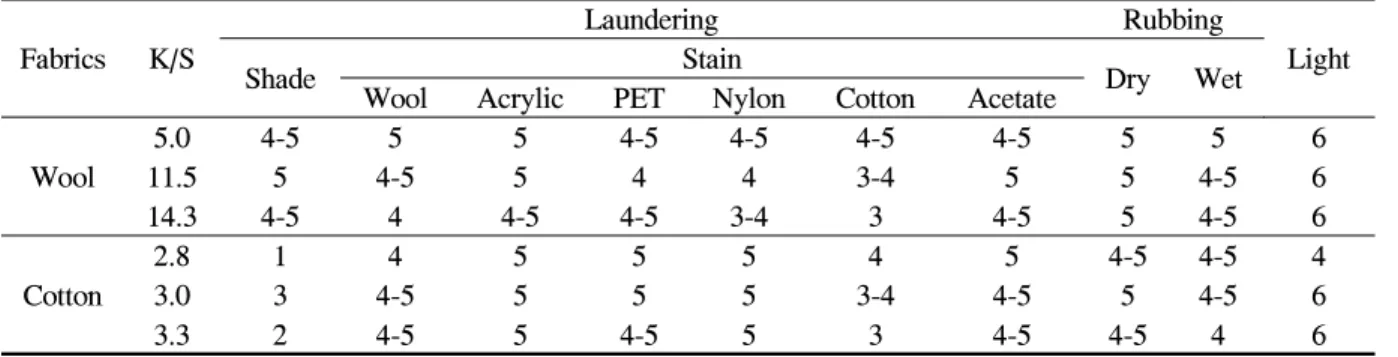
Table 2. Color fastness of melanin-dyed fabrics