Allium Hookeri Extract Enhances Glucose Uptake through GLUT4 Up-regulation in 3T3-L1 Cells
Young Eun Kang
†, Kyeong-Mi Choi
†, Eunjin Park, Won-Beom Jung, Heejin Jeong and Hwan-Soo Yoo*
College of Pharmacy, Chungbuk National University, Cheongju 28644, Korea
Received January 2, 2017 /Revised February 27, 2017 /Accepted March 23, 2017
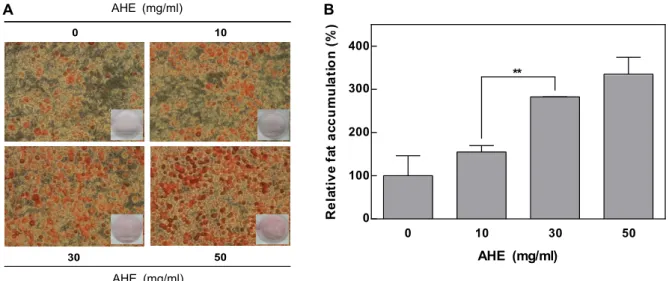
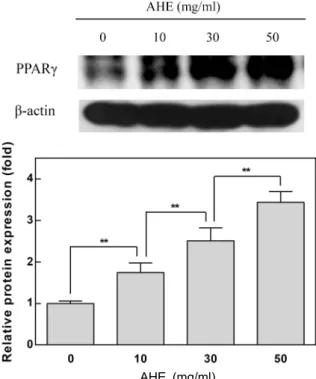
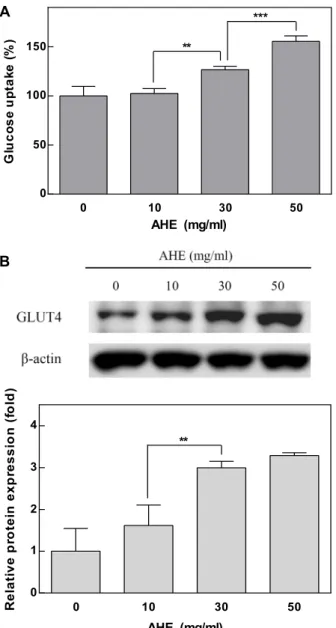
Diabetes mellitus is associated with insulin resistance, which leads to down-regulation of insulin sig- naling and the decreased glucose uptake. Adipocytes are sensitive to insulin, and closely implicated in insulin resistance and diabetes. Insulin stimulates differentiation of preadipocytes to adipocytes, and increases glucose transport. Allium species have been used as traditional medicine and health-pro- moting foods. Allium hookeri (A. hookeri) is reported to improve the pancreatic β-cell damage and ex- hibit pancreatic anti-inflammatory activity in streptozotocin-induced diabetic rats. We investigated whether A. hookeri extract (AHE) may stimulate glucose uptake in adipocytes through increasing in- sulin sensitivity. AHE enhanced fat accumulation, a differentiation biomarker, under the partial in- duction of differentiation by insulin. PPARγ, a transcription factor highly expressed in adipocytes, promotes adipocyte differentiation and insulin sensitivity. AHE increased the differentiation of pre- adipocytes through up-regulation of PPARγ. The activation of PPARγ increases the GLUT4 expression during adipocyte differentiation. GLUT4 is responsible for glucose uptake into the adipocytes. AHE increased the expression of GLUT4 in adipocytes, and subsequently enhanced the insulin-stimulated glucose uptake. These results suggest that AHE promotes adipocyte differentiation through activation of PPARγ, and leads to enhance glucose uptake in adipocytes along with GLUT4 up-regulation. Thus, AHE may be effective for the insulin-sensitizing and anti-diabetic activities.
Key words : Allium hookeri, adipocyte differentiation, glucose uptake, PPARγ, 3T3-L1 cells
†
Authors contributed equally.
*Corresponding author
*Tel : +82-43-261-3215, Fax : +82-43-268-2732
*E-mail : [email protected]
This is an Open-Access article distributed under the terms of the Creative Commons Attribution Non-Commercial License (http://creativecommons.org/licenses/by-nc/3.0) which permits unrestricted non-commercial use, distribution, and reproduction in any medium, provided the original work is properly cited.
Journal of Life Science 2017 Vol. 27. No. 3. 289~294 DOI : https://doi.org/10.5352/JLS.2017.27.3.289
Introduction
Adipocytes have been studied as a potential target for diabetes mellitus as well as obesity [9, 14]. Dysfunctional adipocytes induce insulin resistance and inflammation [2].
Insulin is an essential regulator for stimulating the adipo- cyte differentiation which is induced through transcription factors such as peroxisome proliferator-activated receptor γ (PPARγ) and CCAAT/enhancer-binding protein α [1, 5, 10].
PPARγ plays the major role in the adipogenic transcrip- tional cascade, and activates the expression of various genes involved in glucose and lipid metabolism [5, 13, 20]. PPARγ activates expression of glucose transporter 4 (GLUT4) dur- ing adipogenesis which is responsible for glucose uptake into adipocytes [13, 20].
Allium species have been used as traditional medicine and health-promoting foods [3, 4, 11]. Allium hookeri (A. hookeri), a member of Liliaceae family, is widely found in Sri Lanka, India, China and Bhutan, and has anti-oxidant and anti-in- flammatory activities [3, 7, 12]. Water extract of A. hookeri protected oxidative stress-mediated inflammatory responses and pancreatic β-cell damage in streptozotocin-induced dia- betic rats [12]. In addition, A. hookeri leaf or root decreased blood glucose level, and increased plasma insulin level in type 2 diabetic mice [8].
In this study, we investigated whether A. hookeri extract may modulate adipocyte differentiation under sub-optimal concentrations of insulin, and elucidated its mechanism for increasing insulin sensitivity.
Materials and Methods
Materials
3T3-L1 cells were purchased from the American Type
Culture Collection (ATCC; Manassas, VA, USA). Dulbecco’s
Modified Eagle’s Medium (DMEM), bovine calf serum (BCS)
and fetal bovine serum (FBS) were purchased from
Invitrogen (Carlsbad, CA, USA). Insulin and bovine serum
10 0
30 50
AHE (m /mL)
AHE (m /mL)