․투고일: 2017.09.12, 심사일: 2017.09.26, 게재확정일: 2017.09.25
․교신저자: 김기봉 경남 양산시 물금읍 금오로 20 부산대학교 한방병원 한방소아과
TEL: +82-55-360-5952 FAX: +82-55-360-5952 E-mail: [email protected]
․These two authors contributed equally to this work.
Choi planned study flow and analyzed results.
Ahn conducted in-vitro and in-vivo experiments and wrote first draft.
두시하태독법의 Th2 분화 조절을 통한 알레르기 비염 완화 효과
최준용1,4, 안상현2, 김기봉3,4
1부산대학교한방병원 한방내과, 2세명대학교 한의과대학 해부학교실
3부산대학교한방병원 한방소아과, 4부산대학교 한의학전문대학원
Reduction of Allergic Rhinitis by Controlling the Th2 Differentiation of Douchi Hataedock
Jun-yong Choi1,4, Sang-hyun Ahn2, Ki-bong Kim3,4
1Dept. of Internal Medicine, Korean Medicine Hospital of Pusan National University
2Dept. of Anatomy, College of Korean Medicine, Se-Myung University
3Dept. of Pediatrics, Korean Medicine Hospital of Pusan National University
4School of Korean Medicine, Pusan National University
ABSTRACT
Objectives: This study investigated the effects of Douchi Hataedock on Th2-skewed conditions to control allergic rhinitis.
Methods: NC/Nga mice were divided into three groups: 10 mice were assigned to the control group (CTRL; no treatment), 10 mice to allergic rhinitis-induced (ARE) without treatment group, and 10 mice to the allergic rhinitis-induced (FGT) after Douchi Hataedock treatment group. The 3-week-old mice of the FGT group were given one 10 mg/kg dose of Douchi Hataedock extract and resensitized to allergic antigens at weeks four, five, and six. Allergic rhinitis was induced primarily in mice nasal cavities for five days after one week of final sensitization. The second induction used the same method one week after the first induction was completed. After one week, the nasal mucosal tissues of each group were observed. Immunohistochemical staining for IL-4, STAT6, CD40, FcεRI, substance P, MMP-9, NF-κB p65, p-IkB, and iNOS in the nasal mucosa was also performed.
Results: The FGT group had less respiratory epithelial damage and less mucin secretion in goblet cells than the ARE group and showed a 62% decrease in IL-4, 85% decrease in STAT6, 71% decrease in CD40, 69% decrease in FcɛRI, 43%
decrease in substance P, 49% decrease in MMP-9, 43% decrease in NF-kB p65, 38% decrease in p-IkB, and 73% decrease in iNOS compared to the ARE group.
Conclusions: Douchi Hataedock lessens inflammation in epithelial and goblet cells and reduces inflammatory mediator secretion in a mouse allergic rhinitis model.
Key words: Hataedock, Douchi, allergic rhinitis, Th2 skewed condition, inflammation
Ⅰ. 서 론
알레르기 비염은 특정 알레르기 항원에 대한 면
역반응으로 모세혈관 확장과 분비샘 과민반응이
나타나는 염증 질환이다
1. 대부분 수양성 콧물, 코
막힘, 재채기, 비강 내 가려움증 등을 호소하며, 이
러한 증상이 하나 또는 여러 가지가 복합적으로
나타나기도 한다
2,3.
국내 알레르기 질환 발병률은 10~15%로 정도 이며, 최근 환경오염과 스트레스 등으로 인한 면역 력 저하로 알레르기 비염을 비롯한 다양한 알레르 기 질환이 증가하고 있다
4. 알레르기 비염 치료는 소염제, 휴식, 수분섭취, 습도 및 온도조절 등의 대 증요법이며, 만성인 경우에는 보존적 치료나 수술 적 처치로 증상을 완화시킬 수 있지만 근본적인 치료법이 확립되어 있지 않다
5.
알레르기 비염에 관한 국제적 치료 가이드라인 (Allergic rhinitis and its impact on asthma, ARIA)
6에서는 치료법으로 회피요법, 스테로이드 주입, 항 히스타민제, 약물요법, 면역요법, 아래코선반 절제 술, 레이저 수술 등을 제시하였다. 이러한 치료법 들은 여러 가지 부작용을 유발할 수 있다. 약물요 법은 과민반응, 어지럼증, 두통, 불면증, 빈맥 등의 부작용이 생길 수 있으며, 항히스타민제는 소아에 게 사용할 수 있는 근거가 부족하고, 장기간의 스 테로이드제 사용은 성장장애를 유발할 수 있다
6. 특정 항원을 이용하는 면역요법의 경우에는 국소 부종, 두드러기, 아나필락시스를 일으킬 위험이 있 다
7. 이러한 치료의 한계로 대부분 증상 재발이 반 복되면서 한방치료를 병행하고 있는 추세이다
8. 알 레르기 비염은 환자가 항원에 대한 면역력이 약하 고 알레르기 소인이 있을 경우 재발률이 높고 다 른 질환으로 이환되거나 합병되기 쉽다
9.
소아에서의 알레르기 비염은 태아에서 발생하는 Th2 skewed condition과 연관이 있다
10,11. 임신 중 에는 모체 내에서 임신 상태를 유지하기 위한 면 역 기전의 변화가 일어나서 Th2 cytokine이 Th1 cytokine보다 과발현하게 된다
12. 이러한 변화는 알 레르기 비염 같은 알레르기 질환에서 발생하는 변 화와 일치하며, 출생시 모체의 불균형적인 면역체 계 영향을 받아 알레르기 비염과 같은 Th2 분화 주도 염증성 질환이 발병하게 된다
13.
하태독법은 두시법(豆豉法), 감초법(甘草法), 황 련법(黃連法), 주밀법(朱蜜法) 등이 있으며, 한약 재를 달인 약물을 부드러운 천이나 비단에 묻혀
입안의 더러운 것들을 닦아주면서 소량 먹이는 방 법이다
14. 두시하태독법과 관련된 이전 연구
14-16에 서 두시하태독법을 시행한 Nc/Nga mouse에서는 아토피피부염에서 보여지는 과도한 Th2 분화가 감 소하였으며 염증으로 인한 피부손상도 적었다. 이 러한 결과를 보면 Th2 skewed condition 조절을 통 하여 알레르기 비염에도 예방적 효과가 있을 것으 로 생각된다.
이에 본 연구는 하태독법의 Th2 skewed condition 조절을 통한 알레르기 비염 완화 효과를 알아보고 자 하였다.
Ⅱ. 재료와 방법
1. 두시 추출물 제조
두시(duochi, fermameted Glycine max Merr.;
남영제약영농조합, Muju, Korea)는 서리태(Glycine max Merr.)를 청호(Artemisia Apiacea Herba)와 상엽(Mori Folium) 2가지 약재를 1:1로 한 전탕액 에 삶은 후, 5일간 37~38 ℃에서 발효시킨 다음 열풍으로 건조시켰다. 두시 열수추출물은 두시 100 g을 파쇄하여 1000 ml의 증류수에 넣고 3시간 동안 전탕하여 여과하였다. 그 여액을 rotary evaporator 에서 50 ml으로 농축한 후 동결 건조하여 추출물 15 g(수득률 15%)을 얻었다.
동일 시료로 수행된 이전 연구에서의 HPLC 결 과에 따르면 두시에 포함된 isoflavone은 genistin, genistein, daidzine, daidzein이다. 일반 콩에 비해 genistin, genistein, daidzein는 증가하였고, daidzine 은 감소하였다
14.
2. 실험동물
실험동물은 태령 3주된 Nc/Nga 수컷 생쥐(중앙
실험동물, Seoul, Korea)를 사용하였다. 대조군(Ctrl),
알레르기 비염 유발군(ARE), 두시하태독법 시행
후 알레르기 비염 유발군(FGT)으로 나누었다. 각
군에 10마리씩 배정하였다. FGT는 태령 3주에 두
시 추출물 10 mg/kg을 1회 경구 투여하는 하태독 법을 실시하였다.
3. 알레르기 비염 유발
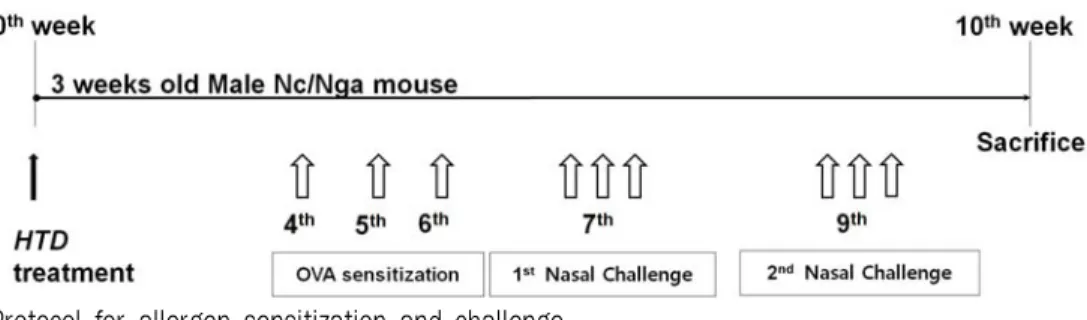
ARE와 FGT는 하태독법 실시 4주, 5주, 6주에 각 1회씩 ovalbumin(OVA : chicken egg albumine, grade V, Sigma)을 항원으로 사용하여 0.1% OVA 용액(OVA 25
μg, 수산화알루미늄겔(Al(OH)
3gel) 1 mg, 인산완충용액(phosphate buffered saline, PBS)
300
μl을 복강주사하여 감작시켰다. 최종 감작 후 1 주 후 5일 동안 OVA 100
μg, PBS 20
μl을 생쥐 비 강 내에 점적하여 1차로 알레르기 비염을 유발하 였다. 1차 유발 완료 후 1주 후 동일한 방법으로 2 차 유발하였다(Fig. 1). 유발 확인은 콧물과 코 긁 기 행동을 통하여 확인하였다. 본 연구는 부산대학 교 IACUC 승인을 받았으며(IACUC number:
PNU-2016-1187), 실험실 동물의 관리와 사용은 NIH guideline에 따라 시행되었다.
Fig. 1. Protocol for allergen sensitization and challenge.
Hataedock using fermameted Glycine (FG) was orally administered on week 3th. Mice were sensitized on week 4th, 5th, and 6th by intraperitoneal injection of ovalbumin (OVA) emulsified in alum hydroxide (Alum) (OVA 25 μg : Alum 1 mg : PBS 300 μl). On week 7th, the mice were challenged with OVA (OVA 100 μg : PBS 20 μl) intranasally.
On week 9th, the mice were challenged with OVA (OVA 100 μg : PBS 20 μl) intranasally. Ctrl : no treatment group, ARE : allergy rhinitis elicited group, FGT : Hataedock using fermameted Glycine treated group before allergy rhinitis elicitation
4. 조직절편 제작
각 군을 펜토바비탈나트륨(sodium pentobarbital) 용액으로 마취하였다. vascular rinse와 10% 중성 포르말린용액(neutral buffered formalin, NBF)으로 심장관류고정을 실시하였다. 머리를 분리하고 비강 주변 구조물을 제거하였다. 실온에서 24시간 동안 10% NBF에 고정한 후 탈회액(decalcification solution, BBC, UK)에 12시간 처리하였다. 세척한 후 파라 핀에 포매하여 5
μm 두께로 연속절편을 만들었다.
5. 조직화학
아래코선반의 호흡상피에서 중성점액질(neutral mucin)을 분비하는 점액분비세포의 변화를 조사하
기 위하여 periodic acid-schiff reaction stain(PAS) 를 실시하였다. Periodic acid에서 5분간 반응시킨 후 Schiff reagent에서 15분 동안 처리하였다. 이후 sulfurous rinse에서 2분씩 3회 세척한 후 Hematoxylin 에서 1분 동안 대조염색하였다.
6. 면역조직화학
Proteolysis를 위해 proteinase K(20
μg/ml)에 5
분 동안 처리한 후 10% normal mouse serum에서
2시간 동안에서 blocking 시켰다. 1차 항체인 goat
anti-IL-4(1:200, Santa Cruz Biotechnology, Inc.,
Dallas, TX, USA), goat anti-CD40(1:50, Santa
Cruz Biotec), goat anti-Fc
ɛRI receptor(1:50, Santa
Cruz Biotec), goat anti-substance P(1:50, Santa Cruz Biotec), goat anti-MMP-9(1:50, Santa Cruz Biotec), goat anti-NF-kB p65(1:50, Santa Cruz Biotec), goat anti-p-I
κB(1:250 Santa Cruz Biotec), goat anti-iNOS(1:100, Santa Cruz Biotec)에 4 ℃ humidified chamber에서 72시간 동안 반응시켰다.
이후 2차 항체인 biotinylated mouse anti-goat IgG (1:100, Santa Cruz Biotec)에 실온에서 24시간 link 하였다. 그런 다음 avidin biotin complex kit (Vector Lab, USA)에 실온에서 1시간 동안 반응시 켰다. 0.05M tris-HCl 완충용액(pH 7.4)에서 발색 시킨 후, hematoxylin으로 대조염색하였다.
7. 영상처리
면역조직화학 결과는 영상분석을 통해 수치화 (means±standard error) 하였으며, image Pro Plus (Media cybernetics, USA)를 이용하였다. 각 군의 표본에서 임의로 선정된 코점막 10개를 x400배율에서 촬영한 다음 10,000,000 pixels를 영상분석 하였다.
8. 통계처리
영상분석 결과의 통계는 SPSS software(SPSS 23, SPSS Inc., USA)를 이루어졌으며, one-way ANOVA 시행을 통해 유의성(P<0.05)을 검증하고 Duncan’s multiple range test로 사후 검증하였다.
Ⅲ. 결 과
1. 코 점막 손상
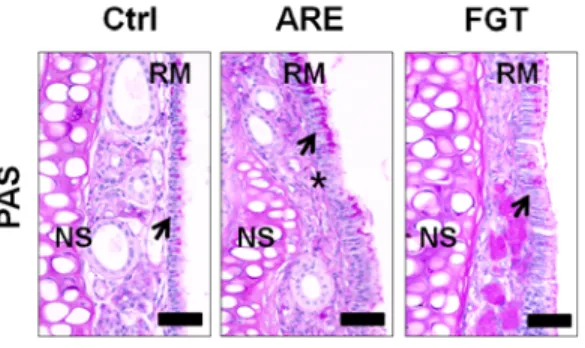
PAS 염색 결과, ARE군와 FGT군는 알레르기
비염 유발 후 아래코선반에서 호흡상피의 손상(*) 이 증가하였다. 특히 분비소낭이 없는 술잔세포 (arrow)가 다수 관찰되었다. FGT군은 ARE군에 비해 호흡상피의 손상이 적었으며, 술잔세포의 점 액분비도 감소하였다(Fig. 2).
Fig. 2. The alleviation of AR induced respiratory epithelial damages by HTD using Douchi (PAS).
Ctrl : no treatment group, ARE : allergy rhinitis elicited group, FGT : Hataedock using Douchi (fermameted Glycine) treated group before allergy rhinitis elicitation, NS : nasal septum, RM : respiratory nucosa, arrow : goblet cell, asterisk : respiratory damaged region, bar size : 50 μm
2. Th2 분화 조절
아래코선반의 점막에서 IL-4은 세포질에서 강한 양성반응을 보였다. FGT군은 ARE군에 비해 62%
유의성 있게 감소하였다. STAT6은 세포질에서 강
한 양성반응을 보였다. FGT군은 ARE군에 비해
85% 유의성 있게 감소하였다. CD40는 세포질에서
약한 양성반응을 보였다. FGT군은 ARE군에 비해
71% 유의성 있게 감소하였다(Fig. 3).
Fig. 3. The regulation of Th2 skewed condition.
The IL-4, STAT6, and CD40 positive reaction decreased in the FGT compared with the ARE group (immunohistochemistry; bar size, 50 μm). Data of image analysis was also shown same result (*p<0.05, compared with the ARE). Ctrl : no treatment group, ARE : allergy rhinitis elicited group, FGT : Hataedock using Douchi (fermameted Glycine) treated group before allergy rhinitis elicitation, NS : nasal septum, RM : respiratory nucosa, arrow : goblet cell, asterisk : respiratory damaged region, bar size : 50 μm
3. 비만세포 활성 조절
코안아래코선반내 비만세포의 활성에 관여하는 Fc
ɛRI 양성반응에서 FGT군은 ARE군에 비해 69%
유의성 있게 감소하였다. Itching에 관여하는 substance
P 양성반응에서 FGT군은 ARE군에 비해 43% 유
의성 있게 감소하였다. 코점막내 부종을 유도하는
MMP-9 양성반응에서 FGT군은 ARE군에 비해
49% 유의성 있게 감소하였다(Fig. 4).
Fig. 4. The regulation of mast cell's activation.
The FcɛRI, substance P, and MMP-9 positive reaction decreased in the FGT compared with the ARE group (immunohistochemistry; bar size, 50 μm). Data of image analysis was also shown same result (*p<0.05, compared with the ARE). Ctrl : no treatment group, ARE : allergy rhinitis elicited group, FGT : Hataedock using Douchi (fermameted Glycine) treated group before allergy rhinitis elicitation, NS : nasal septum, RM : respiratory nucosa, arrow : goblet cell, asterisk : respiratory damaged region, bar size : 50 μm
4. 항염증효과
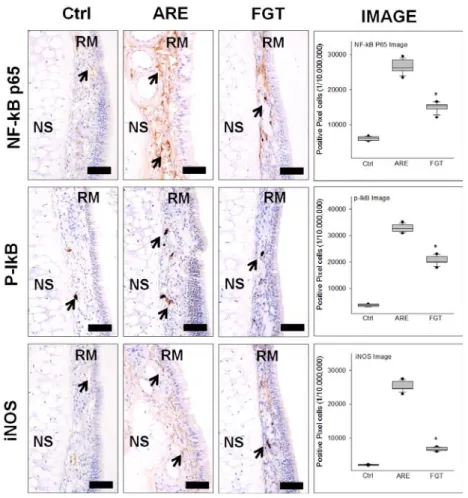
염증효소전사인자인 NF-kB p65 양성반응에서 FGT군은 ARE군에 비해 43% 유의성 있는 반응 감소가 나타났다. 또한 p-IkB 양성반응에서도 ARE
군에 비해 FGT군에서 38% 유의성 있는 감소를
보였다. 염증효소 iNOS 양성반응에서 FGT군은
ARE군에 비해 73% 유의성 있는 감소가 나타났다
(Fig. 5).
Fig. 5. The anti-inflammation effect.
The Nf-kB p65, p-IkB, and iNOS positive reaction decreased in the FGT compared with the ARE group (immunohistochemistry; bar size, 50 μm). Data of image analysis was also shown same result (*p<0.05, compared with the ARE). Ctrl : no treatment group, ARE : allergy rhinitis elicited group, FGT : Hataedock using Douchi (fermameted Glycine) treated group before allergy rhinitis elicitation, NS : nasal septum, RM : respiratory nucosa, arrow : goblet cell, asterisk : respiratory damaged region, bar size : 50 μm