• 검색 결과가 없습니다.

Spontaneous Pulmonary Hematoma with No Underlying Causes: A Case Report

N/A
N/A
Protected

Academic year: 2021

Share "Spontaneous Pulmonary Hematoma with No Underlying Causes: A Case Report"

Copied!
3
0
0

로드 중.... (전체 텍스트 보기)

전체 글

(1)

363

Spontaneous Pulmonary Hematoma with No Underlying Causes: A Case Report

Eun Joo Lee, M.D.

1

, Sang Hoon Park, M.D.

1

, Ho Hyun Park, M.D.

1

, Seung Heon Park, M.D.

1

, Jung Yeon Lee, M.D.

2

, Woo Surng Lee, M.D., Ph.D.

3

and Sun-Young Yoon, M.D., Ph.D.

4

1

Department of Internal Medicine,

2

Division of Pulmonary and Critical Care Medicine, Department of Internal Medicine,

3

Department of Thoracic and Cardiovascular Surgery,

4

Division of Allergy and Pulmonology, Department of Internal Medicine, Konkuk University Chungju Hospital, Chungju, Korea

A 57-year-old male patient was admitted to our center because of a cystic mass on the lower portion of the right major fissure that was found incidentally by chest X-ray. He did not have a history of trauma or anticoagulant use. The lesion was removed by video-assisted thoracoscopic surgery. Pathological examination revealed an organizing pulmonary hematoma without any complications, and a follow-up chest X-ray after 1 year showed no recurrence.

Keyword: Hematoma

subclavian vein catheterization

3,4

. One study reported a total of 38 cases of pulmonary hematoma, and all of these cases occurred after thoracic injury

5

. To the best of our knowledge, no case of pulmonary hematoma has manifested without any underlying causes. Here, we report a case of spontaneous pulmonary hematoma where the patient did not have any identifiable underlying causes. Pulmonary hematoma was fi- nally diagnosed after histopathological review of the surgically removed mass.

Case Report

A 57-year-old male patient was admitted to our center because of a cystic mass in the right upper lung field that was discovered incidentally by chest X-ray during a routine health checkup. He was a current smoker with more than 30 pack years of cigarette exposure. He had been diagnosed with chronic obstructive pulmonary disease (COPD) 20 years previously and had been using an inhaled corticosteroid and bronchodilator. The patient has been working at the con- venience store, and had no history of trauma or use of any anticoagulants. He had no chest pain, fever, cough, or sputum.

There were no other episodes of hemoptysis. His physical ex- amination showed decreased lung sounds in both lung fields without wheezes or crackles. There was no palpable lymph node enlargement. Routine laboratory studies including a Copyright © 2015

The Korean Academy of Tuberculosis and Respiratory Diseases.

All rights reserved.

Introduction

Pulmonary hematomas are collections of blood within the alveolar and interstitial spaces

1

. Usually, they are resolved within two to four weeks. However, if secondary infection accompanies a hematoma, it can progress into an abscess re- quiring drainage

2

.

Non-penetrating injury of the thorax, by either direct blunt trauma or indirect forces, is generally known to be the ma- jor cause of pulmonary hematoma. There have been a few reports of spontaneous pulmonary hematoma as a com- plication of anticoagulant therapy or a rare complication of

CASE REPORT

http://dx.doi.org/10.4046/trd.2015.78.4.363

ISSN: 1738-3536(Print)/2005-6184(Online) • Tuberc Respir Dis 2015;78:363-365

Address for correspondence: Sun-Young Yoon, M.D., Ph.D.

Division of Allergy and Pulmonology, Department of Internal Medicine, Konkuk University Chungju Hospital, 82 Gugwon-daero, Chungju 27376, Korea

Phone: 82-43-840-8691, Fax: 82-43-840-8961 E-mail: [email protected]

Received: Jun. 2, 2015 Revised: Jul. 1, 2015 Accepted: Jul. 6, 2015

cc
It is identical to the Creative Commons Attribution Non-Commercial

License (http://creativecommons.org/licenses/by-nc/4.0/).

(2)

EJ Lee et al.

364 Tuberc Respir Dis 2015;78:363-365 www.e-trd.org

platelet count and coagulation profiles yielded normal results, except a slightly increased C-reactive protein (CRP) level (7.13 mg/dL). Pulmonary function tests showed a severe obstruc- tive pattern, the forced expiratory volume in 1 second (FEV

1

) was 1.38 L (36% of predicted volume); the forced vital capacity (FVC) was 4.08 L (85% of predicted capacity); and the ratio of FEV

1

to FVC was 34%. The diffusing capacity was 15.7 mL/

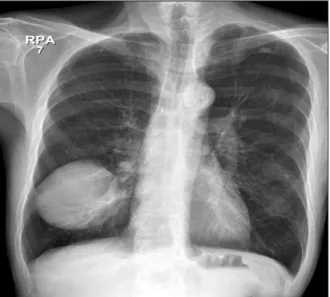
mm Hg/min (61% of predictive capacity). Several sputum analyses were negative for malignancy, bacterial infection, and tuberculosis. There was no evidence of human immu- nodeficiency virus infection. Chest X-ray showed a clearly defined homogeneous round opacity without calcification in the right lower lung field (Figure 1). Computed tomography (CT) scanning of the chest revealed a huge round cystic mass across the upper and lower lobes of the right lung, which mea- sured 9×7.9 cm at its maximum diameter (Figure 2).

Single port video-assisted thoracoscopic surgery approach using 5-mm scope through a 3.0 cm skin incision was per- formed under general anesthesia and one lung intubation.

After dissection of the pleural adhesions present, a thick yel- lowish cystic mass with a well-defined margin of 9×8×8 cm in size was found along the major fissure between the right upper and lower lobes (Figure 3). Fine needle aspiration col- lected a dark brownish colored viscous fluid. The mass was re- sected completely. Pathological examination revealed a large amount of dense fibrous tissue with blood clots, compatible with pulmonary hematoma (Figure 4), with no evidence of malignant cell infiltration. After postoperative care, the patient was discharged without any complications. A follow-up chest X-ray after 2 months showed no recurrence, and there was no evidence of recurrence 1 year after the follow-up period.

Discussion

Trauma is known to be the leading cause of pulmonary he- matoma, and spontaneous cases are rare

5,6

. Anticoagulation therapy, thrombocytopenia, and congenital disorders such as Ehlers-Danlos syndrome have been reported to be causes of

Figure 1. Chest X-rays shows a well-defined round homogenous opacity in the right lower lung field. RPA: posterior anterior view.

A

Figure 3. (A, B) Surgical findings dem- onstrates a large cystic mass with a thick yellowish capsule in the right upper and lower lobes, containing a large amount of dark brown muddy material.

Figure 2. Chest computed tomography scanning reveals a 9.0×

7.9-cm-sized well-defined cystic mass in the upper and lower lobes

of the right lung.

(3)

Spontaneous pulmonary hematoma with no underlying causes

http://dx.doi.org/10.4046/trd.2015.78.4.363 365

www.e-trd.org

spontaneous pulmonary hematoma, but the number of cases is extremely small

3,4,7,8

. In the current case, pulmonary hema- toma developed without any preexisting causes. To the best of our knowledge, this is the first case of a spontaneous pulmo- nary hematoma with no underlying conditions.

Generally, pulmonary hematoma is understood to occur by vessel rupture and consequent hemorrhage into the lung parenchyma due to physical trauma to the chest

7,9

. Several re- searchers have proposed another pathological mechanism of hematoma, which involves its occurrence in preexisting cysts via angionecrosis and erosion of the cystic wall

4,10

.

We suppose that these pathomechanisms may be appli- cable to explain the formation of pulmonary hematoma in present case. As the patient had underlying COPD, the eleva- tion of CRP levels detected suggests the possibility of infection leading to necrosis of the walls of preexisting emphysematous bullae and angionecrosis although bullae were not prominent in the area surrounding the hematoma upon CT. Alternatively, as though the patients did not aware, a minor trauma to the chest may be the leading cause of pulmonary hematoma through blood vessels rupture.

While the incidence of hematoma is low, it can be difficult to differentiate malignancy from hematoma in imaging results.

When a pulmonary cystic mass is observed, clinicians should be aware of the possibility of a hematoma, even if no underly-

ing symptoms exist.

Conflicts of Interest

No potential conflict of interest relevant to this article was reported.

Acknowledgements

The authors thank Professor Gyu Rak Chon for critical re- view of the manuscript and image evaluation.

References

1. Trinkle JK, Richardson JD, Franz JL, Grover FL, Arom KV, Hol- mstrom FM. Management of flail chest without mechanical ventilation. Ann Thorac Surg 1975;19:355-63.

2. Mathai M, Byrd RP Jr, Roy TM. The posttraumatic pulmonary mass. J Tenn Med Assoc 1996;89:41-2.

3. Chakraborty AK, Dreisin RB. Pulmonary hematoma second- ary to anticoagulant therapy. Ann Intern Med 1982;96:67-9.

4. Kaira K, Takei Y, Matsuura M, Saito R. Pulmonary hematoma resulting from anticoagulant therapy. AJR Am J Roentgenol 2003;180:1740.

5. Specht EE. Pulmonary hematoma. Am J Dis Child 1966;111:

559-63.

6. Williams JR. The vanishing lung tumor: pulmonary hema- toma. Am J Roentgenol Radium Ther Nucl Med 1959;81:296- 302.

7. Luna MA, Leary WV, Jing BS. Pulmonary hematoma associ- ated with thrombocytopenia. Chest 1970;57:487-9.

8. Matsushita A, Takayanagi N, Ishiguro T, Harasawa K, Tsuchi- ya N, Yoneda K, et al. A case of Ehlers-Danlos syndrome sus- pected from pulmonary hematoma due to disruption of the lung. Nihon Kokyuki Gakkai Zasshi 2009;47:704-10.

9. Joynt GH, Jaffe F. Solitary pulmonary hematoma. J Thorac Cardiovasc Surg 1962;43:291-302.

10. Jay SJ, Johanson WG Jr. Massive intrapulmonary hemorrhage:

an uncommon complication of bullous emphysema. Am Rev Respir Dis 1974;110:497-501.

Figure 4. Histopathological findings shows dense fibrous tissue con-

taining fragments of blood clots separating the lung parenchyma

(H&E stain, ×40).

수치

Figure 1. Chest X-rays shows a well-defined round homogenous  opacity in the right lower lung field
Figure 4. Histopathological findings shows dense fibrous tissue con- con-taining fragments of blood clots separating the lung parenchyma  (H&E stain, ×40).

참조

관련 문서

The chest X-ray and CT showed multiple, variable sized, and irregular patch consolidations with cavities combined with some ground glass opacities in both lower

Bactericidal/permeability-increasing protein attenuates systemic inflammation and acute lung injury in porcine lower limb ischemia- reperfusion injury.. Role of

Cysts of the mandibular condyle are rare and can be difficult to diagnose and treat. Clinically, a simple bone cyst is asymptomatic and often discovered incidentally on

Along with findings of pulmonary vein atresia, we observed the cysts in affected lung, more on upper lobe and subpleural areas.. These cystic lung lesions seem to be the late

Follow-up chest radiogram obtained 8 months later shows enlarged cyst in right upper lung zoneD. Initial chest CT scan taken on same day as figure 1C shows variable

2; Close-up chest radiograph after open thoracostomy shows reticulonodular increased densities with honeycombing predominently in lower lung fie1d _..

Chest X-ray showed improved lesion of both upper lung fields and disappeared previous right side pleural

Chest X-ray shows a cystic lesion (arrow) in left upper lung field and a radiolucent area between the aorta and the pulmonary artery, suggesting the pericardial defect.. 시행하였으나