• 검색 결과가 없습니다.

The Beck Depression Inventory-Second Edition:

N/A
N/A
Protected

Academic year: 2021

Share "The Beck Depression Inventory-Second Edition: "

Copied!
8
0
0

로드 중.... (전체 텍스트 보기)

전체 글

(1)

The Beck Depression Inventory-Second Edition:

Psychometric Properties in Korean Adult Populations

Seung-U Lim 1 Eun-Ho Lee 2† Soon-Taeg Hwang 3 Sang-Hwang Hong 4 Ji-Hae Kim 1

1

Department of Psychiatry, Samsung Medical Center, Sungkyunkwan University School of Medicine, Seoul;

2

Depression Center, Department of Psychiatry, Samsung Medical Center, Sungkyunkwan University School of Medicine, Seoul;

3

Department of Psychology, Chungbuk National

University, Cheongju;

4

Department of Education, Chinju National University of Education, Seoul, Korea

The present study evaluated the psychometric characteristics and the factor structure of the Beck Depression Inventory-Sec- ond Edition (BDI-II) among the general population in South Korea. The BDI-II was completed by a total of 1,022 adult par- ticipants from South Korea with an average age of 35.61 years. Of the 1,022 participants, 53.9% were females. The Korean version of the BDI-II demonstrated strong internal consistency, test-retest reliability, and had a strong correlation with other depression-related self-report measures. Using confirmatory factor analyses, a bifactor model identified a general factor and two specific factors consisting of somatic group factor and cognitive group factor provided the best fit to the data. These find- ings suggest that the BDI-II is a useful psychological instrument for assessing and understanding depressive symptoms in the Korean general population. Additionally, these findings provide support for a detailed evaluation of depression by numerous healthcare professionals who require a reliable and valid assessment to screen depression.

Keywords: Beck Depression Inventory-II, BDI-II, depression, reliability, validity, bifactor model

Depression is a disabling disorder in which patients suffer from a combination of symptoms that undermine their ability to sleep, study, work, eat, and enjoy activities they used to find pleasurable.

Given the many pressures, anxieties, and uncertainties inherent in our present-day world, it is not surprising that people in all societ- ies and walks of life are experiencing the debilitating effects of de- pression. Indeed, the World Health Organization (WHO) (2001) identified depression as one of the leading causes of disability worldwide. The lifetime prevalence of major depressive disorder is 3–17%, and in Korea, the rate is found to be increasing from 5.6%

in 2006 to 6.7% in 2011 (Cho, 2011). In general, diagnosis of de- pression is made by the conjoined data of mental status examina- tion and clinical interview conducted by the clinicians. The Beck Depression Inventory (BDI), the Center for Epidemiological Stud-

ies Depression Scale (CES-D), the Hamilton Rating Scale for De- pression (HRSD), and the Zung Self-Rating Depression Scale (SDS) are four of the most widely used depression tests (Shafer, 2006).

Among the scales used to examine depression, BDI is one of the widely used instrument to assess the presence and severity of de- pressive symptoms (Beck, Steer, & Brown, 1996). Since its intro- duction in 1996, Beck Depression Inventory-Second Edition (BDI- II) has been revised from BDI in order to reflect the Diagnostic Statistical Manual of Mental Disorders-IV (DSM-IV) criteria for major depressive disorder (Beck et al., 1996). More specifically, the revised BDI-II made modifications to 17 responses, including op- tions for both increases and decreases in appetite, weight, and sleep. In addition, four items including body image change, work difficulty, weight loss, and somatic preoccupation were replaced by agitation, worthlessness, loss of energy, and concentration dif- ficulty. The time frame for responses was lengthened from 1 week to 2 weeks. Like its predecessor, the BDI-II contains 21 items which measure the severity of depressive symptoms ranging from 0 to 63.

eISSN 2733-4538

Correspondence to Eun-Ho Lee, Depression Center, Department of Psychiatry,

Samsung Medical Center, Sungkyunkwan University School of Medicine,

81 Irwon-ro, Gangnam-gu, Seoul, Korea; E-mail: [email protected]

Received Apr 3, 2019; Revised May 30, 2019; Accepted Jun 24, 2019

(2)

Although the primary aim of the BDI-II is to measure the global construct of depression, the question as to whether meaningful groups of items in the questionnaire can be discerned through factor analysis has been of ongoing interest (Beck et al., 1996). Beck et al. (1996) suggested two-dimensional models consisting of ‘so- matic-affective’ (12 items) and ‘cognitive’ (9 items) from the data collected from a clinical sample of 500 psychiatric outpatients. Sim- ilarly, they analyzed data from a sample of 120 primarily White undergraduate students, and suggested a model consisting of ‘cog- nitive-affective’ (16 items) and ‘somatic’ (5 items). Through their naming of the factors, it has been found that cognitive, affective, and somatic elements underlie the factors, but the authors failed to determine fixed sets of items that measure these elements. Such lack of clarity in the factor structure of the BDI-II has led to several other models. In at least two studies, a three-factor solution (affec- tive-cognitive-somatic) has been supported (Buckley, Parker, &

Heggie, 2001; Osman et al., 1997). The factor analysis and validity of the BDI-II have been studied in various countries (Al-Musawi, 2001; Ghassemzadeh, Mojtabai, Karamghadiri, & Ebrahimkhani, 2005; Kojima et al., 2002). These studies examined whether the two-factor model proposed by Beck and colleagues are applicable to other population as well. Although all studies demonstrated its factorial validity, only some confirmed a similar two-factor struc- ture to that of the original inventory (Ghassemzadeh et al., 2005;

Kojima et al., 2002). The most recent studies have proposed a bi- factor model of the BDI-II (Arnau, Meagher, Norris, & Bramson, 2001; Brouwer, Meijer, & Zevalkink, 2013; Ward, 2006). In this model, a general factor and several group factors, and items can be loaded on more than one factor (Buhler, Keller, & Lage, 2014). Ar- nau et al. (2001) and Brouwer et al. (2013) have demonstrated a general factor comprised of all items, with the cognitive group and somatic-affective group. Ward (2006) has found a general factor, along with the cognitive group and somatic group. The diverse ex- planation for the structure of the BDI-II and its applicability in a variety of cultures leads to an exploration of the BDI-II in South Korea as well. In particular, cross-cultural validation for the BDI- II has not been conducted yet and needs further research.

Depression can be manageable, and the use of psychometrically sound and appropriate screening instruments can identify poten- tial cases of depression quickly and inexpensively. The BDI-II

should receive more attention because of its capacity to be imple- mented for clinical and research purposes among many cultures.

The relationship between ethnicity and depression is complex and influenced by various factors (Plant & Sachs-Ericsson, 2004). Giv- en the increasing rates of depression, it is evident that early detec- tion and diagnosis of depression in Korean adults is extremely im- portant. The applicability of a widely used valid and reliable in- strument for the detection of depression in the general population can help address this problem in Korea. Unfortunately, to our knowledge, there has been very limited research regarding the psychometric properties of the BDI-II in Korea, nor how they compare with those of the original English version. Thus, psycho- metric information related to an appropriate screening instru- ment, specifically adapted for use in Korean populations, would have high utility not only for practitioners but also for researchers for whom they would serve a pivotal role in empirical investiga- tions of depressive disorders. An understanding of the dimensions of depressive symptoms could facilitate valid and interpretable comparisons across cultures. However, the instrument should be first psychometrically valid in order to be used as a screening tool.

Therefore, the current study aims to provide information on the validity and reliability of the Korean version of the BDI-II in an adult community sample. The present study was designed to as- certain two main objectives: (a) to analyze the psychometric prop- erties (internal consistency) of the BDI-II and (b) to evaluate the factorial structure suggested by previous studies in a Korean non- clinical sample.

Methods

Participants and procedure

The study sample consisted of 1,022 general adults from 5 regional areas (i.e., Seoul, Incheon, Cheongju, Daegu, Jinju) across South Korea. We used data drawn from Korean Beck Anxiety And De- pression Inventory (K-BANDI) project, which is designed to ad- dress psychometric investigation of the scales developed by Beck and his colleagues (Beck & Steer, 1990; Beck et al., 1996). Partici- pants were recruited from social organizations, religious services, places of employment, psychology classes, and by word-of-mouth.

They received approximately $5.00 for their participation. The

(3)

mean age of the sample was 35.61 years (SD =12.45, range 19–72), and 53.9% of the participants were female. The mean BDI-II total score was 9.29 (SD =7.23). Other available sample demographics are summarized in Table 1. This study was approved by the Sam- sung Medical Center Ethics Review Board.

Measures

Beck Depression Inventory-II (BDI-II)

The BDI-II is a 21-item inventory that assesses the presence and the severity of depressive symptomatology. Each item is rated on a 4-point scale from 0 to 3 with summation scores ranging from 0 to 63. The BDI-II has been found to display high internal consistency.

Adequate content and factorial validity has been reported, and di-

agnostic discrimination has been well established. With a permis- sion of the publisher, The Psychological Corporation, two inde- pendent licensed clinical psychologists (i.e., JHK and STH) trans- lated the original English version of the BDI-II into Korean and confirmed the content of the questionnaire through a debate among three researchers. A proficient bilingual person who mas- tered in clinical psychology re-translated it to English and re- searchers reviewed and revised into the final version.

Patient Health Questionnaire-9 (PHQ-9)

The PHQ-9 is a depression module of the PHQ that consists of the nine criteria upon which the diagnosis of DSM-IV depressive dis- orders is based. It is only half the length of many other depression scales, but it has comparable sensitivity and specificity. Each item is scored on a scale of 0 to 3, after which the circled numbers are added to yield a score ranging between 0 and 27. The Korean ver- sion of the PHQ-9 is well validated and widely used for depression screening (Choi et al., 2007).

State-Trait Anxiety Inventory (STAI)

The STAI Form Y assesses two types of anxiety with two scales:

State Anxiety and Trait Anxiety. State Anxiety is measured by 20 short descriptive statements, which the individual answers in ref- erence to how he or she feels at the moment, whereas Trait Anxiety is measured by 20 statements that refer to one’s general feelings.

The Korean version of STAI showed good validity and reliability for adult samples (Hahn, Lee, & Chon, 1996).

Adult ADHD Self-Report Scale (ASRS)

The ASRS is developed by WHO workgroup (Kessler et al., 2005).

The ASRS is a checklist of 18 questions about ADHD symptoms that are based on the diagnostic criteria of DSM-IV. The reliability and validity of the Korean version are well established (Kim, Lee,

& Joung, 2013).

Data analyses

The internal consistency of the BDI-II was evaluated by calculat- ing Cronbach’s α coefficient. Test-retest reliability was estimated by Pearson’s correlation coefficient of the BDI-II scores obtained 1-week apart. The concurrent validity of the BDI-II was estimated Table 1. Study Sample Demographics

Variable n %

Age

19–29 420 41.1

30–39 224 21.9

40–49 182 17.8

Over 50 196 19.2

Education

Elementary school 3 0.3

Middle school 19 1.9

High school 399 39.0

Some college 413 40.4

Graduate degree 183 17.9

Unreported 5 0.5

Marital status

Single 523 51.2

Married 468 45.8

Divorced 13 1.3

Separated 3 0.3

Widowed 10 1.0

Unreported 5 0.5

Personal income (won)

Under 1,000,000 379 37.1

1,000,000–2,000,000 186 18.2

2,000,000–3,000,000 215 21.0

3,000,000–4,000,000 125 12.2

Over 4,000,000 113 11.1

Unreported 4 0.4

Past Psychiatric/Counseling Service

Yes 33 3.2

No 984 96.3

Unreported 5 0.5

(4)

by Pearson’s correlation coefficient with other well-validated clini- cal depression and anxiety measures. For the discriminant validity, we evaluated Pearson’s correlation coefficient with ADHD symp- tom measures.

The factor structure of the BDI-II was examined using a set of confirmatory factor analysis (CFA). Five previously reported mod- els of the BDI-II factor structure were selected. On selecting, we considered the generalizability of the sample to nonclinical popu- lation, methodology (e.g., appropriate sample size, tests of assump- tions etc.), overall model fit, and cross-validation of findings in other samples. Given the ordinal nature of items, each model was analyzed using the mean and variance adjusted weighted least squares estimation (WLSMV). Three different fit indices were used to assess the adequacy of a well-fitting model: The compara- tive fit index (CFI; good fit >.95), the Tucker-Lewis index (TLI;

good fit >.95), the root mean square error of approximation (RM- SEA; good fit <.05) (Hu & Bentler, 1999). Also, when examining the unidimensionality of a bifactor model, it is highly recom- mended to consider additional indices, mainly the hierarchical

omega (ω

H

), the percentage of explained common variance (ECV) and the percentage of uncontaminated correlations (PUC) (Rodri- guez, Reise, & Haviland, 2016). General guidelines regarding PUC suggest that instrument can be interpreted as primarily unidi- mensional if PUC is more than .80. However, if the PUC is lower than .80, then the ECV must be above .60, and the hierarchical omega (ω

H

) must be more than .70 (Reise, Scheines, Widaman, &

Haviland, 2013).

All statistical analyses were performed using SPSS 21.0, except for the CFA. Mplus 6.1 was used for the analyses of the factor structure of the BDI-II (Muthen & Muthen, 2010). The p-value was set at .01 to justify statistical significance for all analyses.

Results

Internal consistency and test-retest reliability

Cronbach’s α coefficient of the BDI-II was .89, which is similar to the previous studies. Examination of the corrected item-total cor- relation coefficients showed that each item contributed substan-

Table 2. Means, Standard Deviations, Percentages Symptomatic, and Item-Total Correlations of the Korean BDI-II

Symptom M SD Skewness Kurtosis % r

it

Sadness .34 .51 1.18 1.15 33 .57

Pessimism .35 .56 1.57 2.80 32 .47

Past failure .31 .57 1.78 2.44 25 .50

Loss of Pleasure .50 .64 1.08 .87 43 .52

Guilty Feelings .54 .63 .79 -.02 48 .50

Punishment Feelings .28 .62 2.68 7.83 22 .50

Self-Dislike .30 .64 2.04 2.93 20 .56

Self-Criticalness .41 .69 1.58 1.69 31 .54

Suicidal Thoughts or Wishes .24 .46 1.78 3.09 23 .43

Crying .28 .60 2.32 5.35 22 .45

Agitation .30 .51 1.76 3.80 27 .55

Loss of Interest .47 .62 1.14 .90 40 .54

Indecisiveness .52 .62 .99 1.02 46 .52

Worthlessness .20 .48 2.50 6.15 17 .55

Loss of Energy .69 .63 .41 -.44 60 .50

Changes in Sleeping Pattern .77 .74 .83 .62 61 .45

Irritability .51 .63 .95 .45 44 .54

Changes in Appetite .62 .67 .80 .15 52 .43

Concentration Difficulty .54 .60 .71 -.03 49 .55

Tiredness or Fatigue .69 .61 .39 -.07 61 .56

Loss of Interest in Sex .43 .69 1.58 2.06 34 .25

BDI-II total 9.30 7.12

Note. N=1,008. %=Total percentage endorsing response choices 1, 2, or 3. r

it

=item-total correlations.

(5)

tially to the total BDI-II score (range=.25 to .57). Item 21 (Loss of libido) showed the lowest item-total correlation, but still signifi- cant in magnitude. Test-retest reliability was examined for the 48 respondents in the one week’s interval. The Pearson correlation coefficient of the two trials was .90 (p<.001). Other available means, standard deviations, percentages symptomatic, and item- total correlations are summarized in Table 2.

Concurrent and discriminant validity

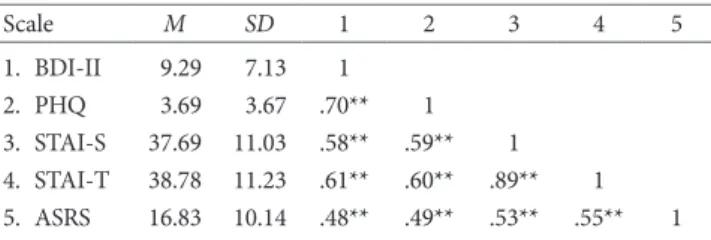
Using Pearson correlation analysis, we investigated the relations between scores on the BDI-II and the four other self-report mea- sures. The Pearson correlation coefficient for the Korean BDI-II with the PHQ-9 was .70, indicating a strong correlation between two measures of depression. Correlations between the Korean BDI-II and anxiety-related measures (i.e., STAI-S, STAI-T) were .58 and .61, which is moderate in range. The ASRS also showed significant but relative lower levels of correlation with the Korean BDI-II than depression or anxiety-related measures (Table 3).

Factorial validity

We ran a series of confirmatory factor analysis to test six different

previously reported models. Fit statistics for the CFA models are shown in Table 4. Model fit was generally adequate for all of the models tested. All items loaded significantly on their respective factors. Each model is introduced, explained, and assessed as de- scribed below.

Model A: Unidimensional Model

We tested a one-factor model with all 21 items loading onto a sin- gle factor. This model produced an acceptable fit to the sample data (CFI=.92, TLI=.91, RMSEA=.07).

Model B: Beck et al. (1996)’s two-factor model

Beck et al. (1996) presented a two-factor solution where somatic- affective (items 4, 10–14, 15–21) and cognitive symptoms (items 1–3, 5–9, 14) were considered as independent dimensions using initial BDI-II validation sample of students. Using our dataset, two-factor model produced a good fit to the sample data across all fit statistics (CFI=.95, TLI=.94, RMSEA=.05).

Model C: Viljoen, Iverson, Griffiths, Woodward (2003)’s two- factor model

The model supported by Vijoen et al. (2003) consisted of two group factors – a somatic-affective factor (items 1, 4, 11–13, 15–21), and cognitive factor (items 2, 3, 5–10, 13, 14, 21). This model showed acceptable fit to the sample data (CFI=.93, TLI=.92, RMSEA=

.06).

Model D: Osman et al. (1997)’s three-factor model

The Osman et al. (1997) model consists of three oblique latent fac- tors, with describing as negative attitude (items 1–3, 5–9, 14), per- formance difficulty (items 4, 10, 12, 13), and somatic elements Table 3. Means, Standard Deviations, and Scale Intercorrelations

Scale M SD 1 2 3 4 5

1. BDI-II 9.29 7.13 1

2. PHQ 3.69 3.67 .70** 1

3. STAI-S 37.69 11.03 .58** .59** 1 4. STAI-T 38.78 11.23 .61** .60** .89** 1 5. ASRS 16.83 10.14 .48** .49** .53** .55** 1 Note. BDI-II=Beck Depression Inventory-II; PHQ-9=Patient Health Questionnaire-9; STAI-S=State-Trait Anxiety Inventory-State; STAI- T=State-Trait Anxiety-Trait; ASRS=Adult ADHD Screening Scale.

**All tests are significant at the .001-level.

Table 4. Summary of Results From Confirmatory Factor Analyses for Korean Adult Samples

Study Model χ

2

df CFI TLI RMSEA 90% CI

Null Model One Factor 1,024.312 189 .918 .909 .066 .062–.070

Beck et al., 1996 Two Factor 747.289 188 .945 .939 .054 .050–.058

Viljoen et al., 2003 Two Factor 897.461 186 .930 .921 .062 .058–.066

Osman et al., 1997 Three Factor 745.935 186 .945 .938 .055 .051–.059

Buckley et al., 2001 Three Factor 700.210 186 .950 .943 .052 .048–.057

Ward, 2006 Bifactor 568.051 176 .962 .954 .047 .043–.051

Note. CFI=comparative fit index; TLI=Tucker-Lewis index; RMSEA=root mean square error of approximation; CI=confidence interval; Bifactor=

model with one general and two group factors.

(6)

(items 11, 15–21). The CFI and TLI were .95 and .94, respectively.

RMSEA was .05.

Model E: Buckley et al. (2001)’s three-factor model

Buckley et al. (2001) reported a three-factor model, with the fac- tors described as cognitive (items 1–3, 5–9, 14), affective (items 4, 10, 12, 13), and somatic symptoms (items 11, 15–21). The CFI and TLI were .95 and .94, respectively. RMSEA was .05, which is in ad- equate range.

Model F: Ward (2006)’s bifactor model

The bifactor model from the Ward (2006)’s study consists of one general factor and two specific factors - a five-item somatic group factor (items 15, 16, 18–20) and an eight-item cognitive group fac- tor (items 2, 3, 5–9, 14). This model showed a best fit to the dataset

among all six tested models (CFI=.96, TLI=.95, RMSEA=.05).

We also calculated three bifactor strength indices; ω

H

, ECV, PUC.

The omega coefficient (ω

H

) for the general factor was .89, which suggests it accounted for the majority of reliable variance in the to- tal score among the BDI-II items. The other two BDI-II specific factors demonstrated considerably lower estimates of ω

H

(cogni- tive factor: ω

H

= .18, somatic factor: ω

H

= .30). The ECV for the BDI-II was .81, indicating a strong general factor. In the BDI-II, PUC was .65. Reise et al. (2013) suggest that even though the PUC is lower than .8, if the values of ECV and ω

H

are high (i.e., ECV >.6 and ω

H

>.7), a scale may be considered unidimensional enough to warrant the use of a total score. Other standardized factor load- ings and bifactor indices are summarized in Table 5.

Discussion

The present study evaluated the reliability, validity, and factor structure of the BDI-II in the general population of Korea. Cron- bach’s α coefficient of the BDI-II found in this study has been proven to be a reliable measure of depression. Such finding is con- sistent with Beck et al. (1996), Whisman, Perez, & Ramel (2000) as well as other non-clinical sample studies (Kapci, Uslu, Turkcapar,

& Karaoglan, 2008; Kojima et al., 2002). The BDI-II also showed high internal validity and concurrent validity. Also, the BDI-II showed a strong correlation with the PHQ-9 and also had a mod- est correlation with the STAI. While the correlation between the BDI-II and the ASRS had the lowest correlation amongst the scales and was lower than previous studies (Storch, Roberti, & Roth, 2004), it was still significantly correlated.

The present study found that the bifactor model fitted to our data most accurately, which suggests that along with cognitive and somatic factor, general factor underlying the BDI-II best describes depression. Such finding is in line with the previous finding made by Ward (2006). In previous researches, there have been different recommendations for determining the factor structure of the BDI- II (Arnau et al., 2001; Beck et al., 1996; Buckley et al., 2001; Dozois, Dobson, & Ahnberg, 1998; Osman, Barrios, Gutierrez, Williams,

& Bailey, 2008; Osman et al., 1997; Vanheule, Desmet, Groen- vynck, Rosseel, & Fontaine, 2008; Ward, 2006). The previous two- or three-factor models, including two-factor model originally sug- Table 5. Standardized Factor Loadings and Bifactor Indices for Best

Fitting Model of the BDI-II

Symptom General

Depression Cognitive Somatic

Sadness .77

Pessimism .62 .14

Past failure .58 .38

Loss of Pleasure .67

Guilty Feelings .56 .33

Punishment Feelings .63 .36

Self-Dislike .67 .55

Self-Criticalness .65 .36

Suicidal Thoughts or Wishes .55 .18

Crying .61

Agitation .73

Loss of Interest .68

Indecisiveness .66

Worthlessness .73 .22

Loss of Energy .59 .36

Changes in Sleeping Pattern .47 .52

Irritability .68

Changes in Appetite .46 .52

Concentration Difficulty .67 .19

Tiredness or Fatigue .63 .50

Loss of Interest in Sex .34

Omega hierarchical (ω

H

) .89 .18 .30

Explained common variance (ECV) .81 .09 .10 Percentage of uncontaminated

correlations (PUC) .65

Note. All standardized factor loadings are significant at the .001-level

p<.01.

(7)

gested by Beck et al. (1996), raised two main controversies over the years. First of all, partitioning the BDI-II into subscales would present limited clinical value due to the substantial overlap be- tween the latent factors (Subica et al., 2014). More specifically, pre- vious tests showed that depending on the nature of the sample, items could load on different factors (Storch et al., 2004). The bi- factor model examined in this study can overcome such ambigui- ty. Secondly, BDI-II common item variance appears to be inde- pendently accounted for by both a general depression factor and multiple specific factors (Brouwer et al., 2013; Ward, 2006). While cognitive and somatic factors each contribute as a specific factor, given the nature influence of general factor in the bifactor model, it is best to assess the BDI-II as a unidimensional construct. How- ever, it is important to note that in clinical settings, specific factors might help describe varying diagnostic properties. Therefore, in order to determine the appropriate factor structure and clinical interpretability of an instrument that appears to be comprised of items that simultaneously assess a general depression construct and narrower subdomains of depressive symptomology, bifactor model proposed by Ward (2006) can help identify the severity of depression among a set of different items.

It was reported that ethnicity was not significantly correlated with the BDI-II total score (Beck et al., 1996). Similarly, the total score of the BDI-II was similar to previous findings (Beck et al., 1996; Dozois et al., 1998; Ghassemzadel et al., 2005; Kojima et al., 2002; Whisman et al., 2000). It should be noted, however, that means of somatic items such as ‘changes in sleeping pattern’, ‘loss of energy’, and ‘tiredness or fatigue’ were the highest. Such char- acteristic could be explained by cultural factors, as Korean patients who are depressed “tend to reveal culture-specific somatic com- plaints because they feel shame or fear stigma if they are seen as mentally ill” (Lee, Kim, Choi, & Lee, 2014).

There were some limitations to this study. First of all, the partic- ipants in the study solely relied on a nonclinical sample. Further evaluation is needed, especially for clinical sample, in order to en- hance the generalizability of the BDI-II in Korea. Secondly, only self-report measures were used, so relationships between study variables may have been inflated by a questionnaire-specific meth- od variance. Continuous investigations should be conducted to examine the reliability and clinical utility of the BDI-II using cli-

nician-rated scales, such as the Hamilton depression rating scale.

Nevertheless, the present study is the first published work in ad- dressing the reliability, validity, and factor structure of the BDI-II in the Korean adult populations. The results suggest that the BDI-II is a useful psychological instrument for assessing and understand- ing depressive symptoms. Such findings provide support for a de- tailed evaluation of depression by numerous healthcare profes- sionals who require a reliable and valid assessment to screen de- pression.

References

Al-Musawi, N. M. (2001). Psychometric properties of the Beck de- pression inventory-II with university students in Bahrain. Jour- nal of Personality Assessment, 77, 568-579.

Arnau, R. C., Meagher, M. W., Norris, M. P., & Bramson, R. (2001).

Psychometric evaluation of the Beck Depression Inventory-II with primary care medical patients. Health Psychology, 20, 112- 119.

Beck, A. T., & Steer, R. A. (1990). Manual for the Beck Anxiety In- ventory. San Antonio, TX: Psychological Corporation.

Beck, A. T., Steer, R. A., & Brown, G. K. (1996). BDI-II: Beck De- pression Inventory Manual (2nd ed.). San Antonio, TX: Psycho- logical Corporation.

Brouwer, D., Meijer, R. R., & Zevalkink, J. (2013). On the factor structure of the Beck Depression Inventory-II: G is the key. Psy- chological Assessment, 25, 136-145.

Buckley, T. C., Parker, J. D., & Heggie, J. (2001). A psychometric evaluation of the BDI-II in treatment-seeking substance abusers.

Journal of Substance Abuse Treatment, 20, 197-204.

Bühler, J., Keller, F., & Läge, D. (2014). Activation as an overlooked factor in the BDI-II: A factor model based on core symptoms and qualitative aspects of depression. Psychological Assessment, 26, 970-979.

Cho, M. J. (2011). The Epidemiological survey of mental disorders in Korea. Seoul, Korea: Ministry of Health and Welfare.

Choi, H. S., Choi, J. H., Park, K. H., Joo, K. J., Ga, H., Ko, H. J., &

Kim, S. R. (2007). Standardization of the Korean version of Pa- tient Health Questionnaire-9 as a screening instrument for ma- jor depressive disorder. Journal of the Korean Academy and Fam- ily Medicine, 28, 114-119.

Dozois, D. J., Dobson, K. S., & Ahnberg, J. L. (1998). A psychomet- ric evaluation of the Beck Depression Inventory–II. Psychological Assessment, 10, 83-89.

Ghassemzadeh, H., Mojtabai, R., Karamghadiri, N., & Ebrahim-

khani, N. (2005). Psychometric properties of a Persian-language

(8)

version of the Beck Depression Inventory-Second Edition: BDI- II-PERSIAN. Depression and Anxiety, 21, 185-192.

Hahn, D. W., Lee, C. H., & Chon, K. K. (1996). Korean adaptation of Spielberger's STAI (K-STAI). Korean Journal of Health Psy- chology, 1, 1-14.

Hu, L. T., & Bentler, P. M. (1999). Cutoff criteria for fit indexes in covariance structure analysis: Conventional criteria versus new alternatives. Structural Equation Modeling, 6, 1-55.

Kapci, E. G., Uslu, R., Turkcapar, H., & Karaoglan, A. (2008). Beck Depression Inventory II: Evaluation of the psychometric proper- ties and cut-off points in a Turkish adult population. Depression and Anxiety, 25, E104-110.

Kessler, R. C., Adler, L., Ames, M., Demler, O., Faraone, S., Hiripi, E., . . . Walters, E. E. (2005). The World Health Organization Adult ADHD Self-Report Scale (ASRS): A short screening scale for use in the general population. Psychological Medicine, 35, 245-256.

Kim, J. H., Lee, E. H., & Joung, Y. S. (2013). The WHO adult ADHD Self-Report Scale: Reliability and validity of the Korean version.

Psychiatry Investigation, 10, 41-46.

Kojima, M., Furukawa, T. A., Takahashi, H., Kawai, M., Nagaya, T.,

& Tokudome, S. (2002). Cross-cultural validation of the Beck Depression Inventory-II in Japan. Psychiatry Research, 110, 291- 299.

Lee, S. H., Kim, B., Choi, T. K., & Lee, M. H. (2014). Long-standing depression and anxiety in a Korean woman. The American Jour- nal of Psychiatry, 171, 622-624.

Muthén, L. K., & Muthén, B. O. (2010). Mplus 6.1. Statistical analy- sis with latent variables: User’s guide (Version 6.1). Los Angeles, CA: Muthén & Muthén.

Osman, A., Barrios, F. X., Gutierrez, P. M., Williams, J. E., & Bailey, J. (2008). Psychometric properties of the Beck Depression Inven- tory-II in nonclinical adolescent samples. Journal of Clinical Psy- chology, 64, 83-102.

Osman, A., Downs, W. R., Barrios, F. X., Kopper, B. A., Gutierrez, P.

M., & Chiros, C. E. (1997). Factor structure and psychometric characteristics of the Beck Depression Inventory-II. Journal of Psychopathology and Behavioral Assessment, 19, 359-376.

Plant, E. A., & Sachs-Ericsson, N. (2004). Racial and ethnic differ- ences in depression: The roles of social support and meeting ba- sic needs. Journal of Consulting and Clinical Psychology, 72, 41- 52.

Reise, S. P., Scheines, R., Widaman, K. F., & Haviland, M. G. (2013).

Multidimensionality and structural coefficient bias in structural equation modeling: A bifactor perspective. Educational and Psy- chological Measurement, 73, 5-26.

Rodriguez, A., Reise, S. P., & Haviland, M. G. (2016). Evaluating bifactor models: Calculating and interpreting statistical indices.

Psychological Methods, 21, 137-150.

Shafer, A. B. (2006). Meta-analysis of the factor structures of four depression questionnaires: Beck, CES-D, Hamilton, and Zung.

Journal of Clinical Psychology, 62, 123-146.

Storch, E. A., Roberti, J. W., & Roth, D. A. (2004). Factor structure, concurrent validity, and internal consistency of the Beck Depres- sion Inventory-Second Edition in a sample of college students.

Depression and Anxiety, 19, 187-189.

Subica, A. M., Fowler, J. C., Elhai, J. D., Frueh, B. C., Sharp, C., Kel- ly, E. L., & Allen, J. G. (2014). Factor structure and diagnostic va- lidity of the Beck Depression Inventory-II with adult clinical in- patients: Comparison to a gold-standard diagnostic interview.

Psychological Assessment, 26, 1106-1115.

Vanheule, S., Desmet, M., Groenvynck, H., Rosseel, Y., & Fontaine, J. (2008). The factor structure of the Beck Depression Inventory- II: An evaluation. Assessment, 15, 177-187.

Viljoen, J. L., Iverson, G. L., Griffiths, S., & Woodward, T. S. (2003).

Factor Structure of the Beck Depression Inventory-II in a medi- cal outpatient sample. Journal of Clinical Psychology in Medical Settings, 10, 289-291.

Ward, L. C. (2006). Comparison of factor structure models for the Beck Depression Inventory-II. Psychological Assessment, 18, 81-88.

Whisman, M. A., Perez, J. E., & Ramel, W. (2000). Factor structure of the Beck Depression Inventory-Second Edition (BDI-II) in a student sample. Journal of Clinical Psychology, 56, 545-551.

World Health Organization. (2001). The World Health Report 2001:

Mental health: new understanding, new hope.

수치

Table 2. Means, Standard Deviations, Percentages Symptomatic, and Item-Total Correlations of the Korean BDI-II
Table 4. Summary of Results From Confirmatory Factor Analyses for Korean Adult Samples

참조

관련 문서

Inclusion and Inclusiveness: Shared Vision of Youth for Local, National, and Global Village Inclusion at large stands for embracing populations with disabilities and

감각손실(Sensory deficits) 관절염(Arthritis) 고혈압(High blood pressure) 심장병(Heart disease) 당뇨(Diabetes) 폐질환(Lung diseases) 뇌졸증(Stroke)

웹 표준을 지원하는 플랫폼에서 큰 수정없이 실행 가능함 패키징을 통해 다양한 기기를 위한 앱을 작성할 수 있음 네이티브 앱과

It is impossible to change the voltage across a capacitor by a finite amount in zero time, for this requires an infinite current through the capacitor.. (A capacitor resists

Figure 8.4 The four basic feedback topologies: (a) voltage-mixing voltage-sampling (series–shunt) topology;.. (b) current-mixing current-sampling (shunt–series)

The index is calculated with the latest 5-year auction data of 400 selected Classic, Modern, and Contemporary Chinese painting artists from major auction houses..

The key issue is whether HTS can be defined as the 6th generation of violent extremism. That is, whether it will first safely settle as a locally embedded group

After the stock market crash of October 1929, President Herbert Hoover tried to reassure Americans that the nation’s economy was on a sound footing?. “Any lack of confidence