Effects of ultrasonic instrumentation with different scaler-tip angulations on the shear bond strength and bond failure mode of metallic orthodontic brackets
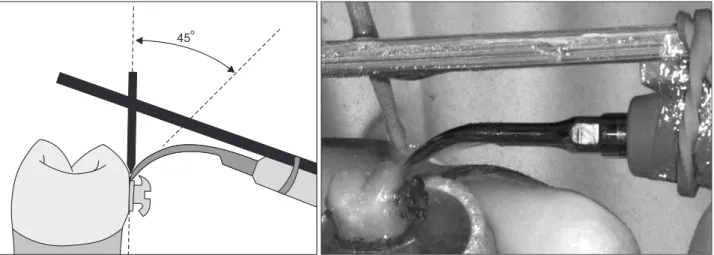
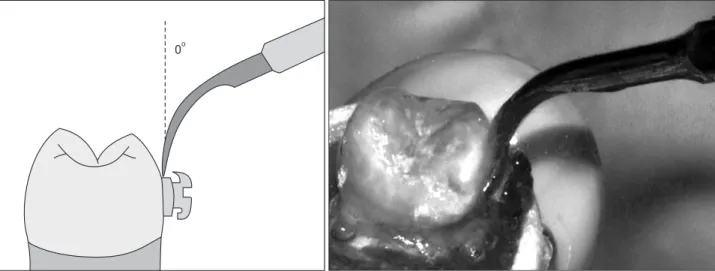
Objective: To evaluate the effects of ultrasonic instrumentation with different scaler-tip angulations on the shear bond strength (SBS) and bond failure mode of metallic orthodontic brackets. Methods: Adhesive pre-coated metallic brackets were bonded to 72 extracted human premolars embedded in autopolymerizing acrylic resin. The teeth were randomly divided into 3 groups (n = 24 each) to undergo no treatment (control group) or ultrasonic instrumentation with a scaler-tip angulation of 45
o(45
o-angulation group) or 0
o(0
o-angulation group). SBS was tested in a universal testing ma chine, and adhesive remnant index (ARI) scores were recorded. The Kruskal-Wallis test and Mann-Whitney U-test were used for statistical analysis. Results: The control group had a significantly higher mean SBS value than the treated groups, which showed no significant differences in their mean SBS values. The ARI scores were not significantly different among the groups. Conclusions:
Ultrasonic instrumentation around the bracket base reduces the SBS of metallic orthodontic brackets, emphasizing the need for caution during professional oral hygiene procedures in orthodontic patients. The scaler-tip angulation does not influence the SBS reduction and bond failure mode of such brackets.
[Korean J Orthod 2014;44(1):44-49]
Key words: Bracket, Bonding, Oral hygiene, Ultrasonics Giulio Alessandri Bonetti
aSerena Incerti Parenti
aDaniela Rita Ippolito
aMaria Rosaria Gatto
aLuigi Checchi
ba
Department of Orthodontics, University of Bologna, Bologna, Italy
b
Department of Periodontology, University of Bologna, Bologna, Italy
Received April 9, 2013; Revised August 5, 2013; Accepted August 6, 2013.
Corresponding author: Giulio Alessandri Bonetti.
Assistant Professor, Department of Orthodontics, University of Bologna, Via San Vitale 59, Bologna 40125, Italy.
Tel +39-0512088133 e-mail [email protected]
© 2014 The Korean Association of Orthodontists.
The authors report no commercial, proprietary, or financial interest in the products or companies described in this article.
This is an Open Access article distributed under the terms of the Creative Commons Attribution Non-Commercial License (http://creativecommons.org/licenses/by-nc/3.0) which permits unrestricted non-commercial use, distribution, and reproduction in any medium, provided the original work is properly cited.