https://doi.org/10.5468/ogs.2018.61.1.7 pISSN 2287-8572 · eISSN 2287-8580
Introduction
A single course of antenatal corticosteroid (ACS) treatment has become the standard of care for women at risk of imminent or anticipated preterm delivery, particularly before 32–34 weeks’
gestation [1], representing an effective therapy for respiratory distress syndrome (RDS) and improving morbidity and mortal- ity in preterm babies. Based on a double-blind, placebo-con- trolled, randomized clinical trial suggesting that betametha- sone can be beneficial in pregnant women at high risk of late
Antenatal corticosteroids and outcomes of preterm small-for-gestational-age neonates in a single medical center
Woo Jeng Kim, Young Sin Han, Hyun Sun Ko, In Yang Park, Jong Chul Shin, Jeong Ha Wie
Department of Obstetrics and Gynecology, Seoul St. Mary’s Hospital, The Catholic University of Korea College of Medicine, Seoul, Korea
Objective
This study investigated the effect of an antenatal corticosteroid (ACS) in preterm small-for-gestational-age (SGA) neonate.
Methods
This study was a retrospective cohort study. We compared women who received ACS with unexposed controls and evaluated neonatal complications among those having a singleton SGA neonate born between 29 and 34 complete gestational weeks. The neonates born after 32 weeks of gestation were divided into subgroups. Multivariable logistic regression analysis was performed.
Results
A total 82 of the preterm infants met inclusion criteria; 57 (69.5%) were born after 32 weeks of gestation. There were no sig- nificant differences in terms of mechanical ventilation, seizure, intracranial hemorrhage, retinopathy of prematurity, necrotizing enterocolitis, feeding difficulty, and neonatal mortality between infants whose mothers received ACS ant those whose mothers did not (all P>0.05). However, newborns whose mothers received ACS exhibited a significantly increased risk of developing respiratory distress syndrome (RDS) (adjusted odds ratio [aOR], 3.271; 95% confidence inter- val [CI], 1.038-10.305; P=0.043). In case of neonates born beyond 32 weeks of gestation, the risk of neonatal hypogly- cemia was significantly higher in women receiving ACS after controlling for confounding factors (aOR, 5.832; 95% CI, 1.096-31.031; P=0.039).
Conclusion
ACS did not improve neonatal morbidities, in SGA neonates delivered between 29 and 34 gestational weeks. Rather, ACS could increase the risk of RDS. In cases of SGA neonate delivered between 32 and 34 complete gestational weeks, the risk of hypoglycemia was significantly increased. The use of ACS in women with preterm SGA infants needs to be evaluated further, especially after 32 weeks’ gestation.
Keywords: Antenatal corticosteroids; Premature birth; Infant; Fetal growth retardation; Respiratory distress syndrome, newborn
Articles published in Obstet Gynecol Sci are open-access, distributed under the terms of the Creative Commons Attribution Non-Commercial License (http://creativecommons.
org/licenses/by-nc/3.0/) which permits unrestricted non-commercial use, distribution, and reproduction in any medium, provided the original work is properly cited.
Copyright © 2018 Korean Society of Obstetrics and Gynecology
Received: 2017.04.07. Revised: 2017.06.11. Accepted: 2017.06.13.
Corresponding author: Jeong Ha Wie
Department of Obstetrics and Gynecology, Seoul St. Mary’s Hospital, The Catholic University of Korea College of Medicine, 222 Banpo-daero, Seocho-gu, Seoul, 06591, Korea
E-mail: [email protected]
https://orcid.org/0000-0001-7897-5148
preterm birth [2], the American Congress of Obstetricians and Gynecologists (ACOG) has released a practice advisory that the “administration of betamethasone may be considered in women with a singleton pregnancy between 34 and 36 com- plete weeks of gestation at imminent risk of preterm birth within 7 days” [3]. However, there are no randomized stud- ies on the effect of ACS in preterm small-for-gestational-age (SGA) cases. The first randomized controlled trial of ACS in 1972 [4] not only demonstrated a reduction in RDS in preterm infants but also suggested an excess of fetal death in cases of pregnancy-related hypertension and fetal growth restriction (FGR) treated with corticosteroid. However, many of the sub- sequent clinical trials on the effect of ACS excluded pregnan- cies with such complications. In a recent meta-analysis, effects of ACS use were still inconclusive for cases with SGA [5]. In the extreme preterm birth before 29 weeks, the benefit might outweigh the possible harm, considering lung development.
However, we need to consider potential risks and benefits of ACS to FGR or small-for-gestational-age (SGA) infants, especially after 32 weeks [6]. Thus, our aim was to assess the association of ACS, when administrated within the ideal in- terval of 1–7 days before birth, with the outcomes of preterm SGA neonates. We also evaluated the effect of ACS on SGA neonates who born at 32 weeks of gestation. At this age, the level of surfactant started to increase in the amniotic fluid [7].
Materials and methods
1. Subjects
We retrospectively analyzed the medical records and perinatal database of the Department of Obstetrics and Gynecology be- tween 2009 and 2016 for deliveries at Seoul St. Mary’s Hospi- tal. Ethics approval was obtained from the Institutional Review Boards of The Catholic University of Korea. We selected SGA (defined at birth weight less than the 10th percentile for ges- tational age based on sex-specific national growth charts [8]) neonates, from all consecutive singleton pregnancies resulting in a preterm neonate (gestational age between 29 and 34 complete weeks of gestation). The standard recommendation for ACS was up to 34 weeks of gestation, so the neonate born until 34 complete gestational weeks were included in this study, who exposed ACS before 34 weeks and had delivered within one weeks. Exclusion criteria for this study were still- births, multiple gestations, term births, and major congenital
anomalies. Major congenital anomalies were defined as life- threatening, disabling or requiring major surgery, including chromosomal trisomy. The cases of ACS within 24 hours be- fore births or birth after 7 days were also excluded. Subgroup analysis was conducted in neonates born after 32 weeks of gestation.
2. Demographic characteristics and study outcomes From the medical records and database, we extracted the maternal age, parity, delivery mode and gestational age at the time of delivery, without distinction among spontaneous or induced delivery, elective or emergency cesarean delivery.
The medical history and diseases during pregnancy were also recorded. The gender, birthweight, placental weight and Apgar scores of the neonates were reviewed. The neonatal outcomes according to gestational week included neonatal death, intracranial hemorrhage (ICH), intraventricular hemor- rhage (IVH, grade 3 or 4), sepsis, RDS, mechanical ventilation within 48 hours after birth, necrotizing enterocolitis (NEC), feeding difficulty, persistent pulmonary hypertension of new- born (PPHN), hypoglycemia (a glucose level of less than 40 mg per deciliter [2.2 mmol/L at any time]) and admission to the neonatal intensive care unit (NICU) within 48 hours after birth. Sepsis included both suspected infections (with clini- cal findings suggesting infection) and proved infections (as confirmed in a subgroup of neonates with positive cultures of blood, cerebrospinal fluid, or urine obtained by catheterization or suprapubic aspiration; cardiovascular collapse; or an un- equivocal radiograph confirming infection in a neonate with clinical sepsis). The listed complications were selected only when diagnosed by a pediatrician. Outcomes were compared between SGA neonates who received an ACS before birth (ACS group) and those who did not receive ACSs (no ACS group). The outcomes of 2 subgroups of SGA neonates were compared according to ACS. All ACS was administration of dexamethasone-5 mg every 12 hours for 4 doses.
3. Statistical analysis
Continuous variables are described as the median and inter-
quartile range while categorical variables are shown as num-
bers and percentages. Maternal baseline characteristics and
neonatal outcomes were compared by the Mann-Whitney U-
test for continuous variables and the χ
2test or Fisher’s exact
test for categorical variables. Logistic regression analysis was
performed to demonstrate whether the adverse neonatal out-
come was reduced with ACS, when adjusted for confounding factors such as gestational age, parity, mode of delivery, ma- ternal diabetes, gestational hypertensive disorder, and preterm premature rupture of membrane. Statistical analyses were performed using SPSS (version 18.0; IBM Corp., Chicago, IL, USA) and statistical significance was set as a P-value of <0.05, 2-tailed.
Results
1. Baseline characteristics
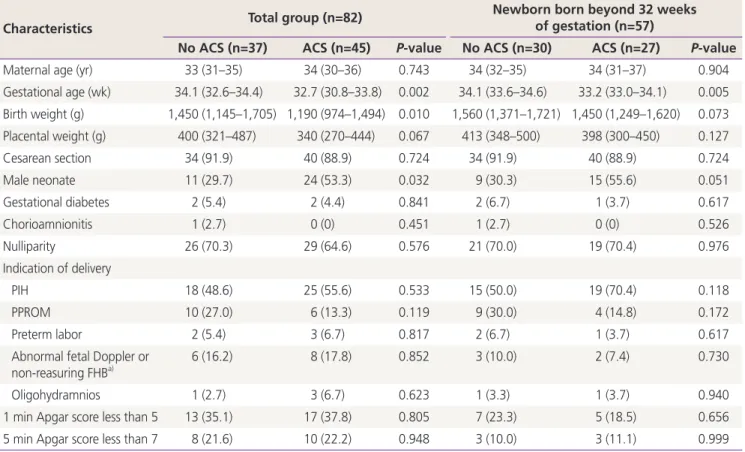
Eight hundred and thirty-two live infants were born between 29 and 34 complete weeks of gestation in our institute during the study period. A total of 82 newborns met the inclusion criteria and 57 (69.5%) of these were born after 32 weeks of gestation. The baseline characteristics are shown in Table 1.
There were no significant differences in maternal age, mode of delivery, gestational diabetes, chorioamnionitis, nulliparity,
indication of delivery, and Apgar score. Infants who exposed ACS were born earlier and had lower birth weight than did those who did not received ACS (all P<0.05). The frequency of male infants being born was higher in the group that received ACS.
2. SGA neonates born between 29 and 34 complete weeks of gestation
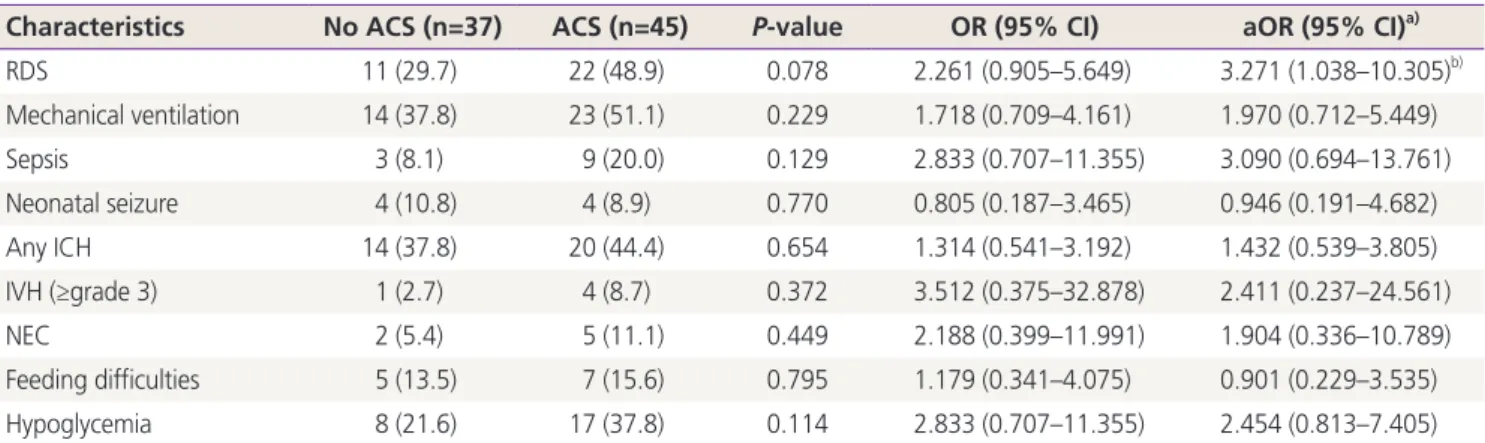
The neonatal outcomes according to the use of ACS is de- scribed Table 2. In total, 45 mothers (54.8%) received ACS with dexamethasone prior to delivery. There were no significant differences in terms of RDS, mechanical ventilation, neonatal seizure, ICH, NEC, and feeding difficulty regardless of ACS (all P>0.05). The incidence of NICU admission, retinopathy of pre- maturity (ROP), PPHN, and neonatal mortality were also similar between the group that received ACS and the group that did not (NICU admission, 35 [94.5%] vs. 45 [100%]; ROP, 0 vs. 2 [4.4%]; PPHN, 0 vs. 1 [2.2%]; neonatal mortality, 1 [2.7%] vs.
1 [2.2%]; respectively; all P>0.05). However, after adjusting
Table 1. Baseline characteristics of study population by antenatal steroid use
Characteristics Total group (n=82) Newborn born beyond 32 weeks
of gestation (n=57)
No ACS (n=37) ACS (n=45) P-value No ACS (n=30) ACS (n=27) P-value
Maternal age (yr) 33 (31–35) 34 (30–36) 0.743 34 (32–35) 34 (31–37) 0.904
Gestational age (wk) 34.1 (32.6–34.4) 32.7 (30.8–33.8) 0.002 34.1 (33.6–34.6) 33.2 (33.0–34.1) 0.005 Birth weight (g) 1,450 (1,145–1,705) 1,190 (974–1,494) 0.010 1,560 (1,371–1,721) 1,450 (1,249–1,620) 0.073 Placental weight (g) 400 (321–487) 340 (270–444) 0.067 413 (348–500) 398 (300–450) 0.127
Cesarean section 34 (91.9) 40 (88.9) 0.724 34 (91.9) 40 (88.9) 0.724
Male neonate 11 (29.7) 24 (53.3) 0.032 9 (30.3) 15 (55.6) 0.051
Gestational diabetes 2 (5.4) 2 (4.4) 0.841 2 (6.7) 1 (3.7) 0.617
Chorioamnionitis 1 (2.7) 0 (0) 0.451 1 (2.7) 0 (0) 0.526
Nulliparity 26 (70.3) 29 (64.6) 0.576 21 (70.0) 19 (70.4) 0.976
Indication of delivery
PIH 18 (48.6) 25 (55.6) 0.533 15 (50.0) 19 (70.4) 0.118
PPROM 10 (27.0) 6 (13.3) 0.119 9 (30.0) 4 (14.8) 0.172
Preterm labor 2 (5.4) 3 (6.7) 0.817 2 (6.7) 1 (3.7) 0.617
Abnormal fetal Doppler or non-reasuring FHB
a)6 (16.2) 8 (17.8) 0.852 3 (10.0) 2 (7.4) 0.730
Oligohydramnios 1 (2.7) 3 (6.7) 0.623 1 (3.3) 1 (3.7) 0.940
1 min Apgar score less than 5 13 (35.1) 17 (37.8) 0.805 7 (23.3) 5 (18.5) 0.656
5 min Apgar score less than 7 8 (21.6) 10 (22.2) 0.948 3 (10.0) 3 (11.1) 0.999
ACS, antenatal corticosteroid; PIH, pregnancy induced hypertension; PPROM, premature preterm rupture of membrane; FHB, fetal heart beat.
a)
Abnormal fetal Doppler included cases of absence or reverse end-diastolic flow in umbilical artery and abnormal cerebroplacental ratio (less
than 5th percentile).
for confounding factors, such as gestational age, nulliparity, neonatal sex, mode of delivery, gestational diabetes, preg- nancy induced hypertension, and premature preterm rupture of membrane (PPROM), the neonates who had received ACS showed significantly higher frequencies of RDS than those who had not received ACS (adjusted odds ratio [aOR], 3.271; 95%
confidence interval [CI], 1.038–10.305; P=0.043).
3. SGA neonate born between 32 and 34 complete weeks of gestation
Of the 57 women who delivered between 32 and 34 complete weeks of gestation, 27 (54%) women received ACS prior to delivery. Neonatal outcome showed in Table 3. There was no
significant difference in the frequency of neonatal adverse outcomes according to ACS administration (all P<0.05) (Table 4). After adjustment for confounding factors, neonatal hypo- glycemia was significantly more prevalent in the ACS group (aOR, 5.832; 95% CI, 1.096–31.031; P=0.039).
4. SGA neonate born between 29 and 31 complete weeks of gestation
Of the 25 women who delivered between 29 and 31 complete weeks of gestation, 18 (72%) women received ACS prior to delivery. There were no significant differences in the frequency of neonatal adverse outcome (All P<0.05).
Table 2. Neonatal outcomes related to antenatal corticosteroid use between 29 and 34 weeks of gestation
Characteristics No ACS (n=37) ACS (n=45) P-value OR (95% CI) aOR (95% CI)
a)RDS 11 (29.7) 22 (48.9) 0.078 2.261 (0.905–5.649) 3.271 (1.038–10.305)
b)Mechanical ventilation 14 (37.8) 23 (51.1) 0.229 1.718 (0.709–4.161) 1.970 (0.712–5.449)
Sepsis 3 (8.1) 9 (20.0) 0.129 2.833 (0.707–11.355) 3.090 (0.694–13.761)
Neonatal seizure 4 (10.8) 4 (8.9) 0.770 0.805 (0.187–3.465) 0.946 (0.191–4.682)
Any ICH 14 (37.8) 20 (44.4) 0.654 1.314 (0.541–3.192) 1.432 (0.539–3.805)
IVH (≥grade 3) 1 (2.7) 4 (8.7) 0.372 3.512 (0.375–32.878) 2.411 (0.237–24.561)
NEC 2 (5.4) 5 (11.1) 0.449 2.188 (0.399–11.991) 1.904 (0.336–10.789)
Feeding difficulties 5 (13.5) 7 (15.6) 0.795 1.179 (0.341–4.075) 0.901 (0.229–3.535)
Hypoglycemia 8 (21.6) 17 (37.8) 0.114 2.833 (0.707–11.355) 2.454 (0.813–7.405)
ACS, antenatal corticosteroid; OR, odds ratio; CI, confidence interval; aOR, adjusted odds ratio; RDS, respiratory distress syndrome; ICH, intracranial hemorrhage; IVH, intraventricular hemorrhage; NEC, necrotizing enterocolitis.
a)
Adjusted by as gestational age, nulliparity, neonatal sex, mode of delivery, gestational diabetes, pregnancy induced hypertension, and premature preterm rupture of membrane;
b)P<0.05.
Table 3. Neonatal outcomes related to antenatal corticosteroid use in newborn born beyond 32 weeks of gestation
Characteristics No ACS (n=30) ACS (n=27) P-value OR (95% CI)
a)aOR (95% CI)
a)RDS 5 (16.7) 6 (22.2) 0.596 1.429 (0.381–5.353) 4.993 (0.595–41.910)
Mechanical ventilation 7 (23.3) 7 (25.9) 0.820 1.150 (0.344–3.845) 1.597 (0.387–6.584)
Sepsis 1 (3.3) 3 (11.1) 0.336 3.625 (0.354–37.142) 3.387 (0.285–40.240)
Neonatal seizure 4 (13.3) 3 (11.1) 0.799 0.813 (0.165–4.010) 1.124 (0.193–6.542)
Any ICH 10 (33.3) 10 (37.0) 0.770 1.176 (0.396–3.496) 1.457 (0.409–5.191)
IVH (≥grade 3) 1 (3.3) 2 (7.4) 0.599 2.320 (0.198–27.137) 1.256 (0.078–20.159)
Feeding difficulties 4 (13.3) 4 (14.8) 0.872 1.130 (0.253–5.042) 0.851 (0.151–4.781)
Hypoglycemia 4 (13.3) 9 (33.3) 0.072 3.250 (0.866–12.194) 5.832 (1.096–31.031)
b)ACS, antenatal corticosteroid; OR, odds ratio; CI, confidence interval; aOR, adjusted odds ratio; RDS, respiratory distress syndrome; ICH, intra- cranial hemorrhage; IVH, intraventricular hemorrhage; NEC, necrotizing enterocolitis.
a)
Adjusted by as gestational age, nulliparity, neonatal sex, mode of delivery, gestational diabetes, pregnancy induced hypertension, and prema-
ture preterm rupture of membrane;
b)P<0.05.
Discussion
In this study, we observed that the exposure of preterm SGA fe- tuses to ACSs between 29 and 34 weeks of gestation was not associated with a significant decrease or increase in the odds of NICU admission, mechanical ventilation, sepsis, seizure, IVH, ROP, NEC, PPHN, feeding difficulties, neonatal death, or hypoglycemia. However, the frequency of RDS was notably increased in the group that received ACS. Although this re- sult was adjusted with gestational age and birth weight, it is thought that the group that received ACS included more newborns that were born earlier and weighed less. And ex- posure of preterm SGA fetuses to ACSs before birth between 32 and 34 weeks of gestation was associated with neonatal hypoglycemia.
Retarded fetal growth is associated with chronic hypoxia and acidosis. Because SGA fetuses might be already exposed to elevated endogenous corticosteroid levels, ACS can cause too much burden including fetal hemodynamics and neurologic development [9]. There are many evidences from basic science and observational studies for potential fetal harms [6]. It has been reported that restricted fetal growth is related with adult hypertension, atherosclerosis, type 2 diabetes, and metabolic derangement [10,11], although the degree to which low birth weight mediates adult disease is controversial. Also, it was reported that ACS was associated with increased cortisol reactivity to acute psychosocial stress in 6–11 years old [12].
The effect of ACS on the developing brain is controversial [6].
Multiple courses of ACS have been associated with decreased weight, length, and fetal head circumference at birth, and in- creased risk of neurodevelopmental and neurosensory impair- ment by 5 years of age [13,14]. A recent meta-analysis sug-
gested that a single course of ACSs in women at high risk for preterm birth appears to improve most neurodevelopmental outcomes in offspring born before 34 weeks of gestation [15].
Growth restricted fetal brain might be more vulnerable to oxi- dative damage, as an experimental sheep model of FGR has demonstrated the relationship between betamethasone and disturbed neuronal integrity and enhanced cell death in the brain due to increased cerebral oxidative stress [9]. However, the effects of ACS on the brain of human growth-restricted fetuses remain largely understudied. The effects of ACS on the hemodynamics of the growth restricted fetuses were evaluated with end-diastolic flow of umbilical artery after ACS, using Doppler ultrasonography. While there were higher risks of neonatal morbidity associated with lack of return of end-diastolic flow after ACS in growth-restricted fetuses, the mechanisms and the long-term impact are still unknown [16,17]. The only data available about long-term neurocogni- tive outcomes after late preterm administration of ACSs vs.
placebo come from the initial corticosteroids study [4], which showed no difference between exposure groups, in cognitive functioning, working memory and attention, and other neu- rocognitive assessments. Considering the proven mechanisms and effects of ACS on developing brain, we should be cautious when we give ACS in the premature FGR cases [18]. There are 2 recent retrospective studies reporting that ACS significantly reduced mortality and severe morbidities among preterm SGA neonates [19,20]. However, one study included SGA neonates within 24–31 weeks’ gestation, while the other study included SGA neonates from 24 to 33 weeks’ gestation. The present study included SGA neonates from 29 to 34 weeks’ gesta- tion, which might present less mortality and severe morbidities.
Low incidence of mortality and morbidity might be the reason Table 4. Crude and adjusted odds ratios of each outcome related to antenatal corticosteroid uses in neonate who delivered beyond 32 weeks of gestation
Characteristics OR (95% CI) P-value Adjusted OR (95% CI)
a)P-value
RDS 0.923 (0.305–2.788) 0.755 2.432 (0.463–12.764) 0.294
Mechanical ventilation 4.875 (0.479–49.586) 0.877 0.708 (0.184–2.729) 0.616
Sepsis 1.125 (0.231–5.481) 0.295 1.988 (0.136–29.051) 0.615
Seizure 0.929 (0.331–2.603) 0.884 1.461 (0.172–12.385) 0.728
Feeding difficulties 0.708 (0.161–3.115) 0.647 0.562 (0.094–3.369) 0.528
Hypoglycemia 4.500 (1.218–16.622) 0.018 13.111 (1.943–88.494) 0.008
OR, odds ratio; CI, confidence interval; RDS, respiratory distress syndrome.
a)