• 검색 결과가 없습니다.

Hybrid Approach for the Treatment of Thoracic Aortic Arch Aneurysm in a Patient With Chronic Obstructive Lung Disease and Retrosternal Adhesion

N/A
N/A
Protected

Academic year: 2022

Share "Hybrid Approach for the Treatment of Thoracic Aortic Arch Aneurysm in a Patient With Chronic Obstructive Lung Disease and Retrosternal Adhesion"

Copied!
4
0
0

로드 중.... (전체 텍스트 보기)

전체 글

(1)

413

Print ISSN 1738-5520 / On-line ISSN 1738-5555 Copyright © 2011 The Korean Society of Cardiology CASE REPORT

DOI 10.4070/kcj.2011.41.7.413

Open Access

Hybrid Approach for the Treatment of Thoracic Aortic Arch Aneurysm in a Patient With Chronic Obstructive Lung Disease and Retrosternal Adhesion

Ki Bang Kim, MD

1

, Won Ho Kim, MD

1

, Jin Ho Choi, MD

2

, Jeong Hee Kim, MD

1

, Yu Jeong Choi, MD

1

, Kyung Tae Jeong, MD

1

, Sun Chang Park, MD

1

, and Sahng Lee, MD

1

1

Divisions of Cardiology and

2

Thoracic and Cardiovascular Surgery, Eulji University Hospital, Daejeon, Korea

ABSTRACT

A 73-year-old woman with a history of chronic hypertension and severe chronic obstructive pulmonary disease, presented to a district general hospital with thoracic pain in a profound state of shock. She was diagnosed with cardiac tamponade, severe mitral regurgitation, and Stanford type A (Debakey type I) intramural hematoma. Her ascending aorta was of a significant size and therefore emergent repair was done to replace the ascending aorta and mitral valve. After 6 months, an increased aneurys- mal size of 6.0 cm was observed in a follow up contrast-enhanced computed tomography angiography. The patient was success- fully treated by a staged hybrid procedure involving initial supra-aortic reconstruction. (Korean Circ J 2011;41:413-416) KEY WORDS: Aortic aneurysm, thoracic; Vascular grafting; Endovascular procedure.

Received: October 28, 2010

Revision Received: November 8, 2010 Accepted: November 15, 2010

Correspondence: Sahng Lee, MD, Division of Cardiology, Eulji University Hospital, 1306 Dunsan-dong, Seo-gu, Daejeon 302-799, Korea Tel: 82-42-611-3083, Fax: 82-42-611-3083

E-mail: [email protected]

• The authors have no financial conflicts of interest.

cc
This is an Open Access article distributed under the terms of the Cre- ative Commons Attribution Non-Commercial License (http://creativecom- mons.org/licenses/by-nc/3.0) which permits unrestricted non-commer- cial use, distribution, and reproduction in any medium, provided the origi- nal work is properly cited.

Introduction

An aortic arch aneurysm is a well described pathological lesion of the thoracic aorta known to have a high risk of aor- tic rupture.

1)

Recently, a hybrid procedure combining surgical and endovascular repair has become established as a prefer- ential treatment for extensive pathologies of the aorta.

We report a 73-year-old woman with an aortic arch aneu- rysm involving the distal aortic arch. We performed a com- bined procedure of extra-anatomic supra-aortic trunk de-br- anching and stent grafting of the aortic arch because of severe retrosternal adhesion and lung problems.

Case

A 73-year-old woman with a history of chronic hypertension

and severe chronic obstructive pulmonary disease (COPD), pre- sented to a district general hospital with thoracic pain in a pro- found state of shock (blood pressure, 80/50 mmHg; pulse rate, 115 per minute; hemoglobin level, 8.7 g/dL). Echocardio- gram and chest computed tomography (CT) scan showed a large pericardial effusion with right ventricular collapse which was consistent with cardiac tamponade (Fig. 1), as well as se- vere mitral regurgitation (MR). Closed pericardial drainage was immediately performed. Although over 500 mL of blo- ody fluid had been drained, the patient was stabilized with ag- gressive hydration and taken for an aorta CT scan to deter- mine a dissection protocol. It revealed a Stanford type A (De- bakey type I) intramural hematoma (IMH) extended into the distal portion of the left subclavian artery (SCA) with aneu- rysmal change. After the above-mentioned procedure, she was referred to our institution for further management.

The aortic arch between the innominate artery (IA) origin and the left SCA origin was preserved, and the maximum dia- meter was measured at 4.3 cm, which did not pose a signifi- cant risk for imminent rupture. However the IMH in the as- cending aorta was significantly large and the risk of rupture was increasing. Therefore, emergent repair was planned.

Under circulatory arrest and deep hypothermia, the ascend-

ing aorta from the sinotubular junction to the proximal por-

tion of the IA was resected and completely removed. Subse-

quently, a 30×16 mm InterGard graft

®

(Maquet, Rasttat, Ger-

(2)

414 Hybrid Approach, Thoracic Aortic Arch Aneurysm

many) was used to replace the ascending aorta. In addition, mitral valve replacement was performed for MR.

After 6 month, an aorta CTA was performed, which showed that the aneurysmal size had increased from 4.3 to 6.0 cm, and the IA itself was aneurysmal (Fig. 2). A repeat of general an- esthesia was difficult due to the patient’s lung problems. The dissection of retrosternal adhesions may also be at risk for da- mage to the adjacent aneurysm, with a high possibility of rup- ture (Fig. 2).

Therefore, a staged hybrid procedure was performed with initial supra-aortic reconstruction because of the expected landing zone of the endograft covering all arch branch vessels.

Magnetic resonance imaging (MRI) of distal carotid arteries and the vertebral arteries showed neither stenotic pathology nor anomalous origin from the aorta that may compromise cerebral blood flow during the procedure.

The first part of the hybrid procedure consisted of de-bran- ching right-left SCA and right-left common carotid arteries (CCA). This was done via a low partial sternotomy without using cardiac bypass, where a 16×8 mm bifurcated trouser graft was anastomosed to the previous graft of the ascending aorta using a side biting arterial clamp. Two additional 8 mm

grafts were sutured to each limb of the inverted trouser graft and all 4 limbs were then tunneled behind the clavicles. They were anastomosed end-to-end to both CCAs and end-to-side to the right and left SCA (Fig. 3). Though both CCAs were li- gated to prevent type 2 endoleak, the VAs were maintained in circulation.

For the next stage, endovascular stent grafting was com- pleted after 10 days. The left common femoral artery was pu- nctured with a 6 Fr sheath and an aortogram showed the pre- vious graft. A right common femoral access was prepared for inserting an Amplatz

®

vascular plug (AGA Medical Corp, Golden Valley, MN, USA). The 16 Fr sheath was inserted into the origin of the left SCA using a guidewire. A 16×12 mm Amplatz vascular plug II was then deployed into the left SCA

Fig. 1. The aorta CTA at initial presentation. The CT scan showed a large pericardial effusion (A) and Stanford type A (Debakey type I) intramural hematoma (B). CTA: computed tomography angiog- raphy.

Fig. 2. The aorta CTA after 6 months. The CT scan showed an in- crease in aneurysmal size from 4.3 cm to 6.0 cm (A). It also showed retrosternal adhesions of arch aneurysm and manubrium of the sternum (B). The innominate artery itself was aneurysmal (C). CTA:

computed tomography angiography.

Fig. 3. The aorta CTA one week after the de-brancing procedure.

The CT scan showed that the circulation was maintained in right- left CCAs and right-left SCA. CTA: computed tomography angiogra- phy, CCA: common carotid artery, SCA: subclavian artery.

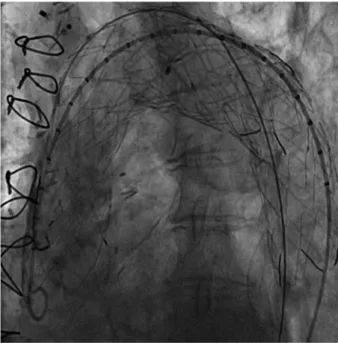
Fig. 4. Angiography during the stenting of the descending thoracic aorta. A 38×150 mm and 40-38-100 mm tapered SEAL thoracic st- ent graft (S&G Biotech INC., Seongnam, Korea) were deployed to cover the full length of the aneurysm.

A

A

B

B C

(3)

Ki Bang Kim, et al. 415

through the sheath. The IA was occluded using the 16×12 mm Amplatz

®

vascular plug II in the same way.

The diameter of the graft was chosen with 20% over-sizing, and its length covered the aortic arch from the graft of the as- cending aorta to the proximal SEAL thoracic stent graft (S&G Biotech INC., Seongnam, Korea) descending aorta. Consequ- ently, a 38×150 mm stent graft was positioned using the guide wire to guarantee safe positioning. The landmark for stent graft placement was the origin of IA, and deployment was per- formed 3 cm proximally to this landmark. And, a second 40- 38-100 mm tapered stent graft was overlapped to the first one to cover the full length of the aneurysm (Fig. 4). Follow up an- giography showed good positioning and no leakage.

There were neither neurologic nor vascular complications.

After one week, a post-procedural aorta CTA showed the com- plete exclusion of the aneurysm (Fig. 5), and the patient was discharged on the seventh post-procedural day in good gen- eral condition.

Discussion

This report describes the feasibility of combined surgical and endovascular repair of extensive pathologies of the aorta.

The hybrid procedure was designed for a patient with decreas- ed pulmonary function experiencing difficulty to wean from the respirator and with retrosternal adhesion that could lead to a higher risk of rupture.

Without proper management a thoracic aortic aneurysm can worsen rapidly, with a rupture rate of approximately 50%.

2-4)

Although surgical repair technology has improved, it still car- ries a high mortality (10-16%) and is associated with severe morbidity.

5-9)

In addition, because of older age, as well as the frequency and severity of concomitant medical problems such as hypertension, COPD, cardiac disease, and chronic renal in- sufficiency, these patients are less than ideal candidates for conventional open surgery. Endovascular treatment may th- erefore play a considerable role in the treatment of these pa- tients. The benefits of an endovascular approach include re- duced mortality rates and reduced complication rates with spe- cific reference to paraplegia and pulmonary complications.

10)

However, there is a critical need for more complex endo- vascular techniques when the arch vessels are involved in the lesions leaving an insufficient proximal or distal landing zone.

The technique has been developed to account for short land- ing zones and aneurysmal extension into the aortic arch seg- ment by the use of hybrid de-branching techniques and br- anched stent grafts.

Recently there have been many reports of hybrid appro- aches to address thoracic arch aneurysms. Kang et al.

11)

report- ed the effectiveness and safety of employing the hybrid ap- proach in patients with aortic arch pathologies, but the study is limited by its retrospective design, small sample size, diver- sity of thoracic aortic pathologies and a short follow-up dura- tion. In an extensive meta-analysis to evaluate the overall re- sults of the hybrid approach, Koullias

12)

showed that hybrid arch procedures are technically feasible in patients with a va- riety of arch diseases. Overall 30-day mortality was 8.3%, wh- ich is better than standard operative repair.

We selected a hybrid approach method to treat our patient because a full sternotomy had a higher risk of aortic rupture due to retrosternal adhesion. We delayed the stenting to a week after the de-brancing procedure to confirm maintained circul- ation in right-left CCAs and right-left SCA because the stent- ing has a possibility to block the flow of vessels. To the best of our knowledge, the current case is the first report of a com- plex thoracic aortic arch aneurysm with severe obstructive lung disease and retrosternal adhesion. Additionally, in car- diac tamponade due to arotic dissection, percutaneous peri- cardiocentesis can accelerate bleeding and shock, which is also observed in our patients.

In conclusion, our case shows a hybrid approach which was a combination of extra-anatomic supra-aortic trunk de- branching and stenting of the descending aorta. The approach may be a good strategy for the treatment of complex aortic pa- thology in patients who are less than ideal candidates for con- ventional open surgery.

REFERENCES

1) Alsac JM, Coscas R, Paraskevas N, Francis F, Castier Y, leseche G.

Acute debranching and stent grafting for a ruptured penetrating ul- cer of the aortic arch. Ann Vasc Surg 2009;23:687.e5-8.

Fig. 5. The aorta CTA one week after stenting of the descending th- oracic aorta. The CT scan showed stent graft covering ascending aorta (A)-aortic arch (B)-proximal descending thoracic aorta. It also showed mural thrombus outside of the stent-graft. There was no evidence of contrast leakage from the anastomosis site of the graft and aortic arch (C). Bypass grafts from the ascending aorta to the bilateral CCA and SCA were patent (D). CTA: computed to- mography angiography, CCA: common carotid artery, SCA: sub- clavian artery.

A

C

B

D

(4)

416 Hybrid Approach, Thoracic Aortic Arch Aneurysm

2) Pressler V, McNamara JJ. Thoracic aortic aneurysm: natural history and treatment. J Thorac Cardiovasc Surg 1980;79:489-98.

3) Perko MJ, Norgaard M, Herzog M, Olsen PS, Schröder TV, Petters- son G. Unoperated aortic aneurysms: a survey of 170 patients. Ann Th- orac Surg 1995;59:1204-9.

4) Pressler V, McNamara JJ. Aneurysms of the thoracic aorta. J Thorac Cardiovasc Surg 1985;89:50-4.

5) De Bakey ME, McCollum CH, Graham JM. Surgical treatment of an- eurysms of the descending thoracic aorta: long-term results in 500 pa- tients. J Cardiovasc Surg 1978;19:571-6.

6) Livesay JJ, Cooley EA, Ventemiligia RA, et al. Surgical experience in descending thoracic aneurysmectomy with and without adjuncts to avoid ischeamia. Ann Thoracic Surg 1985;39:37-46.

7) Borst HG, Jurmann M, Bühner B, Laas J. Risk of replacement of de-

scending aorta with a standardized left bypass technique. J Thorac Cardiovasc Surg 1994;107:126-33.

8) von Segesser LK, Killer I, Jenny R, Lutz U, Turina MI. Improved dis- tal circulatory support for repair of descending thoracic aortic aneury- sms. Ann Thorac Surg 1993;56:1373-80.

9) Shim WH. Hybrid approach for complex thoracic aortic pathology.

Korean Circ J 2010;40:368-9.

10) Sayed S, Thompson MM. Endovascular repair of the descending thoracic aorta: evidence for change in clinical practice. Vascular 2005;

13:148-57.

11) Kang WC, Shin EK, Ahn TH, et al. Combined open endovascular re- pair for aortic arch pathology. Korean Circ J 2010;40:399-404.

12) Koullias GJ, Wheatley GH 3rd. State-of-the-art of hybrid procedures for

the aortic arch: a meta-analysis. Ann Thorac Surg 2010;90:689-97.

수치

Fig. 3. The aorta CTA one week after the de-brancing procedure.
Fig. 5. The aorta CTA one week after stenting of the descending th- th-oracic aorta. The CT scan showed stent graft covering ascending  aorta (A)-aortic arch (B)-proximal descending thoracic aorta

참조

관련 문서

세부전공에 따라 농학 또는 이학박사.

09 are used, soccer, everyday life 10 try writing, help you improve 11 to see, singing, dancing, perfect 12 without subtitles, translations, tips 13 should find,

Independently of the question of seduction, our patient, while he was a child, found in his sister a n inconvenient com- petitor for the good opinion of

If both these adjustments are considered, the resulting approach is called a bootstrap-BC a -method (bias- corrected-accelerated). A description of this approach

We derive a mathematical formulation and a process for an appro- priate control along the portion of the boundary to minimize the vorticity motion due to the flow in the

Since every classical or virtual knot is equivalent to the unknot via a sequence of the extended Reidmeister moves together with the forbidden moves, illustrated in Section 2,

보존적 복제의 경우 무거운 오래된 가닥과 가벼운 새로 만든

Sesame street film- Louisiana Zydeco music 참조 http://www.youtube.com/watch?v=c_SGKnw611k Cookie and the cupcakes – Mathilda