*These authors contributed equally as first authors.
Address reprint requests to : Song, Ju-Eun
College of Nursing · Research Institute of Nursing Science, Ajou University, 164 Worldcup-ro, Yeongtong-gu, Suwon 16499, Korea Tel: +82-31-219-7018 Fax: +82-31-219-7020 E-mail: [email protected]
Jang, Sun Joo
Red Cross College of Nursing, Chung-Ang University, 221 Heukseok-dong, Dongjak-gu, Seoul 06974, Korea Tel: +82-2-820-5934 Fax: +82-2-824-7961 E-mail: [email protected]
Received: July 29, 2021 Revised: August 23, 2021 Accepted: August 27, 2021 Published online October 31, 2021
This is an Open Access article distributed under the terms of the Creative Commons Attribution NoDerivs License. (http://creativecommons.org/licenses/by-nd/4.0) If the original work is properly cited and retained without any modification or reproduction, it can be used and re-distributed in any format and medium.
J Korean Acad Nurs Vol.51 No.5, 511 https://doi.org/10.4040/jkan.21156
Healthcare Considerations for Special Populations during the COVID-19 Pandemic: A Review
Kim, Jeung-Im
1,* · Im, YeoJin
2,* · Song, Ju-Eun
3· Jang, Sun Joo
41
School of Nursing, Soonchunhyang University, Cheonan
2
College of Nursing Science · East-West Nursing Research Institute, Kyung Hee University, Seoul
3
College of Nursing · Research Institute of Nursing Science, Ajou University, Suwon
4
Red Cross College of Nursing, Chung-Ang University, Seoul, Korea
The coronavirus disease 2019 (COVID-19) has emerged as a threat to human health and public safety. People of all ages are susceptible to severe acute respiratory syndrome coronavirus 2 infection. However, the clinical manifestations of this infection differ by age. This study purposes to describe healthcare considerations for special populations, such as children, pregnant and lactating women, and older adults, who may have unique healthcare needs, in the pandemic situation. To realize the research purpose, we conducted a review of the practice guidelines of public documents and qualified studies that were published online/offline during a specific period. The review identified cur- rent knowledge on care for newborns, children in schools, pregnant women (from antenatal to postpartum care), and older adults suffer- ing from high-risk conditions. Subsequently, we summarize vaccination guidance for special populations and, finally, discuss the issues cur- rently affecting special populations. Therefore, this current knowledge on care for special populations helps nurses to provide accurate in- formation on vaccinations aimed at preventing COVID-19 and protecting the masses from infection. Currently, the scarcity of information on COVID-19 variants necessitates further research on measures to reduce pandemic spread.
Key words: Child; Pregnant Women; Aged; COVID-19; SARS-CoV-2
INTRODUCTION
Currently , everyone may be susceptible to severe acute respiratory syndrome coronavirus 2 (SARS-CoV-2) infec- tion (COVID-19). However , the specific clinical features of COVID-19 vary with age [1]. According to existing reports, most children and the majority of pregnant women with COVID-19 experience mild or no symptoms, and the symp- toms are similar to those of several common illnesses, such as cold, sore throat, influenza, and allergies [2,3].
Populations at higher risk for infection, such as pregnant
women, individuals with preexisting medical conditions, and
older adults, need to take precautions to protect themselves
from getting COVID-19. Meanwhile, various other groups
such as families, children, newborns, and breastfeeding indi-
viduals, are also susceptible to infection [4]. Moreover, in-
fants may have a higher risk of COVID-19 than older chil-
dren [2]. Pregnant women with underlying health conditions,
such as diabetes, are also more likely to develop severe
COVID-19 [3]. Furthermore, the risk of severity is higher in
people aged 65 years or older; this group has a 630 times higher risk of dying from COVID-19 than the 18- to 29-year-old group [5]. In South Korea, the lethality rates were 1.1% for individuals aged 60 years or older and 18.7%
for those aged 85 years or over (Appendix 1) [6]. Therefore, the vaccination of the 65 years and older group was priori- tized among all the age groups.
There is significant heterogeneity among special popula- tions regarding the effectiveness of COVID-19 vaccination, as well as the risk and severity of COVID-19, which influ- ences the pandemic decision-making process. Further, a risk/benefit analysis for individual patients is at the center of the collaborative clinician/patient decision-making process, since the data for vaccination in specific populations remain limited.
Nurses play an important role in providing vaccination-re- lated information and support to prevent COVID-19 [7].
Pregnant and lactating women are encouraged to clarify any queries on health concerns, such as the negative impact of COVID-19 vaccines on oneself and fetal outcomes, with their healthcare providers [8]. Vaccination may be considered at any gestational age, including the first trimester. As indicated by published safety data, a messenger RNA (mRNA) vaccine is generally preferred over other vaccines for pregnant women [9]. Further , the American College of Obstetricians and Gynecologists recommends that COVID-19 vaccines should not be withheld from pregnant or breastfeeding indi- viduals.
Since the identification of SARS-CoV-2 has not been com- pleted and a vaccine developed over a short period does not guarantee high levels of protection against the virus’s muta- tions, nurses should remain sensitive to updated information.
The Ministry of Health in Canada encourages its nurses to regularly check its website for updates and recommends them to consider the website information as current infor- mation and check whether the data are up-to-date before conveying the information to patients or performing counsel- ing [9].
Doctors report on and revise the guidelines for their areas of expertise based on the cases and evidence collected over the previous year. To ensure that each special population
group receives adequate and appropriate care, guidelines should be established for nurses on the different approaches to be adopted for outpatients and inpatients, children and pregnant women, older people, surgical patients and drug- treated patients, and oncological and non-neoplastic patients [4].
This review describes the nursing practice guidelines and specific healthcare considerations for special population groups, who may have unique healthcare needs, to prevent and manage infections during the COVID-19 pandemic pe- riod, based on reliable data and public documents. Further, we focus on such special populations, including children, pregnant women, and older adults, as high-risk groups for COVID-19.
HEALTHCARE CONSIDERATIONS FOR CHILDREN
The main clinical symptoms of COVID-19 in children—
from newborns to adolescents—are generally less severe than those in adult patients. Mild symptoms include fever , cough, and rhinorrhea; in some cases, there are no symp- toms [10]. On the other hand, infants may have a higher risk of COVID-19 than older children; further, respiratory symp- toms are less frequently reported among children compared to adults [10,11]. Although the severity of dyspnea symptoms in children with COVID-19 was generally lower than that of the symptoms reported in adult patients, infants with COVID
‐19 are more likely to develop dyspnea than others. More- over , there have been increasing reports about cases of older school-aged children and adolescents experiencing prolonged fever , abdominal pain, shock, and cardiac dysfunction follow- ing a COVID-19 infection [10].
Thus, given that children are also vulnerable to morbidity and mortality from COVID-19, and considering that families and children are basic members of society for whom preven- tive and health management efforts against COVID-19 are implemented, specific health care guidelines for children, from newborns to adolescents, need to be considered.
The clinical manifestations of COVID‐19 in pediatric pa-
tients include mild respiratory symptoms, such as sore
throat; cough; difficulty in breathing; gastrointestinal symp- toms, including diarrhea, vomiting, or stomachache; or the onset of severe headache accompanied by fever. Often, chil- dren do not exhibit any symptoms [2,10]. Dyspnea was more common in infants than in any other age group, whereas mild gastrointestinal symptoms, such as vomiting and diar- rhea, occurred more in older children [10,11].
Infants and children with underlying medical conditions have a greater probability of developing severe COVID-19 [2].
The underlying medical conditions include chronic lung dis- ease; asthma; diabetes; and other genetic, neurologic, or metabolic conditions. Further , congenital heart disease, med- ical complexities, immunosuppression, and obesity were con- ditions that increased the risk of severe infection in children [2]. Although most pediatric patients with COVID‐19 do not exhibit severe symptoms, severe COVID‐19 in children often results in fatal conditions requiring Intensive Care Unit (ICU) admission [10,11].
For children with COVID-19 symptoms, the following guidelines are relevant [2]: 1) Keep the child home. 2) Con- sider whether the child should see a healthcare provider and be tested for COVID-19. The Centers for Disease Control and Prevention (CDC) recommend the testing of all children with COVID-19 symptoms. 3) Protect the caregivers caring for the sick child from COVID-19 by guiding them to wear masks, frequently practice hand hygiene, perform symptom monitoring on COVID-19, as well as using preventive/pro- tective measures for symptoms of COVID-19. 4) Inform the child’s school about the symptoms, notifying whether the child took a COVID-19 test, and conveying the test results. 5) Review the policies of the child’s school (or childcare facility) to understand when a child who has been sick can return to the school (or childcare facility). 6) Finally , when children return to school or participate in in-person activities, they should stay safe with others [2]. In case the child shows any of the emergency warning signs, such as breathing difficul- ties; chest pain or pressure; confusion; cyanotic conditions like pale, gray-colored, or blue-colored lips, skin, or nail beds; and an inability to wake up or stay awake, the care- giver should call emergency services or take the child to the emergency department [2,11].
1. Guidelines for newborn care
COVID-19 during pregnancy is associated with only a slight increase in the risk of neonatal morbidities and no in- crease in neonatal mortality. Currently, it is difficult to con- clude whether the rare cases of infection during pregnancy occur from horizontal transmission at birth or vertical trans- mission through the placenta [12].
The American Academy of Pediatrics recommends the rooming-in of infants with their mothers in accordance with hospital practices unless the mother is too unwell to care for her infant. The mother should implement infection-control precautions, including hand hygiene and mask wearing, during breastfeeding and performing rooming-in care of the newborn [13]. Further, even the most recent guidelines indi- cate that the breastfeeding practice is the best option to feed infants despite any risk of the mother or infant getting in- fected. Along with following all COVID-19 precaution mea- sures, hospitals should provide breast milk or donor milk to sick infants admitted in the neonatal care unit [13,14].
In addition to encouraging caregivers to take personal pre- cautions, the hospital should develop a strategy to support breastfeeding in suspected or infected cases of mothers or newborns using a systemic approach. Healthcare delivery with minimal or no contact can be ensured by promoting telemedicine or the remote monitoring of patients. The ef- forts of the Texas Tech University Health Science Center El Paso Children’s Hospital Neonatal Intensive Care Unit to support low-cost breast milk delivery with minimal contact can be one of options that hospitals can emulate [14].
Additionally , among all mothers, including those with con-
firmed or suspected COVID-19, and newborns, kangaroo
mother care and breastfeeding should be encouraged. If
mothers are unwell, healthy family members should provide
kangaroo care to newborns. In many regions, in the post-
pandemic recovery period, the importance of creating op-
portunities to rebuild strategies to provide high-quality ma-
ternal and child health services, including kangaroo care,
was emphasized [15].
2. Guidelines for child care centers and schools
Although strategies to combat infection may change ac- cording to variations in national strategies depending on the number of confirmed COVID-19 cases, the Ministry of Edu- cation in South Korea is trying to expand in-person educa- tion for all students at every level of school from the upcom- ing second fall semester. Further , the COVID-19 guidelines for kindergarten, elementary, and middle-to-high schools are presented on the Ministry of Education’s webpage [16], and the updated guideline for child care centers is published on the Ministry of Health and Welfare’s webpage. These guidelines pertain to the quarantining, isolation, symptom screening, and testing of children, as well as the national strategy to combat COVID-19 spread. Aspects such as at- tendance checking and school performance evaluation are mentioned in the guideline for schools.
The key prevention strategies for schools and child care centers include consistent and correct mask usage, hand hy- giene, physical distancing and respiratory etiquette, timely sanitization of the physical environment, provision of appro- priate ventilation, and facilitation of contact tracing in collab- oration with community health centers [2,16]. During the COVID-19 pandemic, school nurses play an important role in ensuring the safety of schools and promoting child care pro- grams (in case healthcare professionals are involved in health care management in child care facilities). The critical tasks of school nurses include the routine evaluation of symptoms or exposures in students and provision of support to school administrators and teachers in executing prevention strategies, such as participating in contact tracing; main- taining school-based clinics (if available); implementing school-based testing strategies; and providing medical sup- port to students, families, and school staff in various ways [2,16].
3. Vaccination of children
Early information reveals that vaccines may help prevent people from spreading COVID-19 to others. The guidelines issued by the CDC in the United States recommend the Pfiz- er-BioNTech vaccine (Pfizer , New York, NY, USA; Bi-
oN-Tech, Mainz, Germany) for people aged 12 years and older [2,7]. South Korea is scheduled to begin the vaccination of senior high school students, teachers, and school staffs during July to August 2021 [16]. The CDC states that vacci- nation can protect children from becoming infected. More- over , vaccination can help keep children from becoming se- verely sick even if they do become infected. Finally, the vac- cination of all adult family members and children aged 12 years and older helps protect the entire family against COVID-19. Currently , the impact of COVID-19 vaccines on children younger than 12 years old is under study.
Recently , the CDC reported an increase in myocarditis and pericarditis cases in adolescents and young adults following COVID-19 vaccination in the United States [2]. Despite being associated with a possible risk of myocarditis or pericarditis, vaccination has several known and potential benefits that outweigh its known and potential risks. Hence, the CDC continues to recommend COVID-19 vaccination for all chil- dren aged 12 years and older [2]. Further , children should undergo timely and routine immunization as per the national immunization schedule.
4. Issues faced by children during the COVID-19 pandemic
Measures to diminish the spread of COVID-19, such as physical distancing, quarantining, and nationwide school clo- sures, affect the health and well-being of children. In these circumstances, children may feel isolated, anxious, bored, and uncertain, as well as being fearful or sorrowful about the virus’s impact on their families. Hence, policies that intro- duce helpful resources and ideas to support parents in help- ing their children understand the virus and protect them- selves against COVID-19 should be implemented.
The suspension of in-person education in schools during the COVID-19 pandemic has raised concerns regarding the possibility of learning loss in students. In all communities, schools form an important part of the infrastructure by pro- viding safe and supportive learning environments for stu- dents; employing teachers and other staff; and enabling par- ents, guardians, and caregivers to work outside their homes.
Research suggests that students make no or little academic
progress through home learning and the related learning losses are more serious in countries with more fragile politi- cal and health care infrastructures or longer school closure periods compared to other countries [17]. The results of a research suggested that school closures did not contribute to epidemic control and the implementation of school closures alone would prevent only 2%~4% of deaths, which are far lower than the corresponding figures for other social dis- tancing interventions [18]. Hence, policymakers should con- sider such relevant evidence and implement combinations of various social distancing measures, rather than focusing on school closures alone.
Additionally , the increase in mental health issues, including depression and anxiety, among children as a result of the social isolation practiced by people during the COVID-19 pandemic is a cause of widespread concern [19,20]. In the United Kingdom, a study on the longitudinal changes in childhood mental health that occurred during lockdowns, which promote social distancing practices and school clo- sures, observed a significant increase in depressive symp- toms and medium-to-large effect sizes of confidence inter- nals in a cohort of 8- to 12-year-olds compared to the pe- riod before lockdowns [19]. Therefore, policymakers should incorporate the association between school closures and so- cial distancing and childhood mental health in the deci- sion-making process of the education sector.
HEALTHCARE CONSIDERATIONS FOR PREGNANT WOMEN
Pregnant women constitute a very special population be- cause their health affects fetal health; hence, healthcare professionals should be aware of certain special consider- ations to prevent this group from contracting COVID-19 or manage them in case they do become infected. Generally , pregnant women are not considered a high-risk group for SARS-CoV-2 infection [21]. However, since pregnancy causes numerous physical changes, including immune and respiratory system changes [22,23], pregnant women have significantly higher risk of severe COVID-19 than non-preg- nant women of similar age groups [21,24]. Therefore, preg-
nant women are considered clinically vulnerable to COVID-19 [23,25].
According to the national data in the United States, the majority of pregnant women with COVID-19 were infected during the third trimester (≥ 28 weeks), followed by the second (14~27 weeks) and first trimesters (< 14 weeks) [26].
Although the severity of COVID-19 in pregnant women ranges from asymptomatic to severe or critical, more than two-thirds generally remain asymptomatic and most of the symptomatic pregnant women experience only mild symp- toms, for instance, a cold or the flu [21]. Further, although the common symptoms varied across studies, cough and fe- ver were identified as the most common ones, whereas dys- pnea, myalgia, loss of the sense of taste, and diarrhea were considered relatively less common [21].
Regarding the impact of COVID-19 on pregnancy , symp- tomatic maternal COVID-19 is related to a greater risk of preterm birth [3,27] and still birth [27] or a higher rate of caesarean birth compared to non-infected pregnant women [21,25]. Further, symptomatic pregnant women requiring hospitalization show worse overall progress than their non-symptomatic counterparts, and maternal outcomes in- clude the risk, albeit very low, of death [22]. Further, preg- nant women who are relatively older (≥ 35 years); are over- weight (body mass index ≥ 25 kg/m
2); or have preexisting disease conditions, such as hypertension and diabetes, expe- rience worse progress than the healthy pregnant women.
Hence, they are more likely to receive ICU care than non-pregnant women of similar ages or non-risk pregnancy groups [22,24]. Therefore, pregnant women with high risk factors must promptly report any early symptoms of COVID-19, such as fever or cough, to their healthcare pro- viders.
With respect to birth outcomes for individuals with
COVID-19 in the US, vaginal delivery was more common
than caesarean section, and the number of term births (37
weeks and over) was higher than that of preterm births (be-
fore 37 weeks) [26]. Also, today, data suggesting COVID-
19’s negative effects on the fetus or neonatal outcomes are
limited [21-23]. Although some cases of vertical transmis-
sion (i.e., transmission from a woman to her baby during the
antenatal or intrapartum period) of SARS-CoV-2 have been reported [28], currently available data indicate that this transmission is uncommon [28-30]. Even cases of newborn infection do not appear to be affected by delivery modes, skin-to-skin contact, feeding types, or practices of room- ing-in right after childbirth [21,22]. Therefore, healthcare professionals in the obstetric setting should support pregnant women to achieve successful maternal transition during pregnancy and childbirth by following the care principles or guidelines associated with the COVID-19 pandemic.
1. Guidelines for antenatal care of pregnant women
Healthy , uninfected pregnant women should adhere to the following general precautions to ensure protection from COVID-19: 1) frequently washing hands with an alco- hol-based hand rub or soap and water; 2) maintaining a dis- tance of at least six feet from others and avoiding crowded spaces; 3) wearing a non-medical fabric mask whenever one is unable to maintain social distancing; 4) avoiding touching the mouth, nose, and eyes; and 5) maintaining respiratory hygiene, such as covering the mouth and nose with a bent elbow or tissue when sneezing or coughing [21]. If pregnant women are not in self-isolation due to suspected or con- firmed COVID-19, they should continue their routine ante- natal care with modifications, if necessary [21,23]. When healthy pregnant women without any COVID-19 symptoms visit the hospital for antenatal care, healthcare professionals should use adequate personal protective equipment (PPE) before meeting them. In general, all women and anyone ac- companying them should wear face coverings, such as face masks, according to national guidelines [21,22,29].
In many nations, if women report symptoms of COVID-19, such as fever or cough, or suspicions of being infected over telephone, the maternity nurse first conducts differential di- agnoses regarding the symptoms. If the symptoms suggest COVID-19, pregnant women should refer themselves to the national service for SARS-CoV-2 testing. Obstetric units should have specific checklists or triage tools to assess the severity of the suspected or confirmed COVID-19 referred to over telephone [21,29,31]. For women with mild symptoms but no comorbidities, general rules of infection management,
including staying home, keeping a minimum distance of at least 6 ft from other people, and performing frequent hand- washing with soap and water or alcohol solutions, can be ap- plied. In such cases, telephonic evaluation, rather than face- to-face prenatal visits, to monitor symptom severity is sug- gested [22]. However , if women experience fever exceeding 38℃ or shortness of breath, which are the widely acknowl- edged COVID-19 alarm signs, they should visit the emer- gency room of the nearest hospital as soon as possible [22,31]. Further, on experiencing urgent pregnancy-related issues, such as uterine contractions, fluid leakage, or vaginal bleeding, women should directly visit the emergency depart- ment of the nearest hospital, as mentioned in the national guidelines, regardless of the severity of their COVID-19 symptoms [22].
When pregnant women show symptoms that necessitate hospitalization, the following general principles regarding the clinical management of pregnant women with COVID-19 are applicable: early isolation, strict infection control, SARS- CoV-2 and coinfection testing, oxygen therapy initiation (as needed) , fluid overload avoidance, antibiotic use to prevent secondary bacterial infection, fetal condition and uterine con- traction monitoring, early mechanical ventilation to avoid progressive respiratory failure, individualized delivery plan- ning, and adoption of a team-based approach that facilitates multispecialty consultations [24]. Further, health care pro- fessionals should practice clinical management in keeping with the national guidelines when treating infected women in hospitals [21 ,29,32].
For women recovering from COVID-19 without hospital
admission, due to the mildness or absence of symptoms, an-
tenatal care should be maintained without any change in
schedule following a period of self-isolation. However , women
recovering from a critical condition that required hospital
admission should plan antenatal care together with health-
care professionals before hospital discharge. Further , those
experiencing severe COVID-19 symptoms should undergo
ultrasound scanning 14 days after recovery to assess fetal
health in case urgent clinical reasons for earlier scans are
absent [21,22]. In general, all pregnant women with con-
firmed COVID-19 who have experienced hospitalization
should be given thromboprophylaxis for 10 days following hospital discharge, as pregnancy increases the risk of thromboembolism [21,22].
2. Vaccination of pregnant women
On December 30, 2020, the Joint Committee on Vaccina- tion and Immunization (JCVI) in the United Kingdom pub- lished a guideline regarding the vaccination of pregnant women and confirmed that vaccination does not pose any safety concerns or harm to these women [33]. Nevertheless, the guideline stated that vaccination should be considered during pregnancy only when the risk of exposure to an in- fection is high or unavoidable [33]. However , the JCVI up- dated its advice on June 12, 2021 and notified that pregnant women should receive COVID-19 vaccination according to the general guidelines specified for people of the same age or risk group [22].
Only limited verified data regarding vaccination safety in pregnant women are available because of this group’s exclu- sion from the Phase 3 COVID-19 vaccine trial [34,35].
However , according to data from the “v-safe after vaccina- tion health checker , surveillance system” in the United States, pain at the injection site was reported as a common side effect of the COVID-19 vaccine in pregnant women compared to non-pregnant women; meanwhile, the occur- rence of headache, myalgia, chills, and fever was less fre- quent in pregnant than non-pregnant women [34]. A com- parison of adverse pregnancy and neonatal outcomes re- vealed similar incidence rates in pregnancy loss, live birth, and preterm birth between pregnant women receiving COVID-19 vaccination and pregnant women in the pre-pan- demic period [34]. Further , in pregnant women, the receipt of a COVID-19 mRNA vaccine was immunogenic and the vaccine-elicited antibodies were transferred to infant cord blood and breastmilk [35]. However, in South Korea, no guideline has yet been established for vaccination in pregnant women; therefore, currently, vaccination is not performed in pregnant women [36]. Currently , the vaccines by Pfizer and Moderna are preferred for first-dose vaccination in pregnant women of any age in the United States. Anyone who received the first dose of a vaccine before becoming pregnant and
needs to take the second dose during pregnancy should take the second dose of the same vaccine unless they experienced any serious side effects after their first dose [22].
3. Issues faced during delivery and postpartum care during the COVID-19 pandemic
Regarding issues pertaining to labor and delivery care, to date, there is no evidence to suggest that the active COVID-19 virus passes through the placenta or breastmilk, since the virus has not been found in amniotic fluid or breastmilk samples [30]. Therefore, healthcare professionals should discuss delivery modes with the pregnant woman and her family , understand their preferences, and consider any obstetric or fetal condition requiring special care. In these women, caesarean section should be performed only when its obstetrical criteria are satisfied; hence, there is no need for pregnant women to give birth by caesarean section even if they are suspected of or confirmed as having COVID-19 [21,22,29].
Further , laboring women should be placed in a dedicated delivery room during labor and delivery, preferably with negative pressure. To avoid the unnecessary transfer of pa- tients from one room to another , it should be possible to con- vert this delivery room to satisfy the requirements of a cae- sarian section, if necessary. The women in labor must wear a surgical mask throughout labor and delivery. The health- care professionals supporting these women should wear PPE during obstetric procedures [37]. Further , electrical fetal monitoring throughout the labor process is suggested to check for any increase in the risk of fetal distress. Vaginal examination should be minimized to reduce the risk of pro- fessional exposure, as well [22].
With regards to postpartum care issues, the World Health
Organization (WHO) recommends mothers with COVID-19
be roomed with their babies [3]; further , these mothers
should be encouraged to practice skin-to-skin/kangaroo
care if the newborn does not require additional medical care
after childbirth. Hence, healthcare professionals should sup-
port women to breastfeed safely and ensure good respiratory
hygiene while holding their newborns and providing skin-to-
skin contact in the rooming-in environment [3,21]. More de-
tails on breastfeeding are included in the section “Guidelines for newborn care.”
Mothers showing COVID-19 symptoms should wear a medical mask during any contact with their baby. To mini- mize the risk of mother-to-infant transmission, everyone involved in the care of the mother and her infant should adopt a precautionary approach. Healthcare professionals should support the mother and her family in making deci- sions based on adequate information about breastfeeding or rooming-in even when they have COVID-19 symptoms [38].
Once women with COVID-19 are discharged from hospi- tals after childbirth, they should practice self-isolation at home for 14 days [25]. Those who gave birth recently and tested positive for COVID-19 after childbirth should follow all recommended guidelines, including the necessary in-per- son assessments conducted by healthcare professionals using appropriate PPE.
HEALTHCARE CONSIDERATIONS FOR OLDER ADULTS
Globally , the proportion of the older population is increas- ing, and the pace of population aging is significantly higher today , compared to earlier figures [39]. Due to the occur- rence of aging-related changes, diseases, and disabilities, the medical and nursing needs of older adults have escalated over the past several years, causing an increase in their medical expenditure [40]. In particular , the functions of the immune and respiratory systems decline with age [40,41].
Among older individuals, adaptive immune responses result- ing from a cytokine storm cause uncontrollable inflammatory response and lymphocyte depletion; these effects are often aggravated by COVID-19 [41].
Older individuals are likely to experience neurocognitive disorders, hypertension, diabetes or cardiovascular disease, respiratory diseases, or disabilities caused by aging. There- fore, they form a high-risk group during the COVID-19 pandemic, and advanced age can be an independent risk fac- tor of high mortality from COVID-19 [42]. Accordingly , the CDC, National Institute for Health, WHO, and National Health Service suggest various precautions for older people and
have established guidelines for healthcare professionals car- ing for older adults at high risk of COVID-19 [42-44]. Here, we integrate and summarize such guidelines to enable nurses to make optimal decisions while caring for older patients and to contribute to the prevention and prognosis of COVID-19 in this group.
1. Guidelines for care of older adults
Along with adhering to the guidelines specifically targeting the older population, nurses should strictly follow all general precautions while caring for this population group. The same preventive measures, including getting vaccinated, wearing a mask, practicing physical distancing (maintaining a distance of six feet from others), disinfecting surfaces, and washing hands [7] , applicable to any other age group should be ad- hered to while caring for older individuals [44]. Normal body temperatures can be lower in older adults than in younger adults. Consequently , fever temperatures can be lower among older individuals [44]. A single temperature reading above 37.8℃, multiple readings higher than 37.2℃, or a rise in temperature greater than 1.1℃ above the person’s baseline temperature can be signs of infection. Further, older people with cardiovascular disease have higher risks of developing multi-organ microvascular endothelial damage and uncon- trolled systemic inflammatory response [41]. In addition, other unexplained and new symptoms include, but are not limited to, dizziness, lethargy, changes in cognition, chest pain, or loss of appetite. Older individuals may likely present with atypical signs and symptoms (delirium, increased fre- quency of falls, etc.), as well. Further, individuals with cog- nitive impairment who may not be able to describe COVID-19 symptoms may present with refusal of food and drink or an abrupt change in mental status, functional status, or behaviors [5,42-44]. In addition, the WHO’s guideline recommends strict social isolation in the geriatric population to control deaths in countries heavily affected by COVID-19 [43].
Currently , there is no evidence to suggest that taking any
specific medication (e.g., blood pressure medication or ibu-
profen) increases the severity of COVID-19 [44]. Therefore,
nurses should encourage older adults to continue taking their
medications and following their treatment plans, as pre- scribed by their doctors. Any changes to medications should be made only after consulting the relevant doctor [44].
If healthcare professionals having close contact with older individuals diagnosed with COVID-19 are completely vacci- nated, they will not need to stay away from others or get tested unless they show symptoms [42-44]. However , if they are not completely vaccinated, healthcare professionals should report to the manager , not attend any services at their workplace until the completion of their quarantine pe- riod, stay home, self-monitor for symptoms, and follow the national CDC’s guidelines in case they develop symptoms [5,43].
2. Vaccination of older adults
Currently , older adults are being encouraged to get vacci- nated as soon as possible. According to the CDC’s morbidity and mortality report [45], older people should be prioritized over other groups for vaccination because the risk of COVID-19 severity increases with age. In the United States, COVID-19 vaccination began toward the end of 2020, and older adults were prioritized in the early phases [45]. As on May 1 , 2021, 82% of older adults received at least one vac- cine dose and, as on June 27, 2021, more than 90% of this group received at least one dose in the United Kingdom [46].
Consequently , the number of COVID-19 cases, emergency department visits, hospital admissions, and deaths declined in the older adult populations of the two countries [47]. In the United States, in the first 5 months after the initiation of vaccination, the rates of COVID-19 incidence in the older population decreased by 40% compared to the 18~49 years age group [47]. Additionally, the older adults’ emergency de- partment visits and deaths decreased by 50% and 66%, re- spectively [47]. Further , evaluation reports reveal that the risk of COVID-19-related hospitalizations significantly de- creased among adults aged 65 years and older following the complete vaccination of this group [42]. However , older adults may require additional support to get vaccinated and, there- fore, collaborations with other healthcare professionals or in- stitutions that may already be working with older adults should be considered. In addition, according to a longitudinal
study [48], the COVID-19 antibody responses significantly decreased after 3 months. Therefore, after vaccination, ad- hering to the implementation of adequate healthcare protocols should be the most crucial strategy to be followed during the pandemic.
3. Issues faced by older adults during the COVID-19 pandemic
The globally implemented COVID-19 prevention strategy of social distancing can be a major cause of loneliness, which is an independent risk factor for mental health problems [49].
Social distancing is an effective preventive measure that can save lives; however , it also deprives older adults of basic hu- man needs, such as companionship and direct communication [48].
Their bio-psychosocial vulnerabilities make older adults the group that is the most susceptible to COVID-19 pan- demic–related mental health problems, therefore, social iso- lation can negatively affect their mental health [50]. Health- care professionals should consider the discriminatory value of cumulative deficit frailty to identify older people [51].
While recommending older people to isolate themselves and shield themselves from infection, authorities should use Q-Frailty as a balanced measure of the risk of isolation leading to adverse health (physical, mental, and cognitive) and functional outcomes in the target population [52]. During the COVID-19 pandemic, anxiety exacerbates the severity of depression among older individuals [53]; therefore, appropri- ate psychological interventions to reduce anxiety and de- pression in this age group are recommended.
In long-term care settings, healthcare professionals should assess and improve their readiness to respond to COVID-19.
Additional precautions and quarantine practices must be guaranteed for older adults and healthcare professionals in long-term care facilities. The CDC preparedness checklist for long-term acute care facilities should be utilized as a tool to develop a comprehensive COVID-19 strategy [43,54].
This checklist comprises three sections: 1) a structure for
making plans and decisions; 2) the development of a written
COVID-19 plan; and 3) the elements of a COVID-19 plan (a
general plan to protect residents and visitors from getting
infected; facilitate communications; provide supplies and re- sources; identify and manage unwell residents, provide oc- cupational health education and training; and focus on con- siderations regarding visitors and surge capacities, including a contingency staffing plan) [54]. Refer to the “Strategies to prevent the spread of COVID-19 in long-term care facilities”
(available from: https://www.cdc.gov/coronavirus/2019-ncov/
healthcare-facilities/prevent-spread-in-long-term-care fa- cilities.html) and “Infection prevention and control for COVID-19: Interim guidance for long-term care homes”
(available from: https://www.canada.ca/en/public-health/ser- vices/diseases/2019-novel-coronavirus-infection/prevent- control-covid-19-long-term-care-homes.html) for more details.
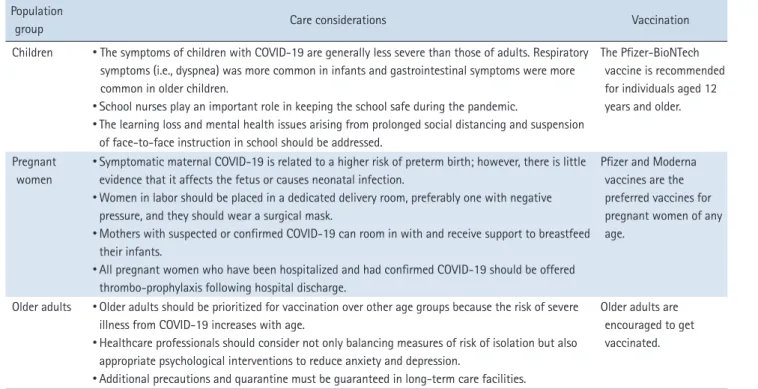
In summary, we described the guidelines and specific healthcare considerations for special populations at high risk of infection, including children, pregnant and lactating women, and older adults, during the pandemic period. Table 1 presents the core summaries of specific considerations for each population group.
CONCLUSIONS
The COVID-19 pandemic continues to threaten human health and public safety , and people of all ages appear to be susceptible to SARS-CoV-2 infection. However , the infec- tion’s clinical manifestations differ among groups. This re- view described the nursing practice guidelines and specific healthcare considerations for special populations, who might have unique healthcare needs, in preventing and managing COVID-19. Nurses should be educated with accurate infor- mation to maximize protection against COVID-19, including the Delta variants, and to prevent spreading it to others.
However , this review is limited by the scarcity of informa- tion. Hence, further research is required to confirm the ac- curacy of the presented data before providing the information to patients or performing counseling.
CONFLICTS OF INTEREST
The authors declared no conflict of interest.
Table 1. Summary of the Healthcare Considerations for Special Populations Population
group Care considerations Vaccination
Children
•The symptoms of children with COVID-19 are generally less severe than those of adults. Respiratory symptoms (i.e., dyspnea) was more common in infants and gastrointestinal symptoms were more common in older children.
•
School nurses play an important role in keeping the school safe during the pandemic.
•
The learning loss and mental health issues arising from prolonged social distancing and suspension of face-to-face instruction in school should be addressed.
The Pfizer-BioNTech vaccine is recommended for individuals aged 12 years and older.
Pregnant women
•
Symptomatic maternal COVID-19 is related to a higher risk of preterm birth; however, there is little evidence that it affects the fetus or causes neonatal infection.
•
Women in labor should be placed in a dedicated delivery room, preferably one with negative pressure, and they should wear a surgical mask.
•
Mothers with suspected or confirmed COVID-19 can room in with and receive support to breastfeed their infants.
•
All pregnant women who have been hospitalized and had confirmed COVID-19 should be offered thrombo-prophylaxis following hospital discharge.
Pfizer and Moderna vaccines are the preferred vaccines for pregnant women of any age.
Older adults
•Older adults should be prioritized for vaccination over other age groups because the risk of severe illness from COVID-19 increases with age.
•
Healthcare professionals should consider not only balancing measures of risk of isolation but also appropriate psychological interventions to reduce anxiety and depression.
•