재활치료과학 제 10 권 제 3 호
Therapeutic Science for Rehabilitation Vol. 10. No. 3. 2021.
https://doi.org/10.22683/tsnr.2021.10.3.057
뇌졸중 작업치료 지침의 질 평가
이은영*, 한대성**, 박지혁***
*원광대학교병원 재활의학과 연구원
**상지대학교 작업치료학과 교수
***연세대학교 소프트웨어디지털헬스케어융합대학 작업치료학과 교수
국문초록
목적 : 본 연구는 임상지침 중 뇌졸중 환자의 작업치료를 다룬 지침을 확인하고, 확인된 지침들의 질과 특성에 대해 알아보고자 하였다.
연구방법 : 본 연구는 2008년부터 2019년까지 국내․외의 재활 치료 지침을 살펴보았으며, 검색어는
‘stroke’, ‘guideline’, ‘practice guideline’, ‘recommendation’, ‘protocol compliance’, ‘practice guideline’,
‘뇌졸중 가이드라인’, ‘뇌졸중 지침’ 등으로 하였다.
결과 : 검색을 통해 총 708편의 논문이 검색되었고, 자료 선정 기준에 부합한 지침 8편을 최종적으로 선정하였다. 선정된 논문은 캐나다, 미국, 영국, 한국, 호주 등에서 개발한 지침이었으며. 8개의 지침 중 1개는 작업치료 지침이었고, 나머지 7개는 재활치료 지침이었다. 지침에서 다룬 내용을 총 36개의 주제로 분류하였으며, 이 중 호주 뇌졸중 재활치료 지침은 28개, 영국과 미국심장협회(AHA)의 지침은 24개, 한국에서 개발한 뇌졸중 재활치료 지침은 23개 등의 내용을 포함하고 있었다.
결론 : 본 연구에서는 기존의 뇌졸중 환자를 위한 작업치료 지침을 확인하고, 지침들의 질과 특성을 비교해 보았다. 이는 추후 뇌졸중 작업치료 지침 개발을 위한 중요한 기초자료가 될 수 있을 것으로 사료된다.
주제어 : 뇌졸중, 임상지침, 작업치료, 지침의 질
교신저자 : 박지혁([email protected]) || 접수일: 2020.07.29 || 심사일: 2020.08.05
|| 게재승인일: 2021.02.03
Ⅰ. 서 론
뇌졸중은 신경학적 손상 범위에 따라 다양한 운동, 인지, 심리사회, 정서적 손상을 일으킨다(CDC, 2014;
Roger et al., 2012). 뇌졸중 환자의 80% 정도는 초기 치료 이후에 어떠한 형태로든 장애를 가지며, 뇌졸중 환자 5,000명 중에 25~74%는 보호자에게 의지하여 일 상생활을 한다(Baker & Mullooly, 1997; Miller et al.,
2010). 뇌졸중 환자의 독립성은 뇌졸중 재활에 있어 중 요한 성공적인 요소로 측정되며, 이러한 활동의 독립성 을 회복시키거나 유지시켜 주는 것이 작업치료이다 (AOTA, 1994; Stroke Unit Trialists’ Collaboration, 2013). 작업치료는 환자의 일상생활을 수행하는데 있 어서 의존적인 문제를 보완해주며, 능동적이고 긍정적 인 삶을 유지하고 증진시키는 데에 초점을 둔다(Na et al., 1997).
작업치료는 여러 연구에서 기능적 과제 수행 향상에 효과적이며, 일상생활활동에 독립성을 향상시킨다고 하였다(Legg, Drummond, & Langhorne, 2006). 또한 작업치료는 뇌졸중 환자의 운동, 지각, 인지기능 뿐만 아니라 기능적 과제수행 향상에 효과적이라고 하였다 (Latham et al., 2006). 작업치료는 지금까지 다양한 측 면에서 효과적이라고 증명되었는데, 이렇게 효과가 입 증된 자료들을 체계적으로 정리하여 임상가들이 효과 가 입증된 치료를 할 수 있도록 도와주는 것이 임상지침 이다(Brouwers et al., 2010).
임상지침은 ‘특수한 임상환경에서 건강관리에 대한 임상가의 의사결정을 돕기 위해 체계적으로 개발된 진 술’이며, 잘 개발된 임상지침은 환자들의 건강을 관리하 는데 변수를 최소화해주어 최적의 결과를 내는데 도움 을 준다(Field & Lohr, 1990; Woolf, Grol, Hutchinson, Eccles, & Grimshaw, 1999). 또한 임상 지침은 연구와 임상실행 간의 차이를 연결하는데 도움을 주며, 증명된 중재와 비효과적인 중재에 대한 인식을 높여주는 역할 을 한다(Grimshaw, Eccles, Lavis, Hill, & Squire, 2012).
미국, 영국, 호주 등 국외는 질환별로 활용할 수 있는 지침 개발이 활발하게 이루어지고 있으나, 국내는 상 대적으로 개발된 지침이 부족한 실정이다(Han et al., 2018). 영국의 대표적인 지침 개발 기관인 NICE (National Institute for Health and Care Excellence) 사이트에서 뇌졸중 지침을 검색해보면 1,271개가 검색 되는 것에 반해, 국내의 경우 임상 진료지침 정보센터 사이트에서 뇌졸중 지침을 검색해보면 17개뿐이다. 이 렇듯 국내의 경우 지침의 개발이 국외에 비해 현저히
저조한 실정이다.
작업치료 지침의 경우, 현재까지 국내에 개발된 작업 치료 지침은 Han 등(2018)이 개발한 한국 치매 작업치 료 지침뿐이다. 이 지침은 국외 치매 임상지침과 국내 치매 연구를 고찰하여 치매환자들을 위한 작업치료 평 가와 치료에 대한 지침을 정리한 것이다. 현재까지 국내 에는 뇌졸중과 관련된 지침은 의료행위와 관련된 임상 지침이 대부분이며, 작업치료를 포함한 재활에 초점을 둔 지침은 없는 실정이다. 국외에는 뇌졸중 작업치료 지침들이 개발되어 있지만, 지침의 저작권 문제로 국내 작업치료사들이 자유롭게 문서를 열람하는데 어려움 이 있으며, 재활치료 지침의 일부분으로 작업치료 내용 이 포함되어 있는 경우가 많아 지침에 작업치료 내용이 충분히 포함되었다고 보기에는 어려움이 있다. 지침 개 발방법 중 하나인 수용 개작은 이미 개발된 지침이 있는 경우 선택하는 방법으로, 기존 지침들의 수준을 평가하 여 가장 질 높은 지침을 선정하고, 추가적인 검색을 통 해 지침의 부족한 근거를 보완하는 방식으로 이루어진 다(Kim et al., 2009). 뇌졸중 작업치료 지침의 경우 국 내에는 지침이 없는 실정이므로, 국외에 개발된 지침을 수용 개작하여 지침을 개발하는 방법으로 이루어져야 한다. 본 연구에서는 뇌졸중 작업치료 지침 개발 과정의 일환으로 지금까지 개발된 뇌졸중 작업치료 지침들의 질을 평가하여 수용 개작을 위해 가장 적절한 지침을 알아보고자 한다. 이를 위해 뇌졸중 작업치료를 위한 권고들을 포함하고 있는 기존 뇌졸중 작업치료 임상지 침을 확인하고, 지침의 질을 평가할 수 있는 Appraisal of Guidelines for Reasearch and Evaluation 2.0 (AGREE 2.0)을 이용하여 기존 지침들의 질을 비교해보 고자 한다. 또한 각 지침들이 특징을 비교하고, 기존 지침들이 갖고 있는 제한점을 제시하여 추후 뇌졸중 작업치료 지침 개발에 있어 기초자료로 활용할 수 있을 것으로 사료된다.
Ⅱ. 연구 방법
1. 자료 검색
국내․외의 개발된 뇌졸중 작업치료 지침을 살펴보 기 위하여, 2008년에서 2019년까지의 자료를 검색하였 다. 기존의 지침들은 뇌졸중 환자의 작업치료 내용만을 다루기보다는 뇌졸중 지침에 작업치료 내용을 포함하 고 있는 경우가 많아 뇌졸중 지침을 검색할 수 있는 용어 로 검색어를 선정하였다. 검색어는 ‘stroke’, ‘guideline’,
‘practice guideline’, ‘recommendation’, ‘protocol compliance’, ‘practice guideline’, ‘뇌졸중 지침’, ‘뇌졸 중 가이드라인’ 등을 사용하였다. 지침 검색을 위하여 GIN(http://g-i-n.net), NGC(http://www.guideline.gov), NICE(http://www.nice.org.uk), RNAO(http://rnao.ca), GAC(http://www.gacguidelines.ca), SIGN(http://www.
sign.ac.uk/guideline/index.html), KGC(http://www.
cpg. or.kr), KoMGI(http://www. guideline.or.kr) 등과 같은 진료지침 지원센터나, 뇌졸중과 관련한 지침을 확인 할 수 있는 Stroke (https://www.ahajournals.
org), SSNAP(https://www.ahajournals.org)에서 자료 를 수집하였다. 추가적인 검색을 위하여 PubMed (http://www.ncbi.nlm.nih.gov)와 Embase (http://
www.embase.com)를 활용하였다.
2. 자료 선정 기준
뇌졸중 작업치료 지침 자료를 선정하기 위한 포함 기준과 배제 기준은 다음과 같다.
1) 포함 기준
(1) 뇌졸중 지침 중 작업치료 내용을 포함하고 있는 문헌
(2) 영어 및 한글로 표기된 문헌
(3) 개정판이 있는 경우 최신판으로 선정 (4) 2008년~2019년 사이에 발표된 지침
2) 배제 기준
(1) 조직을 대표하지 않고 한 명이 쓴 지침 (2) 한 개의 지침의 내용을 번역하거나 부분 수용
개발한 지침
3. 평가 도구
지침의 질을 평가하기 위해 가장 널리 사용되어 온 도구는 AGREE 2.0이다(Knight et al., 2019). AGREE 2.0은 임상 지침을 평가하기에 타당하며, 지침에 포 함된 근거들의 질보다는 개발 방법론에 질적인 측면 을 평가하기 위해 사용된다(Brouwers et al., 2010).
AGREE 2.0은 총 6개 영역(범위와 목적, 이해당사자의 참여, 개발의 엄격성, 표현의 명확성, 적용성, 편집의 독립성), 23개 문항으로 이루어져 있다. ‘범위와 목적’은 지침의 전반적인 목적, 건강 관련 질문, 진료지침을 적 용할 인구집단이 구체적으로 서술되어 있는지를 알아 보는 항목이며, ‘이해당사자의 참여’는 적합한 이해당사 자들에 의해 지침이 개발되었는지와 지침을 활용하게 될 사용자들의 의견을 반영하고 있는지에 중점을 두고 있다. ‘개발의 엄격성’은 근거를 모으고 종합화하는데 사용된 방법, 권고안 도출 방법, 진료지침 갱신방법 등 이 구체적으로 서술되어 있는지를 평가하는 항목이며,
‘표현의 명확성’은 권고안이 구체적이고, 쉽게 확인 가 능하게 제시되어 있는지를 평가하는 항목이다. ‘적용성’
은 지침을 적용하는데 영향을 주는 요인, 적용 시 필요 한 자원, 적용에 대한 감독과 기준 등을 평가하는 항목 으로 이루어져 있으며, ‘편집의 독립성’은 개발에 참여 한 구성원들 간의 상충되는 이해관계가 권고안 도출에 영향을 주었는지 알아보는 항목이다. 모든 항목은 7점 척도(1: 전혀 동의 안함~7: 매우 동의함)로 이루어져 있으며, 평가는 최소 2인에서 4인의 평가자들이 시행하 여 점수를 합산하여 산출하는 방법을 따른다. 평가자들 이 항목별로 평가를 하면, 평가자들의 개별 평가항목의 점수를 모두 합산하고, 이 총점을 해당 영역에서 받을 수 있는 최고점에 대한 백분율로 환산한 지표를 사용하
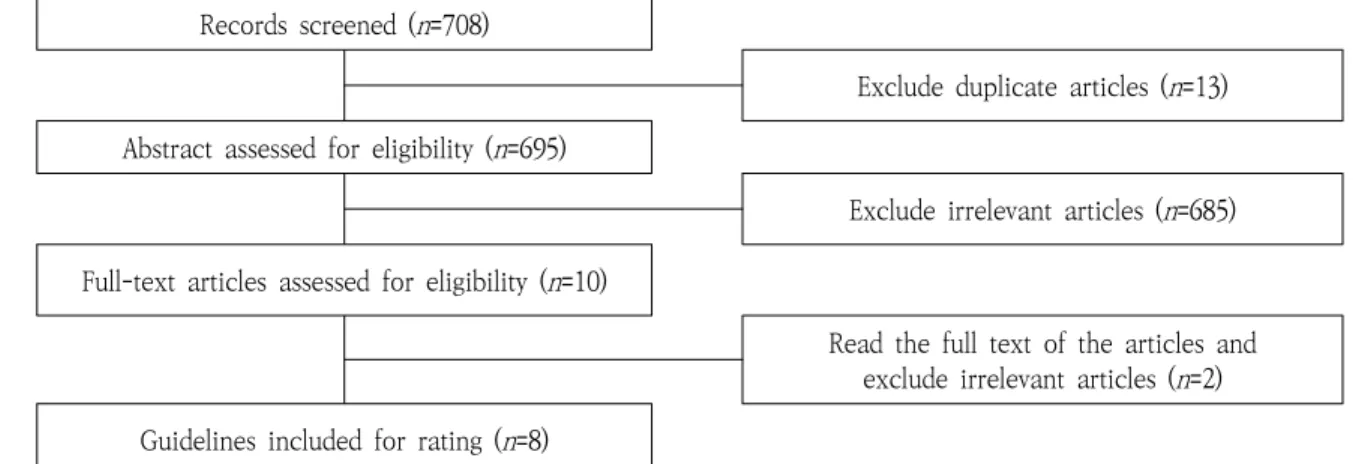
Records screened ( n =708)
Exclude duplicate articles ( n =13) Abstract assessed for eligibility ( n =695)
Exclude irrelevant articles ( n =685)
Full-text articles assessed for eligibility ( n =10)
Read the full text of the articles and exclude irrelevant articles ( n =2) Guidelines included for rating ( n =8)
Figure 1. Flow Chart of Search Process
여 점수를 산출한다.영역별 취득 총점-영역별 가능한 최저 점수 영역별 가능한 최고 점수-영역별 가능한 최저 점수
AGREE 2.0은 평가점수에 따라 질 높은 경우와 낮은 경우를 구분하는 전체 영역별 점수의 유형이나 최저 영역 점수를 규정하고 있지 않다. 지침들의 영역별 점수 를 비교하거나, 해당 지침의 사용을 권장해도 되는지 여부에 대한 정보를 알아보기 방법으로 사용될 수 있다 (Clinical Care Guidance Committee, 2009).
4. 지침 평가 과정
자료 선정 기준에 따라 최종 지침을 선택한 후, 두 명의 평가자가 AGREE 2.0으로 최종 선정된 지침을 평 가하였다. 평가는 지침 개발 연구에 경험이 있는 대학 교수와 본 연구자가 시행하였다. 또한 지침들의 일반적 인 특성을 파악하기 위해 각 지침들의 개발 방법을 살펴 보아 지침들의 특성을 비교하고자 하였다. 마지막으로, 지침들이 어떠한 항목의 지침 내용을 다루고 있는지 알아보기 위해 각 지침들이 제시하고 있는 권고 항목들 을 정리하였고, 이를 작업치료실행체계(Occupational Therapy Practice Framework: OTPF)의 분류기준에 근 거하여 분류하였다.
Ⅲ. 연구 결과
1. 지침의 선정
검색을 통해 총 708편의 논문이 확인되었다. 이 중 중복된 논문 13편을 제외 후, 695편 논문의 주제와 초록 으로 보며 각 논문이 뇌졸중 작업치료 지침과 관련된 내용을 다루고 있는지 확인하였다. 뇌졸중 작업치료 지 침과 관련 없는 내용을 다루고 있는 685편의 논문을 제외시켰으며, 나머지 10편의 논문은 전문을 확인하여 자료 선정기준에 부합되는지 확인하였다. 이러한 과정 에 통해 최종 8편의 논문이 선정되었다(Figure 1).
2. 지침의 특징
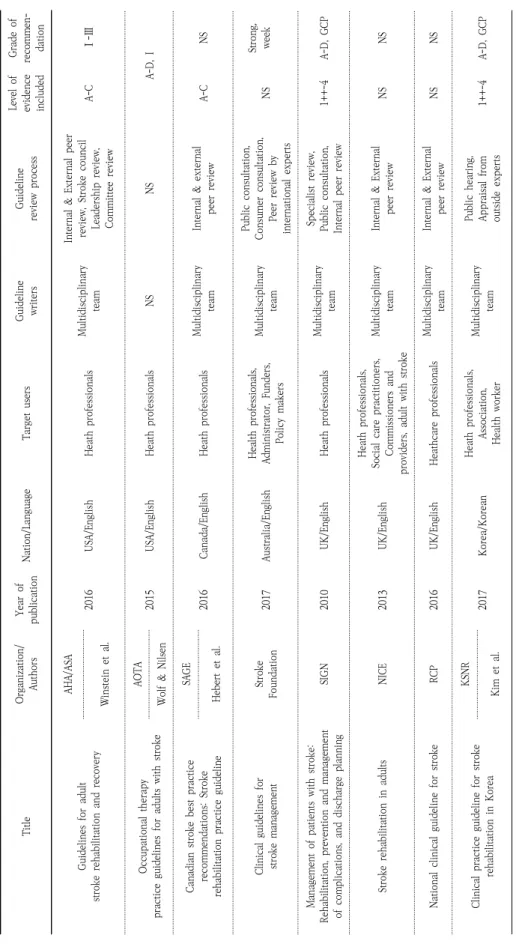
최종 선정된 8개 지침 중, 뇌졸중 작업치료 지침 으로 개발된 것은 미국작업치료사협회(American Occupational Therapy Association: AOTA)에서 개발 한 지침이 유일하였고, 나머지 7개의 지침은 뇌졸중 환 자의 전반적인 재활치료 내용을 다루고 있었다. 개발된 지침의 수를 나라별로 비교해보면 영국 3개, 미국 2개, 호주 1개, 캐나다 1개, 한국 1개였다. 모든 지침은 의사, 간호사, 작업치료사, 물리치료사, 언어치료사, 사회복 지사 등 보건 전문가들을 위해 개발되었으며, 미국작업 치료사협회(AOTA)에서 개발한 지침을 제외한 모든 지
TitleOrganization/ AuthorsYear of publicationNation/LanguageTarget usersGuideline writersGuideline review process Level of evidence included
Grade of recommen- dation Guidelines for adult stroke rehabilitation and recovery
AHA/ASA 2016USA/EnglishHeath professionalsMultidisciplinary team Internal & External peer review, Stroke council Leadership review, Committee review
A-CⅠ-Ⅲ Winstein et al. Occupational therapy practice guidelines for adults with stroke
AOTA 2015USA/EnglishHeath professionalsNSNSA-D, I Wolf & Nilsen Canadian stroke best practice recommendations: Stroke rehabilitation practice guideline
SAGE 2016Canada/EnglishHeath professionalsMultidisciplinary teamInternal & external peer reviewA-CNS Hebert et al. Clinical guidelines for stroke managementStroke Foundation2017Australia/EnglishHealth professionals, Administrator, Funders, Policy makers Multidisciplinary team Public consultation, Consumer consultation, Peer review by international experts
NSStrong, week Management of patients with stroke: Rehabilitation, prevention and management of complications, and discharge planningSIGN2010UK/EnglishHeath professionalsMultidisciplinary team
Specialist review, Public consultation, Internal peer review1++-4A-D, GCP Stroke rehabilitation in adultsNICE2013UK/English
Heath professionals, Social care practitioners, Commissioners and providers, adult with stroke
Multidisciplinary teamInternal & External peer reviewNSNS National clinical guideline for strokeRCP2016UK/EnglishHeathcare professionalsMultidisciplinary teamInternal & External peer reviewNSNS Clinical practice guideline for stroke rehabilitation in Korea
KSNR 2017Korea/KoreanHeath professionals, Association, Health worker Multidisciplinary team
Public hearing, Appraisal from outside experts1++-4A-D, GCP Kim et al. AHA=American Heart Association; AOTA=American Occupational Therapy Association; ASA=American Stroke Association; GCP=Good Clinical Practice; KSNR=Korean Society for NeuroRehabilitation; NICE=National Institute for Health and Care Excellence; NS=Non Stated; RCP=Royal College of Physicians; SAGE=Standards-Based Active Guideline Environment; SIGN=Scottish Intercollegiate Guidelines Network; UK=United Kingdom
Ta ble 1. Basic Characte ristics of the S e le cted Gu ide lin es
Guideline Scope and purpose
Stakeholder involvement
Rigour of development
Clarity and
presentation Applicability Editorial
independence Average
AHA (2016) 56.0 64.0 59.0 83.0 25.0 58.0 57.5
AOTA (2015) 81.0 81.0 75.0 81.0 46.0 38.0 67.0
SAGE (2016) 64.0 67.0 84.0 81.0 40.0 100.0 72.7
Stroke Foundation
(2017) 67.0 36.0 25.0 56.0 8.0 0.0 32.0
SIGN (2010) 94.0 78.0 50.0 97.0 48.0 33.0 66.7
NICE (2013) 69.0 72.0 69.0 81.0 46.0 13.0 58.3
RCP (2016) 83.0 94.0 93.0 89.0 69.0 100.0 88.0
KSNR (2017) 69.0 61.0 73.0 94.0 38.0 88.0 70.5
AHA=American Heart Association; AOTA=American Occupational Therapy Association; KSNR=Korean Society for NeuroRehabilitation; NICE=National Institute for Health and Care Excellence; RCP=Royal College of Physicians;
SAGE=Standards-Based Active Guideline Environment; SIGN=Scottish Intercollegiate Guidelines Network Table 2. Quality Appraisal by the AGREE Ⅱ Instrument of Stroke Guidelines (%)
침은 다학제간 팀을 구성하여 지침을 개발하였다. 개 발과정 중 지침의 초안이 완성되면 내․외부 위원 통 한 검토과정을 거치게 되는데, 미국작업치료사협회 (AOTA)에서 개발된 지침을 제외한 모든 지침은 내․외 부위원 검토과정을 거쳐 최종본이 완성되었다. 지침 내 용들의 근거 수준과 권고 등급은 개발된 지침마다 다양 한 등급을 사용하여 제시하고 있었다. 그러나 SAGE 지 침은 권고수준이, Stroke Foundation 지침은 근거수준 이 제시되어있지 않았으며, NICE(National Institute for Health and Care Excellence)와 RCP(Royal College of Physicians)에서 개발한 지침은 근거수준과 권고등급 모두 제시되어 있지 않았다(Table 1).
3. 지침의 질
지침의 질을 평가하는 AGREE-Ⅱ는 6개의 영역으로 평가가 이루어진다. 이 중 범위와 목적에 대한 평가항목 은 SIGN(Scottish Intercollegiate Guidelines Network) 지침이 94.0%로 가장 높은 점수를 받았으며, 이해당사 자의 참여를 평가하는 항목은 RCP 지침이 94.0%로 가 장 높았다. 개발의 엄격성 항목도 RCP 지침이 93.0%로
가장 높았으며, 표현의 명확성은 SIGN 지침이 97.0%로 가장 높은 점수를 받았다. 그리고 적용성은 RCP 지침이 69.0%로 가장 높았으며, 편집의 독립성은 SAGE와 RCP 지침이 100%로 가장 높은 점수를 받았다. 지침의 평균 점수를 비교해 본 결과, RCP 지침 88.0%로 가장 높았으 며, 그 다음으로는 SAGE 지침 72.7%, KSNR 지침 70.5%, AOTA 지침 67.0%, SIGN 지침 66.7%, NICE 지 침 58.3%, AHA 지침 57.5%, Stroke Foundation 지침 32.0% 순이었다(Table 2).
4. 지침의 내용
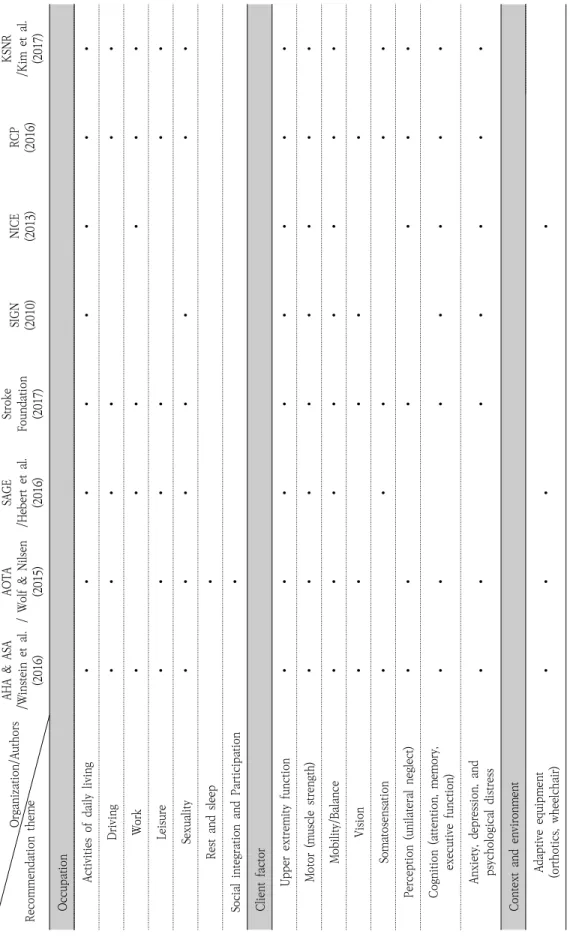
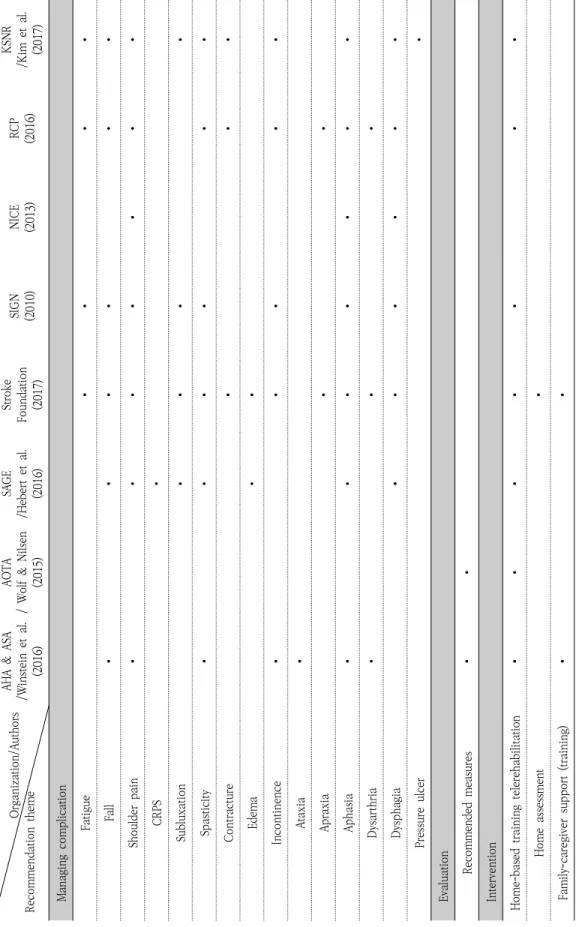
지침에 포함된 내용들을 비교하기 위해 작업치료 실행체계 제3판(Occupational Therapy Practice Framework Ⅲ: OTPF Ⅲ)을 근거로 하여 분류하였으며 (AOTA, 2017), 작업치료실행체계 영역 내에서 분류되 지 않는 내용들은 합병증 관리, 평가 그리고 중재 영역 으로 추가하여 분류하였다. 이렇게 하여 총 6개의 영역 (작업, 환자요소, 환경 및 배경, 합병증 관리, 평가, 중재) 과 36개 요소로 분류하였다. 지침별로 포함하고 있는 요소를 비교해보면 Stroke Foundation 지침은 28개,
Or ga n iz at io n /A u th o rs R ecom m endati on t h em e AH A & ASA /W in st ei n et a l. (2 016 ) AO TA / W o lf & N ils en (2 01 5) SAG E /H eb er t et a l. (201 6) Stro ke Fo u n da ti o n (2 017 ) SI G N (2 01 0) NI C E (201 3) RCP (2 016 )
KS N R /K im e t al . (2 01 7) O cc u p at io n A ctiv iti es o f da ily liv in g •• ••• ••• Dr iv in g •• •• •• Wo rk •• •• • • Leisur e •• •• •• Sexual it y •• ••• •• R es t a n d s le ep • Soc ial i nt egr at io n an d Pa rt ic ipat io n • C li en t f ac to r U p per ext rem it y fu nct io n •• ••• ••• M o to r (m u sc le s tr en gth ) •• ••• ••• M o bi li ty /B al anc e •• ••• •• • Vi si on •• •• • Som at o se n sa ti o n •• • • • P er cep ti o n ( un il at er al n egl ec t) •• • ••• C o gn it io n (a tte n tio n , m em o ry , execut iv e funct ion ) •• •• ••• An xi et y, d epres si o n , and p sy ch o lo gica l di st re ss •• •• ••• C o n te xt a n d e n vi ro n m en t Adapt iv e eq u ip m en t (o rt hot ics , w hee lc hai r) •• • •
Tab le 3. Categ orizatio n of R ecom men datio n Th eme
Or ga n iz at io n /A u th o rs R ecom m endati on t h em e AH A & ASA /W in st ei n et a l. (2 016 ) AO TA / W o lf & N ils en (2 01 5) SAG E /H eb er t et a l. (201 6) Stro ke Fo u n da ti o n (2 017 ) SI G N (2 01 0) NI C E (201 3) RCP (2 016 )
KS N R /K im e t al . (2 01 7) M an ag in g c o m p li ca ti o n Fat igu e •• •• Fal l • ••• •• Shou ld er p ai n • ••• ••• CR PS • Subl ux at io n ••• • Sp as tic ity • ••• •• Cont ra ct ur e •• • Ede m a •• In co n ti n en ce •• • • • At ax ia • Ap ra xi a •• Ap has ia • ••• ••• Dy sa rt h ri a ••• Dy sp ha gi a ••• ••• P re ssu re u lc er • E va lu at io n R ec o m m ended m eas ur es •• I n te rv en ti o n H o m e- b as ed tr ain in g te le re h ab ilita tio n •• ••• •• H o m e asse ssm en t • Fam ily -c ar eg iv er su p p o rt ( tr ai n ing ) •• AH A=Am er ic an H ear t A ss oc ia ti on; A OT A=Am er ic an O cc up at io na l Th er apy A ss oc iat ion; C RP S= Com p le x Re gi on al Pai n Sy ndr om e; KS N R =K or ea n Soc ie ty f or N eu ro Re hab ili ta ti on; N IC E= N at ional In st it u te fo r H eal th a n d C ar e Ex cel lence; R CP=Ro yal C ol lege of P h ys ic ia n s; SA G E= Sta n da rd s-B as ed A ctiv e G u id el in e En vi ro n m en t; SI GN =S co tt is h I nt er co llegi at e Gu id el in es N et w o rk
Tab le 3. Categ orizatio n of R ecom men datio n Th eme ( conti nue d)
RCP 지침은 24개, AHA/ASA는 24개, 대한의학회 지침 은 23개, 캐나다 뇌졸중 전문가 집단이 개발한 지침은 19개, SIGN 지침은 17개, AOTA 지침은 16개, NICE 지침은 12개의 지침내용을 다루고 있었다. 8개의 지침 에서 공통적으로 다루고 있는 요소를 비교해보면, 모든 지침에서 다루고 있는 요소는 일상생활활동, 상지기능, 이동성/균형, 운동기능 등이었고, 7개 지침에서 다루고 있는 요소는 가정기반 재활, 성생활, 인지, 어깨통증, 실어증, 심리적 요소 등이었으며, 6개 지침에서 다루고 있는 요소는 직업복귀, 여가활동, 운전, 지각, 낙상, 강 직, 연하장애 등이었다(Table 3).
Ⅳ. 고 찰
본 연구에서는 국내․외의 뇌졸중 환자를 위한 작업 치료 지침을 확인하고, 지침의 특성과 내용에 대해 알아 보고자 하였다. 검색을 통해 총 708편의 논문 검색되었 으며, 이 중 기준에 적합한 8편의 논문을 최종 선정하였 다. 본 연구에서는 이렇게 선정된 지침들의 질을 평가하 고, 지침의 특성과 내용을 비교하였다.
본 연구에서 최종적으로 선정된 8편의 지침 중 작업 치료를 중심으로 다룬 지침은 하나였으며, 나머지 7편 은 뇌졸중의 전반적인 재활치료 지침에 작업치료 내용 을 포함한 형식으로 이루어진 지침이었다. 임상지침은 임상가들의 의사결정을 도우며, 최선의 치료를 가능하 게 해준다(Carl & James, 2012). 또한 근거 기반으로 잘 개발된 임상지침은 변수를 최소화하여 결과를 향상 시키며, 연구 기반의 명백한 권고를 제공해주므로 연구 와 임상을 연결해주는 역할을 한다(Bero et al., 1998;
Woolf et al., 1999). 이렇듯 임상지침은 임상가들에게 효율적이고 근거있는 치료를 제공하기에 필요한 수단 이지만, 본 연구 결과 작업치료 지침이 많이 부족한 실 정임을 알 수 있었다.
AGREE Ⅱ로 기존의 뇌졸중 지침을 평가한 결과, 가 장 질이 높은 지침은 2016년 영국 런던의과대학(Royal
College of Physicians: RCP)에서 개발한 지침이었다.
Hoffmann-Eßer 등(2017)에 의하면 AGREE Ⅱ의 6가지 평가영역 중 ‘개발의 엄격성’은 전반적인 지침 질에 중 요한 영향을 준다고 하였는데, RCP에서 개발한 지침은 개발의 엄격성 영역에서도 가장 높은 점수를 받았다.
이렇듯 RCP에서 개발한 지침은 기존 지침 중 가장 질 높은 지침으로 볼 수 있지만, 이 지침은 근거수준과 권 고등급이 제시되어 있지 않았다. 지침에는 임상가들이 최선의 치료를 위해 사용될 수 있는 권고들을 제공하는 데(Henry et al., 2015), 이 권고들은 근거 수준을 바탕으 로 권고 등급이 매겨진다(SIGN, 2010). 등급이 높은 권 고 사항일수록 객관적인 근거가 있는 치료라는 것을 알 수 있게 되는데, 근거 수준과 권고 등급이 제시되지 않은 지침은 작업치료사들이 권고들의 수준을 비교해 볼 수 없다는 단점이 있다. 이러한 점에서 RCP에서 개 발한 지침은 지침 질 평가 상으로는 높은 점수를 받았지 만, 근거와 권고 등급을 제시되어 있지 않다는 제한점이 있다.
본 연구에서 최종 선택된 지침 중 미국작업치료협회 (AOTA)에서 개발한 작업치료 지침은 다른 지침들의 평 균보다 높은 수준이었다. 8개 지침의 질 평균은 64.1%
였는데, 미국작업치료협회(AOTA)에서 개발한 지침의 질 평균은 67.0%였다. 이 지침은 인지 및 지각, 운동, 심리사회적 및 정서적 손상, 일상생활활동 등 4개의 영 역을 나눠 작업치료 관련 근거들을 정리하였으며, 근거 수준과 권고등급을 모두 제시하고 있어 임상가들이 보 다 객관적인 권고사항을 선택하는데 도움이 된다. 또한 미국작업치료협회(AOTA)에서 개발한 지침은 본 연구 에서 고찰한 지침 중 유일한 뇌졸중 작업치료 지침이었 기 때문에 권고안의 내용들이 작업치료를 중심으로 이 루어졌다는 것에 의미가 있으며, 추후 개발을 위한 기초 자료가 될 수 있을 것으로 사료된다.
본 연구에서 지침들의 권고 내용을 분류한 결과, 모 든 지침에서 공통적으로 다루고 있는 영역은 일상생활 활동, 상지기능, 운동기능, 이동성/균형 등이었다. 그 다음으로 공통적으로 다루고 있는 영역은 인지, 어깨통
증, 실어증, 심리적 요소, 가정기반 재활, 성생활 등이었 다. 공통적으로 다루고 있는 요소들을 작업치료실행체 계(OTPF)에 제시하는 5개의 작업치료 영역으로 분류해 보면 작업과 클라이언트 요소에 해당되는 영역들이 대 부분이었다. 이러한 점에서 보면, 기존 지침들에서는 수행기술, 수행패턴, 배경과 관련된 권고 사항들이 부 족하다는 것을 알 수 있다. 이는 작업치료 영역을 전반 적으로 담고 있는 뇌졸중 작업치료 지침의 개발이 필요 함을 의미한다.
본 연구에는 기존의 뇌졸중 재활 및 작업치료 지침들 에 대해 고찰하여 지침들의 특성과 질에 대해 알아보았 지만, 다음과 같은 제한점을 갖는다. AGREE Ⅱ는 임상 지침의 방법론적 문제점을 평가하여 질을 분석하는 도 구이므로(AGREE Next Steps Consortium, 2009), 지침 에서 다루고 있는 권고 사항들의 내용 타당도를 평가할 수는 없었다. 즉, 기존 지침들의 질은 분석할 수 있었지 만, 지침 내용들의 타당도를 알아보지 못했다는데 제한 점을 갖고 있다. 또한 본 연구에서 지침들에서 다룬 권 고 영역들을 작업치료 영역으로 분류하여 지침들에서 다룬 영역을 파악할 수는 있었지만, 각 영역에서 다룬 지침들의 권고 등급을 비교해보지는 않아 권고 수준이 낮거나 높은 영역이 무엇인지 파악할 수 없었다는 것도 제한점이 된다.
이러한 제한점에도 불구하고 본 연구는 뇌졸중 작업 치료와 관련된 지침들의 질을 평가하여 기존 지침들의 문제점과 강점들을 파악할 수 있었다. 이는 추후 뇌졸중 작업치료 지침 개발에 필요한 기초자료로 활용할 수 있을 것으로 기대한다.
Ⅴ. 결 론
본 연구에서는 기존의 뇌졸중 환자를 위한 작업치료 지침들을 고찰하였고, 총 8편의 지침이 선정되었다. 한 개의 지침을 제외하고 나머지 지침들은 작업치료 영역 을 충분히 포함하고 있기 보다는 재활치료 지침에 작업 치료가 포함된 형태로 제시되어 있는 것이 대부분이었
다. 지침들이 다루고 있는 내용은 작업치료실행체계 기 준으로 작업과 환자요소에 해당되는 항목들이 대부분 이었다. 본 연구에서는 기존의 뇌졸중 환자를 위한 작업 치료 지침들의 질과 특성을 비교해보았으며, 이는 추후 지침 개발을 위한 중요한 자료가 될 수 있을 것으로 사료된다.
References
AGREE Next Steps Consortium. (2009). The Agree II Instrument. AGREE . Retrieved from https://www.
agreetrust.org
American Occupational Therapy Association (AOTA).
(1994). Policy 5.3. 1: Definition of occupational therapy practice for state regulation. American Journal of Occupational Therapy, 48 , 1072-1073.
American Occupational Therapy Association (AOTA).
(2017). Occupational therapy practice framework:
Domain & process (3rd ed.). American Journal of Occupational Therapy, 68 (1), 1-48. doi:10.5014/
ajot.2014.682006
Baker, W. H., & Mullooly, J. P. (1997). Stroke in a defined elderly population, 1967-1985: A less lethal and disabling but no less common disease. Stroke, 28 (2), 284-290. doi:10.1161/01.str.28.2.284
Bero, L. A., Grilli, R., Grimshaw, J. M., Harvey, E., Oxman, A. D., & Thomson, M. A. (1998). Closing the gap between research and practice: An overview of systematic reviews of interventions to promote the implementation of research findings. The British Medical Journal, 317 (7156), 465-468. doi:10.1136/
bmj.317.7156.465
Brouwers, M. C., Kho, M. E., Browman, G. P., Burgers, J.
S., Cluzeau, F., Feder, G., ... Littlejohns, P. (2010).
AGREE II: Advancing guideline development, reporting and evaluation in health care. Canadian Medical Association Journal, 182 (18), 839-842.
doi:10.1016/j.ypmed.2010.08.005
Carl, H. S., & James, E. G. (2012). Guidelines for the
management of cognitive and behavioral problems in
dementia. Journal of the American Board of Family
Medicine, 25 (3), 350-366. doi:10.3122/jabfm.2012.03.
100183
Centers for Disease Control and Prevention (CDC). (2014).
Stroke facts . Retrieved from http://www.cdc.gov/
stroke/facts.htm
Clinical Care Guidance Committee. (2009). A guide to utilization of K-AGREE Ⅱ . Retrieved from https://
www.guideline.or.kr
Field, M. J., & Lohr, K. N. (1990). Clinical practice guidelines: Directions for a new program . Washington: National Academy Press.
Grimshaw, J. M., Eccles, M. P., Lavis, J. N., Hill, S. J., &
Squires, J. E. (2012). Knowledge translation of research findings. Implementation Science, 7 (1), 1-17.
doi:10.1186/1748-5908-7-50
Han, D. S., Jung, M. Y., Kim, J. B., Park, J. H., Lee, H. S.,
& Jung, W. M. (2018). Development of Korean occupational therapy practice guideline for dementia. Korean Journal of Occupational Therapy, 26 (1), 75-89. doi:10.14519/jksot.2018.26.1.06 Hebert, D., Lindsay, M. P., McIntyre, A., Kirton, A., Rumney,
P. G., Bagg, S., ... Teasell, R. (2016). Canadian stroke best practice recommendations: Stroke rehabilitation practice guidelines, update 2015. International Journal of Stroke, 11 (4), 459-484. doi:10.1111/ijs.
12557
Henry, H., Howard, C., Andres, G., Alan, S., Georgios, C., Georgios, E. C., ... Emmanouil, S. B. (2015). Evolution of the American college of cardiology/American heart association clinical guidelines. Journal of American College of Cardiology, 65 (25), 2726-2734. doi:10.
1016/j.jacc.2015.04.050
Hoffmann-Eßer, W., Siering, U., Neugebauer, E. A., Brockhaus, A. C., Lampert, U., & Eikermann, M. (2017).
Guideline appraisal with AGREE II: Systematic review of the current evidence on how users handle the 2 overall assessments. PloS One, 12 (3), 1-15. doi:
10.1371/journal.pone.0174831
Kim, D. Y., Kim, Y. H., Lee, J. M., Jang, W. H., Kim, M.
O., Pyoun, S. B. ... Song, Y. J. (2017). Clinical practice guideline for stroke rehabilitation in Korea 2016.
Brain & Neurorehabilitation, 10(1), 1-139. doi:10.
12786/bn.2017.10.e11
Kim, N. S., Park, J. I., Bae, H. J., Ahn, H. S., Lee, S. M., Lee, S. H., ... Jung, M. J. (2009). Guide to the development of care guidelines . Seoul, Korea:
Ministry of Health, Welfare and Family Affairs Korean
Medical Association.
Knight, S., Takagi, M., Fisher, E., Anderson, V., Lannin, N.
A., Tavender, E., & Scheinberg, A. (2019). A systematic critical appraisal of evidence-based clinical practice guidelines for the rehabilitation of children with moderate or severe acquired brain injury. Archives of Physical Medicine and Rehabilitation, 100 (4), 711-723. doi:10.1016/j.apmr.2018.05.031
Latham, N. K., Jette, D. U., Coster, W., Richards, L., Smout, R. J., James, R. A., ... Horn, S. D. (2006). Occupational therapy activities and intervention techniques for clients with stroke in six rehabilitation hospitals.
American Journal of Occupational Therapy, 60 (4), 369-378. doi:10.5014/ajot.60.4.369
Legg, L., Drummond, A., & Langhorne, P. (2006).
Occupational therapy for patients with problems in activities of daily living after stroke. Cochrane Database of Systematic Reviews, 2006 (4), 1-48.
doi:10.1002/14651858.cd003585
Miller, E. L., Murray, L., Richards, L., Zorowitz, R. D., Bakas, T., Clark, P., & Billinger, S. A. (2010). Comprehensive overview of nursing and interdisciplinary rehabilitation care of the stroke patient: A scientific statement from the American Heart Association.
Stroke, 41 (10), 2402-2448. doi:10.1161/str.0b013e 3181e7512b
Na, E. W., Jeon, S. I., Kim, D. Y., Bae, H. S., Jung, J. S.,
& Oh, H. C. (1997). A survey on the state of physically disabled elderlies in Kangwha. Annals of Rehabilitation Medicine, 21 (6), 1124-1133.
National Institute for Health and Care Excellence (NICE).
(2013). Stroke rehabilitation in adults . Retrieved from https://www.nice.org.uk/guidance/cg162
Roger, V. L., Go, A. S., Lloyd-Jones, D. M., Benjamin, E.
J., Berry, J. D., ... Turner, M. B. (2012). Heart disease and stroke statistics-2012 update: A report from the American Heart Association. Circulation, 125 (1), 2-220. doi:10.1161/CIR.0b013e31823ac046
Royal College of Physicians (RCP). (2016). National clinical guideline for stroke . Retrieved from https://www.
research.manchester.ac.uk/portal/en/publications/n ational-clinical-guideline-for-stroke(e517ee08-d911 -4707-8b6e-736ba14ee3bb).html
Scottish Intercollegiate Guidelines Network (SIGN). (2010).
Management of patients with stroke: Rehabilitation,
prevention and management of complications and
discharge planning . Retrieved from https://www.
sign.ac.uk/media/1056/sign118.pdf
Stroke Foundation. (2017). Clinical guidelines for stroke management. Retrieved from https://informme.
org.au/en/Guidelines/Clinical-Guidelines-for-Stroke -Management
Stroke Unit Trialists’ Collaboration. (2013). Organised inpatient (stroke unit) care for stoke. Cochrane Database of Systematic Reviews, 2013 (9), 1-84. doi:
10.1002/14651858.CD000197.pub3
Winstein, C. J., Stein, J., Arena, R., Bates, B., Cherney, L.
R., Cramer, S. C., ... Zorowitz, R. D. (2016). Guidelines for adult stroke rehabilitation and recovery: A guideline for healthcare professionals from the American Heart Association (AHA)/American Stroke Association. Stroke (ASA), 47 (6), 98-169. doi:10.1161/
str.0000000000000098
Wolf, T. J., & Nilsen, D. M. (2015). Occupational therapy practice guidelines for adults with stroke . AOTA Press, The American Occupational Therapy Association (AOTA). doi:10.7139/2017.978-1-56900- 460-9
Woolf, S. H., Grol, R., Hutchinson, A., Eccles, M., &
Grimshaw, J. (1999). Potential benefits, limitations, and harms of clinical guidelines. The British Medical Journal, 318 (7182), 527-530. doi:10.1136/bmj.318.
7182.527
Abstract
Quality Evaluation of the Occupational Therapy Guidelines for Stroke
Lee, Eun-Young*, M.D., O.T., Han, Dae-Sung**, Ph.D., O.T., Park, Ji-Hyuk***, Ph.D., O.T.
*Dept. of Rehabilitation Medicine, Won-kwang University Hospital, Researcher
**Dept. of Occupational Therapy, Sangji University, Professor
***Dept. of Occupational Therapy, College of Software and Digital Healthcare Convergence, Yonsei University, Professor
Objective : The purpose of this study was to identify occupational therapy guidelines for patients with stroke according to the clinical guidelines, and to investigate the quality and characteristics of the identified guidelines.
Methods : This involved a review of domestic and foreign rehabilitation treatment guidelines from 2008 to 2019. These guidelines were searched using, the search terms: ‘stroke’, ‘guideline’, ‘practice guideline’, ‘recommendation’, ‘protocol compliance’, ‘practice guideline’, and ‘stroke guidelines’.
Results : A total of 708 papers were identified from the search. Eight guidelines met the selection criteria and were included in this review. The selected guidelines were developed in Canada, Australia, the United States, the United Kingdom, and Korea. One of the eight guidelines was occupational therapy guidelines, and the other seven were rehabilitation guidelines. The guidelines were categorized into a total of 36 topics, including 28 guidelines for stroke rehabilitation in Australia, 24 guidelines for the British and American Heart Association, and 23 guidelines for stroke rehabilitation developed in Korea.
Conclusion : In this study, the guidelines for occupational therapy for existing stroke patients were identified, and the quality and characteristics of the guidelines were compared. The results of this study will provide important basic data for the development of occupational therapy guidelines for stroke in the future.
Keywords : Clinical guideline, Occupational therapy, Quality of guideline, Stroke