80
o 서론
Constraint-Induced movement therapy(CIMT) 는 마비된 상지의 신경회복을 돕기위해 Spint, Arm sling, Cast, Triangular bandage, Half glove, Mitt 등을 이용하여 비마비된 상지를 구속시켜 마비된 상 지를 강제적으로 사용하게 함으로써 기능적인 회복
을 도모하는 것이다
1-3). CIMT는 전통적인 재활치료 에 비하여 운동기능의 회복에서 유의한 효과를 보였 고
3), 발병일이 오래되지 않은 뇌졸중 후 편마비 환 자의 운동기능의 회복뿐 아니라
2)발병일이 오래된 뇌졸중 후 편마비 환자의 운동기능의 회복에도 긍 정적인 효과를 미쳤다
3-6). 하지만 CIMT는 비마비된 상지 구속의 불편함으로 인한 높은 탈락률, 재활치 료 프로그램 개발의 어려움, 높은 비용 등의 단점이 있다
7). 또한 본원에서 CIMT를 받은 뇌졸중 후 편마 Ilsuk Lee, Hyungmoon Lim
1, Sanho Choi, Jaegun Oh, Kang-keyng Sung, Sangkwan Lee
*Department of internal medicine and neuroscience, College of Korean medicine, Wonkwang University
1
Department of Psychology, Chonnam National University
n Objectives The aim of study is to analyze the change of gait pattern by arm sling in a hemiplegic patient.
n Methods We analyzed the change of gait pattern under three conditions using Treadmill Gait analysis equipment(Zebris Co.Ltd FDM-T) First, the patient didn’t have arm sling on her upper limb, second, the patient have arm sling on her affected upper limb, third, patient have arm sling on her unaffected upper limb.
n Results In terms of spatiotemporal gait values, swing phase, step time, step length of unaffected lower limb increased. Furthermore, stride time and stride length also increased when the patient had arm sling on her unaffected upper limb. In terms of displacement of Center of pressure(CoP), anterior/posterior position and lateral symmetry of CoP increased.
Furthermore, lateral symmetry of decreased when the patient had arm sling on her affected upper limb.
n Conclusion Arm sling applied on affected side would be advantage to gait improvement in hemiplegic patients.
n Key words Stroke, Arm sling, Gait analysis, Spatiotemporal parameter 이일석, 임형문
1, 최산호, 오재건, 성강경, 이상관
*원광대학교 한의과대학 광주한방병원 심계내과학교실 ,
1전남대학교 사회과학대학 심리학과
팔걸이가 편마비 환자의 보행에 미치는 영향
The effect of arm sling during hemiplegic gait
* 교신저자: 이상관
전화: 062 670 6407, E-mail: [email protected]
의 마비된 상지만 팔걸이를 착용한 채 실험을 진행 하였다. 이 때문에 CIMT와 같이 비마비된 상지에 팔걸이를 착용했을 때에 대한 연구는 거의 전무한 상황이다. 이에 본 연구에서는 뇌졸중 후 편마비 환 자 1례에서 팔걸이를 착용하지 않았을 때와 마비된 상지에 팔걸이를 착용했을 때, 비마비된 상지에 팔 걸이를 착용했을 때의 보행양상을 각각 비교하여 팔 걸이 착용이 뇌졸중 후 편마비 환자의 균형과 보행 에 미치는 영향을 알아보고자 한다.
o 재료 및 방법
1. 연구대상
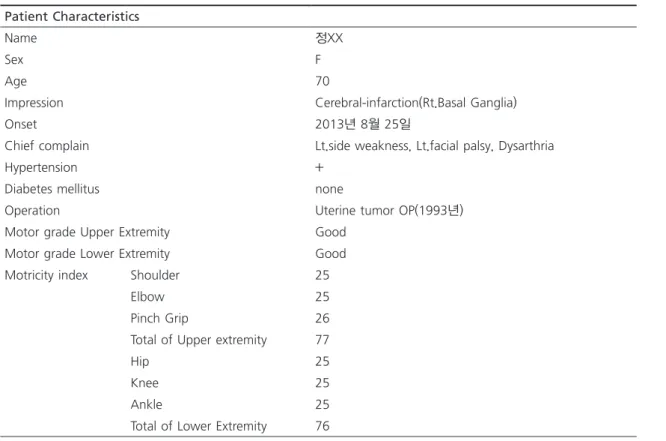
뇌졸중 후 편마비를 진단받은 환자 중 자가보행이 가능하고, 보행에 영향을 줄 수 있는 근골격계 질환 이 없으며, 지시하는 내용을 충분히 이해할 수 있는 한 명(Table 1)을 대상으로 실험을 시행하였다
2. 실험방법 및 재료
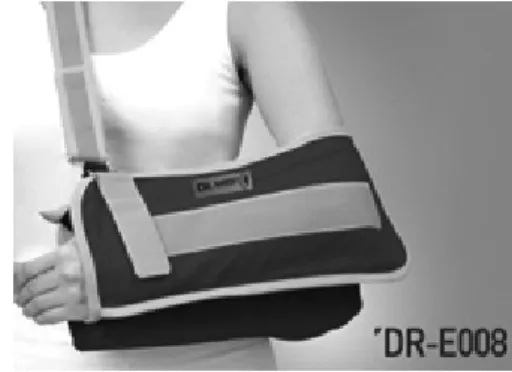
본 연구를 위해 사용된 팔걸이는 Ultra-Sling(Dr.
Med Co.LtD DR-E008)제품으로 일반적으로 견관 절 재질환의 수술 전, 후 외전고정 및 견관절 탈구용 으로 사용된다(Fig. 1).
보행 분석을 위해서 Treadmill Gait analysis 장비 (Zebirs Co.Ltd FDM-T)를 사용하였다. Treadmill Gait analysis 장비는 보행을 하는 동안 다양한 측 면에서 보행양상을 측정할 수 있다. 뇌졸중 후 편마 비 환자가 Treadmill 위에서 걸을 때의 보행양상 분 석을 통해, 1분간 보행수(Cadence), 보행속도(Ve- locity), 보행주기 동안의 입각기(Stance phase)와 비 환자들은 팔걸이로 비마비된 상지를 구속하지 않
았을 때에 비해 비마비된 상지를 구속했을 때 신체의 균형을 잡고 보행을 하는 데 어려움을 토로하였다.
뇌졸중 후 편마비 환자의 상지에 팔걸이를 착용할 경우 보행의 다양한 측면에서 긍정적인 영향을 미친 다는 연구결과들이 있다. 송근호
8)는 마비된 상지에 팔걸이를 착용했을 때 팔걸이를 착용하지 않은 환자 들에 비해 1분간 보행수(Cadence, step/min), 보행 속도(Walking velocity, km/h), 마비된 하지의 단하 지 지지기(Single support time, %), 시간적 비대칭 률(Temporal asymmetry, %), 마비된 하지의 한 발 짝 길이(Step length, cm), 공간적 비대칭률(Spatial asymmetry, %)에서 긍정적인 변화를 관찰하였으 며, 심영보
9)는 뇌졸중 후 편마비 환자의 마비된 상 지에 팔걸이를 착용하는 것이 안정성 지수(Stabil- ity index)
10), 체중 분포 지수(Weight Distribution index)
10), Berg 균형 척도(Berg balance scale)
11), Time Up & go test
12), 10m 보행속도 검사(10m Gait speed test)
13)에서 긍정적인 효과를 보여 기능 적 균형 및 보행 속도의 향상에 효과가 있음을 보고 하였다. 또한 Yavuzer 등
14)은 뇌졸중 후 편마비 환 자가 마비된 상지에 팔걸이를 착용했을 때 팔걸이가 고유수용감각으로 작용하여 상지를 재인식시켜 자 세 적응을 돕는다고 보고하였다. Faghri PD 등
15)은 고유수용감각 손상으로 인한 무시가 있는 뇌졸중 후 편마비 환자의 마비된 상지에 팔걸이를 착용했을 때 팔걸이가 마비된 상지에 주의를 기울일 수 있게 해 준다고 보고하였다. 이도경 등
16)은 팔걸이의 착용이 뇌졸중 후 편마비 환자의 기립자세가 치우치는 것을 감소시켜 균형 유지에 효과가 있으므로, 결과적으로 뇌졸중 후 편마비 환자의 보행에 긍정적인 효과가 있다고 주장하였다. 비록 팔걸이가 기능적인 활동을 방해할 뿐 아니라 마비된 상지의 굴곡을 증가시키기 때문에 그 효용성에 대해서는 논란이 있지만
15, 17), 그럼에도 불구하고 뇌졸중 후 편마비 환자들이 마비 된 상지에 팔걸이를 착용하지 않았을 때보다 팔걸이 를 착용했을 때 보다 향상된 안정감을 느끼기 때문 에 아직까지도 팔걸이는 널리 사용되고 있다
14).
하지만 기존의 연구 모두 뇌졸중 후 편마비 환자
Fig. 1. Ultra-sling(Dr.Med Co.Ltd DR-E008).
Table 2. Definitions of Gait Parameters
18). Temporal Gait Parameters
Cadence(step/min) Step frequency Velocity(km/h) Average gait speed
Stance phase(%) The phase of a gait cycle in which the foot has contact with the ground Swing phase(%) The phase of a gait cycle during which the foot has no contact with the
ground
Double support(%) The phase of contact time of the feet on the ground
Step time(sec) Time of within a gait cycle between the heel contact of one side of the body and the heel contact of the contralateral side
Stride time(sec) Time span of a stride Spatial Gait Parameters
Step length(cm) The distance between the heel contact of one side of the body and the heel contact of the contralateral side
Stride length(cm) The distance between two heel contacts on the same side of the body center of pressure Intersection point parameters
Anterior/Posterior Position(mm) The shift forwards or backwards of the Center of Pressure Intersection Point in chronological sequence in the cyclogram display
Lateral symmetry(mm) The left or right shift of the Center of Pressure Intersection Point in chrono- logical sequence in the cyclogram display
Table 1. Personal and medical information of a subject.
Patient characteristics
Name 정XX
Sex F
Age 70
Impression Cerebral-infarction(Rt.Basal Ganglia)
Onset 2013년 8월 25일
Chief complain Lt.side weakness, Lt.facial palsy, Dysarthria
Hypertension +
Diabetes mellitus none
Operation Uterine tumor OP(1993년)
Motor grade Upper Extremity Good
Motor grade Lower Extremity Good
Motricity index Shoulder 25
Elbow 25
Pinch Grip 26
Total of Upper extremity 77
Hip 25
Knee 25
Ankle 25
Total of Lower Extremity 76
1분당 보행수(Cadence), 보행속도(Velocity), 보 행주기 중 입각기(Stance phase)와 유각기(Swing phase), 양하지 지지기(Total double support), 한 발 짝 시간(Step time)과 한 걸음 시간(Stride time) 등 의 보행의 시간적인 변수들을 측정하였다. 측정조건 은 팔걸이를 비착용시(NO Sling), 마비된 상지에 착 용시(Affected side sling), 비마비된 상지에 착용시 (Unaffected side sling)로 구분하였다.
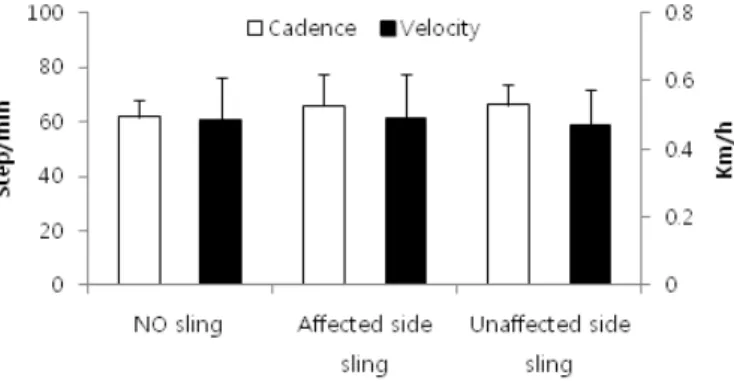
1) 1분간 보행수(cadence) 및 보행속도(Velocity) (Fig. 3)
1분간 보행수(step/min)은 NO Sling 61.88±6.19, Affected side sling 66.03±7.28, Unaffected side sling 66.18±11.44로, 팔걸이를 하지 않았을 때 보 다 마비된 상지 또는 비마비된 상지에 팔걸이를 했 을 때 보행수가 증가하였다. 보행속도(km/h)는 NO Sling 0.48±0.13, Affected side sling 0.49±0.11, Unaffected side sling 0.47±0.13였다.
2) 입각기(Stance phase) 및 유각기(Swing phase) (Fig. 4)
마비된 하지의 입각기(%)는 NO Sling 74.45±
8.62, Affected side sling 71.93±6.60, Unaffected side sling 75.26±8.83였고, 비마비된 하지의 입 각기(%)는 NO Sling 85.63±4.11, Affected side sling 81.98±3.95, Unaffected side sling 79.70±
14.06였다. 마비된 하지의 유각기(%)는 NO Sling 25.54±8.62, Affected side sling 28.07±6.60, Un- affected side sling 27.74±8.83였고, 비마비된 하 지의 유각기(%)는 NO Sling 14.37±4.11, Affect- ed side sling 18.01±3.95, Unaffected side sling 20.29±14.06였다.
유각기(Swing phase), 양하지 지지기(Total double support), 한 발짝 길이(Step length), 한 걸음 길이 (Stride length), 한 발짝 시간(Step time), 한 걸음 시간(Stride time), 질량중심 교차점(CoP Intersec- tion point)의 전후위치(Ant./Post. Position), 좌우대 칭성(Lateral symmetry) 등을 측정하였다(Table 2).
3. 실험순서
본 연구는 뇌졸중 후 편마비 환자에게 팔걸이 방 식을 달리하여 3일동안 실험을 진행하였다. 첫째 조건에서는 환자가 팔걸이를 착용하지 않았고(NO sling), 두번째 조건에서는 마비된 상지에 팔걸이를 착용했으며(Affected side sling), 세번째 조건에서 는 비마비된 상지에 팔걸이를 착용했다(Unaffected side sling)(Fig. 2). 각각 조건에서 Treadmill gait analysis 장비(Zebris Co.Ltd FDM-T)로 환자가 보행하는 동안 보행양상을 측정하였다. 환자가 1 분동안 Treadmill 위에서 보행하는 동안 측정 장 비는 0.05초 단위로 데이터를 기록하였다. 측정시 의 걷기 속도는 환자의 선호 속도(preferred speed) 로 하였다. 보행양상을 측정하기 전에 환자가 미리 Treadmill 위에서 걸으며 선호속도를 확인하였으며, Treadmill과 Speed에 충분히 적응을 한 후 측정을 시작하였다.
o 결과
1. 보행의 시간적인 변수(Temporal gait pa- rameter)
팔걸이의 착용 여부 및 착용방식이 뇌졸중 후 편 마비 환자의 보행에 미치는 영향을 확인하기 위해
Fig. 2. Experimental design.
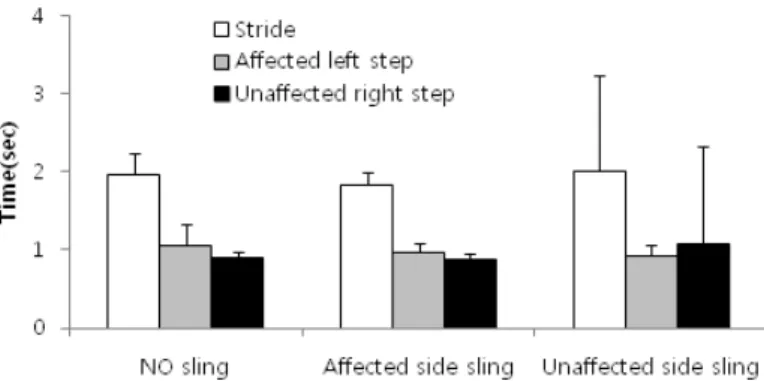
4) 한 발짝 시간(Step time) 및 한 걸음 시간(Stride time)(Fig. 6)
마비된 하지의 한 발짝 시간(sec)은 NO Sling 1.06±0.27, Affected side sling 0.97±0.11, Unaf-
3) 양하지 지지기(Total double support)(Fig. 5)양하지 지지기(%)는 NO Sling 60.11±8.73, Affected side sling 54.04±7.06, Unaffected side sling 54.74±11.05였다.
Fig. 3. Cadence(left scale) and Velocity(right scale) under three conditions, no arm sling, arm sling on affected side and, arm sling on unaffected side.
Fig. 4. Stance and swing phase under three conditions, no arm sling, arm sling on affected side and, arm sling on unaffected side.
Fig. 5. Total double support under three conditions, no arm sling, arm sling on affected side and, arm sling
on unaffected side.
상지에 착용시(Affected side sling), 비마비된 상지 에 착용시(Unaffected side sling)로 구분하였다.
1) 한 발짝 길이(Step length) 및 한 걸음 길이 (Stride length)(Fig. 7)
마비된 하지의 한 발짝 길이(cm)는 NO Sling 12.23±5.45, Affected side sling 9.66±4.32, Unaffected side sling 8.74±10.15였고, 비마비 된 하지의 한 발짝 길이(cm)는 NO Sling 13.64±
4.62, Affected side sling 14.81±3.35, Unaffected side sling 16.90±17.08였으며, 한 걸음 길이(Cm) 는 NO Sling 25.95±6.23, Affected side sling 24.74±5.00, Unaffected side sling 26.01±16.74 였다.
fected side sling 0.92±0.13였고, 비마비된 하지의 한 발짝 시간(sec)은 NO Sling 0.9±0.07, Affected side sling 0.87±0.08, Unaffected side sling 1.08±
1.25였으며, 한 걸음 시간(sec)은 NO Sling 1.97±
0.28, Affected side sling 1.84±0.17, Unaffected side sling 2.01±1.22였다.
2. 보행의 공간적인 변수(Spatial Gait pa- rameter)
팔걸이의 착용 여부 및 착용방식이 뇌졸중 후 편 마비 환자의 보행에 미치는 영향을 확인하기 위해 한 발짝 길이(Step length)와 한 걸음 길이(Stride length)등의 보행의 공간적인 변수들을 측정하였다.
측정조건은 팔걸이를 비착용시(NO Sling), 마비된
Fig. 6. Step and stride time under three conditions, no arm sling, arm sling on affected side and, arm sling on unaffected side.
Fig. 7. Step and stride length under three conditions, no arm sling, arm sling on affected side and, arm sling
on unaffected side.
한 걸음 시간, 비마비된 하지의 한 발짝 길이, 한 걸 음 길이의 변동성(Variability)이 증가한 결과를 얻 었다.
보행 변동성(Gait variability)은 보행주기 동안 각 발짝(Step) 사이의 보행요소들의 변동(Fluctuation) 으로 정의된다
19). 보행 변동성은 정상인에 비해 뇌 졸중 후 편마비 환자에게서 양발간 너비(Stride width)를 제외한 모든 시공간적인 보행 변수에서 증 가한다
20). 이는 마비된 하지뿐 아니라 비마비된 하 지에서도 같이 나타나지만, 일반적으로는 마비된 하 지에서 비마비된 하지보다 변동성이 증가하는 경 향을 보인다
20). 이러한 보행 변동성의 증가는 균형 장애로 인한 낙상과 연관이 깊고
21), 운동기능장애 (Motor disability)를 예측하는데 사용될 수 있기 때 문에
22), Balasubramanian 등
20)은 보행 변동성의 증 가가 뇌졸중 후 편마비 환자의 보행시 불량한 균형 과도 연관될 수 있다고 보고하였다.
정상인의 보행에서 상지의 고정은 체간상부의 안 정성을 감소시킨다
23). 이는 상지가 횡단면에서의 골 반부 회전과 반대방향으로 회전을 일으키며 보상작 용을 하여 몸의 균형을 유지하는 역할을 하기 때문
이다
24-26). 또한 Marks 등
27)은 한 명의 정상 성인을
대상으로 한쪽 상지를 고정한 후 운동형상학적 분석 을 한 결과 하지의 수평적인 이동이 변화했고, 발의 궤적은 매우 불안정했음을 보고하였다.
기존 연구들
20, 21, 23, 27)을 근거로 하였을 때, 본 연 구에서 비마비된 상지에 팔걸이를 착용한것은 환자
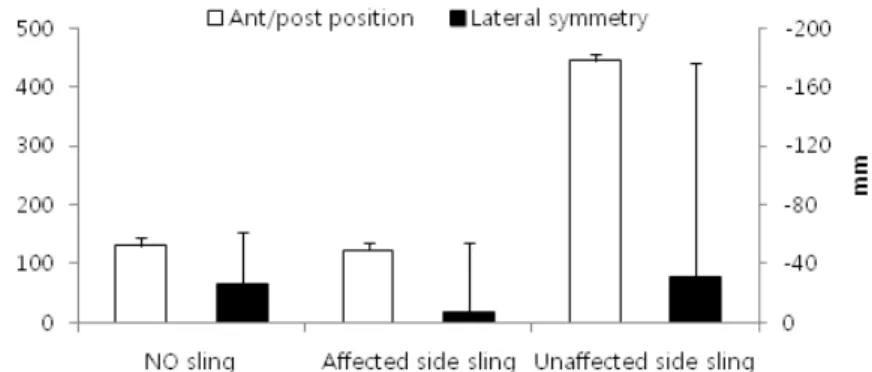
3. 질량중심의 교차점 변수(CoP Intersectionpoint parameter)
팔걸이의 착용 여부 및 착용방식이 뇌졸중 후 편 마비 환자의 보행에 미치는 영향을 확인하기 위해 전후위치(Ant./Post. Position)와 좌우대칭성(Lateral symmetry) 등의 질량중심의 교차점변수(CoP Inter- section point parameter)를 측정하였다. 측정조건 은 팔걸이를 비착용시(NO Sling), 마비된 상지에 착 용시(Affected side sling), 비마비된 상지에 착용시 (Unaffected side sling)로 구분하였다.
1) 전후위치(Ant./Post. Position) 및 좌우대칭성 (Lateral symmetry)(Fig. 8)
전후위치(mm)는 NO Sling 131±14, Affected side sling 123±14, Unaffected side sling 445±
10였고, 좌우대칭성(mm)은 NO Sling 226±35, Affected side sling 27±47, Unaffected side sling 231±145였다.
o 고찰 및 결론
본 연구에서는 팔걸이의 착용이 뇌졸중 후 편마비 환자의 보행에 미치는 영향을 알아보기 위하여 각 각 팔걸이를 착용하지 않았을 때, 마비된 상지에 팔 걸이를 착용했을 때, 비마비된 상지에 팔걸이를 착 용했을 때로 나누어 보행양상의 변화를 측정하였다.
이에 비마비된 상지에 팔걸이를 착용했을 때 비마 비된 하지의 유각기, 비마비된 하지의 한 발짝 시간,
Fig. 8. Ant./Post. Position(left scale) & lateral symmetry(right scale) of CoP intersection point(mm) under three
conditions, no arm sling, arm sling on affected side and, arm sling on unaffected side.
환자가 보다 균형잡힌 보행을 한 것으로 사료되며 기존 연구
14)와 일치하는 효과를 보였다.
본 연구의 결과를 볼 때, 마비된 상지에 팔걸이를 착용하는 것은 환자가 보다 안정적인 보행을 하도록 했고, 비마비된 상지에 팔걸이를 착용하는 것은 환 자의 보행을 돕기보다는 보행의 불안정성을 증가시 켰다. 하지만, 본 연구에서는 단 1명의 환자를 대상 으로 하였고, 보행양상을 각각 1회씩만 측정하였으 며, 다양한 종류의 팔걸이로 실험을 진행하지 못한 제한점을 갖고 있다. 또한 질량중심 교차점의 전후 위치, 좌우대칭성과 연관이 깊은 골반의 운동학(Ki- nematics) 변수를 측정하지 못 하였고, 상지와 하지 의 상호협응력(Coordination)에 대해서도 측정하지 못하였다. 향후 본 연구의 이와 같은 제한점을 해결 한 광범위한 연구가 추가적으로 진행된다면, 뇌졸중 후 편마비 환자의 균형과 보행에 상지가 미치는 영 향 또한 명확하게 밝힐 수 있을 것이라 사료된다.
참고문헌
01. Taub E, Uswatte G, Pidikiti R. Constraint-in-
duced movement therapy: a new family of techniques with broad application to phys- ical rehabilitation-a clinical review. Journal of rehabilitation research and development.1999;36(3):237-51.
02. Wolf SL, Winstein CJ, Miller JP, Taub E,
Uswatte G, Morris D, et al. Effect of con- straint-induced movement therapy on upper extremity function 3 to 9 months after stroke.JAMA: the journal of the American Medical As- sociation. 2006;296(17):2095-104.
03. Page SJ, Sisto S, Levine P, McGrath RE. Effi-
cacy of modified constraint-induced movement therapy in chronic stroke: a single-blinded ran- domized controlled trial. Archives of physical medicine and rehabilitation. 2004;85(1):14-8.04. Kunkel A, Kopp B, Müller G, Villringer K,
Villringer A, Taub E, et al. Constraint-induced movement therapy for motor recovery in chron- ic stroke patients. Archives of physical medicine and rehabilitation. 1999;80(6):624-8.05. Miltner WH, Bauder H, Sommer M, Dettmers 의 보행시 균형을 불안정하게 만들었다고 사료된다.
그러나 비마비된 상지에 팔걸이를 착용했을 때 보 행속도, 1분간 보행수, 양하지 지지기, 양측 하지의 입각기의 변동성에는 변화가 없었다. 이는 Tread- mill의 속도를 일정하게 설정했고, 팔걸이를 통한 비마비된 상지의 구속이 비마비된 하지의 유각기를 제외하고 나머지 보행 주기에는 영향을 미치지 못했 기 때문으로 사료된다.
본 연구에서는 비마비된 상지에 팔걸이를 착용했 을 때 질량중심의 전후위치가 전방으로 편중되고 좌 우대칭성의 변동성이 커졌다. Ustinova 등
28)은 시상 면에서 질량중심의 전후위치를 보았을 때, 정상인은 상지의 전방 움직임과 반대로 체간이 후방 이동하여 전체적인 질량중심의 이동을 감소시키지만 뇌졸중 후 편마비 환자는 마비된 측의 체간이 제대로 후방 이동하지 못하기 때문에 전체적인 질량중심이 전방 으로 이동한다고 보고하였다. 또한 Tyson 등
29)은 질 량중심의 좌우대칭성은 보행능력이 호전될수록 좌 우로 움직이는 정도가 감소하여 중심으로 모인다고 보고하였고, Iida Hirokazu 등
30)은 운동기능이 떨어 지는 환자일수록 좌우로 움직이는 정도가 증가한다 고 보고하였다. 이를통해 본 연구에서 비마비된 상 지에 팔걸이를 착용한 것은 보행시 균형의 불안정성 을 증가시켰다고 사료된다.
보행의 진행선상에서 질량중심의 이동을 최소화 하는 것은 보행 시 근육의 수고(Effort)를 감소시키 고, 더 나아가서는 소모되는 에너지를 절약할 수 있 다
31). 그러나 뇌졸중 후 편마비 환자는 비능률적인 보행으로 인해 질량중심의 과도한 움직임이 나타난 다
32). 이에 Yavuzer 등
14)은 관상면, 시상면, 수평면 에서 질량중심의 전체 움직임은 정상인에 비하여 뇌 졸중 후 편마비 환자에게 더 많이 나타났지만, 뇌졸 중 후 편마비 환자의 마비된 상지에 팔걸이를 착용 했을 때 질량중심의 움직임이 유의하게 감소했다고 보고하였다.
본 연구에서도 환자의 마비된 상지에 팔걸이를 착
용했을 때 질량중심 교차점(CoP Intersection point)
의 전후위치는 팔걸이를 착용하지 않았을 때에 비하
여 변화가 없었지만 좌우대칭성은 감소하였다. 이는
hemiplegic stroke patients. Archives of physical medicine and rehabilitation. 1994;75(1):73-9.
16. 이도경, 한승진, 윤성익, 김미정, 이규훈. 팔걸이 가 편마비 환자의 기립자세 균형에 미치는 영향.
대한재활의학회지. 2004.
17. Chantraine A, Baribeault A, Uebelhart D, Gremion G. Shoulder pain and dysfunction in hemiplegia: effects of functional electrical stimulation. Archives of physical medicine and rehabilitation. 1999;80(3):328-31.
18. Zebris. Zebris FDM 1.0 Software user manual.
2012.
19. Gabell A, Nayak U. The effect of age on variability in gait. Journal of Gerontology.
1984;39(6):662-6.
20. Balasubramanian CK, Neptune RR, Kautz SA.
Variability in spatiotemporal step characteris- tics and its relationship to walking performance post-stroke. Gait & posture. 2009;29(3):408-14.
21. Hausdorff JM, Rios DA, Edelberg HK. Gait variability and fall risk in community-living older adults: a 1-year prospective study. Ar- chives of physical medicine and rehabilitation.
2001;82(8):1050-6.
22. Brach JS, Studenski S, Perera S, VanSwearin- gen JM, Newman AB. Stance time and step width variability have unique contributing impairments in older persons. Gait & posture.
2008;27(3):431-9.
23. Wolfson L, Whipple R, Amerman P, Tobin JN.
Gait assessment in the elderly: a gait abnormali- ty rating scale and its relation to falls. Journal of Gerontology. 1990;45(1):M12-M9.
24. Hogue RE. Upper-extremity muscular activity at different cadences and inclines during normal gait. Physical therapy. 1969 09/;49(9):963-72.
25. Murray MP, Sepic SB, Barnard EJ. Patterns of sagittal rotation of the upper limbs in walking.
Phys Ther. 1967 04/01;47(4):272-84. eng.
26. Ohsato Y. Relationships between trunk rota- tion and arm swing in human walking. Nihon Seikeigeka Gakkai zasshi. 1993;67(5):440.
27. Marks R. The effect of restricting arm swing during normal locomotion. Biomedical sciences instrumentation. 1997;33:209.
C, Taub E. Effects of Constraint-Induced Move- ment Therapy on Patients With Chronic Motor Deficits After Stroke A Replication. Stroke.
1999;30(3):586-92.
06. Taub E, Uswatte G, King DK, Morris D, Cra-
go JE, Chatterjee A. A placebo-controlled trial of constraint-induced movement thera- py for upper extremity after stroke. Stroke.2006;37(4):1045-9.
07. Viana R, Teasell R. Barriers to the Implementa-
tion of Constraint-Induced Movement Therapy Into Practice. Topics in Stroke Rehabilitation.2012;19(2):104-14.
08. 송근호, 이현옥. 팔걸이가 편마비환자의 보행에
미치는 영향. 대한물리치료학회지. 2006.09. 심영보, 최원호. 팔걸이가 편마비 환자의 균형과
보행 속도에 미치는 효과. 2011.10. Kohen-Raz R, Kohen-Raz A, Erel J, Davidson B. Postural control in pilots and candidates for flight training. Aviation, space, and environmen- tal medicine. 1994.
11. Berg K, Wood-Dauphinee S, Williams J. The Balance Scale: reliability assessment with elder- ly residents and patients with an acute stroke.
Scandinavian journal of rehabilitation medicine.
1995;27(1):27-36.
12. Shumway-Cook A, Anson D, Haller S. Postural sway biofeedback: its effect on reestablishing stance stability in hemiplegic patients. Ar- chives of physical medicine and rehabilitation.
1988;69(6):395-400.
13. Bohannon RW. Recovery and correlates of trunk muscle strength after stroke. International journal of rehabilitation research Internationale Zeitschrift fur Rehabilitationsforschung Revue internationale de recherches de readaptation.
1995 06/;18(2):162-7.
14. Yavuzer G, Ergin S. Effect of an arm sling on gait pattern in patients with hemiplegia. Ar- chives of physical medicine and rehabilitation.
2002;83(7):960-3.
15. Faghri PD, Rodgers MM, Glaser RM, Bors JG, Ho C, Akuthota P. The effects of functional electrical stimulation on shoulder subluxation, arm function recovery, and shoulder pain in
30. Iida H, Yamamuro T. Kinetic analysis of the center of gravity of the human body in normal and pathological gaits. Journal of biomechanics.
1987;20(10):987-95.
31. Perry J, Burnfield JM. Gait analysis: normal and pathological function: Slack; 1993.
32. J.M. Adams JP. Gait analysis: clinical applica- tion. Baltimore: Williams & Wilkins; 1994.
28. Ustinova KI, Goussev VM, Balasubramaniam R, Leven M. Disruption of coordination between arm, trunk, and center of pressure displacement in patients with hemiparesis. MOTOR CON- TROL-CHAMPAIGN-. 2004;8(2):139-59.
29. Tyson SF. Trunk kinematics in hemiplegic gait and the effect of walking aids. Clinical rehabili- tation. 1999;13(4):295-300.