stress https://doi.org/10.17547/kjsr.2020.28.1.1
제 2형 당뇨병 노인의 우울증상과 혈당조절에 대한 지역사회 기반 심리 중재의 효과: 체계적 문헌고찰과 메타분석
유혜진
1
ㆍ황보영2
1
서 울 대 학 교 간 호 대 학 ㆍ시 립 은 평 병 원 ,2
서 울 대 학 교 간 호 대 학 ㆍ간 호 과 학 연 구 소Effects of Community- Based Psychological Interventions on Depressive Symptoms and Blood Glucose Control for Older Individuals with Type 2 Diabetes: A Systematic Review and Meta- Analysis
Heajin Yu 1 , Boyoung Hwang 2
1
College of Nursing, Seoul National University & Seoul Metropolitan Eunpyeong Hospital,
2College of Nursing & The Research Institute of Nursing Science, Seoul National University, Seoul, Korea
Received July 15, 2019 Revised February 13, 2020 Accepted February 14, 2020 Corresponding author Heajin Yu
College of Nursing, Seoul National University, 103 Daehak-ro, Jongro-gu, Seoul 13080, Korea Tel: +82-2-740-8477 Fax: +82-2-740-8477 E-mail: [email protected] ORCID:
Heajin Yu
(https://orcid.org/0000-0003-2555-8070) Boyoung Hwang
(https://orcid.org/0000-0003-1786-7236)
Copyright © 2020 by stress. All rights reserved.Key messages
본 연구에서는 노인 당뇨 환자를 대상으로 한 지역사회 기반 심리 중재가 환자들의 우울 증상과 혈당조 절에 미치는 효과를 체계적으로 고찰하였다. 국내외 7개의 데이터베이스를 사용하여, 2008년 1월 1일부터 2018년 7월 31일까지 발표된 문헌들을 확인하였다. 선정기준에 따라 다섯 편의 연구가 최종 선정되었으 며, 총 대상자는 제2형 당뇨 진단을 받은 지역사회 거주 노인 596명이었다. 메타분석에 선정된 네 편의 연구 모두 행동 교육을 목적으로 프로그램을 구성하였다. 추후에는 표본 크기를 늘려 심리적 중재 프로그램 을 시행하는 것이 바람직하며 더욱 다양한 지역에서 수행하는 것이 필요함을 확인할 수 있었다.
중심단어: 당 뇨 , 우 울 , 노 인 , 심 리 적 중 재 프 로 그 램 , 체 계 적 문 헌 고 찰
Abstract
Background: To review the effects of community-based psychological interventions on depressive symptoms and blood glucose levels of older individuals with type 2 diabetes (T2D).
Methods: A literature search was conducted using seven electronic databases (CINAHL, EMbase, PubMed, CENTRAL, KoreaMed, KISS, and KMbase). The main search terms were ‘diabetes’, ‘depre- ssion’, ‘older adult’, and ‘psychological intervention’. The search was restricted to peer-reviewed RCTs published between January 1, 2008 and July 31, 2018.
Results: Five studies with a total of 596 participants met the inclusion criteria. Four studies that were included in the meta-analysis incorporated some form of behavioral strategies. Depressive symptoms were measured in four of the five studies, and HbA1c was measured in two of the five studies. The pooled SMD for depressive symptoms was − 0.13 (95% CI, − 0.31, 0.04; p=0.13) and − 0.63 (95% CI,
− 0.98, − 0.28; p < 0.001) for HbA1c.
Conclusions: This review highlights the need for additional clinical trials for psychological interventions in older individuals with T2D, especially trials on a larger scale with a wider geographical scope.
Key Words: Diabetes, Depression, Older adults, Psychological interventions, Systematic review REVIEW ARTICLE
Introduction
Diabetes mellitus (DM) is a serious health con- dition that is approaching epidemic proportions (Hu, 2011). According to the World Health Orga-
nization (WHO), roughly 400 million adults are diagnosed with DM worldwide (World Health Or- ganization [WHO], 2016). T2D results from the abnormal regulation of glucose metabolism and is known to be the most common type of DM. The
risk of T2D increases with advancing age, and therefore, it is approximately eight times more prevalent in the older population than in younger adults.
With its increasing prevalence and the aging of the population, it is estimated that the number of older individuals diagnosed with T2D will increase more than fourfold from 2005 to 2050 (Kirkman
et al
., 2012). This indicates that T2D will continue to be a considerable burden on healthcare systems and societies (de Vrieset al
., 2016).T2D is a chronic, debilitating disorder that affects various body systems simultaneously, resulting in serious complications. Some of the major compli- cations of T2D are neuropathy, nephropathy, re- tinopathy, and macrovascular problems (Sjostrom
et al
., 2014). In addition to these physiological com- plications, depression is a common comorbidity.Approximately 18% of diabetic patients have dia- betes-specific emotional distress, and 20 to 40%
of them end up being diagnosed with depression (Mushtaque
et al
., 2016). Depression in DM ne- gatively affects the patient’s physical and mental functioning, which results in difficulty controlling hemoglobin A1c (HbA1c) and following recommen- dations for diet, exercise, and self-care (de Vrieset al
., 2016).Psychological well-being is one of the ultimate goals of holistic diabetes management, yet little attention has been given to the psychological implications of DM. Psychological interventions are a subset of non-pharmacological interventions in diabetes management and have been shown to be effective in decreasing symptoms of depression and blood glucose levels (Safren
et al
., 2013;Chapman
et al
., 2015). There is increasing evi- dence of the acceptability and feasibility of com- munity-based psychological interventions for indi- viduals with DM, but evidence of their effecti- veness is yet to be explored, especially for older individuals (Beverlyet al
., 2013).The vast majority of older individuals dwell in community settings. Most visit their primary health care providers for the management of DM. However, there is a major barrier in the form of very limited time availability for comprehensive care (Glasgow
et al
., 2004). Studies have shown that various interventions for older diabetic individuals are available in community settings. Community-based programs that focused on dietary changes, exercise, health behavior changes, and psycholo- gical support (including psychological interventions) have shown substantial benefits in the prevention and management of T2D (Shirinzadeh
et al
., 2019).However, no systematic review to date has been conducted to synthesize the effects of community- based psychological interventions for depressive symptoms and blood glucose levels in the older diabetic population. The purpose of this systematic review and meta-analysis was to review the effects of community-based psychological interventions among older diabetic adults on depressive symptoms and blood glucose levels. The specific aims were:
1) to identify the types of psychological interven- tions used for older diabetic individuals in com- munity or outpatient settings; and 2) to determine the effectiveness of psychological interventions on depressive symptoms and blood glucose levels in older diabetic individuals.
Materials and Methods
This study was conducted following the Preferred Reporting Items for Systematic Review and Meta- analysis (PRISMA) guidelines for systematic reviews of interventions (Cochrane Handbook, 2018).
1. Eligibility criteria and study selection
Studies were included in the review if the follo- wing criteria were met: 1) studies that focused on adults with T2D; 2) studies that included older adults (aged 60 years or older) only, or reported results from a subgroup of adults aged 60 years or older; 3) primary research studies that inves- tigated psychological interventions; 4) studies that included the outcomes of depressive symptoms; 5) studies that tested the effects of psychological interventions in community settings; 6) RCTs; and 7) studies published in English or Korean. In this review, the term “psychological interventions” was defined as psychological therapies based on psycho- therapeutic principles, such as cognitive- behavioral therapy (CBT), non-directive counseling, motivational interviewing, and supportive therapy (Ismail
et al
., 2004).2. Search strategy
We systematically searched seven electronic data-
bases to identify relevant and eligible research trials. Studies published in English were identified by searching Cumulative Index to Nursing and Allied Health Literature (CINAHL), Cochrane Cen- tral Register of Controlled Trials (CENTRAL), EMbase, PubMed, and KoreaMed. In the following databases, the search terms were entered in Korean: Korean Studies Information Service Sys- tem (KISS) and Korean Medical Database (KMbase).
The search queries within each electronic data- base were created based on the PubMed Clinical Queries. The search was restricted to peer- reviewed RCTs published between January 1, 2008 and July 31, 2018. Search terms included: “type 2 diabetes”, “diabetes mellitus”, “diabetes”, “adult onset diabetes mellitus”, “community-based psychological interventions”, “aged”, “older patients”, “elderly pa- tients”, “depression”, “emotional depression”, “depre- ssive symptoms”, “psychological intervention”, “psy- chotherapy”, “therapy”, and “program.” All of these search terms were then exploded to increase the search yield. Controlled vocabularies, such as Medical Subject Headings (MESH), EMTREE terms, and CINHAL subject headings, were used along with free-text terms. Only free-text terms were combined when searching in Korean databases.
3. Data collection and analysis methods
Eligible studies were identified by both authors and inter-rater reliability was reported by using Cohen’s K (Mchugh, 2012). The degree of inter- rater reliability agreement between the reviewers was moderate (Cohen’s K=0.56; 95% CI, 0.19, 0.92). Disagreements were resolved by discussion.
The data were extracted and coded in a standard way for the study sample and the characteristics of therapy in the intervention and control group.
Pertinent data of the trial characteristics were extracted using the Cochrane’s review data extra- ction form. Effect sizes were calculated to assess the effectiveness of psychological interventions on depressive symptoms and glycemic controls using Review Manager 5.3 software (RevMan). The overall effect size was estimated by calculating the weighted mean difference, 95% confidence intervals, and standardized mean differences (SMD).
For the computational model, the fixed-effect model was applied since the data were homoge- neous (common true treatment effect).
For the sake of completeness, Cochran’s Q-test and Higgins’
I 2
statistics were used to quantify statistical heterogeneity. Before using these statis- tical methods, forest plots were used to see the directions of the effect sizes and confidence in- tervals and whether they were overlapping. Hig- gins’I 2
values of 25%, 50%, and 75% were set as representing low, moderate, and high heteroge- neity, respectively (Higginset al
., 2001).4. Risk of bias assessment
To assess the quality of each study, we used the Cochrane RoB, which assesses five different areas:
sequence generation, allocation concealment, blin- ding of outcome assessors, incomplete outcome data, and selective outcome reporting (Cochrane Handbook, 2018). Both authors independently rated bias using the selection process. Any dis- crepancies were resolved through discussion. The level of agreement (Mchugh, 2012) was excellent (intraclass correlation coefficient, 0.89, 95% CI, 0.78, 0.95).
Results
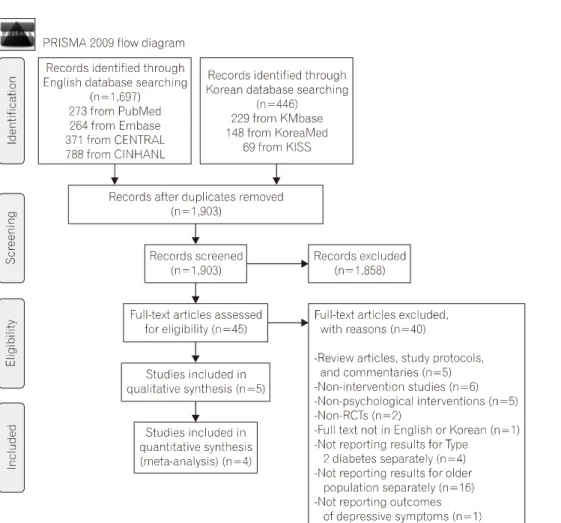
The initial search yielded 2,143 articles (Fig. 1).
After all duplicates were eliminated, a total of 1,903 abstracts and titles were reviewed. A total of 45 RCTs were included for full-text review.
Five RCTs (Bond
et al
., 2010; Taveiraet al
., 2011;Nowlan
et al
., 2015; Weisset al
., 2015; Markle- Reidet al
., 2018) were included in a qualitative literature synthesis and a description of changes in depressive symptoms and blood glucose controls.Among those excluded from the review, there were five RCTs of intervention programs for com- munity-residing older adults with T2D. These studies did not meet the inclusion criteria because the interventions were non-psychological in nature.
Specifically, the following intervention programs were tested in these studies: peer advisor program (Baksi
et al
., 2008), pharmacotherapy (Bogneret
al
., 2010), diabetes education (Gagliardinoet al
., 2013), patient prioritized planning (de Vrieset al
., 2016), and nurse-administered pharmacological intervention (Lamerset al
., 2011). Among the five RCTs included in the qualitative synthesis, one study (Nowlanet al
., 2015) that did not report variance data was excluded from the quantitativeFig. 1. PRISMA flow diagram.
literature synthesis.
1. Participant characteristic
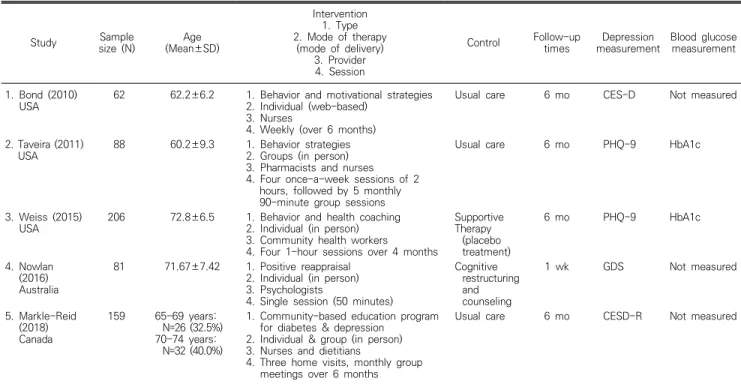
Table 1 summarizes the key characteristics of the studies that were included in the review. Five studies (Bond
et al
., 2010; Taveiraet al
., 2011;Nowlan
et al
., 2015; Weisset al
., 2015; Markle- Reidet al
., 2018) with a total of 569 participants met the inclusion criteria. Sample sizes ranged from 62 to 206 (median, 88). The participants’mean age ranged from 60.2 to 72.8 (median, 66.5) years. Approximately 40% of the participants were female. Four of the studies reported the length of time that participants had T2D, with the range being 7.4 to 20 years.
2. Study characteristics
The publication years ranged between 2007 and 2018, and three (Nowlan
et al
., 2015; Weisset al
., 2015; Markle-Reidet al
., 2018) of the five studies were published within the last five years. The studies were conducted in three countries: The United States (n=3), Canada (n=1), and Australia(n=2). The average length of the intervention period was 8.2 (1
∼
45) weeks, and the average number of intervention sessions was 7 (1∼
13). In three (Bondet al
., 2010; Nowlanet al
., 2015;Weiss
et al
., 2015) out of the five studies, interventions were delivered individually. The remaining two (Bondet al
., 2010; Taveiraet al
., 2011) were delivered in web-based and group formats, respectively. The psychological interven- tions tested in four studies (Bondet al
., 2010;Taveira
et al
., 2011; Weisset al
., 2015; Markle- Reidet al
., 2018) incorporated some form of behavioral strategies, and one study (Nowlanet al
., 2015) included positive reappraisal. In three out of the five studies (Bondet al
., 2010; Tavieraet al
., 2011; Markle-Reidet al
., 2018), the control group received usual care or standard treatment.In the remaining two studies placebo therapy (Weiss
et al
., 2015) and an alternative intervention (Nowlanet al
., 2016) were provided to the control group, respectively.The participants were recruited from diabetes centers or healthcare clinics in five RCTs (Bond
et
Table 1. Descriptive summary of included studies
Study Sample
size (N) Age
(Mean±SD)
Intervention 1. Type 2. Mode of therapy
(mode of delivery) 3. Provider 4. Session
Control Follow-up
times Depression
measurement Blood glucose measurement
1. Bond (2010)
USA 62 62.2±6.2 1. Behavior and motivational strategies 2. Individual (web-based)
3. Nurses
4. Weekly (over 6 months)
Usual care 6 mo CES-D Not measured
2. Taveira (2011)
USA 88 60.2±9.3 1. Behavior strategies
2. Groups (in person) 3. Pharmacists and nurses 4. Four once-a-week sessions of 2
hours, followed by 5 monthly 90-minute group sessions
Usual care 6 mo PHQ-9 HbA1c
3. Weiss (2015)
USA 206 72.8±6.5 1. Behavior and health coaching
2. Individual (in person) 3. Community health workers 4. Four 1-hour sessions over 4 months
Supportive Therapy
(placebo treatment)
6 mo PHQ-9 HbA1c
4. Nowlan (2016) Australia
81 71.67±7.42 1. Positive reappraisal 2. Individual (in person) 3. Psychologists
4. Single session (50 minutes)
Cognitive restructuring and counseling
1 wk GDS Not measured
5. Markle-Reid (2018) Canada
159 65-69 years:
N=26 (32.5%) 70-74 years:
N=32 (40.0%)
1. Community-based education program for diabetes & depression
2. Individual & group (in person) 3. Nurses and dietitians
4. Three home visits, monthly group meetings over 6 months
Usual care 6 mo CESD-R Not measured
PHQ-9: The Patient Health Questionnare-9, GDS: Geriatric Depression Scale, CES-D: Center for Epidemiologic Studies Depression Scale, CES-D-R: 10 item Center for Epidemiologic Studies Depression Scale, HbA1c: hemoglobin A1c.
Fig. 2. Risk of bias (RoB).
Fig. 3. Forest plots of the effect of psychological interventions on depressive symptoms and blood glucose control.
al
., 2010; Taveiraet al
., 2011; Nowlanet al
., 2015; Weisset al
., 2015; Markle-Reidet al
., 2018).In all trials, outcomes were measured at baseline and at six-month follow-up. Four measures of depressive symptoms were identified: The Patient Health Questionnaire-9 (PHQ-9), Geriatric Depre- ssion Scale (GDS), Center for Epidemiologic Stu- dies Depression Scale (CES-D), and 10-item Center for Epidemiologic Studies Depression Scale (CES- D-R). To measure blood glucose control, HbA1c levels were used in the studies.
3. Risk of bias
Figure 2 presents details on the quality assess- ment of the included studies.
Of the five RCTs, four (80%) adequately des- cribed their randomization sequence (Bond
et al
., 2010). Two of the five studies (40%) adequately demonstrated allocation concealment (Taveiraet al
., 2011; Weisset al
., 2015). Three studies (Bondet al
., 2010; Nowlanet al
., 2015; Markle-Reidet al
., 2018) did not provide a clear description, so they were rated as unclear. Blinding of parti- cipants, personnel, and outcome assessors was not entirely possible for the included studies. In all five studies (Bondet al
., 2010; Taveiraet al
., 2011; Nowlanet al
., 2015; Weisset al
., 2015;Markle-Reid
et al
., 2018), blinding of study per-sonnel was not described; all were rated as either high or unclear. For the attrition bias assessment, only two studies (40%) were free from frequent missing data (Nowlan
et al
., 2015; Weisset al
., 2015). In the three remaining studies (Bondet al
., 2010; Taveiraet al
., 2011; Markle-Reidet al
., 2015, 2018), no information was provided concerning the attrition rate or reasons for missing data.Lastly, for the selective reporting assessment, one study (20%) provided a study protocol (Weiss
et al
., 2015). The other studies either provided insufficient information, or the study protocol could not be located.4. Effectiveness of the interventions on depressive symptoms and blood glucose control
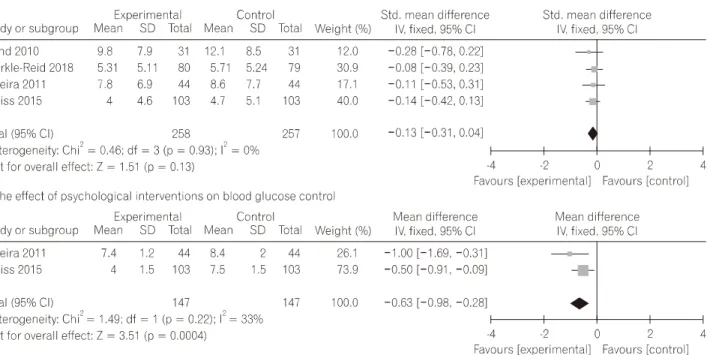
Figure 3 shows the forest plots for the effect sizes of psychological interventions on depressive symptoms and blood glucose control, respectively.
For depressive symptoms, there were four trials (515 participants) in the review with data that could be pooled. Individually, two studies showed statistically significant improvement in the inter- vention groups for depressive symptoms. In the fixed-effect model, the pooled SMD in the impro- vement of depressive symptoms between parti- cipants assigned to the psychological intervention group and those assigned to the control group was
not statistically significant (
d
=0.13; 95% CI,−
0.31, 0.04; p=0.31). The Cochrane Q andI 2
scores indicated low heterogeneity (Q value=0.46; p=0.93;I 2
=0%).HbA1c was measured in two of the five studies with 294 participants. Both studies reported im- provement of HbA1c in the intervention group. At a six-month follow-up, HbA1c had fallen by 1.44% (from a baseline of 7.75%) in 147 parti- cipants in the intervention group and by 0.05%
(from a baseline of 8%) among the remaining 147 participants in the control group. The pooled SMD of blood glucose control (HbA1c) was (
d
=0.63;95% CI,
−
0.98,−
0.28; p<
0.001), indicating a medium effect size. The Cochran Q test andI 2
scores for HbA1c (Q value=1.49, p=0.22,I 2
=33%) indicated low to moderate heterogeneity.5. Publication bias
Tests of heterogeneity showed that the included studies were sufficiently homogeneous to be included in the meta-analysis. Due to the small number of studies, we were unable to assess pub- lication bias.
Discussion
We identified five RCTs that examined the effects of community-based psychological inter- ventions on depressive symptoms and blood glucose levels in older individuals with T2D. The results were derived from studies involving 596 participants from three countries. The meta-an- alysis indicated that the effect size for depressive symptoms was small and not statistically signi- ficant. We found that psychological interventions had a significant overall effect in reducing blood glucose levels in older individuals with T2D. The effect was moderate in size. By means of a risk of bias assessment, most of the trials were rated as moderate in quality, and the overall statistical heterogeneity was low.
To the best of our knowledge, this is the first systematic review of the effects of psychological interventions in community-dwelling older indivi- duals with T2D. We used multiple types of elec- tronic databases with a rigorous search strategy to identify eligible studies, which contributed to a higher sensitivity of the review. Moreover, the
selection of eligible trials and quality assessment were completed independently by trained resear- chers, resulting in sufficient reliability. Even when only using a relatively small number of trials to perform the meta-analysis, it was possible to quantify the effect of depressive symptoms in conjunction with glycemic control. The low variance within the interventions and the lack of statistical heterogeneity of the findings indicate that the studies are highly consistent (Higgins, 2003).
Our review has several limitations that need to be highlighted. First, all of the RCTs included were conducted in Western nations, whereas T2D is most prevalent in the South Pacific and South- east Asia. Moreover, in two of the five studies, 97% of the participants were Caucasian, while all of the participants in another study were African- American. Therefore, the generalizability of our findings may be limited to populations with similar characteristics. Second, in all of the included studies, the method of blinding was not fully described or was unclear, which might have resulted in performance bias (Cochrane Handbook, 2018). Third, the methods of psychological inter- vention included in our meta-analysis were not uniform. However, because all four interventions had in common that their foundations were based on behavioral strategies and the overall hetero- geneity of the studies was on the lower side, we proceeded to conduct a meta-analysis. Fourth, various types of comparison conditions were used in the studies and this may have affected study findings. Among the three studies that compared psychological interventions to usual care or standard treatment (Bond
et al
., 2010; Tavieraet al
., 2011; Markle-Reidet al
., 2018), the intervention group had a significant reduction in depressive symptoms in two studies (Bondet al
., 2010;Markle-Reid
et al
., 2018). No intervention effect on depressive symptoms was observed in the studies using placebo or alternative therapy as a comparison group (Weisset al
., 2015; Nowlanet al
., 2016). Therefore, it is possible that the reduction in depressive symptoms may have resulted from non-specific therapeutic factors (i.e., the provision of attention, care, or social support) rather than the intervention per se (Oeiet al
., 1996).One RCT was excluded from our review because
it did not report the full quantitative results of the outcomes (only F-values were provided). Research studies with negative outcomes occasionally fail to provide full results (Heneghan
et al
., 2017).Also, the RCT that was excluded from our review had some non-significant results regarding anxiety and depressive symptoms. Accordingly, a tendency toward reporting bias exists. Since the search was limited to the English and Korean languages, it is possible that we may have missed some studies in other languages that would otherwise have been eligible for the review. In addition, the exclusion of gray literature from our review may have in- creased the chance of, or led to, publication bias (McAulely
et al
., 2000).We were unable to measure publication bias due to the small number of included RCTs. As a general principle, tests for funnel plot asymmetry and Egger’s regression test are used when ten or more studies are included in a meta-analysis (Dalton
et al
., 2016). With such a small number of included trials, all methods for the possible de- tection of publication bias were underpowered.We found a small effect on depressive sym- ptoms of community-dwelling older adults with T2D; however, the effect was not significant. This finding is not consistent with those from a pre- vious meta-analysis. Reviewing studies that exa- mined the effects of CBT on depressive symptoms of community-dwelling older adults regardless of the existence of comorbid chronic disease, Gould, Coulson, and Howard (2012) found a significant greater reduction in depressive symptoms in the intervention group compared to the control. The inconsistent findings may be explained by the difference in the severity of depressive symptoms.
The studies included in the meta-analysis by Gould, Coulson, and Howard (2012) specifically targeted depressive symptoms, and therefore, all of the participants had some degree of depressive symptoms. In contrast, having some degree of depressive symptoms was one of the inclusion criteria in only one of the studies included in our meta-analysis, which may have contributed to the small effect size. In all four of the studies inclu- ded in our meta-analysis, depression scores in the intervention group decreased from baseline to follow-up by an average of 1.2 points, while the control group showed an average decrease of 0.2
points. These findings indicate that CBT-based interventions can be effective in reducing depre- ssive symptoms in older adults living in the com- munity, including those with T2D. However, more studies are needed to draw firm conclusions on the effect of psychological interventions on depressive symptoms in community-dwelling older adults with T2D.
In relation to blood glucose control, we found that the absolute units of HbA1c from baseline to follow-up were reduced by 1.44% in the inter- vention group, while the control group showed a decrease of 0.05% from the baseline. These find- ings are partially consistent with two previous meta-analyses that reported the effects of psy- chological interventions intended to decrease blood glucose levels in adults (18 years and older) with T2D in a hospital or outpatient setting (Ismail
et al
., 2004; Chapmanet al
., 2015). Both meta-analyses showed significant improvement in glucose control. Variants of cognitive behavioral techniques were found to be the most effective and most widely-used psychological interventions for the reduction of blood glucose levels, as compared to other types of psychological inter- ventions, such as motivational interviewing, coun- seling, and supportive therapy (Ismailet al
., 2004;Chapman
et al
., 2015). These findings indicate that psychological interventions, especially CBT- based interventions, are effective in reducing blood glucose levels, regardless of setting and age range, from young adults to older adults.In conclusion, the pooled effect size of com- munity-based psychological interventions for older diabetic individuals in reducing depressive sym- ptoms was not statistically significant, and the effect size was small. On the other hand, a moderate effect size with statistically significant results was found for blood glucose control.
The overall heterogeneity of the trials was low.
As our results indicated, research on psychological interventions for community-residing older dia- betic individuals is still in its infancy. The results from our review emphasize the need for studies on psychological interventions for older adults with T2D that have a wider geographical scope (more countries outside the West) and a larger scale to provide more robust evidence.
Conflicts of interest
The authors declared no conflict of interest.
References