[원저]
한일 중학생의 서구식 패스트푸드에 대한 기호도와 섭취빈도의 비교
송경희
1), 진봉경
2)명지대학교 자연과학대학 식품영양학과1), 대원외국어고등학교2)
- 요 약 -
연구배경 식생활 문화에서 공통점이 많은 한국과 일본에서 서구식 패스트푸드의 섭취 증가는 비만과 관련 합병증의 증가 원인으로 여
겨지고 있다. 영양교육을 위한 기초 자료를 제공하기 위해 두 나라의 중학생을 대상으로 서구식 패스트푸드의 기호도와 섭취 빈도를 비교하고자 하였다.
방 법 조사대상자는 한국의 서울과 일본의 동경에서 사회경제적 수준이 높은 지역에 위치하는 공립중학교의 학생으로서 각각 360
명과 244명에 의한 설문지를 통계처리 하였다.
결 과 일본 학생에 비해 기호도가 유의적으로 더 높게 나타난 돈까스와 프라이드 치킨은 물론, 비슷한 기호도를 나타낸 햄버거와
피자 뿐 아니라, 오히려 기호도가 더 낮게 나타난 라면과 만두를 한국 학생들이 유의하게 더 자주 섭취하는 것으로 나타났 다. 두 나라의 남학생은 여학생에 비해, 스파게티를 제외한 거의 모든 항목에서 유의하게 더 좋아하고 더 자주 먹는 것으로 나타났다.
결 론 일본 학생들에 비해 식품기호도가 높은 것은 물론이고, 비슷하거나 더 낮은 서구식 패스트푸드조차도 섭취빈도가 한국 중학
생들에서 더 높은 이유를 추후 연구에서 더 밝힐 수 있다면, 한국 중학생이 서구식 패스트푸드의 섭취를 줄이도록 하는 영양 교육에 도움이 될 것으로 사료된다.
(대한임상건강증진학회지 2007;7(3):172~179)
중심단어 패스트푸드, 식품기호도, 섭취빈도, 중학생, 한국, 일본
INTRODUCTION5
It has been reported that Korean adolescents show a new type of nutritional problems threatening their health these days. This includes nutritional imbalance, obesity, and related complications such as hypertension and hyperlipidemia.
1-2)Because fast foods are convenient, cheap and tasty, they attract consumers, especially adolescents. However, fast food is very often held responsible for the increasing rate of obesity and related complications, because of the high contents of fat, cholesterol, and sodium in such food, and the lack of vitamins, minerals, and dietary fiber. Moreover,
* 본 연구는 국가청소년위원회의 2006년 일본탐험대의 탐험 결과의 일부임.
∙교신저자 : 송 경 희 명지대학교 자연과학대학 식품영양학과
∙주 소 : 경기도 용인시 처인구 남동 산 38-2
∙전 화 : 031-330-6206
∙E-mail : [email protected]
∙접 수 일 : 2007년 9월 2일 ∙채 택 일 : 2007년 9월 27일
fast foods are likely to accustom consumers to salty and greasy tastes, leading to over-consumption of dietary fat and sodium. Fast foods can be defined as foods that can be prepared and served very quickly, best represented by brand-type fast foods such as hamburger, pizza and fried chicken but may also include other foods that can be cooked easily by the consumer, such as ready-to-eat foods.
According to a previous study
3)on nutrient intake by
middle school students consuming fast foods, 43% of
energy was from fat, instead of the recommended 15–25%,
and protein intake also exceeded the recommended daily
value.
4)On the other hand, dietary fiber appeared to be
severely lacking, therefore, as little as 17.7% of the
recommended daily level was ingested and a typical fast
food meal contained only 22% of the recommended daily
level of vitamin C. Moreover, subjects preferring fast food
also showed many problems in dietary habits.
5)Recent studies have revealed that the major consumers of fast food are teenagers. The Korean National Health and Nutrition Examination Survey (KNHANES) of 2005
6)reported that teenagers consumed excessive amount of ramyeon (ready-to-eat noodles), and hamburgers/ sandwiches.
This result is attributed to a social trend among teenagers, as well as to tight class schedules, limited financial allowances, and a newly-gained control of food choice. Whereas eating patterns and food choices of children in elementary school tend to be under parental control, middle school students, whose dietary habits have yet to be established, are more susceptible to nutritional imbalance, especially under peer pressure.
Fast food consumption is increasing in both Korea and Japan. A previous study on factors affecting fast food consumption in college students showed that the fast food consumption was highest in those with fathers who held professional jobs, and increased with the education levels of mothers, and with monthly household incomes.
7)Therefore, fast food consumption is expected to increase even more in the future.
Traditional Korean diets have been considered one of the healthiest in the world because they contain ample quantities of vegetables and are cooked primarily by steaming, grilling, or blanching, rather than by frying, resulting in foods low in fat and cholesterol but high in vitamins, minerals, and dietary fiber. The Japanese traditional diet is also well known for cooking methods that maximally retain natural components.
When large amounts of skim milk and wheat flour were imported from the West because of food shortages after World War II, the Japanese were encouraged to adopt Westernized dietary habits.
8)Although undernutrition in Korea and Japan is no longer a problem, concerns over Westernized dietary habits have been voiced since the 1980s, as overeating and obesity became major health problems in both countries, associated with an increasing number of convenience stores.
This study was conducted to investigate the eating frequencies of and preferences for selected Westernized fast foods by middle school students in Korea and to compare them to those in Japan, which has undergone a Westernization of dietary culture as Korea did, with a hope to find strategies to reduce the consumption of these foods.
METHODS
1. Subjects
The subjects of this study were from public middle schools located in areas of high socioeconomic class both in Seoul, Korea and in Tokyo, Japan. The number of questionnaires collected was 770 (388 and 382 from Korea and Japan, respectively), and 604 questionnaires were processed for statistical analysis, after discarding 166 (20 from Korea and 146 from Japan) that were not completely answered. Poorer study compliance from Japanese subjects compared to Korean subjects may be due to the fact that the latter were asked to provide their names, whereas the former were not. The survey was conducted in November 2006.
2. Questionnaire
The information on eating frequencies of and preferences for Westernized fast foods was obtained by self administered questionnaire. Fast food items selected to analyze middle students' preferences and eating frequencies were fried chicken, pork cutlet, pizza, hamburger, spaghetti, ramyeon, gyoza, and curry. These items were selected according to popularity in both countries. For example, crepes, which are very popular in Japan but not in Korea, was not included in this study. Although pork cutlet, spaghetti, ramyeon, gyoza, and curry were not typical fast foods, they were selected because the type of these foods consumed by middle school students are usually ready-to- eat foods, such as frozen or retortable pouched.
Strictly speaking, ramyeon, gyoza, and curry originated from Asia. Ramyeon and gyoza can, however, be categorized as foods that became popular after Westernization, because they have been widely consumed only after large amounts of wheat flour were imported after World War II. Also curry, although originated in India, is often categorized as a Western food, because it was introduced to Japan by the East India Company at the time of the Imperial Restoration.
Food preference was determined by marking ‘like a lot',
‘tend to like’, ‘average’, ‘tend to dislike’, and ‘dislike a lot’,
as 5, 4, 3, 2, and 1, respectively. Eating frequency was
determined by marking one of ‘more than once a week’,
Table 1. Age distribution of subjects according to gender and country
Korea Mean±SD(N)
Japan Mean±SD(N)
Total Mean±SD(N) Male 13.75±.60(216) 13.69±1.03(146) 13.73±.80(362) Female 13.72±.52(144) 13.54± .91( 98) 13.64±.71(242) Total 13.74±.57(360) 13.63±.98(244) 13.70±.76(604)
Table 2. Preference for selected Westernized fast foods of middle school students in Korea and Japan
Male Female Total
Korea (N=216)
Japan (N=146)
P value
Korea (N=144)
Japan (N=98)
P value
Korea (N=360)
Japan (N=244)
P value
Fried chicken 4.25±.84 3.87±.91 .000** 3.98±.88 3.59±.85 .001** .4.14±.87 3.76±.90 .000**
.004‡ .017†
Pork cutlet 4.00±.89 3.84±.89 .086 3.76±.80 3.30±.89 .000** 3.91±.86 3.62±.92 .000**
.013† .000‡
Pizza 4.25±.89 4.16±.92 .363 3.92±.83 3.85±.88 .532 4.11±.88 4.03±.91 .274
.000‡ .009‡
Hamburger 4.04±.91 3.95±.80 .301 3.57±.89 3.91±.81 .003** 3.85±.93 3.93±.81 .291
.000‡ .726
Spaghetti 4.05±.94 3.91±.82 .160 4.10±.90 4.06±.82 .706 4.07±.93 3.97±.82 .182
.562 .163
Ramyeon 4.07±1.0 4.32±.77 .013* 3.78±.93 4.06±.81 .021* 3.96±.98 4.21±.91 .001**
.009‡ .014†
Gyoza 3.87±.98 4.03±.91 .113 3.58±.96 3.91±.85 .008** 3.75±.98 3.98±.89 .004**
.007‡ .304
Curry 3.64±1.1 4.04±.92 .000** 3.19±1.1 3.65±.96 .001** 3.46±1.2 3.89±.95 .001**
.000‡ .002‡
Values are mean ± standard deviation; 5, 4, 3, 2, and 1 represented ‘like a lot', ‘tend to like’, ‘average’, ‘tend to dislike’, and ‘dislike a lot’, respectively.
*, ** Significantly different between countries at p<0.05 and p<0.01, respectively, by Student's t-test.
†, ‡ Significantly different between genders within country at p<0.05and p<0.01, respectively, by Student's t-test.
‘2-3 times/month’, and ‘less than once a month’ respectively.
3. Statistical analysis
Collected data were processed by SPSS 14.0K for Windows for statistical analysis. Age and food preference are expressed as means ± standard deviations, and eating frequencies were expressed as frequency count (%).
Statistical significances of differences in ages and food preferences and those in eating frequencies between countries and genders were examined by Student's t-test and chi-square test, respectively.
RESULTS
1. The age distribution of subjects
The ages of Korean boys and girls were 13.75±.60 and
13.72±.52 years, respectively, which were matched with those of their Japanese boys and girls, which were 13.69±1.03 and 13.54±.91 years, respectively (Table 1).
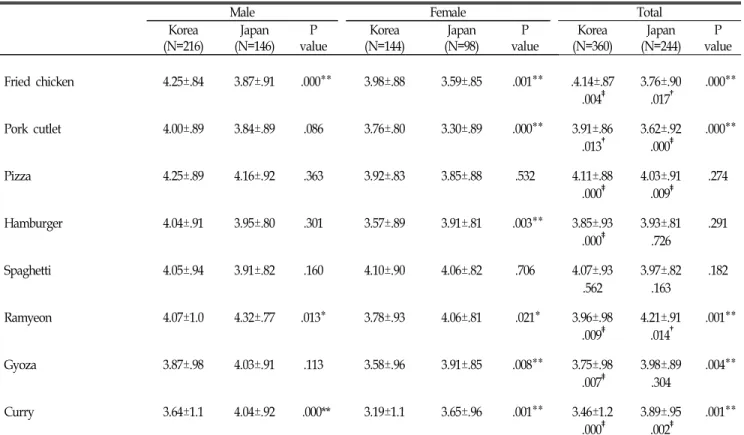
2. Preferences for Westernized fast foods
Preferences of Westernized fast foods of the subjects are
presented in Table 2. In Korea, fried chicken and pizza
(both 4.25) were the most preferred items in boys whereas
spaghetti (4.10) was the most preferred item in girls. Curry
was the least preferred item for both Korean boys and
girls (3.64 and 3.19, respectively). Both Japanese boys and
Table 3. Eating frequency of selected Westernized fast foods of middle school students in Korea and Japan
Male Female Total
Korea (N=216)
Japan (N=146)
P value
Korea (N=144)
Japan (N=98)
P value
Korea (N=360)
Japan (N=244)
P value
.002‡ .076
Fried chicken
<1/month 71(32.9)§ 67(45.9)
.009**
54(37.5) 58(59.2)
.004**
125(34.7) 125(51.2)
.000**
2-3/month 81(37.5) 54(37.0) 70(48.6) 31(31.6) 151(41.9) 85(34.8)
>1/week 64(29.6) 25(17.1) 20(13.9) 9( 9.2) 84(23.3) 34(13.9)
.001‡ .145
Pork cutlet <1/month 62(29.7) 71(48.6)
.000**
53(36.8) 60(61.2)
.000**
115(31.9) 131(53.7)
.000**
2-3/month 74(34.3) 59(40.4) 64(44.4) 31(31.6) 138(38.3) 90(36.9)
1/week 80(37.0) 16(11.1) 27(18.8) 7( 7.1) 107(29.7) 23( 9.4)
.029† .007‡ Pizza <1/month 71(32.9) 67(45.9)
.009**
61(42.4) 65(66.3)
.001**
137(38.1) 137(56.4)
.007**
2-3/month 81(37.5) 54(37.0) 64(44.4) 28(28.6) 151(41.9) 78(32.1)
1/week 64(29.6) 25(17.1) 19(13.2) 5( 5.1) 72(20.0) 298(11.9)
.025† .827
Hamburger <1/month 59(27.3) 51(34.9)
.001**
54(37.5) 38(38.8) .527
113(31.4) 89(36.5)
.002**
2-3/month 77(35.6) 67(45.9) 55(38.2) 42(42.9) 132(36.7) 109(44.7)
1/week 80(37.0) 28(19.2) 35(24.3) 18(18.4) 115(31.9) 46(18.9)
.766 .721
Spaghetti <1/month 93(43.1) 51(34.9)
.000**
59(41.0) 35(35.7) .160
152(42.2) 86(35.2)
.000**
2-3/month 70(32.4) 76(52.1) 52(36.1) 47(48.0 122(33.9) 123(50.4)
1/week 53(24.5) 19(13.0) 33(22.9) 16(16.3) 86(23.9) 35(14.3)
.002‡ .037† Ramyen <1/month 17( 7.9) 29(19.9)
.000**
18(12.5) 33(33.7)
.000**
35( 9.7) 62(25.4)
.000**
2-3/month 40(18.5) 68(46.6) 46(31.9) 42(42.9) 186(23.9) 110(45.1)
1/week 159(73.6) 49(33.6) 80(55.6) 23(23.5) 239(66.4) 72(29.5)
.001‡ .271
Gyoza <1/month 57(26.4) 54(37.0)
.000**
55(38.2) 44(44.9) .088
112(31.1) 98(40.2)
.000**
2-3/month 71(32.9) 66(45.2) 57(39.6) 43(43.9) 128(35.6) 109(44.7)
1/week 88(40.7) 26(17.8) 32(22.2) 11(11.2) 120(33.3) 37(15.2)
.192 .015†
Curry <1/month 90(41.7) 39(26.7) .011*
74(51.4) 42(42.9) .350
164(45.6) 81(33.2)
.007**
2-3/month 77(35.6) 70(47.9) 49(34.0) 42(42.9) 26(35.0) 112(45.9)
1/week 49(22.7) 37(25.3) 21(14.6) 14(14.3) 70(19.4) 51(20.9)
*, ** Significantly different between countries at p<0.05 and p<0.01, respectively, by chi-squared test.
†, ‡ P value, Significantly different between genders within country at p<0.05 and p<0.01, respectively, by chi-squared test.
§Number (%)
girls liked ramyeon the most (4.32 and 4.06, respectively) and pork cutlet the least (3.56 and 3.3), although Japanese girls expressed the same preference for spaghetti as they did for ramyeon.
Fried chicken was significantly more preferred by Korean boys, while curry and ramyeon were significantly more preferred by Japanese boys, compared to their
counterparts in the other country. When girls were
compared, fried chicken and pork cutlet were preferred
significantly more by Korean girls, whereas Japanese girls
significantly more preferred hamburger, gyoza, curry, and
ramyeon. Therefore, Korean students had significantly
higher preferences for fried chicken and pork cutlet, similar
preferences for pizza, spaghetti and hamburger and lower
preferences for ramyeon, gyoza and curry than the Japanese students.
Table 2 also shows gender differences in Westernized fast food preferences. Korean boys had significantly higher preferences for all items except spaghetti, for which the preference did not differ between boys and girls. Japanese boys had significantly higher preferences for fried chicken, pork cutlet, pizza, ramyeon and curry, while preferences for spaghetti, gyoza, and hamburger were not significantly different between genders.
3. Eating frequency of Westernized fast foods
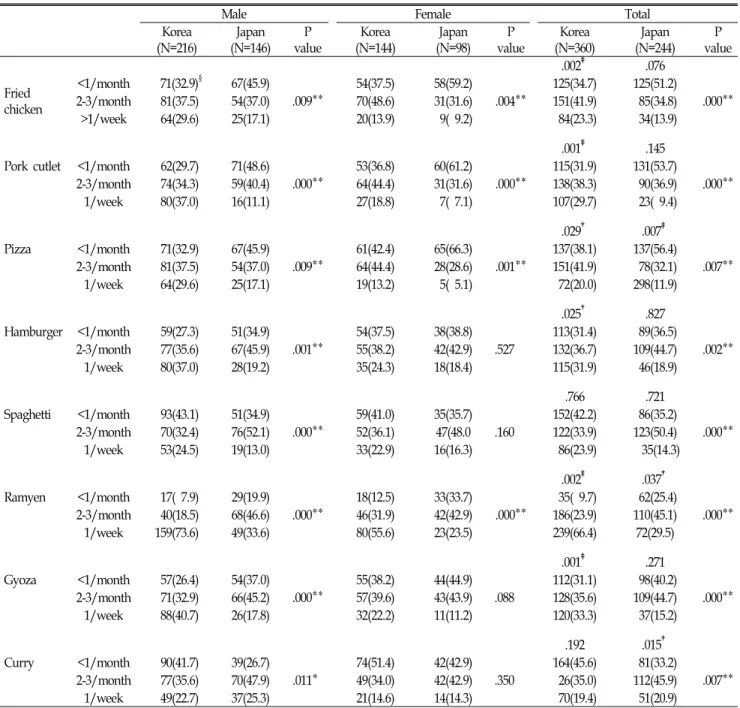
Table 3 shows the subjects' eating frequencies of Westernized fast foods. Two countries shared the most frequently eaten Westernized fast-food, which was ramyeon (66.4% and 29.5% in Korea and Japan, respectively). The least frequently eaten item was curry (45.6% ate less than once a month) in Korea and that was pizza (56.4% ate less than once a month) in Japan.
The Korean subjects had significantly higher eating frequencies for all the surveyed items than the Japanese, except for curry and spaghetti. Fried chicken, for which preferences of Korean subjects were significantly higher, was eaten significantly more often by them, compared to the Japanese counterparts; the proportions of the subjects who eat more than once a week were 29.6% vs. 17.1% for the Korean and the Japanese boys, respectively and 13.9%
and 9.2% for the Korean and the Japanese girls. Pork cutlet, for which preference was also significantly higher in Korean subjects, was eaten significantly more often by them, compared to the Japanese counterparts; the proportions of the subjects who eat more than once a week were 29.7% vs. 9.4% for the Korean and the Japanese subjects, respectively.
Also, hamburger and pizza, which were preferred similarly by the subjects of two countries, were eaten significantly more often by the Koreans. Compared for Japanese subjects, more Korean subjects ate hamburger (31.9% vs. 18.9%) and pizza (20.0% vs. 11.9%) more than once a week .
Although significantly more preferred by Japanese subjects, ramyeon and gyoza were consumed significantly
more often by the Koreans. More Korean subjects ate ramyeon (73.6% vs 33.6% for boys and 55.6% vs. 23.5% for girls) more often than once a week and less Korean subjects ate less than a month compared to Japanese subjects (7.9% vs. 19.9% for boys and 12.5% vs. 33.7% for girls). More Korean subjects (33.3% vs 15.2%) ate gyoza more often than once a week and less of them (31.1% vs.
40.2%) ate gyoza less often than once a month, compared to Japanese subjects.
Despite of the statistical significance (p=0.000) in eating frequencies of spaghetti between two countries, it can not be concluded which group ate the item more often; while more Koreans than Japanese (23.9% vs. 14.3%, respectively) responded to eat spaghetti more than once a week, the number of those who ate spaghetti less than a month was higher in Korea than in Japan as well (42.2% vs. 35.2%, respectively).
DISCUSSION
As the existing studies have reported the differences in fast food utilization between Seoul and small city
9), and among southern Seoul, northern Seoul, and small cities and towns in Korea
10), both schools from which the subjects of this study were recruited, were chosen from the areas of high socioeconomic class in Seoul and Tokyo, respectively.
One notable finding was that ramyeon was the most preferred Westernized fast food among both Japanese boys and girls, whereas curry was the least preferred item, by both genders, in Korea. There is a big difference not only in food quality but also in the relative importance in the total diet, of ramyeon in the two countries: in that Japanese ramyeon is cooked with non-fried noodles and plenty of meat and fresh vegetables while in Korea, ramyeon is the cheapest portable food and is often considered inadequate, either quantitatively or qualitatively, as a meal.
A similar explanation may be offered to the significantly
higher preference of Japanese students for curry compared
to their Korean counterparts. In Japan, many kinds of new
dishes have been developed with curry and there are
many restaurants specializing in curry dishes. Curry and
curry-containing foods are therefore considered to be a relatively adequate meal in Japan. In Korea, however, curry is regarded as merely a ready-to-eat fast food, with a touch of Western culture, for young people on tight budgets. These differences in cultural importance of items to overall diet between two countries may limit the validity of this study.
High preference for fried chicken of Korean 7-9
thgraders found in this study was not consistent with the report that the 6
th-grade Korean children have been reported to have a higher preference for hamburger (2.84) and pizza (2.80) than for fried chicken (2.74) or spaghetti (2.71).
11)Tendency of the higher preference in boys than in girls for the majority of food items found in this study has been also reported in another study
12)but not in preschool children
13), in Korea. The higher overall eating frequency in boys than in girls found in this study is not consistent with a previous study which reported a more frequent fast food consumption by girls in high schools in Seoul.
14)Also, female college students in Korea have been reported to use fast food restaurants more than males (90.3% vs. 77.6%, respectively).
15)The significantly higher eating frequencies for fried chicken and pork cutlet of the Korean subjects than the Japanese counterparts were not surprising, considering the higher preferences for those two items of the same subgroup. The most notable founding may be Korean subjects' significantly higher eating frequencies of pizza and hamburger, which were preferred similarly by two countries and those for even ramyeon and gyoza, which were preferred significantly less by them than by the Japanese subjects.
Curry was the only item which was eaten more often by the Japanese subjects, which can be attributed to the significantly higher preference by them than by the Korean subjects. Similarly, there was no significant difference between two countries in eating frequencies of spaghetti, which was preferred the most evenly liked among subgroups divided by country and gender.
Further study, preferably surveying more and better- defined Westernized fast food items and using larger and randomized samples from various areas of the two countries, is required to identify why Korean middle school students
eat these foods more often than the Japanese students. Such studies would help more effectively to encourage Korean youths to reduce their consumption of Westernized fast foods.
Acknowledgement
Authors appreciate Seo In Kwon, Jin Hyung Park and Sang Hun Song for helping conducting survey as a Japan Exploration Team and also thank Dr. Teiji Nakamura for his kind interview.
REFERENCES
1. Kim KA, Kwun IS, Kwon CS. Potential relationship between children obesity and risk for coronary heart disease in Kyungbuk area. Korean Journal of Nutrition 2001;34: 644-670.
2. Ministry of Health and Welfare Reports on 2001 Korea National Health and Nutrition Survey. Seoul. Korea. 2002
3. Kim KN, Park EJ. Nutrient density of fast-food consumed by the middle school students in Cheongju city. Korean J Community Nutrition 2005;10(3): 271-280.
4. Korean Nutrition Society. Dietary Recommended Intake. 2005 5. Lee SS. A study on dietary behavior of children according to
their preferences for fast food. Korean J Community Nutrition 2004;9(2): 204-213.
6. Ministry of Health and Welfare Reports on 2005 Korea National Health and Nutrition Survey. Seoul. Korea. 2006
7. You DR, Park GS, Kim SY, et al. Fast food consumption patterns - Focused on college students in Taegu. Korea J Home Economics 2000;38(2):27-40.
8. Nakamura T. Integration of health promotion into community nutrition in Japan: Past, present and future. The 10th Anniversary International Symposium. The Korean Society of Community Nutrition. 2005;39-43.
9. Yoon HJ, Wi SU. A survey of college students' behaviors on fast food restaurants. Korean J Food & Nutrition 19947(4):
323-331.
10. Jo HY, Kim S. Korean youths’ use of fast food and family restaurants in different regions: a comparison among cities and rural towns. Korean J Food Culture 2004; 20(1):44-52.
11. Koo NS, Park JI. Food preference of elementary school children under meal service in Taejon. Korean J Community Nutrition
1998;3(3): 440-453.
12. Ro HK, Park J. Grade and gender difference in dietary behavior, food preference and perception about body image of 4, 5, and 6th grade students in elementary school. Korean J Dietary Culture 2001;16(2):158-169.
13. Sin EK, Lee YK. Menu development and evaluation through eating behavior and foodpreference of preschool children in
day-care centers. Korean J Food Culture 200520: 1-14.
14. Jeong JH, Sim SH. A survey of dietary behavior and fast food consumption by high school students in Seoul. Korean J Home Economics 2001;39(10): 111-124.
15. Shin AS, Roh SB. Fast food consumption patterns of college students in Busan. Korean J Dietary Culture 2000;15(4): 287-293.
[ Abstract ]
Eating Frequency of and Preference for Selected Westernized Fast Foods by Middle School Students in Korea and Japan
Kyung-Hee Song
1), Wanda Bongkyung Jin
2)Department of Food and Nutrition, Myongji University1), Daewon Foreign Language High School2)
Background Increased consumption of Westernized fast foods recently has been considered to contribute to the high prevalence of obesity and related complications in both Korea and Japan, which share many dietary cultural characteristics. We surveyed middle school students in the two countries to compare eating frequencies of and preferences for Westernized fast foods in order to provide basic information for nutrition education.
Methods The subjects were 360 Korean and 244 Japanese students from public middle schools located in the areas of high socioeconomic class in Seoul and Tokyo, respectively.
Results The Korean subjects ate more frequently not only fried chicken and pork cutlet, which they preferred significantly more than the Japanese, but also pizza and hamburger, for which preferences were not different between two countries and even ramyeon and gyoza, for which they showed significantly lower preferences than the Japanese. Both preference for and eating frequencies of curry were significantly higher in Japanese subjects. Eating frequency of spaghetti, as the most evenly preferred item surveyed in this study, was not different among the subgroups divided by countries and genders.
Boys of either country expressed higher preferences for Westernized fast foods and ate them more often than their girl counterparts, with statistical significance being achieved for most surveyed items except spaghetti.
Conclusions Further study is required to identify why Korean middle school students ate Westernized fast foods more often than Japanese counterparts, especially the items preferred significantly less than Japanese students, to help Korean youths to reduce their intake of these foods more effectively. (Korean J Health Promot Dis Prev 2007 ; 7(3):172~179) Key words fast food, food preference, eating frequency, middle school students, Japan, Korea
6
`
* This study was from the part of the results of the Japan Exploration Project in 2006 of Government Youth Commission.
∙Address for correspondence : Kyung-Hee Song Department of Food and Nutrition, Myongji University
∙T e l :031- 330-6206
∙E-mail : [email protected]