• 검색 결과가 없습니다.

Research Through Empirical Analysis on SCM Efficiency Aspects of Retail Ready Packaging System

N/A
N/A
Protected

Academic year: 2021

Share "Research Through Empirical Analysis on SCM Efficiency Aspects of Retail Ready Packaging System"

Copied!
8
0
0

로드 중.... (전체 텍스트 보기)

전체 글

(1)

https://doi.org/10.20909/kopast.2020.26.2.85

Research Through Empirical Analysis on SCM Efficiency Aspects of Retail Ready Packaging System

Sung-Tae Jung

1

* and Ji-Hyun Kim

2

1

Caroline University, USA

2

Korea Certified Logistics Consultants Association

Abstract In this study, the relationship between packaging design and logistics efficiency raised in prior research was to be conducted through empirical analysis in terms of SCM efficiency. The main research contents were carried out in the pursuit of efficiency of the relevant store operation, relationship with SCM efficiency aspects, resolution of differences in recognition between manufacturers and distributors, establishment of automated systems for RRP production facilities and processes in the manufacturer's facilities, logistics costs, environment and quality safety, and promotion of RRP through the manufacturer's packaging system. As a result of the verification of SCM efficiency aspects through this study, logistics efficiency will be reduced in the case of the packaging system or delivery system, where only the operational efficiency of the store is the top priority(χ

2

= 178.500, p < 0.001). This is because of the strong interaction between pack- aging and supply chain activities, many packaging systems affect the performance criteria of the supply chain, and the content that packaging personnel should ensure that the packaging system meets other essential requirements while meet- ing the primary goal of protecting the product is also a result consistent with the preceding study. An analysis of whether the RRP promotion through the manufacturer's packaging system would result in improved loading efficiency showed that there was a statistically meaningful difference at a significant level of 0.000, as χ

2

= 140.133.

Keywords SCM efficiency aspects, Logistics efficiency, Retail Ready Packaging System, Empirical Analysis

Introduction

These days, concept of distribution in 1980s' was optimization of logistics function thorugh managing their inner whole logistics function. Otherwise, after 1990s', concept has been transgressed the boundary of firms' inner part and still expanded to outer area with application of concept of supply chain management. So, supply net is the tactical method that maximizes the efficiency by integrating managing the interfaces between chains with the total view of information, goods, cash flow

1)

. The reason of emphasizing the importance of capacity of partnership in supply chain is that, without collaboration between enterprises, efficient management of supply net can't be established. Success or failure of SCM(Supply Chain Management) that emphasizes the efficiency called COST-REDUCEMENT is considered as the basis of standard of collaboration of participants

2)

. With the case study of fiber industry that defines collaboration

outcomes is made and goal is achieved through collaboration between partner enterprises

3)

. Holland

4)

, electronic connection type between manufacturing enterprise and distribution enterprise was suggested and the effect of level of information system on administration outcome was emphasized. Meanwhile, positive influence on supply chain that proper packaging makes can be seen in many case studies. One of the study that indicates Packaging manager and technician should achieve primary goal that packaging system is protecting goods, with satisfying the other requirements was conducted in various hospitals in America

5)

. Kumar et al.

6)

found the conclusion that effective packaging design and management have huge effect on the cost of supply chain cost of medical industy.

Most of enterprises don't recoginze the importance or characteristics of packaging cost, so they don't include the distribution activity in estimation of total cost of packaging

7)

. Twede

8)

claimed that total cost and value of packaging are still estimaed exactly even though importance of packaging is widely used and finance and measurement method of packaging is discussed. In competitive environment of industry distribution, cost reducement is more useful than increment of revenue to maximize the profit, but without analyzing finance, room for improvement is hard to found in system of whole distribution

9)

. So, instead of view of packaging management,

*Corresponding Author : Sung-Tae Jung

Caroline University, 3660 Wilshire Blvd Suite 320, Los Angeles, CA 90010, USA

Tel : +82-10-6616-8955, Fax : +82-2-528-1827 E-mail : [email protected]
(2)

looking the relation in the aspect of management of supply net is important

10)

. In the process of the supply chain, the efficiency of logistics is greatly affected by packaging, design, unitization, and communication characteristics, and the weight, volume and robustness of industrial packaging determine the requirements for transportation and logistics and the efficiency of the overall logistics system

11)

. In the process of supply chain progress, the efficiency of logistics is greatly affected by packaging, design, unitization, communication, etc. Improved cooperation with logistics packaging design and packaging suppliers can achieve a more efficient and cost-effective supply chain, but the problem is that there is no major driver to drive such changes. In this study, the relationship between packaging design and logistics efficiency raised in prior research was to be conducted through empirical analysis in terms of SCM efficiency. The main research contents were carried out in the pursuit of efficiency of the relevant store operation, relationship with SCM efficiency aspects, resolution of differences in recognition between manufacturers and distributors, establishment of automated systems for RRP (Retail Ready Packaging) production facilities and processes in the manufacturer's facilities, logistics costs, environment and quality safety, and promotion of RRP through the manu- facturer's packaging system.

Study Procedure and Methods

Kumar et al.

12)

conducted research on several hospitals in the United States and argued that improved cooperation with logistics packaging design and packaging suppliers could achieve a more efficient and cost-effective supply chain.

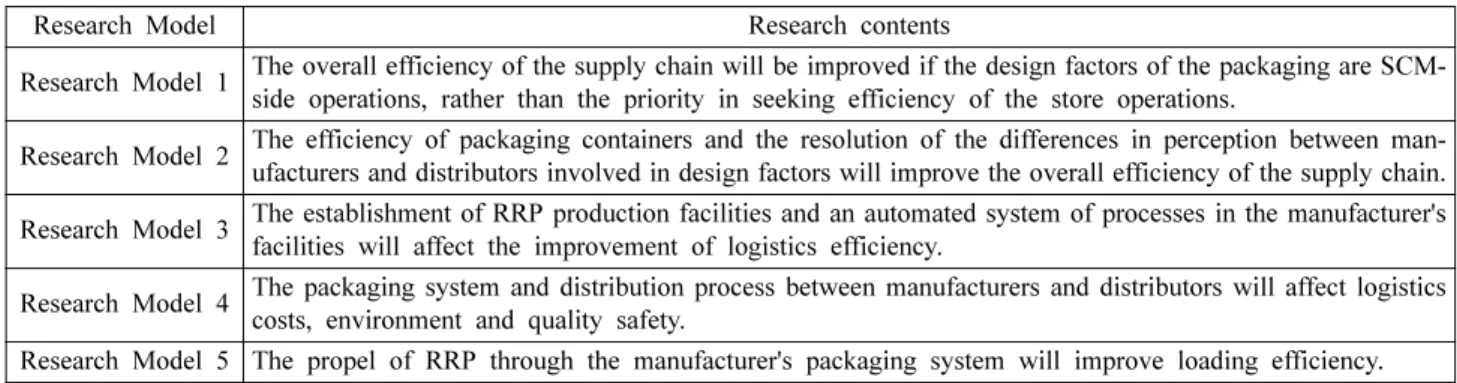
Therefore, in terms of SCM efficiency of such packaging system, the following verification details were set in this study. (Research model 1) The overall efficiency of the supply chain will be improved if the design factors of the packaging are SCM-side operations, rather than the priority in seeking efficiency of the store operations.

Regarding the major success and failure factors affecting the formation and maintenance of partnerships, Ellram

13)

said that Research Model 1 shows a difference in perception between

buyers and suppliers. Therefore, the following verification details were established assuming that the resolution of the fundamental differences between manufacturers and distributors could affect the overall efficiency of the supply chain. (Research model 2) The efficiency of packaging containers and the resolution of the differences in perception between manu- facturers and distributors involved in design factors will improve the overall efficiency of the supply chain.

Jemison

14)

said that maximising the value of the com- bination would be achieved if the opponent had complementary resources. The following verification details were established assuming that the RRP production facilities and process automation system in the manufacturer's facilities would be established, which would reduce the round-trip transportation for manual rental work by commissioning the RRP packaging company, thereby affecting the logistics efficiency. (Research model 3) The establishment of RRP production facilities and an automated system of processes in the manufacturer's facilities will affect the improvement of logistics efficiency.

Dubiel

15)

concluded that many companies are not aware of the importance of packaging costs and are not making sufficient efforts to find potential cost savings by separating packaging costs from primary cost-generating activities such as logistics. Assuming that the packaging system and distribution process between manufacturers and distributors will affect logistics costs, environment and quality safety, the following verification details were set. (Research model 4) The packaging system and distribution process between manufacturers and distributors will affect logistics costs, environment and quality safety.

Jung

16~22)

said that for improvement of commercial activity caused by RRP of large stores and reduction of packaging standardization and logistics cost, if the efficiency of collabo- ration between manufacturers and distributors is provided, it will contribute to reducing national logistics costs due to the results of collaboration. Therefore, the following verification details were established assuming that the use of the manufacturer's packaging system to ensure that the outbox can be constructed with a proper pallet loading efficiency while considering the settings of the large discount store shelves

Table 1. Research Model contents

Research Model Research contents

Research Model 1 The overall efficiency of the supply chain will be improved if the design factors of the packaging are SCM- side operations, rather than the priority in seeking efficiency of the store operations.

Research Model 2 The efficiency of packaging containers and the resolution of the differences in perception between man- ufacturers and distributors involved in design factors will improve the overall efficiency of the supply chain.

Research Model 3 The establishment of RRP production facilities and an automated system of processes in the manufacturer's facilities will affect the improvement of logistics efficiency.

Research Model 4 The packaging system and distribution process between manufacturers and distributors will affect logistics costs, environment and quality safety.

Research Model 5 The propel of RRP through the manufacturer's packaging system will improve loading efficiency.

(3)

when constructing the new RRP products. (Research model 5) The propel of RRP through the manufacturer's packaging system will improve loading efficiency.

To check the verification of each of the above research models, a chi-square test was performed, and for the analysis of the variance of one-way layout, the test method of Scheffe was used as a post-test method. After showing a brief description and picture related to RRP, the survey was conducted and retrieved only to those who clearly knew or knew RRP, and those who did not know or indicated that they knew little about it were not allowed to conduct the survey itself. Accordingly, surveys were requested only if the the manufacturer and the distributor were practical or hands-on workers related to RRP, and logistics experts and logistics company employees who responded that they knew or knew the RRP were selected for the sample.

Results and discussion

1. One-way analysis of variance and Scheffe Post- test method

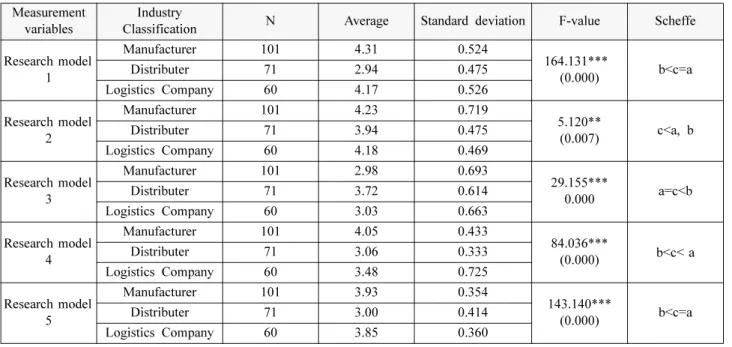
A one-way analysis of variance was performed to compare the average of each industry by measurement variable, as shown in <Table 2>, and a follow-up test of the shape was conducted as shown in <Table 3> to find out which

measurement variable levels differed statistically. A follow-up test by Scheffe showed that there were statistically meaningful average differences in all questions.

2. Research Model Verification Result

(Research model 1) : The overall efficiency of the supply chain will be improved if the design factors of the packaging are SCM-side operations, rather than the priority in seeking efficiency of the store operations. An analysis of whether logistics efficiency improves when the packaging system is operated, taking into account overall efficiency of the supply chain rather than the highest priority of store operation, showed that there was a statistically significant difference at a significant level of 0.000, as χ

2

=178.500, as shown in <Table 4>. Overall, 112 respondents (48.3%) answered 'yes' and 10 respondents answered 'no' (4.3%), while manufacturers and logistics companies answered 'yes' the most, while distributors answered ‘so so’ the most.

(Research model 2) : The efficiency of packaging containers and the resolution of the differences in perception between manufacturers and distributors involved in design factors will improve the overall efficiency of the supply chain.

An analysis of whether the resolution of the difference of views between manufacturers and distributors on the benefits of RRP, design factors, and operating systems would result in Table 2. One-way analysis of variance result

Measure- ment variables

Industry

Classification N Average Standard deviation

Standard error

95% confidence interval

for the mean Minimum value

Maximum value Lower limit

value

Upper limit value

Research model 1

Manufacturer 101 4.31 0.524 0.052 4.20 4.41 3 5

Distributer 71 2.94 0.475 0.056 2.83 3.06 2 4

Logistics Company 60 4.17 0.526 0.068 4.03 4.30 3 5

Total 232 3.85 0.792 0.052 3.75 3.96 2 5

Research model 2

Manufacturer 101 4.23 0.719 0.072 4.09 4.37 2 5

Distributer 71 3.94 0.475 0.056 3.83 4.06 3 5

Logistics Company 60 4.18 0.469 0.061 4.06 4.30 3 5

Total 232 4.13 0.603 0.040 4.05 4.21 2 5

Research model 3

Manufacturer 101 2.98 0.693 0.069 2.84 3.12 2 5

Distributer 71 3.72 0.614 0.073 3.57 3.86 3 5

Logistics Company 60 3.03 0.663 0.086 2.86 3.20 2 4

Total 232 3.22 0.738 0.048 3.12 3.32 2 5

Research model 4

Manufacturer 101 4.05 0.433 0.043 3.96 4.13 3 5

Distributer 71 3.06 0.333 0.040 2.98 3.14 2 4

Logistics Company 60 3.48 0.725 0.094 3.30 3.67 2 4

Total 232 3.60 0.657 0.043 3.51 3.68 2 5

Research model 5

Manufacturer 101 3.93 0.354 0.035 3.86 4.00 3 5

Distributer 71 3.00 0.414 0.049 2.90 3.10 2 4

Logistics Company 60 3.85 0.360 0.046 3.76 3.94 3 4

Total 232 3.63 0.560 0.037 3.55 3.70 2 5

(4)

an overall improvement in efficiency of the supply chain showed that there was a statistically meaningful difference at a significant level of 0.000, as χ

2

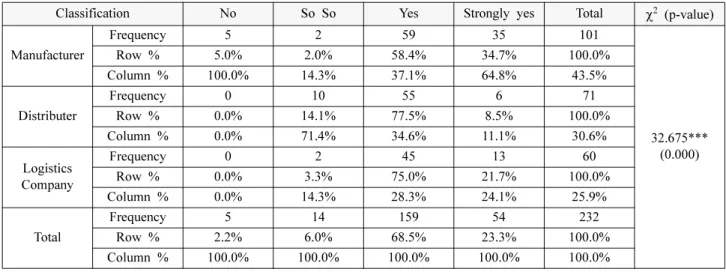
= 32.675, as shown in <Table 5>. Overall, 159 respondents (68.5%) answered 'yes' and only five respondents (2.2%) answered ‘no’. Manufacturers, logistics companies and distributors all said yes the most, while five said no. It can be interpreted that the resolution of the view differences between manufacturers and distributors on the benefits of RRP, design factors, and operating systems of the RRP will result in an overall improvement in efficiency of the supply chain, and that the overall efficiency of the supply chain may be reduced if the RRP is operated unilaterally because there may be differences of views between distributors and manufacturers.

(Research model 3) : The establishment of an automated system for RRP production facilities and processes in the manufacturer's facilities will affect the improvement of logistics efficiency. An analysis of whether the RRP production facilities and process automation system in the manufacturer's facility are helpful for improving logistics efficiency such as preventing redundant transportation for manual work showed that there was a statistically meaningful difference at a significant level of 0.000, as χ

2

= 49.107, as shown in <Table 6>. Overall, 119 respondents (51.3 percent) answered ‘so so’, 8 respondents (3.4 percent) answered ‘strongly yes’, while manufacturers and logistics companies answered ‘so so’ the most, and retailers answered ‘yes’ the most. Automation of RRP production facilities and processes is the result of the Table 3. Scheffe post-test result (Manufacturer:a, Distributer:b, Logistics Company:c)

Measurement variables

Industry

Classification N Average Standard deviation F-value Scheffe

Research model 1

Manufacturer 101 4.31 0.524

164.131***

(0.000) b<c=a

Distributer 71 2.94 0.475

Logistics Company 60 4.17 0.526

Research model 2

Manufacturer 101 4.23 0.719

5.120**

(0.007) c<a, b

Distributer 71 3.94 0.475

Logistics Company 60 4.18 0.469

Research model 3

Manufacturer 101 2.98 0.693

29.155***

0.000 a=c<b

Distributer 71 3.72 0.614

Logistics Company 60 3.03 0.663

Research model 4

Manufacturer 101 4.05 0.433

84.036***

(0.000) b<c< a

Distributer 71 3.06 0.333

Logistics Company 60 3.48 0.725

Research model 5

Manufacturer 101 3.93 0.354

143.140***

(0.000) b<c=a

Distributer 71 3.00 0.414

Logistics Company 60 3.85 0.360

p<0.05*, p<0.01**, p<0.001***

Table 4. Results of Chi-Square Test for primarily seeking efficiency in store operation

Classification No So So Yes Strongly yes Total χ

2

(p-value)

Manufacturer

Frequency 0 3 64 34 101

178.500***

(0.000)

Row % 0.0% 3.0% 63.4% 33.7% 100.0%

Column % 0.0% 4.8% 57.1% 70.8% 43.5%

Distributer

Frequency 10 55 6 0 71

Row % 14.1% 77.5% 8.5% 0.0% 100.0%

Column % 100.0% 88.7% 5.4% 0.0% 30.6%

Logistics Company

Frequency 0 4 42 14 60

Row % 0.0% 6.7% 70.0% 23.3% 100.0%

Column % 0.0% 6.5% 37.5% 29.2% 25.9%

Total

Frequency 10 62 112 48 232

Row % 4.3% 26.7% 48.3% 20.7% 100.0%

Column % 100.0% 100.0% 100.0% 100.0% 100.0%

p<0.05*, p<0.01**, p<0.001***

(5)

response that will help improve logistics efficiency, such as preventing redundant transportation for manual work, and it is meaningful that the largest number of respondents from distributors expressed their opinions more aggressively than manufacturers and logistics companies. These results can also be found at a higher average of 3.72 for distributors compared to manufacturer 2.98 and logistics company 3.03 as a result of the <Table 2> Scheffe post-test. Meanwhile, it was analyzed that the average of manufacturers and logistics companies is low in relation to this verification because redundant transportation can be prevented if the toll manufacturing company enters the facilities and carries out manual work even if automated facilities are not set. However, if a separate workplace is not available for manual work in the manufacturer's production facilities, or if the toll manufacturing company has to utilize the facilities and personnel outside, it may be difficult to transfer them to the manufacturer's production facilities, and in this case, additional transportation for the production of a

another RRP is inevitable.

(Research model 4) : The packaging system and distribution process between manufacturers and distributors will affect logistics costs, environment and quality safety. As a result of analyzing whether the RRP packaging system and warehouse type discount store delivery system considering SCM will lead to improved loading efficiency, reduced logistics costs, and reduced CO

2

generation, χ

2

= 152.606 as shown in <Table 7>

showed a statistically meaningful difference at a significant level of 0.000, as χ

2

= 152.606, as shown in <Table 7>. Overall, 125 respondents (53.9%) answered ‘yes’, 10 respondents (4.3%) answered ‘no’, while manufacturers and logistics companies answered ‘yes’ the most, and distributors answered ‘so so’. It can be analyzed that the RRP packaging system and the delivery system of warehouse-type discount stores considering SCM will lead to improved loading efficiency, reduced logistics costs, and reduced CO

2

generation, and interpreted that the RRP packaging system itself can lead to lower loading Table 5. Results of Chi-square test on packaging system operation to resolve differences in perception

Classification No So So Yes Strongly yes Total χ

2

(p-value)

Manufacturer

Frequency 5 2 59 35 101

32.675***

(0.000)

Row % 5.0% 2.0% 58.4% 34.7% 100.0%

Column % 100.0% 14.3% 37.1% 64.8% 43.5%

Distributer

Frequency 0 10 55 6 71

Row % 0.0% 14.1% 77.5% 8.5% 100.0%

Column % 0.0% 71.4% 34.6% 11.1% 30.6%

Logistics Company

Frequency 0 2 45 13 60

Row % 0.0% 3.3% 75.0% 21.7% 100.0%

Column % 0.0% 14.3% 28.3% 24.1% 25.9%

Total

Frequency 5 14 159 54 232

Row % 2.2% 6.0% 68.5% 23.3% 100.0%

Column % 100.0% 100.0% 100.0% 100.0% 100.0%

p<0.05*, p<0.01**, p<0.001***

Table 6. Results of Chi-Square Test for RRP Production Facility and Process Automation

Classification No So So Yes Strongly yes Total χ

2

(p-value)

Manufacturer

Frequency 23 59 17 2 101

49.107***

(0.000)

Row % 22.8% 58.4% 16.8% 2.0% 100.0%

Column % 65.7% 49.6% 24.3% 25.0% 43.5%

Distributer

Frequency 0 26 39 6 71

Row % 0.0% 36.6% 54.9% 8.5% 100.0%

Column % 0.0% 21.8% 55.7% 75.0% 30.6%

Logistics Company

Frequency 12 34 14 0 60

Row % 20.0% 56.7% 23.3% 0.0% 100.0%

Column % 34.3% 28.6% 20.0% 0.0% 25.9%

Total

Frequency 35 119 70 8 232

Row % 15.1% 51.3% 30.2% 3.4% 100.0%

Column % 100.0% 100.0% 100.0% 100.0% 100.0%

p<0.05*, p<0.01**, p<0.001***

(6)

efficiency, and the delivery system of RRP products to warehouse-type discount stores can lead to increased logistics costs and increased CO

2

generation.

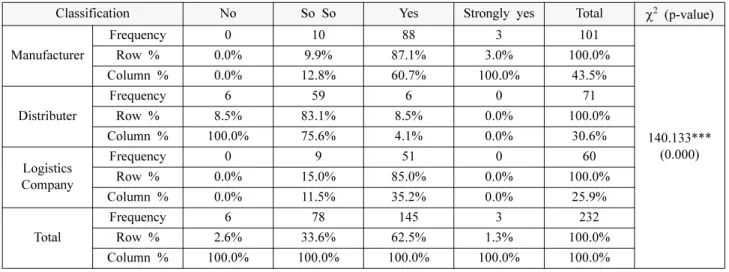
(Research model 5) : RRP promotion through manufacturer packaging system will improve loading efficiency. An analysis of whether the RRP promotion through the manufacturer's packaging system would result in improved loading efficiency showed that there was a statistically meaningful difference at a significant level of 0.000, as χ

2

= 140.133, as shown in

<Table 8>. Overall, 145 respondents (62.5%) answered 'yes' and 3 respondents (1.3%) answered ‘strongly yes’. Manufacturers and logistics companies responded most commonly to yes, while retailers responded most to ‘so so’. A typical manufacturer's packaging system is structured by a manufacturer's established process, such as a load efficiency simulation, so that the standards of the product outbox can maintain matching with the pallet when planning a new product. However, it is analyzed that the outbox standards of the RRP products

requested in a nearly fixed form at each large retail store inevitably proceed differently from the manufacturers' general packaging system and that distribution with reduced pallet loading efficiency can lead to social waste due to reduced logistics efficiency.

3. Summary of Verification result of Research Model As a result of the verification of SCM efficiency aspects through this study, logistics efficiency will be reduced in the case of the packaging system or delivery system, where only the operational efficiency of the store is the top priority.

2

=178.500, p<0.001). This is because of the strong interaction between packaging and supply chain activities, many packaging systems affect the performance criteria of the supply chain

23)

, and the content that packaging personnel should ensure that the packaging system meets other essential requirements while meeting the primary goal of protecting the product

5)

is also a result consistent with the preceding study.

Table 7. Results of Chi-Square Test of SCM Perspective on Packaging System and Delivery System

Classification No So So Yes Strongly yes Total χ

2

(p-value)

Manufacturer

Frequency 0 7 82 12 101

152.606***

(0.000)

Row % 0.0% 6.9% 81.2% 11.9% 100.0%

Column % 0.0% 8.2% 65.6% 100.0% 43.5%

Distributer

Frequency 2 63 6 0 71

Row % 2.8% 88.7% 8.5% 0.0% 100.0%

Column % 20.0% 74.1% 4.8% 0.0% 30.6%

Logistics Company

Frequency 8 15 37 0 60

Row % 13.3% 25.0% 61.7% 0.0% 30.6%

Column % 80.0% 17.6% 29.6% 0.0% 25.9%

Total

Frequency 10 85 125 12 232

Row % 4.3% 36.6% 53.9% 5.2% 100.0%

Column % 100.0% 100.0% 100.0% 100.0% 100.0%

p<0.05*, p<0.01**, p<0.001***

Table 8. Results of Chi-Square Test for RRP Propel Using Manufacturer's Packaging System

Classification No So So Yes Strongly yes Total χ

2

(p-value)

Manufacturer

Frequency 0 10 88 3 101

140.133***

(0.000)

Row % 0.0% 9.9% 87.1% 3.0% 100.0%

Column % 0.0% 12.8% 60.7% 100.0% 43.5%

Distributer

Frequency 6 59 6 0 71

Row % 8.5% 83.1% 8.5% 0.0% 100.0%

Column % 100.0% 75.6% 4.1% 0.0% 30.6%

Logistics Company

Frequency 0 9 51 0 60

Row % 0.0% 15.0% 85.0% 0.0% 100.0%

Column % 0.0% 11.5% 35.2% 0.0% 25.9%

Total

Frequency 6 78 145 3 232

Row % 2.6% 33.6% 62.5% 1.3% 100.0%

Column % 100.0% 100.0% 100.0% 100.0% 100.0%

p<0.05*, p<0.01**, p<0.001***

(7)

(Research model 1) has confirmed that the operation efficiency of the store can be reduced if packaging is formed as a top priority rather than considering the overall efficiency of the supply chain, such as consumers, distributors, manu- facturers, environmental issues, and logistics efficiency.

Considering the overall efficiency of the supply chain rather than the top priority of store operation, it indicates that logistics efficiency will be improved if the packaging system is operated. An analysis of whether resolving the differences of view between manufacturers and distributors about the benefits of RRP, design factors, and operating systems would result in an overall improvement in efficiency over the supply chain found that there were statistically meaningful differences at a significant level of 0.000, as χ

2

= 32.675.

In the case of (Research Model 2), the operation of a reasonable packaging system stands out to resolve the differences of view between groups. It can be explained that it is necessary to supplement the institutional aspect of supporting win-win management with the organic cooperative system between the parties for the rational operation of the packaging system.

(Research model 3) confirmed that efforts to reduce SKU by monotonous configuration of RRP specifications could facilitate the introduction of automation of manufacturers' production facilities and processes in the future.

(Research model 4) is an result of analysis that shows that delivering RRP to warehouse-type discount stores also has a significant impact on logistics efficiency, which is manu- factured with the packaging system of RRP making process.

It suggests that the will to establish a system to rationally improve and operate it and reduce the social costs of the various entities that constitute the supply chain should be supplemented in various ways.

(Research model 5) indicates that the packaging process should be established to increase the efficiency of loading the product into the extent of the pallet, which is currently commonly used. In this case, it can be explained that it can have a positive impact on SCM efficiency regardless of the processes in any industry, suggesting that, in a partnership aspect, cooperation relationship is required.

Conclusion

Packaging is a fundamental component of all kinds of goods supply chains, so it is important to look at the relationship from the point of view of supply chain manage- ment, not from the point of view of packaging management.

ECR(Efficient Consumer Response) Europe

24)

already verified the excellence of function of RRP, and local logistics company A's RRP guidebook claimed that RRP is not only in social, economic view but also environmental view provide various advantages, through eco-friendly packaging through reduction

of outer packaging. The analysis of the whether RRP production facilities and process automation system in the manufacturer's facility would help improve logistics efficiency, such as preventing redundant transportation for manual work showed that there was a statistically meaningful difference at a significant level of 0.000, as χ

2

=49.107. Due to the various specifications of RRP and the structure of small-volume production of many varieties, it is difficult for general manufacturers to introduce automated production facilities. Therefore, for the purpose of RRP production, some manufacturers are manually carrying the product to the toll processing company, and are taking the part that could lead to the loss of logistics.

Nevertheless, it is believed that more fundamental causes

should be found in terms of merchandising of distributors, not in

terms of marketing by manufacturers, for those that have

relatively strong support from distributors related to automation

of RRP production facilities and processes. In the case of the

RRP packaging system considering SCM and the warehouse

type discount store delivery system, the analysis was conducted

on whether it would lead to improved load efficiency, reduced

logistics costs, and reduced CO

2

generation, and found that

there was a statistically meaningful difference at a significant

level of 0.000, as χ

2

=152.606. Increased pallet loading

efficiency is a result of analysis that indicates that the effect of

filling standard pallets with products while preventing the

efficiency of logistics, cost savings, and environmental costs,

while also helping to prevent double-stage loading, tran-

sportation, storage, and transduction (falling) accidents in the

warehouse. An analysis of whether the RRP promotion

through the manufacturer's packaging system would result in

improved loading efficiency showed that there was a

statistically meaningful difference at a significant level of

0.000, as χ

2

= 140.133. The manufacturer's packaging system

may focus on pallet loading efficiency, but RRP shares the

view that the RRP design process can reduce logistics

efficiency because it may take into account the size of its

shelves and the environment of its stores. It is analyzed that

when a distributor plans a new product, it will improve

logistics efficiency by participating manufacturers and con-

sidering the overall efficiency of the supply chain so that the

product can be constructed by established processes such as

simulation of load efficiency by maintaining consistency with

the specifications of the product outbox. At the same time, it

was confirmed that efforts to reduce SKUs were needed in

consideration of display and pallet specifications in RRP

patterns of a small-number production with various type to

facilitate the construction of automated systems for RRP

production, and that efforts in terms of partnership should be

made to address differences of view between manufacturers

and distributors while improving SCM efficiency. It has been

confirmed that if the newly constructed product standards lead

to improved consistency with pallet, they will not only reduce

(8)

logistics costs and eliminate social waste, but also have a positive impact on safety and quality control and eco-friendly management during loading and unloading and transportation.

Meanwhile, if efforts are made to reduce SKU using only a few selected standards considering the display stand and pallet specifications, it will be easier to convert RRPs into returnable packaging rather than disposable packaging, which will greatly contribute to society. In addition, it is necessary to simul- taneously start promoting packaging standardization and modularization, which are the basis of logistics, in con- sideration of logistics rationalization and cost. This is because the change in the dimensions of the packaging greatly affects the loading efficiency of transport or the logistics efficiency of storage and unloading, resulting in an increase in logistics costs. Therefore, in product, packaging development, and design, it is important to raise a logistics mind that puts packaging logistics first, and it should be developed con- sidering the logistics system level, not simply thinking about products or packaging.

Acknowledgements

This article is created by editing a portion of my doctoral dissertation. I would like to deliver my sincere gratitude to everyone.

References

1. Hukushima ,Y. 1999, 「Management Innovation of Supply Chain Management 」 , The books of 21C.

2. Kwon, J.H., Han, C.H., and Seo, S.W. 2010, Information Sharing and Knowledge Acquisition through Cooperation among the Logistics Firms in China Market: Evidence from the Bohai Bay Region, Journal of Korea Trade Review, 35(5): 159-182.

3. Das, T. K.., and Teng. 1998, Between Trust and Control:

Developing Confidence in Partner Cooperation in Alliances, Academy of Management Review, 23(3): 491-512.

4. Holland, C.P. 1995, Cooperative supply chain management:

the impact of interorganizational information systems, The Journal of Strategic Information Systems, 4(2): 117-133.

5. Twede, D. 1992. The process of logistical packaging innova- tion, Journal of Business Logistics, 13(1): 69-95.

6. Kumar, S., Degroot, R. A., and choe, D. 2008. Rx for smart hospital purchasing decision: The impact of package design within US hospital supply chain. International Journal of Phys- ical Distribution and Logistics Management, 38(8): 601-615.

7. Mollenkopf, D., Closs, Twede, D., Lee, S., and Burgess, G.

2005. Assessing the viability of reusable packaging: a rela- tive cost approach, journal of Business Logistics, 26(1): 169- 197.

8. Twede, D. 2009, Economics of packaging. In K. L. Yam, The Wiley Encyclopedia of packaging Technology, 1(1): 383-389.

9. Holmes, D. 1999, Economic and environmental benefits of reusable transport packaging: Case studies and implementa- tion guidelines, Monash Centre for Environmental Manage- ment. Department of Geography and Environmental Science, Clayton Vic.

10. Kim, J.K. 2012. Perspectives and Strategies of Food Packag- ing Supply Chain, International Symposium on Packaging Science & Technology, 1(1): 67-79.

11. Bowersox, D., Closs, D., and cooper, M. B. 2007, Supply chain logistics management (2 Ed.). New York, NY.: McGraw- Hill.

12. Kumar, K. and van Dissel, H.G. 1996, Sustainable collabora- tion: managing conflict and cooperation in interorganiza- tional systems, MIS Quarterly, 20(3): 279-300.

13. Ellram, L. 1995, A structured method for applying purchas- ing cost management tools, International Journal of Purchas- ing and Materials Management, Winter, 32(1): 9-11.

14. Johnsson M. 1998, Packaging logistics – a value-added approach. Doctoral thesis, Department of Engineering Logis- tics, Lund University, Sweden.

15. Dubiel, M. 1996, Costing structures of reusable packaging systems. Packaging Technology and Science, 9(5): 237-254.

16. Jung, S.T., Yun, N.S., and Han, K.C. 2014. Study on the Effect of Product Line Pricing on Loading Efficiency and Logistics Cost, Korean Journal Distribution Science, 12(8):

55-69.

17. Jung, S.T., and Han, K.C. 2015. A Study on RRP Loading Patterns and Standard Dimensions for Block Pattern in Membership Wholesale Club. Korean Journal Distribution Science, 13(7): 41-51.

18. Jung, S.T. 2018a. A Study on the Operation Method of Pack- aging System to Enhance Logistics Efficiency. KOREAN JOURNAL OF PACKAGING SCIENCE & TECHNOLOGY, 24(2): 73-84.

19. Jung, S.T. 2018b. A Study on Prioritizing Packaging Sys- tems to Enhance Logistics Efficiency, Journal of the Korean Society of Supply Chain Management, 18(2): 151-162.

20. Jung, S.T., and Yun, N.S. 2013. The Effect on Logistics Cost of Incompatible Packaging Sizes in T-11 and T-12 pallet sys- tems, Korean Journal Distribution Science, 11(8): 15-23.

21. Jung, S.T. 2019a. Survey on the difference in perception of packaging among supply chains -Focusing on RRP. KOREA LOGISTICS REVIEW, 29(3): 1-10.

22. Jung, S.T. 2019b. A Study on the Effect of Product Display Type on Loading Efficiency in Membership Wholesale Club - Based on Standard Specifications. KOREA LOGISTICS REVIEW, 29(6): 1-11.

23. Marcus, A.A. and Anderson, M.H. 2006, A General Dynamic Capability: Does it Propagate Business and Social Competencies in the Retail Food Industry?, Journal of Man- agement Studies, 43(1), 19-46.

24. ECR E., 2007. Shelf Ready Packaging/Retail Ready Packag- ing, Dublin, Ireland: Accenture Publishing.

투고: 2020.07.31 / 심사완료: 2020.08.15 / 게재확정: 2020.08.18

수치

Table 1. Research Model contents
Table 4. Results of Chi-Square Test for primarily seeking efficiency in store operation
Table 6. Results of Chi-Square Test for RRP Production Facility and Process Automation
Table 8. Results of Chi-Square Test for RRP Propel Using Manufacturer's Packaging System

참조

관련 문서

1 John Owen, Justification by Faith Alone, in The Works of John Owen, ed. John Bolt, trans. Scott Clark, &#34;Do This and Live: Christ's Active Obedience as the

In this paper, the variable capacitors and the superconducting relay antenna were applied to the superconducting WPT system to increase efficiency and the transmission distance

- The level of radioactivation, along with other radioactivity aspects such as the T inventory will be a key factor in determining the environmental impact of fusion

- The level of radioactivation, along with other radioactivity aspects such as the T inventory will be a key factor in determining the environmental impact of fusion

In this study, the reliability of high efficiency air conditioning compressor applied with high vacuum local pressure die casting technique is to be analyzed through

In the efficiency review of the Trombe wall system through the experiment, if the Trombe wall was applied in the building structure, the Trombe wall had the

This study focuses on the energy-related legal system of Australia and examines (1) the general regulatory framework of energy industries, (2) the management and oversight

Based on the result of such assessment, this study attempted to establish a basis for establishment of physical epidemiology research evaluation system