Clin Nutr Res 2014;3:39-47
http://dx.doi.org/10.7762/cnr.2014.3.1.39 pISSN 2287-3732 ∙ eISSN 2287-3740
Effect of 8-Week Nutrition Counseling to Increase Phyto- chemical Rich Fruit and Vegetable Consumption in Korean
Breast Cancer Patients: A Randomized Controlled Trial
Sang Woon Cho
1, Jin Hee Kim
1, Seung Min Lee
2,
Song Mi Lee
3, Eun Jung Choi
4, Joon Jeong
5*, Yoo Kyoung Park
1,6*
1Department of Medical Nutrition, Graduate School of East-West Medical Science, Kyung Hee University, Yongin 446-701, Korea
2Department of Food and Nutrition, Sungshin Women’s University, Seoul 136-742, Korea
3Nutrition Services Department, Gangnam Severance Hospital, Yonsei University, Seoul 135-720, Korea
4Department of Food Nutrition, Shinheung College, UijeongBu 480-701, Korea
5Department of Surgery, Gangnam Severance Hospital, Yonsei University Medical College, Seoul 135-720, Korea
6Research Institute of Medical Nutrition, Kyung Hee University, Seoul 130-701, Korea
High fruit and vegetable consumption is associated with a lower risk of breast cancer. The incidence of breast cancer is continu- ously increasing in Korea, but only a few studies on nutrition intervention in breast cancer patients has been reported. The aim of this study was to investigate whether an 8-week nutrition intervention based on dietary counseling can promote fruit and vegetable consumption, increase serum antioxidant nutrient levels, and improve quality of life in Korean breast cancer patients.
Sixty-one breast cancer patients received either standard care (n = 31) or nutrition counseling (n = 30). The standard care group was given brochures recommending phytochemical rich diet. The intervention group was provided with two nutrition counseling sessions and one cooking class session, thereby encouraged subjects to eat at least 10 or more servings of fruits and vegetables per day. After 8-week intervention, waist circumference in the intervention group was significantly decreased (p < 0.001) even though no difference was reported for body mass index. Energy intake (p = 0.007), fiber (p < 0.001), and antioxidant nutrient (vitamin A, C, E, and β-carotene, p < 0.001, respectively) intakes were significantly increased. Serum antioxidant level was also increased significantly, i.e., vitamin A (p = 0.048); vitamin E (p = 0.004). Total vegetable intake (excluding kimchi intake) in the intervention group was increased from 425 g to 761 g (p < 0.001), fruit consumption was also increased from 232 g to 334 g (p <
0.001), while standard care group did not show any significant change. Our study showed that nutrition counseling and providing cooking tips helped to encourage the patient to consume and maintain more fruit and vegetable intakes.
Key Words: Counseling, Breast neoplasms, Fruits, Vegetables, Antioxidants
© 2014 The Korean Society of Clinical Nutrition
This is an Open Access article distributed under the terms of the Creative Commons Attribution Non-Commercial License (http://creativecommons.org/licenses/by-nc/3.0/) which permits unrestricted non-commercial use, distribution, and reproduction in any
*Corresponding author Joon Jeong
Address Department of Surgery, Gangnam Severance Hospital, Yon- sei University Medical College, 211 Eonju-ro, Gangnam-gu, Seoul 135- 720, Korea
Tel +82-2-2019-2950 E-mail [email protected]
*Corresponding author Yoo Kyoung Park
Address Department of Medical Nutrition, Kyung Hee University, 1732 Deogyeong-daero, Giheung-gu, Yongin 446-701, Korea
Tel +82-31-201-3816 Fax +82-31-201-3816 E-mail [email protected]
Received December 30, 2013 Revised January 16, 2014 Accepted January 24, 2014
Introduction
Although breast cancer is still less prevalent in Korea than in western countries, the incidence of breast cancer, especially in the younger women, is increasing. In 2008, breast cancer was reported as one of the most common forms of cancer being treated in women [1,2]. Possible explanations for these in- creases are the change to a westernized diet, such as the high consumption of fat and less physical activity, together with early detection [3,4].
High in fruit and vegetable diet has been suggested to be associated with decreased breast cancer [5-7], although not consistently [8-10]. It is generally assumed that the active di- etary constituents contributing to these protective effects are antioxidant nutrients such as vitamin A and vitamin E includ- ing phytochemicals. Although reasonable evidences proved that they are not enough in the treatment of breast cancer, but those antioxidant compounds, especially consumed as whole food, have been shown to neutralize free radicals, and reduce or even prevent some of the damages caused by free radicals [11,12].
Previous studies reported from the U.S. have demonstrated that intervention programs for breast cancer patients improve breast cancer prognosis and promote positive dietary behaviors [13-15]. The results of Women’s Intervention Nutrition Study (WINS), which was an intensive dietary intervention designed to reduce dietary fat intake in postmenopausal women with early stage breast cancer, indicated that those in the interven- tion group showed reduction of the incidence of breast can- cer recurrence and increase of relapse-free survival [13]. The Women’s Healthy Eating and Living (WHEL) study also showed that an intensive one-on-one intervention delivered over the telephone had positive effects, in that it led to increased fruit, vegetable and fiber intakes, as well as reduced fat intake [14,15].
Taken together, these studies suggested that intervention pro- gram successfully accomplished and maintained a good health status during and after breast cancer treatment.
Some studies have shown that diet quality is associated with quality of life (QOL) [16-18]. It is unclear whether diet influences QOL or reflects it. However, if diet does influence QOL, nutrition intervention programs to improve overall diet quality in breast cancer patients could help to increase QOL.
Dietary intake differs significantly across the countries.
Korean, especially, shows relatively high carbohydrate and low dietary fat consumption [19]. It is, therefore, very important to adjust the dietary modification according to their original
dietary pattern. Do et al. [20]. showed that the dietary habit and nutrient intakes of postoperative breast cancer patients can be improved by individual nutrition counseling program.
In that sense, however, the net effects of nutrition counseling intervention programs (increasing fruit and vegetable intake without much modification of fat intake) for reducing breast cancer recurrence and mortality have not enough investigated in Korea until now.
We hypothesized that breast cancer patients assigned to the dietary intervention group will show greater improvements in fruit and vegetable consumption, which would increase serum antioxidant levels than those of patients assigned to a standard care group. We also hypothesized that the dietary intervention group would show more favorable improvements in QOL than in the control group. In view of this, the aims of this study were: (1) to implement an 8-week intensive nutri- tion intervention to increase fruit and vegetable intake and (2) to evaluate changes in dietary intake, serum antioxidant level, and QOL after intervention.
Materials and Methods
Subjects and Study design
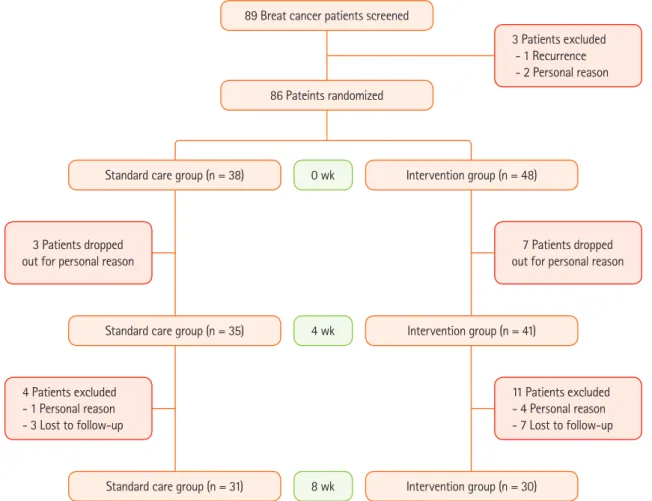
Between February 2009 and October 2009, a randomized dietary intervention study was carried out with breast cancer patients aged 25-65 year who had completed cancer treat- ment for stage Ⅰ to Ⅲ. The research protocol was approved by the Institutional Review Board of the S Hospital (Seoul, Ko- rea), and all subjects provided written informed consent before participation. Subjects were also excluded if they present un- controlled disease or women with body mass index (BMI) ≥25 kg/m2. Figure 1 shows a flow chart of this study. Breast cancer patients were randomly assigned to the standard care group (n = 38) or the intervention group (n = 48). The standard care group received no treatment but only received a brochure of general dietary guideline, and the intervention group received individualized dietary modification counseling with a profes- sional dietitian (Table 1). Seven subjects in the standard care group and 18 subjects in the intervention group were excluded due to personal reason or lost to follow-up. Overall, 61 breast cancer patients (standard care group: n = 31, intervention group: n = 30) were included in the final analyses. Information regarding the general characteristics of the subjects, including age, medical history, and menopausal status, were collected by self-reported questionnaires.
Table 1. Study protocol
Weeks Standard Care Group (n = 31) Intervention Group (n = 30)
-1 wk (1:1) 30 min
․ Anthropometric assessment
․ General questionnaire
․ Dietary habits questionnaire
․ 24 hr recall
․ Physical activity questionnaire
․ Quality of life scale
․ 3 days food record (homework)
․ Anthropometric assessment
․ General questionnaire
․ Dietary habits questionnaire
․ 24 hr recall
․ Physical activity questionnaire
․ Quality of life scale
․ 3 days food record (homework)
0 wk (1:1) 40 min ․ Blood test
․ Blood test
․ First nutrition class
․ 3 days food record (homework)
1 wk (Intervention) 60 min - ․ Cooking class
4 wk (1:1) 40 min - ․ Second nutrition class
․ 3 days food record (homework)
8 wk (1:1) 40 min
․ Anthropometric assessment
․ Blood test
․ Dietary habits questionnaire
․ 24 hr recall
․ Physical activity questionnaire
․ Quality of life scale
․ Anthropometric assessment
․ Blood test
․ Dietary habits questionnaire
․ 24 hr recall
․ Physical activity questionnaire
․ Quality of life scale Figure 1. Flowchart of the study.
89 Breat cancer patients screened
86 Pateints randomized
7 Patients dropped out for personal reason 3 Patients excluded - 1 Recurrence - 2 Personal reason
3 Patients dropped out for personal reason
11 Patients excluded - 4 Personal reason - 7 Lost to follow-up 4 Patients excluded
- 1 Personal reason - 3 Lost to follow-up
Standard care group (n = 38) Intervention group (n = 48)
Standard care group (n = 35) Intervention group (n = 41)
Standard care group (n = 31) Intervention group (n = 30)
0 wk
4 wk
8 wk
Measurements
Anthropometric measurements of subjects were conducted by a trained staff. Subjects were asked to remove their shoes and heavy outer garments before being weighed. The BMI was calculated as the body weight (kg)/height squared (m2), and waist circumference was measured to the nearest 0.1 cm, at the middle of the space between the lowest rib and the iliac crest, with subjects in standing position and after breathing out gently.
Blood samples (20 mL) were collected from each subject after overnight fasting for more than 8 hour, which were centrifuged for 15 minutes at 3,000 rpm and stored at -80°C until analyzed.
All the biochemical measurements were performed in the labora- tory of the S Hospital. Serum antioxidant nutrient (carotene, vita- min A and vitamin E) were measured by using HPLC method [21].
Dietary intake was determined from diet records for 3 con- secutive days (2 weekdays, 1 weekend day). The subjects were instructed to record all foods, beverages and supplements consumed, including detailed descriptions of foods, prepara- tion methods and recipes. All the food items eaten, how they were cooked, and the amounts consumed were confirmed by the professional dietitian using food models and measuring tools. Nutrient intake was analyzed with the computer aided nutritional analysis program (CAN-pro 3.0, The Korean Nutri- tion Society, Seoul, Korea).
QOL was assessed with the Functional Assessment of Can- cer Therapy (FACT-B) designed to measure multidimensional health-related quality of life in patients with breast cancer [22]. FACT-B comprises of five subscales: physical well-being (7 items), social well-being (7 items), emotional well-being (6 items), functional well-being (7 items), and concerns specific to patients with breast cancer (10 items). Each item is rated on a 5-point scale with 0 equal to “not at all” and 5 equal to “very much”. Higher subscale score indicates higher well-being or satisfaction. All ratings on the FACT-B are completed in terms of the past seven days.
Intervention
The 8-week intervention program consisted of two nutri- tion counseling sessions of 40 minutes and one cooking class session with a professional dietitian. The counseling sessions focused on individualized dietary counseling to induce the subjects to concentrate on modifying or changing their eating habits. Intervention participants were encouraged to achieve the following advices but attainable goals chosen to promote a dietary pattern that maximizes intake of protective nutrients
(antioxidant vitamins and fiber) and phytochemicals. The cook- ing class session and health-related materials (e.g. pamphlets and brochures) supported this individualized counseling. The cooking class focused on healthy food to promote adherence and understanding of the intervention dietary pattern, and gave patients an opportunity to learn how to prepare recipes to incorporate more fruit and vegetable.
Statistical analyses
Statistical analyses were conducted using the SPSS program (SPSS 15.0 KO for Windows; SPSS Inc., Chicago, USA). All val- ues are expressed as the mean ± standard deviation or num- ber (%).Differences between the two groups were analyzed by an independent Student’s t-test or chi-square test. Paired t- tests were used to compare the changes in anthropometrics, dietary intakes, serum antioxidant levels, and quality of life scores between baseline and after intervention values. All reported p values were two-tailed, and the statistical signifi- cance was set at p < 0.05.
Results
General characteristics of the subjects
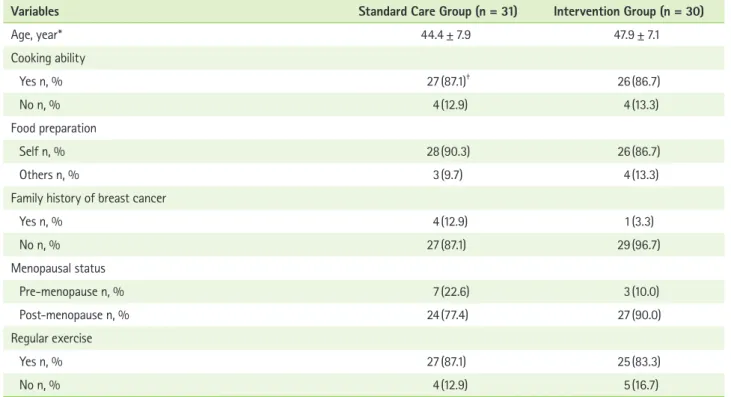
The baseline characteristics of the subjects are presented in Table 2, which shows that neither group differed in any base- line category. The number of subjects who were cooking her- self was 27 (87.1%) in the standard care group and 26 (86.7%) in the intervention group. The majority had no family history of breast cancer, and was post-menopausal. Several types of exercise were performed; walking and hiking were the most common type of exercise, whereas stretching and swimming were also reported (data not shown).
Changes in anthropometrics parameters, dietary intake, serum antioxidant levels
Changes in anthropometrics parameters after the 8-week- nutrition intervention are presented in Table 3. There were no significant differences in the baseline weight, BMI, and waist circumference between the standard care group and the intervention group. After nutrition intervention, waist circum- ference in the intervention group was significantly decreased (p < 0.001) even though BMI remained unchanged. For the standard care group, in contrast, all of the anthropometric- measurements did not show any significant changes.
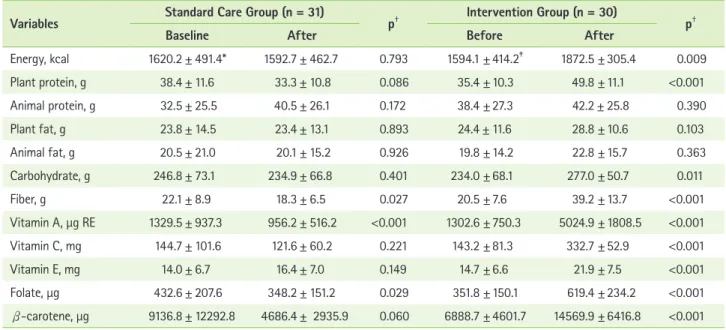
The average daily intakes of nutrients are presented in Table 4. After nutrition intervention, in the intervention group, there
was a significant increase in the daily intake of energy (p = 0.009), plant protein (p < 0.001), carbohydrate (p = 0.011), fiber (p < 0.001), vitamin A (p < 0.001), vitamin C (p < 0.001), vitamin E (p < 0.001), folate (p < 0.001), and β-carotene (p
< 0.001). Whereas, in the standard care group, there was a significant reduction in the daily intake of fiber (p = 0.027), vitamin A (p < 0.001), and folate (p = 0.029). Daily fruit and vegetable intake are shown in Figure 2. The intervention group increased their consumption of fruit from 266.0 to 341.5 g/
d, vegetable consumption was also markedly increased from 410.0 to 716.0 g/d (p < 0.001), whereas standard care group did not show any changes in fruit and vegetable intake.
Changes in serum antioxidant levels after the 8 week nutri-
tion intervention are presented in Table 5. Serum carotene concentration was significantly decreased in the standard care group (p < 0.001), but not in the intervention group. Serum concentrations of vitamin A (p = 0.048) and vitamin E (p = 0.004) in the intervention group were significantly increased, with no significant change in the standard care group.
Effect on quality of life
In the standard care group, physical well-being score was significantly increased after nutrition intervention (p = 0.017).
However, there were no significant differences in social/family well-being, emotional well-being, and functional well-being, breast cancer subscale after 8 weeks (Table 6).
Table 2. Baseline characteristics of the subjects
Variables Standard Care Group (n = 31) Intervention Group (n = 30)
Age, year* 44.4 ± 7.9 47.9 ± 7.1
Cooking ability
Yes n, % 27 (87.1)† 26 (86.7)
No n, % 4 (12.9) 4 (13.3)
Food preparation
Self n, % 28 (90.3) 26 (86.7)
Others n, % 3 (9.7) 4 (13.3)
Family history of breast cancer
Yes n, % 4 (12.9) 1 (3.3)
No n, % 27 (87.1) 29 (96.7)
Menopausal status
Pre-menopause n, % 7 (22.6) 3 (10.0)
Post-menopause n, % 24 (77.4) 27 (90.0)
Regular exercise
Yes n, % 27 (87.1) 25 (83.3)
No n, % 4 (12.9) 5 (16.7)
*Values are means ± SD or n, %; †Chi-Square Test shows no statistical significance.
Table 3. Changes in anthropometrics parameters after intervention
Variables Standard Care Group (n = 31)
p† Intervention Group (n = 30)
p†
Before After Before After
Body weight, kg 56.1 ± 7.4* 56.4 ± 7.2 0.324 57.6 ± 6.7‡ 57.8 ± 6.7 0.528
BMI, kg/m2 22.6 ± 2.5 22.7 ± 2.4 0.303 23.2 ± 2.8 23.3 ± 2.8 0.505
WC, cm 73.7 ± 6.8 73.2 ± 6.7 0.252 77.0 ± 7.6 75.1 ± 7.4 <0.001
BMI: body mass index, WC: waist circumference.
*Values are means ± SD (all such values); †Measured by paired t-test between baseline and 8 week within each group at p < 0.05; ‡Baseline level between stan- dard care group and intervention group showed no statistical significance after independent t-test.
Discussion
The goal for this particular nutrition intervention was to adopt and maintain an antioxidant rich dietary habit of breast cancer patients. This nutrition intervention program was designed to improve knowledge and skills in selecting phyto- chemical rich foods and to improve motivation with respect to healthy behavior in the patients. The results of this study showed that the 8-week nutrition intervention program pri- marily based on dietary counseling, supplemented by cooking classes and health-related materials, can promote a substantial change in the overall dietary pattern, with significant increases
in consumptions of phytochemical rich fruit and vegetable.
The health benefits of fruit and vegetable seen in epide- miological studies are the main reasons for the recommended intake of at least 400 g of fruit and vegetable per day, pota- toes not included [23]. The world cancer research fund (WCRF) panel of experts also recommended that the consumption of 400 grams/day or more of a variety of vegetables and and fruits, irrespective of other diet and lifestyle patterns, could decrease overall cancer incidence by at least 20% [24]. Accord- ingly, several clinical trials have intervened specifically on fruit and vegetable consumption. Pierce et al. [25] reported that telephone counseling intervention including cooking classes Table 4. Changes in nutrient intakes after intervention
Variables Standard Care Group (n = 31)
p† Intervention Group (n = 30)
p†
Baseline After Before After
Energy, kcal 1620.2 ± 491.4* 1592.7 ± 462.7 0.793 1594.1 ± 414.2‡ 1872.5 ± 305.4 0.009
Plant protein, g 38.4 ± 11.6 33.3 ± 10.8 0.086 35.4 ± 10.3 49.8 ± 11.1 <0.001
Animal protein, g 32.5 ± 25.5 40.5 ± 26.1 0.172 38.4 ± 27.3 42.2 ± 25.8 0.390
Plant fat, g 23.8 ± 14.5 23.4 ± 13.1 0.893 24.4 ± 11.6 28.8 ± 10.6 0.103
Animal fat, g 20.5 ± 21.0 20.1 ± 15.2 0.926 19.8 ± 14.2 22.8 ± 15.7 0.363
Carbohydrate, g 246.8 ± 73.1 234.9 ± 66.8 0.401 234.0 ± 68.1 277.0 ± 50.7 0.011
Fiber, g 22.1 ± 8.9 18.3 ± 6.5 0.027 20.5 ± 7.6 39.2 ± 13.7 <0.001
Vitamin A, µg RE 1329.5 ± 937.3 956.2 ± 516.2 <0.001 1302.6 ± 750.3 5024.9 ± 1808.5 <0.001 Vitamin C, mg 144.7 ± 101.6 121.6 ± 60.2 0.221 143.2 ± 81.3 332.7 ± 52.9 <0.001
Vitamin E, mg 14.0 ± 6.7 16.4 ± 7.0 0.149 14.7 ± 6.6 21.9 ± 7.5 <0.001
Folate, µg 432.6 ± 207.6 348.2 ± 151.2 0.029 351.8 ± 150.1 619.4 ± 234.2 <0.001 β-carotene, µg 9136.8 ± 12292.8 4686.4 ± 2935.9 0.060 6888.7 ± 4601.7 14569.9 ± 6416.8 <0.001
*Values are means ± SD (all such values); †Measured by paired t-test between baseline and 8 week within each group at p < 0.05; ‡Baseline level between stan- dard care group and intervention group showed no statistical significance after independent t-test.
400 330 410
716* 1,200
Standard Care Group
Vegetable, g
Intervention Group 900
600 300 0
Baseline After
216 210 266 342
1,200
Standard Care Group
Fruit, g
Intervention Group 900
600 300 0
Baseline After
Figure 2. Daily fruit and vegetable intake between standard care control group and intervention group. The statistical significance measured by paired t-test. * Significant difference between baseline and 8 week (p < 0.001).
and monthly newsletters led to significant increase in fruit (18%, 0.6 serving/d) and vegetable (82%, 3.2 serving/d) intake in the intervention group of breast cancer survivors. Smith- Warner et al. [26] also showed that after 1-year diet interven- tion to increase fruit and vegetable consumption to at least 8 servings per day in an at-risk population, the intervention group had increased their daily fruit and vegetable intake an average of 5.5 servings over 1 year; the standard care group had an average decrease of 0.5 servings per day. In agreement with these intervention trial findings, we found that total fruit and vegetable (excluding kimchi and Korean pickles, etc) con- sumption in the intervention group was increased by 56.4%
(382 g/d, p < 0.001). In detail, there was a 74.6 % (306 g/d, p <
0.001) increase of vegetable and a 28.3% (76 g/d) increase of fruit. The participants achieved these changes via increasing frequency and/or serving size of foods already consuming. In addition, the participants were more successful at increasing vegetable rather than fruit consumption. This may be due to food preferences and convenience because the Korean side dishes that use a wide variety of vegetables are easier to inte- grate into current eating pattern. These results suggest that it is indeed possible to further increase individual’s total fruit and vegetable intake to more than the 1,000 g/d (equivalent to >14
servings), even if the intervention program is only provided for a short-term period.
The change in dietary intake was validated by increases in serum antioxidant nutrient levels which are considered objec- tive biomarkers of fruit and vegetable intake [27,28]. In the intervention group, the average daily intake of vitamin A, vita- min C, vitamin E and β-carotene was significantly increased after the nutrition intervention (p < 0.001, respectively). As expected, serum vitamin A (5.6%, 0.03 mg/L) and vitamin E (8.2%, 0.88 mg/L) levels also were significantly increased after nutrition intervention. Higher dietary intakes and blood con- centrations of carotenoids (precursor of vitamin A), including β-carotene, have been shown to reduce breast cancer risk although not entirely consistent [29,30]. According to results by performing a meta-analysis of 11 studies, intake of 7,000 μg per day or more of β-carotene was associated with 18%
reduction of breast cancer risk compared with intake of 1,000 μg per day or less [31]. Sato et al. [32] reported that the risk of developing breast cancer in women with high levels of serum β-carotene, lycopene, and total carotene was approximately half of that of women with low levels of these nutrients. Al- though the intervention did not change the serum carotene level directly, it is hypothesized that the intervention would Table 5. Changes in serum antioxidant levels after intensive nutritional counseling
Variables Standard Care Group (n = 31)
p† Intervention Group (n = 30)
p†
Before After Before After
Carotene, µg/dL 175.58 ± 57.12* 128.45 ± 60.40 <0.001 221.50‡ ± 75.93 207.00 ± 94.64 0.144
Vitamin A, mg/L 0.52 ± 0.10 0.49 ± 0.11 0.169 0.54 ± 0.14 0.57 ± 0.16 0.048
Vitamin E, mg/L 11.15 ± 2.73 11.24 ± 2.30 0.852 10.72 ± 2.88 11.60 ± 3.45 0.004
*Values are means ± SD (all such values); †Measured by paired t-test between baseline and 8 week within each group at p < 0.05; ‡Baseline level between stan- dard care group and intervention group showed no statistical significance after independent t-test.
Table 6. Effect of intervention on quality of life
Variables Standard Care Group (n = 31)
p† Intervention Group (n = 30)
p†
Before After Before After
Physical well-being 22.7 ± 6.2* 24.0 ± 5.0 0.017 23.8 ± 4.1‡ 24.3 ± 2.9 0.544
Social/Family well-being 16.5 ± 5.0 16.7 ± 4.9 0.748 18.2 ± 6.2 18.0 ± 7.0 0.766
Emotional well-being 16.7 ± 4.1 17.1 ± 3.9 0.504 18.4 ± 4.3 18.1 ± 4.5 0.662
Functional well-being 18.1 ± 6.0 17.5 ± 5.6 0.494 19.9 ± 4.6 19.9 ± 4.7 0.922
Breast cancer subscale 21.1 ± 5.9 21.5 ± 5.7 0.597 22.1 ± 5.0 22.9 ± 4.5 0.302
Total score 95.0 ± 21.2 96.8 ± 17.1 0.462 102.4 ± 15.9 103.1 ± 17.4 0.754
*Values are means ± SD (all such values); †Measured by paired t-test between baseline and 8 week within each group at p < 0.05. The higher score shows the better quality of life; ‡Baseline level between standard care group and intervention group showed no statistical significance after independent t-test.
influence this variable.
Nutrition plays an important role in a cancer patient’s over- all health and QOL. Accordingly, cancer survivors are often motivated to modify their diets and seek nutritional guidance to reduce cancer recurrence risk. Some studies suggest that nutrition intervention improves QOL of cancer patients [33-36], whereas others report no such benefits [37,38]. In the current study, we could not observe a significant impact on the QOL in the both groups after the intervention. This results show that even though the nutrition intervention participants made sig- nificant modifications in their eating behavior, it might be hard to induce improvement on the QOL due to short-term inter- ventions. The physical wellness was significantly increased in the control group, which is hard to explain. It may be possible that because the overall scores in the control group was rather lower than the intervention group, it was easier to be restored to normal level after 8 weeks.
Waist circumference and BMI are predictor biomarkers of breast cancer risk [39,40]. Especially, waist circumference as a measure of visceral adiposity is associated with increased risk of cancer development; is a stronger predictor of cancer risk than BMI [41]. In this study, waist circumference was signifi- cantly decreased in the intervention group (p < 0.001) even though BMI remained unchanged. Although not a primary goal of the study, this waist circumference reduction would be considered as desirable outcome for the breast cancer pa- tients.
It should be noted that this study has several limitations.
First, the period of the intervention was short. Thus, there is a need to examine if the effects of intervention program would be sustained over the long-term period. Second, fruit and vegetable intake was measured through self-reports rather than direct inspection of food consumption. Self reports can lead to response bias. The participants knew that the goal was to promote their fruit and vegetable consumption, therefore may report it. Indeed, even though the diet screening phase based on fruit and vegetable intake for participant eligibility, total fruit and vegetable intakes were above 500 g at the be- ginning of the intervention in the both groups. Despite these limitations, our study also has major strength. Cooking class provided an opportunity to taste new foods and a support- ive learning environment. The participants could observe the dietitian to show cooking skills, practice these skills, and then demonstrate the skills themselves.
In conclusion, the results of this study showed that the 8-week nutrition intervention can facilitate positive dietary
change, and this was reflected in increased fruit and vegetable intake and enhanced serum antioxidant nutrient levels such as vitamin A and vitamin E, but no significant change in QOL.
Conflict of interest
We declare that we have no conflict of interest.
References
1. Ministry of Health & Welfare; National Cancer Center, Korea Central Cancer Registry. Annual report of cancer statistics in Korea in 2010.
Goyang: Korea Central Cancer Registry; 2012.
2. Park SK, Kang D, Kim Y, Yoo KY. Epidemiologic characteristics of the breast cancer in Korea. J Korean Med Assoc 2009;52:937-45.
3. Ahn SH; Korean Breast Cancer Society. Clinical characteristics of breast cancer patients in Korea in 2000. Arch Surg 2004;139:27-30.
4. Son BH, Kwak BS, Kim JK, Kim HJ, Hong SJ, Lee JS, Hwang UK, Yoon HS, Ahn SH. Changing patterns in the clinical characteristics of Ko- rean patients with breast cancer during the last 15 years. Arch Surg 2006;141:155-60.
5. Bessaoud F, Daurès JP, Gerber M. Dietary factors and breast cancer risk: a case control study among a population in Southern France. Nutr Cancer 2008;60:177-87.
6. Edefonti V, Randi G, Decarli A, La Vecchia C, Bosetti C, Franceschi S, Dal Maso L, Ferraroni M. Clustering dietary habits and the risk of breast and ovarian cancers. Ann Oncol 2009;20:581-90.
7. Zhang CX, Ho SC, Chen YM, Fu JH, Cheng SZ, Lin FY. Greater vegetable and fruit intake is associated with a lower risk of breast cancer among Chinese women. Int J Cancer 2009;125:181-8.
8. Smith-Warner SA, Spiegelman D, Yaun SS, Adami HO, Beeson WL, van den Brandt PA, Folsom AR, Fraser GE, Freudenheim JL, Goldbohm RA, Graham S, Miller AB, Potter JD, Rohan TE, Speizer FE, Toniolo P, Willett WC, Wolk A, Zeleniuch-Jacquotte A, Hunter DJ. Intake of fruits and vegetables and risk of breast cancer: a pooled analysis of cohort stud- ies. JAMA 2001;285:769-76.
9. Wang C, Baumgartner RN, Yang D, Slattery ML, Murtaugh MA, Byers T, Hines LM, Giuliano AR, Baumgartner KB. No evidence of association between breast cancer risk and dietary carotenoids, retinols, vitamin C and tocopherols in Southwestern Hispanic and non-Hispanic White women. Breast Cancer Res Treat 2009;114:137-45.
10. van Gils CH, Peeters PH, Bueno-de-Mesquita HB, Boshuizen HC, Lahmann PH, Clavel-Chapelon F, Thiébaut A, Kesse E, Sieri S, Palli D, Tumino R, Panico S, Vineis P, Gonzalez CA, Ardanaz E, Sánchez MJ, Amiano P, Navarro C, Quirós JR, Key TJ, Allen N, Khaw KT, Bingham SA, Psaltopoulou T, Koliva M, Trichopoulou A, Nagel G, Linseisen J, Boeing H, Berglund G, Wirfält E, Hallmans G, Lenner P, Overvad K, Tjønneland A, Olsen A, Lund E, Engeset D, Alsaker E, Norat T, Kaaks R, Slimani N, Ri- boli E. Consumption of vegetables and fruits and risk of breast cancer.
JAMA 2005;293:183-93.
11. Liu RH. Potential synergy of phytochemicals in cancer prevention:
mechanism of action. J Nutr 2004;134:3479S-85S.
12. Thomson CA, Stendell-Hollis NR, Rock CL, Cussler EC, Flatt SW, Pierce JP. Plasma and dietary carotenoids are associated with reduced oxida- tive stress in women previously treated for breast cancer. Cancer Epi- demiol Biomarkers Prev 2007;16:2008-15.
13. Winters BL, Mitchell DC, Smiciklas-Wright H, Grosvenor MB, Liu W, Blackburn GL. Dietary patterns in women treated for breast cancer who successfully reduce fat intake: the Women's Intervention Nutrition Study (WINS). J Am Diet Assoc 2004;104:551-9.
14. Pierce JP, Newman VA, Natarajan L, Flatt SW, Al-Delaimy WK, Caan BJ, Emond JA, Faerber S, Gold EB, Hajek RA, Hollenbach K, Jones LA,
Karanja N, Kealey S, Madlensky L, Marshall J, Ritenbaugh C, Rock CL, Stefanick ML, Thomson C, Wasserman L, Parker BA. Telephone counsel- ing helps maintain long-term adherence to a high-vegetable dietary pattern. J Nutr 2007;137:2291-6.
15. Newman VA, Thomson CA, Rock CL, Flatt SW, Kealey S, Bardwell WA, Caan BJ, Pierce JP; Women's Healthy Eating and Living (WHEL) Study Group. Achieving substantial changes in eating behavior among women previously treated for breast cancer--an overview of the intervention. J Am Diet Assoc 2005;105:382-91.
16. Wayne SJ, Baumgartner K, Baumgartner RN, Bernstein L, Bowen DJ, Ballard-Barbash R. Diet quality is directly associated with quality of life in breast cancer survivors. Breast Cancer Res Treat 2006;96:227-32.
17. Ravasco P, Monteiro-Grillo I, Vidal PM, Camilo ME. Dietary counseling improves patient outcomes: a prospective, randomized, controlled trial in colorectal cancer patients undergoing radiotherapy. J Clin Oncol 2005;23:1431-8.
18. Corle DK, Sharbaugh C, Mateski DJ, Coyne T, Paskett ED, Cahill J, Daston C, Lanza E, Schatzkin A; PPT Study Group. Polyp Prevention Trial. Self- rated quality of life measures: effect of change to a low-fat, high-fiber, fruit and vegetable enriched diet. Ann Behav Med 2001;23:198-207.
19. Ministry of Health and Welfare, Korea Institute for Health and Social Affairs; Korea Health Industry Development Institute; Korea Centers for Disease Control and Prevention. The Third Korea National Health and Nutrition Examination Survey (KNHANES III), 2005. Seoul: Korea Insti- tute for Health and Social Affairs; 2006.
20. Do MH, Lee SS, Jung PJ, Lee MH. The effect of individual nutrition counseling on diet and nutrition status of postoperative breast cancer patients. Korean J Nutr 2004;37:557-65.
21. Bieri JG, Tolliver TJ, Catignani GL. Simultaneous determination of alpha- tocopherol and retinol in plasma or red cells by high pressure liquid chromatography. Am J Clin Nutr 1979;32:2143-9.
22. Functional Assessment of Chronic Illness Therapy (US). Functional as- sessment of cancer therapy-breast cancer version 4-Korean version.
Elmhurst (IL): Functional Assessment of Chronic Illness Therapy; 2008 [cited 2013 December]. Availble from: http://www.facit.org/FACITOrg/
Questionnaires.
23. World Health Organization (CH); Food and Agriculture Organization (US).
Diet, nutrition and the prevention of chronic diseases. Report of a joint WHO/FAO expert consultation. WHO technical report series No. 916.
Geneva: World Health Organization: 2003.
24. World Cancer Research Fund; American Institute for Cancer Research.
Food, nutrition, and the prevention of cancer: a global perspective.
Washington DC: American Institute for Cancer Research; 2007.
25. Pierce JP, Newman VA, Flatt SW, Faerber S, Rock CL, Natarajan L, Caan BJ, Gold EB, Hollenbach KA, Wasserman L, Jones L, Ritenbaugh C, Stefanick ML, Thomson CA, Kealey S; Women's Healthy Eating and Liv- ing (WHEL) Study Group. Telephone counseling intervention increases intakes of micronutrient- and phytochemical-rich vegetables, fruit and fiber in breast cancer survivors. J Nutr 2004;134:452-8.
26. Smith-Warner SA, Elmer PJ, Tharp TM, Fosdick L, Randall B, Gross M, Wood J, Potter JD. Increasing vegetable and fruit intake: randomized intervention and monitoring in an at-risk population. Cancer Epidemiol Biomarkers Prev 2000;9:307-17.
27. Al-Delaimy WK, Ferrari P, Slimani N, Pala V, Johansson I, Nilsson S, Mattisson I, Wirfalt E, Galasso R, Palli D, Vineis P, Tumino R, Dorronsoro M, Pera G, Ocké MC, Bueno-de-Mesquita HB, Overvad K, Chirlaque
M, Trichopoulou A, Naska A, Tjønneland A, Olsen A, Lund E, Alsaker EH, Barricarte A, Kesse E, Boutron-Ruault MC, Clavel-Chapelon F, Key TJ, Spencer E, Bingham S, Welch AA, Sanchez-Perez MJ, Nagel G, Lin- seisen J, Quirós JR, Peeters PH, van Gils CH, Boeing H, van Kappel AL, Steghens JP, Riboli E. Plasma carotenoids as biomarkers of intake of fruits and vegetables: individual-level correlations in the European Pro- spective Investigation into Cancer and Nutrition (EPIC). Eur J Clin Nutr 2005;59:1387-96.
28. McEligot AJ, Rock CL, Flatt SW, Newman V, Faerber S, Pierce JP. Plasma carotenoids are biomarkers of long-term high vegetable intake in women with breast cancer. J Nutr 1999;129:2258-63.
29. Pan SY, Zhou J, Gibbons L, Morrison H, Wen SW; Canadian Cancer Registries Epidemiology Research Group [CCRERG]. Antioxidants and breast cancer risk- a population-based case-control study in Canada.
BMC Cancer 2011;11:372.
30. Duncan AM. The role of nutrition in the prevention of breast cancer.
AACN Clin Issues 2004;15:119-35.
31. Gandini S, Merzenich H, Robertson C, Boyle P. Meta-analysis of studies on breast cancer risk and diet: the role of fruit and vegetable con- sumption and the intake of associated micronutrients. Eur J Cancer 2000;36:636-46.
32. Sato R, Helzlsouer KJ, Alberg AJ, Hoffman SC, Norkus EP, Comstock GW. Prospective study of carotenoids, tocopherols, and retinoid con- centrations and the risk of breast cancer. Cancer Epidemiol Biomarkers Prev 2002;11:451-7.
33. Isenring EA, Capra S, Bauer JD. Nutrition intervention is beneficial in oncology outpatients receiving radiotherapy to the gastrointestinal or head and neck area. Br J Cancer 2004;91:447-52.
34. Ravasco P, Monteiro-Grillo I, Vidal PM, Camilo ME. Dietary counseling improves patient outcomes: a prospective, randomized, controlled trial in colorectal cancer patients undergoing radiotherapy. J Clin Oncol 2005;23:1431-8.
35. Steptoe A, Perkins-Porras L, Hilton S, Rink E, Cappuccio FP. Quality of life and self-rated health in relation to changes in fruit and vegetable intake and in plasma vitamins C and E in a randomised trial of behav- ioural and nutritional education counselling. Br J Nutr 2004;92:177-84.
36. Marín Caro MM, Laviano A, Pichard C. Nutritional intervention and quality of life in adult oncology patients. Clin Nutr 2007;26:289-301.
37. Halfdanarson TR, Thordardottir E, West CP, Jatoi A. Does dietary coun- seling improve quality of life in cancer patients? A systematic review and meta-analysis. J Support Oncol 2008;6:234-7.
38. Persson CR, Johansson BB, Sjöden PO, Glimelius BL. A randomized study of nutritional support in patients with colorectal and gastric cancer. Nutr Cancer 2002;42:48-58.
39. Hajian-Tilaki KO, Gholizadehpasha AR, Bozorgzadeh S, Hajian-Tilaki E.
Body mass index and waist circumference are predictor biomarkers of breast cancer risk in Iranian women. Med Oncol 2011;28:1296-301.
40. Wang Y, Jacobs EJ, Patel AV, Rodríguez C, McCullough ML, Thun MJ, Calle EE. A prospective study of waist circumference and body mass index in relation to colorectal cancer incidence. Cancer Causes Control 2008;19:783-92.
41. Moore LL, Bradlee ML, Singer MR, Splansky GL, Proctor MH, Ellison RC, Kreger BE. BMI and waist circumference as predictors of lifetime colon cancer risk in Framingham Study adults. Int J Obes Relat Metab Disord 2004;28:559-67.