The efficacy and safety of miniaturized
percutaneous nephrolithotomy versus standard percutaneous nephrolithotomy: A systematic review and meta-analysis of randomized
controlled trials
Dechao Feng* , Xiao Hu* , Yin Tang , Ping Han , Xin Wei
Department of Urology, Institute of Urology, West China Hospital, Sichuan University, Chengdu, China
Purpose: Our aim was to assess the efficacy and safety of miniaturized percutaneous nephrolithotomy (mPCNL) versus standard PCNL (sPCNL) to provide higher-level evidence.
Materials and Methods: Eligible randomized controlled trials were identified from electronic databases. The data analysis was performed by the Cochrane Collaboration’s software RevMan 5.3.
Results: A total of 1,219 patients from 9 articles published between 2004 and 2019 were included. Compared with those who received sPCNL, patients who received mPCNL experienced a higher stone-free rate (SFR) (odds ratio [OR], 1.43; 95% confidence interval [CI], 1.03–1.99; p=0.03), lower transfusion rates (OR, 0.33; 95% CI, 0.17–0.63; p=0.0007), and lower drops in hemoglobin (mean difference [MD], -0.72; 95% CI, -1.04 to -0.40; p<0.00001), but the operative time seemed to be significantly longer (MD, 10.98; 95% CI, 3.64–18.32; p=0.003). Of note, there was no significant difference between the two groups regarding the SFR (p=0.09) for renal calculi ≥2 cm. In addition, the meta-analysis results showed no significant differences between the groups regarding urine leakage (p=0.60), postoperative fever (p=0.71), impaired ventilation (p=0.97), or total complications (p=0.29) with no heterogene- ity between trials. These results remain unaffected with regard to renal calculi ≥2 cm.
Conclusions: Our findings suggested that mPCNL had a higher SFR than sPCNL and there was no significant difference between the two groups for renal stones ≥2 cm. Besides, mPCNL tended to be associated with significantly less bleeding and a lower trans- fusion rate, but the duration of the procedure seemed to be significantly longer.
Keywords: Meta-analysis; Minimally invasive surgical procedures; Nephrolithotomy, percutaneous; Randomized controlled trial
This is an Open Access article distributed under the terms of the Creative Commons Attribution Non-Commercial License (http://creativecommons.org/licenses/by-nc/4.0) which permits unrestricted non-commercial use, distribution, and reproduction in any medium, provided the original work is properly cited.
Received: 5 October, 2019 • Accepted: 12 December, 2019
Corresponding Author: Xin Wei https://orcid.org/0000-0001-9363-0455
Department of Urology, Institute of Urology, West China Hospital, Sichuan University, Guoxue Xiang #37, Chengdu 610041, Sichuan, China TEL: +86-28-85422444, FAX: +86-28-85422451, E-mail: [email protected]
*These authors contributed equally to this study and should be considered co-first authors.
ⓒ The Korean Urological Association
www.icurology.org
Investig Clin Urol 2020;61:115-126.
https://doi.org/10.4111/icu.2020.61.2.115 pISSN 2466-0493 • eISSN 2466-054X
INTRODUCTION
At present, the primary treatment modalities for urinary stones include extracorporeal shock wave lithotripsy (ESWL), rigid ureteroscopy (RUS), flexible ureteroscopy (FUS), percu- taneous nephrolithotomy (PCNL), and laparoscopic and open surgery. Among these approaches, PCNL is regarded as the first-line treatment for renal stones larger than 2 cm owing its higher stone clearance and cost-effectiveness compared with other treatment alternatives such as ESWL and FUS [1]. However, PCNL has potentially higher rates of blood loss and postoperative pain because of the larger nephrostomy tract [2]. In this scenario, Jackman et al. [3] first proposed the concept and technique of miniaturized PCNL (mPCNL), which is defined as the procedure conducted by forming a
≤22 Fr nephrostomy tract [1]. In recent years, modifications of PCNL have continued with the introduction of micro- PCNL, ultra-mPCNL, and super mPCNL techniques [4].
Currently, whether mPCNL is an equivalent alterna- tive to standard PCNL (sPCNL) remains controversial. A previous meta-analysis [5] concluded that mPCNL results in less bleeding, fewer transfusions, less pain, shorter lengths of hospitalization, and comparable stone-free rates (SFRs) compared with sPCNL. Nevertheless, most of the studies were nonrandomized comparisons and only three random- ized controlled trials (RCTs) were available. In addition, het- erogeneity among studies was found to be high for several parameters. Thus, we performed this meta-analysis of RCTs to assess the efficacy and safety of mPCNL compared with sPCNL to provide higher-level evidence.
MATERIALS AND METHODS
1. Search results
Electronic databases were searched from inception to October 2019 using PubMed, the Cochrane Library, Embase,
Random sequence generation (selection bias) Allocation concealment (selection bias) Blinding of participants and personnel (performance bias) Blinding of outcome assessement (detection bias) Incomplete outcome data (attrition bias) Selective reporting (reporting bias) Other bias
0% 25% 50% 75% 100%
Low risk of bias Unclear risk of bias High risk of bias
Random sequence generation (selection bias) Allocation concealment (selection bias)
Blinding of participants and personnel (performance bias) Blinding of outcome assessment (detection bias) Incomplete outcome data (attrition bias) Selective reporting (reporting bias) Other bias
Chengetal.[11](2010)
Guleretal.[4](2019)
Haghighietal.[12](2017)
Kandemiretal.[7](2020)
Songetal.[8](2011)
Tianetal.[10](2011)
Wangetal.[13](2011)
Zhongetal.[9](2011)
Zhou[14](2014)
A Risk of bias summary
BRisk of bias graph
..
Fig. 1. (A, B) The risk of bias by use of the Cochrane Collaboration’s tools [4,7-14].
and WANFANG in accordance with the PRISMA guide- lines [6] with no limitations as to the language. Related ar- ticles were also retrieved by manual searching. All studies reporting the outcomes of interest were included. Informed consent was obtained from all individual participants in- cluded in the study. The detailed search strategy is shown in Supplementary material.
2. Data extraction
Studies were considered eligible if they met the following criteria: 1) RCT, 2) comparing mPCNL to sPCNL, 3) report- ing at least one outcome of interest mentioned below, and 4) including related data (either reported or could be cal- culated). Exclusion criteria were as follows: 1) nephrostomy tract size in mPCNL >20 Fr, 2) non-RCT studies or reviews, 3) trials not available, and 4) data not available.
The following outcomes were extracted. Demographic data and stone characteristics: age, sex, body mass index (BMI), stone size, hydronephrosis, and operation side; opera- tive data: operative time; complications and postoperative outcomes: SFR, hospitalization time, hemoglobin drop, blood transfusion rate, fever, impaired ventilation, urine leakage, and total complication rate.
The primary outcomes were SFR, hemoglobin drop, and blood transfusion rate. The secondary outcomes were opera-
tive time, hospitalization time, fever, impaired ventilation, urine leakage, and total complication rate.
3. Quality assessment
Two independent reviewers (D.C.F., X.H.) evaluated the study quality (Fig. 1) according to the Cochrane Collabora- tion’s Risk of Bias tool in the Review Manager software (https://community.cochrane.org/help/tools-and-software/rev- man-5) [4,7-14]. This tool primarily evaluates seven domains:
random sequence generation (selection bias), allocation concealment (selection bias), blinding of participants and personnel (performance bias), blinding of outcome assess- ment (detection bias), incomplete outcome data (attrition bias), selective reporting (reporting bias), and other bias (such as funding sources). Three independent investigators (D.C.F., X.H., and Y.T.) screened the study based on titles and abstracts. Studies that satisfied the inclusion criteria were retrieved for full-text assessment. Data were independently extracted by two reviewers (D.C.F., X.H.). Disagreements were resolved by another researcher (X.W.). The manuscript was revised by the reviewer (P.H.).
4. Statistical analysis
Data are presented as means and standard deviations (SDs). Median and range were used to estimate mean and SD
IncludedEligibilityScreeningIdentification
Records excluded (n=139) Records identified through
database searching English (811); Chinese (405)
Additional records identified through other sources
(n=3)
Records after duplicates removed (n=795)
Records screened (n=159)
Full-text articles assessed for eligibility
(n=19)
Studies included in quantitative synthesis
(meta-analysis) (n=9)
Full-text articles excluded, with reasons (n=10):
(4) meta-analysis; (5) non- RCTs; (1) data not available PRISMA 2009 flow diagram [19]
Fig. 2. The study selection process [19].
RCTs, randomized controlled trials.
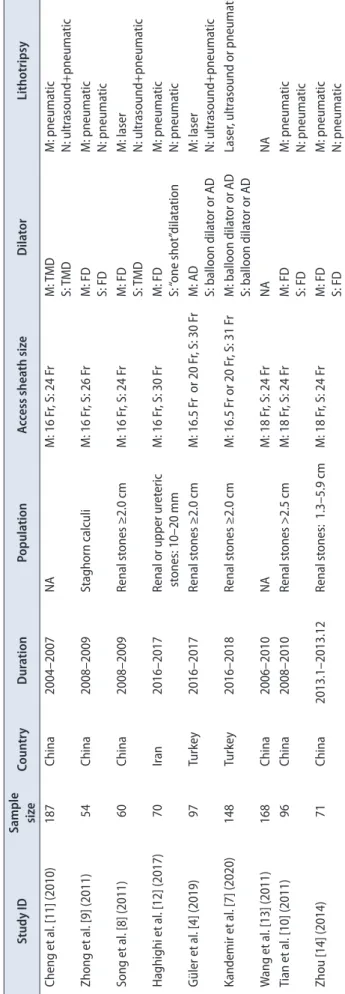
Table 1. The baseline characteristics of the included studies Study IDSample sizeCountryDurationPopulationAccess sheath sizeDilatorLithotripsy Cheng et al. [11] (2010)187China2004–2007NAM: 16 Fr, S: 24 FrM: TMD S: TMDM: pneumatic N: ultrasound+pneumatic Zhong et al. [9] (2011)54China2008–2009Staghorn calculiM: 16 Fr, S: 26 FrM: FD S: FDM: pneumatic N: pneumatic Song et al. [8] (2011)60China2008–2009Renal stones ≥2.0 cmM: 16 Fr, S: 24 FrM: FD S: TMDM: laser N: ultrasound+pneumatic Haghighi et al. [12] (2017)70Iran2016–2017Renal or upper ureteric stones: 10–20 mmM: 16 Fr, S: 30 FrM: FD S: “one shot”dilatationM: pneumatic N: pneumatic Güler et al. [4] (2019)97Turkey2016–2017Renal stones ≥2.0 cmM: 16.5 Fr or 20 Fr, S: 30 FrM: AD S: balloon dilator or ADM: laser N: ultrasound+pneumatic Kandemir et al. [7] (2020)148Turkey2016–2018Renal stones ≥2.0 cmM: 16.5 Fr or 20 Fr, S: 31 FrM: balloon dilator or AD S: balloon dilator or ADLaser, ultrasound or pneumatic Wang et al. [13] (2011)168China2006–2010NAM: 18 Fr, S: 24 FrNANA Tian et al. [10] (2011)96China2008–2010Renal stones >2.5 cmM: 18 Fr, S: 24 FrM: FD S: FDM: pneumatic N: pneumatic Zhou [14] (2014)71China2013.1–2013.12Renal stones: 1.3–5.9 cmM: 18 Fr, S: 24 FrM: FD S: FDM: pneumatic N: pneumatic NA, not available; M, minimally invasive percutaneous nephrolithotomy; TMD, telescoping metal dilators; S (or N), standard percutaneous nephrolithotomy; FD, fascial dilators; AD, Amplatz dilators.
[15]. The percentiles, 25th and 75th percentiles as well as 5th and 95th percentiles, were transformed to SD by use of the following formula: SD≈Norm IQR=(P75-P25)×0.7413 (where IQR is interquartile range, P75 is 75th percentile, and P25 is 25th percentile) [16]. Continuous and dichotomous variables were described as means+SD and proportions, respectively.
We calculated pooled estimates of the mean difference (MD) or standard MD (SMD) and odds ratios (ORs) for con- tinuous and dichotomous variables, respectively. We used the Cochran Q test to evaluate between-study heterogeneity [17]. We also did I² testing to assess the magnitude of the het- erogeneity with values ≤50% regarded as being of acceptable heterogeneity [18]. The random effects model was used when the trials yielded heterogeneous (p<0.1) results. Otherwise, the fixed effects model was used. Significance was set at p<0.05. We also did a preplanned subgroup analysis with re- gard to pelvic stone, multiple calyx stones, and renal calculi
≥2 cm. This meta-analysis was accomplished by use of Rev- Man5 (version 5.3).
RESULTS
1. Search results
The initial search yielded 1,219 potential studies and 9 RCTs [4,7-14], including 470 mPCNL cases and 481 sPCNL cases that were included in the final meta-analysis after du- plicates were removed, titles and abstracts screened, and full- text articles assessed. The study selection process is shown in Fig. 2 [19].
Only 2 [4,7] of the 9 RCTs [4,7-14] described pelvic stones and multiple calyx stones. Five RCTs [4,7-10] compared mPCNL with sPCNL for patients with renal calculi ≥2 cm.
Table 1 details the baseline characteristics of the included studies [4,7-14].
2. Demographic data and stone characteristics There were no significant differences with regard to age, proportion of males, BMI, stone size, hydronephrosis, or op- eration side, with no statistically significant p-values and no significant between-study heterogeneity. These results are shown in Table 2.
3. Primary outcomes
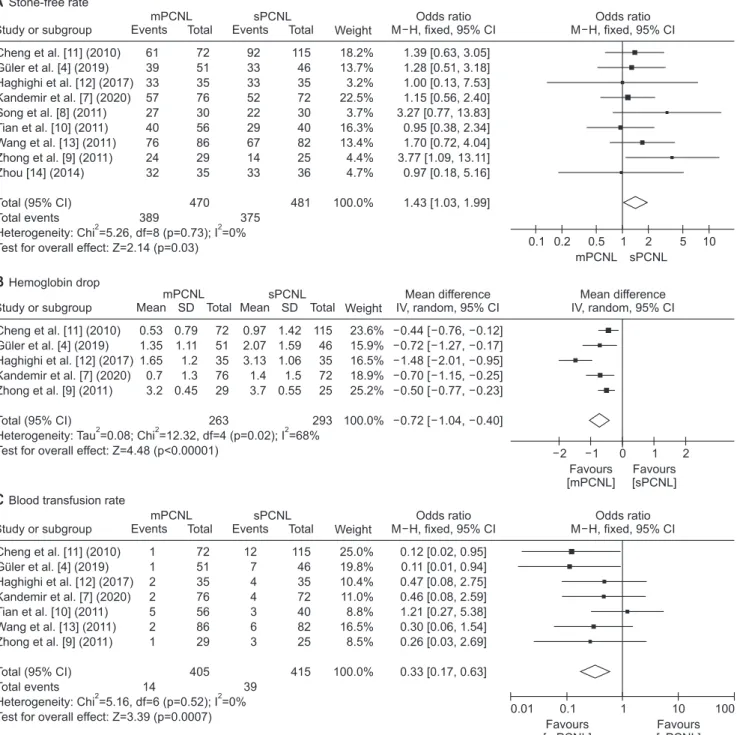
Patients receiving mPCNL experienced a higher SFR (OR, 1.43; 95% CI, 1.03–1.99; p=0.03) and lower transfusion rates (OR, 0.33; 95% CI, 0.17–0.63; p=0.0007) compared with their counterparts in the sPCNL group. In addition, the he- moglobin drop was lower in the mPCNL group (MD, -0.72;
95% CI, -1.04 to -0.40; p<0.00001) with moderate heterogeneity between the trials (I2=68%). The trial of Haghighi et al. [12]
seemed to be the source of the heterogeneity. The hemoglo- bin drop was still lower in the mPCNL group (MD, -0.53; 95%
CI, -0.71 to -0.36; p<0.00001) after the exclusion of this study, which resulted in no heterogeneity between trials (I2=0%).
We thought that the relatively small stone size in this study may have been the cause. The patients in this study had re- nal or upper ureteric stones of 10 to 20 mm in diameter.
4. Secondary outcomes
Compared with sPCNL, operative time was longer in the mPCNL group (MD, 10.98; 95% CI, 3.64–18.32; p=0.003) and there was no significant difference between mPCNL and sPCNL with regard to hospitalization time (SMD, -0.24; 95%
CI, -0.75 to 0.27; p=0.35).
However, both results showed high heterogeneity. Sur- geon experience and hospital regulations for hospitalization may have been the cause of the heterogeneity in operative time and hospitalization time, respectively.
The results of the meta-analysis showed no significant differences between the groups regarding urine leakage (OR, Table 2. The results of the meta-analysis of basic characteristics, pelvic stones, and multiple calyx stones
Data type Data Studies ES ES value LCI UCI Heterogeneity (p/I2) p-value
Age (y) 6 MD -1.41 -2.86 0.05 0.86/0% 0.06
Sex (male rate) 5 OR 1.08 0.77 1.52 0.98/0% 0.66
Body mass index (kg/m2) 2 MD -0.29 -1.69 1.12 0.38/0% 0.69
Demographic data and stone characteristics
Stone size 6 SMD -0.1 -0.27 0.08 0.87/0% 0.27
Hydronephrosis (severe rate) 3 OR 0.68 0.41 1.16 0.53/0% 0.16
Operation side (right rate) 2 OR 1.15 0.69 1.90 0.91/0% 0.59
Operative time (min) Pelvic stone 2 MD 22.73 -1.40 46.85 0.05/75% 0.06
Multiple calyx stone 2 MD 13.18 4.41 21.95 0.82/0% 0.003
Stone-free rate Pelvic stone 2 OR 1.56 0.33 7.34 0.50/0% 0.57
Multiple calyx stone 2 OR 1.48 0.69 3.18 0.29/9% 0.32
ES, effect size; LCI, lower confidence interval; UCI, upper confidence interval; MD, mean difference; OR, odds ratio.
0.69; 95% CI, 0.17–2.75; p=0.60), postoperative fever (OR, 1.10;
95% CI, 0.68–1.78; p=0.71), impaired ventilation (OR, 1.03; 95%
CI, 0.28–3.78; p=0.97), or total complication rate (OR, 0.74; 95%
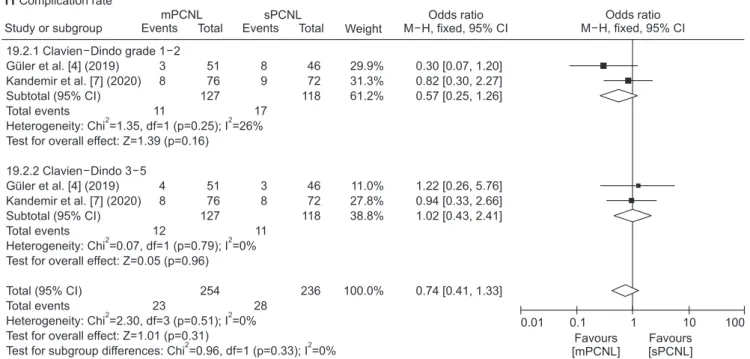
CI, 0.43–1.29; p=0.29) with no heterogeneity between trials.
The pooled results of the primary and secondary outcomes are summarized in Fig. 3 [4,7-14].
5. Pelvic stones and multiple calyx stones
Only two RCTs [4,7] were available for meta-analysis
regarding pelvic stones and multiple calyx stones. There was no significant difference between the groups with regard to operative time (p=0.06) or SFR (p=0.57) for pelvic stones. For multiple calyx stones, the mPCNL group seemed to have a longer operative time (MD, 13.18; 95% CI, 4.41–21.95; p=0.003) compared with the sPCNL group and there was no signifi- cant difference between mPCNL and sPCNL regarding the SFR (OR, 1.48; 95% CI, 0.69–3.18; p=0.32). The pooled results for pelvic stones and multiple calyx stones are also shown in
Study or subgroup
mPCNL
61 39 33 57 27 40 76 24 32
389
Events Total 72 51 35 76 30 56 86 29 35 470
Weight 18.2%
13.7%
3.2%
22.5%
3.7%
16.3%
13.4%
4.4%
4.7%
100.0%
1.39 [0.63, 3.05]
1.28 [0.51, 3.18]
1.00 [0.13, 7.53]
1.15 [0.56, 2.40]
3.27 [0.77, 13.83]
0.95 [0.38, 2.34]
1.70 [0.72, 4.04]
3.77 [1.09, 13.11]
0.97 [0.18, 5.16]
1.43 [1.03, 1.99]
Odds ratio M H, fixed, 95% CI
mPCNL sPCNL Odds ratio M H, fixed, 95% CI
10
0.1 0.5 1 2
92 33 33 52 22 29 67 14 33
375 sPCNL Events Total
115 46 35 72 30 40 82 25 36 481 ..
0.2 5
Study or subgroup
mPCNL
Weight 23.6%
15.9%
16.5%
18.9%
25.2%
100.0%
0.44 [ 0.76, 0.12]
0.72 [ 1.27, 0.17]
1.48 [ 2.01, 0.95]
0.70 [ 1.15, 0.25]
0.50 [ 0.77, 0.23]
0.72 [ 1.04, 0.40]
Mean difference IV, random, 95% CI
Favours [mPCNL]
Favours [sPCNL]
Mean difference IV, random, 95% CI
1 0 1 sPCNL
0.53 1.35 1.65 0.7 3.2
0.79 1.11 1.2 1.3 0.45
72 51 35 76 29 263 Mean SD Total
..
2 2
0.97 2.07 3.13 1.4 3.7
1.42 1.59 1.06 1.5 0.55
115 46 35 72 25 293 Mean SD Total
Study or subgroup
mPCNL
1 1 2 2 5 2 1
14
Events Total 72 51 35 76 56 86 29 405
Weight 25.0%
19.8%
10.4%
11.0%
8.8%
16.5%
8.5%
100.0%
0.12 [0.02, 0.95]
0.11 [0.01, 0.94]
0.47 [0.08, 2.75]
0.46 [0.08, 2.59]
1.21 [0.27, 5.38]
0.30 [0.06, 1.54]
0.26 [0.03, 2.69]
0.33 [0.17, 0.63]
Odds ratio M H, fixed, 95% CI
Favours [mPCNL]
Favours [sPCNL]
Odds ratio M H, fixed, 95% CI
100
0.01 1
12 7 4 4 3 6 3
39 sPCNL Events Total
115 46 35 72 40 82 25 415 ..
0.1 10
AStone-free rate
BHemoglobin drop
CBlood transfusion rate
The primary outcomes
Fig. 3. (A–I) The pooled results of the primary and secondary outcomes. mPCNL, miniaturized percutaneous nephrolithotomy; sPCNL, standard percuta- neous nephrolithotomy; M–H, Mantel–Haenszel; CI, confidence interval; IV, inverse variance.
Table 2.
6. Renal calculi ≥2 cm
Five RCTs [4,7-10] were available for meta-analysis with regard to renal calculi ≥2 cm. The mPCNL group had a longer operative time (MD, 12.26; 95% CI, 1.39–23.13; p=0.03), lower transfusion rate (OR, 0.42; 95% CI, 0.18–0.97; p=0.04), and lower hemoglobin drop (MD, -0.58; 95% CI, -0.79 to -0.36;
p<0.00001) compared with the sPCNL group. There were no
significant differences between the groups regarding the SFR (OR, 1.45; 95% CI, 0.95–2.20; p=0.09), hospitalization time, postoperative fever, impaired ventilation, or total complica- tion rate. The meta-analysis results of renal calculi ≥2 cm are shown in Fig. 4 [4,7-10,20].
DISCUSSION
Urolithiasis is one of the most common diseases in urol-
Study or subgroup
Favours [mPCNL]
Favours [sPCNL]
Mean difference IV, random, 95% CI
20 10 0 10 ..
20
DOperation time
The secondary outcomes
mPCNL
Weight 11.2%
7.6%
12.6%
9.7%
12.2%
10.4%
12.0%
12.4%
11.9%
100.0%
13.85 [6.06, 21.64]
14.50 [ 2.48, 31.48]
3.00 [ 5.34, 0.66]
15.70 [4.09, 27.31]
3.00 [ 7.58, 1.58]
20.20 [10.26, 30.14]
12.00 [6.75, 17.25]
16.25 [12.74, 19.76]
16.80 [11.17, 22.43]
10.98 [3.64, 18.32]
Mean difference IV, random, 95% CI sPCNL
109.8 89.2 48 106.9 39 119.5 116.2 116 91.9
27.02 40.4 4.3 38.8 10 29.6 18.4 8.5 12.4
72 51 35 76 30 56 86 29 35 470 Mean SD Total
95.95 74.7 51 91.2 42 99.3 104.2 99.75 75.1
25.48 44.5 5.6 33.2 8 20.1 16.3 4.25 11.8
115 46 35 72 30 40 82 25 36 481 Mean SD Total
Study or subgroup
mPCNL
Weight 17.9%
17.0%
15.7%
17.7%
15.3%
16.4%
100.0%
0.15 [ 0.44, 0.15]
0.53 [ 0.93, 0.12]
1.54 [ 2.08, 1.01]
0.32 [ 0.64, 0.01]
1.05 [0.48, 1.63]
0.08 [ 0.39, 0.54]
0.24 [ 0.75, 0.27]
Std. mean difference IV, random, 95% CI
Favours [mPCNL]
Favours [sPCNL]
Std. mean difference IV, random, 95% CI
1 0 1 sPCNL
7.3 48 2.32 64.3 9.8 5.8
1 26.3 0.84 36.5 1.75 1.5
72 51 35 76 29 35 298 Mean SD Total ..
2 2
7.5 66.8 3.6 75.5 8.05 5.7
1.5 43.2 0.8 34 1.5 1.1
115 46 35 72 25 36 329 Mean SD Total
EHospitalization time
Study or subgroup
mPCNL
15 1 2 0 3 15 3
39
Events Total 72 51 35 76 30 56 29 349
Weight 52.4%
1.6%
9.0%
8.1%
11.5%
8.2%
9.2%
100.0%
0.86 [0.42, 1.75]
2.76 [0.11, 69.50]
0.65 [0.10, 4.13]
0.18 [0.01, 3.91]
0.72 [0.15, 3.54]
4.51 [1.21, 16.84]
0.85 [0.15, 4.62]
1.10 [0.68, 1.78]
Odds ratio M H, fixed, 95% CI
Favours [mPCNL]
Favours [sPCNL]
Odds ratio M H, fixed, 95% CI
100
0.01 1
27 0 3 2 4 3 3
42 sPCNL Events Total
115 46 35 72 30 40 25 363 ..
0.1 10
FFever
Fig. 3. Continued.
ogy. The prevalence rates for urinary stones vary from 1%
to 20% depending on geographic, climatic, ethnic, dietary, and genetic factors [1]. Traditional open or laparoscopic stone surgery is gradually being replaced by minimally invasive techniques owing to the greater trauma and complications of the former surgical methods. Currently, PCNL is recom- mended as the standard procedure for large renal calculi [1].
The first PCNL was completed in 1976 by Fernström and Johansson (requoted from reference [21]). However, because the nephrostomy tract reached 30 Fr at that time, it was traumatic and dangerous, and complications such as severe bleeding often occurred. For these reasons, mPCNL came into being [3].
At present, there is no accurate definition of the access tracts for mPCNL and sPCNL. There is a consensus that standard access tracts are 24 to 30 Fr and miniaturized ac- cess tracts are smaller than 22 Fr [1]. Recently, smaller renal
access sheaths including micro-PNL (4.5 Fr outer sheath), ultra-mPNL (7.5 Fr nephroscope and 11–13 Fr outer sheath), and super-mPNL (7.5 Fr nephroscope and modified 10–14 Fr outer sheath) techniques have been introduced as alterna- tive procedures to decrease the operation-related morbidities [4]. However, whether mPCNL is a comparable alternative to sPCNL remains controversial. A previous meta-analysis [5]
included only 3 RCTs and the results were not very stable or reliable. Thus, our meta-analysis of RCTs was warranted to confirm and update the conclusions.
Unlike the previous study [5], the results of our study suggested that the mPCNL group had a higher SFR than the sPCNL group. However, the SFR was not significantly different between groups with regard to renal calculi ≥2 cm.
As for pelvic stones and multiple calyx stones, we cannot reach a conclusion owing to the limited number of RCTs.
We believe that mPCNL can be carefully manipulated by
Study or subgroup
Favours [mPCNL]
Favours [sPCNL]
Odds ratio M H, fixed, 95% CI
1,000
0.001 0.1 1 10
..
GImpaired ventilation
mPCNL
1 0 1 1
3
Events Total 72 51 76 29 228
Weight 8.5%
34.9%
45.3%
11.4%
100.0%
4.85 [0.19, 120.58]
0.29 [0.01, 7.41]
0.47 [0.04, 5.26]
2.68 [0.10, 68.87]
1.03 [0.28, 3.78]
Odds ratio M H, fixed, 95% CI 0
1 2 0
3 sPCNL Events Total
115 46 72 25 258
Study or subgroup
Favours [mPCNL]
Favours [sPCNL]
Odds ratio M H, fixed, 95% CI
1,000
0.001 0.1 1 10
HUrine leakage
mPCNL
0 2 1
3
Events Total 72 35 29 136
Weight 38.9%
19.1%
42.0%
100.0%
0.31 [0.01, 6.62]
2.06 [0.18, 23.83]
0.41 [0.03, 4.82]
0.69 [0.17, 2.75]
Odds ratio M H, fixed, 95% CI 2
1 2
5 sPCNL Events Total
115 35 25 175
Study or subgroup
Favours [mPCNL]
Favours [sPCNL]
Odds ratio M H, fixed, 95% CI
100
0.01 0.1 1 10
I Complication rate
mPCNL
7 16 6
29
Events Total 51 76 35 162
Weight 33.8%
46.8%
19.4%
100.0%
0.51 [0.18, 1.44]
0.86 [0.40, 1.87]
0.86 [0.26, 2.86]
0.74 [0.43, 1.29]
Odds ratio M H, fixed, 95% CI 11
17 7
35 sPCNL Events Total
46 72 36 154 ..
Fig. 3. Continued.
tiny operating instruments, such as RUS, the pneumatic lithotripter, and holmium laser lithotripsy [22], and mPCNL is more prone to bleeding, which affects the surgical field
and increases the operative risk. Therefore, mPCNL may be more suitable than sPCNL for kidney stones <2 cm.
Tract size is one of the crucial factors determining bleed-
Study or subgroup
Favours [mPCNL]
Favours [sPCNL]
Odds ratio M H, fixed, 95% CI
20
0.05 0.2 1 5
A Stone-free rate
mPCNL
39 57 27 40 24
187
Events Total 51 76 30 56 29 242
Weight 22.7%
37.1%
6.1%
26.9%
7.2%
100.0%
1.28 [0.51, 3.18]
1.15 [0.56, 2.40]
3.27 [0.77, 13.83]
0.95 [0.38, 2.34]
3.77 [1.09, 13.11]
1.45 [0.95, 2.20]
Odds ratio M H, fixed, 95% CI 33
52 22 29 14
150 sPCNL Events Total
46 72 30 40 25 213 ..
Study or subgroup
mPCNL
Weight 15.1%
18.8%
22.9%
19.9%
23.3%
100.0%
14.50 [ 2.48, 31.48]
15.70 [4.09, 27.31]
3.00 [ 7.58, 1.58]
20.20 [10.26, 30.14]
16.25 [12.74, 19.76]
12.26 [1.39, 23.13]
Mean difference IV, random, 95% CI
Favours [mPCNL]
Favours [sPCNL]
Mean difference IV, random, 95% CI
25 0 25 sPCNL
89.2 106.9 39 119.5 116
40.4 38.8 10 29.6 8.5
51 76 30 56 29 242 Mean SD Total ..
50 50
74.7 91.2 42 99.3 99.75
44.5 33.2 8 20.1 4.25
46 72 30 40 25 213 Mean SD Total
BOperation time
Study or subgroup
Favours [mPCNL]
Favours [sPCNL]
Odds ratio M H, fixed, 95% CI
100
0.01 0.1 1 10
CBlood transfusion rate
mPCNL
1 2 5 1
9
Events Total 51 76 56 29 212
Weight 41.2%
22.8%
18.2%
17.8%
100.0%
0.11 [0.01, 0.94]
0.46 [0.08, 2.59]
1.21 [0.27, 5.38]
0.26 [0.03, 2.69]
0.42 [0.18, 0.97]
Odds ratio M H, fixed, 95% CI 7
4 3 3
17 sPCNL Events Total
46 72 40 25 183 ..
Study or subgroup
Favours [mPCNL]
Favours [sPCNL]
Mean difference IV, fixed, 95% CI
2
2 1 0 1
DHemoglobin drop
..
mPCNL
Weight 15.1%
22.3%
62.6%
100.0%
0.72 [ 1.27, 0.17]
0.70 [ 1.15, 0.25]
0.50 [ 0.77, 0.23]
0.58 [ 0.79, 0.36]
Mean difference IV, fixed, 95% CI sPCNL
1.35 0.7 3.2
1.11 1.30 0.45
51 76 29 156 Mean SD Total
2.07 1.4 3.7
1.59 1.5 0.55
46 72 25 143 Mean SD Total
Fig. 4. (A–H) Results of the meta-analysis of renal calculi ≥2 cm. Complications were stratified by the Clavien–Dindo system into minor (grade 1–2) and major (grade 3–5) complications [20]. mPCNL, miniaturized percutaneous nephrolithotomy; sPCNL, standard percutaneous nephrolithotomy; M–H, Man- tel–Haenszel; CI, confidence interval; IV, inverse variance.
ing during PCNL [2]. It is easy to understand that mPCNL results in less blood loss and a lower transfusion rate than sPCNL owing to less renal parenchymal and renal vascula- ture damage [23]. On the other hand, mPCNL has the disad- vantage of a more restricted visual field with the miniature endoscopes and the need to break the stones into smaller fragments for their removal through the smaller tract [5].
Thus, operative time was longer in the mPCNL group than in the sPCNL group. Despite these significant differences, our pooled analysis showed no significant differences be- tween the groups regarding hospitalization time.
We conducted a meta-analysis of postoperative complica- tions, including fever, impaired ventilation, and urine leak- age. The results suggested that there were no significant dif- ferences between mPCNL and sPCNL. A systematic review including almost 12,000 patients disclosed the following in- cidences of complications in PCNL: fever, 10.8%; transfusion,
7%; thoracic complications, 1.5%; and sepsis, 0.5% [1,24]. Among these complications, perioperative fever can occur, even with a sterile preoperative urinary culture and perioperative an- tibiotic prophylaxis, because the kidney stones themselves may be a source of infection [1].
The present study did have the following limitations.
First, the sample size of the studies included was relatively small and might not have achieved sufficient power to make a definitive conclusion. Second, heterogeneity between trials was high for several outcomes. This may have been caused by the broad heterogeneity in study populations, designs, and definitions of outcome measures. Finally, we were un- able to assess the impact of surgical history, stone location, type, and number of tracts on surgical outcomes. In addition, we also were unable to decide on the optimal tract size.
Study or subgroup
Favours [mPCNL]
Favours [sPCNL]
Std. mean difference IV, random, 95% CI
4
4 2 0 2
E Hospitalization time ..
Study or subgroup
Favours [mPCNL]
Favours [sPCNL]
Odds ratio M H, fixed, 95% CI
200
0.005 0.1 1 10
FFever
mPCNL
1 0 3 15 3
22
Events Total 51 76 30 56 29 242
Weight 4.2%
21.1%
29.7%
21.2%
23.9%
100.0%
2.76 [0.11, 69.50]
0.18 [0.01, 3.91]
0.72 [0.15, 3.54]
4.51 [1.21, 16.84]
0.85 [0.15, 4.62]
1.53 [0.74, 3.15]
Odds ratio M H, fixed, 95% CI 0
2 4 3 3
12 sPCNL Events Total
46 72 30 40 25 213 ..
mPCNL
Weight 33.9%
35.0%
31.1%
100.0%
0.53 [ 0.93, 0.12]
0.32 [ 0.64, 0.01]
1.05 [0.48, 1.63]
0.04 [ 0.76, 0.83]
Std. mean difference IV, random, 95% CI sPCNL
48 64.3 9.8
26.3 36.5 1.75
51 76 29 156 Mean SD Total
66.8 75.5 8.05
43.2 34 1.5
46 72 25 143 Mean SD Total
Study or subgroup
Favours [mPCNL]
Favours [sPCNL]
Odds ratio M H, fixed, 95% CI
1,000
0.001 0.1 1 10
GImpaired ventilation
mPCNL
0 1 1
2
Events Total 51 76 29 156
Weight 38.1%
49.5%
12.4%
100.0%
0.29 [0.01, 7.41]
0.47 [0.04, 5.26]
2.68 [0.10, 68.87]
0.68 [0.15, 3.09]
Odds ratio M H, fixed, 95% CI 1
2 0
3 sPCNL Events Total
46 72 25 143 ..
Fig. 4. Continued.
CONCLUSIONS
Our findings suggested that mPCNL had a higher SFR than sPCNL and there was no significant difference between the two groups regarding renal stones ≥2 cm. Be- sides, mPCNL tended to be associated with significantly less bleeding and a lower transfusion rate, but the duration of the procedure seemed to be significantly longer. There were no significant differences in other complications, such as postoperative fever, urine leakage, or impaired ventilation.
Further research is needed to assess the impact of surgical history, stone location, type, and number of tracts on surgi- cal outcomes and to determine the optimal tract size.
CONFLICTS OF INTEREST
The authors have nothing to disclose.
ACKNOWLEDGMENTS
The study was supported by the Pillar Program from Department of Science and Technology of Sichuan Province (2018SZ0219) and by a grant from the Science and Technol- ogy Department of Sichuan Province (2018SZ0168).
AUTHORS’ CONTRIBUTIONS
Research conception and design: Dechao Feng. Data acquisition: Dechao Feng and Xiao Hu. Statistical analysis:
Dechao Feng. Data analysis and interpretation: Dechao Feng, Xiao Hu, and Yin Tang. Drafting of the manuscript: Dechao Feng. Critical revision of the manuscript: Xin Wei. Obtain- ing funding: Ping Han and Yin Tang. Administrative, tech- nical, or material support: Ping Han. Supervision: Ping Han.
Approval of the final manuscript: Xin Wei.
SUPPLEMENTARY MATERIAL
Scan this QR code to see the supplementary material, or visit https://www.icurology.org/src/sm/icurology-61-115-s001.pdf.
REFERENCES
1. Türk C, Skolarikos A, Neisius A, Petřík A, Seitz C, Thomas K. Guidelines on urolithiasis [Internet]. Netherlands: Eu- ropean Association of Urology; 2019 Nov 8 [cited 2019 Nov 8]. Available from: https://uroweb.org/guideline/
urolithiasis/#note_259.
2. Kukreja R, Desai M, Patel S, Bapat S, Desai M. Factors affecting blood loss during percutaneous nephrolithotomy: prospective study. J Endourol 2004;18:715-22.
3. Jackman SV, Docimo SG, Cadeddu JA, Bishoff JT, Kavoussi LR, Jarrett TW. The "mini-perc" technique: a less invasive Study or subgroup
Favours [mPCNL]
Favours [sPCNL]
Odds ratio M H, fixed, 95% CI
100
0.01 0.1 1 10
HComplication rate
mPCNL
Events Total Weight
Odds ratio M H, fixed, 95% CI sPCNL
Events Total
3 8 11
4 8 12
23
51 76 127
51 76 127
254
29.9%
31.3%
61.2%
11.0%
27.8%
38.8%
100.0%
0.30 [0.07, 1.20]
0.82 [0.30, 2.27]
0.57 [0.25, 1.26]
1.22 [0.26, 5.76]
0.94 [0.33, 2.66]
1.02 [0.43, 2.41]
0.74 [0.41, 1.33]
8 9 17
3 8 11
28
46 72 118
46 72 118
236 ..
..
19.2.1 Clavien Dindo grade 1 2 Guler et al. [4] (2019)
Kandemir et al. [7] (2020) Subtotal (95% CI) Total events
Heterogeneity: Chi =1.35, df=1 (p=0.25); I =26%
Test for overall effect: Z=1.39 (p=0.16) 19.2.2 Clavien Dindo 3 5
Guler et al. [4] (2019) Kandemir et al. [7] (2020) Subtotal (95% CI) Total events
Heterogeneity: Chi =0.07, df=1 (p=0.79); I =0%
Test for overall effect: Z=0.05 (p=0.96) Total (95% CI)
Total events
Heterogeneity: Chi =2.30, df=3 (p=0.51); I =0%
Test for overall effect: Z=1.01 (p=0.31)
Test for subgroup differences: Chi =0.96, df=1 (p=0.33); I =0%
2 2
2 2
2 2
2 2
Fig. 4. Continued.
alternative to percutaneous nephrolithotomy. World J Urol 1998;16:371-4.
4. Güler A, Erbin A, Ucpinar B, Savun M, Sarilar O, Akbulut MF.
Comparison of miniaturized percutaneous nephrolithotomy and standard percutaneous nephrolithotomy for the treatment of large kidney stones: a randomized prospective study. Uroli- thiasis 2019;47:289-95.
5. Zhu W, Liu Y, Liu L, Lei M, Yuan J, Wan SP, et al. Minimally in- vasive versus standard percutaneous nephrolithotomy: a meta- analysis. Urolithiasis 2015;43:563-70.
6. Moher D, Shamseer L, Clarke M, Ghersi D, Liberati A, Petti- crew M, et al.; PRISMA-P Group. Preferred reporting items for systematic review and eta-analysis protocols (PRISMA-P) 2015 statement. Syst Rev 2015;4:1.
7. Kandemir E, Savun M, Sezer A, Erbin A, Akbulut MF, Sarılar Ö.
Comparison of miniaturized percutaneous nephrolithotomy and standard percutaneous nephrolithotomy in secondary pa- tients: a randomized prospective study. J Endourol 2020;34:26- 32.
8. Song L, Chen Z, Liu T, Zhong J, Qin W, Guo S, et al. The appli- cation of a patented system to minimally invasive percutane- ous nephrolithotomy. J Endourol 2011;25:1281-6.
9. Zhong W, Zeng G, Wu W, Chen W, Wu K. Minimally in- vasive percutaneous nephrolithotomy with multiple mini tracts in a single session in treating staghorn calculi. Urol Res 2011;39:117-22.
10. Tian X, Wan F, Liu D, Wang Z, Ge F. Comparison of standard and minimally invasive percutaneous nephrolithotomy for the treatment of complicated renal calculi. China Foreign Med Treat 2011;30:38-9.
11. Cheng F, Yu W, Zhang X, Yang S, Xia Y, Ruan Y. Minimally in- vasive tract in percutaneous nephrolithotomy for renal stones.
J Endourol 2010;24:1579-82.
12. Haghighi R, Zeraati H, Ghorban Zade M. Ultra-mini-percu- taneous nephrolithotomy (PCNL) versus standard PCNL: a randomised clinical trial. Arab J Urol 2017;15:294-8.
13. Wang XQ, Wang CX, Hao YY. The comparison of minimally
invasive tract and standard tract in percutaneous nephroli- thotomy for renal stones. Eur Urol Suppl 2011;10:70-1.
14. Zhou J. Comparison of standard and minimally invasive per- cutaneous nephrolithotomy for the treatment of renal calculi.
Med Forum 2014;(25):3383-4.
15. Hozo SP, Djulbegovic B, Hozo I. Estimating the mean and vari- ance from the median, range, and the size of a sample. BMC Med Res Methodol 2005;5:13.
16. Yang L, Wang G, Du Y, Ji B, Zheng Z. Remote ischemic precon- ditioning reduces cardiac troponin I release in cardiac surgery:
a meta-analysis. J Cardiothorac Vasc Anesth 2014;28:682-9.
17. Higgins JP, Thompson SG, Deeks JJ, Altman DG. Measuring inconsistency in meta-analyses. BMJ 2003;327:557-60.
18. Higgins JP, Thompson SG. Quantifying heterogeneity in a meta-analysis. Stat Med 2002;21:1539-58.
19. Moher D, Liberati A, Tetzlaff J, Altman DG; PRISMA Group.
Preferred reporting items for systematic reviews and meta- analyses: the PRISMA statement. PLoS Med 2009;6:e1000097.
20. Dindo D, Demartines N, Clavien PA. Classification of surgical complications: a new proposal with evaluation in a cohort of 6336 patients and results of a survey. Ann Surg 2004;240:205- 13.
21. Fernström I, Johansson B. Percutaneous pyelolithotomy. A new extraction technique. Scand J Urol Nephrol 1976;10:257-9.
22. El-Nahas AR, Shokeir AA, El-Assmy AM, Shoma AM, Eraky I, El-Kenawy MR, et al. Colonic perforation during percutaneous nephrolithotomy: study of risk factors. Urology 2006;67:937- 41.
23. Mishra S, Sharma R, Garg C, Kurien A, Sabnis R, Desai M.
Prospective comparative study of miniperc and standard PNL for treatment of 1 to 2 cm size renal stone. BJU Int 2011;108:896-9; discussion 899-900.
24. Seitz C, Desai M, Häcker A, Hakenberg OW, Liatsikos E, Nagele U, Tolley D. Incidence, prevention, and management of complications following percutaneous nephrolitholapaxy. Eur Urol 2012;61:146-58.
![Fig. 2. The study selection process [19].](https://thumb-ap.123doks.com/thumbv2/123dokinfo/5240064.130193/3.892.74.601.647.1095/fig-the-study-selection-process.webp)
![Table 1 details the baseline characteristics of the included studies [4,7-14].](https://thumb-ap.123doks.com/thumbv2/123dokinfo/5240064.130193/5.892.72.821.102.316/table-details-baseline-characteristics-included-studies.webp)
![Fig. 4. (A–H) Results of the meta-analysis of renal calculi ≥2 cm. Complications were stratified by the Clavien–Dindo system into minor (grade 1–2) and major (grade 3–5) complications [20]](https://thumb-ap.123doks.com/thumbv2/123dokinfo/5240064.130193/9.892.82.824.92.949/results-analysis-calculi-complications-stratified-clavien-dindo-complications.webp)