663
인자가 전립선특이항원에 미치는 영향
The Effects of Anthropometric Factors and Serologic Factors of the Metabolic Syndrome on Prostate-Specific Antigen Levels in Korean Men
Young Il Hahm, Kwan Joong Joo, Heung Jae Park
From the Department of Urology, Kangbuk Samsung Hospital, Sungkyunkwan University School of Medicine, Seoul, Korea
Purpose: We evaluated the effects of anthropometric and serological para- meters on serum prostate-specific antigen (PSA) in Korean men.
Materials and Methods: This study included 92,891 healthy Korean men who visited our health promotion center for a general health checkup.
The mean age of the participants was 42.6 years (range, 20-77 years).
Exclusion criteria were a serum PSA level over 4.0 ng/dl or pyuria on urinalysis (>5 white blood cells/high power field). All participants were evaluated for several anthropometric factors (height, weight, systolic blood pressure, diastolic blood pressure, body mass index [BMI], body surface area [BSA], fat mass, body fat percentage, and lean body mass) and for serologic parameters including components of the metabolic syndrome (fasting blood sugar, triglyceride [TG], and high-density lipoprotein cholesterol) biochemically. We analyzed the relationship between serum PSA levels and the various anthropometric and serologic parameters.
Results: In the univariate analysis, serum PSA levels were significantly positively correlated with age and with low-density lipoprotein (LDL) cholesterol after adjustment for age. On the other hand, serum PSA levels were negatively correlated with height, weight, BMI, BSA, fat mass, body fat percentage, lean body mass, aspartate aminotransferase, alanine aminotransferase, and TG. In the multivariate analysis, age and LDL-cholesterol had positive correlations with serum PSA levels, but BMI, BSA, fat mass, lean body mass, and TG were negatively correlated with PSA levels.
Conclusions: These results suggest that the serum PSA level is significantly influenced by age, the components of metabolic syndrome (BMI, TG), and serologic parameters such as LDL-cholesterol. The normal range of serum PSA should be considered in association with metabolic syndrome and anthropometric factors as well as age. (Korean J Urol 2009;50:663-668)
Key Words: Prostate-specific antigen, Body mass index, Body surface area, Metabolic syndrome
Korean Journal of Urology Vol. 50 No. 7: 663-668, July 2009 DOI: 10.4111/kju.2009.50.7.663
성균관대학교 의과대학 강북삼성병원 비뇨기과학교실 함영일ㆍ주관중ㆍ박흥재
Received:April 29, 2009 Accepted:June 15, 2009
Correspondence to: Heung Jae Park Department of Urology, Kangbuk Samsung Hospital, Sungkyunkwan University School of Medicine, 108, Pyeong-dong, Jongno-gu, Seoul 110-746, Korea
TEL: 02-2001-2240 FAX: 02-2001-2247
E-mail: [email protected]
Ⓒ The Korean Urological Association, 2009
서 론
한국중앙암등록사업에 의하면 전립선암의 발생이 최근 급격히 증가되고 있다. 1998년에는 남성암 중 발생빈도가
8위였으나 2003년부터 2005년까지는 5위로 순위가 급격히 상승되었고 이로 인한 사망률도 증가하고 있다.1 이는 1980 년대 이후 전립선암 선별 검사로 혈청 전립선특이항원 (prostate-specific antigne; PSA)이 널리 사용되고 있고 전립 선암에 대한 인식이 높아진데 기인한다 하겠다.2,3 그러나
전립선특이항원은 전립선비대증이나 전립선염 등의 질환 이 있는 경우에도 상승할 수 있기에 전립선암 진단에 이상 적인 종양 표지자라 하기에는 충분하지 않은 부분이 있 다.3,4 즉, 전립선특이항원의 수치에 영향을 미치는 여러 인 자에 대한 보고가 있고 이에 따른 보정된 수치를 적용해야 한다는 주장도 있는 실정이다. 전립선암 진단에 있어서 PSA의 민감도와 특이도를 높이기 위해서 최근 PSA밀도, PSA속도, percent free PSA 등이 부가적으로 이용되고 있 다.5 이에 더하여 PSA에 영향을 미치는 인자에 대한 연구가 필요하다.
고혈압, 당뇨, 이상지방혈증, 비만 등 관상동맥질환의 위 험요인이 되는 질환들이 군집되어 나타나는 것을 대사증후 군이라 정의하는데,6 한국 성인 남성에서 34.3%로 높은 유 병률을 나타낸다는 보고와,7 대사증후군은 심혈관계 질환 의 위험도나 대장암, 자궁내막암, 유방암 등의 발생과 유의 한 관계가 있다는 연구도 있다.8 전립선암의 경우에도 일부 역학조사에서 대사증후군이 전립선암의 발생이나 사망과 유의한 관계가 있다고 보고되었고,9 세부적으로는 대사증 후군을 구성하고 있는 대사장애 중 비만, 고혈당 및 고인슐 린혈증,10 지질대사이상11 등이 전립선암과 유의한 관련이 있다고 보고되고 있다.
저자들은 본 연구에서 건강검진을 위해 내원한 한국 성 인 남성에서 연령, 대사장애인자들이 포함된 혈청학적 인 자들 및 인체측정학적지수들과 PSA가 어떤 상관성을 보이 는지 알아보았다.
대상 및 방법
2006년 1월부터 2007년 12월까지 본원 종합건강검진센터 를 방문한 성인 남성 중 PSA가 4.0 ng/ml 미만이며 요검사 에서 정상소견을 보인 92,891명을 대상으로 나이, 혈액검 사, 신장, 체중, 혈압, 체질량지수 (body mass index; BMI), 체표면적 (body surface area; BSA), 체지방량 (fat mass), 체지 방률 (body fat percentage), 제지방량 (lean body mass) 등과 PSA의 관련성을 분석하였다.
전립선특이항원은 radioimmunoassay 방법으로 측정하였 고 혈압은 최소 5분간의 충분한 휴식 후 혈압계로 수축기와 이완기 혈압을 측정하였다. 체질량지수는 신장 (height; H) 과 체중 (weight; W)을 공식 (BMI=W/H2)에 대입하여 정상 (<22.9), 과체중 (23-24.9), 비만 (25-29.9), 중증도 비만 (≥
30)으로 산출하였고,12 체표면적은 Dubois 공식 (BSA=
H0.725xW0.425x0.007184)에 따라 계산하였으며,13 체지방의 정
량화와 분포를 알아보기 위하여 QDR4500의 DEXA system (Hlologic, USA)을 이용하여 지방량과 제지방량, 체지방률
등을 측정하였다. 최소 8시간 이상 금식한 후 오전 10시 이 전에 혈액을 채취하였으며, fasting blood sugar, total protein, albumin, total bilirubin, direct bilirubin, γ-GTP, triglyceride, alkaline phosphatase, aspartate aminotransferase (AST), alanine aminotransferase (ALT)와 총콜레스테롤, high-density lipo- protein (HDL) 콜레스테롤 및 low-density lipoprotein (LDL) 콜레스테롤 등을 측정하였다.
대사증후군의 진단기준 인자는 개정된 Adult Treatment Panel guidelines III (ATP-III)가 2001년 5월 미국에서 발표한 제3차 콜레스테롤관리지침 (National Cholesterol Education Program's Third Adult Treatment Panel)의 정의에 따라 수축 기 및 이완기 혈압, 공복 혈당, 비만 (체질량지수가 25 kg/m2 이상), HDL 콜레스테롤, 중성지방으로 정하였다.14 통계학적인 분석은 WindowⓇ용 SPSS 15.0를 사용하였다.
각각의 측정값은 Pearson’s correlation coefficient, partial correlation coefficient, 로지스틱회귀분석, 다중회귀분석을 시행하여 p값이 0.05 미만인 경우 통계적으로 유의한 것으 로 판단하였다.
결 과
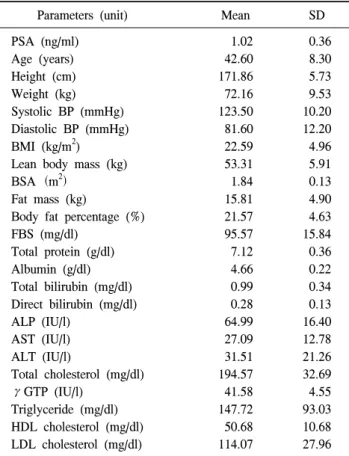
대상자들의 연령, PSA, BMI의 평균은 42.6세, 1.02 ng/ml, 22.59 kg/m2였다 (Table 1). 각각의 측정치와 PSA의 상관관 계를 알아보기 위하여 PSA에 가장 큰 영향을 미치는 연령 에 대한 보정을 시행하고 편상관계수 (partial correlation coefficient)를 구하였다. PSA는 신장 (p<0.001), 체중 (p<
0.001), 체질량지수 (p<0.001), 제지방량 (p<0.001), 체표면 적 (p<0.001), 체지방량 (p<0.001), 체지방률 (p<0.001), AST (p<0.001), ALT (p<0.001), TG (p=0.02)들과 음의 상관 관계를 나타냈으며 각각의 상관계수는 −0.039, −0.073,
−0.062, −0.068, −0.071, −0.055, −0.034, −0.030, −0.028,
−0.037이었다. LDL 콜레스테롤 (p=0.01)과는 유의한 양의 상관관계를 보였고 상관계수는 0.019이었다 (Table 2).
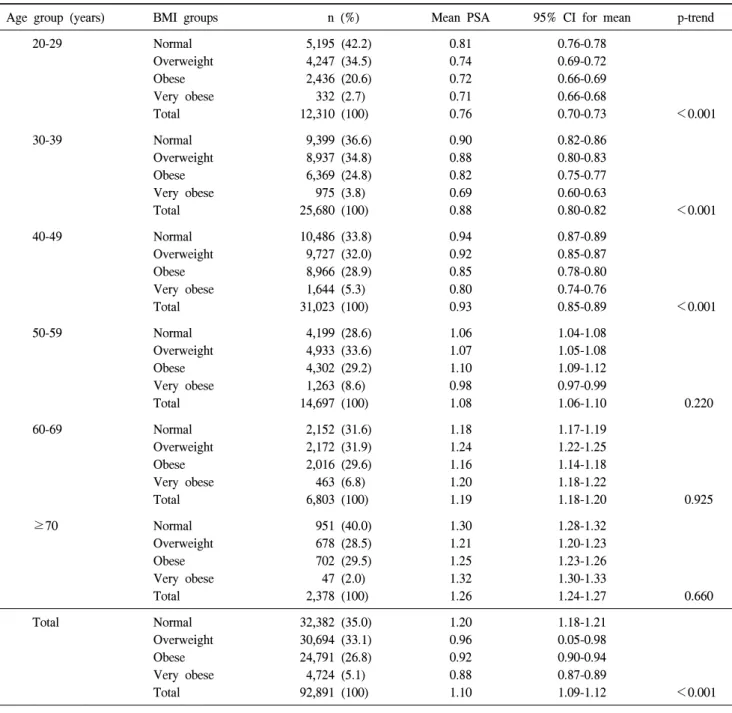
이변량 분석 변수들 중, 체질량지수를 세분화하여, 정상, 과체중, 비만, 중증도비만으로 4군으로 나누어, 연령군별 PSA와의 상관관계를 분석하였다. 20-29세군, 30-39세군, 40-49세군에서는 체질량지수와 PSA는 유의한 상관성을 볼 수 있었지만 50-59세, 60-69세, 70세 이상군에서는 통계적 유의성이 없었다 (Table 3).
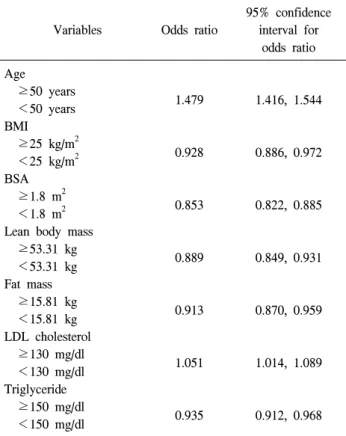
또한 PSA 변화를 예측할 수 있는 인자를 찾기 위해 평균 PSA 절단치 1.0 ng/dl를 종속변수로 하여 로지스틱 선형회 귀모형으로 분석한 결과 연령 (≥50세, <50세)과 LDL 콜레 스테롤 (≥130 mg/dl, <130 mg/dl)의 교차비는 각각 1.479, 1.051로 PSA 증가의 위험인자였고, 체질량지수 (≥25
Table 1. Distribution of clinical parameters
Parameters (unit) Mean SD
PSA (ng/ml) Age (years) Height (cm) Weight (kg) Systolic BP (mmHg) Diastolic BP (mmHg) BMI (kg/m2) Lean body mass (kg) BSA(m2)
Fat mass (kg)
Body fat percentage (%) FBS (mg/dl)
Total protein (g/dl) Albumin (g/dl) Total bilirubin (mg/dl) Direct bilirubin (mg/dl) ALP (IU/l)
AST (IU/l) ALT (IU/l)
Total cholesterol (mg/dl) γGTP (IU/l)
Triglyceride (mg/dl) HDL cholesterol (mg/dl) LDL cholesterol (mg/dl)
1.02 42.60 171.86 72.16 123.50 81.60 22.59 53.31 1.84 15.81 21.57 95.57 7.12 4.66 0.99 0.28 64.99 27.09 31.51 194.57 41.58 147.72 50.68 114.07
0.36 8.30 5.73 9.53 10.20 12.20 4.96 5.91 0.13 4.90 4.63 15.84 0.36 0.22 0.34 0.13 16.40 12.78 21.26 32.69 4.55 93.03 10.68 27.96 SD: standard deviation, PSA: prostate-specific antigen, BP: blood pressure, BMI: body mass index, BSA: body surface area, FBS:
fasting blood sugar, ALP: alkaline phosphatase, AST: aspartate aminotransferase, ALT: alanine aminotransferase, γGTP: γ- glutamyltransferase, HDL cholesterol: high density lipoprotein cholesterol, LDL cholesterol: low density lipoprotein cholesterol
Table 2. Age-adjusted partial correlation between PSA and selected characteristics
Variables PSA
ra p-value
Height (cm) Weight (kg) Systolic BP (mmHg) Diastolic BP (mmHg) BMI (kg/m2) Lean body mass (kg) BSA(m2)
Fat mass (kg)
Body fat percentage (%) FBS (mg/dl)
Total protein (g/dl) Albumin (g/dl) Total bilirubin (mg/dl) Direct bilirubin (mg/dl) ALP (IU/l)
AST (IU/l) ALT (IU/l)
Total cholesterol (mg/dl) γGTP (IU/l)
Triglyceride (mg/dl) HDL cholesterol (mg/dl) LDL cholesterol (mg/dl)
−0.039
−0.073 0.009 0.013
−0.062
−0.068
−0.071
−0.055
−0.034
−0.020
−0.007
−0.009
−0.009
−0.007
−0.004
−0.030
−0.028 0.008
−0.012
−0.037 0.021 0.019
<0.001
<0.001 0.250 0.530
<0.001
<0.001
<0.001
<0.001
<0.001 0.810 0.340 0.240 0.250 0.340 0.590
<0.001
<0.001 0.280 0.130 0.020 0.070 0.010 PSA: prostate-specific antigen, BP: blood pressure, BMI: body mass index, BSA: body surface area, FBS: fasting blood sugar, ALP: alkaline phosphatase, AST: aspartate aminotransferase, ALT:
alanine aminotransferase, γGTP: γ-glutamyltransferase, HDL cholesterol: high density lipoprotein cholesterol, LDL cholesterol:
low density lipoprotein cholesterol, a: partial correlation coefficient between PSA and selected characteristics adjusted by age kg/m2, <25 kg/m2), 체표면적 (≥1.8 m2, <1.8 m2), 제지방량
(≥53.31 kg [mean], <53.31 kg [mean]), 체지방량 (≥15.81 kg [mean], <15.81 kg [mean]), TG (≥150 ng/dl, <150 ng/dl) 의 교차비는 각각 0.928, 0.853, 0.889, 0.913, 0.935으로 PSA 감소의 위험인자였다 (Table 4).
고 찰
현재 전립선암 진단의 기본적인 검사로 직장수지검사 및 PSA 검사를 사용하고 있고, PSA 검사는 전립선암 진단뿐 아니라 전립선암 예후의 판정에도 유용하게 사용되고 있 다. 이러한 PSA에 영향을 미치는 인자들에 대한 여러 연구 들이 있었으나,일부 인자들에 대한 단편적인 연구가 대부 분이고, 그 결과들도 상이하게 나타난 경우가 많았다.15-21 그동안 PSA와 상관관계가 있다고 보고된 인체측정학적지 수와 대사증후군인자 및 혈청학적 검사 등을 종합하여 PSA
와의 상관성을 검토하였는데, PSA에 가장 큰 영향을 주는 연령을 보정한 후 시행한 이변량 분석에서 신장, 체중, 체질 량지수, 제지방량, 지방량, 체지방률, 중성지방 등은 전립선 특이항원과의 상관계수가 −0.1 이하로 낮았지만 통계학적 으로는 의미 있는 음의 상관성을 나타냈다. 다변량분석에 서 연령, LDL 콜레스테롤, 중성지방, 체질량지수, 제지방량, 체표면적이 통계적으로 유의하였는데, 체질량지수, 체표면 적, 제지방량, 지방량, 중성지방이 PSA와 음의 상관성을 보 였고, 연령과 LDL 콜레스테롤은 양의 상관성을 보였다.
PSA의 평균치인 1.0 ng/dl를 기준 절단치로 하였을 때 PSA 증가 위험도에 영향을 미치는 인자는 연령과 LDL 콜레스 테롤이었고, 체질량지수, 체표면적, 제지방량, 지방량, 중성 지방은 PSA 감소의 위험인자였다.
비만의 지표로 사용되는 신체질량지수와 PSA와의 연관 성에 대하여 Thompson 등15은 체질량지수가 PSA와 유의한
Table 3. The correlation of PSA and BMI
Age group (years) BMI groups n (%) Mean PSA 95% CI for mean p-trend
20-29 Normal
Overweight Obese Very obese Total
5,195 (42.2) 4,247 (34.5) 2,436 (20.6) 332 (2.7) 12,310 (100)
0.81 0.74 0.72 0.71 0.76
0.76-0.78 0.69-0.72 0.66-0.69 0.66-0.68
0.70-0.73 <0.001
30-39 Normal
Overweight Obese Very obese Total
9,399 (36.6) 8,937 (34.8) 6,369 (24.8) 975 (3.8) 25,680 (100)
0.90 0.88 0.82 0.69 0.88
0.82-0.86 0.80-0.83 0.75-0.77 0.60-0.63
0.80-0.82 <0.001
40-49 Normal
Overweight Obese Very obese Total
10,486 (33.8) 9,727 (32.0) 8,966 (28.9) 1,644 (5.3) 31,023 (100)
0.94 0.92 0.85 0.80 0.93
0.87-0.89 0.85-0.87 0.78-0.80 0.74-0.76
0.85-0.89 <0.001
50-59 Normal
Overweight Obese Very obese Total
4,199 (28.6) 4,933 (33.6) 4,302 (29.2) 1,263 (8.6) 14,697 (100)
1.06 1.07 1.10 0.98 1.08
1.04-1.08 1.05-1.08 1.09-1.12 0.97-0.99
1.06-1.10 0.220
60-69 Normal
Overweight Obese Very obese Total
2,152 (31.6) 2,172 (31.9) 2,016 (29.6) 463 (6.8) 6,803 (100)
1.18 1.24 1.16 1.20 1.19
1.17-1.19 1.22-1.25 1.14-1.18 1.18-1.22
1.18-1.20 0.925
≥70 Normal
Overweight Obese Very obese Total
951 (40.0) 678 (28.5) 702 (29.5) 47 (2.0) 2,378 (100)
1.30 1.21 1.25 1.32 1.26
1.28-1.32 1.20-1.23 1.23-1.26 1.30-1.33
1.24-1.27 0.660
Total Normal
Overweight Obese Very obese Total
32,382 (35.0) 30,694 (33.1) 24,791 (26.8) 4,724 (5.1) 92,891 (100)
1.20 0.96 0.92 0.88 1.10
1.18-1.21 0.05-0.98 0.90-0.94 0.87-0.89
1.09-1.12 <0.001
PSA: prostate-specific antigen, BMI: body mass index, CI: confidence interval
관계가 없다고 하였으나 Sohn 등16은 체질량지수가 증가할 수록 PSA가 감소한다고 하였다. 이들 연구는 전체 연령에 대한 BMI와 혈청 PSA의 관계를 본 것인데 본 연구에서는 20대부터 70세 이상을 6개의 군으로 나누어 각 연령군에서 BMI와 PSA의 상관성을 연구하였고, 그 결과 50세 이전의 남성에서는 비만도가 심할수록 PSA치가 낮아지는 특징을 보였지만 50세 이후의 남성에서는 비만도가 PSA에 영향을 미치지 않았다 (Table 3). 이것은 50세 이후에 주로 발생하 는 전립선비대증이 PSA를 상승시키는 인자임을 감안하였
을 때, 전립선 크기의 증가로 인한 PSA 상승이 비만으로 인한 PSA 감소 현상과 상쇄되어 통계적 유의성이 소실된다 고 추론할 수 있다.17
비만한 사람은 체내에 지방 조직이 많아 혈청 에스트로 겐이 증가하는 반면, 성호르몬 결합 글로불린과 자유 테스 토스테론은 감소하여 남성호르몬에 영향을 받는 PSA는 낮 아질 것이라는 가설이 있다.18 본 연구에서 체지방량이 증가 할수록 PSA가 낮게 측정되었는데, 지방량의 증가가 PSA를 감소시키는 원인이 될 수 있다는 가설과 일치되는 결과를
Table 4. Multivariates logistic regression analysis of the factors that affected risk of an elevated PSA level of more than 1.0 ng/ml
Variables Odds ratio
95% confidence interval for
odds ratio Age
≥50 years <50 years BMI ≥25 kg/m2 <25 kg/m2 BSA ≥1.8 m2 <1.8 m2 Lean body mass ≥53.31 kg <53.31 kg Fat mass ≥15.81 kg <15.81 kg LDL cholesterol ≥130 mg/dl <130 mg/dl Triglyceride ≥150 mg/dl <150 mg/dl
1.479
0.928
0.853
0.889
0.913
1.051
0.935
1.416, 1.544
0.886, 0.972
0.822, 0.885
0.849, 0.931
0.870, 0.959
1.014, 1.089
0.912, 0.968 PSA: prostate-specific antigen, BMI: body mass index, BSA: body surface area, LDL cholesterol: low density lipoprotein cholesterol
보였다. 비만에 의한 PSA의 감소에 원인에 대한 또 다른 의견으로, 전립선암으로 근치적 전립선적출술을 시행받은 진단받은 13,634명의 환자를 대상으로 연구한 결과, 비만할 수록 혈장량이 증가하고 이에 따른 혈액희석효과가 PSA를 낮추는 기전이라는 가설도 있다.19 물론 이 연구들은 전립선 암 환자를 대상으로 한 것으로 정상 성인을 대상으로 한 본 연구와 직접적으로 비교할 수 없지만 간접적으로 PSA가 비만에 의해 영향을 받을 수 있다고 추론을 할 수 있다.
Kim 등20도 정상 성인에서 대사증후군 진단 인자 중 하나인 체질량지수 25 kg/m2 이상인 비만환자의 경우 PSA가 낮게 측정이 되었다고 보고하였다.
인체측정학적지수 중 제지방량과 체표면적 등이 증가할 수록 PSA가 감소하였는데, 다른 연구에서도 신체질량지수 뿐만 아니라 제지방량이나 체표면적으로 예측할 수 있는 체격의 크기가 증가할수록 PSA가 상대적으로 낮아지는 것 으로 나타났다.18
Han 등21은 혈액검사에서 ALT, HDL 콜레스테롤, 공복혈 당 등이 PSA와 연관이 있다고 하였는데, 본 연구에서는 LDL 콜레스테롤만이 양의 상관관계를 나타냈고, Hamilton 등22은 나이, 인종 그리고 BMI를 보정한 후 측정한 PSA가
LDL 콜레스테롤이 증가할수록 증가한다고 하였는데, 이는 지방대사의 중요 산물인 LDL 콜레스테롤이 PSA에 영향을 미치는 인자일 것이라고 추정할 수 있지만 아직까지 확실 하게 단언하기는 힘들다.
대사증후군 진단기준 인자들 중 HDL 콜레스테롤, 공복 혈당 그리고 중성지방 중 유일하게 중성지방만이 다변량분 석에서 통계학적으로 유의한 인자로 나타났는데, Wuermli 등11도 리놀레산 등의 지방산 축적 및 고중성지방혈증이 전 립선암의 발생률과 유의한 관계가 있다고 하였다.
간기능 검사 중 AST, ALT는 단변량 분석에서 PSA와 음 의 상관관계를 나타냈는데, Jin 등23은 간 기능 부전 환자에 서 PSA가 정상성인보다 낮으며 간 이식 후 정상화된다고 보고하였고, Putnam 등24은 간 기능 부전 환자는 성 호르몬 의 대사에 영향을 받아 여성 호르몬이 증가하고 남성 호르 몬이 감소하여 PSA가 낮게 측정될 수 있다고 주장하였다.
그러나 간에서의 PSA 대사는 아직 명확히 입증되지 않았 다. PSA는 34,000 dalton의 저분자량의 단일 사슬로 이루어 진 당단백질 (glycoprotein)로 93%의 아미노산과 7% 단백질 로 구성되어 있는데,25 Christensson 등26은 α1-antichymotry- psin, α2-macroglobulin 등과 같은 protease inhibitor와 결합 하여 대부분 결합형 PSA로 혈액 중에 존재한다고 하였고, 주로 간에서 배설된다는 보고도 있다.27 간에서의 PSA의 배 설에는 이견이 있는데, 간의 Kuffer cell은 탄수화물 특이 수 용체를 통하여 glycoprotein의 배설에 관여하며, PSA는 glycoprotein의 성분이므로 Kuffer cell을 통하여 배설 될 수 있다는 가설이 있고,28 serine protease와 serine proteinase inhibitor를 배설하는 수용체에 의하여 antiprotease가 대사되 면서 함께 배설된다는 가설이 있다.29 간 기능 검사 항목 중 간 기능을 직접적으로 반영하는 지표는 아직 밝혀지지 않 았지만 AST, ALT는 간 질환의 선별검사와 질환의 활성도 평가에 유용하게 사용되고 있으므로, 만약 간에서 AST, ALT의 의미가 명확히 밝혀진다면 PSA의 배설과 관련하여 AST, ALT와 PSA의 상관관계를 밝히는 데 도움이 될 것이다.
결 론
전립선특이항원은 연령, LDL 콜레스테롤과 양의 상관관 계를 나타냈고, 대사증후군 인자들 중 중성지방과 음의 상 관관계를 나타냈다. 그리고 인체측정학적 지수 중 비만을 예측할 수 있는 체질량지수, 지방량과 체격을 예측할 수 있 는 제지방량, 체표면적과 음의 상관관계를 나타냈다. 50세 이전에서 BMI는 PSA와 유의한 음의 상관성을 보인다. 즉 50세 이전 남성에서 같은 연령대라도 비만이 있는 경우 전 립선특이항원이 낮게 측정될 수 있다는 것으로, 전립선암
의 조기 진단에 중요한 PSA의 정상범위를 정하는 데 있어 서 참고할 수 있겠다. 또한 환자의 연령, 혈청 LDL 콜레스 테롤, 인체측정학적지수 그리고 중성지방 등에 대한 고려 가 필요할 것으로 생각한다.
REFERENCES
1. Cancer Registration and Biostatistics Branch, National Cancer Center. Cancer Statistics in Korea, 2008
2. Wang MC, Valenzuela LA, Murphy GP, Chu TM. Purification of a human prostate specific antigen. Invest Urol 1979;
17:159-63
3. Oesterling JE. Prostate specific antigen: a critical assessment of the most useful tumor marker for adenocarcinoma of the prostate. J Urol 1991;145:907-23
4. Glenski WJ, Malek RS, Myrtle JF, Oesterling JE. Sustained, substantially increased concentration of prostate-specific anti- gen in the absence of prostatic malignant disease: an unusual clinical scenario. Mayo Clin Proc 1992;67:249-52
5. Lee SC, Lee SC, Kim WJ. Value of PSA density, PSA velocity and percent free PSA for detection of prostate cancer in patients with serum PSA 4-10 ng/ml patients. Korean J Urol 2004;45:747-52
6. Reaven GM. Banting lecture 1988. Role of insulin resistance in human disease. Diabetes 1988;37:1595-607
7. Choi SH, Ahn CW, Cha BS, Chung YS, Lee KW, Lee HC, et al. The prevalence of the metabolic syndrome in Korean adults: comparison of WHO and NCEP criteria. Yonsei Med J 2005;46:198-205
8. Calle EE, Rodriguez C, Walker-Thurmond K, Thun MJ.
Overweight, obesity, and mortality from cancer in a pro- spectively studied cohort of U.S. adults. N Engl J Med 2003;
348:1625-38
9. Laukkanen JA, Laaksonen DE, Niskanen L, Pukkala E, Hakkarainen A, Salonen JT. Metabolic syndrome and the risk of prostate cancer in Finnish men: a population-based study.
Cancer Epidemiol Biomarkers Prev 2004;13:1646-50 10. Barnard RJ, Aronson WJ, Tymchuk CN, Ngo TH. Prostate
cancer: another aspect of the insulin-resistance syndrome?
Obes Rev 2002;3:303-8
11. Wuermli L, Joerger M, Henz S, Schmid HP, Riesen WF, Thomas G, et al. Hypertriglyceridemia as a possible risk factor for prostate cancer. Prostate Cancer Prostatic Dis 2005;8:
316-20
12. WHO Expert Consultation. Appropriate body-mass index for Asian populations and its implications for policy and inter- vention strategies. Lancet 2004;363:157-63
13. Xie LP, Bai Y, Zhang XZ, Zheng XY, Yao KS, Xu L, et al.
Obesity and benign prostatic enlargement: a large observa- tional study in China. Urology 2007;69:680-4
14. Expert Panel on Detection, Evaluation, and Treatment of High Blood Cholesterol in Adults. Executive summary of the third report of the national cholesterol education program (NCEP)
expert panel on detection, evaluation, and treatment of high blood cholesterol in adults (Adult Treatment Panel III). JAMA 2001;285:2486-97
15. Thompson IM, Leach R, Troyer D, Pollock B, Naylor S, Higgins B. Relationship of body mass index and prostate specific antigen in a population-based study. Urol Oncol 2004;
22:127-31
16. Sohn JC, Lim MS, Chang HS, Park CH, Kim CI. The asso- ciation of body mass index and prostate-specific antigen.
Korean J Urol 2007;48:1121-4
17. Hammarsten J, Högstedt B. Hyperinsulinaemia as a risk factor for developing benign prostatic hyperplasia. Eur Urol 2001;39:
151-8
18. Koh JI, Yang WJ, Song YS, Park YH. Factors influencing the prostate-specific antigen levels after adjusting age and prostate volume in Korean men. Korean J Urol 2008;49:411-7 19. Banez LL, Hamilton RJ, Partin AW, Vollmer RT, Sun L,
Rodriguez C, et al. Obesity-related plasma hemodilution and PSA concentration among men with prostate cancer. JAMA 2007;298:2275-80
20. Kim YJ, Cho YJ, Oh JE, Jeon YS, Lee SC, Kim WJ. The association between metabolic syndrome and prostate-specific antigen levels. Int J Urol 2008;15:905-9
21. Han JH, Chang IH, Ahn SH, Kwon OJ, Bang SH, Choi NY, et al. Association between serum prostate-specific antigen level, liver function tests and lipid profile in healthy men. BJU Int 2008;102:1097-101
22. Hamilton RJ, Platz EA, Goldberg KC, Freedland SJ. The association between cholesterol and PSA. J Urol 2008;179 (Suppl 4):721
23. Jin B, McCaughan GW, Handelsman DJ. Effects of liver disease and transplantation on the human prostate. J Androl 1999;20:559-65
24. Putnam SD, Cerhan JR, Parker AS, Bianchi GD, Wallace RB, Cantor KP, et al. Lifestyle and anthropometric risk factors for prostate cancer in a cohort of lowa men. Ann Epidemiol 2000;10:361-9
25. Nadji M, Tabei SZ, Castro A, Chu TM, Murphy GP, Wang MC, et al. Prostate-specific antigen: an immunohistologic marker for prostatic neoplasms. Cancer 1981;48:1229-32 26. Christensson A, Laurell CB, Lilja H. Enzymatic activity of
prostate-specific antigen and its reactions with extracellular serine proteinase inhibitors. Eur J Biochem 1990;194:755-63 27. Agha AH, Schechter E, Roy JB, Culkin DJ. Prostate specific
antigen is metabolized in the liver. J Urol 1996;155:1332-5 28. Kolb-Bachofen V, Schlepper-Schafer J, Vogell W, Kolb H.
Electron microscopic evidence for an asialoglycoprotein recep- tor on Kupffer cells: localization on lectin-mediated endo- cytosis. Cell 1982;29:859-66
29. Mast AE, Enghild JJ, Pizzo SV, Salvesen G. Analysis of the plasma elimination kinetics and conformational stabilities of native, proteinase-complexed, and reactive site cleaved serpins:
comparison of alpha 1-proteinase inhibitor, alpha 1-antichy- motrypsin, antithrombin III, alpha 2-antiplasmin, angioten- sinogen, and ovalbumin. Biochemistry 1991;30:1723-30