Journal of Bacteriology and Virology 2013. Vol. 43, No. 2 p.99 – 110 http://dx.doi.org/10.4167/jbv.2013.43.2.99
Characterization of Community-Associated Methicillin-Resistant Staphylococcus aureus in Gwangju, Korea
Hye-Young Kee, Min Ji Kim, Sun Hee Kim, Se Mi Lee, Sun Kyoung Kim, Dong-Ryong Ha, Eun Sun Kim and Jae Keun Chung
*Health Research Department, Health and Environment Institute of Gwangju, Gwangju, Korea
Methicillin-resistant Staphylococcus aureus (MRSA) is one of the most important nosocomial pathogens worldwide.
This study was performed to investigate the characterization of MRSA isolated from healthy persons in Gwangju area.
A total of 404 nasal swab samples was collected during October 2011 and May 2012 in Gwangu, Korea. A survey on MRSA was conducted with meat distributors (n=230), pre-school children (n=108), officers (n=66), respectively. To confirm the MRSA, polymerase chain reaction (PCR) for the S. aureus specific gene and mecA gene was performed. A total of 34 (8.4%) MRSA isolates was isolated from 404 nasal swab samples: 6.1% (14/230) from meat distributors, 16.7% (18/108) from pre-school children, and 3.0% (2/66) from officers samples, respectively. The most prevalent antimicrobial resistance observed in the MRSA isolates was to ampicillin 100% (34/34), followed by penicillin 97.1%
(33/34), oxacillin 94.1% (32/34) and erythromycin 52.9% (18/34). All MRSA isolates were then characterized by panton-valentine leukocidin (pvl) gene detected by PCR, staphylococcal cassette chromosome mec (SCCmec) typing, and pulsed-field gel electrophoresis (PFGE) with Sma I digestion. 34 MRSA isolates from nasal carriage were pvl gene negative, SCCmec type IV; 73.5% (25/34), type II; 17.6% (6/34), type III; 2.9% (1/34), and untypable; 5.9% (2/34), respectively. 34 MRSA isolates showed 16 PFGE patterns. These results indicated that isolation rates of community- associated methicillin-resistant S. aureus (CA-MRSA) from healthy persons were low (8.4%), but continuous surveillance and monitoring should be performed to prevent the spread of MRSA in the community.
Key Words: Community-associated methicillin-resistant S. aureus, mecA gene, Staphylococcal cassette chromosome mec type, Pulsed-field gel electrophoresis
서 론
황색포도알균(Staphylococcus aureus)은 그람양성알균으 로 병원성이 강하고 조직 침습성이 높아 사람과 동물에 화농성 질환, 패혈증, 뇌수막염 및 식중독 등을 일으키는 것으로 알려져 있다 (1). 황색포도알균의 치료를 위해 1960년에 메티실린이 개발되어 이용되었으나, 항생제의 빈번한 사용으로 1961년 영국에서 methicillin-resistant S.
aureus (MRSA)가 처음 보고된 후 세계 여러 나라에서 보 고되었다 (2). 우리나라에서도 1960년대 이전에는 MRSA 가 분리되었다는 보고가 없었으나, 1980년대부터 시작해 현재 국내 3차 의료 기관에서 분리되는 황색포도알균 중 MRSA의 비율이 70~80%를 넘는다고 보고되었다 (3, 4).
MRSA는 항생제를 많이 사용하는 병원 환경이나 기구 를 통해 얻게 되는 대표적인 병원 내 감염으로(healthcare- associated MRSA, HA-MRSA), 지역사회에서는 보균율이 낮고 감염을 잘 일으키지 않는 것으로 알려져 있다 (5).
99
Original Article
Received: March 19, 2013/ Revised: May 21, 2013/ Accepted: May 24, 2013
*Corresponding author: Jae Keun Chung. Health & Environment Institute of Gwangju, 898 Hwajung-dong, Seo-gu, Gwangju 502-837, Korea.
Phone: +82-62-613-7540, Fax: +82-62-613-7549, e-mail: [email protected]
**This research was supported by Health & Environment Institute of Gwangju Metropolitan City.
○CCThis is an Open Access article distributed under the terms of the Creative Commons Attribution Non-Commercial License (http://creativecommons.org/license/by-nc/3.0/).
그러나, 최근 외국에서는 MRSA 감염의 위험인자가 없 는 사람에서 MRSA 감염이 지속적으로 증가하는 것으로 보고되고 있다 (6). 이 중 폐렴이나 패혈증 등 감염의 중등도가 심각한 사례도 발생하는 것으로 나타나 (7), 지역사회 관련 메티실린 내성 황색포도알균(community- associated MRSA, CA-MRSA)의 역학적 변화에 대한 관심 이 점차 커져가고 있는 실정이다.
MRSA는 β-lactamase에 안정하도록 개발된 항생제인 메티실린에 내성을 보일 뿐 아니라 세파계 항생제 등 β-lactam을 기본구조로 하는 대다수의 β-lactam계 항생제 및 aminoglycoside, macrolide, quinolone 등 거의 모든 종 류의 항생제에 대해 광범위한 내성을 나타내는 경우가 많아 보건 및 건강분야에서 중요한 문제로 대두되고 있 다 (8). 또한, MRSA에 감염되면 사용할 수 있는 항생제 가 극히 제한되므로 치료에 어려움을 겪을 수 있으며 심 한 경우 생명이 위태로울 수도 있어 사회적 문제를 야기 할 수 있다. MRSA의 내성기전은 β-lactam 계열 항생제 에 대한 친화성이 낮은 penicillin-binding protein 2a (PBP 2a)의 유도생산에 의한 것으로 황색포도알균 유전체 중 Staphylococcal cassette chromosome mec (SCCmec)이라는 이동성 유전자에 위치한 mecA 유전자에 의해 결정된다 (9). SCCmec 유전자 복합체는 mecA 유전자 복합체와 chromosomal cassette recombinase (ccr) 유전자 복합체를 포 함한 여러 인자의 조합에 따라 5가지 SCCmec type (I~V) 과 여러 가지 아형으로 분류한다 (10~12). 또한 HA- MRSA와 CA-MRSA에 따라 SCCmec type간에 차이가 있 어 MRSA 균주의 역학관계를 파악하는데 많이 이용되고 있다 (13, 14).
최근 국내에서는 다양한 황색포도알균 감염 사례들이 보고되고 있으며, 황색포도알균 감염증의 후향적 연구 등 을 통해 의료 기관과 관련한 위험인자가 없는 CA-MRSA 발생에 관한 연구가 활발히 진행되고 있으며 (15, 16), HA-MRSA와 CA-MRSA간의 연관관계를 규명하고자 하 는 연구들이 수행되고 있다.
따라서, 본 연구에서는 광주지역에 거주하는 건강인의 비강에 존재하는 황색포도알균을 분리하여 MRSA 분포 양상과 항생제 내성 및 특성을 조사함으로써, 주변에 상 재되어 있을 것으로 예상되는 CA-MRSA 감염증에 대한 체계적인 연구와 MRSA균 관리를 위한 기초자료로 활용 하고자 하였다.
재료 및 방법
검체 채취 및 전처리
2011년 11월부터 2012년 5월까지 광주지역 축산업 종 사자 230명, 취학 전 아동 108명, 사무직 종사자 66명 등 404명을 대상으로 연구참여 협조를 요청하였고, 참여 의사를 밝힌 사람을 대상으로 연령, 성별 등의 자료를 작성하였다. 검체 채취는 비강 양쪽에서 Amies transport medium (Yuhan Lab tech, Korea)을 이용하여 비강 분비물 을 충분히 묻힌 후 채취하였으며, 채취한 검체는 가능한 2시간 이내에 냉장 상태를 유지하여 운반한 후 즉시 실 험하였다.
MRSA균 분리동정 균 분리동정
면봉을 이용하여 채취한 검체를 NaCl (6.5%)이 함유 된 muller hinton broth (MHB, Oxoid, England)에 접종하여 37℃, 16~20시간 동안 1차 배양하였다. 배양된 균액은 cefoxitin (3.5 mg/l)이 함유된 9 ml의 tryptic soy broth (TSB, Oxoid, England)에 1 ml을 접종하여 37℃, 16~20시간 동 안 2차 증균 배양하였다. 2차 배양균액을 백금이로 chromogenic MRSA agar (Oxoid, Hampshire, UK)에 도말 배양 후 형태, 색깔 등이 의심되는 colony를 시료당 4개 이상을 선택하여 tryptic soy agar (TSA, Oxoid, England)에 37℃, 16~20시간 동안 순수 배양하였다. 배양된 균주에 대하여 황색포도알균 균종 확인 검사를 하였고, 특이 primer를 이용한 PCR법 (17)을 이용하여 최종 확인하였다.
유전자 확인 시험
순수 분리된 MRSA 균주의 단독 colony를 각각 tryptic soy agar (TSA, Oxoid, England)에 37℃, 24시간 동안 계대 배양한 다음, 일정량의 특이 집락을 멸균 증류수 1 ml에 현탁시키고 14,000 rpm에서 5분간 원심분리한 후 상층액 을 버리고 0.5 ml의 멸균 증류수를 첨가하여 완전히 현탁 시켰다. 이를 끓는 물에서 10분간 중탕하여 세포를 완전 히 파쇄하였고, 14,000 rpm에서 10분간 원심분리한 후 그 상층액을 template DNA로 사용하였다.
mecA 내성 유전자의 검출은 Mason 등 (17)의 방법에 따라 실험하였으며, polymerase chain reaction (PCR) 반응 후, 최종 산물의 확인은 반응액 5 μl를 취하여 2% agarose gel에 전기영동한 후 ethidium bromide (EtBr)로 염색하여
ultra violet (UV) 하에서 확인하였다.
항생제 감수성 검사
확인된 MRSA 균주의 항생제 감수성 시험은 Kirby- Bauer의 Disc diffusion method (18)로 실험하였다. 먼저 tryptic soy agar (TSA, Oxoid, England)에서 균이 순수 분 리되었음을 확인한 후 탁도계를 이용하여 균액을 McFarland 0.5로 조정하여 보정된 균액을 muller hinton agar (MHA, Oxoid, England)에 면봉으로 골고루 도말한 후, 디스펜서를 이용하여 항생제 디스크를 접종하고 37℃에서 18~24시간 동안 배양하였다. 판독은 Clinical and Laboratory Standards Institute M100-S20 (CLSI, 2008) 기준에 따라 균 억제대를 측정하여 감수성 여부를 확 인하였다. 시험에 사용한 항생제 (BD; Becton Dickinson and Company, Cockeysville, MD)의 종류는 다음과 같다.
ampicillin (AM, 10 μg), cefepime (FEP, 30 μg), cefotetan (CTT, 30 μg), ciprofloxacine (CIP, 5 μg), chloramphenicol (C, 30 μg), clindamycin (CC, 2 μg), erythromycin (E, 15 μg), amikacin (CN, 10 μg), imipenem (IPM, 10 μg), oxacillin (OX, 1 μg), penicillin (P, 10 unit), rifampin (RA, 5 μg), tetracycline (TE, 30 μg), trimethoprim/sulfamethoxazole (SXT, 1.25 μg/23.75 μg), vancomycin (Va, 30 μg), cefoxitin (FOX, 30 μg), ceftriaxone (CRO, 30 μg), telithromycin (TEL, 15 μg), amoxicillin/
clavulanic (AmC, 20 μg/10 μg), linenzolid (LZD, 30 μg), cephalothin (CF, 30 μg) 등 21종을 사용하였다. MRSA로
확인된 균주에 대하여 E-test strips (AB BioDisk, Solona, Sweden)을 사용하여 oxacillin (6 μg/ml, Sigma, USA)의 최 소억제농도(MIC)를 검사하였고, S. aureus ATCC 25923을 positive control로 사용하였다 (19).
MRSA균 유전학적 특성 조사
Staphylococcal cassette chromosome
mec
(SCCmec
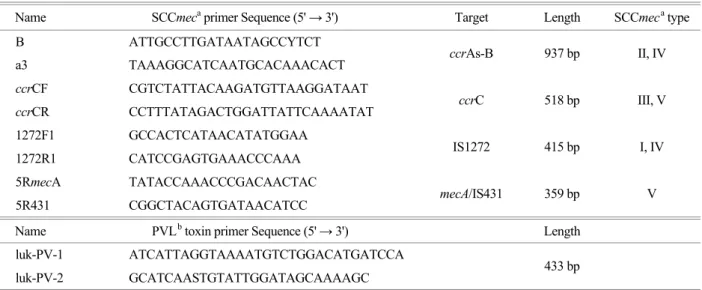
) type 분석MRSA로 확인된 균주들에 대한 SCCmec type 분석은 multiplex PCR법 (20)을 이용하여 Table 1과 같이 I-V형 의 type을 결정하였다. PCR 기기는 GeneAmp PCR system 9700 (Applied Biosystems, MA, USA)을 이용하여 94℃에서 4분간 denaturation 후 94℃/30초, 53℃/30초, 72℃/1분의 cycle을 30회 실시하고, 72℃에서 4분간 반응시켰다. PCR 을 수행한 후 5 μl의 PCR 산물을 2% agarose gel에 전기 영동한 후 EtBr로 염색하여 UV 하에서 확인하였다.
MRSA 독소 유전자 검출
분리된 MRSA로부터 병독소 유전자인 Panton-Valentine Leukocidin (PVL) 독소를 검출하기 위해 Lina 등 (21)의 방법에 따라 실험하였다(Table 1). PCR 조건은 95℃에서 5분간 denaturation 후, 95℃/30초, 50℃/30초, 72℃/1분의 cycle을 35회 실시하고, 72℃에서 5분간 반응시켰다. PCR 을 수행한 후 5 μl의 PCR 산물을 2% agarose gel에 전기 영동한 후 EtBr로 염색하여 UV 하에서 확인하였다.
Table 1. Primers used in the multiplex polymerase chain reaction (PCR)
Name SCCmeca primer Sequence (5' → 3') Target Length SCCmeca type B ATTGCCTTGATAATAGCCYTCT
a3 TAAAGGCATCAATGCACAAACACT ccrAs-B 937 bp II, IV
ccrCF CGTCTATTACAAGATGTTAAGGATAAT
ccrCR CCTTTATAGACTGGATTATTCAAAATAT ccrC 518 bp III, V
1272F1 GCCACTCATAACATATGGAA
1272R1 CATCCGAGTGAAACCCAAA IS1272 415 bp I, IV
5RmecA TATACCAAACCCGACAACTAC
5R431 CGGCTACAGTGATAACATCC mecA/IS431 359 bp V
Name PVLb toxin primer Sequence (5' → 3') Length luk-PV-1 ATCATTAGGTAAAATGTCTGGACATGATCCA
luk-PV-2 GCATCAASTGTATTGGATAGCAAAAGC 433 bp
a Staphylococcal cassette chromosome mec, b panton-valentine leukocidin
Pulsed-Field Gel Electrophoresis (PFGE)
PulseNet Korea network에서 사용되는 표준시험법으로 미국 통제예방센터(CDC; Centers for Disaease Control and Prevention)의 PulseNet USA와 아시아 지역 13개국이 참여 하는 PulseNet Asia Pacific의 표준시험법을 근간으로 제한 효소 Sma I (5,000 U, Roche, Penzberg, Germany)을 사용하 였다.
Agarose plug의 제조
순수 분리된 균을 tryptic soy agar (TSA, Oxoid, England) 에 접종하여, 표준균주(Salmonella Breandrup, BAA-664)와 함께 37℃에서 16~18시간 동안 배양하여 실험에 사용하 였다. 1.2% plug용 agarose solution (Seakem gold agarose, Cambrex, Rockland, ME, USA), plug wash TE buffer를 55℃
항온 수조에 보관하고, 균주 1개당 12 × 75 mm 폴리에 틸렌 튜브 1개, 1.5 ml 용량의 microcentrifuge 튜브 각 2개, plug mold (Biorad, Hercules, CA, USA) 2 well씩 준비하였다.
폴리에틸렌 튜브에 2 ml의 cell suspension TE buffer를 넣 고 멸균 면봉을 사용하여 TSA 평판배지로부터 균을 묻 혀 15~20%의 투명도로 부유시켰다. 균 현탁액 170 μl, lysostaphin (Sigma, USA) 20 μl, lysozyme (Sigma, USA) 10 μl 를 잘 혼합하여 37℃에서 10분간 반응한 후, proteinase K (20 mg/ml, Invitrogen, Carlsbad, CA, USA)를 첨가하여 micropipette으로 천천히 4회 정도 섞은 후 바로 plug mold 에 넣었다. 섞는 횟수를 늘리거나 거칠게 섞을 경우에는 선명한 결과를 얻는데 방해되므로 주의하면서 섞어 주었 다. Plug mold를 4℃에서 5분 정도 굳히면서 ES buffer 1.5 ml과 proteinase K (20 mg/ml, Invitrogen, Carlsbad, CA, USA) 40 μl를 2 ml microcentrifuge tube에 준비하였다.
Plug lysis 및 세척
굳은 plug를 plug mold에서 꺼내어 미리 준비해 둔 ES buffer로 옮기고 96 well microcentrifuge rack에 꽂아 뚜껑 을 덮었다. 55℃ 진탕 항온 수조에 rack을 잘 고정시킨 후 tube가 물 속에 완전히 잠기도록 하여 150~175 rpm으 로 1~1.5시간 방치하였다. Plug 세척을 위하여 lysis가 끝 난 plug를 screen cap (Biorad, Hercules, CA, USA)에 옮기고 이것들을 연결하여 플라스틱 밀폐용기에 넣고 20분 동안 5회 반복하여 세척하였다. 이 때 밀폐용기가 물 속에 완 전히 잠기도록 하고 150~175 rpm으로 20분을 넘기지 않 도록 하였다. 세척이 끝난 plug는 2 ml microcentrifuge tube 에 plug wash TE buffer를 1.5 ml씩 넣고 4℃에 보관하거 나 다음 단계로 진행하였다.
제한효소 처리
세척이 끝난 plug를 슬라이드 글라스 위에 올려놓고 70% 에탄올로 닦은 razor blades를 이용하여 1 mm 두께로 자른 다음, 자른 절편 2개를 1.5 ml microcentrifuge tube에 옮겨 100 μl의 제한효소 반응액을 넣고 37℃ 항온 수조 에서 4시간 동안 반응시켰다. 제한효소 반응액의 조성 은 10 × restriction enzyme buffer 10 μl, 100 × BSA 1 μl, Sma I 40 unit (Roche, Penzberg, Germany)에 멸균 증류수를 이용하여 최종 100 μl를 맞추었다. 반응이 끝나면 제한효 소 반응액을 제거하고 TE buffer를 200 μl를 채워 넣었다.
전기영동
0.5 × TBE (Bioneer, Daejeon, Korea)를 사용하여 1%
agarose solution을 gel 크기에 맞추어 녹여서 55℃ 항온 수조에 보관하고, 제한효소 처리가 끝난 plug 절편을 꺼 내어 agarose gel 성형용 comb (Biorad)의 끝 부위에 맞 춰 올려놓은 다음 여과지로 주변의 물기를 제거하였다.
plug가 comb의 lane 끝에 일직선이 되도록 잘 배치하여 상온에서 2분 정도 추가로 건조시키고 항온 수조에 보관 한 1% agarose solution을 꺼내어 gel 성형틀 안에 부었다.
이 때 agarose solution을 약 1~2 ml 정도 남겨서 다시 항 온 수조에 보관하였다. Gel 성형틀에 plug 절편이 붙어 있 는 comb을 제자리에 위치시키고, gel을 상온에서 30분 정도 굳힌 후 comb을 뽑아냈다. Comb에 의해 만들어진 well에 남아 있는 소량의 agarose solution을 넣어 채웠다.
이렇게 만들어진 gel을 CHEF-Mapper system (Biorad, USA) 을 이용하여 0.5 × TBE, 6 V/cm, 14℃에서 initial time 5.16 초, final time 40.17초의 조건으로 18시간 동안 전기영동 하였다. 전기영동이 완료되면 500 ml의 EtBr (0.5 μg/ml)에 gel을 넣어 15~20분 염색하고, 증류수를 이용하여 매 회 30분씩 2회 탈색하였다. 염색 및 탈색 단계는 모두 빛이 차단된 상태에서 실시하였다.
Dendrogram 작성
PFGE 결과는 Tenover 등 (22)의 방법에 따라 각각의 DNA 위치가 다른 절편의 수에 따라서 group을 결정하였 고, DNA 절편 유형을 software Bionumerics version 5.0으 로 분석하였다. 또한 Dice coefficient similarity (tolerance, 1.5%)로 Unweighted Pair Group Method with Arithmetic mean (UPGMA)법에 의하여 dendrogram을 작성하여 균주 간의 상관관계를 비교 분석하였다.
결 과
MRSA균 분리
광주지역에 거주하는 404명의 비강 도말액을 대상으로 선택배지를 이용하여 MRSA를 동정한 결과 34주(8.4%) 가 분리되었고, 동정된 모든 균주에서 MRSA 특이 유전 자인 clfA와 methicillin 내성에 관여하는 유전자인 mecA 를 확인하였다.
이를 직업군별로 살펴보면 축산업 종사자 230명 중 14주(6.1%), 취학 전 아동 108명 중 18주(16.7%), 사무직 종사자 66명 중 2주(3.03%)가 분리되었다(Table 2).
항생제 감수성 검사
MRSA로 동정된 34주에 대한 항생제 감수성 검사 결
과, ampicillin의 내성률이 100%(34주)로 가장 높게 나타 났고. 그 외 penicillin 97.1%(33주), oxacillin 94.1%(32주), erythromycin 52.9%(18주)의 순으로 나타났다(Fig. 1).
Cephalosporin 계열 항생제 내성은 cefoxitin 94.1%(32 주), cefotetan 91.2%(31주)로 강한 내성을 보였으며, ceftriaxone 73.5%(25주), cephalothin은 26.5%(9주)의 내성 을 보여 내성률 분포에 뚜렷한 차이를 보였다. 그러나 chloramphenicol, trimethoprim/sulfamethoxazole, imipenem, rifampin, vancomycin, linenzolid 등 6가지 항생제에서는 전혀 내성이 관찰되지 않았다.
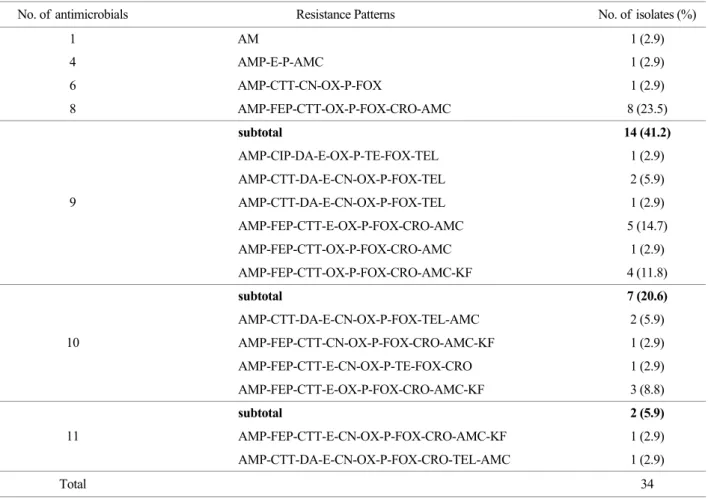
항생제 내성 양상으로는 항생제 1제 내성률 2.9%(1주), 4제 내성률 2.9%(1주), 6제 내성률 2.9%(1주), 8제 내성률 23.5%(8주), 9제 내성률 41.2%(14주), 10제 내성률 20.6%
(7주), 11제 내성률 5.9%(2주) 순으로 나타났다. 즉, 1개 균주를 제외한 모든 균주가 항생제 2제 이상에 내성을 Table 2. Prevalence of community-associated methicillin-resistant S. aureus (CA-MRSA) isolates from meat distributors, pre-school children
and officers
Total Meat distributors Pre-school children Officers No. of positive samples /
No. of samples (%) No. of
samples No. of positive
samples (%) No. of
samples No. of positive
samples (%) No. of
samples No. of positive samples (%) Male 16/210 (7.6) 119 10 (8.4) 56 6 (10.7) 35 0 (0)
Female 18/194 (9.3) 111 4 (3.6) 52 12 (23.1) 31 2 (6.5) Total 34/404 (8.4) 230 14 (6.1) 108 18 (16.7) 66 2 (3.03)
Figure 1. Antimicrobial resistance patterns of community-associated methicillin-resistant S. aureus (CA-MRSA) isolates. S, susceptible;
I, intermediate; R, resistant; AM ampicillin; FEP cefepime; CTT cefotetan; CIP ciprofloxacinem; C chloramphenicol; CC clindamycin; E erythromycin; CN amikacin; IPM imipenem; OX oxacillin; P penicillin; RA rifampin; TE tetracycline; SXT trimethoprim/sulfamethoxazole;
VA vancomycin; FOX cefoxitin; CRO ceftriaxone; TEL telithromycin; AmC amoxicillin/clavulanic; LZD linenzolid; KF, cephalothin
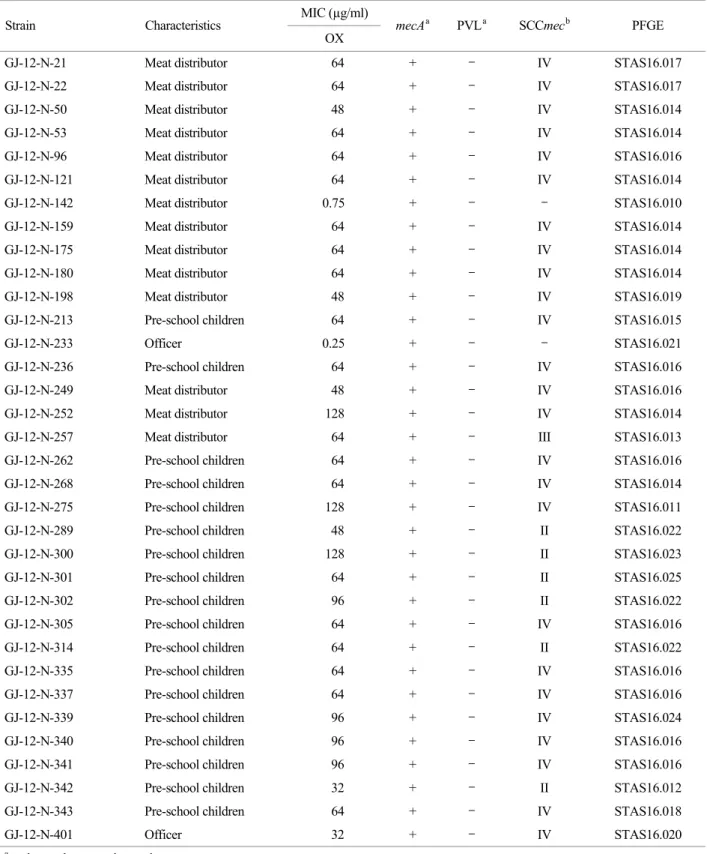
보이는 다제내성균(97.1%)으로 확인되었으며, 10제 이상 내성률은 26.5%(9주)를 보였다. 특히 9제의 항생제에 내 성률을 보이는 균주의 패턴이 6가지 유형으로 가장 다양 한 결과를 보여주었고(Table 3), oxacillin (6 μg/ml, Sigma, USA)에 대한 최소억제농도 측정 결과 2주를 제외한 나 머지 32주 모두 내성(>4 μg/ml)을 보였다.
MRSA균 genotyping SCC
mec
typeMRSA로 동정된 34주에 대해 SCCmec typing을 조사 한 결과 25주(73.5%)에서 SCCmec type IV 양상을 보였으 며, type II는 6주(17.6%), type III는 1주(2.9%) 순으로 분류 되었으나, 2주(5.9%)는 분석이 불가능하였다(Table 4).
PVL 유전자
MRSA로 동정된 34주에서 병독소 유전자인 pvl 유전 자는 모두 검출되지 않았다.
PFGE 분석
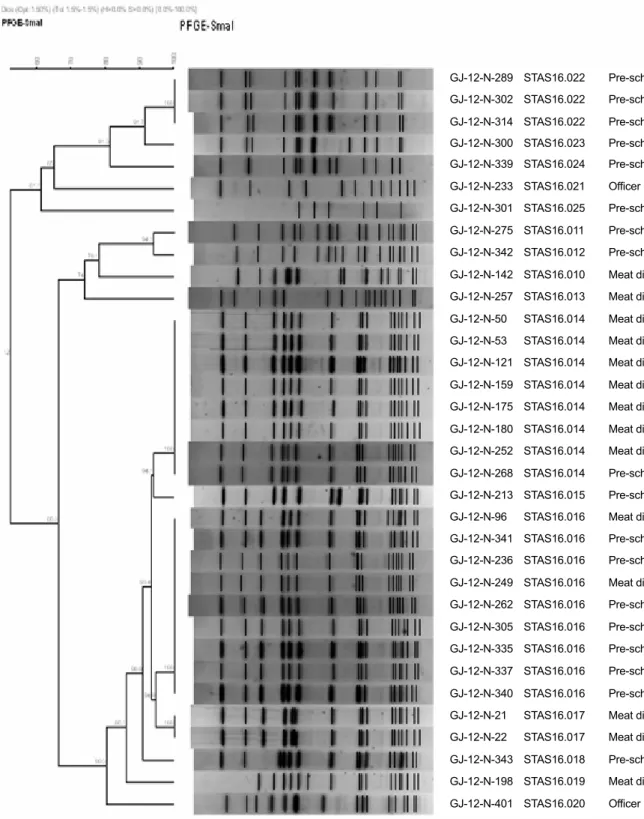
이들 균주의 역학적 연관성을 확인하기 위해 PFGE 분석을 실시한 결과 STAS16.010(1주), STAS16.011(1주), STAS16.012(1주), STAS16.013(1주), STAS16.014(8주), STAS16.015(1주), STAS16.016(9주), STAS16.017(2주), STAS16.018(1주), STAS16.019(1주), STAS16.020(1주), STAS16.021(1주), STAS16.022(3주), STAS16.023(1주), STAS16.024(1주), STAS16.025(1주)로 총 16개의 유형으로 분류되었으며, 그 중 STAS16.016형이 가장 우세하였다.
또한 각 유형간 유사도는 94.8~52.2% 범위로 나타났다 (Fig. 2).
Table 3. Antimicrobial resistance patterns of community-associated methicillin-resistant S. aureus (CA-MRSA) isolates No. of antimicrobials Resistance Patterns No. of isolates (%)
1 AM 1 (2.9)
4 AMP-E-P-AMC 1 (2.9)
6 AMP-CTT-CN-OX-P-FOX 1 (2.9)
8 AMP-FEP-CTT-OX-P-FOX-CRO-AMC 8 (23.5)
subtotal 14 (41.2)
AMP-CIP-DA-E-OX-P-TE-FOX-TEL 1 (2.9)
AMP-CTT-DA-E-CN-OX-P-FOX-TEL 2 (5.9)
AMP-CTT-DA-E-CN-OX-P-FOX-TEL 1 (2.9)
AMP-FEP-CTT-E-OX-P-FOX-CRO-AMC 5 (14.7)
AMP-FEP-CTT-OX-P-FOX-CRO-AMC 1 (2.9)
9
AMP-FEP-CTT-OX-P-FOX-CRO-AMC-KF 4 (11.8)
subtotal 7 (20.6)
AMP-CTT-DA-E-CN-OX-P-FOX-TEL-AMC 2 (5.9)
AMP-FEP-CTT-CN-OX-P-FOX-CRO-AMC-KF 1 (2.9)
AMP-FEP-CTT-E-CN-OX-P-TE-FOX-CRO 1 (2.9)
10
AMP-FEP-CTT-E-OX-P-FOX-CRO-AMC-KF 3 (8.8)
subtotal 2 (5.9)
AMP-FEP-CTT-E-CN-OX-P-FOX-CRO-AMC-KF 1 (2.9) 11
AMP-CTT-DA-E-CN-OX-P-FOX-CRO-TEL-AMC 1 (2.9)
Total 34
AM, Ampicillin; FEP, Cefepime; CTT, Cefotetan; CIP, Ciprofloxacinem; C, Chloramphenicol; CC, Clindamycin; E, Erythromycin; CN, Amikacin; IPM, Imipenem; OX, Oxacillin; P, Penicillin; RA, Rifampin; TE, Tetracycline; SXT, Trimethoprim/Sulfamethoxazole; VA, Vancomycin; FOX, Cefoxitin; CRO, Ceftriaxone; TEL, Telithromycin; AmC, Amoxicillin/Clavulanic; LZD, Linenzolid; KF, Cephalothin
Table 4. Characteristics of community-associated methicillin-resistant S. aureus (CA-MRSA) isolates from nasal swabs MIC (µg/ml)
Strain Characteristics
OX mecAa PVLa SCCmecb PFGE
GJ-12-N-21 Meat distributor 64 + - IV STAS16.017
GJ-12-N-22 Meat distributor 64 + - IV STAS16.017
GJ-12-N-50 Meat distributor 48 + - IV STAS16.014
GJ-12-N-53 Meat distributor 64 + - IV STAS16.014
GJ-12-N-96 Meat distributor 64 + - IV STAS16.016
GJ-12-N-121 Meat distributor 64 + - IV STAS16.014
GJ-12-N-142 Meat distributor 0.75 + - - STAS16.010
GJ-12-N-159 Meat distributor 64 + - IV STAS16.014
GJ-12-N-175 Meat distributor 64 + - IV STAS16.014
GJ-12-N-180 Meat distributor 64 + - IV STAS16.014
GJ-12-N-198 Meat distributor 48 + - IV STAS16.019
GJ-12-N-213 Pre-school children 64 + - IV STAS16.015
GJ-12-N-233 Officer 0.25 + - - STAS16.021
GJ-12-N-236 Pre-school children 64 + - IV STAS16.016
GJ-12-N-249 Meat distributor 48 + - IV STAS16.016
GJ-12-N-252 Meat distributor 128 + - IV STAS16.014
GJ-12-N-257 Meat distributor 64 + - III STAS16.013
GJ-12-N-262 Pre-school children 64 + - IV STAS16.016
GJ-12-N-268 Pre-school children 64 + - IV STAS16.014
GJ-12-N-275 Pre-school children 128 + - IV STAS16.011
GJ-12-N-289 Pre-school children 48 + - II STAS16.022
GJ-12-N-300 Pre-school children 128 + - II STAS16.023
GJ-12-N-301 Pre-school children 64 + - II STAS16.025
GJ-12-N-302 Pre-school children 96 + - II STAS16.022
GJ-12-N-305 Pre-school children 64 + - IV STAS16.016
GJ-12-N-314 Pre-school children 64 + - II STAS16.022
GJ-12-N-335 Pre-school children 64 + - IV STAS16.016
GJ-12-N-337 Pre-school children 64 + - IV STAS16.016
GJ-12-N-339 Pre-school children 96 + - IV STAS16.024
GJ-12-N-340 Pre-school children 96 + - IV STAS16.016
GJ-12-N-341 Pre-school children 96 + - IV STAS16.016
GJ-12-N-342 Pre-school children 32 + - II STAS16.012
GJ-12-N-343 Pre-school children 64 + - IV STAS16.018
GJ-12-N-401 Officer 32 + - IV STAS16.020
a +, detected; -, not detected
b -, untypable
직업군별로는 축산업 종사자 14명 중 7명이 STAS- 16.014형, 취학 전 아동 18명 중 7명에서 STAS16.016형
이 가장 많음을 알 수 있었다(Fig. 3).
GJ-12-N-289 STAS16.022 Pre-school childr GJ-12-N-302 STAS16.022 Pre-school childr GJ-12-N-314 STAS16.022 Pre-school childr GJ-12-N-300 STAS16.023 Pre-school childr GJ-12-N-339 STAS16.024 Pre-school childr GJ-12-N-233 STAS16.021 Officer GJ-12-N-301 STAS16.025 Pre-school childr GJ-12-N-275 STAS16.011 Pre-school childr GJ-12-N-342 STAS16.012 Pre-school childr GJ-12-N-142 STAS16.010 Meat distributor GJ-12-N-257 STAS16.013 Meat distributor GJ-12-N-50 STAS16.014 Meat distributor GJ-12-N-53 STAS16.014 Meat distributor GJ-12-N-121 STAS16.014 Meat distributor GJ-12-N-159 STAS16.014 Meat distributor GJ-12-N-175 STAS16.014 Meat distributor GJ-12-N-180 STAS16.014 Meat distributor GJ-12-N-252 STAS16.014 Meat distributor GJ-12-N-268 STAS16.014 Pre-school childr GJ-12-N-213 STAS16.015 Pre-school childr GJ-12-N-96 STAS16.016 Meat distributor GJ-12-N-341 STAS16.016 Pre-school childr GJ-12-N-236 STAS16.016 Pre-school childr GJ-12-N-249 STAS16.016 Meat distributor GJ-12-N-262 STAS16.016 Pre-school childr GJ-12-N-305 STAS16.016 Pre-school childr GJ-12-N-335 STAS16.016 Pre-school childr GJ-12-N-337 STAS16.016 Pre-school childr GJ-12-N-340 STAS16.016 Pre-school childr GJ-12-N-21 STAS16.017 Meat distributor GJ-12-N-22 STAS16.017 Meat distributor GJ-12-N-343 STAS16.018 Pre-school childr GJ-12-N-198 STAS16.019 Meat distributor GJ-12-N-401 STAS16.020 Officer
Figure 2. Dendrogram of Sma I-digested pulsed-field gel electrophoresis (PFGE) profiles of community-associated methicillin-resistant S. aureus (CA-MRSA) isolates.
고 찰
MRSA는 병원 내 감염을 일으키는 중요한 세균으로 주로 병원 감염 MRSA가 알려져 있으나, 최근 들어 지역 사회 일반인에서도 보고되고 있다 (6). 광주지역에 거주 하는 축산업 종사자, 집단생활을 하는 어린이집 소아 및 사무직 종사자 404명을 대상으로 비강 분비물을 채취하 여 MRSA를 분리한 결과 34주(8.4%)가 분리되었다. Kim 등 (23)은 지역사회 성인의 전비공 조사 결과 전체 조사 대상자의 33% (227/689)에서 황색포도알균을 분리하여 그 중 2.2% (5/227)의 CA-MRSA를 확인하였고, Cho 등 (24)도 지역사회 일반인들로부터 MRSA를 조사한 결과 2.9%의 분리율을 보고하였다. 그러나 Kwon 등 (25)은 지 역별로 무작위 선출된 일반인의 비강에서 27.5%의 황색 포도알균을 검출하였으나, MRSA는 검출되지 않았음을 보고하였다. 본 연구 결과에서는 앞선 연구 결과와 비교 했을 때 높은 양성률을 보였으며, 그 이유로는 동물에 존 재하는 MRSA가 동물에서 사람으로 인수공통 감염병의 전파 가능성이 있음을 고려할 때 검사 대상자 중에 축산 업 종사자가 포함되어 있어 MRSA 양성률을 높였을 가 능성이 있을 것으로 사료된다. 하지만, 국내 종합병원 입 원 환자의 MRSA 분리율(약 70%) (26, 27)과 비교했을 때 지역사회를 대상으로 한 본 연구 결과에서는 상당히 낮 은 MRSA 분리율을 보였다.
직업군별 분류 결과, 취학 전 아동 108명 중 18명 (16.7%)이 MRSA로 분리된 것은, Kim 등 (28)이 서울북
부지역 어린이집 소아 428명 중 38명(8.8%)의 비강에서 MRSA를 분리한 것에 비해 높은 분리율을 보였다. 이를 연령별로 3개 군으로 구분한 결과, 2세 미만 1명(0.9%), 2~5세 미만 5명(4.6%), 6세 이상에서 12명(11.1%)으로 본 연구는 소아들의 입원력과 수술력 등의 조사가 보호자 및 선생님들을 통해 이루어져 객관성이 부족하다는 점과 비강 내 보균 여부를 1회만 조사하였기 때문에 MRSA 보균기간 여부를 정확하게 파악하지 못한 것이 제한점이 라 생각되지만, Kim 등 (28)의 결과인 생후 12~23개월에 서 0명, 생후 24~59개월 21명(10.1%), 생후 60개월 이상 12명(8.1%)의 결과와 유사하였고, 연령이 증가함에 따라 비강 내 MRSA 분리율이 증가하는 추세를 보였다. 이와 같은 결과를 종합해 볼 때 소아를 대상으로 한 비강 내 CA-MRSA 보균율은 국가 및 지역 등 여러 환경적 요인 에 따라 다른 것으로 추측된다. 외국의 경우 타이완에서 는 약 10% 전후 (29, 30), 미국에서는 0.5~24% (31)로 나 타났고, 국내의 경우 Ko 등 (32)이 외래방문 소아를 대상 으로 시행한 MRSA 및 CA-MRSA 보균자를 조사한 결과 6.1%와 4.7%로 분리율이 다양하게 나타남을 알 수 있다.
또한, 축산업 종사자에 대한 MRSA 분리율 조사 결과, 230명 중 14명(6.1%)에서 MRSA가 분리되었다. 이는 황 색포도알균이 동물의 피부에도 존재하는 균이므로 도축 과정 중 가죽에서 오염되었을 경우, 도축된 식육은 가공, 소분 등의 과정을 통해 유통되는 과정에서 식육에 오염 된 황색포도알균이 식육과 접촉한 사람으로 전이되어 상 재균화 될 수 있으며, 이 과정에서 MRSA의 전이가 가능 했을 거라 생각된다. 따라서 축산물 취급 시 도축 과정에 Figure 3. Pulsed-field gel electrophoresis (PFGE) Sma I-pattern of community-associated methicillin-resistant S. aureus (CA-MRSA) isolates.
서부터 판매업자까지 황색포도알균 등의 병원균이 오염 되지 않도록 철저한 위생관리에 노력을 기울여야 할 것 으로 판단된다. 한편, 축산업 종사자의 근무기간에 따른 MRSA 분리율 조사 결과 5년 미만 10명(7.1%), 10년 미 만 2명(5.6%), 15년 미만 2명(5.1%), 15년 이상 불검출로 나타났고 근무기간에 따른 연관성은 없는 것으로 나타 났다.
본 연구 대상에서 조사된 8.4%의 MRSA는 CA-MRSA 감염증의 빈도 및 중요성이 상대적으로 낮았던 국내 상 황에서 향후 CA-MRSA 감염증에 대한 인식을 새로이 하는데 중요한 정보를 제공하고 있다고 생각된다.
Choi 등 (15)이 2004년~2007년까지 서울대학교 어린이 병원에서 분리된 CA-MRSA에 대한 항생제 내성률 조사 결과 ciprofloxacin 31%, clindamycin 28%, erythromycin 66%, gentamycin 31%의 내성률을 보고하였는데, 본 연구에서 도 ampicillin, penicillin 100%, oxacillin 94.1%, cefoxitin 94.1%, erythromycin 52.9%, clindamycin 20.6%의 내성률을 보여 앞선 보고와 유사한 결과를 확인했으나, ciprofloxacin (2.9%)과 trimethoprim-sulfamethoxazole은 각각 높은 감수 성을 나타내는 것으로 확인되었다.
SCCmec 유전자형은 MRSA의 클론성과 연관성이 있 는 것으로 알려져 있어 MRSA 균주의 역학분석에 많 이 이용되고 있다 (14). SCCmec은 I-V형으로 나누어지며 SCCmec I형, II형 및 III형은 원내감염인 반면, SCCmec IV형은 지역사회 감염과 관련이 있는 것으로 알려져 있 다 (13, 33). 본 연구에서 CA-MRSA 34주에 대한 SCCmec 유형을 분석한 결과 type IV가 25주(73.5%)를 차지하였고, type II가 6주(17.6%), type III가 1주(2.9%), 유형 분석이 불 가능한 경우가 2주(5.9%)였다. 이는 Lee 등 (34)이 보고 한 서울지역 어린이집 소아 428명을 대상으로 한, 비강 에서 분리한 40주의 CA-MRSA 연구에서 SCCmec type IV가 32주(80%), SCCmec type II가 8주(20%)의 결과와 비 교했을 때 비슷한 양상을 보였다. 또한 Kim 등 (35)은 다 중시설을 이용한 시민의 손에서 분리한 MRSA 11주에 대 한 유형분석 결과, SCCmec type IV가 13주, type I 1주가 분리되었음을 보고하였다. 본 연구에서는 조사 대상의 차 이에도 불구하고 병원유래 주로 알려진 type II, type III 및 지역사회 유래주인 type IV가 모두 분리된 것은 CA- MRSA와 HA-MRSA와의 전파 가능성이 있음을 보여주 는 것이라 생각되며, 향후 CA-MRSA가 토착화되지 않도 록 적절한 예방대책과 지속적인 감시가 필요하다고 생각
된다.
PVL 유전자는 피부 및 연조직 감염의 병독성에 중요 한 역할을 하고, 최근에는 높은 사망률을 보이는 지역사 회 관련 폐렴에도 관련이 있는 것으로 알려져 있다 (21).
이 유전자는 미국의 경우 CA-MRSA 대부분에서 발견된 다고 보고되고 (36) 있으나, 아시아 지역에서는 낮은 양 성률을 보이고 (37), 국내에는 대부분 존재하지 않는 것 으로 보고되고 있다. Kim 등 (38)은 입원 환자의 혈액에 서 분리된 305개의 MRSA 균주 중 1주가 pvl 유전자 양 성과 SCCmec type IV였음을 보고한 바 있다. 그러나 본 연구에서는 pvl 유전자가 전혀 검출되지 않았으며, 이는 본 연구와 동일한 지역을 대상으로 한 Kim 등 (35)의 연 구에서 손에서 분리한 MRSA 균에서 pvl 유전자 검사 결 과(음성)와 동일한 결과를 보여, 분리균주간의 유전적 차 이가 있음을 알 수 있었다.
MRSA로 확인된 34주의 역학적 연관성을 알아보기 위 해 PFGE를 실시한 결과 STAS10.010 1주를 비롯하여 총 16개의 유형으로 구분되었으며, 그 중 STAS10.016형이 가장 우세하였다. 직업군별로는 축산업 종사자 14명 중 7명에서 STAS16.014형이, 취학 전 아동 18명 중 7명에서 STAS16.016형이 가장 많았고, 직업군별 역학적 연관성은 없는 것으로 나타났다. 미국 CDC에서는 PFGE를 이용하 여 황색포도알균을 Pulsed-field types (PFTs) 8개로 분류 하여(예, USA 100 PFT, USA 200 PFT, USA 800 PFT) 전국 적인 데이터 베이스를 구축 운영하고 있다 (39). 그러나 아직 국내에는 전국적인 데이터 베이스가 확립되지 않아 CA-MRSA 균주간 연관성을 비교하기가 어려웠으며, 향 후 PFGE를 이용한 비강 정착 균주간의 역학적 연관성 비교나 황색포도알균 감염증을 일으키는 균주간의 비교 및 국내외 균주를 비교하기 위해서는 황색포도알균에 대한 PFGE pattern을 표준화해야 할 필요가 있다. 또한 이들 자료를 근거로 손이나 비강 등을 통해 감염되는 CA-MRSA간 역학적 연관성 비교 및 HA-MRSA와 CA- MRSA간의 분자유전학적 관계 등을 정확히 파악함으로 써 MRSA의 효율적 관리에 기여할 수 있을 것이라 생각 된다.
참 고 문 헌
1) Timoney JF, Gillespie JH, Scott FW, Barlough JE. Hagan and Bruner's Microbiology and Infectious Disease of Domestic
Animals. 8th ed. Ithaca: Comstock Publishing Associates;
1988. p. 171-96.
2) Diederen BM, Kluytmans JA. The emergence of Infections with community-associated methicillin resistant Staphylo- coccus aureus. J Infect 2006;52:157-68.
3) Chong Y, Lee K. Present situation of antimicrobial resistant in Korea. J Infect Chemother 2000;6:189-95.
4) Kim HB, Jang HC, Nam HJ, Lee YS, Kim BS, Park WB, et al.
In vitro activities of 28 antimicrobial agents against Staphylo- coccus aureus isolates from tertiary-care hospitals in Korea: a nationwide survey. Antimicrob Agents Chemother 2004;48:
1124-7.
5) Goetz A, Posey K, Fleming J, Jacobs S, Boody L, Wagener MM, et al. Methicillin-resistant Staphylococcus aureus in the community: a hospital-based study. Infect Control Hosp Epidemiol 1999;20:689-91.
6) Kallen AJ, Driscoll TJ, Thornton S, Olson PE, Wallace MR.
Increase in community-acquired methicillin-resistant Staphylo- coccus aureus at a Naval Medical Center. Infect Control Hosp Epidemiol 2000;21:223-6.
7)From the Centers for Disease Control and Prevention. Four pediatric deaths from community-acquired methicillin-resistant Staphylococcus aureus-Minnesota and North Dakota, 1997- 1999. JAMA 1999;282:1123-5.
8) Lee JS, Park O, Woo HJ, Jung HJ, Kim WJ, Kim MJ, et al. A Longitudinal Molecular Epidemiologic Study of Methicillin- resistant Staphylococcus aureus (MRSA) Isolates from a University Hospital. Korean J Infect Dis 2001;33:32-9.
9) Chambers HF. Methicillin resistance in Staphylococci:
molecular and biochemical basis and clinical implications.
Clin Microbiol Rev 1997;10:781-91.
10) Boyle-Varva S, Ereshefsky B, Wang CC, Daum RS. Successful multiresistant community-associated methicillin-resistant Staphylococcus aureus lineage from Taipei, Taiwan, that carries either the novel staphylococcal chromosome cassette mec (SCCmec) type VT or SCCmec type IV. J Clin Microbiol 2005;
43:4719-30.
11) Ito T, Ma XX, Takeuchi F, Okuma K, Yuzawa H, Hiramatsu K.
Novel type V staphylococcal cassette chromosome mec driven by a novel cassette chromosome recombinase, ccrC. Antimicrob Agents Chemother 2004;48:2637-51.
12) Oliveira DC, de Lencastre H. Multiplex PCR strategy for rapid identification of structural types and variants of the mec element in methicillin-resistant Staphylococcus aureus. Antimicrob
Agents Chemother 2002;46:2155-61.
13)Cha EK, Chang KS, Hwang SM. Correlation between staphylococcal cassette chromosome mec type and coagulase serotype of methicillin-resistant Staphylococcus aureus. J Bacteriol Virol 2009;39:71-8.
14)Chongtrakool P, Ito T, Ma XX, Kondo Y, Trakulsomboon S, Tiensasitorn C, et al. Staphylococcal cassette chromosome mec (SCCmec) typing of methicillin-resistant Staphylococcus aureus strains isolated in 11 Asian countries: a proposal for a new nomenclature for SCCmec elements. Antimicrob Agents Chemother 2006;50:1001-12.
15) Choe YJ, Lee SY, Sung JY, Yang MA, Lee JH, Oh CE, et al. A review of Staphylococcus aureus infections in children with an emphasis on community-associated methicillin-resistant S.
aureus infections. Korean J Pediatr Infect Dis 2009;16:150-61.
16) Park JY, Kim HO, Jeong YG, Kim S, Bae IG. Clinical char- acteristics and risk factors of community-acquired methicillin- resistant Staphylococcus aureus infections: comparison of community-acquired methicillin-susceptible Staphylococcus aureus infections. Infect Chemother 2006;38:109-15.
17)Mason WJ, Blevins JS, Beenken K, Wibowo N, Ojha N, Smeltzer MS. Multiplex PCR protocol for the diagnosis of staphylococcal infection. J Clin Microbiol 2001;39:3332-8.
18)Bauer AW, Kirby WM, Sherris JC, Turck M. Antibiotic susceptibility testing by a standardized single disk method.
Am J Clin Pathol 1966;45:493-6.
19)Clinical and Laboratory Standards Institute. Performance standards for antimicrobial susceptibility testing; Eighteenth information supplement, M100-S18. Wayne, PA: CLSI, 2008.
20)Boye K, Bartels MD, Andersen IS, Møller JA, Westh H. A New multiplex PCR for easy screening of methicillin-reistant Staphylococccus aureus SCCmec types I-V. Clin Microbiol Infect 2007;13:725-7.
21)Lina G, Piémont Y, Godail-Gamot F, Bes M, Peter MO, Gauduchon V, et al. Involvement of Panton-Valentine leukocidin-producing Staphylococcus aureus in primary skin infections and pneumonia. Clin Infect Dis 1999;29:1128-32.
22) Tenover FC, Arbeit RD, Goering RV, Mickelsen PA, Murray BE, Persing DH, et al. Interpreting chromosomal DNA restriction patterns produced by pulsed-field gel electrophoresis:
criteria for bacterial strain typing. J Clin Microbiol 1995;33:
2233-9.
23) Kim HB, Shin DH, Park KU, Oh MD, Kim EC, Choe KW.
The methicillin-resistance rate of Stapylococccus aureus
isolated from anterior nares of healthy adults in the community.
Infect Chemother 1998;30:527-31.
24) Cho JK, Kim JH, Sung MS, Kim KS. Genetic characterization of methicillin-resistant Staphylococcus aureus from humans and animals within the community. Korean J Vet Res 2011;
51:267-75.
25) Kwon YI, Kim TW, Kim HY, Chang YH, Kwak HS, Woo GJ, et al. Monitoring of methicillin resistant Staphylococcus aureus from medical environment in Korea. Korean J Microbiol Biotechnol 2007;35:158-62.
26)Kim JS, Kim HS, Song W, Cho HC, Lee KM, Kim EC.
Antimicrobial resistance profiles of Staphylococcus aureus isolated in 13 Korean hospitals. Korean J Lab Med 2004;24:
223-9.
27) Lee HW, Yoon JH, Sohn JH, Lee KH, Yeh BI, Park DW, et al.
Detection of mecA gene in clinical isolates of Staphylococcus aureus by multiplex-PCR, and antimicrobial susceptibility of MRSA. J Microbiol Biotechnol 2003;13:354-59.
28) Kim YM, Oh CE, Kim SH, Lee J, Choi EH, Lee HJ. Nasal carriage of Staphylococcus aureus from healthy Children Attending Day Care Center. Korean J Pediatr Infect Dis 2010;
17:9-15.
29) Lo WT, Lin WJ, Tseng MH, Lu JJ, Lee SY, Chu ML, et al.
Nasal carriage of a single clone of community-acquired methicillin-resistant Staphylococcus aureus among kindergarten attendees in northern Taiwan. BMC Infect Dis 2007;7:51.
30) Lu PL, Chin LC, Peng CF, Chiang YH, Chen TP, Ma L, et al.
Risk factors and molecular analysis of community methicillin- resistant Staphylococcus aureus carriage. J Clin Microbiol 2005;43:132-9.
31) Alfaro C, Mascher-Denen M, Fergie J, Purcell K. Prevalence of methicillin-resistant Staphylococcus aureus nasal carriage in patients admitted to Driscoll Children's Hospital. Pediatr Infect Dis J 2006;25:459-61.
32) Ko KS, Lee JY, Baek JY, Peck KR, Rhee JY, Kwon KT, et al.
Characterization of Staphylococcus aureus nasal carriage from children attending an outpatient clinic in Seoul, Korea. Microb Drug Resist 2008;14:37-44.
33)Ko KS, Lee JY, Suh JY, Oh WS, Peck KR, Lee NY, et al.
Distribution of major genotypes among methicillin-resistant Staphylococcus aureus clones in Asian countries. J Clin Microbiol 2005;43:421-6.
34) Lee J, Sung JY, Kim YM, Oh CE, Kim HB, Choi EH, et al.
Molecular characterization of methicillin-resistant Staphylo- coccus aureus obtained from the anterior nares of healthy Korean children attending daycare centers. Int J Infect Dis 2011;15:558-63.
35) Kim TS, Kim MJ, Kim SH, Kee HY, Seo JJ, Kim ES, et al.
Profile of Antimicrobial resistance of Staphylococcus aureus and molecular epidemiologic characterization of methicillin- resistant Staphylococcus aureus (MRSA) isolated from hands of people using multitude facilities. Infect Chemother 2012;
44:289-98.
36)Vandenesch F, Naimi T, Enright MC, Lina G, Nimmo GR, Heffernan H, et al. Community-acquired methicillin-resistant Staphylococcus aureus carrying Panton-Valentine leukocidin genes: worldwide emergence. Emerg Infect Dis 2003;9:978-84.
37) Song JH, Hsueh PR, Chung DR, Ko KS, Kang CI, Peck KR, et al. Spread of methicillin-resistant Staphylococcus aureus between the community and the hospitals in Asian countries:
an ANSORP study. J Antimicrob Chemother 2011;66:1061-9.
38) Kim JS, Park JS, Song W, Kim HS, Cho HC, Lee KM, et al.
Panton-Valentine Leukocidin Positive Staphylococcus aureus Isolated from Blood in Korea. Korean J Lab Med 2007;27:
286-91.
39)McDougal LK, Steward CD, Killgore GE, Chaitram JM, McAllister SK, Tenover FC. Pulsed-field gel electrophoresis typing of oxacillin-resistant Staphylococcus aureus isolates from the United States: establishing a national database. J Clin Microbiol 2003;41:5113-20.