서 론
미분화 갑상선암이나 탈분화를 통해 분화 정도가 나빠진 갑상선 암의 경우, 종종 p53의 돌연변이를 동반하게 된다.
p53 돌연변이는 인체 여러 암에서 항암화학 요법이나 방사 선 요법에 대한 저항성과 연관되어 있다고 보고되며, 갑상 선 암에서도 탈분화와 관련되어 분화암의 효율적인 술 후 보조요법인 방사능 동위원소 치료와 TSH 억제 치료에 대한 반응성을 저하시킨다. 이러한 기존 치료에 대한 저항성의 문제를 해결하는 새로운 접근의 한 가지가 tumor necrosis factor (TNF)-α, Fas-ligand, 그리고 TNF-related apoptosis in- ducing ligand (TRAIL) 등과 같은 세포소멸을 유도하는 death ligand의 활용이다.
TRAIL은 TNF superfamily에 속하는 새로 발견된 세포소 멸 유도물질로, 인체의 여러 암에서 세포소멸을 유도하여 잠재적 항암 치료제로서의 가능성이 활발히 연구되고 있 다. 그러나 TRAIL에 대한 감수성은 조직에 따라 차이를 보 이며, 불행하게도, 갑상선암 세포주를 대상으로 한 실험의 결과에서 보듯이 갑상선암 세포는 상대적으로 TRAIL 치료 에 반응성이 저하되어 있다.(1,2) 그런데 최근 TRAIL 유도 세포 소멸에 저항하는 세포에서, 항암 화학 요법이나 사이 토카인의 전처치가 유의하게 증가된 세포소멸을 유도할 수 있다는 결과들이 보고되고 있어,(3-5) 저자들은 새로운 항 암 치료의 목표물로 새롭게 각광 받는 PPARγ agonist 인 troglitazone의 전처치가 TRAIL 유도 세포소멸을 향상시킬 수 있는지를 갑상선 세포주를 이용하여 알아보았다.
방 법
1) 재료
세포주 배양에 필요한 Dulbecco's Modification of Eagle's Medium (DMEM): F12 media, l-glutamine, 1×Trypsin/EDTA solution, 1×PBS는 Cellgro Mediatech (Newark, DE)로부터, penicillin-streptomycin, fetal calf serum (FCS), fungizone은 Irvine Scientific (Santa Ana, CA)로부터 구입하였다. 세포소 멸을 알아보기 위해 Annexin V-FITC apoptosis detection kit
갑상선암 세포주에서 Troglitazone에 의한 TRAIL-유도 세포소멸 감수성의 증가
충북대학교 의과대학 외과학교실, 1Department of Surgery University of California, San Francisco 박진우․Orlo H. Clark1
책임저자:박진우, 충북 청주시 흥덕구 개신동 62번지 ꂕ 361-711, 충북대학교 병원 외과
Tel: 043-269-6033, Fax: 043-266-6037 E-mail: [email protected] 게재승인일:2003년 9월 18일
Troglitazone Increases the Susceptibility to TRAIL-Induced Apoptosis in Thyroid Cancer Cell Lines
Jin-Woo Park, M.D. and Orlo H. Clark, M.D.
1Purpose: Tumor necrosis factor related apoptosis-inducing
ligand (TRAIL) induces apoptosis in many human cancer cells but not in normal cells. Thyroid cancer cells, however, appear to be relatively resistant to TRAIL-induced apoptosis.We investigated the effect of troglitazone, a PPARγ ago- nist, on TRAIL-induced apoptosis in thyroid cancer cells.
Methods: We used 6 thyroid cancer cell lines: TPC-1, FTC-
133, FTC-236, FTC-238, XTC-1, and ARO82-1. We used flow cytometry to detect apoptosis and used MTT assay to mea- sure anti-proliferation effects. ANOVA was used for statis- tical analysis.Results: TPC-1 cells were the most sensitive to soluble
TRAIL. FTC-133 and ARO82-1 were resistant to TRAIL and growth inhibition was less than 20% at concentration of 800 ng/ml of TRAIL. In both TPC-1 (TRAIL-sensitive) and FTC- 133 (TRAIL-resistant) thyroid cancer cell lines, pretreatment with troglitazone enhanced TRAIL-induced cell death signifi- cantly. Bcl-family proteins did not seem to be involved in sensitization of TRAIL-induced apoptosis by troglitazone.Conclusion: TRAIL in combination with troglitazone induces
apoptosis in thyroid cancer cells at suboptimal concentra- tions that can not be achieved using TRAIL alone. (KoreanJ Endocrine Surg 2003;3:113-120)
Key Words: TRAIL, Apoptosis, PPARγ, Thyroid cancer
중심 단어: TRAIL, 세포소멸, PPARγ, 갑상선암 ꠏꠏꠏꠏꠏꠏꠏꠏꠏꠏꠏꠏꠏꠏꠏꠏꠏꠏꠏꠏꠏꠏꠏꠏꠏꠏꠏꠏꠏꠏꠏꠏꠏꠏꠏꠏꠏꠏꠏꠏꠏꠏꠏꠏꠏꠏꠏꠏꠏꠏꠏꠏꠏ Department of Surgery, Chungbuk National University, Cheongju, Korea, 1Department of Surgery, University of California, San Francisco, UCSF/Mount Zion Medical Cen- ter, San Francisco, USA를 Oncogene Research Products (Boston, MA)으로부터 구입 하였고, 재조합 soluble human TRAIL (Apo2L)과 troglitazone (a potent PPARγ agonist)은 BIOMOL Research Laboratories, Inc. (Plymouth Meeting, PA)으로부터, cycloheximide (a pro- tein synthesis inhibitor)는 Sigma Chemical Co. (St. Louis, MO) 로 부터 구입하였다. Western blot을 위하여, Bcl-2 단클론성 항체(쥐)와 Bax 다클론성 항체(토끼)는 Sigma Chemical Co.
(St. Louis, MO)로부터, Bcl-xl 단클론성항체(쥐)는 Santa Cruz biotechnology Inc. (Santa Cruz, CA)로부터 구입하였다.
Troglitazone은 100% 에탄올에, cycloheximide는 물에 녹 여 각각 10 mM 농도로 만든 뒤, H5 배양액으로 희석하여 사용하였다. 최고 농도에서 사용된 에탄올의 농도가 0.1%
(v/v) 미만이 되게 하였으며, 이 농도의 에탄올에서는 세포 증식이나 생존에 유의한 차이를 나타내지 않았다(data not shown).
2) 세포주와 배양조건
갑상선 유두암 세포주인 TPC-1은 Nabuo Satoh (일본)로 부터, 갑상선 여포암 세포주인 FTC-133, FTC-236, FTC-238 은 Peter Goretzki (독일)로부터 분양받았으며,(6) Hürthle 세 포는 UCSF/Mount Zion Medical Center에서 확립한 XTC-1세 포주를 사용하였고,(7) 갑상선 미분화암 세포주인 ARO82-1 은 Guy J. F. Juillard (미국)로부터 분양 받아 사용하였다.
세포주의 유지 배양액은 DMEM-12를 기본으로 10% FCS, penicillin (10,000 U/mL), streptomycin (10,000 U/mL), fungi- zone (250 mg/mL), TSH (10 mU/mL), glutamine (12.5 mg/L), insulin (0.01 mg/mL)이 포함되도록 만들어 사용하였다. 세 포주는 가습 배양기에서 37 (C, 5% CO2, 95% O2의 환경을 유지하여 배양하였다. 모든 실험에서 혈청이 제거된 H5 배 양액을 사용하였는데, H5 배양액은 변형 Ambesi-Impiom- bato 방법으로(8) DMEM-12 배양액에 4가지 호르몬을 첨가 하여 만들었다; transferrin (5μg/mL), SRIF (10 ng/mL), glycyl- l-histidyl acetate (2 ng/mL), hydrocortisone (0.36 ng/mL). 배양 액은 실험 시작 24시간 전에 H5 배양액으로 교체하였다.
3) 세포소멸 검사(Apoptosis assay)
세포소멸은 Annexin V-FITC binding assay kit (Oncogene Research Products, Boston, MA)을 이용하여 염색 후 유세포 검사로 측정하였다. 이것은 세포소멸 초기에, 세포막 내에 있던 phosphatidylserine (PS)이 세포막 바깥으로 역전되는 데, Annexin V 는 여기에 선택적으로 결합되는 것을 이용한 방법이다. 갑상선암 세포주를 H5 배양액 또는 몇 가지 농도 의 cycloheximide나 troglitazone을 포함하는 H5 배양액에서 24시간 동안 배양한 후, 16시간 동안 재조합 TRAIL (solu- ble recombinant human TRAIL)에 노출하였다. 갑상선암 세 포 (1×10⁶)를 수확한 뒤, 차가운 PBS로 2회 세척하고, 원침 한 뒤, 다시 1×binding buffer (10 mM Hepes/NaOH, pH 7.4,
140 mM NaCl, and 2.5 mMCaCl2) 1 ml로 재부유시키고, 부유 액 500μl에 1.25μl의 Annexin V-FITC를 첨가한 뒤, 15 분간 암실에 두었다가, 다시 원침하여 상층액을 제거한 뒤, 10μl 의 propidium iodide를 첨가하였다.
4) 세포 증식 억제 검사(MTT colorimetric assay) 세포 증식 억제 검사는 96-well plate를 이용하여, 각 조건 당 6 well을 사용하여 이루어졌다. 갑상선암 세포주에 따라 well 당 세포수가 3∼5×10³ 되도록 분주하고, H5 배양액 또 는 몇 가지 농도의 cycloheximide와 troglitazone을 포함하는 H5 배양액으로 24시간 전처치한 다음, 다시 24시간 동안 재 조합 TRAIL에 노출시키고, Colorometric MTT (dimethyl- thiazol-diphenyltetrazolium bromide) proliferation assays를 시 행하였다. MTT (400μg/mL)를 각 well에 첨가하고, 3시간 동안 배양기에 둔 뒤, 0.04 N HCl/iso-propanol/3% SDS를 추 가하여 1시간 동안 상온에 방치하였다. ELISA microplate reader (Molecular Devices)를 이용하여 595 nm/620 nm (1- reference)에서 흡광도를 측정하였다.
세포증식은 다음의 식을 이용하여 산출하였다:
% Growth=Å (control cells)-Å (treated cells)/Å (control cells)×100
TRAIL 투여에 앞서 cycloheximide와 troglitazone로 전처 치한 경우, TRAIL을 투여하지 않고 전처치만 한 경우를 대 조군으로 삼았다.
5) Western blot
단백 용해 완충액을 이용하여 단백질을 추출한 뒤, bicin- chroninic acid (BCA) 용액을 이용하여 농도를 측정하였다.
각 치료군에서 50μg의 단백질을 얻어 sample buffer와 혼합 하고 95°C에서 3분간 가열하고, 얼음에 식힌 다음, 12%의 SDS-PAGE gel (BioRad, Hercules, CA)에서 전기 영동하였 다. Nitrocellulose membrane으로 단백질을 옮긴 다음, 밤새 5% 탈지분유(10 mM Tris-NaCl buffer)를 이용 비특이적 결 합을 막았다. Bcl-family 단백의 발현을 알아보기 위해, 상온 에서 한 시간 동안 각각 1:200으로 희석한 Bcl-2 단클론성 항체, Bax 다클론성 항체, Bcl-xl 단클론성항체에 노출시켰 다. Tris-NaCl buffer를 이용 3회 세척 후, 다시 한 시간 동안 1:1,000으로 희석한 horseradish peroxidase (HRP)가 결합된 이차 항체(Sigma Chemical Co., St. Louis, MO)에 노출시켰 다. 3회 세척 후 1분간 enhanced chemiluminescence (ECL) detection solution과 접촉시킨 뒤, 방사선 촬영을 통해 단백 질 발현을 알아보았다.
6) 통계적 방법
여러 치료군 간의 비교는 ANOVA를 이용하였으며, P<
0.05을 유의하다고 판정하였다.
결 과
1) 갑상선 암세포주의 TRAIL 유도 세포소멸 재조합 TRAIL은 갑상선 암 세포주의 세포증식을 억제하
였다. 그러나 TRAIL 농도 800 ng/ml에서도, FTC-133과 ARO82-1을 포함한 대부분의 갑상선 세포주(FTC-236, FTC- 238, XTC-1)에서 세포 증식 억제가 20% 미만이었다. 반면 TPC-1 세포는 연구에 사용된 세포주 중 가장 반응성이 좋 아, 100∼1000 ng/ml 농도에서 유의한 세포 증식 억제를 보
Fig. 1. Antiproliferative effects of TRAIL in thyroid cancer cell lines. After 24 hour treatment with recombinant human soluble TRAIL at various concentrations, colorometric MTT proliferation assays was performed. TPC-1 cell line was the most sensitive to treatment with TRAIL. (mean±SD, n=6, *p<0.05), % Growth = optic density of treated cells/optic density of control×100.
Fig. 2. TRAIL-induced apoptosis in thyroid cancer cell lines. After 16 hours of exposure to recombinant human soluble TRAIL, cells were stained using FITC-labeled Annexin V and propidium iodide and flow cytometric analysis was donw. A significant increase in early and late apoptotic cell populations was observed in TPC-1 cells at the concentration of 100 ng/ml of TRAIL. FTC-133 cell lines, however, were relatively resistant to TRAIL-induced apoptosis.
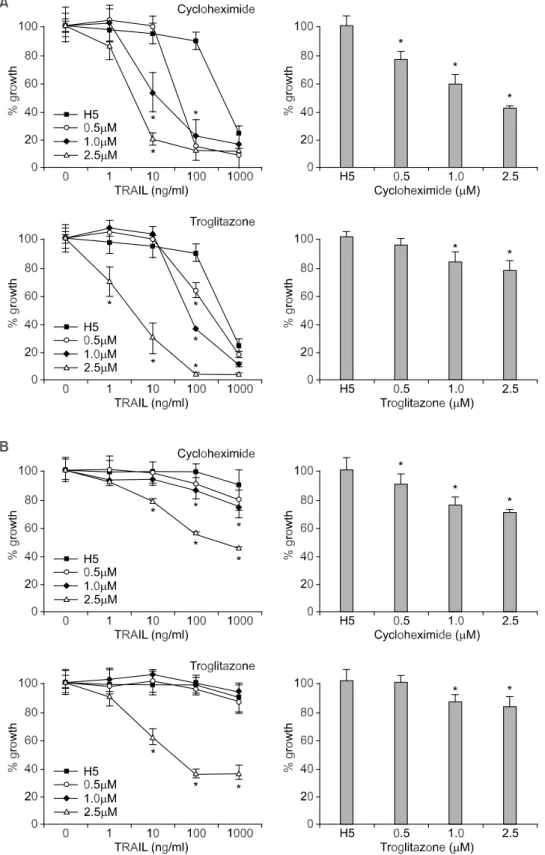
Fig. 3. Changes in TRAIL-induced apoptotic cell death by cycloheximide or troglitazone in TPC-1 (A) and FTC- 133 (B) cell line. Cells were pretreated by cycloheximide or troglitazone for 24 hours and then soluble human recombinant TRAIL was added. Colorometric MTT assay was done 16 hours after TRAIL treatment (mean±SD, n=6, *P<0.05).
였다(Fig. 1). 유세포검사를 통한 세포소멸 검사에서도 100 ng/ml 농도의 재조합 TRAIL은 TPC-1세포에서는 유의한 세 포소멸을 유도하였으나, FTC-133 세포에서는 그렇지 않았 다(Fig. 2).
2) 갑상선 암세포주에서 cycloheximide와 troglitazone 에 의한 TRAIL 유도 세포소멸의 조절
TRAIL 유도 세포소멸을 항진시키는 것으로 잘 알려진 cycloheximide와 새로운 항암치료의 표적으로 연구되고 있 는 PPARγ의 선택적 촉진제인 troglitazone을 이용하여, 이 들 약제의 전처치가 갑상선 암세포의 TRAIL 유도 세포 소 멸의 감수성에 미치는 영향을 알아보았다. 특히 TRAIL에 대한 반응성이 상대적으로 좋은 TPC-1 세포주와 저항성을 보이는 FTC-133 세포주를 선택하여 농도에 따른 변화를 좀 더 자세히 알아보았다. Cycloheximide와 troglitazone은 각각 농도에 비례하여 TRAIL에 의한 세포 증식 억제 효과를 보 여주었다(Fig. 3). 특히 troglitazone은 5μM의 비교적 낮은 농도에서도 TRAIL에 의한 세포 증식 억제 효과를 현저하 게 상승시켰다. Cycloheximide와 troglitazone은 FTC-133과
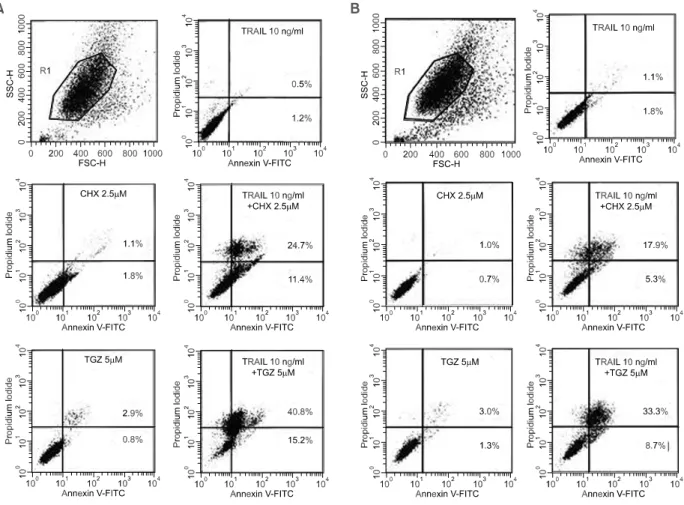
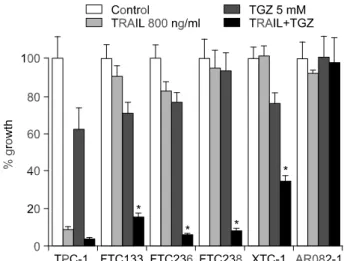
TPC-1세포주 모두에서 10 ng/ml의 낮은 농도의 TRAIL에 의해서도 유의한 세포 소멸의 증가를 가져왔다(Fig. 4). 이 러한 troglitazone의 효과는 FTC-236, FTC-238, XTC-1 세포 주에서도 관찰할 수 있었으나, ARO82-1(미분화 갑상선암) 에서는 현저하지 않았다(Fig. 5).
3) Troglitazone 치료 후 Bcl-family 단백질 발현의 변화 Troglitazone에 의한 TRAIL 유도 세포 소멸의 기전을 알아 보기 위해, 치료에 따른 Bcl family 단백질의 발현 변화를 관 찰하였다. FTC-133과 TPC-1 세포주에서 48시간 동안 여러 농도(2.5, 5, 10, 20μM)의 troglitazone에 노출하였으나, Bcl- 2, Bcl-xl, Bax 단백질의 발현에는 큰 변화가 없었다(Fig. 6).
고 찰
갑상선암 세포주를 이용한 본 연구의 결과, troglitazone (PPARγ agonist)과 cycloheximide의 전처치는 TRAIL 유도 세포소멸의 감수성을 현저히 증가시킴을 알 수 있었다. 그 러나 이 과정에서 Bcl family의 단백질은 관여하지 않는 것
Fig. 4. TRAIL-induced apoptosis in combination with cycloheximide or troglitazone in TPC-1 (A) and FTC-133 (B) cell line. Pretreatment with cycloheximide or troglitazone enhanced TRAIL-induced apoptosis.
으로 생각하였다.
TRAIL은 최근 새로 밝혀진 death ligand로 인체의 항상성 에 중요한 역할을 하는 것으로 알려져 있다. 세포수를 적정 하게 유지하기 위해서는 세포의 증식과 죽음의 균형이 필 요한데, 이러한 균형이 깨어지면 여러 가지 질병을 초래할 수 있다. 인체 암의 일부는 세포 죽음의 조절에 이상이 생겨 발생하는데, 세포소멸(apoptosis)은 세포 죽음의 조절기전의 하나로 주로 활성화된 면역세포나 바이러스 감염이나 종양 유전자 발현에 의해 변형된 세포를 제거하는 데 중요한 역 할을 수행한다. 그러나 암세포는 여러 기전을 통해 세포소 멸을 피해가는데, 암 발생과 진행 과정에서 생기는 p53 유 전자 변이는 그 대표적인 예가 된다. 암세포는 p53 돌연변 이에 의해 항암화학요법이나 방사선 요법에 대한 저항성을 가지게 된다. 그런데 TNF, Fas ligand (FasL), 또는 최근 밝혀 진 TRAIL/APO-2L 등의 death ligand들은 이러한 p53 돌연변 이에 무관하게 여러 인체 암 세포주에서 세포소멸을 유도
할 수 있다.(9) TNF나 FasL의 전신적 투여는 치명적인 염증 반응이나 간독성 등의 심각한 합병증을 초래할 수 있는 반 면,(10,11) TRAIL은 암세포를 포함한 변형 세포에만 선택적 으로 세포독성을 나타내고, 정상세포에는 영향을 미치지 않는 것으로 알려져, 매우 효과적인 항암치료제가 될 것으 로 기대된다.(9,12,13)
TRAIL은 TNF-superfamily에 속하며, 그 유전자는 3q26에 위치하고, 인체의 여러 조직, 특히 비장, 폐, 전립선 등에 존 재한다.(9) 유전자 조작 쥐에서 보고된 바와 같이 TRAIL은 종양의 발생과 성장, 그리고 전이에 중요한 역할을 수행한 다.(14) 5가지의 TRAIL 수용체가 보고되어 있는데, 이들 중 DR4와 DR5만이 기능적인 death receptor이고, 나머지 수용 체로는 길항작용의 decoy receptor인 DcR1, DcR2와 osteo- protegerin (OPG)이 있다.
TRAIL mRNA의 발현은 갑상선 여포 세포, 갑상선내 면 역세포, 갑상선암 세포주에서도 관찰된다.(1) 정상 갑상선 세포와 갑상선암세포의 TRAIL 수용체의 발현 양상은 비슷 한 것으로 보고되어, 이 것이 TRAIL에 대한 감수성의 차이 를 설명하지는 못하는 것으로 보인다.(2) 갑상선 암 세포는 상대적으로 FAS에 의한 세포소멸보다, TRAIL에 의한 세포 소멸에 더 민감한 것으로 보고되나, 현저한 세포소멸은 아 주 높은 농도의 TRAIL (1μg/ml 이상)을 투여하거나, cyclo- heximide로 전처치한 경우에만 관찰할 수 있었다.(1,2) 본 연구에서, TRAIL 유도 세포소멸의 감수성은 갑상선암 세포주에 따라 차이를 보였는데, TPC-1 (갑상선 유두암) 세 포주의 경우 가장 민감하여, 100∼1000 ng/ml의 TRAIL 투 여시 현저한 세포소멸을 관찰할 수 있었다. 그러나 나머지 세포주는 매우 저항성이 높아 1000 ng/ml의 TRAIL 투여에 도 세포소멸은 현저하지 않았다.
최근 TRAIL치료에 저항성을 보이는 일부 종양에서 사이 토카인, 항암화학요법, 방사선 요법 등에 의해 TRAIL에 대 한 감수성이 증가하는 것이 보고되었다.(1-3,15) 본 연구에 서는 cycloheximide와 새로운 항암치료의 목표가 되고 있는 PPARγ의 강력한 선택적 촉진제인 troglitazone을 이용하여 TRAIL 유도 세포사멸의 감수성에 미치는 영향을 알아보았 다. Troglitazone의 암세포 증식 억제 효과는 인체 여러 암세 Fig. 5. Eanced TRAIL-induced apoptotic cell death by troglitazone.
TRAIL (800 ng/ml) induced remarkable apoptotic cell death in the presence of troglitazone (5μM) in thyroid cancer cell lines (mean±SD, n=6, *p<0.05, compared with mono- therapy).
Fig. 6. Changes in expression of Bcl family protein after troglitazone treatment. Thyroid cancer cells were treated with troglitazone for 48 hours at various concentrations (2.5, 5, 10, 20μM). There were no significant changes in protein expression.
포에서 이미 많은 보고가 있으며, 갑상선 암 세포에서도 그 효과가 알려져 있다.(16-18) 본 연구의 결과, 24시간 동안 전 처치를 하였을 때, cycloheximide와 troglitazone 모두에서 현 저하게 TRAIL 유도 세포사멸의 감수성을 증가시켰다.
이러한 병합 치료에 의한 TRAIL에 대한 감수성 증가의 기전은 잘 밝혀져 있지 않고, 여러 가지 기전이 작용할 것으 로 추정되고 있다. TRAIL 수용체의 구성 변화와, TRAIL에 의한 세포 내 신호전달의 제어가 그 대표적인 예인데, 최근 의 연구를 통해 후자가 더 중요한 역할을 하는 것이 알려져 있다. Bcl-2나 Bcl-xl의 과발현은 종양이 세포소멸을 피해 생존하는 중요한 기전의 하나로, 병합치료에 의한 이들 단 백질의 감소는 TRAIL 유도 세포소멸의 감수성 증가와 연 관이 될 수 있다.(19-21) 그러나 본 연구의 결과, troglitazone 은 FTC-133과 TPC-1 세포주에서 TRAIL 유도 세포소멸의 감수성을 증가시키지만, Bcl-2, Bcl-xl, BAD의 발현에는 영 향을 주지 못했다. 최근 새롭게 제시되는 FLIP (Fas-asso- ciated death domain protein (FADD)-like interleukin-1 beta- converting enzyme (FLICE) inhibitory protein)이나 casein ki- nase II의 연관에 대한 연구가 필요할 것으로 생각한다.(22)
결 론
보고된 다른 인체 암 세포주와 비교하여, 본 연구에서 사 용된 갑상선 암 세포주는 TRAIL 유도 세포소멸에 대해 저 항성을 가지며, 그 정도는 세포주에 따라 차이를 보였다. 그 러나 PPARγ의 강력한 선택적 촉진제인 troglitazone으로 전 처치한 경우, 갑상선 암 세포에서 TRAIL 유도 세포소멸의 현저한 증가를 가져오는 것을 알았다. 향후 동물 실험과 임 상 연구에서 효과와 안정성이 다시 검증된다면, 이를 통해 항암화학 요법과 TRAIL의 병합 요법이 기존의 치료에 반 응하지 않는 갑성선 암의 치료에 도움을 줄 수 있을 것이라 고 기대한다.
REFERENCES
1) Bretz JD, Rymaszewski M, Arscott PL, Myc A, Ain KB, Thompson NW, et al. TRAIL death pathway expression and induction in thyroid follicular cells. J Biol Chem 1999;274:
23627-32.
2) Mitsiades N, Poulaki V, Tseleni-Balafouta S, Koutras DA, Stamenkovic I. Thyroid carcinoma cells are resistant to FAS- mediated apoptosis but sensitive tumor necrosis factor-related apoptosis-inducing ligand. Cancer Res 2000;60:4122-9.
3) Griffith TS, Chin WA, Jackson GC, Lynch DH, Kubin MZ.
Intracellular regulation of TRAIL-induced apoptosis in human melanoma cells. J Immunol 1998;161:2833-840.
4) Langaas V, Shahzidi S, Johnsen JI, Smedsrod B, Sveinb- jornsson B. Interferon-gamma modulates TRAIL-mediated ap-
optosis in human colon carcinoma cells. Anticancer Res 2001;
21:3733-8.
5) Munshi A, McDonnell TJ, Meyn RE. Chemotherapeutic agents enhance TRAIL-induced apoptosis in prostate cancer cells.
Cancer Chemother Pharmacol 2002;50:46-52.
6) Goretzki PE, Frilling A, Simon D, Roeher HD. Growth regul- ation of normal thyroids and thyroid tumors in man. Recent Results Cancer Res 1990;118:48-63.
7) Zielke A, Tezelman S, Jossart GH, Wong M, Siperstein AE, Duh Q-Y, et al. Establishment of a highly differentiated thy- roid cancer cell line of Hürthle cell origin. Thyroid 1998;8:
475-83.
8) Ambesi-Impiombato FS, Parks LA, Coon HG. Culture of hor- mone-dependent functional epithelial cells from rat thyroids.
Proc Natl Acad Sci USA 1980;77:3455-9.
9) Wiley SR, Schooley K, Smolak PJ, Din WS, Huang CP, Nicholl JK, et al. Identification and characterization of a new member of the TNF family that induces apoptosis. Immunity 1995;3:673-82.
10) Tartaglia LA, Goeddel DV. Two TNF receptors. Immunol To- day 1992;13:151-3.
11) Nagata S. Apoptosis by death factor. Cell 1997;88:355-65.
12) Walczak H, Miller RE, Ariail K, Gliniak B, Griffith TS, Kubin M, et al. Tumoricidal activity of tumor necrosis factor-related apoptosis- inducing ligand in vivo. Nat Med 1999;5:157-63.
13) Ashkenazi A, Pai RC, Fong S, Leung S, Lawrence DA, Marsters SA, et al. Safety and antitumor activity of recombi- nant soluble Apo2 ligand. J Clin Invest 1999;104:155-62.
14) Cretney E, Takeda K, Yagita H, Glaccum M, Peschon JJ, Smyth MJ. Increased susceptibility to tumor initiation and metastasis in TNF-related apoptosis-inducing ligand-deficient mice. J Immunol 2002;168:1356-61.
15) Kim MR, Lee JY, Park MT, Chun YJ, Jang YJ, Kang CM, et al. Ionizing radiation can overcome resistance to TRAIL in RAIL-resistant cancer cells. FEBS Lett 2001;505:179-84.
16) Ohta K, Endo T, Haraguchi K, Hershman JM, Onaya T.
Ligands for peroxisome proliferator-activated receptor gamma inhibit growth and induce apoptosis of human papillary thyroid carcinoma cells. J Clin Endocrinol Metab 2001;86:2170-7.
17) Martelli ML, Iuliano R, Le Pera I, Sama' I, Monaco C, Cam- marota S, et al. Inhibitory effects of peroxisome poliferator- activated receptor gamma on thyroid carcinoma cell growth.
J Clin Endocrinol Metab 2002;87:4728-35.
18) Park JW, Yeh MW, Wong MW, Duh QY, Clark OH. Tro- glitazone, a peroxisome proliferator-activated receptor gamma agonist, inhibits growth and down-regulates dedifferentiation marker CD97 in thyroid cancer cell lines. 73rd Annual Meet- ing of the American Thyroid Association 2001 (Abstract).
19) Fulda S, Meyer E, Debatin KM. Inhibition of TRAIL-induced apoptosis by Bcl-2 overexpression. Oncogene 2002;21:2283- 2294.
20) Ravi R, Bedi A. Requirement of BAX for TRAIL/Apo2L-in-
duced apoptosis of colorectal cancers: synergism with sulindac- mediated inhibition of Bcl-x (L). Cancer Res 2002;62:1583-7.
21) Ravi R, Bedi A. Sensitization of tumor cells to Apo2 ligand/
TRAIL-induced apoptosis by inhibition of casein kinase II.
Cancer Res 2002;62:4180-5.
22) Poulaki V, Mitsiades CS, Kotoula V, Tseleni-Balafouta S, Ashkenazi A, Koutras DA, et al. Regulation of Apo2L/ Tumor Necrosis Factor-Related Apoptosis-Inducing Ligand-Induced Apoptosis in Thyroid Carcinoma Cells. Am J Pathol 2002;161:
643-54.