* Corresponding author: Ga Yeon Kim
Department of Public Health, Dankook University Graduate School, Dandae-ro, Dongnam-gu, Cheonan 3116, Korea
E-mail: [email protected]
* ORCID: https://orcid.org/0000-0001-8751-5055
†
These authors contributed equally to this work.
ORIGINAL ARTICLE
Inhibition Effect on Pathogenic Microbes and Antimicrobial Resistance of Probiotics
Jae Soo Kim 1,† , Young Sam Yuk 2,† , Ga Yeon Kim 3
1
Department of Laboratory Medicine, Dankook University Hospital, Cheonan, Korea
2
Department of Biomedical Laboratory Science, College of Health Sciences, Dankook University, Korea
3
Department of Public Health, Dankook University Graduate School, Cheonan, Korea
Probiotics의 병원성 미생물에 대한 억제효과와 항균제 내성
김재수 1,† , 육영삼 2,† , 김가연 3
1
단국대학교병원 진단검사의학과,
2단국대학교 임상병리학과,
3단국대학교 대학원 보건학과
ARTICLE INFO ABSTRACT
Received July 17, 2019 Revised 1
stAugust 10, 2019 Revised 2
ndAugust 28, 2019 Revised 3
rdAugust 30, 2019 Revised 4
thSeptember 3, 2019 Revised 5
thSeptember 4, 2019 Accepted September 4, 2019
To investigate the inhibition effect on pathogenic microbes and the antimicrobial resistance of probiotics, a total of 140 probiotics were isolated from 35 kinds of Korean commercially available Kimchi. Of those, L. plantarum was identified from 53 strains (37.9%), E. faecium from 27 strains (19.3%), and L. rhamnosus from 7 strains (5.0%) using 16S rRNA gene sequencing. Sixty nine strains (49.3%) showed overall antimicrobial activity against pathogenic microbes, namely S.
Typhi, S . Enteritidis , E. coli O157:H7 , S. flexneri , NAG Vibrio, Listeria monocytogenesis , Y.
enterocolitica , S. aureus , S. pyogenes , G. vaginalis , C. albicans , and P. acne . The proportions of L.
plantarum , E. faecium , and L. rhamnosus strains to pathogenic microbes were 75.5%, 40.7%, and 28.6%, respectively. In addition, a resistance test with 18 antimicrobial agents using a disk diffusion assay revealed a resistance incidence of 98.6% for nalidixic acid, 83.6% for streptomycin, 75.7% for gentamicin 73.6% for vancomycin, 72.1% for norfloxacin, and 67.9% for ciprofloxacin. In conclusion, L. plantarum , L. sakei , and E. faecium strains with various antimicrobial activities and broad antibiotic resistance are useful for treating diarrhea in long-term inpatients and for the alternative use for treating Candida species female vaginitis.
Copyright © 2019 The Korean Society for Clinical Laboratory Science. All rights reserved.
Key words Antibiotic resistance Pathogenic microbes Probiotics
서 론
Probiotics는 WHO와 FAO의 정의에 의하면 적당량을 투여 하였을 때, 숙주에게 건강을 제공하는 살아있는 미생물로 정의 되어 있는 건강에 유익한 박테리아로서 장내 건강을 유지하고 소화가 잘 되도록 돕는다[1]. 김치에서 분리된 Lactobacillus는
아토피성 피부염과 식품 알러지를 경감하는 능력과 함께 다량 의 IL-12와 IFN-을 생산함으로써 Th1/Th2 균형을 조절하는 것으로 알려져 있으며[2], 오메가 3 polyunsaturated fatty acid가 풍부한 젓갈 기름은 알러지 감작을 감소시킬 수 있다[3].
항생제 치료시 probiotics를 보충제로 제공해야 한다는 의견을 지지하는 연구가 점차 증가하고 있으며 실제로 항생제 치료 과 정에서 probiotics 보충제를 첨가하면 장내 환경에서 발생하는 항생제로 인한 부작용을 감소시킬 수 있다[4]. 식물성 유산균은 동물성 유산균보다 고농도의 염도나 영양이 풍부하지 않은 곳 에서도 생존할 수 있으며, 산에 강해 90%가 살아있는 상태로 장 에 도달할 수 있다.
Korean Society for Clinical Laboratory Science
Table 1. Primers used for PCR sequencing of 16S rRNA
Primer name Sequence Use
27F 1492R
5′ (AGA GTT TGA TCM TGG CTC AG) 3 5′ (TAC GGY TAC CTT GTT ACG ACT T) 3′
PCR amplification
785F 907R
5′ (GGA TTA GAT ACC CTG GTA) 3′
5′ (CCG TCA ATT CMT TTR AGT TT) 3′
PCR sequencing
본 연구에서는 국내에서 시판중인 김치에서 probiotics을 분 리하여 16S rRNA sequencing을 통한 균 동정과 각종 병원성 미생물에 대한 억제효과를 조사하였으며 또한 환자치료에 사용 되는 총 18종의 항균제 내성 패턴을 조사하여 장기간 항균제 치 료중인 설사질환 환자의 치료 및 예방목적에 사용될 수 있는 probiotics를 개발하여 국민보건 향상에 기여하고자 하였다.
재료 및 방법
1. 대상 검체
검체는 2016년 1월말부터 12월말까지 시판되는 김치와 가 정에서 제조된 김치 등 총 35종을 사용하였으며, 김치액을 무균 의 50 mL 채취병에 채취하여 사용하였다.
2. Probiotics 분리 및 동정
Probiotics의 분리시험은 식품의 기준 및 규격[5] 및 건강기 능식품의 기준 및 규격[6]에 따라 실시하였다. 즉 김치액을 멸균 식염수로 10배 단계희석을 한 후, 각 분리용 배지에 희석액 0.1 mL를 접종하고 spreader를 이용하여 배지 전체에 균일하게 도 말하고, TOS-MUP agar (Difco, MI, USA) BS agar (Difco, MI, USA) 및 BL agar (Difco, MI, USA)는 혐기배양을, 나머지 배지 는 10% CO
2
incubator에서 35°C 48시간 배양하였다. 배양 후 분리된 집락을 선택한 후 유산균 배양을 위해 Lactobacilli MRS agar (Difco, MI, USA)에 획선 도말하여 순수 배양됨을 확인하 였다. 또한 분리균의 동정은 Kaewsrichan 등[7], Lawalata 등 [8], Aboserh 등[9]의 방법에 따라 16S rRNA sequencing을 실 시하였다. 보관된 균주의 동정을 위해 Lactobacilli MRS agar (Difco)에 재도말하고 35°C, 10% CO2
incubator에서 48시간 배양하고 균집락 형성을 확인하고 Lactobacilli MRS agar (Difco)에서 배양하고 냉장상태로 140개의 균주를 염기서열 분 석기관인 ㈜마크로젠(Korea)에 의뢰하여 각 균종에 대한 16S rRNA 염기서열 분석을 바탕으로 Genbank의 BLAST search를 통한 균 동정 결과를 회사측으로부터 얻었다. 염기서열 분석을 위해 사용된 PCR primer와 sequencing primer는 현재 보편적으로 사용되는 것으로써 Table 1과 같다.
3. Probiotics 배양균액의 병원성 미생물에 대한 억제효과 억제시험은 Ligocka와 Paluszak [10], Kaewsrichan 등[11]
의 방법에 따라 실시하였다. 즉 −80°C에 보관된 균주를 Lacto- bacilli MRS agar (Difco)에 획선도말하고 35°C에서 10% CO
2
, 24∼48시간 배양하여 순수배양 유무를 확인하고 3회 계대배양 한 균액을 시험에 사용하였다.시험균주로 사용된 병원성 미생물들은 장내설사를 일으키는 Eschericia coli O157:H7 (ATCC 43895; E. coli O157:H7), Salmonella Typhi (ATCC 19430; S. Typhi), Salmonella Enteritidis (ATCC 13076; S. Enteritidis), Shigella flexneri (ATCC 12022; S. flexneri), Non-agglutinable Vibrio cholerae (ATCC 25873; NAG-Vibrio), Listeria monocy- togenesis (ATCC 13932; L. monocytogenesis), Yersinia enterocolitica (ATCC 9610; Y. enterocolitica), Staphyloco- ccus aureus (KCTC 1927; S. aureus)등 총 8종과 패혈증을 일 으키는 Streptococcus pyogenes (ATCC 19615; S. pyogenes), 질염을 일으키는 Gardnerella vaginalis (KCTC 5097; G.
vaginalis)와 Candida albicans (KCTC 7752; C. albicans), 그 리고 피부염을 일으키는 Propionibacterium acnes (KCTC 5012; P. acnes) 등 4종을 포함하여 총 12종의 병원성 미생물을 사용하였다.
4. Probiotics 배양균액의 항균제 내성시험
항균제 감수성 및 내성시험은 2017년 CLSI guideline M100 S27을 기준으로 시험하였으며[12] 또한 Manual of antimicrobial susceptibility testing [13], WHO [14] 및 Clinical and Labo- ratory Standards Institute (CLSI) guidelines [15]을 참고하여 실시하였다. Lactobacilli MRS agar (Difco)을 이용하여 디스 크 한천 확산법을 사용했으며, 임상에서 많이 사용되는 총 18종 의 항균제 중 다양한 계열을 포함시켰고 Table 2와 같이
-lactam 계열이 3개, cephalosporins 계열이 2개, amino- glycosides 계열이 2개, quinolone 계열이 3개, 그리고
Table 2. The antimicrobials used in this study
Groups Antimicrobials Abbreviation
-lactam Ampicillin AM
Penicillin P
Oxacillin OX
Cephalosporins Cefotetan CTT
Cephalothin CF
Aminoglycosides Gentamicin GM
Streptomycin S
Quinolone Ciprofloxacin CIP
Norfloxacin NOR
Nalidixic acid NA
Glycopeptide Vancomycin VA
Tetracyclines Tetracycline TE
Lincosamide Clindamycin CC
Carbapenem Imipenem IMP
Macrolide Erythromycin E
Others Chloramphenicol C
Trimethoprim/sulfamethoxazole SXT
Refampin RA
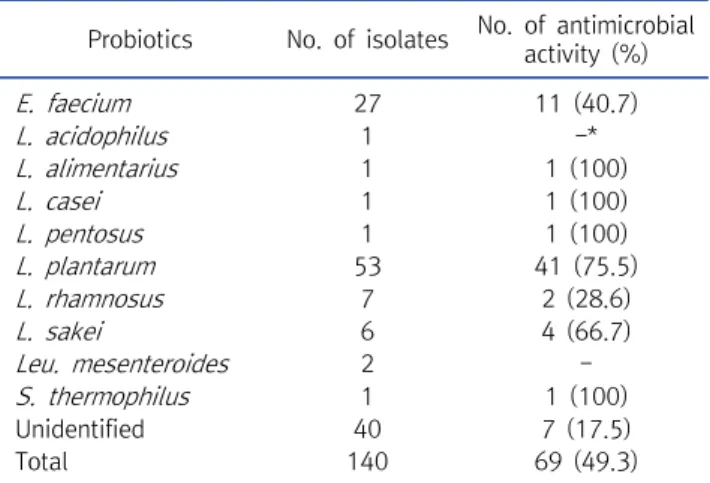
Table 4. Distribution of the antimicrobial activity rates of the cell-free cultured solution of probiotics isolated from Kimchi
Probiotics No. of isolates No. of antimicrobial activity (%)
E. faecium 27 11 (40.7)
L. acidophilus 1 -*
L. alimentarius 1 1 (100)
L. casei 1 1 (100)
L. pentosus 1 1 (100)
L. plantarum 53 41 (75.5)
L. rhamnosus 7 2 (28.6)
L. sakei 6 4 (66.7)
Leu. mesenteroides 2 -
S. thermophilus 1 1 (100)
Unidentified 40 7 (17.5)
Total 140 69 (49.3)
* Presents not inhibition.
Table 3. Identification of probiotics isolated from Kimchi by 16S rRNA sequencing
Identification of
probiotics No. of isolates (%) Genbank (Accession No.)
L. plantarum 53 (37.9) NR104573
E. faecium 27 (19.3) NR114742
L. rhamnosus 7 (5.0) NR043408
L. sakei 6 (4.3) NR042443
Leu. mesenteroides 2 (1.4) CP012009
L. acidophilus 1 (0.7) NR117062
L. alimentarius 1 (0.7) LC063166
L. casei 1 (0.7) KP326371
L. pentosus 1 (0.7) NR029133
S. thermophilus 1 (0.7) NR042778
Unidentified 40 (28.6)
Total 140
glycopeptide, tetracyclines, lincosamide, carbapenem, macrolide 계열이 각 1개씩, 기타 항균제가 2개 사용되었다.
결 과
1. 검체에서의 pobiotics 분리율
시판 김치 15종과 가정에서 만든 김치 20종을 검사한 결과 총 140주의 probiotics를 분리하였으며 시판 김치에서는 60주 (42.9%), 가정에서 만든 김치에서는 80주(57.1%)를 각각 분리 하였다(Table 3).
2. 분리된 pobiotics 균종 동정
분리한 140주의 probiotics를 16S rRNA sequencing 분석 을 위해 사용된 primers와 동정된 결과는 Table 1, 2와 같다. 이 중 Lactobacillus plantarum이 53주(37.9%)로 가장 많이 분리 되었으며, Enterococcus faecium이 27주(19.3%), Lactobacillus rhamnosus 7주(5.0%), Lactobacillus sakei 6주(4.3%), Leuconostoc mesenteroides 2주(1.4%), Lactobacillus acidophilus, Lactobacillus casei, Lactobacillus alimentarius, Lactobacillus pentosus, Streptococcus thermophilus 각 1주(0.7%), 미동정 분류균은 40주(28.6%)이었다.
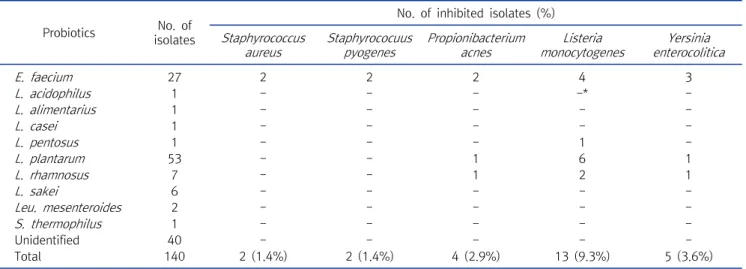
3. Probiotics 배양균액의 병원성 미생물에 대한 억제효과 12종의 병원성 미생물에 대한 probiotics의 항균성을 시험 한 결과 분리한 140주의 전체적인 항균성은 49.3% (69)주로 나 타났다(Table 4). 균종별로는 L. plantarum 53주 중 41주 (75.5%)가 항균효과를 나타내었고, 이어서 L. sakei 6주 중 4주 (66.7%), E. faecium 27주 중 11주(40.7%)에서 항균성을 나타 내었으며, L. alimentarius, L. casei 그리고 L. pentosus 각 1주 씩, L. rhamnosus 7주 중 2주(28.6%), 그리고 S. thermophilus 1주가 모두 항균효과를 나타내었다. 한편 배양액에 대한 균종별 억제효과는 Table 5, 6과 같았다. E. coli O157:H7을 억제한 균 주는 15주(10.7%)이었고, S. typhi 억제는 20주(14.3%), S.
enteritidis는 18주(12.9%), S. flexneri는 31주(22.1%), Y.
enterocolitica는 5주(3.6%), NAG-Vibrio는 32주(22.9%) 그 리고 L. monocytogenes를 억제한 균주는 13주(9.3%)로 나타 났다(Table 3, 4). 또한 S. pyogenes를 억제한 균주는 2주 (1.4%), S. aureus는 2주(1.4%), P. acnes는 4주(2.9%), 그리고
Table 5. The inhibition effects of cell-free cultured solution of probiotics to pathogenic microbes
Probiotics No. of isolates
No. of inhibited isolates E. coli
O157:H7
Salmonella Typhi
Salmonella Enteritidis
Shigella
flexnerii NAG-Vibrio
†
Gardnerella vaginalis
Candida albicans
E. faecium 27 2 3 3 3 4 1 -*
L. acidophilus 1 -* - - - - - -
L. alimentarius 1 - 1 - - 1 - -
L. casei 1 - - - - 1 - -
L. pentosus 1 - - - 1 1 - -
L. plantarum 53 12 14 14 25 24 1 -
L. rhamnosus 7 - 2 1 2 1 - -
L. sakei 6 1 - - - - - -
Leu. mesenteroides 2 - - - - - - -
S. thermophilus 1 - - - - - - -
Unidentified 40 - - - - - - -
Total 140 15 (10.7%) 20 (14.3%) 18 (12.9%) 31 (22.1%) 32 (22.9%) 2 (1.4%) 0 (0%)
* Presents not inhibition.
†
Presents non agglutinable vibrio.
Table 6. The inhibition effects of cell-free cultured solution of probiotics to pathogenic microbes
Probiotics No. of isolates
No. of inhibited isolates (%) Staphyrococcus
aureus Staphyrococuus
pyogenes Propionibacterium
acnes Listeria
monocytogenes Yersinia enterocolitica
E. faecium 27 2 2 2 4 3
L. acidophilus 1 - - - -* -
L. alimentarius 1 - - - - -
L. casei 1 - - - - -
L. pentosus 1 - - - 1 -
L. plantarum 53 - - 1 6 1
L. rhamnosus 7 - - 1 2 1
L. sakei 6 - - - - -
Leu. mesenteroides 2 - - - - -
S. thermophilus 1 - - - - -
Unidentified 40 - - - - -
Total 140 2 (1.4%) 2 (1.4%) 4 (2.9%) 13 (9.3%) 5 (3.6%)
* Presents not inhibition.
G. vaginalis는 2주(1.4%)였으나 C. albicans를 직접적으로 억 제하는 probiotics는 전혀 관찰되지 않았다.
4. Probiotics 배양균액의 항균제 내성시험
분리한 probiotics에 대한 항균제 내성 및 감수성 시험결과 는 Table 7과 같다. Ampicillin내성률은 11.4%이었고 strep- tomycin은 83.6%, sulfamethoxazole/trimethoprim 59.3%, vancomycin 73.6%, gentamicin 75.7%, tetracycline 10%, oxacillin 70%, norfloxacin 72.1%, nalidixic acid 98.6%, erythromycin 32.1%, cephalothin 19.3%, clindamycin 26.4%, rifampicin 22.9%, cefotetan 97.1%, chloramphenicol 10%,
penicillin 10%, imipenem 10.7% 그리고 ciprofloxacin 내성 률이 67.9%로 나타났다.
고 찰
발효야채와 우유제품에서 분리된 많은 종의 유산균은 박테 리오신, 니신과 같은 항균물질을 생산함으로써 항미생물 작용 을 갖고 있으며[16, 17] 특히 김치유산균같은 probiotics는 장 내 시스템의 감염을 포함하여 감염성 질환의 치료에 새로운 대 체적인 항균 물질로서 흥미롭게 조명되고 있다[18].
본 실험에서는 항균제에 많이 노출된 장기 입원환자의 설사
Table 7. Distribution of resistant, intermediate and susceptible isolates in probiotics isolated from Kimchi to antimicrobial agents
Antimicrobials No. of isolates (%)
Resistant Intermediate Susceptible Ampicillin 16 (11.4) 11 (7.9) 113 (80.7) Streptomycin 117 (83.6) 5 (3.6) 18 (12.9) Sulfamethoxazole/
Trimethoprim
83 (59.3) 12 (8.6) 45 (32.1) Vancomycin 103 (73.6) 2 (1.4) 35 (25.0)
Gentamicin 106 (75.7) 0 34 (24.3)
Tetracycline 14 (10.0) 8 (5.7) 118 (84.3) Oxacillin 98 (70.0) 18 (12.9) 24 (17.1) Norfloxacin 101 (72.1) 24 (17.1) 15 (10.7) Nalidixic acid 138 (98.6) 1 (0.7) 1 (0.7)
Erythromycin 45 (32.1) 0 95 (67.9)
Cephalothin 27 (19.3) 34 (24.3) 79 (56.4) Clindamycin 37 (26.4) 28 (20.0) 75 (53.6) Rifampicin 32 (22.9) 24 (17.1) 84 (60.0)
Cefotetan 136 (97.1) 1 (0.7) 3 (2.1)
Chloramphenicol 14 (10.0) 1 (0.7) 125 (89.3) Penicillin 14 (10.0) 57 (40.7) 69 (49.3)
Imipenem 15 (10.7) 0 125 (89.3)
Ciprofloxacin 95 (67.9) 22 (15.7) 23 (16.4)
질환 증상을 완화시킬 수 있는 probiotics 개발을 위해 국내 시 판 35종의 김치에서 140주의 probiotics를 분리하였으며, 이들 의 대부분은 L. plantarum (37.9%), E. faecium (19.3%)이 차 지하였으며 소량 발견된 L. rhamnosus, L. sakei, L. alimen- tarius, L. acidophilus, L. pentosus 및 L. sakei도 있었다. 서울 대에서 보고된 김치에서 분리한 유산균 중 Lactobacillus가 63.7%인 것에 비해 본 실험에서는 50%보다 조금 높게 나타났 으며[19], Kwon 등[20]은 김치에는 30종 이상의 유산균종이 있으며, 그 중 우점종으로는 L. plantarum, L. brevis, E.
faecalis 그리고 Leu. mesenteroides인으로 보고 하였다. 젓갈 류에는 Lactobacillus 속의 유산균주[21], 장류인 간장에서는 Pediococcus 속의 유산균주가 많이 분리된다고 보고되고 있으 며[22], 본 시험에서는 E. faecium이 19%나 검출되어 검체 환 경조건에 따라 다양한 균주가 분포함을 나타내었다. 분리한 김 치유산균 총 140주 중 49.3%에서 항균성을 나타냈으며, 균종 별 분포를 살펴보면 NAG-Vibro에 대한 항균성이 22.9%, S.
flexneri는 22.1%로 이중 가장 높았으며, S. Typhi는 14.3%, S.
enteritidis 12.9%, E. coli O157:H7 10.7%, L. monocyto- genes 9.3% 순으로 나타났다. 본 실험에서는 대다수의 병원균 에 항균활성과 광범위한 항균제 내성을 나타낸 L. plantarum, L. sakei, 그리고 E. faecium가 향후 장기간 항균제 치료 설사질 환 치료시 대체할 수 있는 유용한 항균물질로 생각된다. 최근의 국외보고에 의하면 항균제 치료 후 probiotics 처리시 장점막
microbiome의 재구성이 떨어진다고 하며 또한 자가 분변이식 (aFMT)은 오히려 증강시킨다고 보고 되었으나[23] 본 실험에 서는 역으로 항균활성과 항균제 내성이 있는 probiotics를 선별 하여 항균제 처리 전이나 병용 처리시 장이나 질에 투입하여 선 제적으로 장점막의 유산균과 microbiome을 보존함과 동시에 재건함을 목표로 실험에 임하였다. 한편 18종의 항균제에 대한 내성시험 결과 nalidixic acid (98.6%), streptomycin (83.6%), gentamicin (75.7%), vancomycin (73.6%), norfloxacin (72.1%) 그리고 ciprofloxacin (67.9%)에 높은 내성률을 나타 내었고 또한 chloramphenicol (89.3%), imipenem (89.3%), tetracycline (84.3%), ampicillin (80.7%) 그리고 erythromycin (67.9%)는 반대로 높은 감수성을 나타내어 분리된 probiotics 가 여러 항균제에 선천적인 내성과 감수성이 다양하게 분포함 을 알 수 있었다. 다른 연구자와 비교해 보면 Coppola 등[24]은 치즈에서 분리한 L. rhamnosus 63주에서 ampicillin, penicillin, imipenem, tetracycline, erythromycin, clinda- mycin, chloramphenicol, refampin의 감수성과 vancomycin, sulfamethoxazole/trimethoprim 내성을 보고하여 본 실험과 유사한 결과를 나타내었으며, Han 등[25]은 Lactobacillus 29주에서 vancomycin, streptomycin, gentamicin, nalidixic acid의 높은 내성과 refampin, cephalothin, ampicillin, tetracycline 및 chloramphenicol의 낮은 내성을 나타내어 본 실험과는 약간 다른 결과를 나타내었다. Charteris 등[26]은 vancomycin, sulfamethoxazole/trimethoprim의 내성과 tetracycline, chloramphenicol, clindamycin, refampin의 감수성을 보고하여 본 실험과 다른 결과를 보고 하였으며, Beyan 등[27]은 penicillin, tetracycline 및 erythromycin 감 수성과 norfloxacin의 내성을 보고하였고, Lonkar 등[28]은 ampicillin, gentamicin, penicillin, 및 tetracycline의 감수성 을 보고하여 균종마다 약간의 차이와 다양성을 발견할 수 있었 다. 따라서 장기 항균제 투여 설사질환 환자나 여성질염환자의 치료시 유익한 장내 유산균총과 microbiome의 재건시 이러한 항균제의 내성과 감수성 특성등을 파악하여 항균제를 선별하는 것이 치료효과를 크게 증대 시킬수 있을것이라 생각되며 향후 이러한 probiotics에 대한 최소한의 안정성 평가항목인 항생제 내성패턴, 대사활성, side effects, 독소생성 및 용혈 가능성, 동 물연구에서의 감염성 결핍확인 등의 추가적인 안전성 연구와 Enterococcus 속의 경우 식품의약품안전처 고시대로 항생제 내성유전자 10종, 독성유전자 4종 등의 확인시험 절차가 추가 적으로 담보되어야 할것으로 생각된다[29]. 한편 최근 국내외 연구에서 특히 체력과 면역력이 부족한 사람의 경우 구토, 설사,
복통, 피부두드러기 증상 등의 probiotics 부작용에 대한 보고 가 있으며 특히 면역력 취약층인 미숙아, 노인, 중증질환자등의 균혈증, 진균혈증, 패혈증을 일으킨 사례가 보고 되고 있다.
Probiotics의 과다 장내유입은 장내 미생물간의 경쟁을 유발시 켜 장내세균 활동을 크게 위축시키고 이것은 특히 면역력이 부 족한 환자의 장점막을 일시적으로 손상시켜 균혈증을 초래한 것으로 생각된다[30].
이상을 종합해 보면 국내 시판중인 김치에서 분리된 pro- biotics는 여러 병원성 미생물과 임상치료에 사용되는 18종의 다양한 계열의 항균제에 대해 광범위한 항균효과와 내성을 나 타내었는데 이것은 병원에서 장기 항균제 치료중인 입원환자의 설사질환 치료제 및 장내 시스템의 개선제로서의 대체 사용에 유용할 것으로 생각된다.
요 약
국내시판 김치로부터 분리한 probiotics의 병원생 미생물에 대한 억제효과와 항균제 내성을 조사하기 위해 35종의 국내시 판 김치에서 총 140주의 probiotics를 분리하였으며, 16S rRNA 염기서열 분석을 통해 L. plantarum이 53주(37.9%), E.
faecium 27주(19.3%) 그리고 L. rhamnosus 7주(5.0%) 순으로 동정되었고, 12종(species)의 다양한 병원성 미생물 즉 S.
Typhi, S. Enteritidis, E. coli O157:H7, S. flexneri, NAG Vibrio, L. monocytogenesis, Y. enterocolitica, S. aureus, S.
pyogenes, G. vaginalis, C. albicans, P. acne에 대한 전체적인 항균성은 69주(49.3%)이었으며, 균종별로 살펴보면 L.
plantarum 75.5%, L. sakei 66.7%, E. faecium 40.7%, 그리고 L. rhamnosus 28.6% 순이었다. 또한 디스크 확산법에 의한 18 종의 다양한 계열의 항균제에 대한 내성시험 결과 nalidixic acid가 98.6%의 내성을, S 83.6%, gentamicin 75.7%, vancomycin 73.6%, norfloxacin 72.1%, 그리고 ciprofloxacin 67.9% 순으로 나타났다. 결론적으로 본 실험에서 다양한 항균 활성과 광범위한 항생제 내성을 지닌 L. plantarum, L. sakei, 그 리고 E. faecium 균주가 장기 항생제 치료환자에 대한 유용한 설사 치료용 및 Candida 속이 야기하는 여성질염 치료제로서 의 사용이 유용할 것으로 생각된다.
Acknowledgements: None Conflict of interest: None
Author’s information (Position): Kim JS
1
, M.T.; Yuk YS2
, Professor; Kim GY3
, Professor.REFERENCES