The Association between Involuntary Smoking Exposure with Urine Cotinine Level and Blood Cadmium Level in General Non-Smoking Populations
Unintentional environmental exposure to toxicants is associated with an aggravated health status of the general population. Involuntary smoking (IS) exposure is one of the main routes to involuntary toxicants exposure. However, few studies have attempted to understand the environmental cadmium exposure by IS exposure in the general, non- smoking population. The purpose of the current study was to examine the relationship between blood cadmium level and IS level according to gender and age. We used the Korea National Health and Nutrition Examination Survey (KNHANES) IV–VI data that included heavy metal and urine cotinine sampling with IS exposure history. The final analysis comprised 3,493 adults (1,231 males and 2,262 females) and 395 adolescents (210 males and 185 females). Linear regression was performed to estimate the association between self-reported IS exposure with urine cotinine level and blood cadmium level in non-smokers with gender and age group stratification. In final regression model, the effect values (B) (standard errors [SE]) between blood cadmium and urine cotinine level in men was 0.0004 (0.0001) and 0.0006 (0.0002) in adults and adolescents, the B (SE) in women was 0.0006 (0.0002) and 0.0016 (0.0006) in adults and adolescents. Our study revealed, for the first time, a significant association between blood cadmium and IS exposure in non-smokers. Greater efforts are needed to improve environmental justices of the general population from IS, considering the severe harmful effects of involuntary exposure to even a low level of cadmium.
Keywords: Involuntary Smoking; Second-hand Smoking; Passive Smoking; Cotinine;
Cadmium; Adolescent Wanhyung Lee,1,2,3 Seunghyun Lee,4
Jaehoon Roh,1,2,3,5 Jong-Uk Won,1,2,3,5 and Jin-Ha Yoon1,2,3,5
1The Institute for Occupational Health, Yonsei University College of Medicine, Seoul, Korea;
2Graduate School of Public Health, Yonsei University College of Medicine, Seoul, Korea; 3Incheon Worker’s Health Center, Incheon, Korea;
4Department of Internal Medicine, University of Occupational and Environmental Health, Kitakyushu, Japan; 5Department of Preventive Medicine, Yonsei University College of Medicine, Seoul, Korea
Received: 6 July 2016 Accepted: 11 December 2016 Address for Correspondence:
Jin-Ha Yoon, MD, PhD
Department of Preventive Medicine, Yonsei University College of Medicine, 50-1 Yonsei-ro, Seodaemun-gu, Seoul 03722, Korea E-mail: [email protected]
Funding: This work was supported by the Students’ Association of the Graduate School of Yonsei University, funded by the Graduate School of Yonsei University.
https://doi.org/10.3346/jkms.2017.32.4.568 • J Korean Med Sci 2017; 32: 568-575
INTRODUCTION
Humans have the right to the highest attainable standard of health, and society has duties to protect individuals from unin- tentional exposure to hazards that cause health inequity. Those rights and duties are essential concepts in most international legal instruments such as World Health Organization (WHO) (1). Recently, WHO announced that involuntary smoking (IS) exposure, which has the nature of passive, environmental, or second-hand exposure, can disturb the fundamental right and freedoms of non-smokers. Because those unintentional health disturbances are deeply related to systemic social regulation for smoke-free laws, IS has been discussed in environmental jus- tices, particularly for vulnerable subjects such as children and women (2).
Although a number of policies for protection of the general population from IS exposure have been introduced since 2000 worldwide, 58 million persons were still exposed to IS from 2011–
2012 in the United States (3), and 4.9%–55.2% of the general pop- ulation, including adolescents, was exposed to IS at home or in
public places in Asia during the same period (4).
Previous studies have indicated that higher passive exposure to cigarette smoke leads to a higher risk of disease than second- ary exposure to less cigarette smoke, but there is no ‘safe’ level of exposure to IS (3,5). Non-smokers are not safe from breath- ing IS despite opening windows, using air filters, or separating smokers from non-smokers in public spaces (3). Thus, IS expo- sure to non-smokers might exacerbate the environmental in- equalities. Yet, surprisingly, the effects of exposure to environ- mental toxicants on non-smokers, which are hazardous com- pounds from IS, have not been closely examined, particularly cadmium.
Involuntary exposure to cadmium is a serious public health problem as it is causally related to respiratory diseases (6), sev- eral cancers (7), cardiovascular diseases (8), and toxic effects on the reproductive system and the foetus (9). Furthermore, cad- mium is poorly excreted and, as it has a long biological half-life that leads to extreme accumulation, it is toxic for a relatively long time (over 20 to 30 years) for the general population (10). A pre- vious study demonstrated the possibility of obtaining an actual Epidemiology, Occupation & Environmental Medicine
cigarette addiction status using cadmium as an indicator (10).
Thus, cadmium level in the blood may serve as a good reflec- tion of the body’s burden of IS exposure in the general popula- tion (11). For this reason, we have focused in the present study on non-smokers’ cadmium levels out of the other cigarette-smoke- linked heavy metals.
Research into the issue of humans’ early cadmium exposure from smoking has generally not been concerned with the gen- eral population or non-smokers but mainly with smokers’ health problems. A previous study has analyzed exposure to heavy met- als according to IS status, but it did not obtain information about the amount of exposure to IS (12). Furthermore, it did not in- vestigate vulnerable members of the population, such as chil- dren. One study has reported an analysis of children, but it did not account for the most common sources of cadmium, such as lifestyle factors, including food consumption (13). Investiga- tion of the level of both IS exposure and cadmium are impor- tant for the understanding of the dose-response relationship of IS hazard. However, a previous study has demonstrated this re- lationship only in a specific gender and age group: the adult fe- male population (14,15). Such approaches have been limited in examining the comprehensive association between IS and cad- mium exposure in non-smokers.
Therefore, the primary objective of this study was to investi- gate the blood cadmium level in both adults and adolescents related to IS exposure with urine cotinine level, evaluated by gender stratification and considering both food consumption and IS exposure level using national representative data. We hope our investigation supports scientific evidence to discuss about the health effects of IS, including environmental justices for vulnerable populations.
MATERIALS AND METHODS Data collection and study design
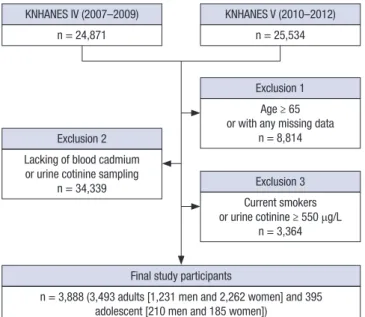
The Korea National Health and Nutrition Examination Survey (KNHANES) is a series of nationally representative, cross-sec- tional, and population-based surveys of the health and nutri- tional status of Koreans, which has been conducted by the Ko- rea Centers for Disease Control and Prevention (16). The cur- rent study used the KNHANES IV–VI (2007–2012) survey data, which included heavy metal and urine cotinine sampling with IS exposure history. From an initial 50,405 males and females, we excluded those older than 65 years and those missing data on age, sex, sociodemographic factors (education level, occupa- tional status, household income, and residential area), or health behavior factors (exercise level and alcohol consumption sta- tus). We further excluded those lacking blood cadmium level, urine cotinine level, IS exposure status, or with missing data or no answers given on the food frequency questionnaire. More- over, we excluded those who were current smokers or defined
as active smokers by self-report of smoking status and a bioche- mical marker (urine cotinine level over 550 μg/L) (17). Finally, 3,493 adults (1,231 males and 2,262 females) and 395 adoles- cents (210 males and 185 females) met the inclusion criteria for this study (Fig. 1).
Second-hand tobacco smoke exposure level
To investigate the IS exposure level, we used data both from a self-report questionnaire about IS status by non-smokers and urine cotinine level. The questionnaire asked about the hourly exposure level to IS in both the workplace and at home during the day in adults. In adolescents, IS level or status was not asked about in the KNHANES. Thus, we could investigate the associa- tion between self-reported IS exposure level and blood cadmi- um level only in adults.
A trained pathologist collected urine samples from selected participants (both adult and adolescent) in a urine specimen cup. Participants were requested to submit early morning sam- ples when possible. All samples were stored in an icebox, which maintained a temperature of 4°C–7°C, and were transported to the permitted central laboratory. For cotinine analysis, 175 µL diphenylamine, the internal standard, was added and then 1 mL of each urine sample was hydrolyzed with 50 µL of 0.1 M sodium hydroxide and extracted with 500 µL of chloroform. Af- ter centrifugal separation (1,900 × g, 10 minutes), the residue was dried with sodium sulphite. Urinary cotinine was analysed by gas chromatographic mass spectrometry using a PerkinElmer Clarus 600T instrument (PerkinElmer, Waltham, MA, USA) (18).
As part of external quality assurance and control, the German External Quality Assessment Scheme (G-EQUAS) was conduct- ed for the measurement of urine cotinine.
Fig. 1. Schematic diagram depicting study participants.
KNHANES = Korea National Health and Nutrition Examination Survey.
Exclusion 2 Lacking of blood cadmium
or urine cotinine sampling n = 34,339
Exclusion 1 Age ≥ 65 or with any missing data
n = 8,814
Exclusion 3 Current smokers or urine cotinine ≥ 550 μg/L
n = 3,364
Final study participants
n = 3,888 (3,493 adults [1,231 men and 2,262 women] and 395 adolescent [210 men and 185 women])
KNHANES IV (2007–2009) n = 24,871
KNHANES V (2010–2012) n = 25,534
Determination of cadmium in whole blood
To determine the concentrations of blood cadmium in whole blood, 3 mL blood samples were collected from each participant into a standard commercial evacuated tube containing sodium heparin (Vacutainer®; BD, Franklin Lakes, NJ, USA). For trace elements, the drawn samples were collected using an ethylene- diaminetetraacetic acid tube. The concentration of blood cad- mium was measured by graphite-furnace atomic absorption spectrometry with Zeeman background correction (PerkinElmer AAnalyst 600; PerkinElmer, Turku, Finland) and presented as μg/L. All blood cadmium analyses were performed by the Neo- din Medical Institute, a laboratory certified by the Ministry of Health and Welfare, Korea. Internal quality assurance and con- trol was conducted 4 times per month using 4 commercial ref- erence materials (Lyphochek Whole Blood Metals Control; Bio- Rad Laboratories, Hercules, CA, USA) with different concentra- tions, and most of the results were within an allowable range.
The coefficients of blood cadmium variation were within 0.95%–
4.82% in the reference samples. External quality assurance and control was performed 4 times per year; the institute passed both the G-EQUAS operated by Friedrich-Alexander University and the Quality Assurance Program operated by the Korea Oc- cupational Safety and Health Agency (19). The institute is also certified by the Ministry of Labor as one of the designated labo- ratories for special chemicals, including heavy metals. In this study, method detection limits for blood cadmium were 0.056 μg/L. None of the samples was below the detection limits (20).
Other covariates
Accessible covariates were different according to age group (adult and adolescent) from the KNHANES. The covariates were so- cioeconomic and lifestyle factors of the adult population that could affect IS status and blood cadmium level. Due to social disparities, people with lower socioeconomic status (i.e. poor education, lower household income, and poor working condi- tions) are more likely to be exposed to IS (21). Furthermore, the blood cadmium level of the general population is associated with socioeconomic status (22). Educational level was classi- fied as less than middle school, high school, and college or more.
Household income was calculated using standardized classifi- cation by sex, residence, and 5-year age groups, and the value was compared with the standard income level of Korean citizens.
Then, the total household income was divided into quartiles.
Type of residence was categorized as rural and urban areas by population size (50,000 citizens) primarily using the Korean ad- ministrative units. Occupation was categorized as white-collar workers, blue-collar workers, or unemployed. Managers, experts and related workers, and office workers were classified as white- collar workers. Workers in sales and services, agriculture, forest- ry, fishery, engineering, assembling, technical work, and man- ual labor were classified as blue-collar workers. The unemployed
were included as no job, students, and homemakers.
Lifestyle factors included alcohol consumption, exercise lev- el, and food consumption pattern, especially the high cadmium- containing food-intake status linked to blood cadmium level (23). Alcohol consumption level was classified as never, moder- ate, and heavy. It was defined differently according to sex. Heavy drinking was defined as at least 7 glasses of alcohol twice or more per week for men and at least 5 glasses of alcohol twice or more per week for women. Level of exercise was divided into 3 cate- gories: none, moderate (between none and high), and high (more than 20 minutes at least 3 times per week of activity that result- ed in increased respiration). Information about high cadmium- containing food consumption was obtained using a food fre- quency questionnaire administered by a trained nutritionist for both the adult and adolescent population. High cadmium-con- taining food includes seaweed, mushrooms, root vegetables, and shellfish (22,24). In the present study, high cadmium-con- taining food consumption status was classified as less than, more than, or once per week.
Statistical analysis
The statistical analyses were conducted using SAS statistical soft- ware (version 9.4; SAS Institute, Cary, NC, USA). The age-adjust- ed blood cadmium levels were calculated according to baseline characteristics with stratification of age (adult and adolescent population). To explore visually the association between blood cadmium level and both the greatest risk factor (age) and poten- tial related factor of interest (cotinine level), we used the ‘CAR’
and ‘RGL’ R packages with gender stratification. It demonstrat- ed plotting of the regression surface that using contour or per- spective plots to visualization of models with interactions (25).
In the current study, we fitted a complicated model that was bas- ed on calculation of vectors with a least-squares linear regression involving a multiplicative interaction between 2-degree-of-free- dom natural spline terms for a logarithm of urine cotinine level and age with gender stratification.
Regression models were performed for urine cotinine level by IS exposure level to estimate the objective exposure level of passive nicotine in non-smokers according to gender. To inves- tigate the relationship between IS exposure level and blood cad- mium, we conducted regression models for blood cadmium level by the self-reported IS status in adults, and urine cotinine level in both adults and adolescents with gender stratification.
We conducted 2 regression models: an age-adjusted and a fully adjusted model. The full model was adjusted for age, sociode- mographic factors (educational level, occupation, household income, and residence), and lifestyle factors (alcohol consump- tion, level of exercise, and high cadmium-containing food con- sumption, including seaweed, laver, mushrooms, root vegeta- bles, and shellfish) for adults, and adjusted for age and high cad- mium-containing food consumption (seaweed, laver, mush-
Table 1. Baseline characteristics of study participants
Characteristics No. % Age adjusted blood cadmium level, μg/L P value*
Adult 3,493 100.0 - -
Gender Men Women
1,231 2,262
35.3 64.8
0.78 1.20
< 0.001
Age, yr 19–35 36–50 51–65
1,033 1,232 1,228
29.5 35.3 35.2
0.93 1.09 1.11
< 0.001
Educational level Under middle school High school Over university
907 1,376 1,210
26.0 39.4 34.6
1.16 1.05 0.95
< 0.001
Household income 1st quartile 2nd quartile 3rd quartile 4th quartile
371 891 1,091 1,140
10.6 25.5 31.2 32.7
1.13 1.07 1.05 1.01
0.005
Residence Rural Urban
2,785 708
79.7 20.3
1.04 1.05
0.953
Occupation White-collar workers Blue-collar workers Unemployed
1,364 828 1,301
33.1 24.3 42.6
1.01 0.99 1.12
< 0.001
Alcohol consumption Never
Moderate Heavy
852 2,346 295
24.4 67.2 8.5
1.10 1.04 1.00
0.006
Level of exercise None Moderate High
2,231 998 264
63.8 28.6 7.6
1.08 0.99 1.02
< 0.001
Exposure of IS None
Yes 2,095
1,398 60.0
40.0 1.02
1.07
< 0.001
High cadmium-contained food-intake status† Less than once per a week
Once per a weak More than once per a weak
745 2,101 647
21.3 60.2 18.5
0.99 1.06 1.10 Urine cotinine level, ng/mL
1st tertile ( < 2.92) 2nd tertile (2.92–9.19) 3rd tertile ( > 9.19)
1,164 1,162 1,167
33.3 33.3 33.4
1.01 1.04 1.09
< 0.001
Adolescent 395 100.0 - -
Gender Men
Women 210
185 53.1
46.9 0.39
0.37
0.085
Age, yr 13–15
16–18 205
190 51.9
48.1 0.39
0.38
0.438
High cadmium-contained food-intake status† Less than once per a week
Once per a weak More than once per a weak
8 76 251
2.0 19.3 63.7
0.37 0.37 0.41
0.027
Urine cotinine level, ng/mL 1st tertile ( < 2.02) 2nd tertile (2.02–6.20) 3rd tertile ( > 6.20)
142 143 145
33.0 33.3 33.7
0.36 0.38 0.41
0.014
IS = involuntary smoking.
*P value for statistical different of age adjusted blood cadmium level (μg/L) by each category; †Cadmium contained food included seaweed, mushrooms, root vegetables, and shellfish.
rooms, root vegetables, and shellfish) for adolescents. For all statistical calculations, a P value < 0.05 was considered statisti- cally significant both tails.
Ethics statement
This study was approved by the Institutional Review Board (IRB) of the Korea Centers for Disease Control and Prevention (IRB No. 2007-02-CON-04-P 2008-04EXP-01-C, 2009-01CON-03-2C, 2010-02CON-21-C, 2011-02CON-06-C, and 2012-01EXP-01-2C).
RESULTS
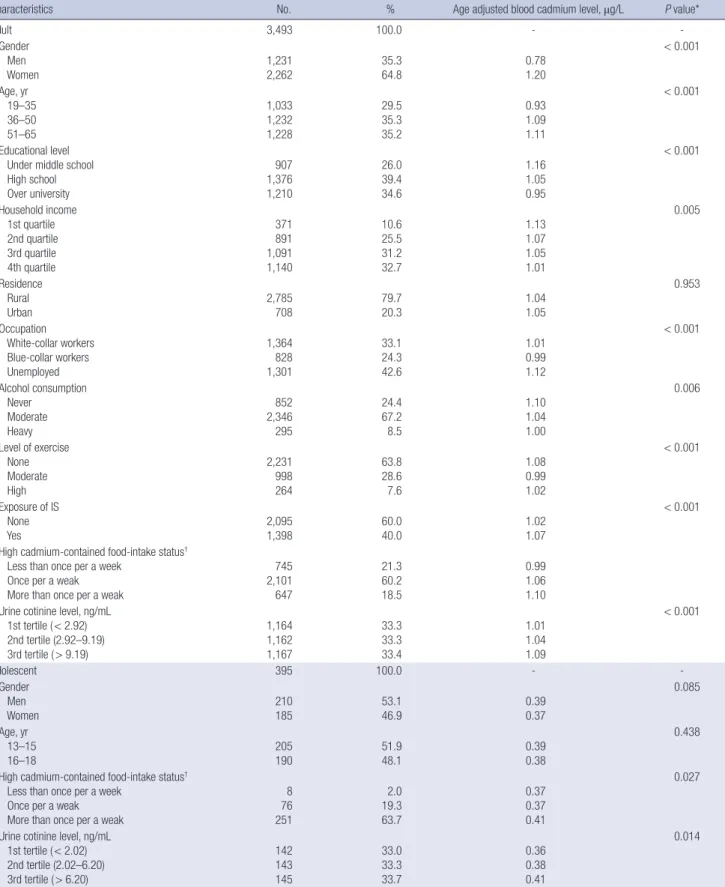
The baseline characteristics and age-adjusted blood cadmium levels of the study population of Korean adults and adolescents are presented in Table 1. There were 1,231 (35.3%) adult men and 2,262 (64.8%) adult women, and 210 (53.1%) adolescent males and 185 (46.9%) adolescent females. In the adults, the wo- men’s age-adjusted blood cadmium level was significantly high- er than the men’s. The age-adjusted blood cadmium concen- tration was highest in the oldest group and in those with a low level of education and household income. Regarding the blood cadmium concentration in the occupational category, it was significantly higher in the unemployed, followed by white-col- lar workers and then blue-collar workers. In the case of alcohol consumption and level of exercise, the ‘never’ alcohol intake and non-exercising groups of participants showed a significant- ly higher level, followed by those with heavy alcohol intake and moderate exercise. No significant differences were found for residence. The blood cadmium level was highest in those ex- posed to IS. It was also highest when there was more intake of high cadmium-contained food per week and when urine coti- nine concentration was higher. Gender and age did not show any significant correlation with blood cadmium level in the ad-
olescent group. However, the same result was found as for the adult group regarding consumption of cadmium-containing food per week and urine cotinine level.
A 3-dimensional scatter graph that shows the fit to the regres- sion model is presented in Fig. 2. There was a significant visual positive correlation of blood cadmium level with age and urine cotinine level in both men and women. In addition, there was a significant difference of the fit to the model between men and women (P < 0.001). The model fit of the blood cadmium level of women had a higher relationship with urine cotinine level and age (blue dots and blue surface) than that of men.
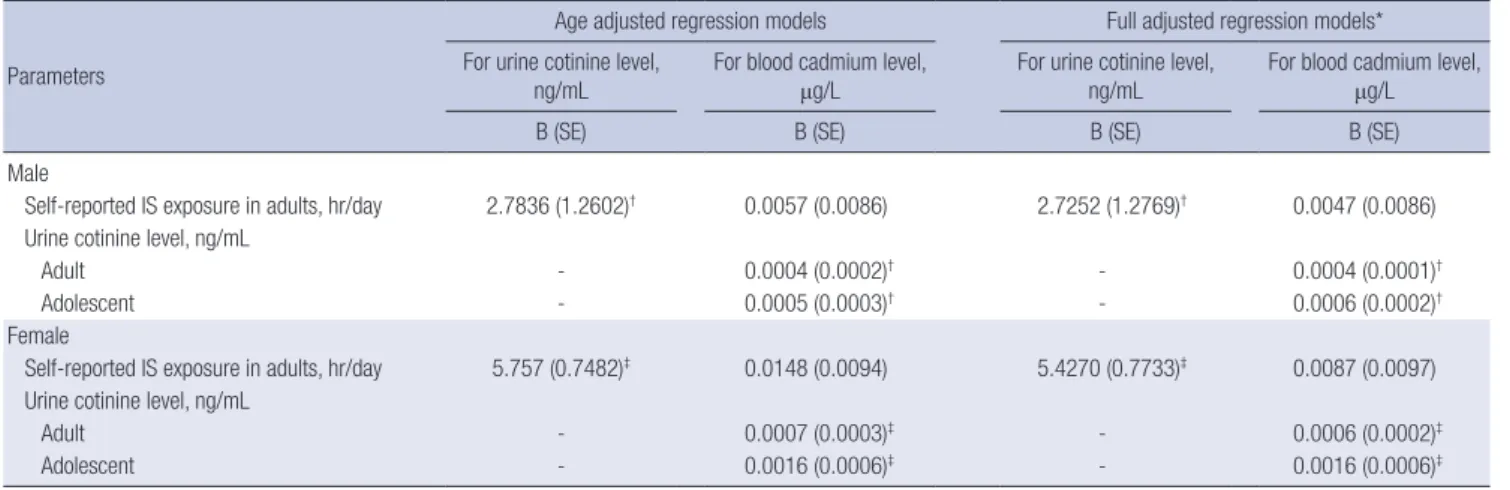
As shown in Table 2, there was no statistically significant as- sociation between blood cadmium levels and the level of expo- sure to IS in both adult men and women. However, IS exposure
Fig. 2. The 3-dimensional scatter graph with fit models for the blood cadmium level related with both age and urine cotinine level according to gender.
Log blood cadmium (μg/L) 2.12
–3.73 –4.71 12 Age (year)
Log urine cotinine (ng/mL) 6.29 Female
Male
65
P < 0.001
Table 2. Results of regression models relating urine cotinine level and blood cadmium level to IS exposure
Parameters
Age adjusted regression models Full adjusted regression models*
For urine cotinine level,
ng/mL For blood cadmium level,
μg/L For urine cotinine level,
ng/mL For blood cadmium level, μg/L
B (SE) B (SE) B (SE) B (SE)
Male
Self-reported IS exposure in adults, hr/day 2.7836 (1.2602)† 0.0057 (0.0086) 2.7252 (1.2769)† 0.0047 (0.0086) Urine cotinine level, ng/mL
Adult - 0.0004 (0.0002)† - 0.0004 (0.0001)†
Adolescent - 0.0005 (0.0003)† - 0.0006 (0.0002)†
Female
Self-reported IS exposure in adults, hr/day 5.757 (0.7482)‡ 0.0148 (0.0094) 5.4270 (0.7733)‡ 0.0087 (0.0097) Urine cotinine level, ng/mL
Adult - 0.0007 (0.0003)‡ - 0.0006 (0.0002)‡
Adolescent - 0.0016 (0.0006)‡ - 0.0016 (0.0006)‡
IS = involuntary smoking, B = effect value, SE = standard error.
*Adjusted for age, sociodemographic factors (educational level, occupation, house hold income, and residence), life style factors (alcohol drinking, level of exercise, and high cadmium-contained food-intake status including seaweed, mushrooms, root vegetables, and shellfish for adult and adjusted for age and high cadmium-contained food-intake status (seaweed, mushrooms, root vegetables, and shellfish) for adolescent; †P value < 0.05; ‡P value < 0.01.
level was significantly related to urine cotinine level in all of re- gression model l. In adults, after controlling for age, socio-de- mographics, lifestyle factors, and high cadmium-contained food intake, each 1 hour per day exposure to IS was associated with 2.7252 (± 1.2769) and 5.4270 (± 0.7733) ng/mL increase in urine cotinine level in men and women respectively. There were still statistically significant linear correlations between blood cad- mium level and urine cotinine level in all strata after full adjust- ment. In adults, the results of fell adjusted model showed that increasing each 1 ng/mL of urine cotinine level did elevate 0.0004 (± 0.0001) and 0.0006 (± 0.0002) μg/L of blood cadmium level in men and women respectively. Furthermore, adolescents also showed a statistically significant positive correlation between urine cotinine level and blood cadmium level; 0.0006 (± 0.0002) in boy and 0.0016 (± 0.0006) in girl.
DISCUSSION
Our nationwide cross-sectional study showed that the relation- ship between urine cotinine level and blood cadmium level was statistically significant. Moreover, this association was not atten- uated even after the adjustment of potential confounders, in- cluding particularly high cadmium-containing food consump- tion status. Such a link was also observed in both genders and even in the adolescents who have susceptibilities to environmen- tal toxicants.
The inequality of exposure level and its health effect among different socioeconomic systems is one of the starting factors of environmental justice. Environmental exposure to smoke in Korea is merely unintentional and merely depends on social systems including smoke-free regulation laws. Furthermore, our study shows the IS exposure related to increment of blood cadmium level in both genders and even in adolescents. Because many advanced societies made rules that severely restricted IS exposure from non-smokers, particularly from vulnerable hu- mans such as adolescents, even public open areas potentially accessible to the general population are defined as smoke-free zones. However, our study reported that non-smokers are ex- posed to IS and those exposures also show potential health ef- fects which are related to blood cadmium. Furthermore, because the blood cadmium level was increased in adolescent non-smok- er women, who are our future, urgent social concern is needed to prevent health effects of IS.
In our study design, we excluded active or current smokers using both a self-reported questionnaire and urine cotinine lev- el. Urine cotinine level can be a biochemical indicator of cur- rent exposure to IS in non-smokers. Cotinine is a key metabo- lite of nicotine, with a half-life of about 20 hours, which can be measured in blood, saliva, hair, and urine, and is therefore a re- liable and useful biochemical marker of current nicotine expo- sure from smoking (26,27). Thus, the observed increase in blood
cadmium level could be attributed to passive exposure to ciga- rette smoke in non-smokers.
Cadmium can be absorbed into the body through multiple routes, including inhalation, ingestion, and directly through the skin. Inhalation is considered the main exposure route in non- smokers. Up to 50 percent of cadmium released from burning cigarettes can enter the body by inhalation (14). The main tar- get organ of inhaled cadmium toxicity is the lung. In the lung, cadmium is efficiently absorbed when inhaled in cigarette smoke by cadmium oxide, which is highly bioactive when generated during the burning of cigarettes (28). Cadmium oxide particles affect the gene expression of several different inflammation in- ducers and trigger pulmonary cell apoptosis even at fairly low concentrations in humans (29). In addition, a previous study indicated that even very short-term inhalation of cadmium ox- ide particles could produce persistent pulmonary cell injury and stimulate pathways in the lungs associated with inflamma- tion, as well as alter systemic immune function (30). These mech- anisms of pulmonary irritation by inhaled cadmium seem to be involved in the development of many lung and systemic diseases.
Recent epidemical evidence has suggested that the cadmium level in the human body is closely related with smoking rate changes. In the United States’ general population, the cadmium level declined markedly over 2 decades (1988–2008), and the smoking rates and changes decreased with a similar trend in the same period, which might importantly have been caused by reducing exposure to tobacco smoke for both smokers and non-smokers (31). In addition, blood cadmium level was usu- ally assessed using whole blood and was considered the most valid marker of recent exposure (32). A previous research indi- cated the possibility of obtaining an actual cigarette addiction information of smokers using cadmium as an indicator (10).
According to our present research, blood cadmium level was significantly related to urine cotinine level in non-smoker groups including both adolescent and adult. Thus, cadmium level in the blood may serve as a good reflection of the body’s burden of IS exposure in the general population (11).
The finding that blood cadmium level was closely associated with urine cotinine from IS exposure offers some important in- sights into the control of smoking for non-smokers. It indicates that the IS exposure level can be checked using urine cotinine, although it is still difficult to know whether it is linked with the severity of IS exposure. Cadmium could be an important indi- cator of the harmfulness of IS to the general non-smoking pop- ulation as smokers’. Although we did not find a statistically sig- nificant direct association between self-reported IS exposure level and blood cadmium level, we can suggest that cadmium level might be useful for understanding, examining, and pre- venting public health concerns about IS through the relation- ship between urine cotinine level and blood cadmium level.
Another important finding was that there were gender and
age group differences in the regression models. Women and adolescents had higher estimates for blood cadmium level ac- cording to urine cotinine level than men and the adult popula- tion in the final regression model. It is possible that these results are due to gender differences of the body burden for cadmium.
Women have a higher cadmium body burden than men from the highly increased absorption of environmental cadmium into the body due to lower iron stores (33). This indicates that women are more vulnerable than men to IS even with the same exposure level. Furthermore, it is a serious public health con- cern because women exposed to IS can develop an unhealthy status not only as individuals but also in the next generation due to an irritated reproductive system from involuntary cigarette smoke exposure (34).
Regarding the biology of adolescence, it is important to pre- vent exposure to IS. The maturation of several whole organ sys- tems including not only the reproductive system but also the skeletomuscular, respiratory, immune, and central nervous sys- tems occurs during this period. Differences in body surface, blood volume level, metabolic needs, and both sensitivity and capacity all contribute to an altered exposure level for toxicity of IS (35).
Furthermore, our study demonstrated that the blood cadmium level by IS of adolescents had higher effect values than that of adults in both genders. As their bodies and minds are develop- ing, adolescents (who are our future) are especially vulnerable to the hazardous effect of IS. Thus, more proactive strategies for preventing IS exposure are needed that focus on women who have a high body burden for IS and adolescents who are vulner- able to the exposure to IS.
These findings may be somewhat limited by the study design.
We adjusted or stratified many possible confounders including age, sociodemographic factors, and lifestyle factors with both gender and age group, which could have an effect on the level of blood cadmium. However, it is uncertain if there was another potential source of cadmium exposure. For example, blood cad- mium level could be affected by working tasks (smelting, plat- ing, and welding) and living area conditions (air and water) (36, 37). Furthermore, we only could investigate blood cadmium linked to IS without urine cadmium level. The blood cadmium level was known to reflect longer-term exposure that accumu- lates in the blood stores over a 10-year period. On the other hand, the urine cadmium level reflects recent exposure. Thus, it is im- portant to bring a clinical implication of IS exposure to non-smo- kers that to measure and to analyze IS exposure level with both urine and blood cadmium level. Unfortunately, these data about occupational characteristics or urine cadmium level were not accessible because of the nature of the KNHANES data. In ad- dition, we used both self-reported IS level and urine cotinine level to evaluate the exposure level to IS. Only urine cotinine level was related to blood cadmium level with statistical signifi- cance. Our current study might be biased due to using the self-
reported questionnaire, which might be misleading regarding the statistical association between blood cadmium level and self-reported IS status. Nevertheless, as we found a significant association between IS and blood cadmium level after adjust- ing for potential confounders as much as possible in all age groups and both genders for the first time, its clinical implications may not be attenuated by these limitations.
The present study makes several noteworthy contributions to the public issues of preventing and understanding IS exposure in general non-smokers (both adults and adolescents) using national representative data with gender stratification for the first time. Greater efforts are needed to improve environmental justices regarding IS, especially women and adolescents, con- sidering the severe harmful effects of involuntary exposure to even a low level of cadmium.
ACKNOWLEDGMENT
The authors would like to thank participants of the Korea Na- tional Health and Nutrition Examination Survey (KNHANES) for the opportunity to this research.
DISCLOSURE
The authors have no potential conflicts of interest to disclose.
AUTHOR CONTRIBUTION
Conceptualization: Lee W, Yoon JH. Investigation: Lee W, Lee S, Roh J. Writing - original draft: Lee W, Lee S, Won JU, Yoon JH.
Writing - review & editing: Lee W, Lee S, Roh J, Won JU, Yoon JH.
ORCID
Wanhyung Lee http://orcid.org/0000-0001-6408-7668 Seunghyun Lee http://orcid.org/0000-0001-7497-4930 Jaehoon Roh http://orcid.org/0000-0003-4228-7209 Jong-Uk Won http://orcid.org/0000-0002-9200-3297 Jin-Ha Yoon http://orcid.org/0000-0003-4198-2955
REFERENCES
1. World Health Organization. Guidelines on protection from exposure to tobacco smoke [Internet]. Available at http://www.who.int/fctc/cop/art%
208%20guidelines_english.pdf [accessed on 1 July 2016].
2. Tyrrell J, Melzer D, Henley W, Galloway TS, Osborne NJ. Associations be- tween socioeconomic status and environmental toxicant concentrations in adults in the USA: NHANES 2001–2010. Environ Int 2013; 59: 328-35.
3. Warren GW, Alberg AJ, Kraft AS, Cummings KM. The 2014 surgeon gen- eral’s report: “The health consequences of smoking--50 years of progress”:
a paradigm shift in cancer care. Cancer 2014; 120: 1914-6.
4. Choi S, Kim Y, Park S, Lee J, Oh K. Trends in cigarette smoking among ad-
olescents and adults in South Korea. Epidemiol Health 2014; 36: e2014023.
5. Yin P, Jiang CQ, Cheng KK, Lam TH, Lam KH, Miller MR, Zhang WS, Tho- mas GN, Adab P. Passive smoking exposure and risk of COPD among adults in China: the Guangzhou Biobank Cohort Study. Lancet 2007; 370: 751-7.
6. Yoon JH, Kim I, Kim HR, Won JU, Bae KJ, Jung PK, Roh J. The association between blood cadmium level and airflow obstruction in Korean men.
Ann Hum Biol 2015; 42: 569-75.
7. Nawrot T, Plusquin M, Hogervorst J, Roels HA, Celis H, Thijs L, Vangrons- veld J, Van Hecke E, Staessen JA. Environmental exposure to cadmium and risk of cancer: a prospective population-based study. Lancet Oncol 2006; 7: 119-26.
8. Peters JL, Perlstein TS, Perry MJ, McNeely E, Weuve J. Cadmium exposure in association with history of stroke and heart failure. Environ Res 2010;
110: 199-206.
9. Thompson J, Bannigan J. Cadmium: toxic effects on the reproductive sys- tem and the embryo. Reprod Toxicol 2008; 25: 304-15.
10. Talio MC, Luconi MO, Masi AN, Fernández LP. Cadmium monitoring in saliva and urine as indicator of smoking addiction. Sci Total Environ 2010;
408: 3125-32.
11. Järup L, Berglund M, Elinder CG, Nordberg G, Vahter M. Health effects of cadmium exposure--a review of the literature and a risk estimate. Scand J Work Environ Health 1998; 24 Suppl 1: 1-51.
12. Brockhaus A, Freier I, Ewers U, Jermann E, Dolgner R. Levels of cadmium and lead in blood in relation to smoking, sex, occupation, and other fac- tors in an adult population of the FRG. Int Arch Occup Environ Health 1983; 52: 167-75.
13. Willers S, Schütz A, Attewell R, Skerfving S. Relation between lead and cad- mium in blood and the involuntary smoking of children. Scand J Work Environ Health 1988; 14: 385-9.
14. Jung SY, Kim S, Lee K, Kim JY, Bae WK, Lee K, Han JS, Kim S. Association between secondhand smoke exposure and blood lead and cadmium con- centration in community dwelling women: the fifth Korea National Health and Nutrition Examination Survey (2010–2012). BMJ Open 2015; 5: e008218.
15. Campo L, Polledri E, Bechtold P, Gatti G, Ranzi A, Lauriola P, Goldoni CA, Bertazzi PA, Fustinoni S. Determinants of active and environmental ex- posure to tobacco smoke and upper reference value of urinary cotinine in not exposed individuals. Environ Res 2016; 148: 154-63.
16. Kweon S, Kim Y, Jang MJ, Kim Y, Kim K, Choi S, Chun C, Khang YH, Oh K.
Data resource profile: the Korea National Health and Nutrition Examina- tion Survey (KNHANES). Int J Epidemiol 2014; 43: 69-77.
17. Zielińska-Danch W, Wardas W, Sobczak A, Szołtysek-Bołdys I. Estimation of urinary cotinine cut-off points distinguishing non-smokers, passive and active smokers. Biomarkers 2007; 12: 484-96.
18. Park JH, Lee CK, Kim KH, Son BC, Kim JH, Suh CH, Kim SY, Yu SD, Kim SJ, Choi WH, et al. Decrease in the urine cotinine concentrations of Kore- an non-smokers between 2009 and 2011 following implementation of stricter smoking regulations. Int J Hyg Environ Health 2016; 219: 123-8.
19. Choi WJ, Han SH. Blood cadmium is associated with osteoporosis in obese males but not in non-obese males: the Korea National Health and Nutri- tion Examination Survey 2008–2011. Int J Environ Res Public Health 2015;
12: 12144-57.
20. Lee BK, Kim Y. Association of blood cadmium with hypertension in the Korean general population: analysis of the 2008–2010 Korean National
Health and Nutrition Examination Survey data. Am J Ind Med 2012; 55:
1060-7.
21. Evans GW, Kantrowitz E. Socioeconomic status and health: the potential role of environmental risk exposure. Annu Rev Public Health 2002; 23:
303-31.
22. Kim NS, Lee BK. National estimates of blood lead, cadmium, and mercu- ry levels in the Korean general adult population. Int Arch Occup Environ Health 2011; 84: 53-63.
23. Son JY, Lee J, Paek D, Lee JT. Blood levels of lead, cadmium, and mercury in the Korean population: results from the second Korean National Hu- man Exposure and Bio-monitoring Examination. Environ Res 2009; 109:
738-44.
24. Figueroa B E. Are more restrictive food cadmium standards justifiable health safety measures or opportunistic barriers to trade? An answer from economics and public health. Sci Total Environ 2008; 389: 1-9.
25. Nie Z, Racine JS. The crs package: nonparametric regression splines for continuous and categorical predictors. R J 2012; 4: 48-56.
26. Benowitz NL, Kuyt F, Jacob P 3rd, Jones RT, Osman AL. Cotinine disposi- tion and effects. Clin Pharmacol Ther 1983; 34: 604-11.
27. DeLorenze GN, Kharrazi M, Kaufman FL, Eskenazi B, Bernert JT. Expo- sure to environmental tobacco smoke in pregnant women: the associa- tion between self-report and serum cotinine. Environ Res 2002; 90: 21-32.
28. Arain MB, Kazi TG, Jamali MK, Jalbani N, Afridi HI, Kandhro GA, Ansari R, Sarfraz RA. Hazardous impact of toxic metals on tobacco leaves grown in contaminated soil by ultrasonic assisted pseudo-digestion: multivari- ate study. J Hazard Mater 2008; 155: 216-24.
29. Låg M, Rodionov D, Ovrevik J, Bakke O, Schwarze PE, Refsnes M. Cadmi- um-induced inflammatory responses in cells relevant for lung toxicity:
expression and release of cytokines in fibroblasts, epithelial cells and mac- rophages. Toxicol Lett 2010; 193: 252-60.
30. Blum JL, Rosenblum LK, Grunig G, Beasley MB, Xiong JQ, Zelikoff JT. Short- term inhalation of cadmium oxide nanoparticles alters pulmonary dy- namics associated with lung injury, inflammation, and repair in a mouse model. Inhal Toxicol 2014; 26: 48-58.
31. Tellez-Plaza M, Navas-Acien A, Caldwell KL, Menke A, Muntner P, Gual- lar E. Reduction in cadmium exposure in the United States population, 1988–2008: the contribution of declining smoking rates. Environ Health Perspect 2012; 120: 204-9.
32. Järup L, Akesson A. Current status of cadmium as an environmental health problem. Toxicol Appl Pharmacol 2009; 238: 201-8.
33. Kippler M, Ekström EC, Lönnerdal B, Goessler W, Akesson A, El Arifeen S, Persson LA, Vahter M. Influence of iron and zinc status on cadmium ac- cumulation in Bangladeshi women. Toxicol Appl Pharmacol 2007; 222:
221-6.
34. Roth LK, Taylor HS. Risks of smoking to reproductive health: assessment of women’s knowledge. Am J Obstet Gynecol 2001; 184: 934-9.
35. Golub MS. Adolescent health and the environment. Environ Health Per- spect 2000; 108: 355-62.
36. Dunphy B. Acute occupational cadmium poisoning. A critical review of the literature. J Occup Med 1967; 9: 22-6.
37. Cai S, Yue L, Shang Q, Nordberg G. Cadmium exposure among residents in an area contaminated by irrigation water in China. Bull World Health Organ 1995; 73: 359-67.