Received April 24, 2018, Revised August 2, 2018, Accepted for publication August 14, 2018
Corresponding author: Young Lip Park, Department of Dermatology, Soonchunhyang University Bucheon Hospital, 170 Jomaru-ro, Wonmi-gu, Bucheon 14584, Korea. Tel: 82-32-621-5062, Fax: 82-32-327-3550, E-mail:
ORCID: https://orcid.org/0000-0002-6532-3156
Si Hyung Lee, Department of Ophthalmology, Soonchunhyang University Bucheon Hospital, 170 Jomaru-ro, Wonmi-gu, Bucheon 14584, Korea. Tel:
82-32-621-5053, Fax: 82-32-327-3550, E-mail: [email protected] ORCID: https://orcid.org/0000-0002-6383-4673
This is an Open Access article distributed under the terms of the Creative Commons Attribution Non-Commercial License (http://creativecommons.
org/licenses/by-nc/4.0) which permits unrestricted non-commercial use, distribution, and reproduction in any medium, provided the original work is properly cited.
Copyright © The Korean Dermatological Association and The Korean Society for Investigative Dermatology
Ann Dermatol Vol. 31, No. 1, 2019 https://doi.org/10.5021/ad.2019.31.1.37
ORIGINAL ARTICLE
Cataract, Glaucoma, and Dry Eye Disease in Adults with Atopic Dermatitis: A Nationwide Cross-Sectional Study from the Republic of Korea
Sul Hee Lee, Sang-Hoon Lee, Si Hyung Lee1, Young Lip Park
Departments of Dermatology and 1Ophthalmology, Soonchunhyang University Bucheon Hospital, Bucheon, Korea
Background: Atopic dermatitis (AD) is an inflammatory skin disorder characterized by relapsing eczema with intractable itching. Ocular diseases in patients with AD, including cata- ract, retinal detachment, blepharitis, glaucoma, kerato- conjunctivitis, and keratoconus, have frequently been re- ported worldwide. However, only a few studies using a large-sample, population-based study design have been re- ported so far. Objective: We investigated the association be- tween cataract, glaucoma, and dry eye disease and AD in an adult population in the Republic of Korea. Methods: A total of 14,900 adults who participated in the Korean National Health and Nutrition Examination Survey, a nationwide, population-based, cross-sectional survey, between 2010 and 2012 were included in the study. Multiple logistic re- gression analyses identified the possible association be- tween cataract, glaucoma, and dry eye disease and AD rela- tive to matched controls. Results: After we adjusted for con- founding factors in patients with AD, cataract and glaucoma were significantly associated with AD. Moreover, patients
with AD had a higher prevalence of ophthalmic surgery com- pared to those without AD. Conclusion: Dermatologists should therefore be aware of possible ocular disorders in pa- tients with AD and should recommend regular ophthalmic screening for early detection. (Ann Dermatol 31(1) 37∼43, 2019)
-Keywords-
Atopic dermatitis, Cataract, Glaucoma, Dry eye disease
INTRODUCTION
Atopic dermatitis (AD) is an inflammatory skin disorder characterized by relapsing eczema with intractable itch- ing1. Besides well-known allergic conditions, including asthma, allergic rhinitis, and allergic conjunctivitis, many other comorbidities have recently been associated with AD2. Ocular disorders in patients with AD have been widely acknowledged and frequently reported worldwide.
Specifically, cataract, retinal detachment, blepharitis, glau- coma, keratoconjunctivitis, and keratoconus are asso- ciated with AD3-6. However, the ocular disorders of AD patients are not of primary concern to most dermatolo- gists, particularly if patients do not complain of associated symptoms. If left untreated, cataract and glaucoma in AD patients may progress to the advanced stages, resulting in irreversible vision loss.
To the best of our knowledge, only a few studies have used a large-sample, population-based study design to in- vestigate possible relationships between AD and ocular disease. The aim of the present study was therefore to use a population-based design to determine whether cataract, glaucoma, and dry eye disease are associated with AD in
an adult Korean population.
MATERIALS AND METHODS
Study population
This study was based on data from the 2010∼2012 Korean National Health and Nutrition Examination Survey (KNHANES), a cross-sectional, population-based health examination and survey conducted by the Korea Centers for Disease Control and Prevention with Institutional Review Board approval7. The survey used multistage, stratified, probability cluster sampling to produce esti- mated health statistics representative of the non- institutionalized civilian population of the Republic of Korea. The survey consisted of four components: a health-related interview, a health behavior survey, a health examination, and a nutrition survey. The interview included questions on demographics, socioeconomics, health, and nutrition. The health examination included vi- tal signs, physiological measurements, and basic labo- ratory tests. We included subjects as AD patients who an- swered “yes” to the following question: “Have you ever been diagnosed as atopic dermatitis by doctor?.” This study adhered to the tenets of the Declaration of Helsinki for biomedical research involving human subjects.
Approval for this study was obtained from the institutional review board/Ethics Committee of Soonchunhyang University Bucheon Hospital (approval number SCHBC 2017-12-014).
Ophthalmic examinations and surveys
Participants underwent ophthalmic interviews, visual acui- ty measurements, intraocular pressure (IOP) measure- ments, autorefraction, slit-lamp examination, and fundus photography for their ophthalmic examinations. A past history of ophthalmic surgery and a family history of any ophthalmic disease were obtained from the interviews.
The presence of dry eye disease was determined by fol- lowing question: “Have you ever been diagnosed with dry eye disease by a doctor?” Available responses were “yes”
or “no”. If a participant answered “yes,” he or she was classified as having clinical diagnosis of dry eye disease. A slit-lamp examination was performed to detect anterior segment abnormalities, evaluate the status of cataracts, and measure anterior chamber depth using the Van Herick method. The standard Lens Opacities Classification System (LOCS) III was used to categorize the type of cataract. Through a comparison with standard photo- graphs, cataracts were categorized as cortical (LOCS III score ≥2), nuclear (LOCS III score ≥4 for nuclear opa- lescence or nuclear color), posterior subcapsular (PSC;
LOCS III score ≥2), or mixed (more than one type of cata- ract per eye). The spherical equivalent was calculated as the sphere +1/2 cylinder. The IOP was measured once per eye from right to left with a Goldmann applanation tonometer (BQ-900; Haag-Streit, Bern, Switzerland) by a trained ophthalmologist. A digital non-mydriatic retina camera (TRC-NW6S; Topcon, Tokyo, Japan) and a Nikon D-80 digital camera (Nikon, Tokyo, Japan) were used to obtain digital fundus images under physiological mydriasis. Horizontal and vertical cup-to-disc ratios were measured from the fundus images, and features of diabetic retinopathy or age-related macular degeneration were checked.
A visual field test with frequency double technology was performed on participants with suspected glaucomatous features of the optic disc or an elevated IOP (≥22 mmHg). Suspected glaucomatous features of the optic disc included (1) a horizontal or vertical cup to disc ratio (VCDR) ≥0.5, (2) presence of optic disc hemorrhage, (3) presence of retinal nerve fiber layer defects, or (4) viola- tion of the ISNT rule (i.e., normal eyes had a neuroretinal rim thickness configuration as follows: inferior>superior>
nasal>temporal). Open-angle glaucoma was diagnosed using modified International Society of Geographical and Epidemiological Ophthalmology criteria for the Korean population. The specific diagnostic criteria were as fol- lows: category 1 required both (1) a reliable visual field defect consistent with glaucoma (a fixation error and false-positive error ≤1 and the presence of at least two lo- cations of reduced sensitivity) and (2) glaucomatous optic disc (neuroretinal rim loss with a VCDR or horizontal cup-to-disc ratio ≥0.6, presence of optic disc hemor- rhage, presence of retinal nerve fiber layer defects, or asymmetry of the VCDR ≥0.2); category 2, if a visual field test was not available or was unreliable (a fixation er- ror or false-positive error ≥2), required a VCDR ≥0.9, asymmetry of the VCDR ≥0.3, or presence of retinal nerve fiber layer defects and violation of the ISNT rule;
category 3 required visual acuity ≤3/60 and IOP >21 mmHg. Subjects with a shallow anterior chamber (a pe- ripheral anterior chamber depth less than or equal to one fourth of the central corneal thickness, indicating an- gle-closure glaucoma) were excluded.
Other covariates
Demographic and socioeconomic variables, including age, sex, urban or rural residence, income, and education level, were obtained from a health interview. Age was classified into 10-year intervals, income was stratified into quartiles, and education was categorized as elementary school or lower, middle school graduate, high school
graduate and college graduate or higher. Regarding the re- gion of residence, the 16 districts of the Republic of Korea were divided into two groups: (1) urban regions: Seoul, Gyeonggi, Busan, Daegu, Incheon, Gwangju, Daejeoun, and Ulsan; and (2) rural regions: Gangwon, Chungbuk, Chungnam, Jeonnam, Jeonbuk, Gyeongbuk, Gyeongnam, and Jeju. Occupation was classified into three groups: (1) white collar, comprising managers, professionals, clerical support workers, and service and sales workers; (2) blue collar, including agriculture, forestry, fishery, craft, and re- lated trade workers; plant and machine operators and as- semblers; and simple laborers; and (3) no occupation, in- cluding unemployed people, retired people, students, and homemakers. Body mass index (BMI) was calculated as follows: weight (kg)/height (m2). Smoking status was cate- gorized as smoker, ex-smoker, or nonsmoker. Drinking habits were classified according to drinking frequency as following: none, ocassional (less than 2 times per week), and frequent (more than 2 times per week).
Systolic and diastolic blood pressure (BP) were measured three times using a standard mercury sphygmomanometer (Baumanometer; WA Baum, Copiague, NY, USA) in a seated position, and the mean values for systolic and dia- stolic BP were recorded. Subjects were defined as having hypertension if they had a history of taking anti- hypertensive medications or had a BP ≥140/90 mmHg.
Participants who had been diagnosed with diabetes by physicians or had a fasting glucose level ≥126 mg/dl were defined as having diabetes mellitus, and hyper- cholesterolemia was defined as having a fasting total cho- lesterol level ≥240 mg/dl or taking oral lipid-lowering agents.
Statistical analysis
Statistical analyses were performed using SAS for Windows, version 9.3 (SAS Institute, Cary, NC, USA). The PROC SURVEY procedure with sample weights was used to account for a complex sampling design and to produce nationally representative prevalence estimates. We pre- sented the demographic characteristics of the participants according to the presence of glaucoma as either means±
standard errors (SEs) or proportions and compared them between groups using the Rao–Scott chi-square test. We performed 4-to-1 matching by adjusting age and sex.
Multiple logistic regression analyses were conducted to determine the associations between AD and various ocu- lar disorders. An adjusted model was developed that in- cluded occupation and region as potential confounders.
Odds ratios (ORs) and 95% confidence intervals (CIs) were also calculated. In all analyses, a two-tailed p<0.05 was considered statistically significant.
RESULTS
Of 25,534 participants in the 2010∼2012 KNHANES, 10,634 were excluded for the following reasons: <19 years of age (n=5,935), missing values for sample weights (n=3,212), and no responders for questions for AD (n=531), dry eye disease (n=712), cataract (n=53), or glaucoma (n=191). Ultimately 14,900 participants were included in the statistical analyses: 14,598 non-AD sub- jects and 302 subjects with AD.
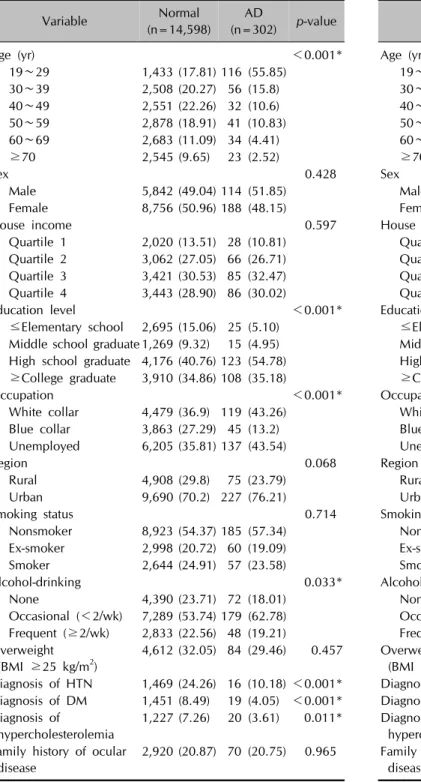
Demographic characteristics of the participants are shown in Table 1. Participants with AD were significantly young- er (p<0.001); were more highly educated (p<0.001);
were less frequent drinkers (p=0.033); and had a lower prevalence of hypertension (p<0.001), diabetes mellitus (p<0.001), and hypercholesterolemia (p=0.011) compared to the non-AD group. Significant difference in occupation was observed between non-AD and AD groups (p<
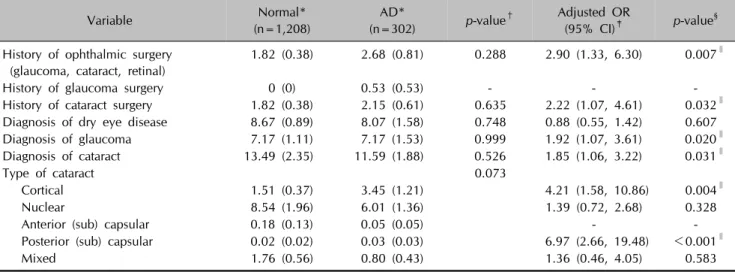
0.001). After we performed 4-to-1 matching by adjusting age and sex (Table 2), the difference in occupation re- mained significant between non-AD and AD groups (p=0.006) and AD participants were more likely to live in urban areas (p<0.001). The prevalence and adjusted odd ratios for ocular diseases including dry eye disease, glau- coma, and cataract, and history of ocular surgery in matched participants are shown in Table 3. There were no significant differences between non-AD and AD groups in the prevalence of ocular disease or history of ophthalmic surgery. Multiple logistic regression analyses were per- formed to identify associations between AD and ocular disease. After we adjusted for potential confounding fac- tors, a history of ophthalmic surgery (OR, 2.90; 95% CI, 1.33∼6.30; p=0.007), a history of cataract surgery (OR, 2.22; 95% CI, 1.07∼4.61; p=0.032), a diagnosis of glau- coma (OR, 1.92; 95% CI, 1.11∼3.32; p=0.020), and a diagnosis of cataract (OR, 1.85; 95% CI, 1.06∼3.22;
p=0.031) were significantly associated with AD. Of the five subtypes of cataracts, the cortical type (OR, 4.21;
95% CI, 1.58∼10.86; p=0.004) and posterior sub- capsular type (OR, 6.97; 95% CI, 2.66∼19.48; p<0.001) were significantly associated with AD.
DISCUSSION
Various ocular diseases are associated with AD, including cataract, retinal detachment, blepharitis, glaucoma, kerato- conjunctivitis, and keratoconus4. This study characterized the possible association between AD and cataract, glauco- ma, and dry eye disease in the adult population of the Republic of Korea using data obtained from the KNHANES. The prevalences of dry eye disease, glaucoma,
Table 1. Baseline characteristics according to atopic dermatitis in Korean adults
Variable Normal
(n=14,598)
AD
(n=302) p-value
Age (yr) <0.001*
19∼29 1,433 (17.81) 116 (55.85)
30∼39 2,508 (20.27) 56 (15.8)
40∼49 2,551 (22.26) 32 (10.6)
50∼59 2,878 (18.91) 41 (10.83)
60∼69 2,683 (11.09) 34 (4.41)
≥70 2,545 (9.65) 23 (2.52)
Sex 0.428
Male 5,842 (49.04) 114 (51.85)
Female 8,756 (50.96) 188 (48.15)
House income 0.597
Quartile 1 2,020 (13.51) 28 (10.81) Quartile 2 3,062 (27.05) 66 (26.71) Quartile 3 3,421 (30.53) 85 (32.47) Quartile 4 3,443 (28.90) 86 (30.02)
Education level <0.001*
≤Elementary school 2,695 (15.06) 25 (5.10) Middle school graduate 1,269 (9.32) 15 (4.95) High school graduate 4,176 (40.76) 123 (54.78)
≥College graduate 3,910 (34.86) 108 (35.18)
Occupation <0.001*
White collar 4,479 (36.9) 119 (43.26) Blue collar 3,863 (27.29) 45 (13.2) Unemployed 6,205 (35.81) 137 (43.54)
Region 0.068
Rural 4,908 (29.8) 75 (23.79)
Urban 9,690 (70.2) 227 (76.21)
Smoking status 0.714
Nonsmoker 8,923 (54.37) 185 (57.34) Ex-smoker 2,998 (20.72) 60 (19.09) Smoker 2,644 (24.91) 57 (23.58)
Alcohol-drinking 0.033*
None 4,390 (23.71) 72 (18.01)
Occasional (<2/wk) 7,289 (53.74) 179 (62.78) Frequent (≥2/wk) 2,833 (22.56) 48 (19.21) Overweight
(BMI ≥25 kg/m2)
4,612 (32.05) 84 (29.46) 0.457
Diagnosis of HTN 1,469 (24.26) 16 (10.18) <0.001*
Diagnosis of DM 1,451 (8.49) 19 (4.05) <0.001*
Diagnosis of hypercholesterolemia
1,227 (7.26) 20 (3.61) 0.011*
Family history of ocular disease
2,920 (20.87) 70 (20.75) 0.965
Data are presented as numbers (weighted percentage). Numbers may not sum to 14,900 because of missing values in the database. AD: atopic dermatitis, BMI: body mass index, HTN:
hypertension, DM: diabetes mellitus. p-values were calculated using the Rao–Scott chi-square test, and those in asterisks (*) are statistically significant.
Table 2. Baseline characteristics according to atopic dermatitis in Korean adults after matching for age and sex
Variable Normal
(n=1,208)
AD
(n=302) p-value
Age (yr) 0.993
19∼29 461 (54.52) 116 (55.85)
30∼39 227 (16.63) 56 (15.8)
40∼49 129 (10.83) 32 (10.6)
50∼59 165 (10.14) 41 (10.83)
60∼69 128 (4.71) 34 (4.41)
≥70 98 (3.17) 23 (2.52)
Sex 0.522
Male 448 (49.35) 114 (51.85)
Female 760 (50.65) 188 (48.15)
House income 0.759
Quartile 1 138 (11.52) 32 (10.81) Quartile 2 324 (27.13) 78 (26.71) Quartile 3 383 (31.85) 97 (32.47)
Quartile 4 353 (29.32) 89 (30.02)
Education level 0.529
≤Elementary school 121 (6.34) 24 (5.10) Middle school graduate 117 (6.12) 23 (4.95) High school graduate 572 (52.53) 152 (54.78) ≥College graduate 362 (33.25) 98 (35.18)
Occupation 0.006*
White collar 451 (40.15) 119 (43.26) Blue collar 301 (23.76) 45 (13.2) Unemployed 455 (36.08) 137 (43.54)
Region <0.001*
Rural 819 (54.42) 75 (23.79)
Urban 389 (45.58) 227 (76.21)
Smoking status 0.167
Nonsmoker 805 (60.1) 185 (57.34)
Ex-smoker 171 (13.61) 60 (19.09)
Smoker 229 (26.29) 57 (23.58)
Alcohol-drinking 0.908
None 285 (16.66) 72 (18.01)
Occasional (<2/wk) 720 (63.73) 179 (62.78) Frequent (≥2/wk) 199 (19.6) 48 (19.21) Overweight
(BMI ≥25 kg/m2)
354 (28.94) 84 (29.46) 0.891
Diagnosis of HTN 170 (8.89) 42 (6.35) 0.143 Diagnosis of DM 61 (3.09) 15 (2.21) 0.344 Diagnosis of
hypercholesterolemia
75 (3.53) 29 (5.12) 0.247
Family history of ocular disease
281 (22.04) 70 (20.75) 0.674
Data are presented as numbers (weighted percentage). Numbers may not sum to 1,510 because of missing values in the database.
AD: atopic dermatitis, BMI: body mass index, HTN: hyperten- sion, DM: diabetes mellitus. p-values were calculated using the Rao–Scott chi-square test, and those in asterisks (*) are statistically significant.
Table 3. Prevalence and adjusted odds ratios for ocular diseases according to atopic dermatitis in Korean adults after matching for age and sex
Variable Normal*
(n=1,208)
AD*
(n=302) p-value† Adjusted OR
(95% CI)‡ p-value§ History of ophthalmic surgery
(glaucoma, cataract, retinal)
1.82 (0.38) 2.68 (0.81) 0.288 2.90 (1.33, 6.30) 0.007∥
History of glaucoma surgery 0 (0) 0.53 (0.53) - - -
History of cataract surgery 1.82 (0.38) 2.15 (0.61) 0.635 2.22 (1.07, 4.61) 0.032∥ Diagnosis of dry eye disease 8.67 (0.89) 8.07 (1.58) 0.748 0.88 (0.55, 1.42) 0.607 Diagnosis of glaucoma 7.17 (1.11) 7.17 (1.53) 0.999 1.92 (1.07, 3.61) 0.020∥ Diagnosis of cataract 13.49 (2.35) 11.59 (1.88) 0.526 1.85 (1.06, 3.22) 0.031∥
Type of cataract 0.073
Cortical 1.51 (0.37) 3.45 (1.21) 4.21 (1.58, 10.86) 0.004∥
Nuclear 8.54 (1.96) 6.01 (1.36) 1.39 (0.72, 2.68) 0.328
Anterior (sub) capsular 0.18 (0.13) 0.05 (0.05) - -
Posterior (sub) capsular 0.02 (0.02) 0.03 (0.03) 6.97 (2.66, 19.48) <0.001∥
Mixed 1.76 (0.56) 0.80 (0.43) 1.36 (0.46, 4.05) 0.583
AD: atopic dermatitis, OR: odds ratio, CI: confidence interval. *Percentages (standard errors) are calculated based on weighted data to better represent the study population. †p-values were calculated using the Rao–Scott chi-square test. ‡Adjusted for occupation and region. §p-values for adjusted odds ratios. ∥Significant p-values.
and cataract in adults with AD were estimated to be 8.07%, 7.17%, and 11.59%, respectively in this study.
After we adjusted for confounding factors, we found that patients with AD had a higher prevalence of ophthalmic surgery, in particular cataract surgery, compared to the normal control group. Patients with AD had a greater like- lihood of having been diagnosed with glaucoma and cata- ract compared to non-AD subjects. Of the five subtypes of cataracts, cortical and posterior subcapsular cataracts were significantly associated with AD. However, an association between dry eye disease and AD was not found.
Cataract is one of the most well-known ocular complica- tions of AD. Because there are not many well-organized studies, the exact prevalence of cataract in patients with AD is currently unknown, but it varies from 1% to 38%6,8,9. In our study, it was estimated to be 11.59%, which is consistent with previous studies. The patho- genesis of cataract in AD is not definitively known. There may be multiple causes, including direct trauma, in- flammatory processes associated with AD, and long-term use of corticosteroids9-12. Oxidative stress in AD patients has also frequently been suggested as a main contributing factor to developing cataracts9. A higher level of serum lip- id peroxide produced from unsaturated fatty acids and a lower level of superoxide dismutase were observed in AD patients with cataracts compared to AD patients without cataracts9,13, irrespective of previous topical corticosteroid treatments13. Decreased activity by superoxide dismutase, which scavenges reactive oxygen species (ROS) and in- hibits the formation of free radicals, has been reported in
AD patients with cataracts9,13. Elevated serum IgE levels and genetic factors associated with AD may also be asso- ciated with the formation of cataracts14.
Among the many subtypes of cataracts, subcapsular cata- racts have typically been reported as being associated with AD. Although the anterior subscapular cataract (ASC) is more specifically related to AD, the PSC is more com- mon in AD patients3,12,15. In our study, AD was associated with PSCs, consistent with previous studies. However, an association with ASCs could not be determined because the prevalence of ASC was very low. The reason for the low prevalence of both ASC and PSC in this study is prob- ably the large number of patients undergoing early cata- ract surgery for these two cataract subtypes, because the location of lens opacification is relatively central to the visual axis and thus may impair visual acuity more severely. The significant association between AD and cat- aract surgery found in this study is consistent with this hypothesis.
The exact pathogenesis of the ASC is still not known.
However, the ASC is neither an age-related nor steroid-in- duced cataract16. It is probably closely related to AD be- cause AD has been suggested as the most common cause of the ASC3,12,15. The ASC tends to develop in early child- hood16, and repeated physical trauma due to rubbing and scratching the eyes plays an important role9. Steroid treat- ment is the most well-known factor contributing to the for- mation of the PSC3,6,9,17,18. This treatment disturbs the nor- mal metabolism of ocular cells, resulting in osmotic fail- ure, thus making lens proteins more vulnerable to oxida-
tive stress18. Because AD is a chronic inflammatory skin disorder that often requires long-term corticosteroid use, the association between PSC and AD seems reasonable.
However, another study reported no differences in the in- cidence of cataracts between corticosteroid-naive AD pa- tients and AD patients with a history of corticosteroid use, which suggests that the PSC in patients with AD cannot be fully explained by the use of corticosteroids alone13. Our study showed that cortical cataracts were also asso- ciated with AD. Known risk factors for cortical cataracts include age, female sex, genetic factors, diabetes mellitus, and ultraviolet B light (UVB)10. In our study, the associa- tion between AD and the cortical cataract subtype was present even after we adjusted for age, sex, and diabetes mellitus, which suggests that other factors may have influ- enced the formation of cortical cataracts. Among these risk factors, the relationship between UVB and cataract has fre- quently been suggested10,19,20. Patients with AD may have a greater chance of being exposed to narrowband UVB, because narrowband UVB is widely used in chronic AD treatment. Having unprotected eyes during therapy may increase the risk of UVB exposure among AD patients9. The relationship between AD and glaucoma has often been reported since Harris21 first suggested glaucoma as an adverse effect of glucocorticoid treatment in 1960.
Although a recent study from Denmark reported no rela- tionship between glaucoma and AD4, many studies have reported a positive association between glaucoma and AD, which is consistent with the results of our study.
Steroid administration has frequently been suggested as the single most important cause of the development of glaucoma in patients with AD. The elevated IOP induced by the use of corticosteroids may cause optic nerve dam- age, resulting in glaucoma3,22. Recently, an increased in- flammatory response in AD was suggested as another pos- sible factor contributing to the development of glaucoma in AD patients. The study reported that inflammatory cyto- kines such as IL-8 and CCL2 were increased in glaucoma patients with AD22.
Dry eye disease has been suggested as a related symptom of atopic keratoconjunctivitis (AKC), which is a severe oc- ular complication in AD patients5,23. Abnormal tear func- tioning, including meibomian gland dysfunction and de- creased tear film break-up time, have been suggested as the main pathogenic mechanisms involved in developing irritation and dry eye in patients with AKC5,23. Goblet cell loss and conjunctival squamous metaplasia may also con- tribute to lacrimal film instability in patients with AKC5. However, whether dry eye syndrome can develop in- dependently from AKC in patients with AD has not been definitively established, and further studies are needed to
confirm this relationship. The results of the present study showed no significant association between AD and a diag- nosis of dry eye disease by clinicians. One possible reason for this is that the diagnosis of dry eye disease was based on self-report questionnaires; most of the participants with AD may have had a doctor’s diagnosis of AKC but not a specific diagnosis of dry eye disease.
The present study has some limitations. First, given the cross-sectional nature of the study, causal relationships be- tween AD and the ocular diseases cannot be definitively established. Second, because the KNHANES is based on self-reported data, there was the potential for incorrect classifications by the participants. Third, although we in- cluded several potential confounders, unidentified factors may have contributed to these associations. Fourth, the route of administration, dose, frequency, and duration of corticosteroid treatments are important factors in the pathogenesis of cataract and glaucoma in AD patients24-26, but these data were not provided by KNHANES.
Nonetheless, a strength of the present study is that it used data from a nationwide survey that included a large pop- ulation, which minimizes selection bias. In addition, be- cause few population-based studies have investigated pos- sible associations between ocular disease and AD world- wide, our study may help to confirm and expand previous findings of associations between cataract and glaucoma in patients with AD.
In summary, this is the first study to comprehensively in- vestigate the associations between AD and selected ocular disorders in the Republic of Korea. The results showed that cataract and glaucoma were significantly associated with AD in adult patients. Furthermore, there was a sig- nificantly higher prevalence of ophthalmic surgery among AD patients than non-AD patients, which implies that ocu- lar diseases occurring in patients with AD require more frequent surgical interventions. Dermatologists should therefore be aware of ocular manifestations in patients with AD and should recommend regular screening of these patients for the early detection of ocular disorders.
ACKNOWLEDGMENT
This work was supported by the National Research Foundation of Korea (NRF) grant funded by the Korea Government (Ministry of Education) (No. 2017R1D1A1B0 3029944) and by the Soonchunhyang University Research Fund.
CONFLICTS OF INTEREST
The authors have nothing to disclose.
ORCID
Sul Hee Lee, https://orcid.org/0000-0002-2990-9774 Sang-Hoon Lee, https://orcid.org/0000-0002-7146-3702 Si Hyung Lee, https://orcid.org/0000-0002-6383-4673 Young Lip Park, https://orcid.org/0000-0002-6532-3156
REFERENCES
1. Weidinger S, Novak N. Atopic dermatitis. Lancet 2016;387:
1109-1122.
2. Brunner PM, Silverberg JI, Guttman-Yassky E, Paller AS, Kabashima K, Amagai M, et al. Increasing comorbidities suggest that atopic dermatitis is a systemic disorder. J Invest Dermatol 2017;137:18-25.
3. Bercovitch L. Screening for ocular complications in atopic dermatitis. Arch Dermatol 2011;147:588-589.
4. Thyssen JP, Toft PB, Halling-Overgaard AS, Gislason GH, Skov L, Egeberg A. Incidence, prevalence, and risk of selected ocular disease in adults with atopic dermatitis. J Am Acad Dermatol 2017;77:280-286.e1.
5. Chen JJ, Applebaum DS, Sun GS, Pflugfelder SC. Atopic keratoconjunctivitis: a review. J Am Acad Dermatol 2014;
70:569-575.
6. Haeck IM, Rouwen TJ, Timmer-de Mik L, de Bruin-Weller MS, Bruijnzeel-Koomen CA. Topical corticosteroids in atopic dermatitis and the risk of glaucoma and cataracts. J Am Acad Dermatol 2011;64:275-281.
7. Kweon S, Kim Y, Jang MJ, Kim Y, Kim K, Choi S, et al. Data resource profile: the Korea National Health and Nutrition Examination Survey (KNHANES). Int J Epidemiol 2014;43:
69-77.
8. Chen CC, Huang JL, Yang KD, Chen HJ. Atopic cataracts in a child with atopic dermatitis: a case report and review of the literature. Asian Pac J Allergy Immunol 2000;18:69-71.
9. Bair B, Dodd J, Heidelberg K, Krach K. Cataracts in atopic dermatitis: a case presentation and review of the literature.
Arch Dermatol 2011;147:585-588.
10. Asbell PA, Dualan I, Mindel J, Brocks D, Ahmad M, Epstein S. Age-related cataract. Lancet 2005;365:599-609.
11. Skalka HW, Prchal JT. Effect of corticosteroids on cataract
formation. Arch Ophthalmol 1980;98:1773-1777.
12. Castrow FF 2nd. Atopic cataracts versus steroid cataracts. J Am Acad Dermatol 1981;5:64-66.
13. Niwa Y, Iizawa O. Abnormalities in serum lipids and leukocyte superoxide dismutase and associated cataract formation in patients with atopic dermatitis. Arch Dermatol 1994;130:1387-1392.
14. Bielory B, Bielory L. Atopic dermatitis and keratoconjunctivitis.
Immunol Allergy Clin North Am 2010;30:323-336.
15. Amemiya T, Matsuda H, Uehara M. Ocular findings in atopic dermatitis with special reference to the clinical features of atopic cataract. Ophthalmologica 1980;180:129-132.
16. Na KS, Park YG, Han K, Mok JW, Joo CK. Prevalence of and risk factors for age-related and anterior polar cataracts in a Korean population. PLoS One 2014;9:e96461.
17. Daniel BS, Orchard D. Ocular side-effects of topical corticosteroids: what a dermatologist needs to know.
Australas J Dermatol 2015;56:164-169.
18. Jobling AI, Augusteyn RC. What causes steroid cataracts? A review of steroid-induced posterior subcapsular cataracts.
Clin Exp Optom 2002;85:61-75.
19. Hollows F, Moran D. Cataract--the ultraviolet risk factor.
Lancet 1981;2:1249-1250.
20. Hightower KR. A review of the evidence that ultraviolet irradiation is a risk factor in cataractogenesis. Doc Ophthalmol 1994;88:205-220.
21. Harris JL. Glaucoma associated with steroid therapy and atopic dermatitis. Am J Ophthalmol 1960;49:351-353.
22. Takakuwa K, Hamanaka T, Mori K, Chin S, Shinmei Y, Funaki T, et al. Atopic glaucoma: clinical and pathophysiol- ogical analysis. J Glaucoma 2015;24:662-668.
23. Dogru M, Nakagawa N, Tetsumoto K, Katakami C, Yamamoto M. Ocular surface disease in atopic dermatitis. Jpn J Ophthalmol 1999;43:53-57.
24. Butcher JM, Austin M, McGalliard J, Bourke RD. Bilateral cataracts and glaucoma induced by long term use of steroid eye drops. BMJ 1994;309:43.
25. Garbe E, LeLorier J, Boivin JF, Suissa S. Risk of ocular hypertension or open-angle glaucoma in elderly patients on oral glucocorticoids. Lancet 1997;350:979-982.
26. Kersey JP, Broadway DC. Corticosteroid-induced glaucoma:
a review of the literature. Eye (Lond) 2006;20:407-416.