© 2014 The Korean Academy of Medical Sciences.
This is an Open Access article distributed under the terms of the Creative Commons Attribution Non-Commercial License (http://creativecommons.org/licenses/by-nc/3.0) which permits unrestricted non-commercial use, distribution, and reproduction in any medium, provided the original work is properly cited.
pISSN 1011-8934 eISSN 1598-6357
Susceptibility of Escherichia coli from Community-Acquired Urinary Tract Infection to Fosfomycin, Nitrofurantoin, and Temocillin in Korea
With increase of multi-drug resistant Escherichia coli in community-acquired urinary tract infections (CA-UTI), other treatment option with a therapeutic efficacy and a low antibiotic selective pressure is necessary. In this study, we evaluated in vitro susceptibility of E. coli isolates from CA-UTI to fosfomycin (FM), nitrofurantoin (NI), temocillin (TMO) as well as trimethoprim-sulfamethoxazole (SMX), ciprofloxacin (CIP) and cefepime (FEP). The minimal inhibitory concentrations were determined by E-test or agar dilution method according to the Clinical and Laboratory Standards Institute guidelines, using 346 E. coli collected in 12 Korean hospitals from March 2010 to February 2011. FM, NI and TMO showed an excellent susceptibility profile; FM 100% (346/346), TMO 96.8% (335/346), and NI 99.4% (344/346). Conversely, resistance rates of CIP and SMX were 22% (76/346) and 29.2% (101/349), respectively. FEP still retained an activity of 98.5%. In Korea, NI and TMO in addition to FM are a good therapeutic option for uncomplicated CA-UTI, especially for lower UTI.
Keywords: Community-Acquired Infections; Urinary Tract; Escherichia coli; Fosfomycin;
Nitrofurantoin; Temocillin; Trimethoprim-Sulfamethoxazole combination; Ciprofloxacin;
Cefepime; Minimal Inhibitory Concentration Mi-Ran Seo,1* Seong-Jong Kim,1*
Yeonjae Kim,1 Jieun Kim,1 Tae Yeal Choi,2 Jung Oak Kang,3 Seong-Heon Wie,4 Moran Ki,5 Young Kyun Cho,6 Seung-Kwan Lim,7 Jin Seo Lee,8 Ki Tae Kwon,9 Hyuck Lee,10 Hee Jin Cheong,11 Dae Won Park,12 Seong Yeol Ryu,13 Moon-Hyun Chung,14 and Hyunjoo Pai1
1Division of Infectious Diseases, Department of Internal Medicine, Hanyang University, Seoul;
2Department of Laboratory Medicine, Hanyang University, Seoul; 3Department of Clinical Microbiology, Hanyang University, Guri;
4Department of Internal Medicine, St. Vincent’s Hospital, School of Medicine, The Catholic University of Korea, Seoul; 5Department of Preventive Medicine, Eulji University School of Medicine, Daejeon; 6Department of Internal Medicine, Gil Hospital, Gacheon University, Incheon;
7Department of Internal Medicine, Ajou University Hospital, Suwon; 8Department of Internal Medicine, Hallym University, Kangdong Sacred Heart Hospital, Seoul; 9Department of Internal Medicine, Daegu Patima Hospital, Daegu; 10Department of Internal Medicine, Dong-A University Hospital, Busan;
11Department of Internal Medicine, Korea University Guro Hospital, Seoul; 12Department of Internal Medicine, Korea University Ansan Hospital, Ansan;
13Department of Internal Medicine, Keimyung University Dongsan Medical Center, Daegu;
14Department of Internal Medicine, Inha University Hospital, Incheon, Korea
*Mi-Ran Seo and Seong-Jong Kim contributed equally to this work.
Received: 6 March 2014 Accepted: 14 May 2014 Address for Correspondence:
Hyunjoo Pai, MD
Department of Internal Medicine, Hanyang University College of Medicine, 232 Wangsimni-ro, Seongdong-gu, Seoul 133-792, Korea
Tel: +82.2-2290-8356, Fax: +82.2-2298-9183 E-mail: [email protected]
Funding: This work was supported by a grant of the Korea Healthcare technology R&D Project, Ministry of Health and Welfare, Republic of Korea (A084063).
http://dx.doi.org/10.3346/jkms.2014.29.8.1178 • J Korean Med Sci 2014; 29: 1178-1181
Urinary tract infections (UTIs) are common with an annual global incidence of at least 250 million cases; and Escherichia coli is the most common pathogen (1). Trimethoprim/
sulfamethoxazole (SMX) has been used successfully to treat community-acquired UTI (CA-UTI) previously, but fluoroquinolones (FQ) are currently being used more fre- quently as the first-line treatment because of the increasing resistance to SMX among uropathogens (2). However, FQ-resistant E. coli is increasing recently in most countries, which becomes a great concern for public health worldwide. Several studies have re- ported that FQ resistance rate of E. coli in Korea reached 30%, indicating that Korea is one of hot spots for antimicrobial resistance of E. coli (3). Increasing trend of multi-drug resistance of E. coli from CA-UTI requires other treatment options.
In terms of candidate antibiotics for CA-UTI, especially for cystitis which is very com- mon but not serious infection in community, selective pressure by antibiotics as well as treatment efficiency should be carefully considered. With this perspective, fosfomy- cin (FM), nitrofurantoin (NI) and temocillin (TMO) would be good candidate antibiot- ics for uncomplicated cystitis from community. In brief, FM has been extensively used in several European countries for the treatment of uncomplicated UTI since 1988. De- spite many years of treatment use, FM continues to be characterized by low resistance of 1% against E. coli strains worldwide (4). NI is also an old drug used for uncomplicat- ed UTI, but its use is limited because of nephrotoxicity. Nevertheless, the potential role of NI for uncomplicated UTI in the growing resistance era has been presented (5, 6). In Korea, there has been a report for in vitro activity of FM (7), but no report for TMO or NI against E. coli isolates from urine. Objective of this study was to figure out the mini- mal inhibitory concentration (MIC) distribution of candidate antibiotics against uro- pathogenic E. coli from CA-UTI in Korea.
BRIEF COMMUNICATION
Infectious Diseases, Microbiology & Parasitology
Seo M-R, et al. • Susceptibility of Escherichia coli from Urinary Tract Infection
http://jkms.org 1179
http://dx.doi.org/10.3346/jkms.2014.29.8.1178
As part of a nationwide multicenter surveillance study, a total of 346 community-acquired E. coli from patients with UTI were collected from April 2010 to March 2011. The isolates were from 12 hospitals with 582-250 beds each, located throughout the Korean peninsula (3 in Seoul, 4 in Gyeonggi–do, 2 in Incheon, 2 in Daegu and 1 in Busan), and 11 were academic hospitals. The study was approved by the institutional review board (IRB) of Hanyang University Hospital (2010-007). Only the first isolate from each patient was included in the study. Susceptibility to FM, TMO, NI, ciprofloxacin (CIP), SMX and cefepime (FEP) was examined. The MIC of FM, TMO, NI, CIP, and FEP was de- termined by E-test (bioMérieux, Marcy L’Etoile, France), and SMX by agar dilution method according to Clinical and Labora- tory Standards Institute (CLSI) guildeline (8). Quality control was performed using E. coli ATCC 25922. Extended-spectrum
beta-lactamase (ESBL)-positivity was defined by extended-spec- trum beta-lactamase test in either a semi-automated system or double disk diffusion test. We considered the isolates as plas- mid-mediated AmpC beta-lactamase (PABL)-producers when they were resistant to extended-spectrum cephalosporins (ESC) but Extended-spectrum beta-lactamase test was negative.
A total of 346 E. coli isolates were collected in urine and/or blood cultures. The susceptibility rates of antibiotics were as follows: FM 100% (346/346), TMO 96.8% (335/346), NI 99.4%
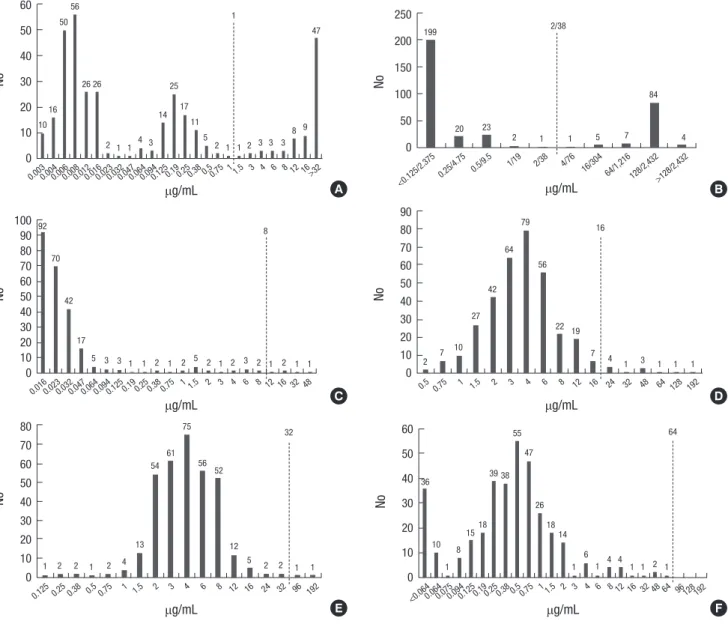
(344/346), FEP 98.5% (341/346), CIP 78% (270/346) and SMX 70.8% (245/346). The MIC50 and MIC90 values (μg/mL) of each antibiotic were measured: FM, 0.5, 1.5; TMO, 4, 12; NI, 4, 8; FEP, 0.016, 0.064; CIP 0.016, > 32; SMX, < 0.125/2.375, 128/2,432.
Fig. 1 shows the MIC distribution of above antibiotics against 346 E. coli isolates.
Fig. 1. Minimal inhibitory concentration (MIC) distribution of 346 E. coli isolates to various antimicrobial agents. (A) ciprofloxacin, (B) trimethoprim-sulfamethoxazole, (C) cefepime, (D) temocillin, (E) nitrofurantoin, and (F) fosfomycin. Vertical black dotted line indicates the breakpoint of each agent.
No
μg/mL
0.016 92
70
42
17
5 3 3 2 3 2
8
1 2 1 1 1 2
1 1 2 1 2 5
0.0230.0320.0470.0640.0940.125 0.19 0.25 0.38 0.75 1 1.5 2 3 4 6 8 12 16 32 48
100 90 80 70 60 50 40 30 20 10 0
No
μg/mL
0.5
64 56
22 19 7 79 16
2 7 10 27
42
4 1 3 1 1 1
0.75 1 1.5 2 3 4 6 8 12 16 24 32 48 64 128 192
90 80 70 60 50 40 30 20 10 0
No
μg/mL
<0.064 36
10 1
8 1518
39 38 55
47
26 18
14
1 6 1 4 4 1 1 2 1 64
0.0640.0750.0940.1250.190.250.380.5 0.75 1 1.5 2 3 4 6 8 12 16 324864 96128192
60 50 40 30 20 10 0
No
μg/mL
0.125
61 54
12 56 52
1 2 2 1 2 4
13 75
5 2
32
1 1 2
0.25 0.38 0.5 0.75 1 1.5 2 3 4 6 8 12 16 24 32 96 192
80 70 60 50 40 30 20 10 0
No
μg/mL
0.003 10 16
50 56
26 26
2 4 3
14 25
17 11
5 2 2 3 3 3
8 9 47 1
1 1 1 1
0.0040.0060.0080.0120.0160.0230.0320.0470.0640.0940.1250.190.250.380.50.75 1 1.5 3 4 6 8 12 16>32
60 50 40 30 20 10 0
No
μg/mL
<0.125/2.375 199
20 23
2 1 1
2/38
5 7
84
4
0.25/4.75 0.5/9.5 1/19 2/38 4/76
16/304 64/1,216 128/2,432>128/2,432
250 200 150 100 50 0
A
C
E
B
D
F
Seo M-R, et al. • Susceptibility of Escherichia coli from Urinary Tract Infection
1180 http://jkms.org http://dx.doi.org/10.3346/jkms.2014.29.8.1178 We compared the antimicrobial resistance of 76 (22%) CIP-
resistant (CIP-R) and 270 (78%) CIP-susceptible (CIP-S) isolates (Table 1). Resistance rates of FEP, TMO and SMX were signifi- can tly higher in CIP-R than CIP-S isolates: 6.6% vs. 0% (P < 0.001);
9.2% vs. 1.5% (P < 0.001) and 55.3% vs. 21.9% (P < 0.001), re- spectively. On the other hand, the resistance rate of FM and NI did not differ significantly between the CIP-R and CIP-S isolates:
0% vs. 0%, P = 0.397; 0% vs. 0.7%, P = 0.637. In accordance with the co-resistance trend between CIP and FEP, TMO or SMX, the MIC50 and MIC90 values of those antibiotics in CIP-R isolates were higher than CIP-S isolates. By the same token, the MIC50
and MIC90 of NI and FM did not differ between the two groups.
With respect to extended-spectrum beta-lactamase or plas- mid-mediated AmpC beta-lactamase phenotypes, 24 E. coli (6.9%) were tested positive for extended-spectrum beta-lacta- mase or plasmid-mediated AmpC beta-lactamase and 322 iso- lates (93.1%), negative. Comparing the resistance rate of antibi- otics according to the ESBL/PABL positivity, resistance rates of TMO, FEP, CIP and SMX were significantly higher in ESBL/PABL- positive than ESBL/PABL-negative isolates: 12.5% vs. 2.5% (P = 0.033); 20.8% vs. 0% (P < 0.001); 83.3% vs. 17.4% (P < 0.001) and 50% vs. 27.6% (P = 0.02), respectively (Table 2). Conversely, the resistance rate of FM and NI did not differ: 0% vs. 0%, P = 0.143;
0% vs. 0.6%, P = 0.267. Likewise, MIC50 and MIC90 values of TMO, FEP, CIP and SMX were higher in ESBL/PABL-positive than ESBL/PABL-negative E. coli isolates, but those values of FM and NI did not differ between the 2 groups.
In this study, we evaluated the in vitro susceptibility of E. coli
isolates from CA-UTI to candidate antibiotics for lower UTI such as FM, NI and TMO, which have a therapeutic efficacy but give a relatively low antibiotic selective pressure. The three antibiot- ics had an excellent susceptibility profile, mainly because FM is not commonly prescribed, and TMO and NI are not available in Korea. We compared the susceptibility of the three antibiot- ics with CIP, SMX and FEP which are major antibiotics for the treatment of CA-UTI as well as other serious infections. CIP, SMX and FEP belong to a different family of antibiotics with a differ- ent resistance mechanism, but uropathogenic E. coli commonly shows a co-resistance against CIP, SMX and FEP. Co-resistance rates of CIP and SMX or CIP, SMX and extended-spectrum ce- phalosporins were 10.6%-12.8% or 1.3%-3.8% in our previous report (9). Interestingly, FM and NI did not show a tendency for co-resistance with CIP or FEP, but ESBL/PABL-positive isolates were more resistant to TMO in this study. Temocillin is a nar- row-spectrum penicillin and known to be resistant to hydroly- sis by penicillinase, extended-spectrum beta-lactamases, and AmpC enzymes (10). However, 3 of 24 ESBL/PABL-positive iso- lates, possibly with change of membrane permeability, were re- sistant to TMO in a previous study (11). In this study, 11 of 346 E. coli were resistant to TMO at the breakpoint of 8 μg/mL, and 6 of the eleven were resistant at the British Society for Antimi- crobial Chemotherapy (BSAC) urinary breakpoint (32 mg/L) (12). In terms of NI and FM, only 1 isolate was resistant to NI, which was resistant to TMO and SMX but susceptible to CIP, FM and FEP, and there was no E. coli resistant to FM among 346 isolates from CA-UTI. Based on these findings, FM, NI and TMO
Table 1. Comparison of antimicrobial susceptibility according to ciprofloxacin-resistance in E. coli isolates from community-acquired UTI
Antibiotics Resistance rates (%) CIP-R CIP-S
CIP-R (n = 76) CIP-S (n = 270) P value MIC50 MIC90 MIC50 MIC90
FM 0 0 0.397 0.38 2 0.5 1.5
NI 0 0.74 0.637 4 8 4 8
FEP 6.58 0 0* 0.032 4 0.016 0.032
TMO 9.21 1.48 0* 6 16 3 8
SMX 55.26 21.85 0* 64/1,216 128/2,432 < 0.125/2.375 128/2,432
MIC50 and MIC90, MIC for 50% and 90% of the isolates respectively. *P value < 0.05 was significant by chi-square test or Fisher’s exact test. CIP-R, ciprofloxacin resistant; CIP- S, ciprofloxacin-susceptible; FM, fosfomycin; CIP, ciprofloxacin; FEP, cefepime; TMO, temocillin; NI, nitrofurantoin; SMX, Trimethoprim-sulfamethoxazole; MIC, minimal inhibitory concentration.
Table 2. Comparison of antimicrobial susceptibility according to ESBL/PABL-positivity in E. coli isolates from community-acquired UTI
Antibiotics Resistance rates (%) ESBL/PABL Non-ESBL/PABL
ESBL/PABL (n = 24) Non-ESBL/PABL (n = 270) P value MIC50 MIC90 MIC50 MIC90
FM 0 0 0.143 0.19 2 0.5 1.5
NI 0 0.62 0.267 4 8 4 8
CIP 83.33 17.39 0* > 32 > 32 0.016 16
FEP 20.83 0 0* 3 16 0.016 0.032
TMO 12.5 2.48 0.034* 8 24 4 8
SMX 50 27.64 0.02* 0.5/9.5 128/2,432 < 0.125/2.375 128/2,432
MIC50 and MIC90, MIC for 50% and 90% of the isolates respectively. *P value < 0.05 by chi-square test or Fisher’s exact test. ESBL, extended-spectrum beta-lactamase; PABL, plasmid-mediated AmpC beta-lactamase; FM, fosfomycin; CIP, ciprofloxacin; FEP, cefepime; TMO, temocillin; NI, nitrofurantoin; SMX, Trimethoprim-sulfamethoxazole; MIC, mini- mal inhibitory concentration.
Seo M-R, et al. • Susceptibility of Escherichia coli from Urinary Tract Infection
http://jkms.org 1181
http://dx.doi.org/10.3346/jkms.2014.29.8.1178
are an excellent therapeutic option for lower UTI in Korea. As we described, FQ and extended-spectrum cephalosporins are major antibiotics for treatment of UTI as well as other serious infections, and uropathogens showed a tendency for co-resis- tance to both major drugs. Therefore, it is mandatory to decrease the use of FQ and extended-spectrum cephalosporins for com- mon but not-serious infections such as lower UTI. Instead, na- tionwide introduction of TMO, NI in addition to FM for treat- ment of lower UTI should be considered.
In conclusion, resistance rate of E. coli from CA-UTI to CIP and SMX were above 20% in Korea. However, TMO, FM and NI showed an excellent activity to them. Therefore, we propose TMO, FM and NI as the first-line antimicrobial agent for CA- lower UTI.
DISCLOSURE
The authors have no conflicts of interest to disclose.
ORCID
Mi-Ran Seo http://orcid.org/0000-0002-7438-7071 Seong-Jong Kim http://orcid.org/0000-0003-2807-1866 Yeonjae Kim http://orcid.org/0000-0003-4144-9077 Jieun Kim http://orcid.org/0000-0002-6214-3889 Tae Yeal Choi http://orcid.org/0000-0002-0607-3513 Jung Oak Kang http://orcid.org/0000-0002-9181-6819 Seong-Heon Wie http://orcid.org/0000-0002-7603-5520 Moran Ki http://orcid.org/0000-0002-8892-7104 Young Kyun Cho http://orcid.org/0000-0003-3781-3665 Seung-Kwan Lim http://orcid.org/0000-0003-1941-6359 Jin Seo Lee http://orcid.org/0000-0003-3913-6370 Ki Tae Kwon http://orcid.org/0000-0003-4666-0672 Hyuck Lee http://orcid.org/0000-0002-4115-0748 Hee Jin Cheong http://orcid.org/0000-0002-2532-1463 Dae Won Park http://orcid.org/0000-0002-7653-686X Seong Yeol Ryu http://orcid.org/0000-0002-6023-8550 Moon-Hyun Chung http://orcid.org/0000-0003-2905-3459 Hyunjoo Pai http://orcid.org/0000-0003-4143-035X
REFERENCES
1. Lee SJ, Lee DS, Choe HS, Shim BS, Kim CS, Kim ME, Cho YH. Antimi- crobial resistance in community-acquired urinary tract infections: re-
sults from the Korean Antimicrobial Resistance Monitoring System. J In- fect Chemother 2011; 17: 440-6.
2. Hooton TM. Fluoroquinolones and resistance in the treatment of un- complicated urinary tract infection. Int J Antimicrob Agents 2003; 22: 65- 72.
3. Lee MY, Choi HJ, Choi JY, Song M, Song Y, Kim SW, Chang HH, Jung SI, Kim YS, Ki HK, et al. Dissemination of ST131 and ST393 community-on- set, ciprofloxacin-resistant Escherichia coli clones causing urinary tract infections in Korea. J Infect 2010; 60: 146-53.
4. Garau J. Other antimicrobials of interest in the era of extended-spectrum beta-lactamases: fosfomycin, nitrofurantoin and tigecycline. Clin Micro- biol Infect 2008; 14: 198-202.
5. Ko KS, Suh JY, Peck KR, Lee MY, Oh WS, Kwon KT, Jung DS, Lee NY, Song JH. In vitro activity of fosfomycin against ciprofloxacin-resistant or ex- tended-spectrum beta-lactamase-producing Escherichia coli isolated from urine and blood. Diagn Microbiol Infect Dis 2007; 58: 111-5.
6. Kim KY, Kim CS, Lim DH. The ciprofloxacin resistance pattern of Esche- richia coli isolated from female patients with community - acquired uri- nary tract infection in the Jeonnam and Gwangju region for the recent 2-years. Korean J Urol 2008; 49: 540-8.
7. Lee SY, Park YJ, Yu JK, Jung S, Kim Y, Jeong SH, Arakawa Y. Prevalence of acquired fosfomycin resistance among extended-spectrum β-lactamase- producing Escherichia coli and Klebsiella pneumoniae clinical isolates in Korea and IS26-composite transposon surrounding fosA3. J Antimi- crob Chemother 2012; 67: 2843-7.
8. Clinical and Laboratory Standard Institute. Performance standards for antimicrobial susceptibility testing: 15th informational supplement: CLSI document M100-S15. Wayne: CLSI, 2005. Available at http://clsi.crg [ac- cessed on 1 January 2005].
9. Kim B, Kim J, Wie SH, Park SH, Cho YK, Lim SK, Shin SY, Yum JS, Lee JS, Kweon KT, et al. Is it acceptable to select antibiotics for the treatment of community-acquired acute cystitis based on the antibiotics suscepti- bility results for uropathogens from community-acquired acute pyelone- phritis in Korea? Infect Chemother 2012; 44: 269-74.
10. Balakrishnan I, Awad-El-Kariem FM, Aali A, Kumari P, Mulla R, Tan B, Brudney D, Ladenheim D, Ghazy A, Khan I, et al. Temocillin use in Eng- land: clinical and microbiological efficacies in infections caused by ex- tended-spectrum and/or derepressed AmpC β-lactamase-producing En- terobacteriaceae. J Antimicrob Chemother 2011; 66: 2628-31.
11. Livermore DM, Warner M, Mushtaq S, Doumith M, Zhang J, Woodford N. What remains against carbapenem-resistant Enterobacteriaceae?
evaluation of chloramphenicol, ciprofloxacin, colistin, fosfomycin, mi- nocycline, nitrofurantoin, temocillin and tigecycline. Int J Antimicrob Agents 2011; 37: 415-9.
12. Andrews JM, Howe RA; BSAC Working Party on Susceptibility Testing.
BSAC standardized disc susceptibility testing method (version 10). J An- timicrob Chemother 2011; 66: 2726-57.