Gender Disparities in the Use of ICT: A Survey of Students
in Urban Schools
Open Access
Accepted date: September 15, 2017 Received date: June 8, 2016
*Corresponding Author: B. T. Sampath Kumar Professor
Department of Studies and Research in Library and Information Science
Tumkur University, Karnataka, India E-mail: [email protected]
All JISTaP content is Open Access, meaning it is accessible online to everyone, without fee and authors’ permission. All JISTaP content is published and distributed under the terms of the Creative Commons Attribution License (http:/ creativecommons. org/licenses/by/3.0/). Under this license, authors reserve the copyright for their content; however, they permit anyone to unrestrictedly use, distribute, and reproduce the content in any medium as far as the original authors and source are cited. For any reuse, redistribution, or reproduction of a work, users must clarify the license terms under which the work was produced.
ABSTRACT
This study aims to investigate gender differences in the use of ICT by the students of urban schools. The objectives of the study are to find out the use of computers and Internet by the students and also the problems encountered by them while using computers and Internet. The study found that there is a significant association between the place (p=.005) and frequency (p=.002) of use of computers and gender. It is also found that there are significant differences in the problems faced by students while using computers (p=.002), use of Internet (p=.004), and the gender. This clearly indicates that there exists a gender disparity in the use of ICT by the male and female students in the urban schools. In order to overcome this disparity, the school authority should provide the basic and neces-sary ICT infrastructure in schools which can be equally used by male and female students.
Keywords: ICT, gender disparities, students, urban schools
Basavaraja M.T.
Department of Studies and Research in Library and Information Science, Tumkur University Karnataka, India
E-mail: [email protected]
B. T. Sampath Kumar *
Department of Studies and Research in Library and Information Science, Tumkur University Karnataka, India
E-mail: [email protected]
http://dx.doi.org/10.1633/JISTaP.2017.5.4.3 eISSN : 2287-4577 pISSN : 2287-9099
1. INTRODUCTION
In India, despite improvements in educational ac-cess over the past several decades, social background is still found to be associated with learning outcomes. Achievement gaps based on gender, region, and other social background factors often arise in primary school, and many Indian children struggle against historical in-equalities such as those based on gender and caste (Desai et al., 2010).
Indian girls may experience lower quality school environments than boys do. In particular, girls are en-rolled in private schools at somewhat lower rates than boys and are less engaged with private tutoring. Togeth-er these factors contribute to highTogeth-er ovTogeth-erall education expenditures for boys than for girls, even with the exis-tence of special fee reduction policies for girls in some areas (Desai et al., 2010). The issue of gender justice as far as access to and use of ICT (Information Communi-cation Technology) continues to be a topical subject not only for India but the world over.
According to a 2011 census, the female literacy rate was 65.46% compared to 82.14% for males. This gap in-dicates a wide gender disparity in India and that Indians do not give enough importance to the education of girls. Educating a female child is still seen as a bad investment because she is bound to get married and leave her pa-ternal home one day (Gender inequality in India, 2017). The underlying thought that educating women is of no value as they will only serve their husbands and family in future makes parents unwilling to spend on girls’ education. A good education or qualification does not bring women up to par with men. Thus without having a good education women are found lacking in the pres-ent day’s challenging job skills. They are still destitute of many work opportunities as men are believed to be more capable than their female counterparts with simi-lar qualifications
While in a few contexts, gender plays a significant role in determining the intention of accepting new tech-nology, there are cases where gender differences cannot be discerned. In the context of usage of Information Technology, which includes computers, email services, electronic data management systems, etc., gender acts as an influencing factor in technology adoption as men are claimed to be more technologically adept compared to women (Goswami & Dutta, 2016).
The increasing use of ICT along with new skills and competencies in education among students are required for effective learning. As an educational and entertain-ment tool, ICT can enable students to learn virtually on any topic. Gender inequality in school education is a per-sistent problem in Indian society. During the past several decades, India has achieved success in moving towards universal school enrollment and in enacting policies to address educational inequalities based on gender. How-ever, education gaps still exist (Teck & Lai, 2011).
Keeping in view the importance of ICT in school ed-ucation, the present study has been undertaken to know the use of ICT by male and female students in urban schools. It also tries to know the disparities in the use of ICT by male and female students.
2. RELATED LITERATURE
Significant studies have been carried out during previous years on various aspects about the use of computers and the Internet by male and female stu-dents to identify gender disparities. In India, Mishra et al. (2005) identified the gender gap in their study and found that 61.5% of males and 51.6% of females used the Internet, and 83.1% of males and 61.3% of fe-males faced the problem of slow Internet connections. In the year 2007, Li and Kirkup concluded that men tend to use email and “chat” rooms more than women do, men play more games on computers, and men are more confident in their computer skills than women are. However, the gender inequality is stronger in the British group than in the Chinese one. Similarly, Afon-so et al. (2012) studied 2,175 users of the Electronic Document Management System (EDMS) and found that gender only moderates performance expectancy towards behavioral intention, as males are argued to be more result oriented than females.
Calvert et al. (2005) had interviewed 1,065 parents to know about the media habits of children aged 6 months to 6 years in the U.S., and found that at young-er ages thyoung-ere was no diffyoung-erence between boys and girls in using computers but, however, the interest level of the girls diminished at later stages. Ono and Zavodny (2005) conducted a comparative study in the USA and Japan and they revealed that during the 1990s there were radical gender gaps in both the countries in
In-formation Technology usage but the situation had re-versed by 2001 in the U.S., while in Japan the situation remained unchanged. In the context of implementing technological revolution, Mazman et al. (2009) indi-cated that females are more induced to adopt techno-logical innovation through social influence rather than by a personal decision whereas in the case of males the personal decision to adopt innovation is much stron-ger than social influence.
Khan and Ghadially (2010) collected the data from 155 young Muslim women and men studying in three computer training centers in Mumbai, and a gen-der-based comparison was conducted. Data for com-puter ownership and home Internet connections were low for the entire sample, and the training centers and cybercafés were important points of access for females and males, respectively. In terms of perceived empow-erment, young women reported higher gains than men did from computer learning when combined with ICT use. Thus, despite the existence of a gender-based digital divide, when bridged, ICTs showed potential as an equalizing force between the genders. In light of the above, policy measures to widen access and provide subsidized training are suggested.
Best and Maier (2007) explored how women use and perceive information technology in five villages in rural Tamil Nadu, India. They analysed the outcomes from structured in-depth interviews with 17 female In-ternet kiosk users and 22 women who had never used the Internet. They identified several critical issues, such as: There are gender-specific usage patterns and perceptions of ICTs; obstacles to ICT use are generally structural (time, location, illiteracy) and not personal; and manifestations of gender awareness correlate with perceptions of obstacles to ICT use.
Thus, after reviewing the literature, it was noted that there were no comprehensive and in-depth studies on computer literacy competencies among male and fe-male students. With this background information, the present study has been undertaken to understand ICT competencies and to identify the gender gap.
3. OBJECTIVES OF THE STUDY
The present study is an attempt to elicit answers to the following research questions:
• What is the frequency and purpose of use of com-puters and Internet by male and female students? • What problems have students encountered while
using computers and Internet?
• How have male and female students learned the var-ious computer applications?
• What is the impact of computers and Internet on studies of male and female students?
4. HYPOTHESES OF THE STUDY
The following hypotheses were formulated and tested with the data using the Chi-square analysis:
• There is an association between the use of comput-ers and the gender of the respondents.
• The students’ gender affects the place and frequency of use of computers.
• The problems faced in the use of computers differ among male and female students.
• The use of Internet varies among male and female students.
5. SCOPE AND METHODOLOGY
There are 157 urban high schools in Shivamogga District, Karnataka state (Directorate of Secondary Education, 2015). Of the 157 high schools, the study selected only 15 private high schools (Non-Government) from which a total of 300 students studying in 10th
stan-dard are selected. Equal numbers of male and female students are selected from all 15 schools. Since it is a time-bound study, the researcher adopted convenience sampling to select the required sample. The time-bound study is constrained by hard deadlines in which the timings of the delivery are as important as the delivery itself. Therefore, the schools which are very much ac-cessible to the research scholar are only considered for the study purpose. In each school, only 20 students are selected based on their interest to participate in the sur-vey. Therefore, the sample size of the study is only 300 students (20 students x 15 schools).
The questionnaire has been designed to fulfill the stated objectives. Questions were asked to capture the data on demographic information, use of computers and Internet, reasons for not using the Internet, and
also to know the impact of computers and Internet on the academic performance of male and female students. The questionnaires were distributed to the selected population in each school and the duly filled question-naires were analyzed using Statistical Package for Social Sciences (SPSS version 21.0) and the data have been presented in the form of tables and charts.
The main objective of the study was to know the use of computers among the male and female students of urban schools. In this context, a question was included in the questionnaire to know the use of computers by male and female students. The data presented in Table 1 indicate that the majority (91.33%) of students used computers and only 8.66% of students are not using computers. Further, the gender wise use of computers shows that 92% of males and 90.66% of females used computers for their academic work. The Chi-square analysis indicates that there is no association between the use of computers and the gender. This shows that an equal percent of male and female students of urban schools used computers for various academic work and thus hypothesis 1 has been rejected.
The place of use of computers by students is presented in Table 2. It reveals that a majority of male (94.20%) and female (78.67%) students used computers at schools followed by home (46.37% - male and 25.73% - female)
and a neighbor’s / friend’s home (31.88% - male and 18.38% - female). Only 37.48% of male and 17.64% of female students used computers at computer coaching centers. Further, it is found that 54.34% of male students used computers at cybercafés compared to females (16.91%). The Chi-square analysis indicates that there is an association between the place of use of computers and gender (X2=14.947, df=4, p=.005). This shows that
male students have more freedom to use the computer either at home, a neighbor’s / friend’s home, or even at a cybercafé as compared to their counterparts, whereas the female students have much less freedom to use com-puters at cybercafés or at a neighbor’s / friend’s home, which has been substantiated by the Chi-square analysis (p<.005). Therefore hypothesis 2 has been accepted.
The study also made an attempt to know the frequen-cy of use of computers. The data related to frequenfrequen-cy of use of computers is presented in Table 3, which indicates that 54.74% of respondents used computers every day. The gender wise use of computers shows that 66.66% of males and only 42.64% of females used computers every day. A very few male students (10.14%) and fe-male students (04.41%) used computers once in a week. The above data indicate that there is a clear disparity between male and female students with respect to the frequency of use of computers. This clearly shows that
Table 1. Use of Computers
Respondents Yes No
Male (N=150) 138 (92.00) 12 (8.00)
Female (N=150) 136 (90.66) 14 (9.33)
Total (N = 300) 274 (91.33) 26 (8.66)
Table 2. Place of Use of Computers
Respondents School Home friend’s homeNeighbor’s / Computer coaching
centers Cyber café Male (N=138) 130 (94.20) 64 (46.37) 44 (31.88) 48 (37.48) 75 (54.34) Female (N=136) 107 (78.67) 35 (25.73) 25 (18.38) 24 (17.64) 23 (16.91) Total (N = 274) 237 (86.49) 99 (36.13) 69 (25.18) 72 (26.27) 98 (35.76)
in India female students may not have more freedom to use ICT and its applications as compared to males. Fur-ther, the Chi-square test has been applied to know the association between the frequency of use of computers and gender. Not surprisingly, the Chi-square analysis also supported the data (X2=12.557, df=2, p=.005) and
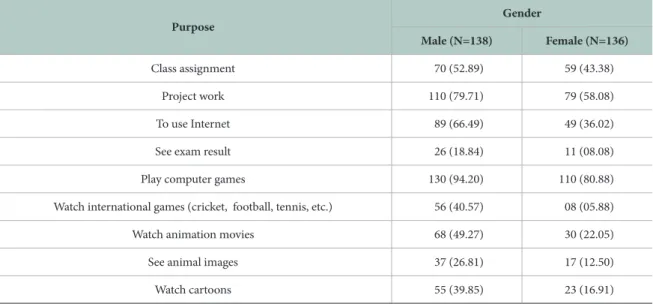
hence the second hypothesis (2) has been accepted. Students were requested to mention the purpose of use of computers and the data are presented in Table 4. It is very interesting to note that a majority of male (94.20%) and female (80.88%) students used computers for playing games, followed by project work (79.71% - male and 58.08% - female); while 66.49% of males and 36.02% of females used computers to access Internet and only 18.84% of males and 8.08% of females used
computers to see exam results.
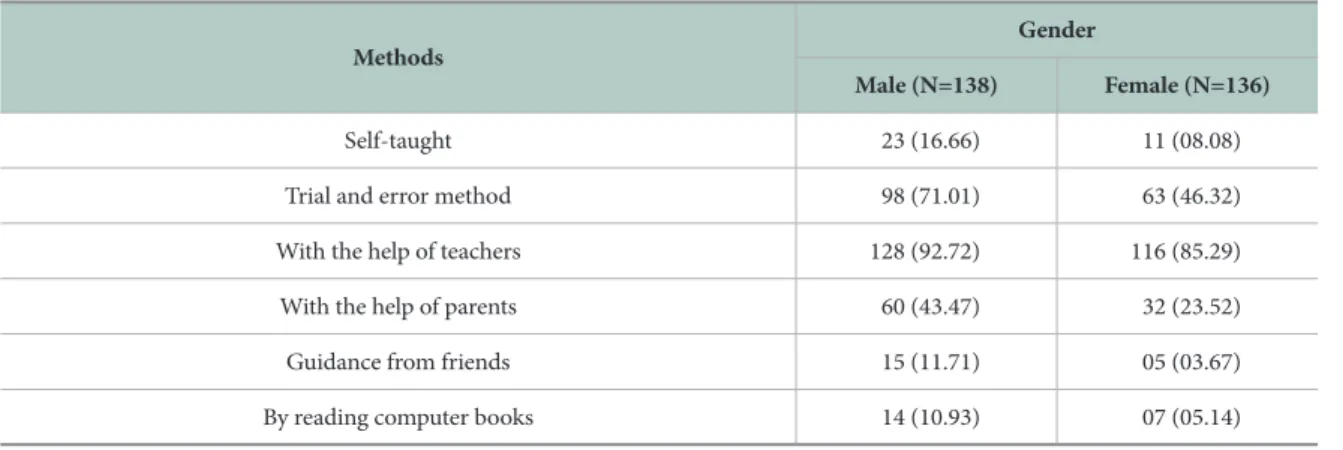
Respondents were asked to mention the methods of learning to use computers and the responses are pre-sented in Table 5. The gender wise methods of learning to use computers shows that the majority (92.72%) of male and 85.29% of female respondents learned to use computers with the help of teachers, followed by the trial and error method (71.01% - male and 46.32% - female) and with the help of parents (43.47% - male and 23.52% - female). Only 10.93% of male and 5.14% of female students learned to use computers by reading computer books. The data clearly show that gender has an impact on the methods of learning to use a computer and its applications.
Students were also asked to mention the various
Table 3. Frequency of Use of Computers
Respondents Frequency
Everyday 2-3 days in a week Once in a week
Male (N=138) 92 (66.66) 52 (37.68) 14 (10.14)
Female (N=136) 58 (42.64) 72 (52.94) 06 (04.41)
Total (N=274) 150 (54.74) 124 (45.25) 20 (07.29)
Table 4. Purpose of Use of Computers
Purpose Gender
Male (N=138) Female (N=136)
Class assignment 70 (52.89) 59 (43.38)
Project work 110 (79.71) 79 (58.08)
To use Internet 89 (66.49) 49 (36.02)
See exam result 26 (18.84) 11 (08.08)
Play computer games 130 (94.20) 110 (80.88)
Watch international games (cricket, football, tennis, etc.) 56 (40.57) 08 (05.88)
Watch animation movies 68 (49.27) 30 (22.05)
See animal images 37 (26.81) 17 (12.50)
Table 5. Methods of Learning Computers
Methods Gender
Male (N=138) Female (N=136)
Self-taught 23 (16.66) 11 (08.08)
Trial and error method 98 (71.01) 63 (46.32)
With the help of teachers 128 (92.72) 116 (85.29)
With the help of parents 60 (43.47) 32 (23.52)
Guidance from friends 15 (11.71) 05 (03.67)
By reading computer books 14 (10.93) 07 (05.14)
computer applications used by them for their academic work (Table 6). It is surprising to note that both males (100%) and females (100%) used Paint Brush. Further, the majority of male (92.75%) and female (77.94%) stu-dents used MS Word, followed by MS Excel (83.33% - male and 53.67% - female) and MS PowerPoint (74.63% - male and 72.05% - female). Very few percent of male (2.89%) and female students (1.47%) used C program-ming.
The study intended to identify the various problems faced by both male and female students in the use of computers. The data presented in Table 7 indicate that both male and female students faced various problems in the use of computers. Frequent electric power failure is the major problem faced by both groups of students (86.95% - male and 58.82% - female). The other major problems faced by students are: inadequate computers at school (55.79% - male and 38.97% - female); and lack of inadequate computer skills (26.08% - male and 19.11% - female). Only 11.59% of males and 6.66% of females reported that there is no support from teachers to learn computer applications.
The data presented in the table clearly indicate that the problems faced by male and female students are different, which is also supported by the Chi-Square analysis (X2=16.991, df= 4, p=.002), and thus there is
an association between the problems faced in the use of computers and gender. Therefore, hypothesis 3 has been accepted.
The study also tried to know the use of Internet among male and female students in urban schools. Thus a question was included in the questionnaire to know the prompt responses of students with respect to the use of Internet. The gender wise analysis shows that 64.49% of male and 47.05% of female students used the Internet while only 35.50% of male students have not used the Internet (Table 8). But the percentage of non-Internet users are female students which accounted for 52.94%. In order to know the association between the use of In-ternet and gender, the Chi-Square analysis is performed. The result indicates that there is a significant association between gender and use of the Internet (X2= 8.443,
df=1, p=.004). It is noticed that a comparatively greater number of male students used the Internet than females did and hence hypothesis 4 has been accepted.
The place of use of Internet by students is presented in Table 9. It reveals that 70.03% of male and 40.62% of female students used the Internet at cybercafés. This clearly indicates that cybercafés are the most preferred places to use the Internet. A notable finding of the study is that a comparatively greater number of male students used the Internet than their female counterparts did. The table also shows that few of them used the Internet at their respective schools (40.44% - male and 31.25% - female) and home (32.58% - male and 42.18% - female). Only 29.21% of male and 29.68% of female respondents used the Internet in their neighbors’/ friends’ homes.
Table 7. Problems Faced in the Use of Computers
Problems Gender
Male (N=138) Female (N=136)
Electric power failure 120 (86.95) 80 (58.82)
Lack of adequate computer skills 36 (26.08) 26 (19.11)
Inadequate computers in school 77 (55.79) 53 (38.97)
Lack of support from teachers 16 (11.59) 09 (06.66)
Lack of support from parents 23 (16.66) 46 (33.82)
Table 8. Use of Internet
Respondents Yes No
Male (N=138) 89 (64.49) 49 (35.50)
Female (N=136) 64 (47.05) 72 (52.94)
Total (N=274) 153 (55.83) 121 (44.16)
Table 6. Use of Various Computer Applications
Computer Applications Gender
Male (N=138) Female (N=136) MS-DOS 76 (55.07) 23 (16.91) MS Word 128 (92.75) 106 (77.94) MS Excel 115 (83.33) 73 (53.67) MS PowerPoint 103 (74.63) 98 (72.05) MS Access 13 (09.42) 04 (02.94) Word Pad 89 (64.49) 43 (31.61) Note Pad 75 (54.34) 33 (24.42) Paint Brush 138 (100) 136 (100) DBMS 06 (04.34) 02 (01.47) C Programming 04 (02.89) 02 (01.47) Tally 08 (05.79) 04 (02.94)
not using the Internet by both male and female students and the data are presented in Table 10. It is surprising to note that a majority of male students (87.75%) have not used the Internet because of lack of Internet facilities at their schools. But the percentage of female students not using computers because of lack of Internet facilities at their schools is comparatively low (54.16%). Further, because of lack of knowledge about the availability of information on the Internet (67.34%) and lack of train-ing regardtrain-ing Internet use, 51.02% of the male students have not used the Internet. It is very important to note that 86.11% of female students have not used the Inter-net mainly because of lack of support from parents. The result indicates that female students need more support from their parents to use the Internet for their academic work.
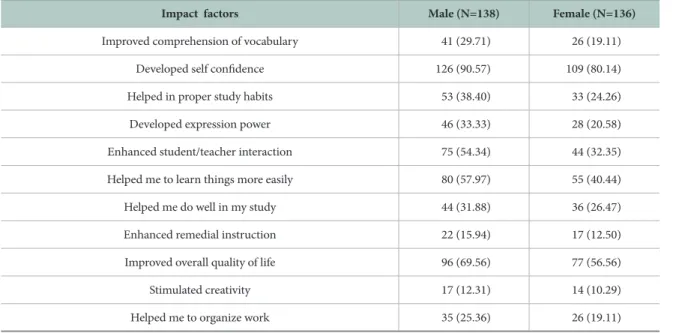
Students were requested to mention the impact of computers and Internet on their academic performance and data are presented in Table 11. A majority of male (90.57%) and female students (80.14%) reported that the use of computers and Internet has made an im-pact in developing self-confidence. A few of them also opined that the use of computers has improved their overall quality of life (69.56% - male and 56.56% - fe-male). The students also mentioned that the use of ICT has enhanced student/teacher interaction (54.34% - male and 32.35% - female).
6. DISCUSSION AND CONCLUSION
The use of ICT has revolutionized the way and man-ner in which school students use information. This study has revealed the use of ICT by male and female
students in urban schools. The findings of the study enlighten the use of computers and Internet by the stu-dents of urban schools. It is found that the majority of students used computers for their academic purposes which shows that the students have a positive attitude towards the use of ICT. Since the majority of students used computers at their respective schools, school au-thorities should increase the ICT facilities in the schools. Apart from the schools, the majority of male students used computers at cybercafés and computer coaching centers as well as at home, as compared to their female counterparts. The data show that female students are not exposed to use of computers and Internet either at cybercafés or at home. This indicates that there is a gen-der difference in the place of use of computers. There-fore, parents should support their children to make use of computers and Internet services for their academic work.
With respect to the purpose of use of computers, both male and female students used computers for similar purposes. But, most of the male and female students showed their interest to play computer games. There-fore, teachers should divert their minds to make opti-mum use of computers for their academic purposes.
All of the students learned to use computers with the help of school teachers. This clearly indicates that the students are mainly dependent on the teachers to learn to use a computer and its applications. To support this result, Li and Ranieri (2013) also found that teachers have more positive influences on the student’s ICT be-havior. Therefore, teachers should be trained frequently and school management should send their teachers to attend ICT oriented workshops and seminars to acquire new ICT skills and competencies, and also they can Table 9. Place of Internet Use
Respondents School Home Neighbor’s /friend’s home Cybercafé
Male (N=89) 36 (40.44) 29 (32.58) 26 (29.21) 65 (70.03)
Female (N=64) 20 (31.25) 27 (42.18) 19 (29.68) 26 (40.62)
Table 10. Reasons For Not Using Internet
Reasons Gender
Male (N=49) Female (N=72 )
Lack of Internet facilities 43 (87.75) 39 (54.16)
Lack of training regarding Internet use 25 (51.02) 13 (18.05) Lack of knowledge about the availability of information on the Internet 33 (67.34) 31 (43.05)
Lack of support from teachers 13 (26.53) 08 (11.11)
Lack of support from parents 05 (10.20) 62 (86.11)
Lack of time 06 (12.24) 02 (02.77)
Table 11. Impact of Use of Computers and Internet on Studies of Urban Students
Impact factors Male (N=138) Female (N=136)
Improved comprehension of vocabulary 41 (29.71) 26 (19.11)
Developed self confidence 126 (90.57) 109 (80.14)
Helped in proper study habits 53 (38.40) 33 (24.26)
Developed expression power 46 (33.33) 28 (20.58)
Enhanced student/teacher interaction 75 (54.34) 44 (32.35)
Helped me to learn things more easily 80 (57.97) 55 (40.44)
Helped me do well in my study 44 (31.88) 36 (26.47)
Enhanced remedial instruction 22 (15.94) 17 (12.50)
Improved overall quality of life 96 (69.56) 77 (56.56)
Stimulated creativity 17 (12.31) 14 (10.29)
Helped me to organize work 35 (25.36) 26 (19.11)
teach these skills to the students.
The study also found that there is a significance dif-ference in male and female students with respect to problems faced while using computers. Therefore, addi-tional care should be taken to solve problems faced by female students while using computers. In this context, the study recommends that the school authority should enhance the ICT facilities equally for both male and
female students. Additionally, more training should be given by teachers on the use of ICT to overcome the problems faced by female students.
It is also noticed that frequent power failure is a ma-jor problem faced by students in urban schools. There-fore, school management should provide Uninterrupted Power Supplies (UPS) in their schools. The majority of the students not using the Internet do so because of lack
of Internet facilities in schools and lack of knowledge about the availability of information on the Internet. There is a need to provide Internet facilities in urban schools and appoint a teacher to teach Internet based applications to the students.
The result of the study also shows that there is an as-sociation between gender and the non-use of Internet by the students of urban schools. For instance, 86.11% of female students opined that the lack of support from parents is one of the reasons for not using the Internet whereas this percentage is very low among male stu-dents (10.20%).
Based on the above discussion the study recommends that the school authority should provide basic infra-structure viz., well equipped computer labs, and separate cabins and separate timing hours to female students. It is also necessary to appoint a female teacher to teach computers and use of the Internet to female students, so that they may feel free to interact with the teachers in the teaching and learning process.
REFERENCES
BAfonso, C. M., Roldán, J. L., Sánchez-Franco, M., & de la Gonzalez, M. O. (2012). The moderator role of gender in the unified theory of acceptance and use of technology (UTAUT): A study on users of elec-tronic document management systems. Proceedings
of the 7th International Conference on Partial Least Squares and Related Methods, Houston, 19-22 May
2012.
Best, M. L., & Maier, S. G. (2007). Gender, culture and ICT use in rural south India. Gender, Technology
and Development, 11(2), 137-155.
Calvert, S., Rideout, V., Woolard, J., Barr, R., & Strou-se, G. (2005). Age, ethnicity, and socioeconomic patterns in early computer use: A national survey.
American Behavioural Scientist, 48, 590-607. http://
dx.doi.org/10.1177/0002764204271508
Directorate of secondary education. (2009). Retrieved from http://www.schooleducation.kar.nic.in/Sec-ondaryEducation/index.htm
Sonalde, D., Amaresh, D., Joshi, B. L., Mitali, S., Abu-saleh, S., & Reeve, V. (2010). Human development
in India: Challenges for a society in transition. New
York: Oxford University Press.
Gender inequality in India. (2017). White planet tech-nologies. Retrieved from www.indiacelebrating. com/social-issues/gender-inequality-in-india/ Goswami, A., & Dutta, S. (2016) Gender differences in
technology usage—A literature review. Open
Jour-nal of Business and Management, 4, 51-59. http://
dx.doi.org/10.4236/ojbm.2016.41006
Karnataka profile. (2010). Retrieved from http://karna-takaonline.in/Profile/
Khan, F., & Ghadially, R. (2010). Empowerment through ICT education, access and use: A gender analysis of Muslim youth in India. Journal of
Inter-national Development, 22(5), 659-673.
Li, N., & Kirkup, G. (2007) Gender and cultural dif-ferences in Internet use: A Study of China and the UK. Computers and Education, 48, 301-317. http:// dx.doi.org/10.1016/j.compedu.2005.01.007
Li , Y., & Ranieri, M. (2013). Educational and social correlates of the digital divide for rural and urban children: A study on primary school students in a provincial city of China. Computers & Education. 60, 97-209.
Mishra, O. P., Yadava, N., & Bisht, K. (2005). Internet utilization pattern of undergraduate students.
Uni-versity News, 43(13), 8-12.
Mazman, S. G., Usluel, Y. K., & Çevik, V. (2009) Social Influence in the adoption process and usage of in-novation: Gender differences. International Journal
of Behavioral, Cognitive, Educational and Psycholog-ical Sciences, 1, 229-232.
Ono, H., & Zavodyn, M. (2005). Gender differences in information technology usage: A US-Japan comparison. Sociological Perspectives, 48, 105-133. http://dx.doi.org/10.1525/sop.2005.48.1.105 Teck, S. H., & Lai, Y. L. (2011). An empirical analysis of
Malaysian pre-university students’ ICT competency gender differences. International Journal of Network