ISSN 2234-3806 • eISSN 2234-3814
580 www.annlabmed.org https://doi.org/10.3343/alm.2019.39.6.580 Ann Lab Med 2019;39:580-583
https://doi.org/10.3343/alm.2019.39.6.580
Letter to the Editor
Diagnostic Hematology
Fluoranthene-Induced Cytotoxicity and Direct Effect of Aryl Hydrocarbon Receptor Antagonist on
Hematopoietic Stem Cell Differentiation
Seung-Hyun Yang , M.A.1,2, Min-Gu Kang , M.D.3, Hye-Ran Kim , Ph.D.4, Young Eun Lee , M.S.2, Bo Ram Na , M.S.2, Jun Hyung Lee , M.D.1, Jong-Hee Shin , M.D.1, and Myung-Geun Shin , M.D.1,2,5
1Department of Laboratory Medicine, Chonnam National University Medical School and Chonnam National University Hwasun Hospital, Hwasun, Korea;
2Brain Korea 21 Plus Project, Chonnam National University Medical School, Gwangju, Korea; 3Department of Laboratory Medicine, GwangYang Sarang General Hospital, GwangYang, Korea; 4College of Korean Medicine, Dongshin University, Naju, Korea; 5Environmental Health Center for Childhood Leukemia and Cancer, Chonnam National University Medical School and Chonnam National University Hwasun Hospital, Hwasun, Korea
Dear Editor,
Fluoranthene (FR) is a polycyclic aromatic hydrocarbon (PAH), a compound that acts as an environmental pollutant. However, no study has examined the carcinogenicity, hematopoietic stem cell (HSC) toxicity, or global hematotoxicity of FR. FR-induced cytotoxicity could be mediated through the cytoplasmic aryl hy- drocarbon receptor (AhR), which is a ligand-dependent tran- scription factor that is activated by various environmental pollut- ants, including PAHs [1, 2]. AhR is highly expressed in hemato- poietic stem and progenitor cells (HSPCs), and its inhibition leads to a marked expansion of human umbilical cord blood–
derived HSPCs following cytokine stimulation [3]. Importantly, a recent study has suggested that AhR plays a critical role in the growth and differentiation of HSCs [4], but there has been lim- ited data regarding the effect of AhR antagonist on HSC differ- entiation [3]. Moreover, whether AhR plays an earlier role in hu- man hematopoietic development remains unknown [3]. We hy- pothesized that blocking AhR using its antagonist might be use- ful in preventing FR-related hematotoxicity. Therefore, we ini- tially investigated FR-induced HSC toxicity and the possible pre-
ventive effect of AhR antagonist on FR-induced hematotoxicity.
Additionally, we examined the direct effect of AhR antagonist on HSC self-renewal proliferation, as well as differentiation. This is the first study examining the effect of AhR antagonist on FR-in- duced toxicity.
Our study was approved by the Institutional Review Board (IRB) of Chonnam National University Hwasun Hospital, Hwa- sun, Korea (IRB No. 2009-35), and all samples were collected after obtaining written informed consent.
HSCs were isolated using a peripheral blood stem cell (PBSC) collection procedure following recruitment of four healthy do- nors and one lymphoma patient with an autologous HSC trans- plantation setting. Briefly, granulocyte colony-stimulating factor (G-CSF) was administered continuously until the white blood cell count reached a threshold above 1×10⁹/L. The patient un- derwent leukapheresis once or twice using a blood cell separa- tor. To quantify production of PBSCs from each leukapheresis, flow cytometry was used to enumerate and quantify CD34+
cells. This study was performed immediately after PBSC collec- tion. Isolated HSCs were cultured using a methylcellulose me-
Received: January 31, 2019 Revision received: March 20, 2019 Accepted: June 11, 2019
Corresponding author: Myung-Geun Shin, M.D., Ph.D.
Department of Laboratory Medicine, Chonnam National University Medical School and Chonnam National University, Hwasun Hospital, 322 Seoyang- ro, Hwasun-eup, Hwasun-gun, Jeollanam-do 58128, Korea
Tel: +82-61-379-7950, Fax: +82-61-379-7984 E-mail: [email protected]
© Korean Society for Laboratory Medicine
This is an Open Access article distributed under the terms of the Creative Commons Attribution Non-Commercial License (http://creativecommons.org/licenses/by-nc/4.0) which permits unrestricted non-commercial use, distribution, and reproduction in any medium, provided the original work is properly cited.
1 / 1 CROSSMARK_logo_3_Test
2017-03-16 https://crossmark-cdn.crossref.org/widget/v2.0/logos/CROSSMARK_Color_square.svg
Yang SH, et al.
Effect of FR and AhR antagonist on HSC
https://doi.org/10.3343/alm.2019.39.6.580 www.annlabmed.org 581
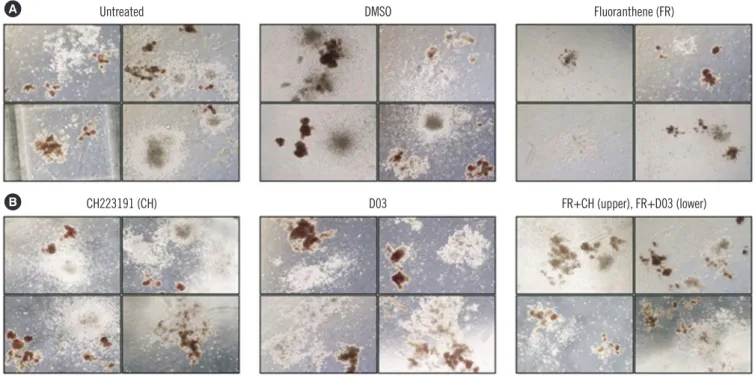
dium for 14–16 days at 37°C, in 5% CO2 with 95% humidity to determine the differentiation capacity of primary HSCs. FR (99%) was purchased from Sigma-Aldrich (St. Louis, MO, USA). Stock FR solutions were made in dimethyl sulfoxide (DMSO; Sigma- Aldrich) at a concentration of 200 M. Colony forming unit-granu- locyte and macrophage (CFU-GM) and burst-forming unit-ery- throid (BFU-E) were identified and counted using an inverted microscope: CFU-GM showed white colonies, and BFU-E showed faint red colonies. The direct effect of FR on the peripheral blood -HSC (PB-HSC) fraction was a general reduction in the number of myeloid (CFU-GM) and erythroid (BFU-E) colonies; the num- ber of BFU-E colonies was lower than that of CFU-GM colonies.
Next, CH223191 (CH), SR1, UM171, D03, E03, and Hit 90186 were selected as candidate AhR antagonists for a preliminary
experiment based on a screening process conducted by a col- laborating research laboratory (Zebra Fish Laboratory, Hwasun, Korea) and then synthesized by the Korea Chemical Bank (Dae- jeon, Korea) (www.chembank.org). To determine the self-re- newal capacity of the PBSC fraction isolated from allogeneic do- nors and an autologous patient, six AhR antagonists were ap- plied in a suspension culture system for HSC expansion. The suspension culture of the PBSC fraction was performed as fol- lows: briefly, PB-derived HSC samples were placed in separate wells of six-well plates and cultured in a serum-free medium containing 100 ng/mL of stem cell factor, 100 ng/mL of fms-like tyrosine kinase 3, 100 ng/mL of thrombopoietin, and 50 ng/mL of G-CSF to examine the self-renewal capacity of the HSC frac- tion. All tested AhR antagonists resulted in a remarkable in-
Fig. 1. Time- and dose-dependent effect of AhR antagonist treatment on HSC self-renewal proliferation in suspension cultures from autolo- gous and allogeneic PB-HSC fractions. (A) Effect of AhR antagonist on the self-renewal of the autologous HSC fraction. SR1 and E03 re- sulted in the greatest increase in self-renewal proliferation in the autologous PB-HSC faction compared with other AhR antagonists. (B) Ef- fect of AhR antagonist on the self-renewal of the allogeneic HSC fraction. UM and HIT resulted in the greatest increase in self-renewal pro- liferation in the allogeneic PB-HSC faction compared with other AhR antagonists.
Abbreviations: UN, untreated; DMSO, dimethyl sulfoxide; HSC, hematopoietic stem cell; PB-HSC, peripheral blood-derived hematopoietic stem cell; AhR, aryl hydrocarbon receptor; UM, UM171; HIT, Hit 90186.
0.20 0.18 0.16 0.14 0.12 0.10 0.08 0.06 0.04 0.02 0
UN DMSO
SR1 1 μM SR1 5 μM UM 35 nM CH 5 μM D03 5 μM D03 10 μM E03 7.5 μM E03 15 μM Hit 3.75 μM Hit 7.5 μM Cell count (×106/mL)
2 days 3 days 4 days 5 days A
0.25 0.20 0.15 0.10 0.05
0
UN DMSO SR 1 μM SR 5 μM UM 1 nM CH 5 μM D03 5 μM D03 10 μM E03 7.5 μM E03 15 μM Hit 3.75 μM Hit 7.5 μM Cell count (×106/mL)
1 day 2 days 3 days 4 days 5 days B
Yang SH, et al.
Effect of FR and AhR antagonist on HSC
582 www.annlabmed.org https://doi.org/10.3343/alm.2019.39.6.580 crease of the PB-HSC fraction in a time- and dose-dependent
manner in both the autologous and allogeneic PB-HSC frac- tions. SR1 and E03 resulted in the greatest increase in self-re- newal proliferation in the autologous HSC fraction compared with other AhR antagonists. Additionally, UM171 and Hit 90186 had the strongest effect on HSC expansion in the allogeneic HSC fraction (Fig. 1).
CH and D03 were selected based on the preliminary tests for AhR blockage experiments to examine the preventive effect on FR-induced cytotoxicity during HSC differentiation. CH or D03 were applied together with FR to a methylcellulose culture. The effect of these AhR antagonists on HSC differentiation was ex- amined using a CFU assay. No remarkable effect on HSC differ- entiation was observed following treatment of the PB-HSC frac- tion with these AhR antagonists. However, we confirmed that there was no significant FR-induced cytotoxic effect on the PB- HSC fraction following combined treatment with AhR antagonists and FR. It seems that co-treatment of CH and D03 with FR re- stored cell number while repairing cell morphology. These find- ings indicate that AhR antagonists have the potential to protect against FR-induced cytotoxicity (Fig. 2).
This study used descriptive analysis or presentation rather than the statistical analysis because of limited number of primary PB- SC samples. Practically, it was not easy to gather a large num- ber of PBSC samples due to relatively small PBSC volume. More- over, our data were collected from a single center in Korea, so the findings may not be generalized to other institutions. The limited number of patients and PBSC samples might preclude definitive conclusions on the effect of FR and AhR antagonist on HSC.
In conclusion, the CFU of the HSC lineage, including erythroid and granulocytic progenitor cells, was remarkably suppressed following FR exposure. Our results indicate that BFU-E was more reduced than CFU-GM. These results seem to be related to ane- mia, which requires further research. Moreover, AhR antagonists might prevent FR-induced hematotoxicity effectively.
Authors’ Disclosures of Potential Conflicts of Interest
No potential conflicts of interest relevant to this article were re- ported.
Fig. 2. Effect of the AhR antagonists on HSC differentiation using a colony forming unit (CFU) assay for PBSC. (A) Exposure of the PBSC fraction to FR induced remarkable suppression of CFC formation. (B) Treatment of the PB-HSC fraction with AhR antagonists (CH and D03) did not show a remarkable effect on HSC differentiation, whereas co-treatment of CH and D03 with FR restored cell number, as well as re- constructed cell morphology. Thus, AhR antagonists seem to have some restorative effect on PBSC following FR exposure.
Abbreviations: CFC, colony-forming cell; DMSO, dimethyl sulfoxide; HSC, hematopoietic stem cell; PB-HSC, peripheral blood-derived hematopoietic stem cell; PBSC, peripheral blood-derived stem cell; AhR, aryl hydrocarbon receptor; FR, fluoranthene.
Untreated DMSO Fluoranthene (FR)
A
CH223191 (CH) D03 FR+CH (upper), FR+D03 (lower)
B
Yang SH, et al.
Effect of FR and AhR antagonist on HSC
https://doi.org/10.3343/alm.2019.39.6.580 www.annlabmed.org 583
Acknowledgements
This research was supported by the Basic Science Research Program through the National Research Foundation of Korea (NRF), funded by the Ministry of Education (NRF-2018R1D1- A1B07040984), and grants from the Environmental Health Cen- ter through the Ministry of Environment, Korea.
ORCID
Seung-Hyun Yang https://orcid.org/0000-0002-6949-8367 Min-Gu Kang https://orcid.org/0000-0003-4946-8512 Hye-Ran Kim https://orcid.org/0000-0002-0658-3345 Young Eun Lee https://orcid.org/0000-0003-2700-3087 Bo Ram Na https://orcid.org/0000-0003-2469-3027 Jun Hyung Lee https://orcid.org/0000-0002-8682-3694
Jong-Hee Shin https://orcid.org/0000-0001-9217-8428 Myung-Geun Shin https://orcid.org/0000-0002-0372-9185
REFERENCES
1. Dietrich C and Kaina B. The aryl hydrocarbon receptor (AhR) in the regulation of cell-cell contact and tumor growth. Carcinogenesis 2010;
31:1319-28.
2. Rondelli CM, Larsen MC, N’Jai A, Czuprynski CJ, Jefcoate CR. PAHs target hematopoietic linages in bone marrow through Cyp1b1 primarily in mesenchymal stromal cells but not AhR: A reconstituted in vitro mod- el. Stem Cells Int 2016;2016:1753491.
3. Angelos MG, Ruh PN, Webber BR, Blum RH, Ryan CD, Bendzick L, et al. Aryl hydrocarbon receptor inhibition promotes hematolymphoid de- velopment from human pluripotent stem cells. Blood 2017;129:3428- 39.
4. Smith BW, Rozelle SS, Leung A, Ubellacker J, Parks A, Nah SK, et al.
The aryl hydrocarbon receptor directs hematopoietic progenitor cell ex- pansion and differentiation. Blood 2013;122:376-85.