Korean J Hepatobiliary Pancreat Surg 2016;20:49-52
http://dx.doi.org/10.14701/kjhbps.2016.20.2.49
Original Article
Changes in the types of liver diseases requiring hepatic resection:
a single-institution experience of 9016 cases over a 10-year period
Hwui-Dong Cho, Shin Hwang, Young-Joo Lee, Kwang-Min Park, Ki-Hun Kim, Jin Cheon Kim, Chul-Soo Ahn, Deok-Bog Moon, Tae-Yong Ha, and Sung-Gyu Lee
Department of Surgery, Asan Medical Center, University of Ulsan College of Medicine, Seoul, Korea
Backgrounds/Aims: To understand the changing demands for hepatic resection (HR), we collected data regarding HR performed in a tertiary centre over a period of 10 years. Methods: We carried out extensive search of institutional databases to identify HR cases performed between January 2005 and December 2014. A study cohort of 9,016 patients were divided into 5 disease categories, namely hepatocellular carcinoma (HCC), intrahepatic cholangiocarcinoma (ICC), intrahepatic duct stone disease (IHDS), colorectal cancer liver metastasis (CRLM), and uncommon/rare diseases (URD). Results: There were 5,661 (62.8%) HCC cases, followed by 1441 (16.0%) CRLM, 942 (10.5%) ICC, 638 (7.1%) IHDS and 334 (3.7%) URD. The number of annual HR cases gradually increased from 443 in 2005 to 1,260 in 2015.
Annual HCC cases also gradually increased, but the annual proportion of HCC cases fluctuated narrowly between 58.3% and 70.2%. Annual CRLM cases increased rapidly, and their proportion increased progressively from 4.7% to 20.5%. Annual ICC cases increased slowly, and their annual proportion fluctuated between 7.2% and 15.6%. Annual IHDS cases decreased slowly, and their annual proportion decreased progressively from 17.2% to 3.4%, while annual URD cases fluctuated, with annual proportions varying between 2.3% and 5.6%. Conclusions: Annual cases of HR increased over the last 10 years in a tertiary center probably due to a center-specific centralization effect. The number of CRLM cases increased rapidly; those of HCC and ICC increased gradually, and those of IHDS declined gradually.
We believe that these results reflect real changes in the types of liver disease requiring HR. (Korean J Hepatobiliary Pancreat Surg 2016;20:49-52)
Key Words: Hepatocellular carcinoma; Intrahepatic cholangiocarcinoma; Liver metastasis; Intrahepatic duct stone;
Benign liver disease; Hepatic resection; Prevalence; Incidence
Received: March 6, 2016; Revised: April 1, 2016; Accepted: April 6, 2016 Corresponding author: Shin Hwang
Department of Surgery, Asan Medical Center, University of Ulsan College of Medicine, 88 Olympic-ro 43-gil, Songpa-gu, Seoul 05505, Korea Tel: +82-2-3010-3930, Fax: +82-2-3010-6701, E-mail: [email protected]
Copyright Ⓒ 2016 by The Korean Association of Hepato-Biliary-Pancreatic Surgery
This is an Open Access article distributed under the terms of the Creative Commons Attribution Non-Commercial License (http://creativecommons.org/
licenses/by-nc/4.0) which permits unrestricted non-commercial use, distribution, and reproduction in any medium, provided the original work is properly cited.
Korean Journal of Hepato-Biliary-Pancreatic Surgery ∙ pISSN: 1738-6349ㆍeISSN: 2288-9213
INTRODUCTION
Hepatic resection (HR) is indicated for a variety of hep- atobiliary diseases and metastatic lesions, and so con- stitutes a major proportion of the workload in the field of general surgery. The analysis of cases should provide insight into the demands of the various diseases requiring HR.
In Korea, the proportions of common hepatobiliary dis- eases encountered in everyday surgical practice have changed during the last decade, probably due to more fre- quent early diagnosis as well as actual changes in the prevalence of certain diseases. However, direct analysis of the incidence and prevalence of common hepatobiliary
diseases is very difficult, and such epidemiologic in- formation is available only through government-controlled cancer registries.1-3
It could be useful to understand the changing demands for HR and recent trends in the types of liver diseases requiring HR. Therefore, we aimed to analyse cohort data regarding HR performed in a tertiary centre over a period of 10 years.
MATERIALS AND METHODS
By extensive search of institutional databases of HR cas- es dealt with between January 2005 and December 2014, we identified more than 10,000 adult patients who under-
50 Korean J Hepatobiliary Pancreat Surg Vol. 20, No. 2, May 2016
Table 1. Annual incidences of liver resection cases
Year 2005 2006 2007 2008 2009 2010 2011 2012 2013 2014 Subtotal
Year order HCC CRLM ICC IHDS URD Subtotal
1 262 21 59 76 25 443
2 259 15 39 45 11 369
3 429 34 75 62 14 614
4 406 49 102 64 33 654
5 582 136 119 87 37 961
6 770 209 109 60 41 1,189
7 716 218 82 61 57 1,134
8 744 284 133 75 41 1,277
9 690 217 100 65 43 1,115
10 803 258 124 43 32 1,260
5,661 1,441 942 638 334 9,016 HCC, hepatocellular carcinoma; ICC, intrahepatic cholangiocarcinoma; IHDS, intrahepatic duct stone disease; CRLM, colorectal cancer liver metastasis; URD, uncommon or rare diseases
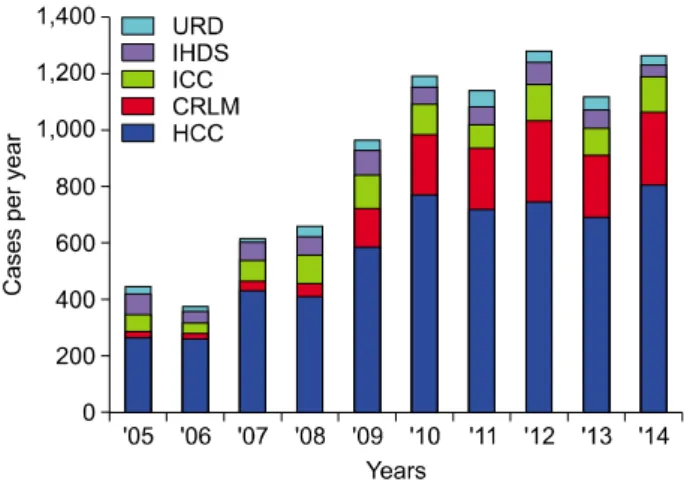
Fig. 1. Cumulative incidences of annual cases in the five dis- ease categories. HCC, hepatocellular carcinoma; ICC, intra- hepatic cholangiocarcinoma; IHDS, intrahepatic duct stone disease; CRLM, colorectal cancer liver metastasis; URD, un- common or rare diseases.
Fig. 2. Changes in the incidences of annual cases per disease category.
went HR, after excluding liver transplantation-associated surgery. At first, the cases were divided into two groups according to the role of HR. One group comprised cases of primary-purpose HR performed to directly remove liver lesions (e.g., hepatocellular carcinoma and intrahepatic cholangiocarcinoma), and the other group comprised cases of secondary-purpose HR performed along with other re- sectional procedures (e.g., bile duct cancer surgery or gall- bladder cancer surgery including HR). In order to make the design of the present study as simple and comprehen- sible as possible, we focused only on primary-purpose HR.
The study cohort was divided into 5 disease categories as follows: hepatocellular carcinoma (HCC), intrahepatic cholangiocarcinoma (ICC), intrahepatic duct stone disease (IHDS), colorectal cancer liver metastasis (CRLM), and uncommon or rare disease entities (URD) including he- mangioma, liver cyst, abscess and focal nodular hyperplasia. Other rare disease entities were not taken into
account in this study. Finally, the study cohort comprised 9,016 patients undergoing HR over the 10-year study period.
This retrospective cohort study was approved by the Institutional Review Board of our institution. Descriptive statistical analyses were performed using SPSS (version 20; IBM).
RESULTS
In the cohort of 9,016 HR cases, there were 5,661 (62.8%) HCC cases, followed by 1441 (16.0%) CRLM, 942 (10.5%) ICC, 638 (7.1%) IHDS, and 334 (3.7%) URD. A detailed profile of the annual incidences is given in Table 1. The total number of annual HR cases in- creased gradually from 443 in year 2005 to 1,260 in year 2015 (Fig. 1).
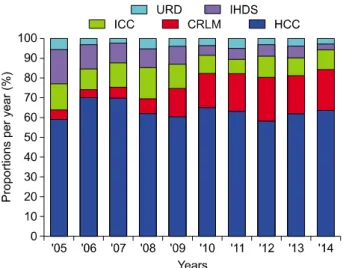
Annual HCC cases increased gradually from 262 in year 2005 to 803 in year 2014 (Fig. 2), but the annual proportion of HCC cases fluctuated narrowly between 58.3% and 70.2% (Fig. 3). Annual CRLM cases increased
Hwui-Dong Cho, et al. Changes in liver diseases requiring hepatic resection 51
Fig. 4. Changes in the proportions of annual cases in the hep- atocellular carcinoma (HCC) and intrahepatic cholangiocarcinoma (ICC) categories.
Fig. 3. Changes in the proportions of annual cases per disease category.
rapidly from 21 in year 2005 to 258 in year 2014 (Fig.
2), and the proportion of annual HR cases increased pro- gressively from 4.7% in year 2005 to 20.5% in 2014 (Fig.
3). Annual ICC cases increased slowly from 59 in year 2005 to 124 in year 2014 (Fig. 2), and their annual pro- portions fluctuated between 7.2% and 15.6% (Fig. 3).
Annual IHDS cases decreased slowly, and their annual proportions decreased progressively from 17.2% to 3.4%.
Annual URD cases fluctuated, with annual proportions varying between 2.3% and 5.6%. Considering only cases of HCC and ICC, the annual proportion of ICC cases also fluctuated between 10.3% and 20.1% (Fig. 4). Annual IHDS cases decreased slowly from 76 in year 2005 to 43 in year 2014 (Fig. 2). For IHDS, annual case numbers slowly decreased and their proportion of annual HR cases decreased progressively from 17.2% in 2005 to 3.4% in 2014 (Fig. 3). Annual URD cases fluctuated from 25 in year 2005 to 32 in year 2014 (Fig. 2), with annual pro- portions varying between 2.3% and 5.6%.
DISCUSSION
Over the last 10 years the annual number of adult pa- tients undergoing HR for abovementioned 5-category dis- eases in our institution nearly tripled from 443 in year 2005 to 1,260 in year 2015. A progressive increase in the number of HCC patients greatly contributed to this increase. Considering that liver cancer incidence de- creased slowly from 25.8 per 100,000 in 2005 to 21.1 per-
sons per 100,000 in 2012, such a marked increase in HCC cases undergoing HR may point to a centralization effect of this specific tertiary centre.1-3 We also presume that an- other reason is an increased preference for HR as HCC treatment over non-surgical treatments because a majority of the HCC were diagnosed early through routine screening. In fact, approximately 80% of solitary HCCs undergoing HR in our institution were detected during regular health screening or routine follow-up.4 The patient concentration via the centralization effect enabled us to establish high-volume HCC databases, from which we could obtain single-centre data for 2558 patients under- going resection of solitary HCC and 471 patients under- going resection of large HCC ≥10 cm.4,5
HR is being performed more frequently for CRLM than before, and this also contributed to the noticeable increase in the number of annual HR cases. This rapid increase may also reflect the recent increase in colorectal cancer prevalence in the general population from 31.0 per 100,000 in year 2005 to 37.3 per 100,000 in year 2012.2 The proportion of CRLM HR cases rose to around 20%
of all HR cases in 2014, indicating that HR is already an established treatment modality for CRLM combined with systemic chemotherapy,6-8 in Korea as in Western countries.
Annual cases of HR for ICC increased slowly, but their annual proportion fluctuated between 10.3% and 20.1% of the sum of ICC and HCC cases. Considering that ICC is rare compared with HCC,9-11 the high case number and proportion of ICC may reflect the centralization effect of
52 Korean J Hepatobiliary Pancreat Surg Vol. 20, No. 2, May 2016
this tertiary centre, where we were able to establish high-volume ICC databases and analyse the single-centre experiences of 659 patients undergoing resection for ICC.12 Although the actual incidence of ICC in the Korean gen- eral population is not available, it is generally accepted that its incidence is gradually increasing worldwide.9-11
Unlike CRLM, the annual number of cases of IHDS slowly decreased. Because of the progressive increase in annual HR volume, the proportion of IHDS rapidly and progressively decreased from 17.2% in year 2005 to 3.4%
in year 2014. This definite decreasing trend may reflect the recent effective management and prevention of Clonorchis sinensis and other inflammatory diseases as well as a higher frequency of non-surgical treatment for hepatobiliary stone diseases.13
We arbitrarily included hemangioma, liver cyst, abscess and focal nodular hyperplasia as the URD group, the fifth category requiring HR. The actual prevalence of these dis- eases in the general population is not low, but only a small proportion of the patients have undergone HR be- cause a majority of these diseases are not indicated for any surgical treatment.14-16
There are several limitations to this study. First, it was a retrospective, single-center study. Although the sample number was not small, HR case numbers and their pro- portions must have been greatly influenced by the cen- ter-specific centralization. Second, we could not reliably match the HR case numbers with the incidences of the corresponding diseases in the general population due to lack of nationwide registry data. Thus, high-volume mul- ti-center studies should be carried out to reveal the real trends in hepatobiliary diseases requiring HR.
In summary, annual cases of HR increased in a tertiary center over the last 10 years probably due to a cen- ter-specific centralization effect. Among them, the total number of CRLM cases rapidly increased; those of HCC and ICC increased gradually, and that of IHDS declined gradually. We believe that these results may reflect the real changes in the types of liver diseases requiring HR and that they will be useful for predicting further changes in the near future.
REFERENCES
1. Jung KW, Won YJ, Kong HJ, Oh CM, Lee DH, Lee JS. Cancer statistics in Korea: incidence, mortality, survival, and prevalence in 2011. Cancer Res Treat 2014;46:109-123.
2. Jung KW, Won YJ, Kong HJ, Oh CM, Cho H, Lee DH, et al.
Cancer statistics in Korea: incidence, mortality, survival, and prevalence in 2012. Cancer Res Treat 2015;47:127-141.
3. Jung KW, Won YJ, Oh CM, Kong HJ, Cho H, Lee DH, et al.
Prediction of cancer incidence and mortality in Korea, 2015.
Cancer Res Treat 2015;47:142-148.
4. Hwang S, Lee YJ, Kim KH, Ahn CS, Moon DB, Ha TY, et al. The impact of tumor size on long-term survival outcomes af- ter resection of solitary hepatocellular carcinoma: single-in- stitution experience with 2558 patients. J Gastrointest Surg 2015;19:1281-1290.
5. Hwang S, Lee YJ, Kim KH, Ahn CS, Moon DB, Ha TY, et al. Long-term outcome after resection of huge hepatocellular car- cinoma ≥ 10 cm: single-institution experience with 471 patients.
World J Surg 2015;39:2519-2528.
6. Yoon YS, Kim CW, Lim SB, Yu CS, Kim SY, Kim TW, et al. Palliative surgery in patients with unresectable colorectal liver metastases: a propensity score matching analysis. J Surg Oncol 2014;109:239-244.
7. Seo SI, Lim SB, Yoon YS, Kim CW, Yu CS, Kim TW, et al.
Comparison of recurrence patterns between ≤5 years and >5 years after curative operations in colorectal cancer patients. J Surg Oncol 2013;108:9-13.
8. Kim KH, Yoon YS, Yu CS, Kim TW, Kim HJ, Kim PN, et al.
Comparative analysis of radiofrequency ablation and surgical re- section for colorectal liver metastases. J Korean Surg Soc 2011;
81:25-34.
9. Njei B. Changing pattern of epidemiology in intrahepatic cholangiocarcinoma. Hepatology 2014;60:1107-1108.
10. Lubezky N, Facciuto M, Harimoto N, Schwartz ME, Florman SS. Surgical treatment of intrahepatic cholangiocarcinoma in the USA. J Hepatobiliary Pancreat Sci 2015;22:124-130.
11. Yamamoto M, Ariizumi S. Surgical outcomes of intrahepatic cholangiocarcinoma. Surg Today 2011;41:896-902.
12. Hwang S, Lee YJ, Song GW, Park KM, Kim KH, Ahn CS, et al. Prognostic impact of tumor growth type on 7th AJCC staging system for intrahepatic cholangiocarcinoma: a single-center ex- perience of 659 cases. J Gastrointest Surg 2015;19:1291-1304.
13. Cheon YK, Cho YD, Moon JH, Lee JS, Shim CS. Evaluation of long-term results and recurrent factors after operative and nonoperative treatment for hepatolithiasis. Surgery 2009;146:
843-853.
14. Hoffmann K, Unsinn M, Hinz U, Weiss KH, Waldburger N, Longerich T, et al. Outcome after a liver resection of benign lesions. HPB (Oxford) 2015;17:994-1000.
15. Ciria R, Cherqui D, Geller DA, Briceno J, Wakabayashi G.
Comparative short-term benefits of laparoscopic liver resection:
9000 cases and climbing. Ann Surg 2016;263:761-777.
16. Hau HM, Atanasov G, Tautenhahn HM, Ascherl R, Wiltberger G, Schoenberg MB, et al. The value of liver resection for focal nodular hyperplasia: resection yes or no? Eur J Med Res 2015;20:86.