ALK-Negative Systemic ALCL
Vol. 28, No. 3, 2016 371
Received November 13, 2015, Revised December 31, 2015, Accepted for publication January 7, 2016
Corresponding author: Joo Yeon Ko, Department of Dermatology, Hanyang University College of Medicine, 222 Wangsimni-ro, Seongdong-gu, Seoul 04763, Korea. Tel: 82-2-2290-8441, Fax: 82-2-2291-9619, E-mail:
This is an Open Access article distributed under the terms of the Creative Commons Attribution Non-Commercial License (http://creativecommons.
org/licenses/by-nc/4.0) which permits unrestricted non-commercial use, distribution, and reproduction in any medium, provided the original work is properly cited.
Copyright © The Korean Dermatological Association and The Korean Society for Investigative Dermatology
pISSN 1013-9087ㆍeISSN 2005-3894 Ann Dermatol Vol. 28, No. 3, 2016 http://dx.doi.org/10.5021/ad.2016.28.3.371
CASE REPORT
CD30-Positive Anaplastic Lymphoma Kinase-Negative Systemic Anaplastic Large-Cell Lymphoma
in a 9-Year-Old Boy
Jeong Eun Kim, Eui Hyun Oh, Young Suck Ro, Joo Yeon Ko
Department of Dermatology, Hanyang University College of Medicine, Seoul, Korea
Anaplastic large-cell lymphoma (ALCL) is a CD30-positive T-cell/null-cell lymphoma that is clinically classified into ei- ther primary cutaneous ALCL or systemic ALCL (S-ALCL) sub-types. Because 90% of childhood S-ALCL cases are ana- plastic lymphoma kinase (ALK)-positive, there is a lack of da- ta on ALK-negative S-ALCL cases among pediatric patients.
Herein, we report a rare case of ALK-negative S-ALCL in a 9-year-old Korean boy who initially presented with itchy er- ythematous maculopapules and an erosive nodule on the trunk area. We emphasize the need of high index of suspi- cion of an underlying malignant disease in the presence of re- fractory eczematous lesions. (Ann Dermatol 28(3) 371∼374, 2016)
-Keywords-
Anaplastic lymphoma kinase, Anaplastic large-cell lym- phoma, Eczema
INTRODUCTION
Anaplastic large-cell lymphoma (ALCL) is a CD30-positive
T-cell lymphoma that accounts for 10%∼15% of all pe- diatric non-Hodgkin’s lymphoma (NHL)1,2. The World Health Organization (WHO) divides ALCL into two groups: 1) a spectrum of CD30-positive T-cell lymphopro- liferative disorders that include lymphomatoid papulosis and primary cutaneous ALCL (C-ALCL) and 2) systemic ALCL (S-ALCL). S-ALCLs are further divided into anaplastic lymphoma kinase (ALK)-positive or ALK-negative subtypes.
In pediatric patients, ALK-negative ALCL accounts for less than 5% of cases, for which there is a lack of data3. Here, we present a rare case of CD30-positive ALK-neg- ative S-ALCL in a child who initially presented with an ec- zematous skin condition.
CASE REPORT
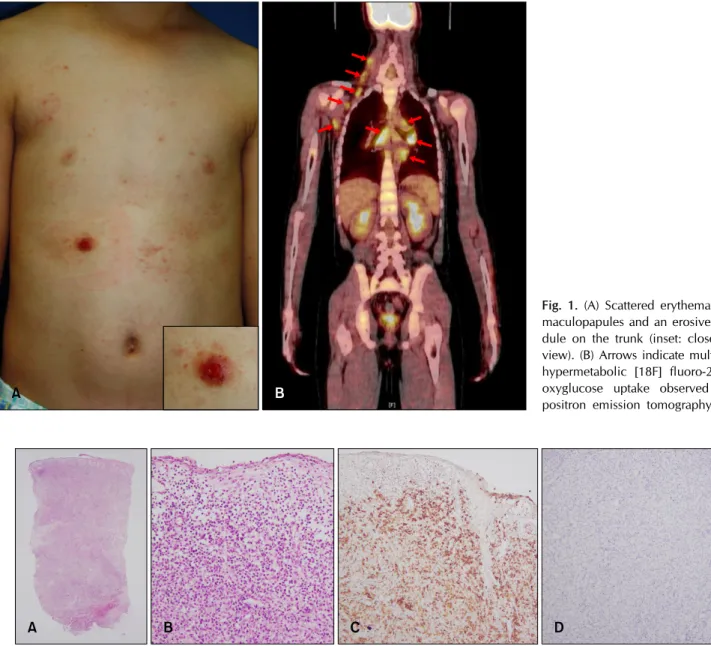
A 9-year-old Korean boy presented with a two-month his- tory of scattered erythematous maculopapules and an ero- sive nodule on his right upper abdomen (Fig. 1). At first, ti- ny itchy erythematous papular eruptions that did not re- spond to topical corticosteroid appeared, and then a nod- ular lesion developed. Although the nodular lesion was treated by incision and drainage along with oral anti- biotics at another hospital, the patient did not improve and subsequently experienced a nighttime fever of 39oC.
Skin biopsy from the erosive erythematous nodule showed pan-dermal infiltration of mixed inflammatory cells and pleomorphic large cells that had eccentric, horseshoe-shaped nuclei (Fig. 2A, B). Strong expression of CD30 in the membranes of these large cells was also observed (Fig.
2C). Other immunohistochemical staining of infiltrating cells indicated positive reaction to CD3, and CD4 with negative reaction to CD5, CD7, CD8, CD20, EMA, and ALK (Fig. 2D). Ki-67 was expressed over 70% of infiltrat- ing tumor cells.
JE Kim, et al
372 Ann Dermatol
Fig. 2. (A) A skin biopsy specimen from the erosive nodule showed epidermal erosion and diffuse dermal cellular infiltration (H&E,
×12.5). (B) The infiltration consisted of large atypical cells with eccentric nuclei admixed with inflammatory cells (H&E, ×200).
Immunohistochemical staining of the specimen showed positivity for (C) CD30 with a membranous staining pattern on large cells (×100), as well as negativity for (D) anaplastic lymphoma kinase (×100).
Fig. 1. (A) Scattered erythematous maculopapules and an erosive no- dule on the trunk (inset: close-up view). (B) Arrows indicate multiple hypermetabolic [18F] fluoro-2-de- oxyglucose uptake observed on positron emission tomography.
Laboratory findings revealed an elevated C-reactive protein level of 2.11 mg/dl (normal <0.3 mg/dl), while the other laboratory results were normal or negative.
Whole-body positron emission tomography (PET) scan- ning showed multiple hypermetabolic lymph nodes in the mediastinum, neck, right axilla, right supraclavicular area, and both the pulmonary interlobular areas. Bone marrow biopsy confirmed involvement of CD30-positive atypical lymphocytes. Therefore, we diagnosed the patient with stage IV CD30-positive ALK-negative S-ALCL and started chemotherapy using the Berlin-Frankfurt-Münster regimen.
After treatment, the scattered maculopapular lesions and
the erosive nodular lesion all regressed, and, one year lat- er, the patient has not experienced relapse (Fig. 3).
DISCUSSION
The diagnosis of ALCL is based upon the WHO classi- fication with the feature of CD30 positive “hallmark cells”.
Hallmark cells are medium to large pleomorphic cells with eccentric nuclei that are usually horseshoe- or kid- ney-shaped4. ALCL is a rare disease in children accounting for about 15% of childhood NHLs and there are limited clinical data regarding S-ALCL in pediatric patients. A pre-
ALK-Negative Systemic ALCL
Vol. 28, No. 3, 2016 373 Fig. 3. After chemotherapy, tiny papular lesions and a nodular
erosive lesion were regressed with a subtle biopsy scar (inset:
close-up view).
vious study of a pediatric Korean population showed that the incidence of childhood T-cell NHL, including S-ALCL cases, is higher than that in a similarly aged Western pop- ulation (20.5% vs. 10.3%), which is consistent with pre- vious findings of T-cell-type dominance among Korean pa- tients5,6.
Among children, 18%∼25% of S-ALCLs develop skin manifestations during the course of disease but S-ALCL presenting as skin lesion is very rare3. The clinical pre- sentation of C-ALCL is characterized by the solitary or lo- coregional occurrence of reddish-brown nodules and tu- mors, which frequently ulcerate. Fifty percent of patients with primary C-ALCL present with solitary lesions and 25% present with generalized lesions7. It is often difficult to distinguish between primary C-ALCL and S-ALCL with cutaneous involvement, but making the correct diagnosis is imperative because treatment strategies differ. Physicians usually consider phenotype, clinical course, and morphol- ogy during differential diagnosis.
ALCL immunophenotypic characteristics of C-ALCL versus S-ALCL could be distinct but may also vary within the subtypes. Because most C-ALCLs are ALK-negative and most S-ALCLs are ALK-positive, ALK status has been thought to be the most helpful feature to differentiate be- tween the two conditions7,8. However, there have been anecdotal case reports of ALK-positive C-ALCL cases and ALK-negative S-ALCL cases, such as in this case9,10. A pre- vious report discussed ALK-negative ALCL cases that were positive for clusterin but negative for CD3 and CD8, with variable CCR4 expression. The cytotoxic proteins gran- zyme B, perforin, and T-cell intracytoplasmic antigen-1
are seen in more than 80% of ALK-positive S-ALCL cases and in 50% of ALK-negative S-ALCL cases11. Although in other ALK-negative S-ALCL cases, CD3 positivity, CD4 negativity, and CD8 positivity were observed, our case had different T-cell marker immunophenotypic features10. Because of this immunophenotypic variability, we consid- ered C-ALCL in the differential diagnosis for a CD30-pos- itive ALK-negative ALCL with cutaneous involvement.
However, with multiple peripheral [18F] fluoro-2-deoxy- glucose uptake detected on the PET-scan and involvement of the bone marrow with atypical lymphoid cells, we fi- nally made a diagnosis of ALK-negative S-ALCL with skin involvement.
Treatment options for pediatric ALCL vary, but systemic polychemotherapy is indicated for S-ALCL, whereas a combination of surgical resection and radiation is the treatment of choice for C-ALCL. There is no consensus re- garding a standard treatment for S-ALCL; some oncologists use short-pulse chemotherapy and others use prolonged semicontinuous leukemia-type chemotherapy or repeated pulse-chemotherapy3. Although S-ALCL is highly chemo- sensitive, with complete remission rates ranging from 66%
to 100%, approximately 20 to 40% of patients will devel- op recurrent disease12,13.
S-ALCL prognosis has been reported to correlate with ALK expression, which most frequently occurs as a result of a t(2;5)(p23q35) translocation, which fuses the ALK gene on 2p23 to the nucleophosmin (NPM) gene on 5q35, activat- ing a unique NPM-ALK protein that acts like an oncogene.
ALK expression is specific to ALCL, because it is absent in postnatal human tissue, except in rarely occurring brain cells. It is also absent from lymphoid neoplasms other than ALCL and ALK-negative large B-cell lymphomas4. ALK-positive S-ALCL often occurs in males who are younger than 30 years old and has a more favorable prog- nosis, while ALK-negative S-ALCL usually affects older pa- tients (>60 years old) of both genders and has an un- favorable prognosis. However, different studies have reached various conclusions about the correlation of vari- ous prognostic factors with survival and the specific fea- tures that are associated with ALK-positive versus ALK-ne- gative disease4,12,14,15. The lack of a systemic review of ALK-negative S-ALCL in pediatric patients may be a re- flection of its rarity, making up ∼10% of ALCL cases.
Therefore, whether the excellent prognosis of ALK-positive S-ALCLs is due to younger age alone or is affected by pre- sentation stage, clinical parameters, and ALK fusion pro- teins remains controversial.
A large European intergroup study on childhood ALCL showed that 10% of ALCLs are ALK-negative S-ALCL. B symptom, mediastinal involvement, skin lesions, visceral
JE Kim, et al
374 Ann Dermatol
involvement, St. Jude stage 3∼4, Ann Arbor stage 3∼4, and elevated lactate dehydrogenase increased the risk of progression/relapse in univariate analysis. In multivariate analysis, three factors remained significant: mediastinal in- volvement, visceral involvement and skin lesions12. A Japanese study showed similar ALK expression and out- comes as the patients in the European reports16. However, a Chinese study found a higher percentage of ALK-neg- ative S-ALCL in a pediatric patient group (15/46, 32.6%)15. In that study, S-ALCL patients who had complete re- mission after induction chemotherapy had a better prog- nosis, and clinical stage at the time of diagnosis was the only significant independent prognostic factor15. Our pa- tient also achieved complete remission after induction chemotherapy and we have seen no evidence of re- currence thus far. Ethnic differences in the distribution or prognostic value of ALK expression in childhood ALCL cases are not well understood and should be studied further.
In this case, an initial skin lesion had an eczematous fea- ture and another newly developed nodular lesion was thought to be an infectious disease such as abscess before taking a biopsy. Therefore, if the eczematous skin lesion persists in a waxing-waning pattern or has systemic symp- toms, the attending physician should have a high level of suspicion of malignant disease and a skin biopsy should be performed. Moreover, classification of ALCL subtypes with clinical and immunotypical features is important for treatment and prognosis. Increasing knowledge of rare lymphoma subtypes may improve progress in treating this disease.
REFERENCES
1. Sandlund JT, Pui CH, Roberts WM, Santana VM, Morris SW, Berard CW, et al. Clinicopathological features and treatment outcomes of children with large cell lymphoma and t(2;5)(p23;q35). Blood 1994;84:2467-2471.
2. Wright D, McKeever P, Carter R. Childhood non-Hodgkin lymphomas in the United Kingdom: findings from the UK children’s cancer study group. J Clin Pathol 1997;50:
128-134.
3. Lowe EJ, Gross TG. Anaplastic large cell lymphoma in children and adolescents. Pediatr Hematol Oncol 2013;
30:509-519.
4. Stein H, Foss HD, Dürkop H, Marafioti T, Delsol G, Pulford K, et al. CD30(+) anaplastic large cell lymphoma: a review of histopathologic, genetic and clinical features. Blood 2000;96:3681-3695.
5. Hwang IG, Yoo KH, Lee SH, Park YH, Lim TK, Lee SC, et
al. Clinicopathologic features and treatment outcomes in malignant lymphoma of pediatric and young adult patients in Korea: comparison of korean all-ages group and Western younger age group. Clin Lymphoma Myeloma 2007;7:
580-586.
6. Burkhardt B, Zimmermann M, Oschlies I, Niggli F, Mann G, Parwaresch R, et al. The impact of age and gender on biology, clinical features and treatment outcome of non- Hodgkin lymphoma in childhood and adolescence. Br J Haematol 2005;131;39-49.
7. Kocabaş E, Türel Ermertcan A, Akinci S, Temiz P, Gündüz K. Primary cutaneous CD30-positive anaplastic large cell lymphoma in a 16-year-old girl. Int J Dermatol 2012;51:
1353-1358.
8. Kim HS, Sim SJ, Kim DC, Kim JS, Song KH, Kim KH. A case of ALK-negative systemic anaplastic large cell lymphoma.
Ann Dermatol 2004;16:125-131.
9. Oschlies I, Lisfeld J, Lamant L, Nakazawa A, d'Amore ES, Hansson U, et al. ALK-positive anaplastic large cell lym- phoma limited to the skin: clinical, histopathological and molecular analysis of 6 pediatric cases. A report from the ALCL99 study. Haematologica 2013;98:50-56.
10. Ju E, Adigun C, Dunphy C, Gold S, Morrell DS. Anaplastic large cell lymphoma: an unusual presentation in a 7-year-old girl. Pediatr Dermatol 2012;29:498-503.
11. ten Berge RL, Oudejans JJ, Ossenkoppele GJ, Meijer CJ.
ALK-negative systemic anaplastic large cell lymphoma:
differential diagnostic and prognostic aspects--a review. J Pathol 2003;200:4-15.
12. Le Deley MC, Reiter A, Williams D, Delsol G, Oschlies I, McCarthy K, et al. Prognostic factors in childhood anaplastic large cell lymphoma: results of a large European intergroup study. Blood 2008;111:1560-1566.
13. Brugières L, Quartier P, Le Deley MC, Pacquement H, Perel Y, Bergeron C, et al. Relapses of childhood anaplastic large-cell lymphoma: treatment results in a series of 41 children--a report from the French Society of Pediatric Oncology. Ann Oncol 2000;11:53-58.
14. Savage KJ, Harris NL, Vose JM, Ullrich F, Jaffe ES, Connors JM, et al. ALK-anaplastic large-cell lymphoma is clinically and immunophenotypically different from both ALK+ ALCL and peripheral T-cell lymphoma, not otherwise specified:
report from the international peripheral T-Cell lymphoma project. Blood 2008;111:5496-5504.
15. Wang YF, Yang YL, Gao ZF, Zhou CJ, Gregg X, Shi YF, et al. Clinical and laboratory characteristics of systemic anaplastic large cell lymphoma in Chinese patients. J Hematol Oncol 2012;5:38.
16. Mori T, Kiyokawa N, Shimada H, Miyauchi J, Fujimoto J.
Anaplastic large cell lymphoma in Japanese children:
retrospective analysis of 34 patients diagnosed at the National Research Institute for Child Health and De- velopment. Br J Haematol 2003;121:94-96.