Introduction
Each year, gunshot injuries constitute approximately 13% to 17% of all vertebra and spinal cord injuries.9) The severity of spinal damage due to gunshot injury depends on mechanical factors of the gun and biological factors. Dam- aging mechanism of this kind of injuries can be explained with velocity of the bullet and transfer of its kinetic energy to the tissue. Thus bullet dimensions and its velocity become the most important factors affecting magnitude of the tis- sue damage. On the other hand civilian guns have general- ly lower velocity and did not cause severe tissue damage.4) Gunshot injuries to the spine at cervical level frequently cause spinal cord dysfunction and death as a result of respi-
ratory distress followed by brainstem damage. In addition to neurological dysfunction, gunshot injuries to the cervical area may cause mechanical instability. Patients rarely gain their normal function after injuries of low velocity guns.12) Gunshot injuries do not have a clear treatment protocol. In- complete neurological deficit, mechanical instability, ce- rebrospinal fluid fistula, risk of migration of the bullet or its fragments within the canal and bullet intoxication are gen- erally accepted criteria for surgical operations.18) Irrespec- tive of the indications of spinal surgery, additional organ injuries unfavorably affect survival in spinal gunshot inju- ries. In this case report, we shared the gunshot injury at C6-7 level which caused an incomplete isolated C7 root damage, treated surgically and resulted in a very good out- come which is not very common for this kind of injuries.
Case Report
A 24-year-old male patient admitted to the emergency room with civilian gunshot injury. In physical examina- tion, gunshot entrance wound was observed at left poste- rior cervical area. In neurological examination, severe pain in the left arm was detected; muscle strength was scaled 2/5 for extension of the left forearm and 3/5 for flexion of the
Incomplete Isolated C7 Root Injury Caused by Gunshot Wound:
A Case Report
Ulvi Çiftçi1, Ahmet Tolgay Akıncı2, Emre Delen3, and Doğan Güçlühan1
1Department of Neurosurgery, Bakırköy Sadi Konuk Training and Research Hospital, Istanbul, Turkey
2Department of Neurosurgery, Tokat State Hospital, Tokat, Turkey
3Department of Neurosurgery, Edirne State Hospital, Edirne, Turkey
Gunshot wounds to the spine cause severe neurological and/or internal organs damages. Although most of publications in the literature are realized on military injuries, increased civilian arming which raises civilian gunshot injuries is a new so- cial danger causing serious health problems. In gunshot injuries to the spine; vertebral column, spinal cord and nerve roots are damaged with direct, indirect and transient cavitation related mechanisms. In this case report, we present 24 years old male patient who had severe pain and monoparesis in left upper extremity followed by gunshot injury to the spine with clini- cal, radiological and postoperative follow-up findings.
(Korean J Neurotrauma 2017;13(1):45-49) KEY WORDS: Cervical vertebrae ㆍGunshot wound ㆍNerve root compression.
Received: October 6, 2016 / Revised: October 29, 2016 Accepted: December 8, 2016
Address for correspondence: Ahmet Tolgay Akıncı
Department of Neurosurgery, Tokat State Hospital, Gültekin Top- çam Cad. No: 76, Tokat 60100, Turkey
Tel: +90-356-214-5400, Fax: +90-356-214-5400 E-mail: [email protected]
cc This is an Open Access article distributed under the terms of Cre- ative Attributions Non-Commercial License (http://creativecommons.
org/licenses/by-nc/4.0/) which permits unrestricted noncommercial use, distribution, and reproduction in any medium, provided the original work is properly cited.
Korean J Neurotrauma 2016;12(2):45-49 https://doi.org/10.13004/kjnt.2017.13.1.45
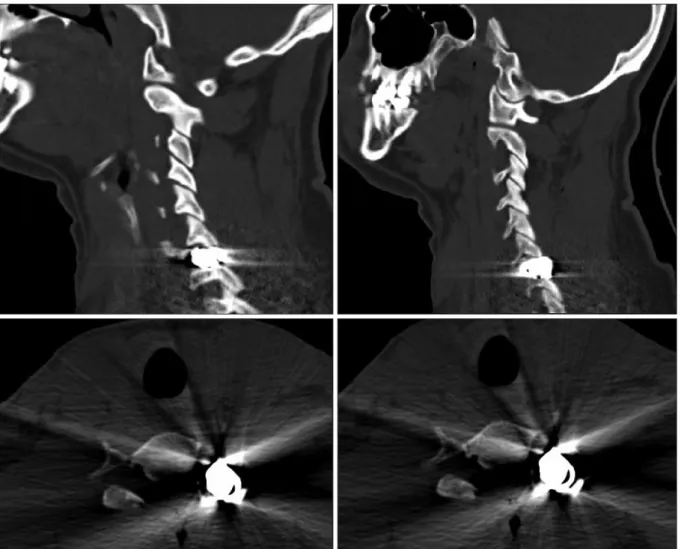
left wrist. In cervical computerized tomography (CT), me- tallic hyperdensity on the left side facet joint level within range of C6-7 discs and bone fragment in C6-7 left para- central area were detected (Figure 1). Because of close neigh- borhood of the metallic foreign body to left transvers fora- men, digital subtraction angiography was realized to observe vascular damage in vertebral artery. Any finding related to laceration or dissection in vertebral artery was not detect- ed (Figure 2).
We decided for a surgical intervention provided that an incomplete neurological deficit was present and aimed to reduce the pain, the main current complaint. We performed emergent surgery on the patient. Metallic foreign body which was considered as bullet and compressing left C7 root on facet joint level of C6-7 disc and bone fragment in left para- central area were removed with posterior approach. In post- operative early period neurological examination, muscle strength of the patient was detected 3/5 for extension of the left forearm and 4/5 for flexion of the left wrist. We checked with cervical CT that the metallic foreign body
and the bone fragment were entirely removed (Figure 3).
We observed changes secondary to operation in cervical magnetic resonance imaging at C6-7 corpus level. We did not detect any pathology compressing C7 root at C6-7 lev- el (Figure 4).
A written consent for the publication of this report was obtained from the patient.
Discussion
Gunshot injuries to the spine constitute approximately 13% to 17% of all spinal cord injuries and are the third most common reason of spinal cord injuries after traffic acci- dents and falls from an elevation.5) Trauma intensity depends on localization. Spinal injuries are localized 48% to 64%
on thoracic area, 19% to 37% on lumbar area and 10% to 29% on cervical area.7,11,15) It is reported that the rate of in- jury to large vessels or to internal organs alongside with spi- nal injuries is 21% to 64%. Gunshot injuries to cervical area may also cause mechanical instability.3,10)
FIGURE 1. Sagital and axial computed tomography images cross-sectionning the bullet.
Treatment in gunshot wounds to the spine is still contro- versial. In military injuries, surgery is mostly suggested to prevent complications of large damages caused by high ve- locity guns. On the other hand in civilian injuries, damage is generally more limited due to lower velocity of the guns.
Thus conservative approach with parenteral antibiotic treat- ment is suggested except for especially cauda/conus area wounds and progressive neurological deterioration.1-3,10)
Indications for surgery with the main lines are progres- sive neurological deterioration; existence of compressing bone fragment, intervertebral disc or foreign body into the spinal canal; cerebrospinal fluid fistula; cauda/conus inju- ries; spinal instability; abscess formation and pain syndromes in late period. Consequently CT is highly important to de- termine integrity of these components. In case of instabil-
ity, internal fixation should be realized. Henceforth patients can start early functional exercises.8) It has been reported by Robertson and Simpson17) that radicular pain in patients with penetrant caudal spinal injuries was recovered after decompressive laminectomy and removal of the fragment.
Besides Waters and Adkins19) have reported that the pain was not relieved after removal of the bullet.
Vertebral artery injury is less observed than the other vas- cular components’ injuries due to its profound location in cervical area and its well protection by bones, muscles and fascias.6) Vertebral artery injuries lead to ischemic neuro- logical findings and high fatality rate. Symptoms are acute or slowly progressive unconsciousness, brainstem and cra- nial nerves findings, aphasia, dysphasia, facial paralysis, extraocular muscles paralysis, nausea, vomiting and dizzi- FIGURE 2. Digital substraction angiography images showing no arterial damage.
FIGURE 3. Sagital and axial computed tomography images cross-sectionning the post-operative region.
FIGURE 4. Sagital magnetic resonance images cross-sectionning the post-operative region.
ness.14) Angiography should be absolutely performed in di- agnosis of artery injuries to locate lesion, to define its type, to show existence of a vasospasm, obstruction, dissection, aneurysm and fistula; and also to observe vertebral artery of the opposite side.16,20) Müller et al.13) have reported that vertebral artery damage was observed in 20% of the pa- tients having transvers foramen fracture and in 31% of the patients having cervical subluxation/dislocation.
Conclusion
Although it was not a very difficult one, our decision for this case was surgical intervention due to an incomplete neurological deficit. Our case had decompressive surgery due to severe left arm pain and muscle weakness in the left forearm extension and in the left wrist flexion. We observed explicit relief in pain and recovery of left upper extremity weakness after removal of the bullet and the bone frag- ment. Surgical intervention is not often the chosen path for the treatment of gunshot wounds to the spine, nevertheless it might lead to very good outcomes in selected cases with incomplete neurological deficit.
■ The authors have no financial conflicts of interest.
REFERENCES
1) Aarabi B, Alibaii E, Taghipur M, Kamgarpur A. Comparative study of functional recovery for surgically explored and conserva- tively managed spinal cord missile injuries. Neurosurgery 39:
1133-1140, 1996
2) Aryan HE, Amar AP, Ozgur BM, Levy ML. Gunshot wounds to the spine in adolescents. Neurosurgery 57:748-752; discussion 748-752, 2005
3) Bono CM, Heary RF. Gunshot wounds to the spine. Spine J 4:230- 240, 2004
4) Dalgic A, Okay O, Nacar O, Daglioglu E, Pasaoglu L, Belen D. Ver- tebral artery insult at the transverse foramina by gun shot wounds:
report of two cases. Turk Neurosurg 19:413-416, 2009
5) Farmer JC, Vaccaro AR, Balderston RA, Albert TJ, Cotler J. The
changing nature of admissions to a spinal cord injury center: vio- lence on the rise. J Spinal Disord 11:400-403, 1998
6) Golueke P, Sclafani S, Phillips T, Goldstein A, Scalea T, Duncan A.
Vertebral artery injury--diagnosis and management. J Trauma 27:
856-865, 1987
7) Heary RF, Vaccaro AR, Mesa JJ, Balderston RA. Thoracolumbar infections in penetrating injuries to the spine. Orthop Clin North Am 27:69-81, 1996
8) Hecimovic I, Vrankovic D, Rubin O, Maksimovic Z, Rukovanjski M. Transoral missile removal from the anterior C1 region follow- ing transpharyngeal missile wound. Arch Orthop Trauma Surg 119:340-343, 1999
9) Hossin J, Joorabian M, Pipelzadah M. A firearm bullet lodged into the thoracic spinal canal without vertebral bone destruction: a case report. J Med Case Rep 5:289, 2011
10) Kahraman S, Gonul E, Kayali H, Sirin S, Duz B, Beduk A, et al.
Retrospective analysis of spinal missile injuries. Neurosurg Rev 27:42-45, 2004
11) Klein Y, Cohn SM, Soffer D, Lynn M, Shaw CM, Hasharoni A.
Spine injuries are common among asymptomatic patients after gun- shot wounds. J Trauma 58:833-836, 2005
12) Mangiardi JR, Alleva M, Dynia R, Zubowski R. Transoral remov- al of missile fragments from the C1-C2 area: report of four cases.
Neurosurgery 23:254-257, 1988
13) Müller CA, Peters I, Podlogar M, Kovacs A, Urbach H, Schaller K, et al. Vertebral artery injuries following cervical spine trauma: a prospective observational study. Eur Spine J 20:2202-2209, 2011 14) Parent AD, Harkey HL, Touchstone DA, Smith EE, Smith RR. Lat- eral cervical spine dislocation and vertebral artery injury. Neuro- surgery 31:501-509, 1992
15) Peacock WJ, Shrosbree RD, Key AG. A review of 450 stabwounds of the spinal cord. S Afr Med J 51:961-964, 1977
16) Reid JD, Weigelt JA. Forty-three cases of vertebral artery trauma.
J Trauma 28:1007-1012, 1988
17) Robertson DP, Simpson RK. Penetrating injuries restricted to the cauda equina: a retrospective review. Neurosurgery 31:265-269;
discussion 269-270, 1992
18) Seçer M, Ulutaş M, Alagöz F, Uçkun ÖM, Çınar K, Yel C, et al.
Relationship of biological factors to survival in spinal gunshot in- juries. Ulus Travma Acil Cerrahi Derg 22:253-258, 2016 19) Waters RL, Adkins RH. The effects of removal of bullet fragments
retained in the spinal canal. A collaborative study by the National Spinal Cord Injury Model Systems. Spine (Phila Pa 1976) 16:934- 939, 1991
20) Wener L, Di Chiro G, Gargour GW. Angiography of cervical cord injuries. Radiology 112:597-604, 1974