Inflammatory pseudotumor is a benign reaction that has been described in both genders of all ages, and in al- most any location (1, 2). It is characterized histologically by the presence of acute and chronic inflammatory cells with a variable fibrous response (2). Its pathogenesis is uncertain, but the lesion is generally regarded as reac- tive or postinfectious, and it originates from an inflam- matory process (2). It has been reported to occur in
many organs, including the lung and orbit, though its oc- currence in the lymph node is rare. To the best of our knowledge, only a few cases of inflammatory pseudotu- mor of the lymph node have been described in the liter- ature (3-6). Two of these reports included the radiolog- ic findings of inflammatory pseudotumor affecting the lymph nodes (4, 6).
We describe the CT findings of inflammatory pseudo- tumor of the inguinal lymph node.
Case Report
A 35-year-old man presented with a palpable mass of several years duration in the left inguinal area. He was otherwise well with no symptoms of unexplained fever, night sweats and weight loss.
Physical examination revealed a hard, non-tender mass, which was presumed to be lymph node enlarge- ment. There was no evidence of enlargement of the oth- er nodal groups or hepatosplenomegaly.
J Korean Radiol Soc 2007;57:459-462
─ 459 ─
Inflammatory Pseudotumor of the Inguinal Lymph Node: A Case Report1
Sung Bin Park, M.D.1,2, Yong Seok Lee, M.D., Ah-Young Kim, M.D., Yong Hae Baik, M.D.3
1Department of Radiology, Dongguk University International Hospital, Dongguk University
2Departments of Radiology, Ulsan University Hospital, University of Ulsan
3Department of Surgery, Dongguk University International Hospital, Dongguk University
Received July 26, 2007 ; Accepted September 12, 2007
Current adress of Sung Bin Park: Department of Radiology, Ulsan University Hospital, University of Ulsan, 290-3, Jeonha-dong, Ulsan 682- 714, Korea.
Address reprint requests to : Sung Bin Park, M.D., Department of Radiology, Dongguk University International Hospital, Dongguk University, College of Medicine, 814 Siksa-dong, Ilsandong-gu, Goyang- si, 410-773, Korea
Tel. 82-31-961-7839 Fax. 82-31-961-7802 E-mail: [email protected]
Inflammatory pseudotumor of a lymph node is a rare cause of benign inguinal lym- phadenopathy, and this mimics the malignant causes of inguinal lymphadenopathy.
The imaging features of inflammatory pseudotumor affecting the inguinal lymph nodes have not previously been described. We report here on a case in which the le- sion was depicted on the contrast-enhanced CT scan as a well-defined mass with strong enhancement. Inflammatory pseudotumor of a lymph node may be included as one of the rare causes of inguinal lymphadenopathy.
Index words :Lymph nodes
Tomography, X-ray computed Granuloma, plasma cell Groin
Diagnosis, differential
The initial investigations, including the complete blood count, electrolytes, liver function tests and chest radiograph, were all within their normal ranges. The Epstein-Barr virus serology and autoimmune antibodies were also negative.
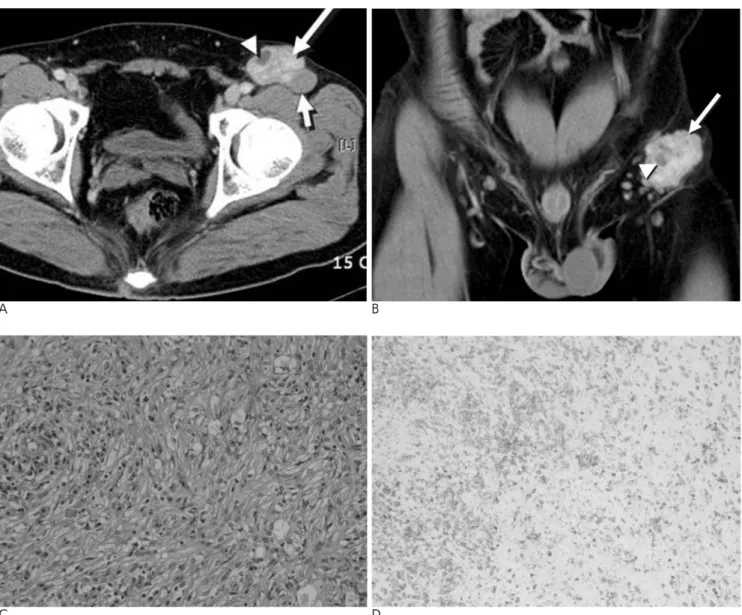
Contrast-enhanced CT scan of the abdomen and pelvis showed about a 5.0×3.0 cm sized well defined mass with strong enhancement in the left inguinal area.
Focal low density within the mass, which was pre- sumed to be necrosis or cystic change, was also shown.
Abutting and invasion to the adjacent muscle was evi- dent (Fig. 1). The radiologic diagnosis was lym- phadenopathy. Contrast-enhanced CT scan of the chest showed no abnormal findings such as primary foci or other lymphadenopathies. Excisional biopsy was per- formed. The pathologic results indicated inflammatory pseudotumor of the left inguinal lymph node.
Sung Bin Park, et al: Inflammatory Pseudotumor of the Inguinal Lymph Node
─ 460 ─ B A
C D
Fig. 1. A 35-year-old man with inflammatory pseudotumor of the inguinal lymph node.
A, B. Axial (A) and coronal (B) images of the contrast-enhanced CT scan show about a 5.0×3.0 cm sized well defined mass with strong enhancement (long arrow) in the left inguinal area. Focal low density within the mass (arrowhead), presumed to be necrosis or cystic change, is also shown. Abutting and invasion to the adjacent muscle (short arrow) are evident. Excisional biopsy was per- formed.
C. Photomicrograph of a histologic specimen shows cytologically bland spindle cells (myofibroblasts) with a prominent mixture of lymphocytes and plasma cells that are replacing the lymph node structures (H & E staining, original magnification ×100).
D. Photomicrograph of an immunohistochemistric specimen for detecting smooth muscle actin shows the strong immunoreactivi- ty of the myofibroblasts (original magnification ×100). The pathologic results indicated inflammatory pseudotumor arising from an inguinal lymph node.
Discussion
Inflammatory pseudotumor is a chronic inflammatory tumefaction of an unknown origin. Because the term
“inflammatory pseudotumor” is nonspecific and these lesions have a variety of histologic presentations, several alternative names have been used to refer to them: in- flammatory myofibroblastic tumor, plasma cell granulo- ma or pseudotumor, xanthomatous pseudotumor, pseu- dosarcomatous myofibroblastic proliferation, inflamma- tory myofibroblastic proliferation and myofibroblas- toma. The term “inflammatory myofibroblastic tumor”
has recently come to be commonly used on the basis of the electron microscopic and immunohistochemical findings (1, 7). The World Health Organization (WHO) continues to classify inflammatory myofibroblastic tu- mor as a distinct borderline lesion with uncertainty as to whether it is reactive or neoplastic in nature.
A number of cases have been reported since the first description of inflammatory pseudotumor of the lymph nodes was published in 1988 (3); this tumor shows no predilection for any age, gender or ethnicity. It is a be- nign form of lymphadenopathy, usually involving a sin- gle node, but multiple nodes may be also affected at one or more sites. Moran et al. (5) described three stages; in the first stage there are multiple small foci of spindle cell proliferation and inflammatory response with preserved nodal architecture and no fibrosis. In the following two stages, there is progressive destruction of nodal architec- ture with initially increasing inflammatory and fibrob- lastic infiltrate and then complete replacement of the node by sclerosis is finally observed.
One third of the patients present with asymptomatic nodal enlargement. The rest have pain or constitutional symptoms such as fever and weight loss. Symptomatic patients usually present with several laboratory abnor- malities (elevation in the erythrocyte sedimentation rate, mild anemia, polyclonal hypergammaglobuline- mia, peripheral eosinophilia and increased lactate dehy- drogenase) and evidence of one or more enlarged lymph nodes (3). One of the most important problems is the un- explained fever. The differential diagnosis of the unex- plained fever has to be made among a large number of clinical entities, and some of which are malignancies.
Because the usual presence of fever, fatigue, night sweats, palpable lymph nodes, and spleen enlargement is associated with an insidious and prolonged onset of disease, clinicians may consider the diagnosis of lym-
phomatous malignant processes to be responsible for the clinical picture. Only histologic evidence can allow a correct diagnosis. Because inflammatory pseudotumors mimic malignant tumors both clinically and radiologi- cally, the radiologist should be familiar with this entity and so avoid unnecessary radical surgery when possi- ble.
On the radiologic report of inflammatory pseudotu- mor involving lymph node by Gunny (4), contrast-en- hanced CT of the neck demonstrated several lymph nodes with uniform low attenuation and the tumor did not demonstrate significant contrast enhancement. MRI of the neck demonstrated peripheral intermediate signal intensity with central hypointensity on the T1 weighted imaging and peripheral hypointensity with central hy- perintensity on the T2 weighted and STIR imaging.
With gadolinium, the lymph nodes demonstrated avid rim enhancement extending into the adjacent fat planes and overlying sternocleidomastoid muscle. On another radiologic report of inflammatory pseudotumor involv- ing lymph node by Spannuth (6), contrast-enhanced CT of the abdomen and pelvis demonstrated an ill-defined, retroperitoneal soft-tissue density, and lymphadenopa- thy.
Conversely, in our study, the contrast-enhanced CT scan showed a well defined mass with strong enhance- ment in the left inguinal area, like that of the previous reports (8-10). The radiologic findings of inflammatory pseudotumor are nonspecific. US demonstrates a vari- able pattern of echogenicity, and the lesion has been de- scribed as hypo- or hyperechogenic with ill-defined or well-defined margins (8). Contrast-enhanced CT may demonstrate homo- or heterogeneity and hypo-, iso- or hyperdensity (9). Delayed enhancement has frequently been observed in these inflammatory pseudotumors, probably because of the accumulation of extravascular contrast media in the fibrotic component within the mass (10). These variable radiologic findings may be at- tributed to varying degrees of fibrosis, cellular infiltra- tion and the dynamic change occurring during the in- flammatory process.
In summary, we report here on a case of inflammato- ry pseudotumor of an inguinal lymph node, which is a very rare inguinal lymphadenopathy. The lesion was depicted on the contrast-enhanced CT scan as a well-de- fined mass with strong enhancement. This tumor may be included as one of the rare causes of inguinal lym- phadenopathy.
J Korean Radiol Soc 2007;57:459-462
─ 461 ─
References
1. Coffin CM, Watterson J, Priest JR, Dehner LP. Extrapulmonary in- flammatory myofibroblastic tumor (inflammatory pseudotumor):
A clinicopathologic and immunohistochemical study of 84 cases.
Am J Surg Pathol 1995;19:859-872
2. Narla LD, Newman B, Spottswood SS, Narla S, Kolli R.
Inflammatory pseudotumor. Radiographics 2003;23:719-729 3. Perrone T, De Wolf-Peeters C, Frizzera G. Inflammatory pseudo-
tumor of lymph nodes: a distinctive pattern of nodal reaction. Am J Surg Pathol 1988;12:351-361
4. Gunny RS, Akhbar N, Connor SE. CT and MRI appearances of in- flammatory pseudotumor of the cervical lymph nodes. Br J Radiol 2005;78:651-654
5. Moran CA, Suster S, Abbondanzo SL. Inflammatory pseudotumor of lymph nodes: a study of 25 cases with emphasis on morphologi-
cal heterogeneity. Hum Pathol 1997;28:332-338
6. Spannuth WA, Leath CA 3rd, Conner MG, Alvarez RD.
Inflammatory pseudotumor of pelvic lymph nodes. Obstet Gynecol 2006;108:779-782
7. Coffin CM, Dehner LP, Meis-Kindblom JM. Inflammatory myofi- broblastic tumor, inflammatory fibrosarcoma, and related lesions:
an historical review with differential diagnostic considerations.
Semin Diagn Pathol 1998;15:102-110
8. Materne R, Van Beers BE, Gigot JF, Horsmans Y, Lacrosse M, Pringot J. Inflammatory pseudotumor of the liver: MRI with man- gafodipir trisodium. J Comput Assist Tomogr 1998;22:82-84 9. Abehsera M, Vilgrain V, Belghiti J, Flejou JF, Nahum H.
Inflammatory pseudotumor of the liver: radiologic-pathologic cor- relation. J Comput Assist Tomogr 1995;19: 80-83
10. Nam KJ, Kang HK, Lim JH. Inflammatory pseudotumor of the liv- er: CT and sonographic findings. AJR Am J Roentgenol 1996;
167:485-487
Sung Bin Park, et al: Inflammatory Pseudotumor of the Inguinal Lymph Node
─ 462 ─
대한영상의학회지 2007;57:459-462
서혜부 림프절의 염증성 가성종양: 증례 보고1
1동국대학교 일산병원 영상의학과
2울산대학교병원 영상의학과
3동국대학교 일산병원 외과 박성빈1,2・이용석・김아영・ 백용해3
서혜부 림프절의 염증성 가성종양은 악성 서혜부 림프절 종대와 비슷한 양성 서혜부 림프절 종대의 드문 원인이 다. 서혜부 림프절 종대로 나타난 염증성 가성종양의 영상 소견은 보고된 바 없다. 이 증례보고에서 주변과 경계가 좋은 조영증강이 잘되는 종괴로 나타났다. 서혜부 림프절 종대의 드문 원인의 하나로 포함되어야 할 것으로 생각된 다.