ABSTRACT
Background: In accordance with the guidelines for the expectant management of women exposed to previable preterm premature rupture of membrane, we compared neonatal outcomes according to the latent period from membrane rupture to delivery among extremely preterm infants exposed to maternal preterm premature rupture of membrane using the Korean Neonatal Network database.
Methods: Of the 3,305 extremely preterm infants born at 23–27 weeks' gestation between 2014 and 2017 who were registered in the Korean Neonatal Network, 1,464 infants were born to pregnant women who were exposed to preterm premature rupture of membrane. The short latency group was defined as infants born with a latent period between membrane rupture and delivery < 7 days (n = 450), whereas the prolonged latency group was defined as infants born with a latent period of ≥ 7 days (n = 434). Using well-established risk factors for adverse short-term outcomes, multivariate logistic regression analysis was performed to assess a prolonged latent period in preterm premature rupture of membrane as an independent risk factor for neonatal outcomes in extremely preterm infants exposed to preterm premature rupture of membrane.
Results: The mean gestational age at membrane rupture in the prolonged latency group was significantly lower than that in the short latency group (22.7 ± 2.5 vs. 25.4 ± 1.3 weeks, P < 0.001). Nevertheless, the mean gestational age at delivery and birth weight were not significantly different between the two groups. The incidence of oligohydramnios and histologic chorioamnionitis in the prolonged latency group was significantly higher than that in the short latency group (38.7 [155/401] vs. 26.1 [105/403], 69.8 [270/384] vs. 61.0 [242/397], respectively, P < 0.05). The survival rate in the prolonged latency group did not differ from that in the short latency group (71.2 [309/434] vs. 73.3 [330/450], P = 0.478). Although the prolonged latency group was not associated with mortality during hospitalization in the multivariate logistic regression analysis, the prolonged latency group's early pulmonary hypertension and bronchopulmonary dysplasia rates were increased by 1.8 and 1.5 times, respectively.
Original Article
Received: Sep 10, 2020 Accepted: Mar 3, 2021 Address for Correspondence:
Yun Sil Chang, MD, PhD
Department of Pediatrics, Samsung Medical Center, Sungkyunkwan University School of Medicine, 81 Irwon-ro, Gangnam-gu, Seoul 06351, Korea.
E-mail: [email protected]
© 2021 The Korean Academy of Medical Sciences.
This is an Open Access article distributed under the terms of the Creative Commons Attribution Non-Commercial License (https://
creativecommons.org/licenses/by-nc/4.0/) which permits unrestricted non-commercial use, distribution, and reproduction in any medium, provided the original work is properly cited.
ORCID iDs Jae Hyun Park
https://orcid.org/0000-0001-8953-3695 Jin Gon Bae
https://orcid.org/0000-0001-6127-162X Yun Sil Chang
https://orcid.org/0000-0001-9201-2938 Funding
This work was supported by the Research Program funded by the Korea National Institute of Health (2019 ER7103 02#).
Disclosure
The authors have no potential conflicts of interest to disclose.
Jae Hyun Park ,1 Jin Gon Bae ,2 and Yun Sil Chang 3
1Department of Pediatrics, Keimyung University Dongsan Medical Center, Daegu, Korea
2Department of Obstetrics and Gynecology, Keimyung University Dongsan Medical Center, Daegu, Korea
3 Department of Pediatrics, Samsung Medical Center, Sungkyunkwan University School of Medicine, Seoul, Korea
Neonatal Outcomes according to the Latent Period from Membrane Rupture to Delivery among Extremely Preterm Infants Exposed to Preterm Premature Rupture of Membrane: a Nationwide Cohort Study
Pediatrics
Author Contributions
Conceptualization: Park JH, Bae JG, Chang YS. Data curation: Park JH, Chang YS. Formal analysis: Park JH, Chang YS. Methodology:
Park JH, Bae JG, Chang YS. Writing - original draft: Park JH. Writing - review & editing: Bae JG, Chang YS.
Conclusion: A prolonged latent period of 7 days or more does not affect the survival rate but increases the risk of bronchopulmonary dysplasia occurrence among extremely preterm infants who are exposed to maternal preterm premature rupture of membrane.
Keywords: Fetal Membranes; Premature Rupture; Mortality; Infant; Extremely Premature
INTRODUCTION
According to the American College of Obstetricians and Gynecology (ACOG), the management of premature rupture of membranes is based on the gestational age at membrane rupture.1 With preterm premature rupture of membrane (PPROM), which is defined as membrane rupture that occurs between 24 and 33 weeks' gestation, conservative management is recommended, including antibiotics and corticosteroid treatment.1 Treatment for previable PPROM, which is defined as membrane rupture that occurs earlier than 24 weeks' gestation, is a combination of conservative management and induction of labor.1-3 Various outcomes have been reported by studies of infants born to women who received expectant treatment after exposure to previable PPROM.4-10 The probability of neonatal death and morbidity associated with PPROM decreases with a longer latent period from membrane rupture to delivery and with advancing gestational age (GA).10 Regardless of advanced obstetric treatment, delivery occurs within 1 week in at least half of women with PPROM.11 Clinically, intraamniotic infection among pregnant women with PPROM occurs in approximately 15–25%.12 In patients with membrane rupture at an early GA, there was a high incidence of intraamniotic infection,13,14 which is associated with a relatively high rate of neonatal mortality and severe long-term neonatal morbidity among surviving infants.15 In particular, persistent oligohydramnios is associated with mortality in infants born to women with previable PPROM.16 Lung hypoplasia, which results from a number of conditions that are associated with fetal lung compression and oligohydramnios, is a serious complication of previable PPROM and mortality from this condition ranges between 50–100%.9,17,18 Due to the contradictory outcomes of extremely preterm infants exposed to previable PPROM, the ACOG suggests that women presenting with previable PPROM should be counseled regarding the risks and benefits of expectant management versus immediate delivery.1 In accordance with the guidelines for the expectant management of women with previable PPROM, a nationwide comparative study of neonatal outcomes over the duration of PPROM exposure is lacking. In the present study, we compared neonatal outcomes according to the latent period from membrane rupture to delivery among extremely preterm infants exposed to maternal PPROM using the Korean Neonatal Network (KNN) database to assess whether PPROM with prolonged latency is an independent risk factor for neonatal outcomes during hospitalization.
METHODS
Patients
The KNN database prospectively registered the clinical information of the very low birth weight infants (VLBWIs, < 1,500 g) admitted to the 67 participating neonatal intensive care units (NICUs), which covered > 80% of VLBWIs in South Korea. Of the 3,305 extremely preterm infants born at 23–27 weeks' gestation between 2014 and 2017 who were registered in the KNN, 1,464 infants were born to pregnant women with PPROM. The dates and times of membrane rupture or the duration from membrane rupture to delivery in each
infant were recorded. We calculated the GA at membrane rupture and latent period from membrane rupture to delivery. We excluded 126 infants who did not have a recorded date of PPROM. Then, we excluded 428 infants born to pregnant women whose latent period from membrane rupture to delivery was less than 24 hours, because we do not know whether they were inevitably delivered due to membrane rupture during preterm labor or whether they were selectively delivered as a therapeutic option for previable PPROM. We also excluded 26 outborn infants to avoid the skewed outcomes that may be encountered with resuscitation in the delivery room and the inevitable circumstances that occur during transfer. Considering previous studies on neonatal outcomes in extremely preterm infants exposed to prolonged PPROM,6,19,20 the short latency group was defined as infants delivered after a latent period of < 7 days (n = 450), whereas the prolonged latency group was arbitrarily defined as infants delivered after a latent period of ≥ 7 days (n = 434).
Data on perinatal characteristics were obtained, including the GA at membrane rupture and delivery, sex, multiple births, mode of delivery, latent period from membrane rupture to delivery, maternal diabetes mellitus, maternal hypertension, antenatal corticosteroid use, oligohydramnios, histologic chorioamnionitis, and birth weight, and compared between the two groups.
To assess PPROM with prolonged latency as an independent risk factor for neonatal outcomes during hospitalization in extremely preterm infants exposed to maternal PPROM, we investigated the rates of bronchopulmonary dysplasia (BPD), sepsis, necrotizing enterocolitis (NEC), intraventricular hemorrhage (IVH), periventricular leukomalacia (PVL), and retinopathy of prematurity (ROP), overall mortality, and timing of death.
Definitions
We based our definitions on the KNN database operation manual for patient characteristics.
Accordingly, GA was determined from the obstetric history based on the last menstrual period. Maternal steroid use was defined as the administration of any corticosteroid to the mother at any time before delivery to accelerate fetal lung maturity. Chorioamnionitis was confirmed by placental pathology. Oligohydramnios was defined as an amniotic fluid index of < 5 cm.21 Early pulmonary hypertension was defined only when accompanied by medical treatment after diagnosis based on echocardiography within 7 days postnatally. BPD was defined as the use of more than supplemental oxygen at 36 weeks' GA, corresponding to moderate to severe BPD using the severity-based definition of BPD in the National Institutes of Health consensus.22 IVH was defined as grade ≥ 3 according to the classification by Papile et al.23 PVL was defined as cystic PVL, based on either head ultrasound or cranial magnetic resonance imaging performed at ≥ 2 weeks of age.24 NEC was defined as ≥ stage 2b according to the modified Bell criteria.25 Sepsis was defined as a positive blood culture in symptomatic infants suggestive of septicemia and more than 5 days of antibiotic treatment.26,27 ROP was defined as any treatment, including anti-vascular endothelial growth factor and/or laser ablative and/or surgical treatment, performed on VLBWIs to prevent visual loss.28 Statistical analysis
Continuous variables were expressed as mean ± standard deviation and categorical variables as numbers and proportions. Comparisons between categorical variables were performed using the χ2 test or Fisher's exact test, and those between continuous variables were performed using the independent t-test. The Kaplan-Meier method was used to describe survival up to discharge from NICU and was compared using the log-rank test.
Infants discharged alive were considered to have survived to a postnatal age of 300 days.
Multivariable analyses were used to identify factors associated with mortality or morbidities in extremely preterm infants exposed to PPROM with prolonged latency. When evaluating mortality in a multi-institutional NICU case mix, risk adjusters are usually used as perinatal factors.29,30 These risk adjusters can be used to predict mortality or morbidity fairly well and are not influenced by physicians in the NICUs being evaluated, unlike postnatal factors.
Therefore, we performed multivariate logistic regression analysis that included well- established risk factors for adverse short-term outcomes to assess PPROM with prolonged latency as an independent risk factor for neonatal outcomes in extremely preterm infants exposed to PPROM. We did not include perinatal factors, including Apgar scores, body temperatures at admission, and pH within 1 hour after birth, as covariates in the multivariate analysis to avoid variance inflation, given their strong correlation with neonatal outcomes. A P value of < 0.05 was considered statistically significant. Analyses were performed using SPSS version 25 (IBM Corp., Armonk, NY, USA).
Ethics statement
The KNN registry was approved by the Institutional Review Board at each participating hospital (IRB No. SMC 2013-03-002). Informed consent was obtained from each infant's parents at enrollment by the NICUs participating in the KNN according to the Korean Privacy Act and was waived only in the case of infants who died in the delivery room or early after admission to the NICU before informed consent was obtained.
RESULTS
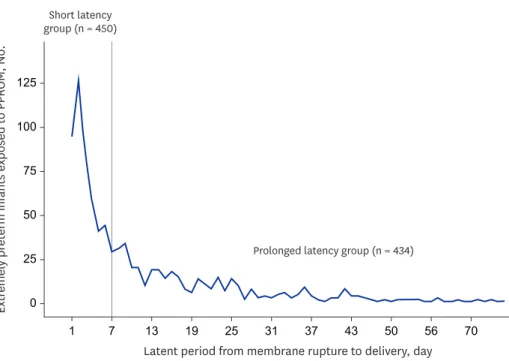
Fig. 1 shows the latent period from membrane rupture to delivery in extremely preterm infants exposed to PPROM. Of all the infants enrolled in this study, the mean GA at
Latent period from membrane rupture to delivery, day Short latency
group (n = 450)
0
1 7 13 19 25 31 37 43 50 56 70
125
100
75
50
25
Extremely preterm infants exposed to PPROM, No.
Prolonged latency group (n = 434)
Fig. 1. Extremely preterm infants exposed to maternal PPROM by latent period from membrane rupture to delivery.
PPROM = preterm premature rupture of membrane.
membrane rupture, mean latent period, and median latent period from membrane rupture to delivery were 24.1 ± 2.4 weeks, 12.2 ± 14.3 days, and 6.0 days, respectively.
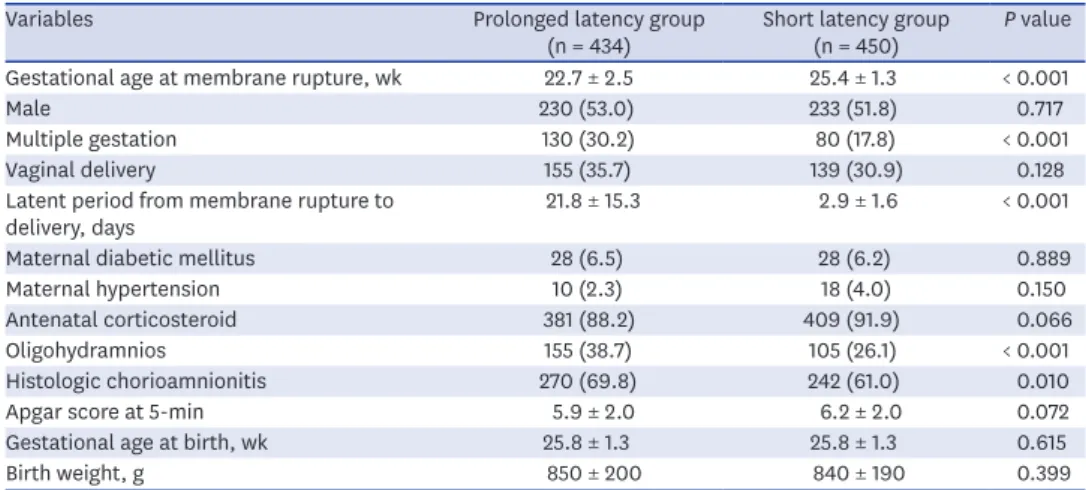
Table 1 shows the comparison of the prenatal characteristics between the prolonged and short latency groups. The mean GA at membrane rupture in the prolonged latency group was significantly lower than that in the short latency group (22.7 ± 2.5 vs. 25.4 ± 1.3 weeks, P < 0.001). Conversely, the mean latent period from membrane rupture to delivery in the prolonged latency group was significantly longer than that in the short latency group (21.8
± 15.3 vs. 2.9 ± 1.6 days, P < 0.001). Nevertheless, the mean GA at delivery and birth weight were not significantly different between the two groups. The incidences of oligohydramnios and histologic chorioamnionitis in the prolonged latency group was significantly higher than that in the short latency group (38.7 [155/401] vs. 26.1 [105/403], 69.8 [270/384] vs.
61.0 [242/397], respectively, P < 0.05). There were significantly different rates of multiple pregnancy in the prolonged and short latency groups (30.2 [130/434] vs. 17.8 [80/450], P < 0.05), but this was not the case for sex, delivery mode, maternal diabetes, maternal hypertension, or the use of antenatal corticosteroids.
Fig. 2 shows the mortality rates of the two groups. Although the survival rate in the prolonged latency group was higher than that in the short latency group, it was not significant. Regarding the timing of death, mortality within the period between birth and 7 days postnatally was the most common, but there was no significant difference between the two groups. The survival curves of the two groups are shown in Fig. 3. On postnatal days 30 and 60, the probability of survival for an extremely preterm infant in the prolonged and short latency groups was 78.3% and 73.3% and 79.1% and 76.8%, respectively. The mean survival times in the prolonged and short latency groups were estimated at 223.7 ± 9.3 days (range:
205.5–241.9) and 223.4 ± 15.2 days (range: 193.6–253.2), respectively. It was expected that 75% of infants in the prolonged and short latency groups would survive after 90 and 43 days, respectively. However, we did not detect significant heterogeneity in the changes in overall mortality between the two groups.
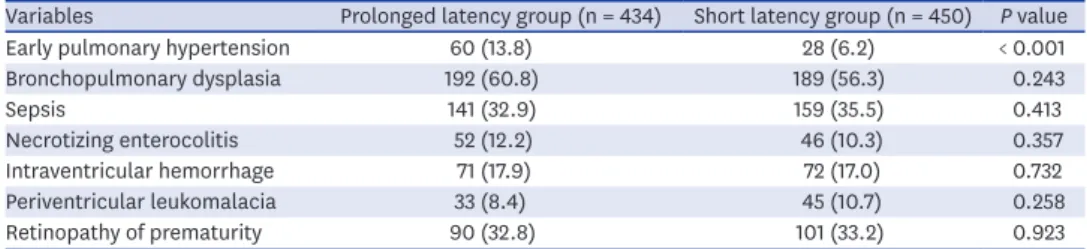
Table 2 presents the comparison of the neonatal outcomes between the two groups. The early pulmonary hypertension rates in the prolonged latency group were significantly higher than those in the short latency group (13.8 [60/434] vs. 6.2 [28/450], P < 0.001). However, the BPD Table 1. Prenatal characteristics of the prolonged and short latency groups
Variables Prolonged latency group
(n = 434) Short latency group
(n = 450) P value Gestational age at membrane rupture, wk 22.7 ± 2.5 25.4 ± 1.3 < 0.001
Male 230 (53.0) 233 (51.8) 0.717
Multiple gestation 130 (30.2) 80 (17.8) < 0.001
Vaginal delivery 155 (35.7) 139 (30.9) 0.128
Latent period from membrane rupture to
delivery, days 21.8 ± 15.3 2.9 ± 1.6 < 0.001
Maternal diabetic mellitus 28 (6.5) 28 (6.2) 0.889
Maternal hypertension 10 (2.3) 18 (4.0) 0.150
Antenatal corticosteroid 381 (88.2) 409 (91.9) 0.066
Oligohydramnios 155 (38.7) 105 (26.1) < 0.001
Histologic chorioamnionitis 270 (69.8) 242 (61.0) 0.010
Apgar score at 5-min 5.9 ± 2.0 6.2 ± 2.0 0.072
Gestational age at birth, wk 25.8 ± 1.3 25.8 ± 1.3 0.615
Birth weight, g 850 ± 200 840 ± 190 0.399
Data are presented as mean ± standard deviation or number (%).
and sepsis rates in the prolonged latency group were not significantly increased. There were no significant differences in the NEC, IVH, PVL, and ROP rates between the two groups.
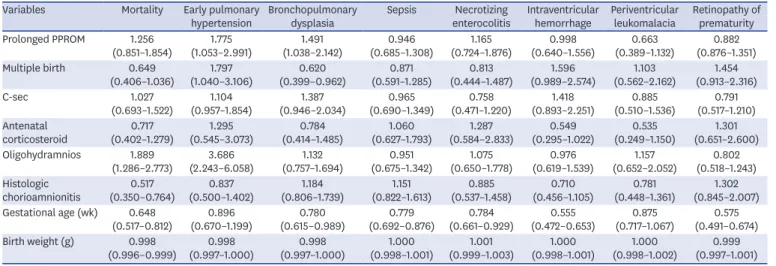
As shown in Table 3, we analyzed the independent effect of PPROM with prolonged latency on the mortality and morbidity adjusted to significant prenatal factors using multivariate models. Although the prolonged latency group was not associated with mortality during
309 (71.2) 58 (13.3)
35 (8.1) 32 (7.4)
330 (73.3) 43 (9.6) 50 (11.1) 27 (6.0)
Short latency group (n = 450) Prolonged latency
group (n = 434) 0
100
80
60
40
20
%
Survival Birth to 7 days 8 to 28 days
> 28 days
Fig. 2. Comparison of the mortality and timing of death between the prolonged and short latency groups. The data are presented as number (%).
Time, day
00 100 200 300
1.0
0.8
0.6
0.4
e survivalCumulativ 0.2
Prolonged latency group Short latency group
Survival functions
Fig. 3. Survival curves up to 300 days postnatally for extremely preterm infants exposed to preterm premature rupture of membrane. The time in days of postnatal hospitalization survival was estimated using the Kaplan- Meier method and log-rank test.
Table 2. Postnatal morbidities in the prolonged and short latency groups
Variables Prolonged latency group (n = 434) Short latency group (n = 450) P value
Early pulmonary hypertension 60 (13.8) 28 (6.2) < 0.001
Bronchopulmonary dysplasia 192 (60.8) 189 (56.3) 0.243
Sepsis 141 (32.9) 159 (35.5) 0.413
Necrotizing enterocolitis 52 (12.2) 46 (10.3) 0.357
Intraventricular hemorrhage 71 (17.9) 72 (17.0) 0.732
Periventricular leukomalacia 33 (8.4) 45 (10.7) 0.258
Retinopathy of prematurity 90 (32.8) 101 (33.2) 0.923
Data are presented as number (%).
hospitalization, the early pulmonary hypertension and BPD rates had increased by 1.8 and 1.5 times, respectively. However, this group was not associated with high NEC, IVH, PVL, and ROP rates. Meanwhile, oligohydramnios, GA at birth, and birth weight were found to be independent risk factors for mortality, early pulmonary hypertension, and BPD in extremely preterm infants exposed to maternal PPROM. Histologic chorioamnionitis showed a mortality reduced by 0.5 times in extremely preterm infants exposed to PPROM.
DISCUSSION
In the present study on neonatal outcomes according to the latent period from membrane rupture to delivery among extremely preterm infants exposed to maternal PPROM, prolonged latency of 7 days or more does not affect survival rate but increases the risk of BPD occurrence.
As maternal and fetal complications in women with previable PPROM remains a concern, providing conservative management to maintain pregnancy in women with previable PPROM has been difficult.1 According to previous studies, 40–50% of women with previable PPROM delivered within 1 week.2,8,31 While it is not clear whether all women with PPROM underwent expectant management in the present study, 50% of extremely preterm infants with PPROM were born within 7 days after membrane rupture. However, extremely preterm infants with latent period less than 24 hours were excluded because it was not clear about a therapeutic option in pregnant women with previable PPROM. For a more accurate analysis, an
investigation of obstetric treatments in pregnant women with previable PPROM is necessary.
The latent period from membrane rupture to delivery has been shown to be inversely correlated with GA at membrane rupture.11,32 In the present study, a correlation coefficient between the latent period from membrane rupture to delivery and GA at membrane rupture was −0.833 (P < 0.001). In general, an absolute correlation coefficient of > 0.7 among two or more predictors indicates the presence of multicollinearity. Considering a potential problem of multicollinearity, GA at membrane rupture was excluded in the multivariate logistic regression analysis of the present study.
Table 3. Multivariate logistic regression analysis of the clinical prenatal factors associated with mortality and morbidities Variables Mortality Early pulmonary
hypertension Bronchopulmonary
dysplasia Sepsis Necrotizing
enterocolitis Intraventricular
hemorrhage Periventricular
leukomalacia Retinopathy of prematurity Prolonged PPROM 1.256
(0.851–1.854) 1.775
(1.053–2.991) 1.491
(1.038–2.142) 0.946
(0.685–1.308) 1.165
(0.724–1.876) 0.998
(0.640–1.556) 0.663
(0.389–1.132) 0.882 (0.876–1.351) Multiple birth 0.649
(0.406–1.036) 1.797
(1.040–3.106) 0.620
(0.399–0.962) 0.871
(0.591–1.285) 0.813
(0.444–1.487) 1.596
(0.989–2.574) 1.103
(0.562–2.162) 1.454 (0.913–2.316)
C-sec 1.027
(0.693–1.522) 1.104
(0.957–1.854) 1.387
(0.946–2.034) 0.965
(0.690–1.349) 0.758
(0.471–1.220) 1.418
(0.893–2.251) 0.885
(0.510–1.536) 0.791 (0.517–1.210) Antenatal
corticosteroid 0.717
(0.402–1.279) 1.295
(0.545–3.073) 0.784
(0.414–1.485) 1.060
(0.627–1.793) 1.287
(0.584–2.833) 0.549
(0.295–1.022) 0.535
(0.249–1.150) 1.301 (0.651–2.600) Oligohydramnios 1.889
(1.286–2.773) 3.686
(2.243–6.058) 1.132
(0.757–1.694) 0.951
(0.675–1.342) 1.075
(0.650–1.778) 0.976
(0.619–1.539) 1.157
(0.652–2.052) 0.802 (0.518–1.243) Histologic
chorioamnionitis 0.517
(0.350–0.764) 0.837
(0.500–1.402) 1.184
(0.806–1.739) 1.151
(0.822–1.613) 0.885
(0.537–1.458) 0.710
(0.456–1.105) 0.781
(0.448–1.361) 1.302 (0.845–2.007) Gestational age (wk) 0.648
(0.517–0.812) 0.896
(0.670–1.199) 0.780
(0.615–0.989) 0.779
(0.692–0.876) 0.784
(0.661–0.929) 0.555
(0.472–0.653) 0.875
(0.717–1.067) 0.575 (0.491–0.674) Birth weight (g) 0.998
(0.996–0.999) 0.998
(0.997–1.000) 0.998
(0.997–1.000) 1.000
(0.998–1.001) 1.001
(0.999–1.003) 1.000
(0.998–1.001) 1.000
(0.998–1.002) 0.999 (0.997–1.001) Data are presented as adjusted odds ratio (95% confidence interval).
PPROM = preterm premature rupture of membrane, C-sec = cesarean section.
Waters et al.2 reported that the neonatal survival rate after conservatively managed PPROM was about 50%. The survival rates were much improved with expectant management following membrane rupture after 22 weeks' gestation compared with membrane rupture before 22 weeks' gestation.2 According to a recent study,7 the expectant management of previable PPROM between 20 to 23 weeks' gestation was associated with a neonatal survival rate of 49%. In another cohort study of infants exposed to PPROM, which occurred before 24 weeks' gestation and who were treated in a modern NICU, the survival-to-discharge rate was 70%.9 In the present study, the survival rate in the prolonged latency group among extremely preterm infants exposed to maternal PPROM was 71.2%, which seems to be similar to the overall survival rate of extremely preterm infants in South Korea.33 Taken together, prolonged latency of 7 days or more did not appear to increase perinatal or overall mortality during hospitalization among extremely preterm infants exposed to maternal PPROM. This finding was consistent with previous studies in which the mortality rates in infants born following maternal PPROM occurring prior to 25 gestational weeks and lasting for 7 days were not significantly higher than those in infants without maternal PPROM.19,20
Chorioamnionitis and oligohydramnios following expectantly managed PPROM during the second trimester of pregnancy are known to be major causes of fetal and neonatal morbidity and mortality.7,9,10,34,35 Clinical chorioamnionitis, often referred to as intra- amniotic infection, is an indication for delivery in accordance with recent guidelines, which is conservatively managed in PPROM with no complications.1 The incidence of histologic chorioamnionitis is directly related to the latent period.36 The consequences of chorioamnionitis also affect multiple organ systems in fetuses and neonates, resulting in conditions such as BPD, pulmonary hypertension, cerebral palsy, ROP, and renal injury.36 In the present study, although the histologic chorioamnionitis and oligohydramnios rates in the prolonged latency group were significantly higher than those in the short latency group, histologic chorioamnionitis was not a risk factor for BPD, early pulmonary hypertension, PVL, and ROP in extremely preterm infants exposed to PPROM. Previous other studies have shown that chorioamnionitis negatively affects the short- and long-term outcomes of preterm infants,37 However, in the present study, histologic chorioamnionitis was shown to be a factor reducing mortality in extremely preterm infants exposed to maternal PPROM.
The possibility of influencing statistical results due to missing data (11%) for histologic chorioamnionitis as well as the different target study group only confined to PPROM cases in the present study might affect the results. Further additional study is needed for the clarification of this disparity.
Meanwhile, oligohydramnios was shown to be a risk factor for early pulmonary hypertension, BPD, and mortality during hospitalization. Pulmonary hypoplasia, which is associated with fetal lung compression and oligohydramnios, is a serious complication of expectant management following previable PPROM, and mortality from this condition ranges between 50–100%.14-16 The factors contributing to the development of pulmonary hypoplasia include the GA at membrane rupture, latent period from membrane rupture to delivery, and residual amniotic fluid volume.18,38 In a recent cohort of infants delivered following PPROM, which occurred before 24 weeks' gestation, and treated with modern neonatal intensive care including high-frequency ventilation and nitric oxide, the survival-to-discharge rate was 90%.9 As there was no clinical information regarding pulmonary hypoplasia in the KNN database, we included early pulmonary hypertension in our comparison, which is an important manifestation in cases of pulmonary hypoplasia after birth. According to the multivariate logistic regression analysis adjusted to other prenatal factors that we performed,
prolonged latency of 7 days or more was an independent risk factor for early pulmonary hypertension and BPD among extremely preterm infants exposed to maternal PPROM. This is consistent with the findings that early pulmonary hypertension and BPD rates in VLBWIs born following maternal PPROM occurring prior to 25 gestational weeks and lasting for 7 days were significantly higher than those in infants without maternal PPROM.20
Since the association between neonatal sepsis and the duration of membrane rupture was first reported in 1963,39 PPROM with prolonged latency has been considered an independent risk factor for neonatal sepsis. However, studies have found conflicting evidence regarding this association.40-43 In the present study, there was no difference between the two groups in the incidence of blood culture-proven neonatal sepsis during hospitalization.
The strength of this study is that it has a prospective, nationwide, population-based design, which included extremely preterm infants who had received active resuscitation at delivery.
However, the lack of available data on the induction of labor and fetal death in women with previable PPROM and comfort care without active resuscitation in the delivery room appears to be a major limitation of this study. Although several hospitals collected all data, including those of mortality in the delivery room, there is a possibility that cases of mortality in the delivery room may have been missed, thereby causing an underestimation of the mortality in the present study. In addition, it was not known whether pregnant women with PPROM underwent immediate delivery or were given expectant management. Although each institution's willingness to use expectant management in women with previable PPROM was not clear, there was no difference in survival rates between the prolonged and short latency groups. On the other hand, PPROM with prolonged latency was shown to be an independent risk factor for early pulmonary hypertension and BPD in extremely preterm infants exposed to maternal PPROM. Although the purpose of the present study is to compare neonatal outcomes between the prolonged and short latency groups among extremely preterm infants exposed to maternal PPROM, a dichotomous variable of the latent period from membrane rupture to delivery may not be suitable. Further studies will be needed to compare neonatal outcomes with a continuous variable not categorical for the latent period.
In conclusion, in accordance with expectant management in women with previable PPROM, prolonged latency of 7 days or more does not affect survival rate but increases the risk of BPD occurrence among extremely preterm infants exposed to maternal PPROM. These findings may be helpful to medical staff preparing to implement more aggressive neonatal intensive care if an extremely preterm infant exposed to maternal PPROM with prolonged latency is delivered quickly.
REFERENCES
1. American College of Obstetricians and Gynecologists' Committee on Practice Bulletins-Obstetrics.
Practice bulletin no. 172: premature rupture of membranes. Obstet Gynecol 2016;128(4):e165-77.
PUBMED | CROSSREF
2. Waters TP, Mercer BM. The management of preterm premature rupture of the membranes near the limit of fetal viability. Am J Obstet Gynecol 2009;201(3):230-40.
PUBMED | CROSSREF
3. Yeast JD. Preterm premature rupture of the membranes before viability. Clin Perinatol 2001;28(4):849-60.
PUBMED | CROSSREF
4. Xiao ZH, André P, Lacaze-Masmonteil T, Audibert F, Zupan V, Dehan M. Outcome of premature infants delivered after prolonged premature rupture of membranes before 25 weeks of gestation. Eur J Obstet Gynecol Reprod Biol 2000;90(1):67-71.
PUBMED | CROSSREF
5. Hadi HA, Hodson CA, Strickland D. Premature rupture of the membranes between 20 and 25 weeks' gestation: role of amniotic fluid volume in perinatal outcome. Am J Obstet Gynecol 1994;170(4):1139-44.
PUBMED | CROSSREF
6. Brumbaugh JE, Colaizy TT, Nuangchamnong N, O'Brien EA, Fleener DK, Rijhsinghani A, et al. Neonatal survival after prolonged preterm premature rupture of membranes before 24 weeks of gestation. Obstet Gynecol 2014;124(5):992-8.
PUBMED | CROSSREF
7. Kibel M, Asztalos E, Barrett J, Dunn MS, Tward C, Pittini A, et al. Outcomes of pregnancies complicated by preterm premature rupture of membranes between 20 and 24 weeks of gestation. Obstet Gynecol 2016;128(2):313-20.
PUBMED | CROSSREF
8. Muris C, Girard B, Creveuil C, Durin L, Herlicoviez M, Dreyfus M. Management of premature rupture of membranes before 25 weeks. Eur J Obstet Gynecol Reprod Biol 2007;131(2):163-8.
PUBMED | CROSSREF
9. Everest NJ, Jacobs SE, Davis PG, Begg L, Rogerson S. Outcomes following prolonged preterm premature rupture of the membranes. Arch Dis Child Fetal Neonatal Ed 2008;93(3):F207-11.
PUBMED | CROSSREF
10. Manuck TA, Eller AG, Esplin MS, Stoddard GJ, Varner MW, Silver RM. Outcomes of expectantly managed preterm premature rupture of membranes occurring before 24 weeks of gestation. Obstet Gynecol 2009;114(1):29-37.
PUBMED | CROSSREF
11. Melamed N, Hadar E, Ben-Haroush A, Kaplan B, Yogev Y. Factors affecting the duration of the latency period in preterm premature rupture of membranes. J Matern Fetal Neonatal Med 2009;22(11):1051-6.
PUBMED | CROSSREF
12. Kenyon S, Boulvain M, Neilson JP. Antibiotics for preterm rupture of membranes. Cochrane Database Syst Rev 2010;(8):CD001058.
PUBMED
13. Garite TJ, Freeman RK. Chorioamnionitis in the preterm gestation. Obstet Gynecol 1982;59(5):539-45.
PUBMED
14. Beydoun SN, Yasin SY. Premature rupture of the membranes before 28 weeks: conservative management.
Am J Obstet Gynecol 1986;155(3):471-9.
PUBMED | CROSSREF
15. Kilbride HW, Thibeault DW. Neonatal complications of preterm premature rupture of membranes.
Pathophysiology and management. Clin Perinatol 2001;28(4):761-85.
PUBMED | CROSSREF
16. Kilbride HW, Yeast J, Thibeault DW. Defining limits of survival: lethal pulmonary hypoplasia after midtrimester premature rupture of membranes. Am J Obstet Gynecol 1996;175(3 Pt 1):675-81.
PUBMED | CROSSREF
17. Rotschild A, Ling EW, Puterman ML, Farquharson D. Neonatal outcome after prolonged preterm rupture of the membranes. Am J Obstet Gynecol 1990;162(1):46-52.
PUBMED | CROSSREF
18. Winn HN, Chen M, Amon E, Leet TL, Shumway JB, Mostello D. Neonatal pulmonary hypoplasia and perinatal mortality in patients with midtrimester rupture of amniotic membranes--a critical analysis. Am J Obstet Gynecol 2000;182(6):1638-44.
PUBMED | CROSSREF
19. Park GY, Park WS, Yoo HS, Ahn SY, Sung SI, Kim SS, et al. Short-term outcomes comparison between preterm infants with and without acute hypoxic respiratory failure attributable to presumed pulmonary hypoplasia after prolonged preterm premature rupture of membranes before 25 gestational weeks. J Matern Fetal Neonatal Med 2019;32(12):1938-45.
PUBMED | CROSSREF
20. Park GY, Park WS, Sung SI, Kim MS, Lee MH, Jeon GW, et al. Neonatal outcome comparisons between preterm infants with or without early pulmonary hypertension following prolonged preterm premature rupture of membranes before 25 gestational weeks in Korean Neonatal Network. J Matern Fetal Neonatal Med 2020;1(6):1-9.
PUBMED | CROSSREF
21. Phelan JP, Ahn MO, Smith CV, Rutherford SE, Anderson E. Amniotic fluid index measurements during pregnancy. J Reprod Med 1987;32(8):601-4.
PUBMED
22. Jobe AH, Bancalari E. Bronchopulmonary dysplasia. Am J Respir Crit Care Med 2001;163(7):1723-9.
PUBMED | CROSSREF
23. Papile LA, Burstein J, Burstein R, Koffler H. Incidence and evolution of subependymal and intraventricular hemorrhage: a study of infants with birth weights less than 1,500 gm. J Pediatr 1978;92(4):529-34.
PUBMED | CROSSREF
24. Sarkar S, Shankaran S, Laptook AR, Sood BG, Do B, Stoll BJ, et al. Screening cranial imaging at multiple time points improves cystic periventricular leukomalacia detection. Am J Perinatol 2015;32(10):973-9.
PUBMED | CROSSREF
25. Bell MJ, Ternberg JL, Feigin RD, Keating JP, Marshall R, Barton L, et al. Neonatal necrotizing enterocolitis. Therapeutic decisions based upon clinical staging. Ann Surg 1978;187(1):1-7.
PUBMED | CROSSREF
26. Lee SM, Chang M, Kim KS. Blood culture proven early onset sepsis and late onset sepsis in very-low- birth-weight infants in Korea. J Korean Med Sci 2015;30 Suppl 1:S67-74.
PUBMED | CROSSREF
27. Kim JK, Chang YS, Sung S, Park WS. Mortality rate-dependent variations in the survival without major morbidities rate of extremely preterm infants. Sci Rep 2019;9(1):7371.
PUBMED | CROSSREF
28. International Committee for the Classification of Retinopathy of Prematurity. The international classification of retinopathy of prematurity revisited. Arch Ophthalmol 2005;123(7):991-9.
PUBMED | CROSSREF
29. Kaplan HC, Provost LP, Froehle CM, Margolis PA. The model for understanding success in quality (MUSIQ): building a theory of context in healthcare quality improvement. BMJ Qual Saf 2012;21(1):13-20.
PUBMED | CROSSREF
30. Gould JB. Quality improvement in perinatal medicine: assessing the quality of perinatal care. Neoreviews 2004;5(2):e33-41.
CROSSREF
31. Schucker JL, Mercer BM. Midtrimester premature rupture of the membranes. Semin Perinatol 1996;20(5):389-400.
PUBMED | CROSSREF
32. Manuck TA, Maclean CC, Silver RM, Varner MW. Preterm premature rupture of membranes: does the duration of latency influence perinatal outcomes? Am J Obstet Gynecol 2009;201(4):414.e1-6.
PUBMED | CROSSREF
33. Shim JW, Jin HS, Bae CW. Changes in survival rate for very-low-birth-weight infants in Korea: comparison with other countries. J Korean Med Sci 2015;30 Suppl 1:S25-34.
PUBMED | CROSSREF
34. Williams O, Hutchings G, Debieve F, Debauche C. Contemporary neonatal outcome following rupture of membranes prior to 25 weeks with prolonged oligohydramnios. Early Hum Dev 2009;85(5):273-7.
PUBMED | CROSSREF
35. Kurdoglu M, Kolusari A, Adali E, Yildizhan R, Kurdoglu Z, Kucukaydin Z, et al. Does residual amniotic fluid after preterm premature rupture of membranes have an effect on perinatal outcomes? 12 years experience of a tertiary care center. Arch Gynecol Obstet 2010;281(4):601-7.
PUBMED | CROSSREF
36. Galinsky R, Polglase GR, Hooper SB, Black MJ, Moss TJ. The consequences of chorioamnionitis: preterm birth and effects on development. J Pregnancy 2013;2013:412831.
PUBMED | CROSSREF
37. Pugni L, Pietrasanta C, Acaia B, Merlo D, Ronchi A, Ossola MW, et al. Chorioamnionitis and neonatal outcome in preterm infants: a clinical overview. J Matern Fetal Neonatal Med 2016;29(9):1525-9.
PUBMED | CROSSREF
38. Vergani P, Ghidini A, Locatelli A, Cavallone M, Ciarla I, Cappellini A, et al. Risk factors for pulmonary hypoplasia in second-trimester premature rupture of membranes. Am J Obstet Gynecol 1994;170(5 Pt 1):1359-64.
PUBMED | CROSSREF
39. Pryles CV, Steg NL, Nair S, Gellis SS, Tenney B. A controlled study of the influence on the newborn of prolonged premature rupture of the amniotic membranes and/or infection in the mother. Pediatrics 1963;31:608-22.
PUBMED
40. Drassinower D, Friedman AM, Običan SG, Levin H, Gyamfi-Bannerman C. Prolonged latency of preterm premature rupture of membranes and risk of neonatal sepsis. Am J Obstet Gynecol 2016;214(6):743.e1-6.
PUBMED | CROSSREF
41. Melamed N, Ben-Haroush A, Pardo J, Chen R, Hadar E, Hod M, et al. Expectant management of preterm premature rupture of membranes: is it all about gestational age? Am J Obstet Gynecol 2011;204(1):48.e1-8.
PUBMED | CROSSREF
42. McElrath TF, Allred EN, Leviton A; Development Epidemiology Network Investigators. Prolonged latency after preterm premature rupture of membranes: an evaluation of histologic condition and intracranial ultrasonic abnormality in the neonate born at <28 weeks of gestation. Am J Obstet Gynecol 2003;189(3):794-8.
PUBMED | CROSSREF
43. Gyamfi-Bannerman C, Son M. Preterm premature rupture of membranes and the rate of neonatal sepsis after two courses of antenatal corticosteroids. Obstet Gynecol 2014;124(5):999-1003.
PUBMED | CROSSREF