INTRODUCTION
Kawasaki disease (KD) is an acute systemic vasculitis that predominantly affects infants and young children. Coronary artery lesions (CALs) develop in 20-25% of the patients, which makes KD the leading cause of acquired heart disease in chil- dren. The cause of this disease is unknown but generally beli- eved to be an infectious agent (1). Many reports have noted an abnormal immune response in the acute phase of this dis- ease and increase in serum cytokines, such as interleukin (IL)- 1β, IL-2, IL-4, IL-6, IL-8, interferon (INF)-γ, and tumor necro- sis factor (TNF)-α(2-5). These cytokines may mediate endo- thelial damage and lead to coronary artery disease while also producing the systemic signs of inflammation that charac- terize the disease (6). Previous reports have shown blood IL- 10 levels were also elevated during the acute phase of KD (5, 7, 8). The elevated IL-10 levels decreased immediately after intravenous immune globulin (IVIG) administration, and the decrease was coincident with rapid improvement in inflam- matory symptoms (8). However, the significance of increased IL-10 levels observed in KD is not fully understood. IL-10 is
a major immunoregulatory cytokine and has a number of im- munomodulating effects on the immune system. It is pro- duced by many cell types, including T lymphocytes, B lym- phocytes, monocytes, and macrophages (9). IL-10 suppresses type 1 T helper lymphocytes by decreasing IL-2 and INF-γ production (10, 11). It also inhibits certain functions of acti- vated macrophages by downregulating the expression of MHC class II antigens, and co-stimulatory molecules (12), and by inhibiting production of proinflammatory cytokines such as TNF-α, IL-1, IL-6, IL-8, and IL-12 (10, 13). Contrary to its T cell and macrophage inhibitory actions, IL-10 enhances B cell survival, proliferation, differentiation, and immunoglob- ulin production (14). Levels of IL-10 production are critical in immune regulation and control the balance between in- flammatory and humoral responses. Various studies have con- firmed the association of IL-10 with autoimmune and infec- tious diseases (15).
The human IL-10 gene is located on chromosome 1 and has been mapped to the junction between 1q31 and 1q32 (16).
The capacity for IL-10 production is correlated with the genet- ic composition of the IL-10 locus. Genetic factors account for
438
Kai-Chung Hsueh1, Ying-Ju Lin2,3,5, Jeng-Sheng Chang1, Lei Wan2,4,5, Yu-Hsin Tsai4, Chang-Hai Tsai5, Chih-Ping Chen6, and Fuu-Jen Tsai2,4,5
Department of Pediatrics1, Medical Research2, China Medical University Hospital, Taichung; Graduate Institute of Acupuncture Science3, Graduate Institute of Chinese Medical Science4, China Medical University, Taichung; Department of Biotechnology and Bioinformatics5, Asia University, Taichung; Department of Obstetrics and Gynecology6, Mackay Memorial Hospital, Taipei, Taiwan
Address for correspondence Fuu-Jen Tsai, M.D.
Department of Medical Research, China Medical University Hospital, No 2 Yuh Der Road, Taichung, Taiwan
Tel : +886.4-22052121, Fax : +886.4-22033295 E-mail : [email protected]
*This work was supported by China Medical University (CMU95-142) and China Medical University Hospital (DMR-91-003).
DOI: 10.3346/jkms.2009.24.3.438
Association of Interleukin-10 A-592C Polymorphism in Taiwanese Children with Kawasaki Disease
Elevated serum levels of interleukin-10 (IL-10) have been reported in patients with Kawasaki disease (KD). IL-10 reduces the inflammatory actions of macrophages and T cells and it may play a significant role in the regulation of inflammatory vascular damage associated with systemic vasculitis. The aim of this study was to examine whether -592 IL-10 promoter polymorphism is a susceptibility or severity marker of KD in Chinese patients in Taiwan. The study included 105 KD patients and 100 nor- mal controls. Genotype and allelic frequencies for the IL-10 gene polymorphism in both groups were compared. There were no significant between-group differences in the genotype distribution of IL-10 A-592C gene polymorphism (P=0.08). How- ever, the frequency of the -592*A allele was significantly increased in the patients with KD compared with controls (71.9% vs. 61.0%, P=0.019). The odds ratio for developing KD in individuals with IL-10 -592*A allele was 1.64 (95% confidence interval, 1.06-2.52) compared to individuals with the IL-10-592*C allele. No signifi- cant difference was observed in the genotype and allelic frequencies for the IL-10 A-592C polymorphism between patients with and without coronary artery lesions.
The IL-10-592*A allele may be involved in the development of KD in Taiwanese children.
Key Words : Mucocutaneous Lymph Node Syndrome; Polymorphism; Interleukin-10
Received : 3 January 2008 Accepted : 22 July 2008
approximately 75% of the variation in IL-10 secretion capaci- ty in humans, and these genetic differences contribute to dis- ease susceptibility (17). The variation of IL-10 expression is thought to be at the transcriptional level since mutations in the IL-10 gene promoter sequence may alter specific transcrip- tional activation and cytokine production (18).
This study hypothesized that the IL-10 gene polymorphisms have a measurable influence on KD susceptibility and contri- bute to or reduce the occurrence of coronary artery lesions. To test this hypothesis, inheritance of the IL-10 promoter poly- morphism at position -592 in patients with KD, as well as the association of the polymorphism with clinical complica- tions of CALs, were examined.
MATERIALS AND METHODS Subjects
We enrolled patients with KD from the Department of Pe- diatrics at the China Medical University Hospital, Taichung, Taiwan. The study group included 105 patients, all of whom met the criteria proposed by the Japanese Kawasaki Disease Research Committee (19). (See Table 1 for the numbers of subject studied.) All patients were treated with IVIG (2 g/kg infused over 8-12 hr) and oral aspirin (80-100 mg/kg/day).
Echocardiographs were obtained by the pediatric cardiolo- gist before or within 2 weeks of IVIG administration. Coro- nary artery lesions were diagnosed from the echocardiograms using the criteria proposed by the Japanese Kawasaki Disease Research Committee (19): coronary arteries were classified as abnormal if the internal lumen diameter was ≥3 mm in chil- dren younger than 5 yr old or ≥4 mm in children older than 5 yr old, if the internal diameter of a segment measured ≥1.5 times that of an adjacent segment, or if the coronary lumen was clearly irregular. We also studied 100 unrelated healthy children (62 males and 38 females, 0.4-7.0 yr old, mean age
=3.2 yr) who served as the control group. All blood samples were drawn before IVIG therapy in the KD patient group.
Control samples were tested in parallel with patient samples.
The ethics committee of the China Medical University Hos- pital Institutional Review Board approved the study, and writ- ten informed consent was obtained from the parents of all subjects.
Analysis of IL-10 A-592C polymorphism
The genomic DNA was prepared from peripheral blood using a genomic DNA isolation reagent kit (Genomaker, Tai- pei, Taiwan). The IL-10 A-592C genotype was determined using a polymerase chain reaction (PCR)-restriction fragment length polymorphism (RFLP) assay. The primers were for- ward 5′-CCTAGGTCACAGTGACGTGG-3′and reverse 5′-GGTGAGCACTACCTGACTAGC-3′. This generated
a PCR product of 412 bp. PCR amplification was done in a 50-μL reaction volume containing 100 ng of genomic DNA, 0.5 μM of each primer, 0.2 mM/L deoxynucleotide triphos- phates, 10 mM/L Tris-HCl (pH 8.3), 50 mM/L KCl, 1.5 mM/
L MgCl2, and 1.25 units of Taq polymerase (Perkin Elmer, Foster City, CA, U.S.A.). The PCR amplification was per- formed in a programmable thermal cycler (Gene Amp PCR System 2400; Perkin-Elmer). PCR cycle conditions consist- ed of an initial denaturation step at 95℃for 5 min followed by 35 cycles of 1 min at 94℃, 1 min at 60℃, 1 min at 72℃, and a final extension at 72℃for 6 min. The PCR products were digested with restriction endonuclease RasI (New Eng- land Biolabs, Beverly, MA, U.S.A.) and the digested DNA fragments were separated by 3% agarose gel electrophoresis and identified by ethidium bromide staining. In the presence of the IL-10 -592*A allele, RasI cut the 412 bp PCR product into two fragments of 236 and 176 bp, respectively.
Statistical analysis
The SAS Version 8.2 (SAS Institute Inc., NC, U.S.A.) with chi-square test was used to compare the genotype and the allelic frequency distribution of the IL-10 gene for patients with KD and control subjects. A chi-square test was also used to compare differences between patients with and without coronary artery lesions. A value of P<0.05 indicated a signif- icant difference between the tested populations. Associations between variables in cases and control subjects were deter- mined using the odds ratio and 95% confidence interval.
RESULTS Characteristics of the study patients
The characteristics of the 105 KD patients studied are sho- wn in Table 1. The sex distribution of the total KD patients was a male/female ratio of 1.4:1, which is comparable to the previous reports of KD male/female ratios ranging from 1.5 to 1.7:1.31 patients (30%) were identified as having coronary artery lesions. Parents of all KD patients enrolled in the study
Number of patients 105
Age (yr) at time of diagnosis
Mean 3.1
Median 1.82
Range 0.2-7.5
Sex, number of patients
Male 61
Female 44
Coronary artery lesions, number of patients
Absent 74
Present 31
Table 1.Characteristics of the Kawasaki disease (KD) patients
on a voluntary basis; therefore, the study population is not representative of the true incidence of either KD or coronary artery lesions in Taiwan.
Allele and genotype frequencies of IL-10 A-592C promoter polymorphisms
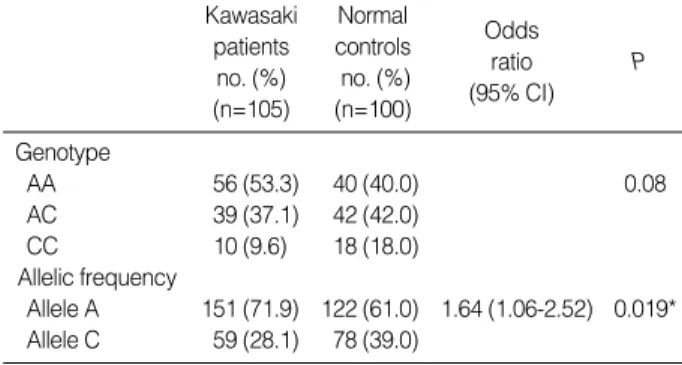
The frequencies of the genotype in the KD and control groups are shown in Table 2. Among the 105 KD patients, 56 (53.3%) had IL-10 genotype AA, 39 (37.1%) had AC, and 10 (9.6%) had CC. Among the 100 control subjects, 40 (40.0%) had genotype AA, 42 (42.0%) had AC, and 18 (18.0%) had CC. There were no significant differences in the genotype distribution of IL-10 A-592C gene polymorphism between the healthy control subjects and KD patients (P=
0.08). However, the frequency of the -592*A allele was signif- icantly increased in the patients with KD compared with con- trols (71.9% vs. 61.0%, P=0.019). The odds ratio for devel- oping Kawasaki disease in individuals with IL-10-592*A allele was 1.64 (95% confidence interval, 1.06-2.52) com- pared to individuals with the IL-10 -592*C allele. The asso- ciation of IL-10 A-592C gene polymorphism with coronary artery lesions of KD was examined. Both genotype and allelic
frequencies were not statistically different between KD patients with and without coronary artery lesions (Table 3).
DISCUSSION
Kawasaki disease is an acute, inflammatory, systemic vas- culitis of unknown etiology that is often complicated by coro- nary artery aneurysm. KD is currently thought to be an infec- tious disease with immunologic manifestations that occur only in genetically susceptible individuals (1). However, the genet- ic background of patients with KD is mostly unknown. Cyto- kines with polymorphic gene sequences are potential mark- ers of disease susceptibility because their gene products are in- volved in KD pathogenesis (2-7). This study provides evidence for a genetic association between KD and the IL-10 gene.
The level of IL-10, one of the anti-inflammatory cytokines, is markedly elevated (as are various proinflammatory cytokines) during the acute phase of KD. IL-10 reduces the inflamma- tory response of monocytes/macrophages and inhibits cytokine production by Th1 cells. On the other hand, IL-10 is a potent stimulator for human B cells. The significance of increased IL-10 level observed in KD is not fully understood. It may contribute to the upregulation of humoral immune respons- es (increased B cell activation and hypergammaglobulinemia are observed during the acute phase of KD [20]) and to the downregulation of acute inflammation arising from increased levels of proinflammatory cytokines such as TNF-α(7).
The genetic makeup of the IL-10 promoter can determine the level of IL-10 secretion. The promoter of the IL-10 gene has been shown to be highly polymorphic. Among the iden- tified polymorphisms in the IL-10 promoter, three linked single nucleotide polymorphisms (SNPs) (i.e., -1,082 G/A, -819 T/C, and -592 A/C) have been shown to influence the IL-10 gene expression (21). Several functional studies showed that -592*A, -819*T, and -1,082*A alleles are associated with low levels of IL-10 production (22-24). In addition, earlier reports (23, 24) found complete linkage disequilibrium bet- ween allele -819*C and allele -592*C and between allele- 819*T and allele -592*A. IL-10 gene polymorphisms, espe- cially the IL-10 A-592C polymorphism, have been implicat- ed in associations with disease outcome. The position -592 is in an area containing putative binding sites for NF-IL-6 and
*P<0.05, significant.
IL-10, interleukin-10; KD, Kawasaki disease.
Kawasaki Normal patients controls Odds
ratio P
no. (%) no. (%)
(95% CI) (n=105) (n=100)
Genotype
AA 56 (53.3) 40 (40.0) 0.08
AC 39 (37.1) 42 (42.0)
CC 10 (9.6) 18 (18.0)
Allelic frequency
Allele A 151 (71.9) 122 (61.0) 1.64 (1.06-2.52) 0.019*
Allele C 59 (28.1) 78 (39.0)
Table 2.Genotypes and allelic frequencies of IL-10 A-592 C pro- moter polymorphism in KD patients and normal control subjects
KD total (n=105) KD (CAL-) KD (CAL+) P no. (%) (n=74) no. (%) (n=31)
Genotype 0.27
AA 42 (56.8) 14 (45.2)
AC 27 (36.5) 12 (38.7)
CC 5 (6.7) 5 (16.1)
Allelic frequency 0.12
Allele A 111 (75.0) 40 (64.5)
Allele C 37 (25.0) 22 (35.5)
Table 3.Genotypes and allelic frequencies of IL-10 A-592C pro- moter polymorphism in KD patients with and without coronary artery lesions
IL-10, interleukin-10; KD, Kawasaki disease; CAL, coronary artery lesions.
Southern British
Alleles Taiwanese Japanese Chinese Korean Cau- (28) from Hong (29) casians
Kong (27) (23, 24)
-592A 0.61 0.672 0.67 0.62 0.21
-592C 0.39 0.328 0.33 0.38 0.79
Table 4.Allele frequencies of the interleukin-10 A-592C promoter polymorphism among Taiwanese controls and other ethnic popu- lations
STAT-1 (25). The -592*A allele has been associated with in- creased incidence of sepsis and mortality in critically ill pati- ents (26) and with renal involvement in SLE patients (27).
These results suggest the influence of the IL-10 A-592C poly- morphism in disease progression and prognosis.
The prevalence of IL-10 -592*A allele varies from popu- lation to population (Table 4), with the greatest rate found in Japanese (67.2%) (28), southern Chinese from Hong Kong (67%) (27), Korean (62%) (29), and British Caucasians (21%) (23, 24). In our study of Chinese healthy subjects from Tai- wan, the IL-10 -592*A allele frequency was 61.0%, which is very similar to this frequency in Korean and Hong Kong Chinese but markedly different from Caucasians. The distri- bution of various genotypes for the IL-10 promoter polymor- phic sites differ significantly between ethnic populations sug- gesting that this could be a useful anthropologic genetic mark- er. The frequency of the IL-10 -592* A allele was significant- ly increased in our patients with KD, suggesting that it might represent a candidate genetic marker to predict the develop- ment of KD for an individual.
Serum levels of an array of cytokines, including proinflam- matory and anti-inflammatory cytokines, are elevated in pati- ents with KD. Complex regulatory interactions exist to sup- press ongoing inflammatory response. Regulation is often achieved via parallel secretion of antagonistic cytokines and soluble receptors. However, it is difficult to predict the net contribution of inhibitory cytokines to an inflammatory res- ponse by determination of serum levels. Furthermore, such regulation is further complicated by the ratio of cytokine to soluble receptor, such as TNF to sTNFR or IL-10 to sIL-10R, within the local environment. Therefore, we speculated that the relative lack of IL-10 compared with the elevated levels of various proinflammatory cytokines may contribute to the proinflammatory milieu in KD even though increased IL-10 level was observed during the acute phase of KD. Thus, the fact that most Asians carry the IL-10 -592*A allele (which is associated with low IL-10-secreting capacity) may partial- ly explain why Kawasaki disease is most highly expressed in Asian populations, mainly Japanese (30). Function-related experiments and investigation to determine whether IL-10 -592*A allele is similarly associated with KD in subjects of other ethnic origin would be intriguing and worthwhile.
Of interest, a recent study conducted in a Korean popula- tion by Jin et al. (31) showed no significant difference in allele or genotype frequency for the IL-10 -592 A/C polymorphism between KD patients and control subjects but the study show- ed a significantly higher frequency of the IL-10 -592 C allele in KD patients with CALs. Although a relatively small sam- ple size is a limitation of both our study and that by Jin et al., the inconsistent results may be due to environmental factors and differences in the genetic backgrounds of the study pop- ulations. Because KD appears to be a polygenic disease, and a wide number of cytokines seem to be implicated in the reg- ulation of vasculitis. It is apparently unlikely that the IL-10
-592 polymorphism is the only gene conferring susceptibil- ity to KD and it remains formally possible that the associa- tion may reflect linkage disequilibrium with polymorphisms in currently uncharacterized genes. As a result, although the distribution of IL-10 promoter polymorphisms is very simi- lar in healthy controls from Taiwan and Korea, the other im- portant immunogenetic differences in terms of disease suscep- tibility and severity between patients from these two popu- lations may also explain the discordant results observed in the IL-10 gene polymorphism distribution.
We were unable to demonstrate a role of this polymorphism in the predisposition of KD patients to the development of CALs. There may be a number of reasons for this. First, the number of patients with CALs was too small to determine a significant association. Second, this polymorphism may sim- ply not be involved in the genetic susceptibility to CALs. Thi- rd, specific characteristics of disease pathology within KD, such as CALs formation, may be associated with specific poly- morphisms in a number of genes and may represent interact- ing complex genetic traits. Thus, the role of IL-10 A-592C polymorphism in the development of CALs may be apparent only when it is examined in the context of the interaction of other polymorphisms in or close to IL-10 gene or located in other genes which are related to angiogenic and inflamma- tory processes.
The present study is somewhat limited by the relatively small study population, the possibility of linkage disequilib- rium with an unknown risk single nucleotide polymorphism and the lack of function-related experiments. However, our findings provide preliminary data suggesting that IL-10 -592
*A allele is associated with susceptibility to KD in the Tai- wanese population. To establish firmly the relationship bet- ween IL-10 promoter polymorphism and KD, further large- scale studies are required in individuals of other ethnicities.
REFERENCES
1. Wang CL, Wu YT, Liu CA, Kuo HC, Yang KD. Kawasaki disease:
infection, immunity and genetics. Pediatr Infect Dis J 2005; 24: 998- 1004.
2. Lin CY, Lin CC, Hwang B, Chiang BN. The changes of interleukin- 2, tumor necrosis factor, and gamma-interferon production among patients with Kawasaki disease. Eur J Pediatr 1991; 150: 179-82.
3. Lin CY, Lin CC, Hwang B, Chiang B. Serial changes of serum inter- leukin-6, interleukin-8, and tumor necrosis factor alpha among patients with Kawasaki disease. J Pediatr 1992; 121: 924-6.
4. Matsubara T, Furukawa S, Yabuta K. Serum levels of tumor necrosis factor, interleukin 2 receptor, and interferon-gamma in Kawasaki disease involved coronary-artery lesions. Clin Immunol Immunopathol 1990; 56: 29-36.
5. Hirao J, Hibi S, Andoh T, Ichimura T. High levels of circulating inter- leukin-4 and interleukin-10 in Kawasaki disease. Int Arch Allergy Immunol 1997; 112: 152-6.
6. Eberhard BA, Andersson U, Laxer RM, Rose V, Silverman ED. Eval- uation of the cytokine response in Kawasaki disease. Pediatr Infect Dis J 1995; 14: 199-203.
7. Kim DS, Lee HK, Noh GW, Lee SI, Lee KY. Increased serum inter- leukin-10 level in Kawasaki disease. Yonsei Med J 1996; 37: 125-30.
8. Noh GW, Lee WG, Lee W, Lee K. Effects of intravenous immunoglob- ulin on plasma interleukin-10 levels in Kawasaki disease. Immunol Lett 1998; 62: 19-24.
9. Mosmann TR. Properties and functions of interleukin-10. Adv Im- munol 1994; 56: 1-2.
10. Fiorentino DF, Bond MW. Mosmann TR. Two types of mouse T helper cell IV. Th2 clones secrete a factor that inhibits cytokine production by Thl clones. J Exp Med 1989; 170: 2081-95.
11. Taga K, Tosato G. IL-10 inhibits T cell proliferation and IL-2 produc- tion. J Immunol 1992; 148: 1143-8.
12. Ding L, Linsley PS, Huang LY, Germain RN, Shevach EM. IL-10 in- hibits macrophage costimulatory activity by selectively inhibiting the up-regulation of B7 expression. J Immunol 1993; 151: 1224-34.
13. De Waal Malefyt R, Abrams J, Bennett B, Figdor CG, de Vries JE.
Interleukin-10 (IL-10) inhibits cytokine synthesis by human monocytes:
an autoregulatory role of IL-10 produced by monocytes. J Exp Med 1991; 174: 1209-20.
14. Rousset F, Garcia E, Defrance T, Peronne C, Vezzio N, Hsu DH, Kas- telein R, Moore KW, Banchereau J. Interleukin-10 is a potent growth and differentiation factor for activated human B lymphocytes. Proc Natl Acad Sci USA 1992; 89: 1890-3.
15. Moore KW, de Waal Malefyt R, Coffman RL, O’Garra A. Interleukin- 10 and the interleukin-10 receptor. Annu Rev Immunol 2001; 19:
683-765.
16. Kim JM, Brannan CI, Copeland NG, Jenkins NA, Khan TA, Moore KW. Structure of the mouse IL-10 gene and chromosomal localiza- tion of the mouse and human genes. J Immunol 1992; 148: 3618-23.
17. Westendorp RG, Langermans JA, Huizinga TW, Elouali AH, Ver- weij CL, Boomsma DI, Vandenbroucke JP. Genetic influence on cytokine production and fatal meningococcal disease. Lancet 1997;
349: 170-3.
18. Eskdale J, Gallagher G, Verweij CL, Keijsers V, Westendorp RG, Huizinga TW. Interleukin 10 secretion in relation to human IL-10 locus haplotypes. Proc Natl Acad Sci USA 1998; 95: 9465-70.
19. Research Committee on Kawasaki Disease. Report of Subcommittee on Standardization of Diagnostic Criteria and Reporting of Coronary Artery Lesions in Kawasaki Disease. Tokyo: Ministry of Health and Welfare of Japan; 1984.
20. Furukawa F, Ohshio G, Hamashima Y. Possible polyclonal B cell activation in mucocutaneous lymph node syndrome. Eur J Pediatr 1986; 145: 104-8.
21. Eskdale J, Kube D, Tesch H, Gallagher G. Mapping of the human IL10 gene and further characterization of the 5’flanking sequence.
Immunogenetics 1997; 46: 120-8.
22. Rosenwasser LJ, Borish L. Genetics of atopy and asthma: the ratio- nale behind promoter-based candidate gene studies (IL-4 and IL-10).
Am J Respir Crit Care Med 1997; 156: S152-5.
23. Turner DM, Williams DM, Sankaran D, Lazarus M, Sinnott PJ, Hut- chinson IV. An investigation of polymorphism in the interleukin-10 gene promoter. Eur J Immunogenet 1997; 24: 1-8.
24. Edwards-Smith CJ, Jonsson JR, Purdie DM, Bansal A, Shorthouse C, Powell EE. Interleukin-10 promoter polymorphism predicts initial response of chronic hepatitis C to interferon alfa. Hepatology 1999;
30: 526-30.
25. Kube D, Platzer C, von Knethen A, Straub H, Bohlen H, Hafner M, Tesch H. Isolation of the human interleukin 10 promoter. Charac- terization of the promoter activity in Burkitt’s lymphoma cell lines.
Cytokine 1995; 7: 1-7.
26. Lowe PR, Galley HF, Abdel-Fattah A, Webster NR. Influence of interleukin-10 polymorphisms on interleukin-10 expression and sur- vival in critically ill patients. Crit Care Med 2003; 31: 34-8.
27. Mok CC, Lanchbury JS, Chan DW, Lau CS. Interleukin-10 promot- er polymorphisms in Southern Chinese patients with systemic lupus erythematosus. Arthritis Rheum 1998; 41: 1090-5.
28. Tegoshi H, Hasegawa G, Obayashi H, Nakano K, Kitagawa Y, Fukui M, Matsuo S, Deguchi M, Ohta M, Nishimura M, Nakamura N, Yoshidawa T. Polymorphisms of interferon-γgene CA-repeat and interleukin-10 promoter region (-592A/C) in Japanese type 1 diabetes.
Hum Immunol 2002; 63: 121-8.
29. Chin HJ, Na KY, Kim SJ, Oh KH, Kim YS, Lim CS, Kim S, Chae DW. Interleukin-10 promoter polymorphism is associated with the predisposition to the development of IgA nephropathy and focal segmental glomerulosclerosis in Korea. J Korean Med Sci 2005;
20: 989-93.
30. Newburger JW, Takahashi M, Gerber MA, Gewitz MH, Tani LY, Burns JC, Shulman ST, Bolger AF, Ferrieri P, Baltimore RS, Wilson WR, Baddour LM, Levison ME, Pallasch TJ, Falace DA, Taubert KA.
Diagnosis, treatment, and long-term management of Kawasaki dis- ease: a statement for health professionals from the Committee on Rheumatic Fever, Endocarditis and Kawasaki Disease, Council on Cardiovascular Disease in the Young, American Heart Association.
Circulation 2004; 110: 2747-71.
31. Jin HS, Kim HB, Kim BS, Lee JK, Seo EJ, Yoo HW, Park IS, Hong YM, Hong SJ. The IL-10 (-627 A/C) promoter polymorphism may be associated with coronary aneurysms and low serum albumin in Kore- an children with Kawasaki disease. Pediatr Res 2007; 61: 584-7.