INTRODUCTION
The interventions for carotid artery stenosis, vein graft and acute myocardial infarction could embolize a large amount of plaque debris, especially unstable, ulcerative, and throm- bus containing lesions (1). Distal protection devices such as FilterWire EX have been widely used in carotid artery stent- ing to prevent distal embolization of plaque debris (2). The large amount of atherothrombotic debris entrapped in the filter could reduce or stop antegrade flow and may be shown as no reflow phenomenon in case using filter type distal pro- tection device.
We present a case of pseudo no-reflow phenomenon after postdilatation of the stent in severe carotid artery stenosis and successful recovery with aspiration thrombectomy using Export Aspiration catheter.
CASE REPORT
A 70-yr-old man was diagnosed with asymptomatic carotid artery stenosis during preoperative risk assessments. He was planned to surgery for rectosigmoid cancer. He was a current smoker and denied history of hypertension and diabetes mel- litus. He had been treated in our hospital for congestive heart failure and stable angina for 2 yr. He did not complain of dyspnea or chest pain and had no neurological abnormality.
Carotid angiogram showed no significant stenosis in the left carotid artery and a 90% stenosis in the right internal carotid
artery (Fig. 1). Shuttle sheath (7F, Cook Medical, Blooming- ton, IN, U.S.A.) was positioned to right common carotid artery via right femoral artery. To prevent distal emboliza- tion of plaque debris during angioplasty, FilterWire EX (Bos- ton Scientific, Natick, MA, U.S.A.) was positioned in the right cervical internal carotid artery distal to stenotic lesion.
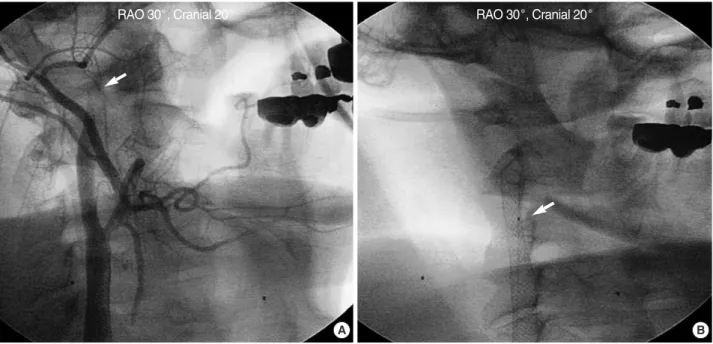
After predilation with 4.0 mm balloon, 8 mm self-expand- ing Wall stent (Boston Scientific) was positioned across the lesion and was deployed in stenotic lesion. After postdilation of the stent with 6.0 mm balloon, carotid angiogram showed abrupt complete flow interruption (Fig. 2A). We suspected this phenomenon induced by obliteration of filter pore by massive atherosclerotic emboli. We decided to perform aspi- ration thrombectomy using Export Aspiration catheter (Med- tronic AVE, Santa Rosa, CA, U.S.A.) (Fig. 2B). After sever- al passes of Export Aspiration catheter into the basket (over the FilterWire EX), antegrade flow was fully restored (Fig. 3).
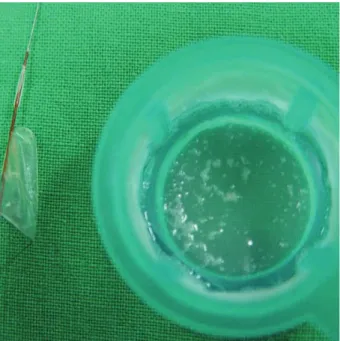
After retrieval of FilterWire Ex, whitish debris was noted within the basket (Fig. 4). After finishing carotid artery stent- ing, the patient complained of slight speech disturbance and this neurological abnormality was completely recovered with- in 24 hr after stenting.
DISCUSSION
Obstructive carotid artery lesions are known to contain friable, ulcerated and thrombolic material that have the poten- tial to embolize during intervention and may be responsible
967
Seung Hwan Han, Woong Chol Kang, Tae Hoon Ahn, and Eak Kyun Shin
Division of Cardiology, Heart Center, Gil Hospital Gachon University of Medicine and Science Incheon, Korea
Address for correspondence Eak Kyun Shin, M.D.
Division of Cardiology, Gil Heart Center, Gachon Medical School, 1198 Guwol-dong, Namdong-gu, Incheon 405-760, Korea
Tel : +82.32-460-3665, Fax : +82.32-460-3117 E-mail : [email protected]
J Korean Med Sci 2009; 24: 967-9 ISSN 1011-8934
DOI: 10.3346/jkms.2009.24.5.967
Copyright � The Korean Academy of Medical Sciences
Pseudo-no-Reflow Phenomenon in Carotid Artery Stenting using FilterWire EX: Successful Recovery by Aspiration Thrombectomy
Distal protection devices such as FilterWire EX have been widely used in carotid artery stenting, however, the large amount of atherothrombotic debris entrapped in the filter could reduce or stop antegrade flow. We present a case of pseudo-no-reflow phenomenon after postdilatation of the stent in a patient with asymptomatic carotid artery stenosis. After several passes using an Export Aspiration catheter, normal flow in the internal carotid artery was restored. Aspiration thrombectomy can suc- cessfully recover pseudo-no-reflow phenomenon.
Key Words : Carotid Artery Stenting; Distal Protection Device; Pseudo-no Reflow Phenomenon; Aspiration Thrombectomy
Received : 24 January 2008 Accepted : 6 May 2008
for the majority of the neurologic events during carotid artery stenting (1). A number of “distal protection” strategies, de- signed to capture embolic debris released during carotid inter- vention, have been evaluated for their efficacy in minimiz- ing the risk of embolic neurologic events. The intravascular filter type distal protection device offers the advantage of a constant cerebral perfusion during carotid artery stenting and
allows more time for careful and precise intervention (2). Dur- ing carotid artery stenting using filter type distal protection device, microscopic particles larger than the size of the filter pores (80 to 130 μm) could be captured. Reimers et al. (3) reported that carotid artery stenting with filter type distal protection device experienced flow impairment due to filter obstruction in 7.9% of procedures, which was resolved in all
968 S.H. Han, W.C. Kang, T.H. Ahn, et al.
Fig. 1. Carotid angiogram showed severe stenotic lesion in the right internal carotid artery.
RAO, right anterior oblique.
Fig. 2. (A) After postdilatation of the stent, sudden antegrade flow interruption (arrow) developed proximal to FilterWire EX location. (B) Several passes of Export Aspiration catheter (arrow) was performed before FilterWire removal.
RAO, right anterior oblique.
A B
RAO 30 , Cranial 20
Fig. 3. After aspiration thrombectomy, antegrade flow was fully re- stored.
RAO, right anterior oblique.
RAO 30 , Cranial 20
RAO 30 , Cranial 20 RAO 30 , Cranial 20
cases after filter removal. In our case, complete flow inter- ruption was developed after postdilatation of the stent. We suspected this pseudo-no-reflow phenomenon was induced by obliteration of filter pore by massive atherosclerotic debris.
We considered to remove filter by retrieval catheter, however, this process may cause entrapment of filter device to retrieval catheter and embolize massive amount of atherosclerotic de- bris. Therefore, we choose aspiration thrombectomy using Export Aspiration catheter. After aspiration thrombectomy, flow interruption in the right internal carotid artery was com- pletely restored, therefore, we confirmed this phenomenon as pseudo-no-reflow phenomenon instead of true no-reflow phenomenon. Yadav (4) recommended practically in his re- view paper if there is no forward blood flow during carotid
angioplasty with filter type distal protection device, this sh- ould be aspirated before the filter is collapsed. Our case is the first case report of pseudo-no-reflow phenomenon in carotid artery stenting using filter type distal protection device and successful recovery of this phenomenon by aspiration throm- bectomy using Export Aspiration catheter. Lee et al. (5) rece- ntly reported that successful management of pseudo-no-reflow phenomenon by the Export Aspiration catheter in ostial saphe- nous vein graft intervention using FilterWire EX protection.
In conclusion, the large amount of atherothrombotic debris entrapped in the filter during carotid intervention could stop antegrade flow. This phenomenon is pseudo-no-reflow phe- nomenon instead of true no-reflow phenomenon. Aspiration thrombectomy can successfully recover pseudo-no-reflow phe- nomenon.
REFERENCES
1. Imparato AM, Riles TS, Gorstein F. The carotid bifurcation plaque:
pathologic findings associated with cerebral ischemia. Stroke 1979;
10: 238-45.
2. Al-Mubarak N, Colombo A, Gaines PA, Iyer SS, Corvaja N, Cleve- land TJ, Macdonald S, Brennan C, Vitek JJ. Multicenter evaluation of carotid artery stenting with a filter protection system. J Am Coll Cardiol 2002; 39: 841-6.
3. Reimers B, Schlu_ter M, Castriota F, Tu_bler T, Corvaja N, Cernetti C, Manetti R, Picciolo A, Liistro F, Di Mario C, Cremonesi A, Schofer J, Colombo A. Routine use of cerebral protection during carotid artery stenting: results of a multicenter registry of 753 patients. Am J Med 2004; 116: 217-22.
4. Yadav JS. Embolic protection devices: methods, techniques, and data.
Tech Vasc Interv Radiol 2004; 7: 190-3.
5. Lee CH, Low A, Tan HC, Lim YT. Pseudo-no-reflow phenomenon in ostial saphenous vein graft intervention using FilterWire EX pro- tection. Int J Cardiol 2005; 104: 233-4.
Recovery of Pseudo-no-Reflow by Aspiration Thrombectomy in Carotid Artery Stenting 969
Fig. 4. After retrieval of FilterWire EX, whitish debris was noted within the basket.