• 검색 결과가 없습니다.

Classic Peripheral Signs of Subacute Bacterial EndocarditisYooyoung Chong, M.D., Sung Joon Han, M.D., Youn Ju Rhee, M.D., Shin Kwang Kang, M.D., Ph.D., Jae Hyeon Yu, M.D., Ph.D., Myung Hoon Na, M.D., Ph.D.

N/A
N/A
Protected

Academic year: 2021

Share "Classic Peripheral Signs of Subacute Bacterial EndocarditisYooyoung Chong, M.D., Sung Joon Han, M.D., Youn Ju Rhee, M.D., Shin Kwang Kang, M.D., Ph.D., Jae Hyeon Yu, M.D., Ph.D., Myung Hoon Na, M.D., Ph.D."

Copied!
5
0
0

로드 중.... (전체 텍스트 보기)

전체 글

(1)

ISSN: 2233-601X (Print) ISSN: 2093-6516 (Online)

Received: September 1, 2015, Revised: October 5, 2015, Accepted: October 5, 2015, Published online: October 5, 2016

Corresponding author: Myung Hoon Na, Department of Thoracic and Cardiovascular Surgery, Chungnam National University Hospital, Chungnam National University School of Medicine, 282 Munhwa-ro, Jung-gu, Daejeon 35015, Korea

(Tel) 82-42-280-7378 (Fax) 82-42-280-7373 (E-mail) [email protected]

© The Korean Society for Thoracic and Cardiovascular Surgery. 2016. All right reserved.

This is an open access article distributed under the terms of the Creative Commons Attribution Non-Commercial License (http://creativecommons.org/

licenses/by-nc/4.0) which permits unrestricted non-commercial use, distribution, and reproduction in any medium, provided the original work is properly cited.

Classic Peripheral Signs of Subacute Bacterial Endocarditis

Yooyoung Chong, M.D., Sung Joon Han, M.D., Youn Ju Rhee, M.D.,

Shin Kwang Kang, M.D., Ph.D., Jae Hyeon Yu, M.D., Ph.D., Myung Hoon Na, M.D., Ph.D.

Department of Thoracic and Cardiovascular Surgery, Chungnam National University School of Medicine

A 50-year-old female patient with visual disturbances was referred for further evaluation of a heart murmur.

Fundoscopy revealed a Roth spot in both eyes. A physical examination showed peripheral signs of infective endocarditis, including Osler nodes, Janeway lesions, and splinter hemorrhages. Our preoperative diagnosis was subacute bacterial endocarditis with severe aortic regurgitation. The patient underwent aortic valve re- placement and was treated with intravenous antibiotics for 6 weeks postoperatively. The patient made a re- markable recovery and was discharged without complications. We report this case of subacute endocarditis with all 4 classic peripheral signs in a patient who presented with visual disturbance.

Key words: 1. Endocarditis 2. Subacute bacterial

Case report

A 50-year-old female patient with visual disturbance was referred to Chungnam National University Hos- pital by an ophthalmologist for further evaluation of a cardiac murmur. The patient had experienced blur- red vision and pain in both eyes for 5 days, and had a history of pain in the lower legs that had lasted for 3 months, coinciding with a persistent mild fever.

A skin rash with tenderness was present on the palms and the soles of the feet and had lasted for 2 months. The patient had previously received 2 weeks of acupuncture treatments of the neck and back at an Oriental medical clinic in an attempt to reduce pain. In addition, the patient had been taking non- steroidal anti-inflammatory drugs for 2 months as prescribed by a local clinic, but the mild fever per- sisted and did not improve.

The patient had a chronically ill, anemic appear- ance, and presented with a mild fever (37.8

o

C), ta-

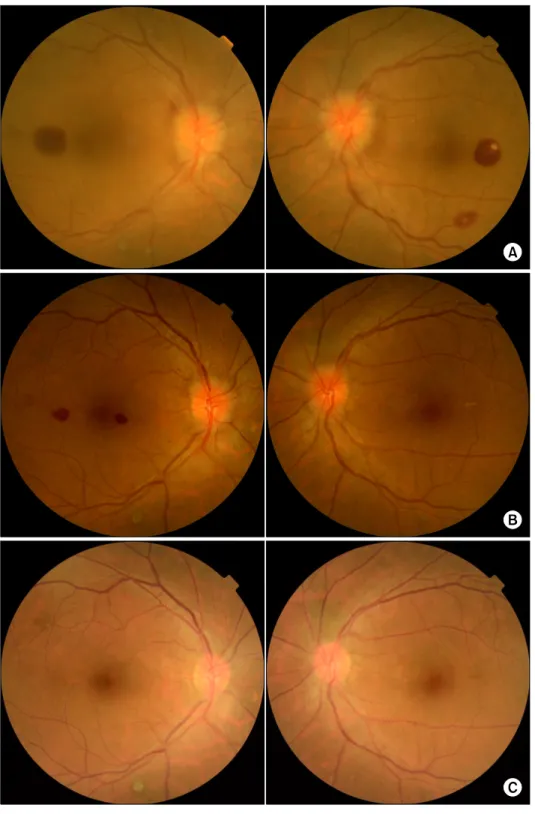
chypnea, and a blood pressure of 110/80 mmHg. An ophthalmic examination revealed reduced visual acuity in both eyes; fundoscopy showed bilateral Roth spots and optic disc edema with retinal hemorrhages (Fig. 1).

A physical examination showed Osler nodules (Fig. 2), Janeway lesions (Fig. 3), and splinter hemorrhages (Fig. 4). Chest auscultation revealed a diastolic decre- scendo murmur at the right and left upper sternal border. The neurologic examination was unremarkable.

The laboratory examination showed marked leuko- cytosis (21,000/mm

3

, 88% neutrophils, and 7% lym- phocytes) and a C-reactive protein level of 13 mg/L.

Urinalysis revealed microscopic hematuria and pro- teinuria. An electrocardiogram showed a normal sinus rhythm and a chest X-ray showed bilateral pleural effusions.

Brain magnetic resonance imaging revealed a sub- arachnoid hemorrhage in the frontal and right occipi- tal lobes, as well as multifocal microhemorrhages in the bilateral cerebellum and the left occipital, left pa-

http://dx.doi.org/10.5090/kjtcs.2016.49.5.408

(2)

Fig. 1. Fundoscopic findings of Roth spots. (A) Preoperative findings. (B) 2 weeks postoperatively. (C) 6 weeks postoperatively.

rietal, and left frontal lobes. Transthoracic and trans- esophageal echocardiograms showed combined se- vere aortic regurgitation and 8×21-mm and 6×20-mm echogenic masses with high mobility attached to the left ventricular sides of the right and left coronary

cusps, respectively. Empirical intravenous antibiotics were started. A peripheral blood culture showed Streptococcus parasanguis.

On the fourth day in the hospital, the patient un-

derwent aortic valve replacement. Cardiopulmonary

(3)

Fig. 3. Janeway lesions. (A) Preoperative findings. (B) 6 weeks postoperatively.

Fig. 4. Splinter hemorrhage. (A) Preoperative findings. (B) 6 weeks postoperatively.

Fig. 2. Osler nodes. (A) Preoperative findings. (B) 6 weeks postoperatively.

bypass was established with aortic and bicaval cann- ulation. After transverse aortotomy, we found huge vegetations on 3 aortic cusps and a small aortic wall abscess in the aortic wall above the noncoronary cusp. The aortic valve was severely damaged, so we

performed aortic valve replacement with a mechan- ical prosthetic valve. The aortic wall abscess was de- brided and reinforced with pledgeted sutures.

Postoperative care and follow-up examinations were

performed, including a weekly blood culture, echo-

cardiogram, fundoscopic exams, and 6 weeks of in-

travenous antibiotics. The pain in the patient’s palms,

soles, and lower limbs resolved on postoperative day

(4)

(POD) 4, and the skin lesions resolved after 2 weeks.

The visual complications started to improve on POD 2 and had completely resolved on POD 7. A fundo- scopic examination showed that the hemorrhages with Roth spots remained present for 4 weeks post- operatively, but were nearly absorbed by the 6th week postoperatively. The patient was discharged af- ter 6 weeks of intravenous antibiotics and routine follow-up at our outpatient division. No complications were observed during the 2-month follow-up period.

Discussion

Infective endocarditis is characterized by inflam- mation of the endothelium of the heart; it most com- monly affects heart valves. Numerous microorganisms are known to cause this condition. Symptoms are usually nonspecific and include fever, chills, anorexia, myalgia, and dyspnea [1]. The clinical signs of endo- carditis are numerous and nonspecific; heart murmur is the most common sign. The peripheral signs can be useful in diagnosis but are less commonly used because of advancements in diagnostic modalities [1].

There are four peripheral signs of endocarditis: Roth spots, Osler nodes, Janeway lesions, and splinter hemorrhages. The Swiss pathologist Moritz Roth first described these eponymous spots in 1872 [2]. Ruth spots appear as white-centered retinal hemorrhages on a fundoscopic examination. The white center of a Roth spot is thought to be a leucocyte accumulation or platelet-fibrin plug. Although Roth spots are a classic peripheral sign of endocarditis, they are also present in other conditions, including hematologic malignancies, connective tissue diseases, vasculitis, anemia, hypertension, diabetes mellitus, human im- munodeficiency virus infections, and intracranial hem- orrhages [2].

The prognosis of Roth spots in septic conditions is poor. However, previous reports have stated that early interventions with medical or surgical modal- ities achieved good results [3]. Our patient experi- enced relief from the visual disturbances in the first postoperative week.

The Canadian physician Sir William Osler first de- scribed Osler nodes in 1893 [3]. They are painful er- ythematous lesions of the hands and feet. The patho- genesis of Osler nodes is unclear, but is thought to involve the deposition of immune complexes. The no-

des are a classic sign of late-phase subacute bacterial endocarditis. However, Osler nodes are also found in other conditions, including bacteremia, septic endar- teritis, typhoid fever, disseminated gonococcal infection, and systemic lupus erythematosus. The usual sites of Osler nodes are the pads of the fingers and toes, but occasionally they appear on the mucous membranes, limbs, and trunk. With adequate intravenous antibiotics, Osler nodes resolve without any sequelae within 3 days [4]. In this case, we found painful nodular le- sions on the patient’s palms and soles, which were relieved 4 days postoperatively.

Janeway lesions are non-tender, small, erythema- tous, or hemorrhagic macular lesions. Microabscesses of the dermis may develop into Janeway lesions. The lesions are similar to Osler nodes, but some notable differences are present. First, they are not tender;

second, they are not of immunological origin; and lastly, they present on the palms and soles rather than on the pads of the fingers and toes [5]. We found Janeway lesions on the patient’s palms and soles, and they resolved within 4 days after surgery.

Splinter hemorrhages are tiny blood clots that run vertically under the nails. They are a non-specific sign of endocarditis and are also seen in sclerod- erma, trichinosis, systemic lupus erythematosus, rhe- umatoid arthritis, psoriasis, antiphospholipid syn- drome, hematological malignancy, and trauma [6].

Sandre and Shafran [7] reported the incidence of peripheral signs of endocarditis as follows: 3% for Roth spots, 6.7% for Osler nodes, 2.2% for Janeway lesions, and 39% for splinter hemorrhages, but no report has previously described a patient with all 4 peripheral signs. We report here a case of subacute infective endocarditis with all 4 classic peripheral signs.

Conflict of interest

No potential conflict of interest relevant to this ar- ticle was reported.

References

1. Mylonakis E, Calderwood SB. Infective endocarditis in adults. N Engl J Med 2001;345:1318-30.

2. Fred HL. Little black bags, ophthalmoscopy, and the Roth

spot. Tex Heart Inst J 2013;40:115-6.

(5)

3. Jackson TL, Eykyn SJ, Graham EM, Stanford MR.

Endogenous bacterial endophthalmitis: a 17-year pro- spective series and review of 267 reported cases. Surv Ophthalmol 2003;48:403-23.

4. Von Gemmingen GR, Winkelmann RK. Osler’s node of sub- acute bacterial endocarditis: focal necrotizing vaculitis of the glomus body. Arch Dermatol 1967;95:91-4.

5. Farrior JB, Silverman ME. A consideration of the differ-

ences between a Janeway’s lesion and an Osler’s node in infectious endocarditis. Chest 1976;70:239-43.

6. Robertson JC, Braune ML. Splinter haemorrhages, pitting, and other findings in fingernails of healthy adults. Br Med J 1974;4:279-81.

7. Sandre RM, Shafran SD. Infective endocarditis: review of

135 cases over 9 years. Clin Infect Dis 1996;22:276-86.

수치

Fig. 1. Fundoscopic findings of Roth  spots. (A) Preoperative findings. (B)  2 weeks postoperatively
Fig. 3. Janeway lesions. (A) Preoperative findings. (B) 6 weeks  postoperatively.

참조

관련 문서

#define 에서 인자 사용 예제 compoundassign.c... 관계와

▪ 실세계의 객체에서 불필요한 부분을 제거하여 필요한 부분만을 간결하고 이해하기 쉬운 클래스 로 만드는 작업. ▪

블록체인 기술은 보안, 금융, 의료 분야 등 여러 산업에서 활용이 가능해 4차 산업혁명의 핵심기술로 거론되지만 법으로 열거한 신성장 R&D 기술에 해당되지 않아

Scale Min 과 Scale Max 아래의 각 채널에 Disable 로 표시 되면 기본값으로 설정 되어 있는 상태 입니다.. 스케일 설정 값은 EEPROM에 저장되어 전원

위의 창에서 마우스로 해당 채널을 더블클릭 하거나 채널 선택 후 채널설정(S) 을 클릭 하면 아래와 같이 채널 설정 창이 나타납니다.. 8.1 채널

One might try to solve the problem by copying the first d elements of x to a temporary array, moving the remaining n − d elements left d places, and then copying the first d

(바) “액체 밀봉드럼 (Liquid seal drum)”이라 함은 플레어스택의 화염이 플레어시 스템으로 거꾸로 전파되는 것을 방지하거나 또는 플레어헤더에

• 글로벌 거버넌스란 국제사회에서 과거 주권국가들이 유읷핚 행위자로서 그들의 관계로 형성되었던 국제관계가 다양핚 다른 행위자들이 등장하고 새로욲 행위자들이 국가들과