■
Yu-Shin Kim, PT, MHsc; Jong-Min Lim, PT
1; Na-Yeon Ko; Bum-Chul Yoon, PT, PhD
■
Department of Physical Therapy, College of Health Science, Korea University;
1Department of Physical Therapy, Graduate School of Public Health Social Welfare, Gachon University of Medicine and Science
Purpose: To evaluate changes in lower extremity muscle activity caused by high heeled shoe wearing during normal, brisk, and upslope walking.
Methods: Twenty healthy young women (age, 23.9±2.47) participated in this study. Muscle activities of the tibialis anterior, peroneus longus, gastrocnemius lateralis, gastrocnemius medialis, soleus, hamstring, vastus lateralis, and vastus medialis while walking normally, walking briskly, and walking up a slope.
Results: When walking normally, the peroneus longus, gastrocnemius lateralis, soleus, and vastus lateralis evidenced higher activity when high‐heeled shoes were worn (p<0.05). During brisk walking, the peroneus longus and gastrocnemius lateralis exhibited higher activity (p<0.05). Although the peroneus longus and vastus lateralis exhibited higher activity when walking up an incline with high‐heeled shoes, the activity levels of the tibialis anterior and gastrocnemius medialis were lower (p<0.05).
Conclusion: The results of this study demonstrate that increased heel height substantially reduces muscle effort when walking up a slope. From a therapeutic perspective, it is possible that using high heeled shoes over a short period might enhance muscle activity of ankle evertor, although it can cause mediolateral muscle imbalances in the lower extremities.
Keywords: High‐heeled shoes, Electromyography, Muscle activity, Upslope, Walking Received: March 31, 2011
Revised: April 18, 2011 Accepted: May 24, 2011
Corresponding author: Bum-Chul Yoon, [email protected]
Shoes under Various Situations: A Therapeutic Perspective
The Journal of Korean Society of Physical Therapy
I. Introduction
For the past 250 years, medical scientists have associated the wearing of high-heeled shoes with several health problems.
1Previous studies regarding the wearing of high-heeled shoes have focused principally on pain and deformity in the back and the lower extremity joints, in addition, alterations of the musculo- skeletal system.
2-4According to previous studies, high-heeled shoes have the following adverse effects on the musculoskeletal system; skeletal deformities of the foot, including metatarsalgia (pes cavus, hallux valgus, Morton's foot and intermetatarsal phalangeal bursitis), Haglund’s disease, and Retro- Achilles bursitis.
3,5-7High-heeled shoes have also been reported to increase the risk of degenerative osteoarthritis in the knee, ankle sprains, falling and back pain.
8-11Additionally, the risk of
secondary damage as the result of muscle imbalance and changes in gait pattern may be elevated in association with high heeled shoes.
12,13Therefore, clinicians should be aware of the negative effects of wearing high-heeled shoe and should pay more attention to this topic when they treat patients.
The general view that high-heeled shoes are abnormal could bias opinions with regarding to their biomechanical effects; thus, it is important to adhere strictly to an objective perspective in order to avoid study bias. A previous questionnaire-based study reported that women who had worn poorly fitting shoes suffered from heel cord pain induced by heel cord tightness.
14However, their classifications included not only high-heeled shoes but also a variety of flat shoes types, such as sandals and slippers, which induce an elongated heel cord.
Several studies have raised doubts regarding the negative
N Year (yr) Height (cm) Weight (kg) Foot length (cm) Foot width (cm)
20 23.9±2.47 163.26±4.69 52.88±5.21 238.47±8.79 8.71±0.45
Table 1. Anthropometric characteristics of subjects (mean±SD)
Trials Composition
Trial 1 Normal walking (velocity: 2 km/h, inclination: 0°) & flat shoes Trial 2 Normal walking (velocity: 2 km/h, inclination: 0°) & high-heeled shoes Trial 3 Bisk walking (velocity: 4 km/h, inclination: 0°) & flat shoes
Trial 4 Brisk walking (velocity: 4 km/h, inclination: 0°) & high-heeled shoes Trial 5 Upslope walking (velocity: 2 km/h, inclination: 15°) & flat shoes Trial 6 Upslope walking (velocity: 2 km/h, inclination: 15°) & high-heeled shoes Table 2. Composition of each trial
effects of high-heeled shoes. In one study, it was determined that the risks of foot deformity and pain in elderly women were greater in wearers of low-heeled shoes.
15Another researcher suggested that high-heeled shoes exert a therapeutic effect. It was determined that the wearing of 7-cm heeled shoes can double mean leg venous pressure as compared with barefooted walking, which suggests that high-heeled shoes might exert positive effects on patients suffering from venous diseases.
16Additionally, in a electromyographic study concerning the effects of high- heeled shoes on muscle activity, it was suggested that high-heeled shoes might be proveduseful in the treatment of tendoachilles bursitis and tenosynovitis of the Achilles tendon, and also in the postoperative management of a ruptured Achilles tendon.
17The studies mentioned above suggested that the effects of high-heeled shoes on the human body are diverse, and appear to be strongly associated with joint deformity or muscular fatigue.
However, studies of the effects of high-heeled shoes have generally been carried out only under normal walking con- ditions. Accordingly, it is necessary to evaluate the effects of high-heeled shoes under various conditions in daily living, such as brisk and upslope walking. The principal objective of this study was to assess both the positive and negative therapeutic aspects of high-heeled shoe wearing by analyzing lower extremity muscle activities in subjects wearing flat shoes and high-heeled shoes under a variety of conditions.
II. Methods
1. Subjects
Twenty healthy females in their 20s participated in this study.
The characteristics of subjects are described in Table 1. Three women had no experience with wearing high heeled shoes (heel height over 8cm). On average, the other subjects reported wearing high-heeled shoes for 3.8±1.69 hours per day. Prior to the experiment, all subjects underwent a 10-minute instruction session and provided informed consent for participating in the study. All subjects completed a questionnaire assessing their living habits and medical histories. None of the subjects had any history of orthopedic or neurologic diseases of the lower extremities over the previous 6 months. The Ethics Committee of the University of Korea approved the protocols of this study.
2. Experimental Procedure
All subjects wore the shorts to permit the attachment of EMG electrodes. After placing electrodes on the dominant leg, the subjects walked on a treadmill wearing flat (0 cm) or high-heeled shoes (8 cm), and leg muscle activities were recorded via EMG.
All subjects were allowed a 10-minute adjustment time on the treadmill while wearing flat or high-heeled shoes. During the measurement sessions, the electrical amplitudes of the dominant leg muscles were recorded. The experiment consisted of two shoe conditions (flat or high-heeled shoes) and three walking conditions (normal walking, brisk walking or upslope walking).
Therefore, the subjects were made to walk under six different
experimental conditions (Table 2). All subjects participated in
randomized order under six distinct experimental conditions.
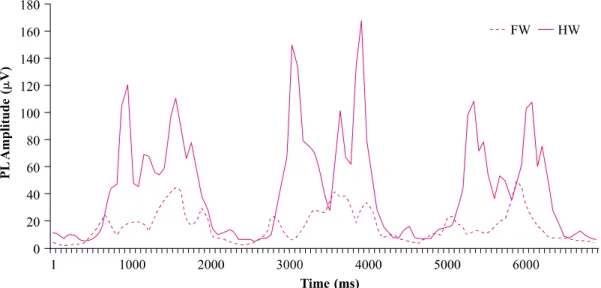
Figure 1. Integrated peroneus longus EMG amplitudes. The RMS values of the muscle activities of gait cycles for flat and high heeled shoes.
PL: peroneus longus FW: walking in flat shoes HW: walking in high-heeled shoes
Normalization of each muscle activity RMS_S_w-Rest_S_W Max_F_w-Rest_F_w During each session, the subjects were instructed to maintain a
walking speed for 11 gait cycles. A one-minute break was allowed between sessions.
3. EMG measurements
Surface EMG was recorded while subjects walked on the treadmill. Unipolar Ag/AgCl surface electrode pairs were attached to the muscle belly of the tibialis anterior (TA), peroneus longus (PL), gastrocnemius lateral head (GL), gastroc- nemius medial head (GM), soleus (SO), vastus lateralis (VL), vastus medialis (VM), and hamstring (HM) muscles of dominant leg. Electrodes were placed as described previously.
18The electrodes were 10 mm in diameter and were positioned with an inter-electrode gap of 22 mm. The ground electrode was placed on the tibial tuberosity. EMG signals were collected with a MES 9000 interface (FA Myotronics Noromed USA) filtered with a band-pass filter (15~500 Hz). The signals were full wave rectified and raw data were transformed with MATLAB Software (MathWorks Inc., USA) for 4th order Butterworth filtering (2.5 Hz). Data from the firstand last gait cycles were not considered. The data of the 9 sequential gait cycles were divided into 3 sets of 3 consecutive gait cycles to analysis of reliability (Figure 1). The normalization method of Romkes J et al.
19was employed to compare the high-heeled and flat shoe data. All data was calculated via the following equation:
in which ‘S’is the shoe type (high-heeled shoe or flat shoe), ‘w’ is the walking type (normal, brisk, or upslope walking).
Resting values were subtracted from all filtered EMG data.
Data for the RMS of the high-heeled shoes was divided by the maximum values of flat shoes under identical walking conditions. All high-heeleddata were expressed as percentages of peak amplitudes of flat shoe data. For example, when a subject executed trial 4 which consisted of brisk walking in high-heeled shoes, the normalization method is as follows. RMS_S_w is the RMS value of trial 4, Rest_S_w is the RMS value under resting conditions in trial 4. Max_F_w is the peak amplitude of trial 3.
Rest_F_w is RMS value of resting condition in trial 3.
After normalization, the RMS values of each of the muscle activities in the 3 EMG data sets—each of which consisted of 3 gait cycles--were calculated for all six experimental conditions.
On average, the intraclass correlation coefficient of all EMG data was 0.90±50.
Statistical analysis was conducted to confirm that the
normalized RMS values of muscle activities for flat and
high-heeled shoes differed. Thus, the averages of three sequential
RMS values for the 8 leg muscles by the two types of shoes in
each normal, brisk and upslope walking were analyzed via
two-way repeated measures of ANOVA, contained in the SPSS 12.0 software package for Windows. Paired t-test was used as a post-hoc procedure. Significance levels were set to = 0.05.
III. Results
Twenty healthy women in their 20s were recruited for this study.
The average subject age was 23.9±2.5 years, and the subjects’ mean height and body weight were 163.3±4.7 cm and 52.9±5.2 kg.
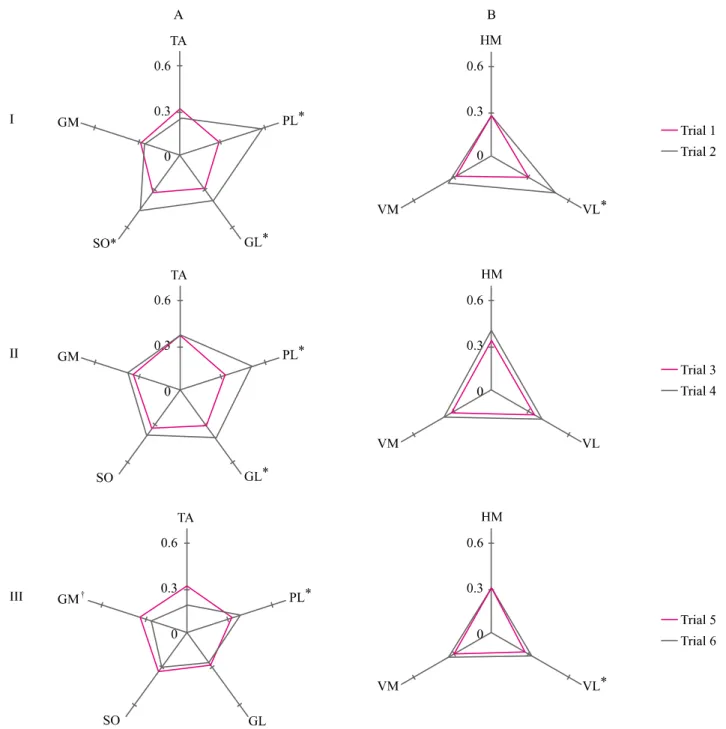
The mean±SD EMG values of muscle activities in flat and high-heeled shoes are shown in Table 1. The figure 2 shows the relative activity of the ankle and knee muscles, comparing muscle activity levels between the flat shoe and high heeled shoes.
As a result of our study, significant differences of muscle activity between two shoe type swere detected for each of the walking conditions tested. During 2 km/h walking on a treadmill at a tilt angle of 0°, the measured activities of the PL (F=32.73, p<0.01), GL (F=5.92, p=0.02), SO (F=6.97, p=0.01), VL (F=
6.43, p=0.02) showed that walking in high-heeled shoes requires more leg muscle activity than walking in flat shoes. In particular, PL activity in high-heeled shoes was nearly twice that measured in flat shoes. During brisk walking (4 km/h), walking in high-heeled shoes required greater muscle activity in PL (F=
14.08, p<0.01) and GL (F=4.77, p=0.04) than flat shoes.
Interestingly, during walking on a treadmill at a tilt angle of 15°, the activities of TA (F=24.84, p<0.01) and GM (F=14.64, p<0.01) were lower and the activities of PL (F=5.28, p=0.037) and VL (F=6.94, p=0.02) were slightly higher for walking in high-heeled shoes than walking in flat shoes.
Figure 2 shows that PL, GL, and SO exhibited higher activities for high heeled shoes during normal walking and brisk walking at a tilt angle of 0°. However, the activities of these muscles were lower for high-heeled shoes on the treadmill at 15°.
In summary, on a flat surface, walking in high-heeled shoes was shown to increase the activity levels of PL, GL, SO, and VL.
Brisk walking on a flat surface in high-heeled shoes was shown to increase PL and GL activity. On an upward slope, walking in high-heeled shoes reduced TA and GM activity, but increased GL and VL activity. In terms of the ankle joint, the activity levels of the lateral muscles (PL, GL, SO) were increased on a flat surface, but reduced on an inclined surface. In the knee joint,
muscle activity levels differed between flat and high-heeled shoes on the flat surface, but no significant differences were observed at an incline of 15°.
IV. Discussion
To evaluate the overall characteristics of lower extremity muscle activity while walking in high-heeled shoes, we devised an experimental plan involving a variety of walking conditions and recorded the RMS values of the EMG outputs from eight lower extremity muscles. Previous studies have shown that leg muscle activities are increased by the wearing of high-heeled shoes while walking on a flat surface at a single walking speed.
11,12,20,21In this study, we also determined that muscle activities are also influenced not only by heel height but also by the walking conditions. Different RMS values of the relative amplitudes of ankle and knee joint muscle activities were noted under three treadmill conditions, with the subjects wearing flat or high- heeled shoes.
In this study, PL, GL, SO, and VL muscleactivities were determined to be greater with high-heeled shoes than with flat shoes; these results are consistent with the findings of previous studies. We confirmed that lower extremity muscle activities in lateral regions such as PL, GL, and VL were more strongly activated when women wore high-heeled shoes. Other studies have also reported higher levels of PL and VL muscle activity when high-heeled shoes were worn.
11,20,22Furthermore, high- heeled shoes were shown to increase lateral leg muscle activity during brisk walking on an incline. This pattern was expected, as the result of increasing angles of hip adduction, shifting the pelvis laterally and the center of pressure medially.
2,23,24Shifting the pelvis laterally in the stance phase might require greater muscle effort in the lateral regions of the lower extremities and a change in the disposition of muscle contraction, from isometric to eccentric contraction.
However, this result regarding the increase of lateral leg
muscle activities might be derived from an EMG pattern of
VM/VL and GM/GL imbalance. A previous study reported that
the PL and GL muscles of habitual wearers of high-heeled shoes
were more prone to fatigue than those of non-high-heeled shoe
wearers.
12This result appears to be attributable to the increased
lateral leg muscle activity induced by high-heeled shoes.
Figure 2. Normalized root mean square values of ankle (A) and knee (B) muscle activities while wearing flat shoes and high-heeled shoes under the three walking conditions: normal walking on a flat surface (I), brisk walking on a flat surface (II), and walking up a 15 degree incline (III). Black lines represent the flat shoes and gray lines illustrate the high heeled shoes.
* significantly greater for flat shoes
†