• 검색 결과가 없습니다.

Detecting gold by voltammetric handhold systems

N/A
N/A
Protected

Academic year: 2021

Share "Detecting gold by voltammetric handhold systems"

Copied!
6
0
0

로드 중.... (전체 텍스트 보기)

전체 글

(1)

http://dx.doi.org/10.12925/jkocs.2014.31.3.472

Detecting gold by voltammetric handhold systems

Nack-Joo Kim

․Dal-Woong Choi

*

․Hai-Soo Yoo

**

․Kyung Lee

***

Chang-Hyun Lee

****

․Suw-Young Ly

*****

․Tae-Yun Kim

*****

Dept. of Fine Chemistry, Seoul National Univ. of Science & Technology, Seoul, Korea

*

Department of Public Health Sciences, Graduate School, Korea University, Seoul 136-703, Korea

**

Korea Institute Ocean Science Technology, 787 Haean ro(st), Sangnok gu, Ansan si, 425-744, KOREA

***

Excavation Literature and Ancient Scripts Research Institute, Fudan University, Shanghai, 400223, China

****

Division of General Education, Pyeongtaek University, Gyeonggi do 405-701, Korea

*****

Biosensor Research Institute, 139-743, Seoul, Korea

(Received August 22, 2014; Revised September 18, 2014; Accepted September 25, 2014)

Abstract : A voltammetric investigation of Au assay was conducted at a low cost, using Nafion and DNA immobilized on a graphite Pencil working electrode (NDP) with a black lead counter and reference. The following optimal parameters were found: 0.4 V amplitude, 500 Hz frequency, -0.7 V initial potential, and 0.015 V increment potential. These optimal conditions were also applied to sand obtained from the river site. The aforementioned technique is simpler and less costly compared to the common voltammetry and spectrophotometric methods.

Keywords : gold, graphite nafion, voltammetry, alluvial gold

1. Introduction

Au is useful and necessary for the manufacture of electronic goods, especially in the composition of circuits. Au is expensive and rare, and is scattered in soil, sand, and planet rocks. Therefore, a convenient and inexpensive method of detecting Au is needed.

Current methods used to detect Au, such as ICP spectrometry and kinetic photometric method [1], electrothermal atomic absorption spectrometry [2], and the ion exchange resin



Corresponding author

(E-mail: [email protected]

method [3], are complicated. The equipment

required by such methods are large and

expensive. The electrochemical method,

however, is easy to execute, is inexpensive,

and uses minute equipment. More recently,

electrochemical methods were used for

detecting Au, such as the graphite-epoxy

composite electrode [4] and the modified

carbon paste electrode with the

ethylenediamine-fixed humic-acid [5]. The

problem with electrochemistry, however, is that

it needs an Ag/AgCl electrode (as a reference

electrode), which is difficult to make, as well

as platinum wire (as an auxiliary electrode),

which is expensive. In this paper, inexpensive

graphite was used as a reference Ag/AgCl

(2)

the detection of the interaction between arsenic trioxide and DNA based on the guanine signal [11], and carbon electrodes for the detection of osmium-labeled target DNA [12]. The disadvantage was compensated for by using graphite, which can be used by anyone as it is convenient to use, renewable, and inexpensive.

Moreover, DNA was used because its surface area is large and it has numerous bond electrons with metal gold. It can also produce reactants fast, and this is why it is often used in antigen-antibody sensors. In the experiment that was performed in this study, DNA was melted with nafion and then fixed onto graphite to detect Au.

2. Experiment Method

2.1. System, preparation of the electrode Analytical measurement systems were used with the new Bioelectronics-2 system, which was constructed at the authors’ institute. The second version is a computerized handheld voltammetric system with a ±2.4 V potential range, a 2 mA current range, a 10-pico A measuring current, and a 5”ⅹ4”ⅹ1”

instrument size, and which uses a rechargeable battery or external power and has a USB port interface with a PC. Before the experiment, a working electrode was made with paste. The DNA was mixed with calf thymus sigma 70

% and 30 % mineral oil. A mixture of 5 g was homogenized in a mortar for 30 min. The

4.75 was used as a supporting electrolyte. All the systems were carried out in dissolved oxygen, and electrode cleaning was not necessary for every measurement. The phosphoric-acid solution was found to be the most suitable medium, 1000 ppm Au was used with automic standard absorption solution.

2.3. Experiment procedure

The common parameter that was used for Cyclic voltammetry (CV) was a scan rate of 100 mVs

-1

, and the common parameters for Square Wave Stripping Voltammetry (SWSV) were set at the optimized conditions. DNA immobilization was performed through a cyclic scan with an initial potential of +1.6 V, a switching potential of 0.6 V, and a scan rate of 0.5 mVs

-1

, with a tan cyclic repeat to stabilize the electrode surface. Since the voltammetric response of Au is dependent on the electrolyte solutions and the hydrogen ionic strength, various types of electrolyte solutions were tested. The phosphate solution was found to yield the best results.

3. Results and Discussion

3.1. Cyclic voltammetry

Cyclic voltammetry was performed using

graphite working, counter and reference

electrode. The first voltammograms were

obtained to sensitive oxidation and reduction

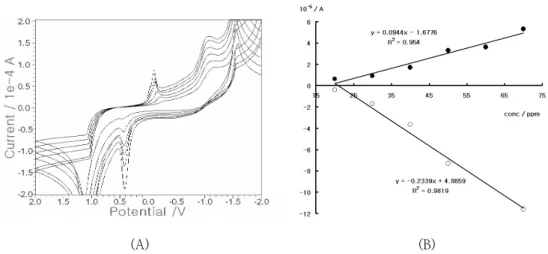
peak currents. Fig. 1(A) shows the results of

(3)

(A) (B)

Fig. 1. (A): Various cyclic voltammetric concentration effects of the 20-70-mgL

-1

Au spike at the 100 mVs

-1

scan rate when three graphite electrode systems were used. (B): Results of the linear regression showing of anodic and cathodic, the 0.5-M phosphate electrolyte solutions.

CV using graphite at 0.4 V oxidation, current ranges from 0.2ⅹ10

-4

A to 1.9ⅹ10

-4

A , -0.2 V reduction, ranges from 0.1ⅹ10

-4

A to 0.8ⅹ 10

-4

A, Fig. 1(B) shows the results of the linear regression with wide working ranges by 5 points reduction and 6 points oxidation, depicting the electrolyte solutions. The concentrations of 20, 30, 40, 50, and 70 mgL

-1

spiked, and the peak’s shape and width symmetrically narrowed. Peak current gradually increased. The more the Au spiked, the higher the peak current was. When the y=0.0944x-1.6776 equation (y: reduction peak current in A; x: concentration in mg/L) was obtained and the R²=0.945 correlation was sensitive. When the y=-0.2339x+4.8859, cathodic linear equation and the R²=0.9819 correlation was obtained. Here, the anodic results were sensitive and were found to be applicable for any field, but better sensitive stripping voltammetry was examined.

3.2. Optimizations of NDP for the square-wave anodic stripping voltammetriy, electrolyte pH effect and statistics

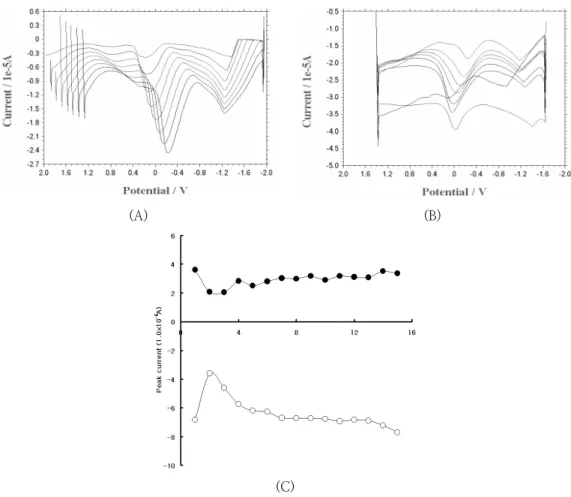
Fig. 2(A) shows the results of the SW amplitude variations in a fixed concentration.

The voltammetric peak current gradually

increased, and the peak current reached

14.36x10

-1

, where 0.4 V was found to be

sensitive. Under this condition, Fig. 2(B) shows

the variation results in electrolyte pH ionic

strength. The peak current increased to

12.96x10

-1

at the range of 2.97 to 6.13 pH

but dropped to 7.572ⅹ10

-1

at 7.18 pH. 6.13

pH was chosen as the optimum SW ionic

strength. Under this solution, other influencing

parameters in the SW increment potential

(0.015 V), initial potential (-0.7 V), SW

frequency (500 Hz), SW stripping

accumulation time (500 s), and 0.1M

electrolyte ionic strength were obtained (not

shown here). In this condition, Fig. 2(C)

shows the electrode statistic results when these

parameters were used. Measurements were

made 15 times, using SW, and the statistics

were obtained. The anodic peak current

reached 3.602ⅹ10

-1

in the fist measurement,

then decreased to 2.066ⅹ10

-1

A but went up

again to 2.835x10

-1

in the fourth

measurement. Thereafter, similar values were

(4)

(C)

Fig. 2. Optimization of the SW stripping voltammetric parameters for (A): the 0.05, 0.1, 0.15, 0.2, 0.25, 0.3, 0.35, and 0.4 V amplitudes variations; (B): the 2.97, 3.3, 3.89, 4.89, 5.43, 5.81, 6.13, and 7.18 pH variation; and (C): the statistics of the SW anodic and cathodic peak currents in the 10.0-mgL

-1

Au spike using the conditions in Fig. 3(A).

recorded. The cathodic peak was obtained from -6.828ⅹ10

-1

to -7.704ⅹ10

-1

and then stabilized. Under this condition, low working ranges and analytical application was performed.

3.3. Analytical application

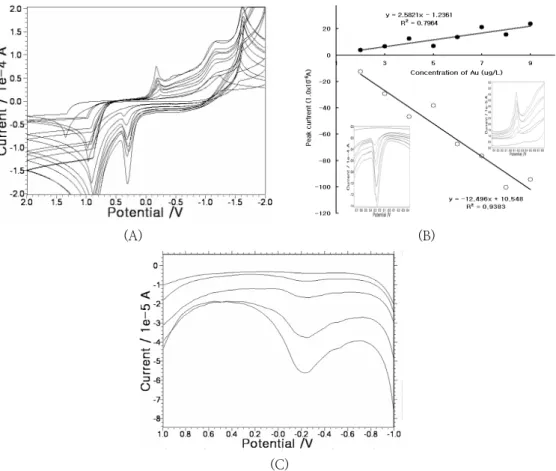
Fig. 3(A) shows the results of CV when NDP was used. The results ranged from 1 to 9 mgL

-1

variation. The reduction peak current reached 47.57ⅹ10

-6

, with the linear equation of y=4.284x-1.53, statistics of R

2

=0.714 and oxidation scan of -51.41ⅹ10

-6

A, y=-9.57x+4.07, R

2

=0.619

.

It can be used in

field analysis. Stripping voltammogram was also obtained for sensitive working ranges. Fig.

3(B) shows the anodic results when SW was

used. At 2-9 mgL

-1

, the peak current reached

to -94.59ⅹ10

-6

, and y=-12.496+10.548,

R

2

=0.9383. In this range, the cathodic SW

manifested and the spikes ranged from 2 to 9

mgL

-1

Here, the linear working curves were

obtained for the ppm levels of

y=2.5821x-1.236, R

2

=0.796. Both peaks can

be applicable for soil fields and water

resources. The developed techniques were

examined on liver sand. Fig. 3(C) shows the

SW anodic results of the application to sand

(5)

(A) (B)

(C)

Fig. 3. (A): Results of CV when the 1- to 9-mgL

-1

Au variation. (B): Results of the anodic and cathodic SW when the 2- to 9-mgL

-1

Au variation. (C): SW anodic standard addition results for the liver sand.

in the liver site. Sand was brought from the city liver, and Au was detected there from using NDP. A 1-ml sand solution (1 gram sand + 10 ml conc HF) was first prepared, and an Au peak was detected using the standard addition method. The bottom line is the result of the blank electrolyte. After that, 0.1 mL solution spiked, then 0.5, 1, 1.5, and 2 uL

-1

AU standards (100 ppm) were added and were determined to have grown at the same slope. Its value was found to be 2.192ⅹ 10

-6

A peak current, after it reached 3.855, 14.24, 16.76. The final result was 0.4 mg/mL.

Here, the developed methods are simple, inexpensive, and can be used in any field of investigation.

4. Conclusions

A voltammetric analysis of Au was

performed using nafion- and

DNA-immobilized on a graphite pencil

electrode. Graphite was used as an auxiliary

electrode and a counter electrode instead of

the Ag/AgCl and Pt electrodes. The Ag/AgCl

electrode is difficult to produce outside a

laboratory, but the defect of electrochemistry

was overcome by using graphite as a reference

electrode and as an auxiliary electrode. As

such, it can be easily used by anyone. NDP is

also easy to make, and the fabricated device is

very small and handy. Therefore, it is expected

that the developed method will be used not

(6)

1. S. M. Rancic; S. D. N. Mandi; , L. M.

Mandic; Kinetic spectrophotometric method for gold(III) determination, Analytica Chimica Acta 547. 144-149 (2005)

2. I.L. Garcıa; N. Campillo; I.A. Jerez; M.

H.Cordoba; Slurry sampling for the determination of silver and gold in soils and sediments using electrothermal atomic absorption spectrometry, Spectrochimica Acta Part B 58, 1715–721 (2003)

3. R. A. Merey; Z. Hariri; J. A Hilal;

Selective separation of gold from iron ore samples using ion exchange resin, Microchemical Journal 75, 169–77 (2003) 4. M. Pumera; M. Aldavert; C. Mills; A.

Merkoc; S. Alegret; Direct voltammetric determination of gold nanoparticles using graphite-epoxy composite electrode, Electrochimica Acta 50, 3702–3707 (2005) 5. C. Wang; H. Zhang; Y. Sun; H.Li;

Electrochemical behavior and determination of gold at chemically modified carbon paste electrode by theethylenediamine fixed humic acid preparation, Analytica Chimica Acta 361; 133-139 (1998)

6. A.M. Bond; P.J. Mahona; J. Schiewe;

V.V. Beckettb; An inexpensive and renewable pencil electrode in field-based stripping voltammetry, Analytica Chimica Acta 345, 67-74 (1997)

Vaneesorn; B. Liawruangrath; Design and fabrication of a low-cost flow-through cell for the determination of acetaminophen in pharmaceutical formulations by flow injection cyclic voltammetry, Talanta 58, 1221--1234 (2002)

10. H. Karadeniz; B. Gulmez; F. Sahinci; A.

Erdem; G.I. Kaya; N. Unver; B. Kivcak;

M. Ozsoz; Disposable electrochemical biosensor for the detection of the interaction between DNA and lycorine based on guanine and adenine signals, Journal of Pharmaceutical and Biomedical Analysis 33, 295-302 (2003)

11. M. Ozsoz; A. Erdem; P. Kara; K.

Kerman; D. Ozkan; Electrochemical Biosensor for the Detection of Interaction Between Arsenic Trioxide and DNA Based on Guanine Signal, Electroanalysis , 15, 613-619 (2003)

12. M. Fojta; L. Havran; S. Billova; P.

Kostecka; M. Masarik; R. Kizek;

Two-Surface Strategy in Electrochemical

DNA Hybridization Assays: Detection of

Osmium-Labeled Target DNA at Carbon

Electrodes, Electroanalysis , 15, 431-440

(2003).

수치

Fig. 1. (A):  Various  cyclic  voltammetric  concentration  effects  of  the  20-70-mgL -1   Au  spike  at  the  100  mVs -1   scan  rate  when  three  graphite  electrode  systems  were  used
Fig. 2. Optimization  of  the  SW  stripping  voltammetric  parameters  for  (A):  the  0.05,  0.1,  0.15,  0.2,  0.25,  0.3,  0.35,  and  0.4  V  amplitudes  variations;  (B):  the  2.97,  3.3,  3.89,  4.89,  5.43,  5.81,  6.13,  and  7.18  pH  variation;
Fig. 3. (A):  Results  of  CV  when the  1-  to  9-mgL -1   Au  variation.  (B):  Results  of the  anodic  and  cathodic  SW  when  the  2-  to  9-mgL -1   Au  variation. (C):  SW  anodic  standard  addition  results  for  the  liver  sand.

참조

관련 문서

A laboratory experiment was performed to investigate the removal of nitrogen and phosphorus from plating factory effluent using the soil column.. Soil,

In Jangsu stream, blue-green algae were temporarily increased by 59% due to the eutrophication and reduction of water level in July, but no toxins

ƒ Reduction (환원) : reduction of metal oxides using gases such as.. ƒ Reduction (환원) : reduction of metal oxides using gases such as hydrogen

▪ When we control the potential of the working electrode with respect to the reference, it is equivalent to controlling the energy of the electrons within the

The purpose and necessity of this study was to investigate the effects of lactic acid fatigue and body oxidation through myofascial relaxation exercise using small tools

Considering that gold and silverware were first prohibited during the rule of King Uijong (毅宗) in Goryeo, such perception could be understood in tandem with

The electron will pass through the external circuit, and back into the solution at a second electrode called the counter electrode.. Electrons at either electrode can flow into

The current carrying capability and current stressing reliability of flip chip assembly using three different types of ACAs were performed to investigate the effect