558
F
ORESTS
OCIETYGrowth, Carbon and Nitrogen Status of Container Grown Black Pine (Pinus thunbergii) Seedlings at Various Levels
of Foliar Fertilization
Choonsig Kim
1*, Jaeyeob Jeong
1, Tae-Shik Moon
1, Jun-Ho Park
2, Jong-Taek Lim
2, Jong-Ik Kim
2and Gwan-Hyo Goo
21Department of Forest Resources, Jinju National University, Jinju 660-758, Korea
2Gyeongsangnam-do Forest Environment Research Institute, Jinju 660-860, Korea
Abstract :
The growth, carbon and nitrogen status of container grown black pine (
Pinus thunbergii) seedlings were examined at various levels of foliar fertilization (control, 0.1%, 0.2%, 0.3%). Root collar diameter, height and dry weight of black pine seedlings increased significantly with increasing levels of foliar fertilization (
P<0.05). Carbon concentration in needle of black pine seedlings was significantly higher in the foliar fertilization than in the control treatments (
P<0.05), while other seedling components such as stem and roots were not significantly different (
P>0.05) between the foliar fertilization and the control treatments. Nitrogen concentration and content were significantly greater in the foliar fertilization than in the control treatments (
P<0.05). Shoot/root ratio of black pine seedlings (needle+stem dry weight/root dry weight) was greater in the foliar fertilization (2.40-2.89) than in the control treatments (1.87). However, nitrogen use efficiency was significantly lower (
P<0.05) in the foliar fertilization (28-46) than in the control (111) treatments. The results indicate that morphological characteristics and nutritional status on container grown black pine seedlings were enhanced by various levels of foliar fertilization.
Key words : container seedling, liquid fertilization, Pinus thunbergii, seedling nutrition,
Introduction
Production of pine seedlings in containers has increased because of better performance of container seedlings over bareroot seedlings on outplanting sites (William and Stroupe, 2002; Ministry of Agriculture and Forestry, 2005; Korea Forest Research Institute, 2007). In addition, container- ized seedlings are more resistant for poor handling prac- tices in the field with less root disturbance and/or transplant shock (Landis
et al., 1989; William and Stroupe, 2002;
Korea Forest Research Institute, 2007), and showed the ability to extend the planting season and to survive highly on adverse sites such as forest fire areas (Dum- roese, 2003; Korea Forest Research Institute, 2007).
These properties are important for the survival and early growth of seedlings at plantation establishment. Contain- erized seedlings with larger root collar diameters sur- vived better and grew more vigorously than seedlings with smaller root collar diameter after out-planting for reforestation purpose (Landis
et al., 1989; Dumroese,
2003; Jackson
et al., 2005). Therefore, nursery manager must apply sufficient nutrients to stimulate growth to obtain larger root collar diameter (Landis
et al., 1989;
Jackson
et al., 2005). Sufficient supply of nutrient in container seedlings showed better survival and growth compared with less fertilized container seedlings (Landis
et al., 1989; Munson and Timmer, 1990; Dumroese, 2003; Oliet
et al., 2004; Dumroese
et al., 2005). In addi- tion, application of water soluble fertilizers is the most common practice in container seedling production because foliar fertilization can be used to recharge nutri- ent depleted seedlings in container (Landis
et al., 1989).
However, little is known about growth and nutrient sta- tus of container seedlings following application of water soluble fertilization in Korea.
Black pine (
Pinus thunbergii) is one of a dominant and important reforestation species in southern Korea.
However, there is little information for the growth and nutrition of seedlings related to container cultivation of black pine seedling. The main objective of this study was to determine the effect of carbon concentration and nitrogen distribution in container black pine seedlings receiving various levels of foliar fertilization. This objec-
*Corresponding author E-mail: [email protected]
tive was met by determining responses (i.e., dry weight, carbon or nitrogen allocation among seedling compo- nents, and nitrogen use efficiency) of black pine seed- lings in nutrient availability associated with different levels of foliar fertilization.
Materials and Methods
The experiment was conducted in a greenhouse at the Jinju National University. Black pine seeds were obtained from a local seed source and sown on 13 March, 2008 into PVC containers having a volume of 250 cm
3in each cavity (40 cavities, each cavity size : Ø47 mm×Ø30 mm
×H16 mm). Black pine seedlings were grown on benches of greenhouses in containers filled with 1:1:1 (V:V:V) peat moss:vermiculite:perlite medium mixed at the nursery.
The seedlings were irrigated as needed to prevent plant water stress. Container black pine seedlings were treated with 4 different levels (Control, 0.1%, 0.2%, 0.3%) of foliar fertilizer (Planta Products 20N:20P
2O
5:20K
2O plus micro-elements) applied during the growing season. The foliar fertilization was applied (25 mL/seedling) with top-dressing over 5 applications (16 June, 30 June, 15 July, 28 July, 12 August, 2008) during the growing sea- son. Six black pine seedlings were lifted randomly from foliar fertilization treatments of each container on 31 October, 2008. All seedlings were dried in a forced-air oven at 65
oC for 48 hours, separated into needle, stem, and roots, and weighed. Seedling components from each treatment plot were combined and ground in a mortar.
Carbon and total nitrogen from ground materials were determined on an elemental analyzer (CE Instruments EA1110 Elemental Analyzer, ThermoQuest Italia S.P.A.
ITALY). Total nitrogen content of seedling components was calculated by multiplying dry weight by nitrogen concentration. Nitrogen use efficiency was calculated as seedling dry weight (mg)/seedling nitrogen content (mg) (Munson and Timmer 1990). Data were subjected to anal- ysis of variance by using the general linear model pro- cedure in SAS (SAS Institute Inc. 1989). Where appropriate, treatment means were compared using Tukey's test and
a significance level of
P=0.05 was chosen.
Results
1. Morphological characteristics of seedlings
Root collar diameter and height of container black pine seedlings increased with increasing levels of foliar fertilization (Table 1). Root collar diameter and height of the seedlings were significantly higher in the foliar fer- tilization than in the control treatments (
P<0.05). In addition, the height was significantly different among foliar fer- tilization treatments. Dry weight of seedling components (needle, stem, root) increased significantly (
P<0.05) with increasing levels of foliar fertilization (Table 1). The greatest weight of the seedling was observed in the 0.3% level of foliar fertilization. The needle weight among seedling components was higher than the stem or root weight of the seedlings.
2. Carbon and nitrogen status of seedlings
Carbon concentration in needle of black pine seedlings was significantly higher in the foliar fertilization than in the control treatments (
P<0.05), while other seedling components such as stem and roots were not signifi- cantly different (
P>0.05) between the foliar fertilization and the control treatments (Table 2). Carbon concentra- tion among the seedling components was generally higher in
Table 1. Morphological characteristics of black pine seedlings grown at various levels of foliar fertilization in containers (n=6).
Treatment Root collar diameter
(mm) Height
(cm) Dry weight (g)
Needle Stem Root Total
Control 1.27±0.06b
0 5.67±0.21c 0.07±0.01c0.03±0.01b 0.06±0.01b 0.15±0.02c
0.1% 2.24±0.14a 10.83±1.33b 0.46±0.03b 0.21±0.03a 0.29±0.04a 0.97±0.07b
0.2% 2.32±0.10a 12.00±1.41b
00.64±0.07ab0.22±0.02a 0.33±0.04a
01.19±0.12ab0.3% 2.52±0.09a 14.67±1.50a 0.76±0.07a 0.24±0.01a 0.36±0.04a 1.33±0.10a
P
-value <0.0001 <0.0001 <0.0001 <0.0001 <0.0001 <0.0001 Mean±SE. Numbers in each column followed by the same letter are not significantly different according to Tukey's test at
P=0.05.
Table 2. Carbon concentration of black pine seedlings grown at various levels of foliar fertilization in containers (n=6).
Treatment Carbon concentration (%)
Needle Stem Root
Control 46.3±0.42b 47.4±0.36a 45.6±0.58a 0.1% 47.7±0.15a 47.4±0.32a 45.7±0.41a 0.2% 47.7±0.17a 47.6±0.34a 45.7±0.16a 0.3% 48.3±0.16a 44.4±1.96a 45.8±0.15a
P-
value <0.0001 0.1081 0.9753 Mean±SE. Numbers in each column followed by the same let- ter are not significantly different according to Tukey's test at
P
=0.05.
needle or stem than in roots. Nitrogen concentrations in the seedlings were greatest in needle, followed by roots and stem (Table 3). Nitrogen concentration of needle and roots was significantly greater in the foliar fertilization than in the control treatments (
P<0.05).
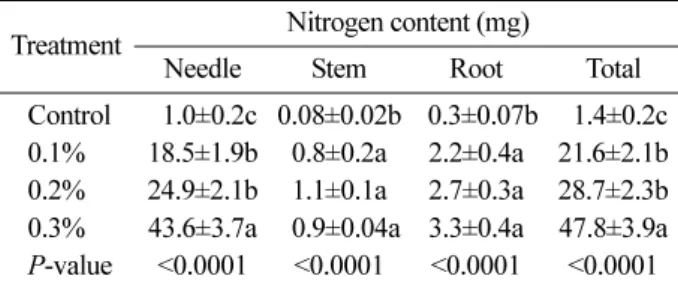
Total N content of seedlings was closely related to seedling weight at various levels of foliar fertilization (0.3% >0.2-0.1%>control) treatments (Table 4). In addi- tion, there was a significant foliar fertilization effect among the nitrogen content of seedling components (
P<0.05). Nitrogen content of seedlings was highest in needle followed by roots and stem. Shoot/root ratio of seedlings (Table 5) was greater in the foliar fertilization
than in the control treatments (control, 1.87; foliar fer- tilization, 2.40-2.89). In contrast, nitrogen use efficiency was significantly lower (
P<0.05) in the foliar fertiliza- tion than in the control treatments (Table 5).
Discussion
Various levels of foliar fertilization have a strong influence on growth of container black pine seedlings.
Seedling height ranged from 5.67 cm for the control to 14.67 cm for the 0.3% level, while root collar diameter ranged from 1.27 mm for the control to 2.52 mm for the 0.3% level. Total seedling biomass ranged 0.15 g for the control to 1.33 g for the 0.3% level. Because nutrient avail- ability is generally considered the major environmental factor limiting growth in many container seedlings (Lan- dis
et al., 1989; William and Stroupe, 2002; Dumroese
etal
., 2005), growth and nitrogen uptake of black pine seedlings were expected to be greatest in the treatment with the greatest levels of foliar fertilization, i.e., in the 0.3% level treatment. In addition, black pine seedlings growing in the foliar fertilization treatments would have greater dry weight, nitrogen concentration, and nitrogen content than those growing in the control treatment. In this study, the seedlings in foliar fertilization had up to about 2-3 times the root collar diameter and height growth of the seedling of the control treatments. Needle weight of the foliar fertilization seedlings was also much greater than that of the control seedlings. Needle nitro- gen concentrations of black pine seedlings was related to differences in application of available nitrogen because there was a significant difference in various levels of foliar fertilization. The significantly greater needle nitro- gen concentrations of black pine seedlings in the foliar fertilization (1.05-1.32%) than in the control treatments (<0.46%) may be due to the increased nitrogen avail- ability after fertilization. However, needle nitrogen con- centration found in the control treatment is quite low, which may indicate a nitrogen deficiency in case of no fertilization in container black pine seedlings. The lowest needle nitrogen concentrations found in the control would limit black pine seedling growth. Therefore, seed- lings in the control treatment showed the lowest weight of seedling components compared with other foliar fer- tilization treatments. Although seedlings given the high- est level of foliar fertilizer (0.3% level) have a foliar nitrogen concentration of 1.32%, all levels of foliar fer- tilization in this study yield needle nitrogen concentra- tions below optimum range (1.5% to 2.5%) of coniferous seedlings suggested by Landis
et al. (1989). This result suggest that the application levels of foliar fertilization in container black pine seedlings of this study were insufficient to maintain the optimum range of nitrogen
Table 3. Nitrogen concentration of black pine seedlings grown at various levels of foliar fertilization in containers (n=6).
Treatment Nitrogen concentration (%)
Needle Stem Root
Control 0.46±0.01c 0.25±0.03b 0.52±0.01c 0.1% 1.05±0.03b 0.37±0.05ab 0.75±0.01b 0.2% 1.09±0.02b 0.53±0.08a 0.82±0.03ab 0.3% 1.32±0.004a 0.38±0.009ab 0.91±0.03a
P
-value <0.0001 <0.0001 <0.0001 Mean±SE. Numbers in each column followed by the same let- ter are not significantly different according to Tukey's test at
P
=0.05.
Table 4. Nitrogen content of black pine seedlings grown at various levels of foliar fertilization in containers (n=6).
Treatment Nitrogen content (mg)
Needle Stem Root Total
Control
01.0±0.2c 0.08±0.02b 00.3±0.07b 01.4±0.2c0.1% 18.5±1.9b 0.8±0.2a 2.2±0.4a 21.6±2.1b 0.2% 24.9±2.1b 1.1±0.1a 2.7±0.3a 28.7±2.3b 0.3% 43.6±3.7a
00.9±0.04a 3.3±0.4a 47.8±3.9aP
-value <0.0001 <0.0001 <0.0001 <0.0001 Mean±SE. Numbers in each column followed by the same let- ter are not significantly different according to Tukey's test at
P
=0.05.
Table 5. Shoot and root ratio (S/R) and nitrogen use efficiency (NUE) of black pine seedlings grown at various levels of foliar fertilization in containers (n=6).
Treatment S/R NUE
Control 1.87±0.27b 110±4.96a
0.1% 2.40±0.20ab 46±2.74b
0.2% 2.63±0.19ab 41±1.33b
0.3% 2.89±0.23a 28±1.05c
P
-value 0.0299 <0.0001
Mean±SE. Numbers in each column followed by the same let- ter are not significantly different according to Tukey's test at
P
=0.05.
concentrations. In contrast to nitrogen concentration, car- bon concentration in black pine seedlings was not sig- nificantly different at various levels of foliar fertilization except for needle carbon concentration. Needle carbon concentration was lower in the control than in the foliar fertilization treatments because low nutrient availability could induce a high carbon consumption (Cheng
et al., 2004). However, carbon concentration in stem and roots was a poor indicator of response to foliar fertilization and was not related to black pine seedling growth response at various levels of foliar fertilization.
Shoot/root ratio of black pine seedlings was greater in the foliar fertilization than in the control treatments.
These greater shoot/root ratio in foliar fertilizer treat- ments may reflect increase in nutrient availability fol- lowing foliar fertilization because of less carbon allocation to roots of seedling in the fertilizer treatments compared with the control treatments. In contrast, low shoot/root ratio of black pine seedlings in the control treatment could be due to a phenotypic response such as a decrease in needle growth and an increase in root growth (Table 1) in response to low nitrogen availability.
Nitrogen use efficiency, usually defined as seedling weight per unit seedling nitrogen content, has frequently been used to compare the response of plant species in nitrogen availability (Aerts, 1990). Seedlings growing under conditions of low nitrogen availability have high nitro- gen use efficiency, which may indicate internal adjust- ments to tolerate nitrogen stress (Munson and Timmer, 1990; Elliott and White, 1994). High nitrogen use effi- ciency with the control and the low level of foliar fer- tilizer treatments may result from decreases in nitrogen in storage compounds.
Conclusions
The growth, carbon and nitrogen status of black pine seedlings grown in containers were influenced by vari- ous levels of foliar fertilization. Root collar diameter, height, nitrogen concentration, and nitrogen content of black pine seedlings increased with increasing levels of foliar fertilization, while black pine seedlings in the con- trol treatment showed the lowest biomass, nitrogen con- centration and content, indicating insufficient nitrogen availability and probably nutrient deficiency. The results indicate that application levels of foliar fertilization are a major environmental factor limiting growth in container black pine seedlings.
Acknowledgements
This study was carried out with the support of “For- est Science & Technology Projects (Project No.
S120808L1301104)” provided by Korea Forest Service.
We thank anonymous reviewers for logical comments.
Literature Cited
1. Aerts, R. 1990. Nutrient use efficiency in evergreen and deciduous species from heathlands. Oecologia 84:
391-397.
2. Cheng, L., Ma, F., and Ranwala, D. 2004. Nitrogen storage and its interaction with carbohydrates of young apple trees in response to nitrogen supply. Tree Phys- iology 24: 91-98.
3. Dumroese, R.K. 2003. Hardening fertilization and nutri- ent loading of conifer seedlings. In Riley L.E., Dumroese, R.K., Landis, T.D. National Proceedings : Forest and Conservation Nursery Associations-2002. Ogden, UT:
USDA Forest Service, Rocky Mountain Research Sta- tion. Proceeding RMRS-P-28: 31-36.
4. Dumroese, R.K., Parkhurst, J., and Barnett, J.P. 2005.
Controlled release fertilizer improves quality of con- tainer longleaf pine seedlings. USDA Forest Service, Proceedings RMRS-P-35: 3-8.
5. Elliott, K.J. and White, A.S. 1994. Effects of light, nitrogen and phosphorus on red pine seedling growth and nutrient use efficiency. Forest Science 40: 47-58.
6. Jackson, D.P., Dumroese, R.K., Barnett, J.P., and Patterson, W.B. 2007. Container longleaf pine seedling morphology in response to varying rates of nitrogen fertilization in nursery and subsequent growth after out- planting. In Riley L.E., Dumroese R.K., Landis T.D.
National Proceedings : Forest and Conservation Nurs- ery Associations-2006. Ogden, UT: USDA Forest Ser- vice, Rocky Mountain Research Station. Proceeding RMRS-P-50: 114-119.
7. Korea Forest Research Institute. 2007. Manual for Pro- duction of 2-0 Pine Container Seedlings. Research Report on Korea Forest Research Institute. 45pp. (with Korean).
8. Landis, T.D., Tinus, R.W., McDonald, S.E., and Bar- nett, J.P. 1989. Seedling Nutrition and Irrigation. Vol. 4.
The container tree nursery manual. Agricultural Hand- book 674. 119pp.
9. Ministry of Agriculture and Forestry. 2005. Develop- ment of Production Method for Container Seedling with High Qquality. 180pp. (with Korean).
10. Munson, A.D. and Timmer, V.R. 1990. Site-specific growth and nutrition of planted
Picea marianain the Ontario Clay Belt. III. Biomass and nutrient allocation.
Canadian Journal of Forest Research 20: 1165-1171.
11. Oliet, J., Olanelles, R., Segura, M.L., Artero F., and Jacobs D.F. 2004. Mineral nutrition and growth of con- tainerized
Pinus halepensisseedlings under controled- release fertilizer. Scientia Horticulture 103: 113-129.
12. SAS Institute Inc. 1989. SAS/STAT User's guide, Ver-
sion 6, 4th ed. Volume 2, Cary, NC.
13. William, H. and Stroupe, M. 2002. First-year survival and growth of bareroot and container water oak and willow oak seedlings grown at different levels of min- eral nutrition. In Outcalt, K.W., ed. Proceedings of the
Eleventh Biennial Southern Silvicultural Research Con- ference. Gen. Tech. Rep. SRS-48: 338-341.
(Received June 17, 2009; Accepted August 20, 2009)