2003, Vol. 14, No.4 pp. 1083∼1090
A Designing for Successful Learning on the Web
Jeong Yong Ahn1)․Kyung Soo Han2)․Beom Soo Han3)
Abstract
Web-based learning is currently an active area of research and a considerable number of studies have been conducted on its application in the learning environment. However, in spite of many advances in the research and development of the educational contents, questions about how the environment affects learning remains largely unanswered. In this article, we propose a Web-based learning environment to improve the educational effect. The goal of this article is not to provide a complete system to support Web-based learning but rather to describe some meaningful strategies and fundamental design concepts that utilize information technologies to support teaching and learning.
Key words : Web-based learning; Learner Relationship Management;
Web data mining
1. Introduction
Many aspects of life hold the potential of being affected by the growth and availability of the Web. Many organizations rely on the Web to recruit high-quality human resources, conduct customer support, advertise oneself and so on. Advances in information technology are creating tremendous opportunities in many areas and many activities are getting on the Web.
In the field of education, Web-based technology presents modern-day instructors with fascinating possibilities, never before explored (Tetiwat and Igbaria, 2000), 1) Assistant Professor, Division of Mathematics and Statistical Informatics, Chonbuk National University, Chonbuk, 561-756, Korea.
E-mail : [email protected]
2) Professor, Division of Mathematics and Statistical Informatics, Chonbuk National University, Chonbuk, 561-756, Korea.
E-mail : [email protected]
3) Dept of Computer Science and Statistics, Chonbuk National University, Chonbuk, 561-756, Korea.
E-mail : [email protected]
and the potential for the medium to enhance students learning experiences is being increasingly recognized and utilized. The benefits of the Web include the ease and instantaneous access to resources and experts, which opens new doors in the educational process. In addition, the Web offers unparalleled diversity for students as an interactive learning tool and as a medium for publication. Online courses offered over the Web are positioned as strategies that make education more relevant and engaging for learners (Harasim et al., 1995; Schrum, 1998).
Nowadays, Web-based learning is an active area of research and a considerable number of studies (e.g. Brandt, 1997; Housego and Freeman, 2000; Kuo et al., 2001; Mitchell et al., 2001) have been conducted on the learning environments.
However, in spite of many advances in the research, the question of how Web-based education affects learning remains largely unanswered and the terrain of online learning remains largely unmapped (Mitchell et al., 2001). What is the reason? Although there are various issues, we think one of the most critical reasons is that we indifferently treat the studying attitude management/monitoring of each learner. Until present, a large percentage of research has focused on the development of educational content/system, and most of them neglected discovery of learning patterns of individual learners and the practical use of these patterns.
Many internet instructors still use teacher-centered instruction, and they just type their lecture onto the Web. We do not believe that the creation of good contents is sufficient to resolve all of the quality issues. As an alternative, therefore, we will put to practical use the learning data usually involved in the education process. Learning data is a highly meaningful resource to observe document learning behaviors. Despite this, it remains a relatively neglected source of data within educational research.
We think the particularly important advantages of Web-based learning are that we can (a) express the learning behaviors of each learner into data, (b) establish strategies to improve learning effect based on the learning data, and (c) provides new capabilities to reconstruct learning environments around specific learning styles. In this paper, we propose a new educational framework, the Learner Relationship Management (LRM) environment. In addition, we suggest some design concepts for an effective LRM system from the viewpoint of the practical use of the learning data.
2. LRM
LRM, an educational framework proposed in this article, is an environment that applies Customer Relationship Management (CRM) techniques to Web-based learning. CRM is a process designed to grasp features of customers and apply those features to marketing activities. It involves acquisition, analysis and use of knowledge about customers in order to sell more goods or services and do it more
efficiently (Bose, 2002). CRM consists of the following processes: (a) data collection from customers, (b) extraction of customer features through the data mining process, (c) offering efficient service and campaign to customers, (d) feedback. The process can be applied just as it is to Web-based learning. For instance, it is very important to express learner actions on-line into data. The data can be used to monitor learners, discover their learning patterns, and providing one-to-one (or personalized) learning environments.
LRM is a process to accumulate the learning behavior data of learners, to grasp learning patterns and to apply these patterns in learning activities. As mentioned in Aggarwal and Bento (2000), there is no denying that Web-based courses open new educational access to non-traditional and geographically dispersed students.
However, quality is one area where Web-based education often comes under heavy criticism and many students seek on-line courses driven by personal situations. To offer students equal or better quality learning as the traditional face-to-face environment, the LRM process is expected to serve a significant role.
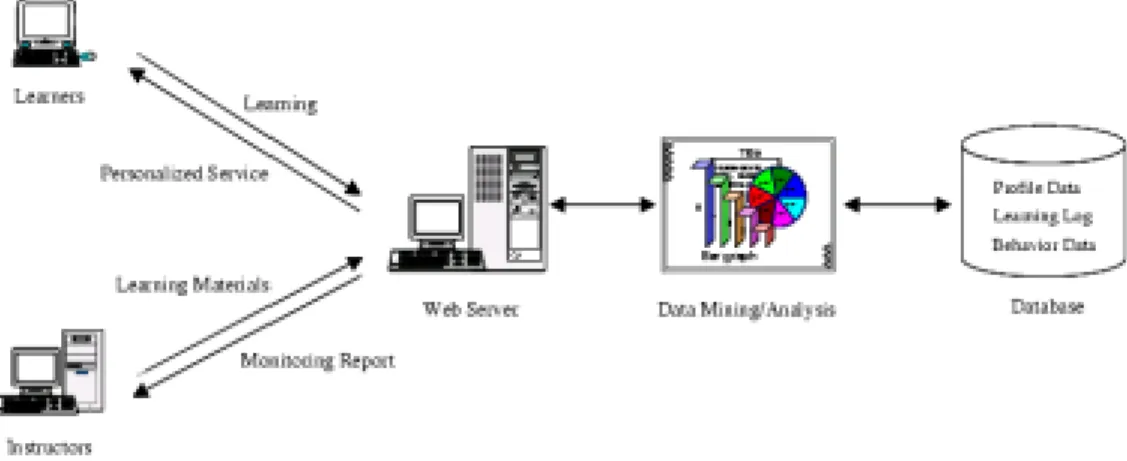
Figure 1. The structure of the LRM environment/system
Figure 1 represents the structure of the LRM environment/system. It includes the design of learning data collection and analysis for monitoring the learners.
With these portions, we can provide studying attitude to learners and data analysis information to instructors. As shown in Figure 1, learners access the environment from web browsers and study learning contents. Then, LRM system gathers and analyzes automatically learning behaviors of each learner.
3. Design concepts of LRM system
Initial efforts toward using the Web for education are usually driven by dreams
of cost effectiveness and a broader reach of information. Therefore, initially educational systems have focused in the development of educational contents using multimedia, interactive applets and so on. When effectively implemented the contents assist in the learning process. If learning on the part of the student has been helped by the use of the contents, then the contents have been used successfully (Shrum and Glisan, 1994). However, the systems still do not fully integrate the current capabilities of the on-line network environment. In particular, the systems do not allow instructors to suggest what they should do in order to monitor and support the learners' education. In other words, the trace and information of valuable learning processes of each learner fall through the cracks and therefore cannot be systematically organized with in the systems to support both learners and instructors.
A method to overcome these shortcomings is LRM, and the current research into computing and information technologies for learning and teaching focuses on individual learning (Fuji et al., 1996). The most important factors in the LRM system are (a) how to convert the learning behaviors of each learner into data, (b) data analysis/mining, and (c) management/monitoring of each learner. In this section, we propose some focusing concepts and functions for an effective LRM system from the viewpoint of practical use of the learning data.
• Web-based interface and personalized mechanism
The most widely preached and important user interface design principle is understanding who the users are and what they want to do (Cooley, 2000). In a LRM system, users are both learners and instructors. Learners require an environment in which they can learn on their own anywhere, anytime, and take exams as needed. Instructors need an environment in which they can post materials and communicate with learners anytime. The Web makes it possible to solve these requests. With Web-based learning, learners can increase their opportunity for obtaining an education because Web-based learning provides greater academic accessibility and flexibility in schedule. This meets many learners' varied demands. Instructors can benefit by using Web-based learning as they gain greater ease in monitoring learners and communicating with them (Tetiwat and Igbaria, 2000).
On the other hand, Web-based learning can provide a personalized environment to each learner. Instructors can design a Web-based learning system that is suitable for the appropriate level. An efficient personalized mechanism is crucial in LRM.
• Collection of the learning data
In a LRM system, collection of the learning data is the most basic and important concept. The reason is that we extract all information for learners from the learning data. Data obtained in Web-based learning are log data, learner's
profile data, learning behavior data and so on.
The data can be collected in server/client-side and various types. The server side data such as log data and learner's profile data can be easily gotten on the Web server. The client-side data such as learning behavior data is common in educational systems that supply simulation techniques to improve learning effect.
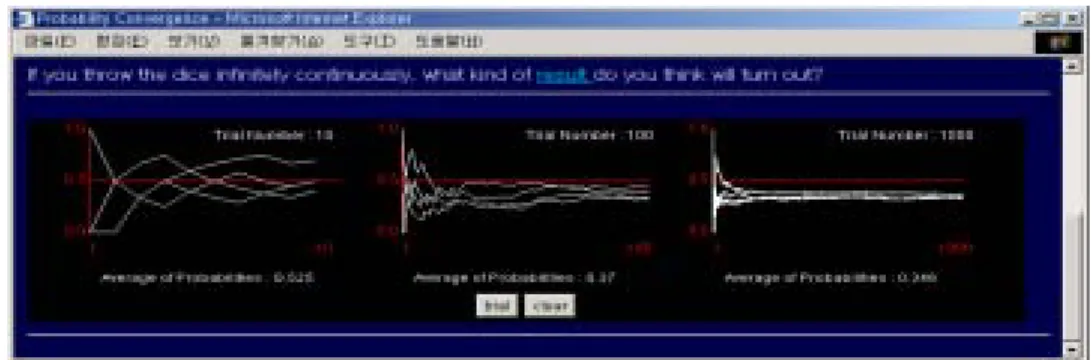
Many systems tend to ignore practical use of this data, but the client-side data as well as server-side data have important and valuable information. For example, we often use JAVA applets as Figure 2 to offer simulation study in Web pages.
Figure 2 shows an applet to learn the concept of probability in statistics education.
When a learner runs the applet, the information happens on the client-side and we can use the information to collect data for LRM.
Figure 2. An example of client-side data
Therefore, the LRM system must be designed to collect the client-side and server-side data, and the concepts to express all on-line behaviors of learners into data are key point of data collection.
• Data preprocessing
Log data, a server side learning data, contain information (for example, client IP address, access time, request method, the URL of the page accessed and so on) about the items accessed and referred by visitors. They do not have the form that can be directly used for analysis/mining. Therefore, data preprocessing is an indispensable task (Ahn, 2002). Data preprocessing includes several processes, such as data cleaning, transaction identification, data transformation and data integration.
It is a time-consuming task, which in many cases is semi-automatic. The growing amount of data produced by modern process monitoring and data acquisition systems has resulted in correspondingly large data processing requirements and efficient techniques for automatic data preprocessing are important (Famili et al., 1997).
• Analysis/mining of the learning data
The main purposes of data analysis/mining in LRM are to extract the learning information, monitor each learner, and establish strategies to improve learning.
Therefore, the LRM system must be constructed to extract the following information through data analysis process:
- Main time zone for learning
- Amount of time invested for learning and comparative information with other learners
- Learning patterns of learners
- Automatic evaluation of online exams
To extract the information, various techniques can be used. For example, descriptive statistics, techniques for pattern discovery (association rules, sequential patterns), techniques for learner classification (decision trees, nearest neighbor, multi-layer perceptron), and so on. As pointed out in Ha et al. (2000), discovery of learning patterns could help in the development of effective customized education, and the management of each learner based on the patterns is a significant factor to improve learning effect.
• Monitoring the learning attitude of learners
Monitoring the learning attitude of learners is one of the most important factors of advanced LRM systems (Novifzki, 2000). In Web-based learning, the instructor acts as a facilitator or supporter and still plays an important role in the learning process. The instructor will have to advise learners on their progress, provide one-to-one counseling and offer prompt and constructive feedback. In addition, parents can profit from Web-based learning as it provides parents with an information resource about learning activities, and more knowledge about their children's studies. In other words, Web-based learning should explain and provide information for parents on how these programs work and suggest what parent should do in order to monitor, help, and support their children's education.
To provide the capabilities, a LRM system is needed to furnish following information based on the analysis of the learning data.
- Individual's studying progress information - Learning level of each learner
- Understanding of specific section - Communication with other learners - Assignment management
• Privacy issue
Privacy issues are further exacerbated now that the Web makes it easy for the new data to be automatically collected and added to databases (Agrawal and Srikant, 2000). In particular, learning data are created and collected while learners do not occasionally recognize the occurrence of the data. When we use the data,
we ought to consider learners' privacy and its related legal and moral issues.
4. Conclusion
The Web is a powerful tool with tremendous, exciting possibilities for education that must be explored and expanded. Many researches and people are exploring the benefits of the tool. However, it is important to remember that the Web is merely a tool and tools don't teach. Though it is feasible to use the Web to simulate the traditional face-to-face environment, this may require more than a linear translation (Aggarwal and Bento, 2000). To design an effective Web-based learning system, we must consider the goals, needs, and monitoring strategies, as well as educational contents and technical requirements. In addition, further studies on strategies to improve the learning effect are needed.
In this article we propose a new educational framework, a LRM learning system. In addition, we suggest some meaningful and fundamental design concepts for effective LRM system from the viewpoint of practical use of learning data.
The proposed environment is focused in the following features: (a) Web-based interface and personalized mechanism, (b) collection of the learning behavior data, (c) analysis/mining of the collected data, and (d) monitoring the learning attitude of learners.
We don't think that the design concepts described in this paper are comprehensive. But we believe that the framework and concepts can help to develop a variety of educational systems to improve the effect of Web-based learning.
References
1. Aggarwal, A. K. and Bento, R. (2000). Web-based education, in: A.
Aggarwal (Eds), Web-Based Learning and Teaching Technologies:
Opportunities and Challenges (London, Idea Group Publishing).
2. Agrawal, R. and Srikant, R. (2000). Privacy-preserving data mining, Proceedings of the ACM SIGMOD International Conference on Management of Data, pp. 139-150.
3. Ahn, J. Y. (2002). A study on the mining access patterns from Web log data, IEICE Transactions on Information & Systems, E85-D(4), pp.
782-785.
4. Bose, R. (2002). Customer relationship management: key components for IT success, Industrial Management & Data Systems, 102(2), pp. 89-97.
5. Brandt, R. (1997). Public education in the 21st century, International Electronic Journal for Leadership in Learning, 1(1).
6. Cooley, R. W. (2000). Web usage mining: Discovery and application of interesting patterns from Web data, PhD dissertation, University of Minnesota, USA.
7. Famili, A. Shen, W. M., Weber, R. and Simoudis, E. (1997). Data preprocessing and intelligent data analysis, Intelligent Data Analysis, 1(1).
8. Fuji, T., Tanigawa, T., Inui, M. and Saegusa, T. (1996). A collaborative learning support system for systems design, IEICE Transactions on Information and Systems, E79-D(4), pp. 363-372.
9. Ha, S. H., Bae, S. M. and Park, S. C. (2000). Web mining for distance education, Proceedings of the Asia Pacific Advanced Network
Conference, pp. 1-5.
10. Harasim, L., Hiltz, S. R., Teles, L. and Turoff, M. (1995). Learning networks: a field guide to teaching and learning online (Cambridge, MIT Press).
11. Housego, S. and Freeman M. (2000). Case studies: Integrating the use of web based learning systems into student learning, Australian Journal of Educational Technology, 16(3), pp. 258-282.
12. Kuo, C., Wible, D. and Tsao, N. (2001). On the system design of Web-based English writing environment and learner corpus, IEICE Transactions on Information and Systems, E84-D(8), pp. 1057-1066.
13. Mitchell, C., Dipetta, T. and Kerr, J. (2001). The frontier of Web-based instruction, Education and Information Technologies, 6(2), pp. 105-121.
14. Novifzki, J. E. (2000). Asynchronous learning tools: What is really needed, wanted and used?, in: A. Aggarwal (Eds), Web-Based Learning and Teaching Technologies: Opportunities and Challenges (London, Idea Group Publishing).
15. Schrum, L. (1998). On-line education: a study of emerging pedagogy, New Directions for Adult and Continuing Education, 78, pp. 53-61.
16. Shrum, J. L. and Glisan, E.W. (1994). Teacher's handbook:
contextualized language instruction (Boston, MA:Heinle and Heinle Publishers).
17. Tetiwat, O. and Igbaria, M. (2000). Opportunities in Web-based teaching: The future of education, in: A. Aggarwal (Eds), Web-Based Learning and Teaching Technologies: Opportunities and Challenges (London, Idea Group Publishing).
[ received date : Aug. 2003, accepted date : Nov. 2003 ]