Quality Characteristics of Low-Fat Plant Oil Emulsion Pork Patties
Young-Joon Choi1, Si-Hyung Lee2, Kyoung-Sook Lee1, Gang-Won Choi1, Kyung-Soo Lee3, In-Chul Jung1 and Dong-Wook Shim4*
1Division of Hotel Culinary Arts, Daegu Technical University, Daegu 42734, Korea
2Sehwa Cooking Academy, Daegu 41930, Korea
3Division of Food Beverage and Culinary Arts, Youngnam University College, Daegu 42415, Korea
4Lotte Signiel Hotel, Seoul 05551, Korea
Received July 15, 2019 /Revised November 13, 2019 /Accepted November 14, 2019
This study investigated the effect of plant oil emulsion as a replacement for animal fat on the quality characteristics of low-fat pork patties. Pork patties were manufactured using a pork fat control (CON) and olive (OPP), soybean (SPP), and canola (CPP) oil emulsions. Replacing animal fat with the plant oil emulsions increased the moisture content and decreased the fat content of the patties as compared to those with pork fat. The water holding capacity and cooking yield, and the moisture and fat re- tention of the patties were significantly increased, and the diameter reduction and shrinkage ratio de- creased with the plant oil replacements. The color parameters of the samples were affected by the ad- dition of the plant oil emulsions, and higher L* and a* values were observed in CON. The b* value of the raw pork patty was highest in OPP, and palmitic acid was the most abundant saturated fatty acid. In terms of unsaturated fatty acids, oleic acid was highest in CON, OPP, and CPP, and linoleic acid was highest in SPP. Hardness, cohesion, and chewiness were no different among the samples, although higher springiness was observed in the pork patties with added plant oil emulsions. The taste, flavor, and palatability of the OPP and CPP patties were higher than in the CON and SPP groups. Fat replacement with plant oil emulsion therefore had a positive effect on the quality charac- teristics of the pork patties, and due to reduced saturated fatty acids, the end-product provides the healthy low-fat option desired by consumers.
Key words : Animal fat replacer, low-fat pork patty, plant oil emulsion, fatty acid composition, quality characteristics
*Corresponding author
*Tel : +82-2-3213-1513, Fax : +82-2-3213-1514
*E-mail : [email protected]
This is an Open-Access article distributed under the terms of the Creative Commons Attribution Non-Commercial License (http://creativecommons.org/licenses/by-nc/3.0) which permits unrestricted non-commercial use, distribution, and reproduction in any medium, provided the original work is properly cited.
Journal of Life Science 2019 Vol. 29. No. 12. 1351~1357 DOI : https://doi.org/10.5352/JLS.2019.29.12.1351
서 론
세계보건기구는 하루에 섭취하는 지방을 일일 열량섭취량 의 15~30%를 초과하지 말고, 포화지방산은 전체 지방산의 10% 정도만 섭취하고 나머지는 불포화지방산으로 섭취할 것 을 권고하고 있다[28]. 육제품에 함유되어 있는 지방은 건강을 유지하기 위한 중요한 성분이면서 입안에서의 촉감, 기호도, 풍미 등을 향상시킨다[5]. 전통적인 육제품은 동물성 지방을 30% 내외로 첨가하게 되는데 포화지방산과 콜레스테롤의 함 량이 높다. 과도한 지방의 섭취는 당뇨, 비만, 관상동맥성질환 등의 발병률을 높이며, 특히 포화지방산의 섭취는 심혈관질환 의 위험을 증가시킨다[1]. 따라서 육제품에서 포화지방산을 불 포화지방산으로 대체하고, 지방함량이 낮은 저지방 육제품의
개발에 대하여 소비자의 요구가 크다. 그러나 동물성 지방은 바람직한 물성, 조직, 관능 특성을 위한 안정된 육 유화물 형성 에 영향을 미치기 때문에[23] 육제품에 동물성 지방을 줄이는 것은 매우 중요한 기술적 문제이다. 최근 동물성 지방을 감소 시킨 육제품의 문제점들을 보완하기 위하여 식물성유와 hy- drocolloid류를 이용한 유화물을 첨가하는 연구들이 이루어지 고 있다.
이전의 연구에서 아마인유와 carrageenan [2], 카놀라유와 ethyl cellulose [5] 및 올리브유와 alginate [21]로 식물성 유화 물을 제조하여 동물성 지방을 대체 첨가한 육제품은 열량 감 소, 불포화지방산 함량 증가, 지방 산화 억제, 조직감 개선 등 의 개선 효과가 나타난다고 보고되고 있다[2, 5, 21]. 식물성유 에는 tocopherol, carotene, phenol화합물 등이 함유되어 있어 서 항산화작용이 있으며[22], linoleic acid는 유리기, aldehy, ketone같은 잠재적 독성물질의 형성을 억제하고[11], oleic acid는 심혈관 질환의 발생을 억제한다[9]. 따라서 육제품에 동물성 지방을 식물성유로 대체하면 인간의 건강에 유익한 제품이 될 것이며, 이는 소비자들의 요구에도 부합되는 것이 다. 본 연구는 돈육 패티 제조에 첨가하는 돼지 등지방을 대체 하여 올리브유, 대두유 및 카놀라유를 carrageenan으로 유화
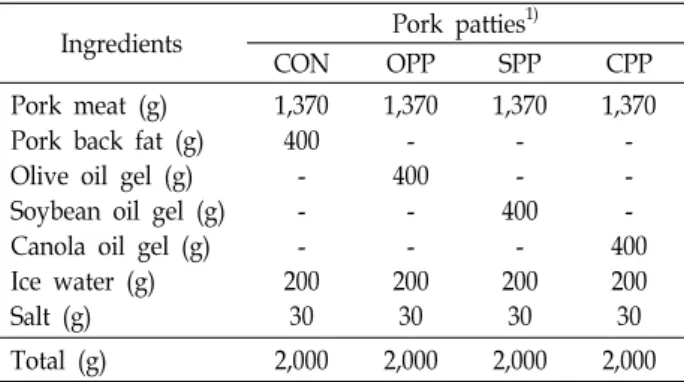
Table 1. Formulation of pork patties containing plant oil pec- tized by carrageenan
Ingredients Pork patties1)
CON OPP SPP CPP
Pork meat (g) Pork back fat (g) Olive oil gel (g) Soybean oil gel (g) Canola oil gel (g) Ice water (g) Salt (g)
1,370 400
- - - 200
30
1,370 - 400
- - 200
30
1,370 - - 400
- 200
30
1,370 - - - 400 200 30
Total (g) 2,000 2,000 2,000 2,000
1)CON with pork back fat 20%, OPP with olive oil gel 20%, SPP with soybean oil gel 20%, CPP with canola oil gel 20%.
시킨 유화물을 첨가하고 이화학적, 관능적 특성, 지방산 조성 등을 검토하였다.
재료 및 방법
식물성유 유화물 제조
식물성유 유화물은 올리브유(Sajo Co., Incheon, Korea), 대 두유(Youngmi Co., Yongin, Korea) 및 카놀라유(Sajo Co.) 각 각 200 g, 냉수 각각 250 g에 i-carrageenan (MSC Co., Yangsan, Korea)을 각각 50 g 첨가하고 버티칼믹서기(YSM 12, Young- song Co., Seoul, Korea)로 10분간 혼합하여 제조하였다.
돈육 패티제조
돈육은 뒷다리 살을, 지방은 돼지 등지방을 제조 당일에 식 육 전문 매장에서 구입하고, 뒷다리의 과도한 결체조직과 지 방은 제거한 후 3 mm로 분쇄하였다. 돈육 패티의 배합은 Table 1과 같이 돈육 1,370 g, 냉수 200 g, 소금 30 g에 대조군 (CON)은 돼지 등지방 400 g (20%), OPP는 올리브유 유화물 400 g (20%), SPP는 대두유 유화물 400 g (20%), CPP는 카놀라 유 유화물 400 g (20%)을 첨가하여 버티칼믹서기로 배합하고 50 g씩(두께 15 mm, 직경 60 mm) 성형하였다. 제조된 돈육 패티는 48시간 동안 숙성시킨 후 실험에 이용하였다.
일반 성분 분석
일반 성분은 AOAC법[3]에 따라 수분함량은 105℃ 상압가 열건조법, 조단백질 함량은 Kjeldahl법, 조지방 함량은 Soxhlet 법, 조회분 함량은 직접회화법으로 분석하였다.
보수력, 가열 수율, 수분 보유율, 지방 보유율, 직경 감소율 및 수축율 측정
보수력은 Hoffman 등[14]의 방법에 따라서 planimeter (X-Plan, Ushikata 360d, Worth Point Co., Atkanta, GA, USA) 를 이용하여 측정하였으며, 가열 수율은 200℃로 예열된 오븐
(RF0-900, Rinnai Co., Inchon, Korea)에서 패티의 중심 온도가 75℃에 도달할 때까지 가열하고 가열 후의 무게에 대하여 가 열 전 무게의 백분율로 계산하였다. 수분 보유율, 지방 보유율 및 직경감소율은 El-Magoli 등[6]의 방법으로, 수축율은 Mur- phy 등[20]의 방법으로 계산하였다.
색도 측정
돈육 패티의 색도는 색차계(CR-400, Konica Minolta Inc., Osaka, Japan)를 이용하여 백색도(L*), 적색도(a*) 및 황색도(b*) 를 측정하였으며, 색보정을 위한 표준백색판의 값은 각각 94.52, -0.91 및 2.42였다.
지방산 조성 측정
돈육 패티의 지방산 조성은 Folch 등[7]의 방법으로 추출 및 정제하여 14% BF3-methanol 용액으로 methylation시킨 것 을 GC (8610C, SRI Ins., Santa Clara, CA, USA)로 분석하였다.
Column은 30 m×0.25 mm I.D. 0.25 μm (0007-1 PHATTM, Quadrex Co., Bethany, CT, USA)였다. Carrier gas는 He 0.7 mL/min, injector 온도 225℃, detector 온도 285℃이며, split ratio는 200:1로 하였다.
물리적 특성 측정
물리적 특성으로서 rheometer (CR-200D, Sun Scientific Co., Tokyo, Japan)를 이용하여 원형 adapter 25번으로 시료를 눌러서 경도, 탄력성, 응집성을 측정하였다. 측정조건은 table speed 120 mm/min, grape interval 30 m/sec, load cell 2 kg 이었으며, 저작성은 (peak max ÷ distance) × cohesiveness
× springiness로 구하였다.
관능 검사
관능 검사는 대학생 10명을 패널로 선정하여 가장 좋다 7점, 가장 나쁘다 1점으로 하는 7점 기호척도법으로 하였다. 관능 검사는 향기, 맛, 풍미, 다즙성, 조직감 및 전체적인 기호도에 대하여 평가하였다. 시료는 25 g씩 제공하여 여러 번 맛을 보 고 평가하게 하였다. 평가 후에는 생수를 제공하여 반드시 입 을 헹구고 다른 시료들을 평가하게 하였다. 난수표가 부착된 동일한 크기와 색상의 일회용 접시에 담아 시료를 제공하였으 며, 패널들 간의 의견교환은 헐 수 없도록 하여 평가에 영향을 미치지 않도록 하였다.
통계처리
본 실험의 결과들은 항목별로 3회 반복 측정한 값을 SPSS Statistics (ver. 18.0, SPSS Inc., Chicago, IL, USA)로 통계 분석 하여 평균과 표준편차를 구하였다. ANOVA (분산분석)를 실 시하여 유의성이 있을 경우 Duncan의 다중범위검정을 이용 하여 시료들 사이의 유의차를 검정하였다(p<0.05).
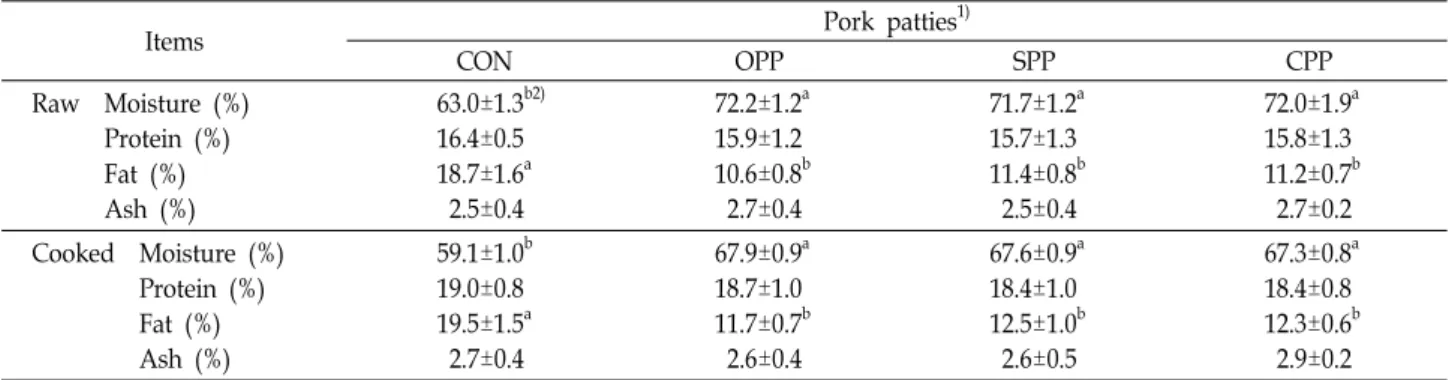
Table 2. Chemical composition of pork patties containing plant oil pectized by carrageenan
Items Pork patties1)
CON OPP SPP CPP
Raw Moisture (%) Protein (%) Fat (%) Ash (%)
63.0±1.3b2) 16.4±0.5 18.7±1.6a 2.5±0.4
72.2±1.2a 15.9±1.2 10.6±0.8b 2.7±0.4
71.7±1.2a 15.7±1.3 11.4±0.8b 2.5±0.4
72.0±1.9a 15.8±1.3 11.2±0.7b 2.7±0.2 Cooked Moisture (%)
Protein (%) Fat (%) Ash (%)
59.1±1.0b 19.0±0.8 19.5±1.5a 2.7±0.4
67.9±0.9a 18.7±1.0 11.7±0.7b 2.6±0.4
67.6±0.9a 18.4±1.0 12.5±1.0b 2.6±0.5
67.3±0.8a 18.4±0.8 12.3±0.6b 2.9±0.2
1)Refer to Table 1 for abbreviations.
2)Mean ± SD., Means in a row (a, b) by different superscripts are significantly different at 5% significance level by Duncan’s multiple range test.
Table 3. Water holding capacity, cooking yield, moisture retention, fat retention, diameter reduction and shrinkage ratio of pork patties containing plant oil pectized by carrageenan
Items Pork patties1)
CON OPP SPP CPP
Water holding capacity (%) Cooking yield (%)
Moisture retention (%) Fat retention (%) Diameter reduction (%) Shrinkage ratio (%)
90.9±1.8b2) 78.9±0.5b 46.6±0.7b 82.6±0.7b 11.1±1.5a 8.3±0.6a
94.5±1.0a 88.4±1.3a 60.0±0.8a 97.8±1.1a 7.1±0.7b 5.4±0.5b
94.1±1.6a 88.8±0.8a 59.9±0.8a 96.7±1.5a 7.2±0.7b 5.4±0.5b
94.6±1.0a 88.9±1.5a 59.8±0.7a 97.4±0.8a 7.0±0.8b 5 .8±0.7b
1)Refer to Table 1 for abbreviations.
2)Mean ± SD., Means in a row (a, b) by different superscripts are significantly different at 5% significance level by Duncan’s multiple range test.
결과 및 고찰
돈육 패티의 일반 성분
돼지 등지방(CON), 올리브유(OPP), 대두유(SPP) 및 카놀라 유(CPP) 유화물을 첨가한 저지방 돈육 패티의 일반 성분 분석 결과는 Table 2와 같다. 가열 전후의 돈육 패티의 수분함량은 CON이 OPP, SPP 및 CPP보다 유의하게 낮았고, 지방 함량은 높게 나타났다(p<0.05). 그러나 가열 전후 돈육 패티의 단백질 및 회분 함량은 시료들 사이에 차이가 없었다. Song 등[26]에 따르면 시료들 사이의 일반 성분의 차이는 원료의 첨가량에 따라 다르게 나타난다고 하였다. 본 연구에 사용한 식물성유 유화물 400 g에는 160 g의 식물성유와 200 g의 물이 함유되어 있고, 대조군에 첨가한 돼지 등지방 400 g에는 약 48 g의 물과 344 g의 지방이 함유되어 있어서[32] 대조군과 식물성유 유화 물 첨가군 사이에 수분과 지방 함량의 차이가 나타난 결과이 다. 이러한 결과는 Pintado 등[21]의 돼지 등지방을 chia와 귀 리 유화물로 대체한 경우 수분함량은 높고, 지방 함량은 낮다 고 한 것과, Alejandre 등[1]의 카놀라유 유화물로 대체한 경우 수분과 지방 함량이 돼지 등지방을 첨가한 것과 차이가 있었 다는 결과와 유사하였다.
돈육 패티의 보수력, 가열 수율, 수분 보유율, 지방 보유율, 직경 감소율 및 수축율
돈육 패티의 보수력, 가열 수율, 수분 보유율, 지방 보유율, 직경 감소율 및 수축율의 실험결과는 Table 3과 같다. 보수력, 가열 수율, 수분 보유율 및 지방 보유율은 OPP, SPP 및 CPP가 CON보다 높았으며(p<0.05), OPP, SPP 및 CPP 사이에는 유의 한 차이가 없었다. 반대로 직경 감소율 및 수축율은 CON이 OPP, SPP 및 CPP보다 높았으며(p<0.05), OPP, SPP 및 CPP 사이에는 유의한 차이가 없었다. Hawashin 등[13]은 올리브유 를 첨가한 우육 패티의 가열 수율, 수분 보유율, 지방 보유율이 대조군보다 높고, 수축율은 낮다고 하였으며, Lee 등[17]은 포 도씨유, 올리브유, 카놀라유 혼합물을 첨가한 돈육 소시지의 보수력과 가열 수율이 대조군보다 높다고 하여서 본 연구의 결과와 유사하였다. 그러나 Serdaroğlu 등[24]은 올리브유를 젤라틴과 이눌린으로 겔화한 유화물을 첨가한 계육 패티의 보수력, 가열 수율, 수분 보유율이 대조군보다 낮고 직경 감소 율은 대조군보다 높다고 하여서 본 연구의 결과와 상반되었 다. 본 연구에 gel화제로 사용한 carrageenan은 증점제, 결착 제, 안정제, 팽윤제 등으로 사용되는 친수성의 물질로서[12]
돈육 패티 전체 중량의 2%를 사용하였으며, 이것이 제품에
Table 4. Color value of pork patties containing plant oil pectized by carrageenan (%)
Items Pork patties1)
CON OPP SPP CPP
Raw L* a* b*
68.5±1.6a2) 8.1±0.7a 11.6±0.1b
59.5±0.3b 6.7±0.3b 12.7±0.4a
57.9±1.5b 7.2±0.4b 10.5±0.2c
57.6±0.8b 6.9±0.1b 9.8±0.2d Cooked
L* a* b*
66.8±0.6a 5.7±0.1a 15.0±0.3
63.8±0.5b 4.4±0.4b 16.2±0.9
64.8±0.9b 4.2±0.4b 15.5±0.8
64.8±1.1b 4.6±0.4b 14.7±1.5
1)Refer to Table 1 for abbreviations.
2)Mean ± SD., Means in a row (a, b) by different superscripts are significantly different at 5% significance level by Duncan’s multiple range test.
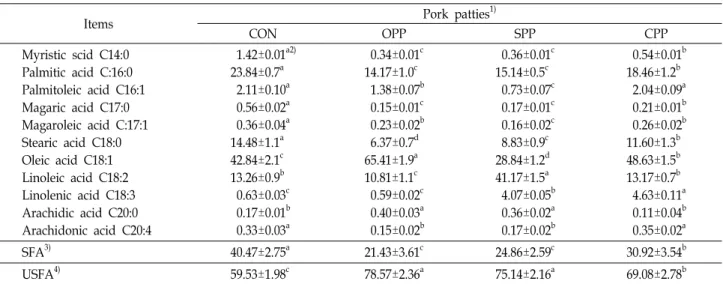
Table 5. Fatty acid composition of pork patties containing plant oil pectized by carrageenan (%)
Items Pork patties1)
CON OPP SPP CPP
Myristic scid C14:0 Palmitic acid C:16:0 Palmitoleic acid C16:1 Magaric acid C17:0 Magaroleic acid C:17:1 Stearic acid C18:0 Oleic acid C18:1 Linoleic acid C18:2 Linolenic acid C18:3 Arachidic acid C20:0 Arachidonic acid C20:4
1.42±0.01a2) 23.84±0.7a 2.11±0.10a 0.56±0.02a 0.36±0.04a 14.48±1.1a 42.84±2.1c 13.26±0.9b 0.63±0.03c 0.17±0.01b 0.33±0.03a
0.34±0.01c 14.17±1.0c 1.38±0.07b 0.15±0.01c 0.23±0.02b 6.37±0.7d 65.41±1.9a 10.81±1.1c 0.59±0.02c 0.40±0.03a 0.15±0.02b
0.36±0.01c 15.14±0.5c 0.73±0.07c 0.17±0.01c 0.16±0.02c 8.83±0.9c 28.84±1.2d 41.17±1.5a 4.07±0.05b 0.36±0.02a 0.17±0.02b
0.54±0.01b 18.46±1.2b 2.04±0.09a 0.21±0.01b 0.26±0.02b 11.60±1.3b 48.63±1.5b 13.17±0.7b 4.63±0.11a 0.11±0.04b 0.35±0.02a
SFA3) 40.47±2.75a 21.43±3.61c 24.86±2.59c 30.92±3.54b
USFA4) 59.53±1.98c 78.57±2.36a 75.14±2.16a 69.08±2.78b
1)Refer to Table 1 for abbreviations.
2)Mean ± SD., Means in a row (a~c) by different superscripts are significantly different at 5% significance level by Duncan’s multiple range test.
3)Saturated fatty acid.
4)Unsaturated fatty acid.
함유되어 있는 수분과 지방을 포집함으로서 물리적 특성인 보수력, 가열 수율, 수분 보유율, 지방 보유율, 직경 감소율 및 수축율을 개선시킨 것으로 판단된다.
돈육 패티의 색도
돈육 패티의 색도를 측정한 결과는 Table 4와 같다. 가열 전 돈육 패티의 백색도(L*값)와 적색도(a*값)는 CON이 OPP, SPP 및 CPP보다 높았으며, OPP, SPP 및 CPP 사이에는 차이 가 없었다. 그리고 황색도(b*값)는 OPP, CON, SPP, CPP 순으 로 높게 나타났다(p<0.05). 가열육의 백색도와 적색도는 CON 이 가장 높았으며, OPP, SPP 및 CPP 사이에는 유의한 차이가
없었다. 그리고 황색도는 모든 시료에서 차이가 나타나지 않 았다. 또한 가열 후 돈육 패티의 백색도와 황색도는 높아지고, 적색도는 낮아졌은데, 이것은 myoglobin이 가열변성되어 나 타난 결과로 사료된다. 본 연구는 돼지 등지방을 올리브유와 대두유로 대체한 분쇄 돈육의 백색도와 적색도가 대조군보다 낮았다는 Yoon 등[31]의 결과, 카놀라유와 아마인유를 첨가한 돈육 소시지의 적색도가 대조군보다 낮았다는 Baek 등[4]의 결과, 카놀라유를 첨가한 육제품의 적색도가 대조군보다 낮았 다는 Alejandre 등[1]의 결과와 유사하였다. 가열 전 돈육 패티 의 황색도가 OPP에서 가장 높게 나타난 것은 올리브유에 함 유된 carotene [10]에 의한 영향으로 추측된다.
돈육 패티의 지방산 조성
돈육 패티의 지방산 조성 분석결과(Table 5), 포화지방산 중 가장 많이 함유된 것은 palmitic acid로 CON이 23.84%로 가장 많았고(p<0.05), OPP와 SPP가 가장 적었다(p<0.05). 그 다음으로는 stearic acid가 많이 함유되어 있었다. 불포화지방 산은 시료들 마다 조성의 차이를 보였는데, CON, OPP 및 CPP 는 oleic acid가 각각 42.84%, 65.41% 및 48.63%를 나타내었으 며, SPP는 linoleic acid가 41.17%로 가장 많이 함유되어 있었 다(p<0.05). 그리고 n=3계 지방산인 linolenic acid의 경우 SPP 와 CPP가 각각 4.07%와 4.63%로 CON과 OPP보다 높았다 (p<0.05). 불포화지방산의 분포는 OPP와 SPP가 가장 높았으 며, 그 다음으로 CPP가 높았다(p<0.05). 이상과 같이 시료들의 지방산 조성에 차이가 있는 것은 지방의 종류에 따라서 지방 산 조성이 다르기 때문이다. 돼지 등지방의 경우 포화지방산은 palmitic acid가 25~28%, 불포화지방산은 oleic acid가 42~44%
Table 6. Texture profile analysis of pork patties containing plant oil pectized by carrageenan
Items Pork patties1)
CON OPP SPP CPP
Hardness (g/cm2) Springiness (%) Cohesiveness (%) Chewiness (g)
2.2±0.3 50.4±1.0b 58.6±0.9 10.5±1.0
2.8±0.5 53.6±1.4a 60.6±1.5 10.8±0.9
2.8±0.4 54.3±1.3a 60.1±1.9 11.4±1.1
3.0±0.6 53.9±1.9a 59.9±1.3 11.3±1.0
1)Refer to Table 1 for abbreviations.
2)Mean ± SD., Means in a row (a, b) by different superscripts are significantly different at 5% significance level by Duncan’s multiple range test.
Table 7. Sensory score of pork patties containing plant oil pec- tized by carrageenan (%)
Items Pork patties1)
CON OPP SPP CPP
Aroma Taste Flavor Juiciness Texture Palatability
4.6±0.7b 4.8±0.8b 4.7±0.8c 5.8±0.8 5.8±0.8 5.4±0.8b
5.6±0.6a 5.8±0.6a 6.1±0.7ab 6.0±0.7 6.1±0.9 6.1±0.9ab
5.3±0.7a 5.4±0.8b 5.5±0.5b 5.7±0.8 5.9±0.7 5.4±0.5b
5.7±0.5a 5.7±0.5a 6.4±0.7a 6.4±0.7 6.0±0.8 6.2±0.9a
1)Refer to Table 1 for abbreviations.
2)Mean ± SD., Means in a row (a~c) by different superscripts are significantly different at 5% significance level by Duncan’s multiple range test.
함유되어 있으며[30], 올리브유는 palmitic acid 9~20%, oleic acid 63~80% [8], 대두유는 palmitic acid 10~15%, oleic acid 22~28%, linoleic acid 48~55%[15, 16], 카놀라유는 palmitic acid 4~5%, oleic acid 57~61%, linoleic acid 17~20%[27] 함유 되어 있다. 따라서 본 연구에서 패티 제조에 첨가된 지방의 종류가 최종 제품의 지방산 조성의 차이를 야기한 것으로 사 료된다. 이러한 결과는 Monteiro 등[19]의 카놀라유를 첨가한 소시지의 지방산 조성이 대조군과 차이가 있었으며, Wolfer 등[29]의 대두유를 첨가한 소시지의 지방산 조성이 대조군과 차이가 있었다는 결과와 일치하였다.
돈육 패티의 물리적 특성
돈육 패티의 물리적 특성으로 경도, 탄력성, 응집성 및 저작 성을 실험한 결과는 Table 6과 같다. 시료들 사이의 경도, 응집 성 및 저작성은 유의한 차이가 없었으나 CON보다 OPP, SPP 및 CPP가 개선되는 경향이었으며, 탄력성은 OPP, SPP 및 CPP가 CON보다 높았다(p<0.05). 식물성유 유화물 제조에 사 용한 carrageenan은 친수성 물질로서 제품의 결착력, 유화 안 정성, 점도 향상, 증량, 팽창 효과 등이 있어서[12] 본 연구에서 돈육 패티의 경도, 탄력성, 응집성 및 저작성을 개선시킨 것으 로 추측된다. 이러한 결과는 카놀라유를 첨가한 육제품의 경 도, 탄력성, 응집성 및 저작성이 개선되었다는 Alejandre 등[1]
의 결과와 해바라기유를 첨가한 소시지의 경도, 탄력성 및 저
작성이 개선되었다는 Silva 등[25]의 결과와 일치하였다.
돈육 패티의 관능 특성
돈육 패티의 관능 특성으로서 패널들을 대상으로 향기, 맛, 풍미, 다즙성, 조직감 및 전체적인 기호도를 조사한 결과는 Table 7과 같다. 향기는 CON보다 OPP, SPP 및 CPP가 우수하 였으며, 맛, 풍미 및 전체적인 기호도는 OPP와 CPP가 CON과 SPP보다 더 우수하였다(p<0.05). 그러나 다즙성과 조직감은 시료들 사이에 차이가 없는 것으로 보아 식물성유 유화물의 첨가는 이들 항목에 영향을 미치지 않음을 알 수 있었다. Yoon 등[31]은 올리브유와 대두유를 첨가한 분쇄 돈육이 대조군보 다 향기, 맛, 조직감, 다즙성, 전체적인 기호도가 더 우수하다 고 하였으며, Lee 등[18]은 올리브유가 함유된 프레스햄이 대 조군보다 전체적인 기호도가 높다고 하여서 본 연구의 결과와 일치하는 경향이었다. 그러나 Monteiro 등[19]은 카놀라유를 첨가한 소시지의 조직감이 대조군보다 저하되며, Lee 등[17]
은 포도씨유, 올리브유, 카놀라유를 첨가한 돈육 소시지의 풍 미 및 전체적인 기호도가 저하된다고 하여 본 연구의 결과와 상반되었다.
이상의 결과들을 종합하면 육제품에 액체 지방인 식물성유 를 전처리 없이 첨가하면 융점이 낮아 가열할 경우 유출되어 품질을 저하시키지만 식물성유를 친수성의 carrageenan으로 유화시켜 첨가하면 이화학적 특성과 관능 특성을 향상시키며, 지방산 조성을 개선하고 지방 첨가량을 감소시켜 건강에 유익 한 육제품의 제조가 가능할 것으로 나타났다.
References
1. Alejandre, M., Astiasaran, I., Ansorena, D. and Barbut, S.
2019. Using canola oil hydrogels and organogels to reduce saturated animal fat in meat batter. Food Res. Inter. 122, 129-136.
2. Alejandre, M., Poyato, C., Ansorena, D. and Astiasaran, I.
2016. Linseed oil gelled emulsion: A successful fat replacer in dry fermented sausage. Meat Sci. 121, 107-113.
3. AOAC. 2000. Official method of analysis of AOAC Inter- national. 17th ed. Association of Official Analytical Chemists, Washington, DC, USA. pp. 33-36.
4. Baek, K. H., Utama, D. T., Lee, S. G., An, B. K. and Lee, S. K. 2016. Effects of replacing pork back fat with cabola and flaxseed oils on physicochemical properties of emulsion sausages from spent layer meat. Asian Australas J. Anim. Sci.
29, 865-871.
5. Barbut, S., Wood, J. and Marangoni, A. 2016. Potential use of organogels to replace animal fat in comminuted meat products. Meat Sci. 122, 155-162.
6. El-Magoli, S. B., Laroia, S. and Hansen, P. T. M. 1996. Flavor and texture characteristics of low fat ground beef patties formulated with whey protein concentrate. Meat Sci. 42, 179-193.
7. Folch, J., Lees, M. and Sloane-Stanley, G. H. 1957. A simple method for the isolation and purification of total lipids from animal tissues. J. Biol. Chem. 226, 497-507.
8. Gavahian, M., Khaneghah, A. M., Lorenzo, J. M., Munekata, P. E. S., Garcia-Mantrana, I., Collado, M. C., Meléndez- Martínez, A. J. and Barba, F. J. 2019. Health benefits of olive oil and its components: Impacts on gut microbiota anti- oxidant activities, and prevention of noncommunicable dis- eases. Trends Food Sci. Technol. 88, 220-227.
9. Gillingham, L. G., Herris-Janz, S. and Jones, P. J. 2011.
Dietary monounsaturated fatty acids are prptective against metabolic syndrome and cardiovascular disease risk factors.
Lipids 46, 209-228.
10. Giuffrida, D., Salvo, F., Salvo, A., Pera, L. L. and Dugo, G.
2007. Pigments composition in monovarietal virgin olive oils from various sicilian olive varieties. Food Chem. 101, 833-837.
11. Guillen, M. and Uriarte, P. 2012. Aldehydes contained in edible oils of a very different nature after prolonged heating at frying temperature: Presence of toxic oxygenated α,β un- satureted aldehydes. Food Chem. 131, 915-926.
12. Han, J. S. and Han, J. A. 2014. Preparation and character- ization of gel food for elderly. Kor. J. Food Sci. Technol. 46, 575-580.
13. Hawashin, M. D., Al-Juhaimi, F., Mohamed Ahmed, I. A., Ghafoor, K. and Babiker, E. E. 2016. Physicochemical, micro- biological and sensory evaluation of beef patties incorpo- rated with destoned olive cake powder. Meat Sci. 122, 32-39.
14. Hoffman, K. R., Hamm, R. and Blüchel, E. 1982. Neues über die Bestimmung der Wasserbindung des Fleisches mit Hilfe der filterpapier press methode. Fleischwirtschaft 62, 87-93.
15. Kim, K. Y. and Lee, E. K. 2007. The effect of adding soybean oil on the fluidity of garlic chunggukjang paste. Kor. J. Food Cookery Sci. 23, 288-293.
16. Kim, N. S. and Lee, K. T. 2005. Analysis and enzymatic pro- duction of structured lipids containing DHA using a stirred- batch type reactor. J. Kor. Soc. Food Sci. Nutr. 34, 1052-1058.
17. Lee, H. J., Jung, E. H., Lee, S. H., Kim, J. H., Lee, J. J. and Choi, Y. I. 2015. Effect of replacing pork fat with vegetable oils on quality properties of emulsion type pork sausage.
Kor. J. Food Sci. An. 35, 130-136.
18. Lee, J. I., Yang, H. S., Jeong, J. Y., Jung, J. D., Lee, J. W., Ha, Y. J., Kwack, S. J. and Park, J. S. 2008. Quality character- istics of pressed ham containing olive oil. Kor. J. Food Sci.
An. 28, 130-137.
19. Monteiro, G. M., Souza, X. R., Costa, D. P. B., Faria, P. B.
and Vicente, J. 2017. Partial substitution pork fat with canola oil in Toscana sausage. Innov. Food Sci. Emerg. Technol. 44, 2-8.
20. Murphy, E. W., Criner, P. E. and Grey, B. C. 1975. Compar- ison of methods for calculating retentions of nutrients in cooked food. J. Agric. Food Chem. 23, 1153-1157.
21. Pintado, T., Herrero, A. M., Jimenez-Colmenero, F., Caval- heiro, C. P. and Ruiz-Capillas, C. 2018. Chia and oat emul- sion gels as new animal fat replacers and healthy bioactive sources in fresh sausage formulation. Meat Sci. 135, 6-13.
22. Ramirez-Anaya, J. D. P., Samaniego-Sanchez, C., Castaneda- Saucedo, M. C., Villalon-Mir, M. and de la Serrana, H. L.
G. 2015. Phenols and the antioxidant capacity of Mediterra- nean vegetables prepared with extra virgin olive oil using different domestic cooking techniques. Food Chem. 188, 430- 438.
23. Saldana, E., Lemos, A. L., Selani, S. C., Spada, M. M., Almeida, F. P. and Contreras-Castillo, C. J. 2015. Influence of animal fat substitution by vegetal fat on Mortadella-type products formulated with different hydrocolloids. Scientia Agricola 72, 495-503.
24. Serdaroğlu, M., Nacak, B. and Karabıyıkoğlu, M. 2017.
Effects of replacement with gelled emulsion prepared with oilve oil on quality parameters of chicken patties. Kor. J.
Food Sci. An. 37, 376-384.
25. Silva, S. L., Amaral, J. T., Ribeiro, M., Sebastião, E. E., Vargas, C., Lima Franzen, F., Schneider, G., Lorenzo, J. M., Fries, L. L. M., Cichoski, A. J. and Campagnol, P. C. B. 2019. Fat replacement by oleogel rich in oleic acid and its impact on the technological, nutritional, oxidative, and sensory proper- ties of Bologna-type sausages. Meat Sci. 149, 141-148.
26. Song, H. I., Park, C. K., Nam, J. H., Yang, J. B., Kim, D.
S., Moon, Y. H. and Jung, I. C. 2002. Quality and palatability of beef patty containing gums. J. Kor. Soc. Food Sci. Nutr.
31, 64-68.
27. Velioglu, S. D., Temiz, H. T., Ercioglu, E., Velioglu, H. M., Topcu, A. and Boyaci, I. H. 2017. Use of raman spectroscopy for determining erucic acid content in canola oil. Food Chem.
221, 87-90.
28. WHO. 2013. Global initiative on diet, physical activity and health. Geneva, Switzerland: World Health Organization.
http://www.who.int/gho/ncd/risk_factors/unhealthy_det_
text/en/
29. Wolfer, T. L., Acevedo, N. C., Prusa, K. J. and Sebranek, J. G. 2018. Replacement of pork fat in frankfurter-type sau- sages by soybean oil oleogels structured with rice bran wax.
Meat Sci. 145, 352-362.
30. Yang, S. J., Jung, I. C. and Moon, Y. H. 2006. Feeding effect of dried citrus byproducts on the quality of Jeju native pig meat. J. East Asian Soc. Dietary Life 16, 592-599.
31. Yoon, D. H., Park, K. S., Lee, K. S., Jung, I. C., Park, H.
S., Moon, Y. H. and Yang, J. B. 2007. Quality and sensory score of ground pork meats on the addition of pork fat, olive oil and soybean oil. J. Life Sci. 17, 964-969.
32. Yum, H. W., Seo, J. K., Jeong, J. Y., Kim, G. D., Rahman,
초록:식물성유 유화물로 대체한 저지방 돈육 패티의 품질 특성
최영준1․이시형2․이경숙1․최강원1․이경수3․정인철1․심동욱4*
(1대구공업대학교 호텔외식조리계열, 2세화요리아카데미, 3영남이공대학교 식음료조리계열, 4롯데시그니엘호텔)
본 연구는 동물성 지방 대체제로서 식물성유 유화물인 올리브유(OPP), 대두유(SPP) 및 카놀라유(CPP) 유화물 을 첨가한 돈육 패티의 품질 특성을 조사하였다. OPP, SPP 및 CPP의 수분 함량이 CON보다 높고, 지방 함량은 낮았다. OPP, SPP 및 CPP는 CON보다 보수력, 수율, 수분 보유율, 지방 보유율이 높았으며, 직경 감소율과 수축율 은 낮았다. 가열 전후의 돈육 패티의 백색도와 적색도는 CON이 OPP, SPP 및 CPP보다 높고, 가열 전 돈육 패티의 황색도는 OPP가 가장 높았다. 돈육 패티의 포화지방산은 palmitic acid가 가장 많이 함유되어 있었다. 불포화지방 산은 CON (42.84%), OPP (65.41%), CPP (48.63%)의 경우 oleic acid가 가장 많았으며, SPP는 linoleic acid (41.17%)가 가장 많이 함유되어 있었다. 돈육 패티의 불포화지방산 함량은 식물성유 유화물의 대체로 증가하였다.
경도, 응집성 및 저작성은 시료들 사이에 차이가 없었으며, 탄력성은 CON보다 OPP, SPP 및 CPP가 높았다. 맛, 풍미, 전체적인 기호도는 OPP 및 CPP가 CON 및 SPP보다 높게 나타났다. 따라서 식물성유를 겔화시켜 동물성 지방을 대체하면 이화학적․관능적 특성이 향상되고 지방산 조성이 개선되어 소비자들이 요구하는 건강에 유익 한 저지방 육제품의 제조가 가능하다.
M. S. and Yang, H. S. 2018. The quality improvement of emulsion-type pork sausage formulated by substituting
pork back fat with rice bran oil. Kor. J. Food Sci. An. 38, 123-134.