• 검색 결과가 없습니다.

The Strategic Alignment between Service Innovation Strategy and Business Strategy: The Empirical Investigation and Implications for Firm Performance

N/A
N/A
Protected

Academic year: 2021

Share "The Strategic Alignment between Service Innovation Strategy and Business Strategy: The Empirical Investigation and Implications for Firm Performance"

Copied!
25
0
0

로드 중.... (전체 텍스트 보기)

전체 글

(1)

비즈니스 전략과 서비스혁신 전략의 전략적 적합성에 대한 연구: 실증적 검증과 기업성과의 의미

The Strategic Alignment between Service Innovation Strategy and Business Strategy: The Empirical Investigation and Implications for Firm

Performance

유 현 선 고려대학교 경영학과 ([email protected]) 이 재 남 고려대학교 경영학과 교수 ([email protected])

A A A

AB B B BS S ST S T TR T R R RA A AC A C CT C T T T

Since service innovation is considered as a new way to gain an advantage in a highly competitive environment, it is imperative for companies to align their service innovation strategy with their business strategy in order to achieve better firm performance. Accordingly, a critical challenge facing firms is how to effectively organize and manage a well-planned service innovation strategy in accordance with the direction of their business strategy. Firms with a good fit between business strategy (i.e., cost leadership, innovative differentiation, and marketing differentiation strategies) and service innovation strategy (service creation-focused, service delivery-focused, and client interface-focused strategies) are expected to have better firm performance than those without such a fit. Based on empirical data from 209 service firms in South Korea, this study aims first to investigate whether a certain service innovation strategy is more effective than others within a particular business strategy. We then examine whether their effective alignment positively affects firm performance. The empirical evidence indicates that the alignment of service innovation strategy with business strategy significantly influences firm performance. The adoption of service innovation strategy was found to have positive effects on firm performance with innovative differentiation and marketing differentiation strategies and negative effects with cost leadership strategy. Lastly, we discuss our study’s implications for further research and practice.

Keywords: Service innovation, Service innovation strategy, Business strategy, Strategic alignment, Fit, Firm performance

Ⅰ Ⅰ.... IIIIn n n nttttrrrro o o od d d du u u uc c c cttttiiiio o on o n n n

1111))))

The service sector currently has tremendous

This work was supported by the first author's research grant form Korea Institute of Economics and Trade (KIET).

제1저자, 교신저자

논문접수일: 2012년 11월 27일; 게재확정일: 2012년 12월 21일;

potential for growth and profitability, especially

with service innovation being one means for

companies to gain an advantage in a highly

competitive environment. Business leaders face the

challenge of achieving a flow of service innovation

that will enhance performance and ensure long-term

survival. However, few companies succeed in

(2)

creating service innovations that generate new markets or reshape existing services (Berry et al., 2006) because they often fail in implementing the necessary determinants for the success of service innovation (Homburg et al., 2003). Thus, practitioners require guidance on how to conduct service innovations for innovation success, thereby leading to the enhancement of firm performance.

Because services have a non-technological nature, a strategic approach toward studying service innovation may be more suitable than the technological perspective that has dominated the field in the past (Sundbo,1997). Given that the strategic approach emphasizes the firm’s strategy as a core innovation determinant for firm success (Teece,1987; Kanter, 1989; Porter,1991; Rumeltetal., 1994; Sundbo,1995), firms adopting a particular strategy may show different innovation activities that result in different firm performances (Griffin,1997; Copperetal.,1999).

An effective service innovation strategy is highly critical to the success of service innovation since more comprehensive customer needs, higher competitive intensity, and the need to exploit new growth potential have rapidly increased.

Furthermore, Neu and Brown (2005) pointed out that firms which successfully develop their services tend to align their strategy with environmental conditions of service business. In other words, it is crucial for service firms to align their service innovation strategy with their business strategy. A misaligned service innovation decision can result in the loss of competencies and capabilities, exposure to unexpected risk, and even business failures.

Consequently, a critical challenge facing firms is how to effectively organize and manage well-planned service innovation strategies in a way

that remains consistent with the business strategy from the beginning of service innovation.

Despite its apparent importance, this issue has received little attention from researchers and practitioners in the field of service innovation because service innovation studies are still in the early stage. Even though a few researchers have identified the reasons for the failure to achieve the expected benefits of service innovation such as the lack of a clear definition of the strategic objectives and lack of a well-planned systematic approach for service innovation from its initial stage, there is no study that simultaneously considers service innovation strategy and business strategy in a single study.

To explore this research gap, we assess whether

service firms with a good fit between service

innovation strategy and business strategy are

expected to have better firm performance than those

lacking such a fit. In other words, this study first

aims to identify whether a certain service

innovation strategy is more effective than others in

relation to a particular business strategy. We then

examine whether their effective alignments

positively affect firm performance. To avoid a

misunderstanding of service innovation from a

technological view, we adopt service innovation

dimensions as defined by Den Hertog (2000) from

an integrative perspective. This study basically

assumes that each form of service innovation

strategy is considered a single service innovation

dimension in practice, i.e., service concept, service

delivery, and client interface, with the exception of

technology. In addition, using typologies by Miller

(1988), we explore the performance implications of

the fit between business strategy (i.e., cost

leadership, innovative differentiation, and marketing

(3)

differentiation strategies) and service innovation strategy (i.e., service creation- focused, service delivery-focused, and client interface-focused strategies).

This study is one of the early attempts to theoretically build feasible sets of internal congruent patterns between service innovation strategy and business strategy that lead to a great achievement of firm performance. The proposed alignment is then examined with the dataset collected from 209 Korean firms that conducted service innovation. The performance implications of the alignment are then discussed. This paper is organized into seven sections. The next section introduces the motivation and background of the study. In Section 3, the theoretical background is developed. Section 4 describes the research methodology, and Section 5 reports the analysis and results of the study.

Discussions of the findings, implication and limitations are presented in Section 6. The last section summarizes the study’s contributions.

Ⅱ. Motivation and Background

1. Evolution of the role of service innovation

Many innovation studies have focused on technological innovation in manufacturing, which indicates that manufacturing is still a major economic activity (Drejer, 2004). Researchers have been skeptical about innovations in the service sector because of their low research and development (R&D) intensity and low patent applications (Salter and Tether, 2006). However, considering that the trend toward a knowledge -intensive economy has changed the economic structure such that services play important roles as

knowledge brokers and intermediaries in all sectors (Hipp and Grupp, 2005), the service sector now has tremendous potential for growth and profitability.

Therefore, the emerging importance of service innovation for contemporary firms cannot be overlooked.

It is clear that when products or services become more homogeneous, or when an original competitive advantage cannot be sustained, service innovation becomes an effective way for a company to accelerate its growth and profitability (Berry et al., 2006). Accordingly, researchers and practitioners have been interested in understanding and explaining service innovation. The research on service innovation over the last few decades has addressed many considerations, including the drivers of service innovation (Howells and Tether, 2004; Berry et al., 2006; Gallouj and Savona, 2009), key antecedents and outcomes of service innovation (Gebauer, 2007; Carbonell et al., 2009), characteristic or typologies of service innovation (Chen et al., 2009; Corrocher et al., 2009), new service development (Menor and Roth, 2007; 2008), service innovation management and strategy (Lee and Park, 2009; Oke 2007), IT-related service innovation (Brady and Fellenz, 2007; Bygstad and Lanestedt, 2009; Corrocher and Montobbio, 2007), and service engineering or service systems (Vargo and Akaka, 2009; Bardhan et al., 2010). Subsequent work attests to the importance of business service practices within innovation management, and it highlights the need for research in this area.

However, although service innovation is deployed

for the purpose of gaining a competitive advantage

and strategic benefit, there is no effective way to

reliably succeed in service innovation and thereby

achieve better performance. Therefore, future

(4)

research on service innovation should not only seek to understand and explain service innovation itself but also take a step forward to verify how service innovation realizes success in terms of performance and how service innovation decisions enhance firm performance. Thus, the attention of service innovation studies should focus on the issue of effective performance.

2. Necessity of alignment between service innovation strategy and business strategy

As the growing importance of service innovation is now widely recognized, service firms frequently face a significant gap between their innovation capabilities and management skills when striving to realize the potential of service innovation.

Especially, strategic management skills in the service sector are not as advanced as those in the manufacturing due to the lack of various empirical studies, such as classification schemes and implementation strategies across the service sector (Lovelock, 1984). Research on service innovation plays a critical role in minimizing the existing gap in terms of strategies. Therefore, service innovation becomes a strategic business practice that has a significant impact on firm performance (Neu and Brown, 2005).

Yet, only a limited number of service firms take a formal approach to service innovation because they have often failed in implementing the necessary determinants for the success of service innovation (Belz et al., 1997; Freitag et al., 2003;

Homburg et al., 2003). The lack of success in innovating service causes not only a failure to introduce new service into the market but also a lack of commercial success as customers are not

willing to pay for service, which leads to lower benefits (Belz et al., 1997; Coyne, 1989; Neely, 2007).

For example, Ulaga (2008) attributed the failure to achieve the expected benefits of service innovation to the lack of a clear definition of the intent and goals for service innovation from the initial stages.

Taken together, prior studies suggest that, whereas the goals of service innovation dynamically change from improving the competitiveness of service firms to delivering business benefits, the approach to service innovation is not flexible enough to adjust to changes in the business and technology. For this reason, it is necessary to emphasize the importance of developing a well-organized service innovation strategy at the initial stage of the service innovation process. In addition, this service innovation strategy should be aligned with the strategic intent as well as the business strategy, which is critical in achieving the service innovation goal and maximizing the returns on innovation investment.

Ⅲ. Theoretical development

This study relies on fit as the theoretical framework to develop our hypotheses. Fit and its accompanying configurational approach are well grounded in the field of organization theory (Delery and Doty, 1996; Drazin and Van de Ven, 1985;

Govindarajan, 1988; Gresov, 1989; Venkatraman,

1989). Also, they have numerous implications for

the alignment between business strategy and

internal other strategies. According to the theory,

organizations are needed to identify the

configurations or unique patterns among strategic

dimensions and multiple unique configurations of

the relevant dimensions can result in maximal

(5)

[Figure 1] A research model for the fit between business and service innovation strategies

performance in terms of equifinality (Delery and Doty 1996). Many studies have empirically shown the significant impact of the fit on firms’

effectiveness (Lee at al., 2004; Sabherwal and Chan, 2001; Snow and Hrebiniak, 1980).

However, although many researchers have regarded strategic fit as the most effective way to accelerate firm’s growth and profitability, little research has been done to study the fit empirically in the service innovation area. Only a few studies have investigated a service strategy-external environment fit in service firms according to contingency theory (Gebauer, 2008; Lightfoot and Gebauer, 2011), or how service strategy and organizational structure in service innovation influence each other (Skaggs and Youndt, 2004;

Gebauer et al., 2009). Therefore, in this study, we explore whether service firms with a fit between service innovation strategy and business strategy are expected to have better firm performance. Based on an integrative view, we develop three service innovation strategies (i.e., service creation-focused, service delivery-focused, and client interface-focused strategies) and adopt three business strategies (i.e.,

cost-leadership, innovative differentiation, and marketing differentiation strategies) according to Miller’s typology (1988). In Figure 1, we present our research model for the strategic fit between business and service innovation strategy and its effects on firm performance.

1. Service innovation strategy

A service innovation strategy is defined as “the logic visible in a firm’s portfolio of service innovation decisions.” This logic may either serve as the guide to decisions regarding the service innovation of specific functions or may simply be revealed in the cumulative pattern visible in individual service innovation decisions. Thus, strategy is not only a single decision that is consciously made but also the manifestation of multiple decisions.

Having defined ‘service innovation strategy’ as

the logic underlying a firm’s service innovation

decisions, we now need to identify the decisions

that are salient in constituting or reflecting a service

innovation strategy. From an integrative perspective

(6)

[Table 1] A single dimensional classification of service innovation strategies Innovation

Strategy type

Dimensional classification

Motivation

(Goal) Results

Service creation -focused strategy

Developing a new service or a new value to its particular market

To create a new design or a new value of service

- Propose a new valuable service to its client - Create a new particular market and new

clients

- Generate new innovation process and interface according to a new service

Service delivery -focused strategy

Developing a new service delivery process to offer a new or existing service to its clients

To increase the efficiency and effectiveness of innovation process

- Reduce cost, time and effort through a new valuable delivery service

- Eliminate the redundancy of innovation process

Client interface -focused strategy

Developing a new design of interface between service provider and its client

To elevate client satisfaction by changes of service interface

- Get closer to clients

- Elevate client’s convenience and satisfaction - Win more loyalties from clients

- Reflect the demand of clients to its service (Sundo, 1997; Dosi, 1982; Drejer, 2004; Gallouj and

Weinstin, 1997; Gallouj and Savona, 2009), service innovation choices may be understood within the service innovation dimension model defined by Den Hertog (2000). He defined different innovation activities as service innovation dimensions and introduced four dimensions of service innovation:

service concept, service delivery, client interface, and technology. Although these dimensions are conceptual, they help to explain the practical development of service innovation strategies.

Based on the service innovation dimensional model, ‘service concept’ refers to the offering of a new service to a particular market or a new value proposition. Innovations in service concept include changes in service characteristics and cover both customer needs and services offered (Edvardssons 1997). Second, ‘service delivery’ indicates that the service innovation process comprises the sequential activities and internal organizational arrangement of a new or existing service. Third, ‘client interface’

relates to the design of the interface between a

service provider and its client.

Finally, ‘technology’, although optional in practice, plays an important role as a facilitating or enabling factor and, is becoming increasingly common in service innovations. Among the four dimensions, technology is ignored in this study because it is not a goal in itself but rather a means of creating favourable conditions for offering better service, and thus coincides with other service innovation dimensions (Edvardssons, 1997; Den Hertog, 2000).

Despite the importance of understanding the

effect of service innovation strategy that consists of

three major dimensions (i.e., service concept, service

delivery, and client interface), little research has

been conducted on service innovation strategy as

either a single decision or multiple decisions. Thus,

it is imperative that service innovation strategy be

investigated initially as a single decision. For these

reasons, we begin by identifying three major service

innovation dimensions and then develop three

different service innovation strategies along these

(7)

three dimensions: 1) service creation-focused, 2) service delivery-focused, and 3) client interface-focused strategies.

Table 1 summarizes these three service innovation strategies.

1.1. Service creation-focused strategy

Given that service concept innovation usually offers a new service to a particular market or a new value proposition (Edvardssons, 1997; Den Hertog, 2000), service creation-focused strategy focuses on changes in service characteristics. Firms adopting this strategy tend to be concerned with what is to be done for the customers and how it should be achieved, implying that the correspondence between these two aspects is critical (Edvardssons,1997). Service creation-focused strategy ultimately aims to give the customers a unique value from new services and increase the rate of adoption and diffusion of new services developed through service concept innovation. This strategy usually accompanies other service innovation activities, such as service delivery or client interface innovations. Although the service creation-focused strategy takes some risks in developing new services, it might give a firm the opportunity to improve its competitiveness, thereby increasing its performance dramatically.

1.2. Service delivery-focused strategy

Service delivery has played a key role in interactions with customers (Chen et al., 2009). As service delivery-focused strategy concentrates on changes in the service processes between the service provider and its customers, firms adopting this strategy focus mainly on increasing the effectiveness and the efficiency of a link between the service

provider and its customers. Service delivery-focused strategy often uses technology such as a new information system as a facilitating or enabling factor in service delivery innovation (Den Hertog, 2000). This strategy creates the opportunity for service firms to reduce cost, time, and effort through a valuable new delivery process (Chen et al., 2009). Furthermore, firms can also improve their competitive advantage in order to eliminate the redundancy of innovation processes by expanding information sharing through the use of technology.

1.3. Client interface-focused strategy

Customers are often a part of the production of a service concept and can be a good source of innovation (Den Hertog, 2000). Many prior studies have stressed the importance of customer interaction as a success factor in service firms (Hipp and Grupp, 2005). Thus, client interface-focused strategy concentrates on changes in how clients are involved in service design, production, and consumption.

Firms can create a unique targeted market because client interface-focused strategy can reflect the demand of clients to its services through innovation process. Moreover, firms using this strategy can get closer to their customers, gain their loyalty, and enhance customers’ convenience and satisfaction (Gruner and Homburg, 2000), thereby improving firm performance.

2. Business strategies

Strategy has been considered the mechanism that

guides environmental alignment and provides

integration for internal operation (Snow and

Hambrick, 1980). In order to survive and flourish,

organizations have to develop and maintain an

(8)

acceptable and reasonable alignment with their environment (Milgate, 2001; Weill et al., 2002).

Various typologies are available for studying diverse aspects of business strategies (Etzioni, 1961;

Segal, 1974; Anderson and Paine, 1975; Porter, 1980;

Miles and Snow, 1987; Miller, 1986, 1988), but the typology introduced by Porter (1980, 1985) is widely used. Porter has distinguished three main strategic orientations: cost leadership, differentiation, and focus strategies. However, Mintzberg (1988) began by distinguishing a focus strategy from differentiation and cost leadership strategies. He argued that a focus strategy defines the scope of a market domain based on a resource-based view, whereas Porter’s other two generic strategies reflect how a firm competes in the market domain.

Furthermore, although Porter did not distinguish among differentiators, Miller (1986, 1988) split this strategy into innovative differentiation and marketing differentiation due to their very different structural implications. Consequently, Miller classified business strategies into three categories: 1) cost-leadership , 2) innovative differentiation , and 3) marketing differentiation strategies . Thus, this paper follows Miller’s typology. In this section, we discuss the relative effectiveness of the three service innovation strategies in aligning them with cost-leadership, innovative differentiation, and marketing differentiation strategies, respectively.

2.1. Cost leadership strategy

The cost leadership strategy implies that, by providing a service, firms gain market share and improve their cost structure (Porter, 1980). The competitive aim of a cost leadership strategy must essentially involve cost reductions in producing an accepted and standardized product (Utterback, 1994;

Suarez and Utterback, 1995). Thus, the cost leadership strategy attempts to locate and maintain existing markets in relatively stable products and services by providing high-quality standardized products and services at low prices. Accordingly, it focuses mainly on tight control and emphasizes operating efficiency as a means to lower costs. A firm following a cost leadership strategy tends to be a late entrant. Having a low-cost position provides a defence against competition, which is similar to Miles and Snow’s (1978) defender, because competitors who are less efficient will suffer from competitive pressures.

The cost leadership strategy tries to reduce cost, effort, and time by improving the efficiency of existing service process or creating a valuable service process in order to increase cost efficiency.

Therefore, implementing a cost leadership strategy usually requires high capital investment in state-of-the-art technology or equipment to increase the operational efficiency and the effectiveness (Fitzsimmons and Fitzsimmons, 1999). For instance, convenient access to ATMs has weaned customers from personal interaction with tellers and, consequently, has reduced transaction costs and time for banks.

Since the valuable service delivery process has

been well planned and developed by firms, the cost

leadership strategy is expected to be more effective

in delivering service to customers, leading

effectively to reduce cost, time and effort. For this

reason, the service delivery-focused strategy seems

more effective in achieving better firm performance

with the cost leadership strategy than other service

innovation strategies. Therefore, we hypothesize the

following:

(9)

Hypothesis 1: A service delivery-focused strategy will be more effective than service creation-focused and client interface-focused ones for the cost leadership strategy with respect to firm performance.

2.2. Innovative differentiation strategy

Firms adopting an innovative differentiation strategy might develop a competitive advantage by innovating and upgrading their products or services, thereby gaining customer loyalty (Porter 1980). The innovative differentiation strategy is based on innovation and is akin to Miles and Snow’s prospector (Durand and Coeurderoy, 2001).

This strategy involves frequently adding and changing products and services in order that these will be the first in the market. In other words, this strategy continuously seeks new opportunities from new products, services, and/or markets. Since firms using this strategy have distinguished their services by adding innovative features, the innovative differentiation strategy features pioneers (Miller et al., 1989). Although emphasizing innovativeness and flexibility leads to lower operational efficiency and a lack of control, the innovative differentiation strategy puts a great deal of effort and investment into developing new products and services, and in searching for new opportunities. Furthermore, this strategy is most likely to be pursued in uncertain environments and correlates with the use of technology.

Given that the service creation-focused strategy focuses on creating a new service to a particular market or a new value proposition, the propensity of service creation-focused strategy is similar to that of innovative differentiation strategy. The service creation-focused strategy could allow the innovative differentiation strategy to explore new business

opportunities through developing a new service. In addition, the service creation-focused and innovative differentiation strategies share valuable information and knowledge with each other that are not available in the market. Combining both strategies may be a very effective way to realize innovativeness. Hence, the service creation-focused strategy is more suitable to lead to better firm performance with the innovative differentiation strategy. This leads to the following hypothesis.

Hypothesis 2: A service creation-focused strategy will be more effective than service delivery-focused and client interface-focused ones for the innovative differentiation strategy with respect to firm performance.

2.3. Marketing differentiation strategy

A marketing differentiation strategy attempts to maintain a relatively stable and limited line of products and services while selectively moving into carefully selected new areas with demonstrated promise. The marketing differentiation strategy is based on marketing expenditures and is similar to Miles and Snow’s analyzers (Durand and Coeurderoy, 2001). This type of firms tends to emphasize formal planning processes and can be an early follower rather than a pioneer in the market, creating a balance between cost and efficiency.

Early followers distinguish their products both by

adding innovative features to the pioneer’s first

offering and by devising a good marketing strategy

for survival (Bownman and Gatignon, 1996). In this

sense, the marketing differentiation strategy includes

the combined characteristics of the cost leadership

strategy and the innovative differentiation strategy

by pursuing cost containment and efficiency as well

as risk taking and innovation. This strategy seeks to

(10)

minimize risks and maximize opportunities for growth through an in-depth analysis of the given situation (Segev, 1989; Venkatraman, 1989).

Clearly and fully specified demands of customers from client interface-focused strategy are believed to be effective for the marketing differentiation strategy, thereby leading to reduce risk and to devise a good marketing strategy. Moreover, firms following a client interface-focused strategy can get closer to their customers, gain their loyalty, and elevate customers’ convenience and satisfaction without a high capital investment in technology or equipment, which seems suitable to control cost efficiency for the marketing differentiation strategy.

As a result, a client interface-focused strategy is an appropriate way to achieve better firm performance for the marketing differentiation strategy. We therefore propose that:

Hypothesis 3: A client interface-focused strategy will be more effective than service creation-focused and service delivery-focused ones for the marketing differentiation strategy with respect to firm performance.

Ⅳ. Research Methodology 1. Sample and data collection

For over three weeks in July 2011, we gathered data from Korean service firms using survey questionnaires. The survey focused on firms’ service innovation strategy and business strategy. Hence, respondents who had implemented at least one service innovation in their firms within the reference period of 2009 to 2010 were asked to respond to the full questionnaire.

The survey provided information on variables

that can be used to describe three service innovation strategies and three business strategies in detail as well as explain their level and intensity.

The survey questionnaires were made for both operations managers and service managers of each 856 firms which promised to fill them out. To avoid a bias in measuring, we asked the operations managers to answer the questionnaires for business strategy and firm performance, and the service managers for service innovation strategy.

For our main study, survey samples were randomly selected from the entire population of service firms based on the 2010 Korean Innovation Survey. The samples were stratified across six broad sub-sectors: transport, communication, computer and software, engineering and architecture, business consulting, and design services. Table 2 summarizes the respondent characteristics in terms of industry type, number of years for which a firm had existed, number of employees, and total sales revenue. A large number of the response came from engineering and architecture (22.0%), communication (20.1%), transport (18.2%), computer and software (17.2%), business consulting (15.3%), and design service (7.2%). The mean of firm age was 14.1, with a standard deviation (S.D) of 9.1. The mean of the number of employees and total sales was 100.1 (S.D= 207.0) and 179.2 billion (S.D= 356.8), respectively.

We distributed the questionnaire to 856 firms by email, fax, mail, and personal interview and received 224 responses. The mean substitution approach and the complete case approach were applied to the missing data imputation method.

Finally, 209 responses were found useful for this

study with a usable response rate of 24.4%.

(11)

Range Frequency Percent

10~29 63 30.1%

30~49 50 23.9%

50~99 49 23.4%

100~299 30 14.4%

300 and above 17 8.1%

Total 209 100%

Range Frequency Percent

Less than 9.9 bil 29 13.9%

10~ 99.9 bil. 107 51.2%

100~ 499.9 bil. 54 25.8%

500~ 999.9 bil. 8 3.8%

1,000 bil. above 11 5.3%

Total 209 100%

Range Frequency Percent

10~29 63 30.1%

30~49 50 23.9%

50~99 49 23.4%

100~299 30 14.4%

300 and above 17 8.1%

Total 209 100%

Range Frequency Percent

Less than 9.9 bil 29 13.9%

10~ 99.9 bil. 107 51.2%

100~ 499.9 bil. 54 25.8%

500~ 999.9 bil. 8 3.8%

1,000 bil. above 11 5.3%

Total 209 100%

[Table 2] Sample characteristics

(a) Industry (b) Firm age

(c) Number of employees (d) Total sales ( : Korean Won)

2. Measurement

To obtain content validity, we developed our survey items based on a thorough literature review.

This study simplified variables in order to make them more understandable for the respondents and thereby increase their response rate. Prior to the main survey administration, a pilot test was conducted to examine the reliability and validity of the newly developed measures using a focus group of both operations managers and service managers from 11 service firms operating in the market. The results of the pilot test led to significant refinement and restructuring of the questionnaire and also established the initial face and internal validity of the measures. The Korean version of all measures adopted from prior studies was created by following Brislin’s (1980) translation-back-translation

procedure. Unless otherwise indicated, all measures for both strategies were based on a five-point Likert-type scale ranging from “extremely low (1)”

to “extremely high (5).” Finally, we employed 7 constructs and 21 items as measures. The structure of all measures used in this study is shown in the Appendix.

Independent Variables

For business strategy, we used Miller’s (1988)

typology: (1) cost leadership, (2) innovative

differentiation, and (3) market differentiation

strategies. In the case of service innovation

strategies, we developed three different service

innovation strategies along Den Hertog’s (2000)

three major service innovation dimensions: (1)

service creation-focused, (2) service delivery-focused,

and (3) client interface-focused strategies.

(12)

Dependent Variables

A survey item concerning firm performance was measured as factual data using total sales as of 2010. Thus, the natural logarithm was used in firm performance due to the extent of the skew of the measure (Gopalakrishnan and Bierly, 2006).

Control Variables

To account for extraneous sources of variation in firm performance, we incorporated industry type and firm age as control variables in our research model. Economists have long theorized that firm performance is influenced by market structure (e.g., Schmalensee, 1985). Industry characteristics affect firm performance through strategic perspectives (Sutcliffe and Huber, 1998) and actions (Slevin and Covin, 1997) indirectly, and through complexity (Zajac and Bazerman, 1991), rivalry (Wiseman and Bromiley, 1996) and regulatory changes (Reger et al., 1992) directly. Thus, we measured industry type by 6 interval scales ranging from “transport (1)” to

“design services (6)”.

In addition, we controlled for firm age measured by the number of years a firm had existed because firm age may manifest itself in a firm’s external legitimacy of existence in its relationships with other firms, its staying power, and the pervasiveness of internal routines (Fichman and Kemerer, 1993). Firm age has an impact on the firm’s aggressiveness and intensity of actions. For example, young services firms may lack the market knowledge that older service firms have and hence may be biased toward maintaining a current situation in their operations (Aldrich and Auster, 1986; Baker and Cullen, 1993). We decided to measure firm age by 5 interval scales ranging from

“less than 5 years (1)” to “30 years and above (5)”

since a service firm’s founding.

3.Measurement reliability and validity

The content validity of the survey instrument was established through the adoption of a standard instrument, as suggested in the literature, and the pretesting of the instrument with experts in the field of the service sector. We conducted a factor analysis to reduce the number of uncorrelated factors. Then, to determine whether our data were suitable for the factor analysis, we calculated the measure of sampling adequacy (MSA) for each variable (Hair et al., 1998). All variables had satisfactory MSA values that exceed the threshold value of 0.5 (service creation-focused=0.628; service delivery-focused=0.652; client interface-focused=0.695;

cost leadership=0.798; innovative differentiation=

0.805; and marketing differentiation=0.731). Then, we used Bartlett’s test of sphericity to determine the overall significance of all correlations within a matrix (Hair et al., 1998).

Before the factor analysis, a reliability test was conducted. Cronbach’s alpha, whose generally acceptable value is above 0.7 (Hair et al., 1998), is the most widely used test for measuring reliability.

All values of Cronbach’s alpha ranged from 0.722 to 0.851, which was acceptable. We then used the extraction technique with varimax rotation and, to select the number of factors, applied the latent root criterion, which requires that the eigenvalues be greater than one. By applying factor analysis, we identified six uncorrelated factors for service innovation strategy and business strategy: service creation-focused, service delivery-focused, client interface-focused, cost leadership, innovative differentiation, and market differentiation strategies.

All rotated factors extracted for this study are

shown in the Appendix.

(13)

Ⅴ. Analysis and Results 1. Analytical approach

The data analysis aims to investigate that firms showing better performance have the fit or congruence, which is defined as “feasible sets of internally consistent configurations” (Venkatraman, 1989) between business strategy and service innovation strategy. Therefore, we explore the strategic fit with respect to a combination of business strategy and service innovation strategy and its effective fit positively affecting firm performance.

In general, research addressing the issue of strategic fit can be classified into six perspectives:

fit as moderation, fit as mediation, fit as matching, fit as gestalts, fit as profile deviations, and fit as covariation (Venkatraman, 1989; Venkatraman and Camillus, 1984). Each perspective differs in terms of its key characteristics, such as the underlying conceptualization of fit, verbalization of strategy proposition, analytical schemes for testing fit, and so on. Analytical schemes for testing fit include structural equation modelling (SEM) or moderated regression analysis. The perspective of the strategic fit in this present study is most similar to the perspective of fit as moderation. Fit as moderation assumes that strategic fit will lead to an interaction effect between business strategy and service innovation strategy that has implications for performance. Fit as moderation requires multiple regression analysis as an analytical approach for testing fit (Venkatraman, 1989).

Therefore, we used a moderated multiple regression analysis technique to explore the synergy effects of each strategic interaction between business

strategy and service innovation strategy on firm performance (for H1, H2, and H3). In this way, we investigated how the strategic fit between business and service innovation strategy in service firms leads to better firm performance. The unit of analysis in our study is the firm level. SPSS software version 12.0 was used to examine the multiple regression analysis.

2. Testing the proposed hypotheses

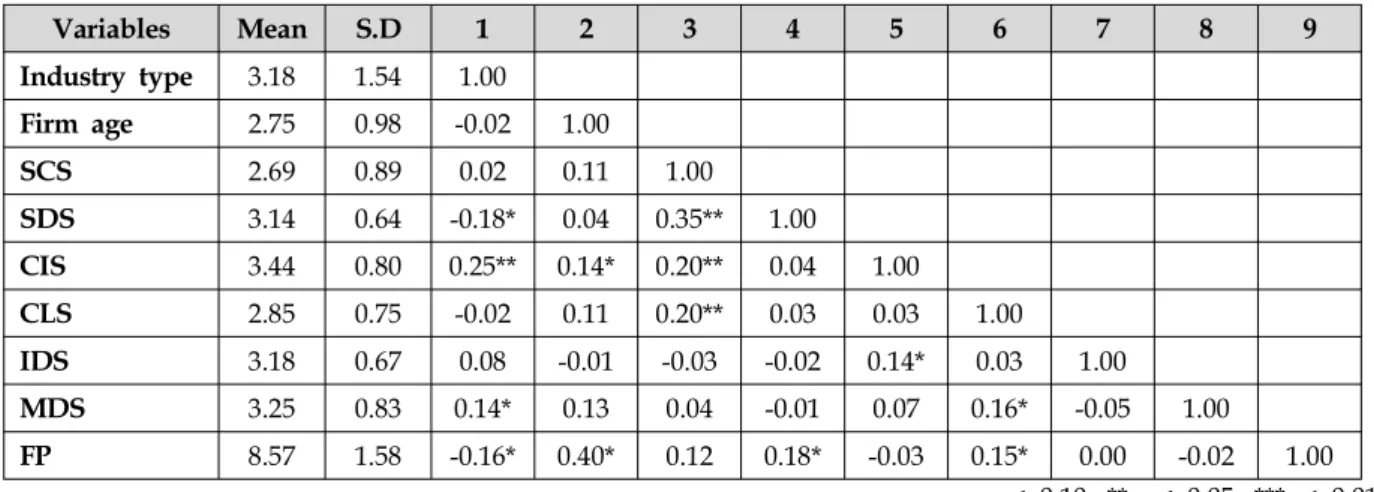
Presented in Table 3 are the mean, standard deviation, and correlations for all the variables of the three service innovation strategies, the three business strategies, firm performance and the control variables. More specially, to resolve the problems with multicollinearity of interaction effects in multiple regression analysis, we used standardization in this study. Standardization, as suggested by Jaccard et al. (1990) and Aiken and West (1991), reduces the multicollinearity inherent in interaction terms and facilitates the interpretation of the coefficients. Thus, all correlation of variables was computed after standardization.

Based on the result of the correlation test, the multiple regression analysis was conducted to identify the interaction effects between business and service innovation strategy on firm performance. To test for multicollinearity, we calculated variance inflation factors (VIFs) for our independent variables. All VIF values that have to be below the threshold value of 10 (Hair et al., 1998) were within the acceptable range (i.e., from 1.031 to 1.429). We also checked autocorrelation between independent variables by Durbin-Watson testing.

The Durbin-Watson test, whose generally acceptable

value is close to 2 (Hair et al., 1998), is the most

(14)

Variables Mean S.D 1 2 3 4 5 6 7 8 9 Industry type 3.18 1.54 1.00

Firm age 2.75 0.98 -0.02 1.00

SCS 2.69 0.89 0.02 0.11 1.00

SDS 3.14 0.64 -0.18* 0.04 0.35** 1.00

CIS 3.44 0.80 0.25** 0.14* 0.20** 0.04 1.00

CLS 2.85 0.75 -0.02 0.11 0.20** 0.03 0.03 1.00

IDS 3.18 0.67 0.08 -0.01 -0.03 -0.02 0.14* 0.03 1.00

MDS 3.25 0.83 0.14* 0.13 0.04 -0.01 0.07 0.16* -0.05 1.00

FP 8.57 1.58 -0.16* 0.40* 0.12 0.18* -0.03 0.15* 0.00 -0.02 1.00

[Table 3] Descriptive statistics and correlations

p < 0.10; **p < 0.05; ***p< 0.01 Note: SCS: Service Creation-focused strategy, SDS: Service Delivery-focused strategy, CIS: Client

interface-focused strategy, CLS: Cost leadership strategy, IDS: Innovative differentiation strategy, MDS:

Marketing differentiation strategy, FP: Firm performance

widely used to test for measuring autocorrelation.

All values of this test were closed to 2, and all independent variables were accepted.

Table 4 summarizes the multiple regression results of our hypothesis tests for H1, H2, and H3.

We conducted multiple regression analysis in four steps in Table 4. First, model 1 reports the influence of all the control variables on the firm performance. Second, models 2 and 3 present the main effects of both service innovation and business strategy on firm performance. Third, models 4 through 6 show the interaction effects in each combination between service innovation and business strategy on firm performance. Finally, model 7 shows all interaction terms.

As shown in model 1, industry type and firm age as control variables were estimated as expected.

Model 1 presents a significant negative relationship between industry type and firm performance, but a significant positive relationship between firm age and firm performance. In other words, regarding the effects of firm-level characteristics, it appears

that firm age in a service firm shows higher firm performance when they are older, and industry type of a service firm presents higher firm performance when they are involved in scale-intensive service industries (i.e., transport and communication) than knowledge intensive service industries (i.e., business consulting and design services) (Hipp and Grupp, 2005). Model 2 shows the main effects of three service innovation strategies on firm performance, and they explained an additional 20.5% of total variance in firm performance accounted for by industry type and firm age. However, with the exception of service creation-focused and client interface-focused strategies, only service delivery-focused strategies were significantly related to firm performance (β=

0.218, p < 0.10). Model 3 also provides a test of the

main effects of three business strategies on firm

performance. The result for the main effects of

business strategies on firm performance show that

only the cost leadership strategy was significantly

related to firm performance (β= 0.184, p < 0.10).

(15)

Independent Variables

Model1 Model2 Model3 Model4 Model5 Model6 Model7

Intercept 7.314***

(20.198)

7.263***

(19.499)

7.299***

(20.198)

7.359***

(20.190)

7.354***

(20.893)

7.355***

(19.985)

7.438***

(20.529) Control effects

Industry type Firm Age

-.159**

(-2.470) .638***

(6.321)

-.132**

(-1.969) .629***

(6.321)

-.147**

(-2.257) .633***

(6.201)

-.134**

(-2.063 .597***

(5.954)

-.161**

(-2.571) .632***

(6.453)

-.144**

(-2.184) .599***

(5.835)

-.137**

(-2.129) .569***

(5.696) Main effects

SCS SDS CIS

.066 (.607) .218*

(1.867) -.036 (-.338) CLS

IDS MDS

.184*

(1.770) .012 (.119)

-.105 (-1.029) Interaction effects

SCS*CLS SCS*IDS SCS*MDS

-.036 (-.364)

.254**

(2.539) .165*

(1.842)

.082 (.780) .248**

(2.177) .092 (.980) SDS*CLS

SDS*IDS SDS*MDS

-.340***

(-2.970) .133 (1.214)

.270**

(2.587)

-.338***

(-2.797) .030 (.254) .249**

(2.299) CIS*CLS

CIS*IDS CIS*MDS

.001 (.008)

.028 (.308) .246**

(2.119)

-.102 (-.994)

-.065 (-.689)

.208*

(1.819)

R2 .185 .205 .200 .224 .245 .203 .284

Adjusted R2 .177 .186 .180 .205 .226 .183 .244

R2 0.020 -0.005 0.024 0.021 -0.042 0.081

F 23.377*** 10.486*** 10.143*** 11.733*** 13.142*** 10.332*** 7.095***

F -12.891 -.343 1.590 1.409 -2.810 -3.237

[Table 4] Regression results for the effects of both Service innovation strategy and Business strategy on Firm performance

p < 0.10; **p < 0.05; ***p< 0.01 Note: SCS: Service Creation-focused strategy, SDS: Service Delivery-focused strategy, CIS: Client interface

-focused strategy, CLS: Cost leadership strategy, IDS: Innovative differentiation strategy, MDS:

Marketing differentiation strategy, FP: Firm performance

(16)

In models 4 through 6, we added the interaction effects of all our moderating variables. Models 4 through 6 provide sequential tests of hypotheses H1, H2, and H3. All interactions were computed by multiplying variables after standardization, which reduced the multicollinearity in interaction terms.

Model 4 provides a test of interaction effects between service creation-focused strategy and three business strategies (Hypothesis 2). As shown in model 4, the strategic fit as the interaction between service creation-focused strategy and innovative differentiation strategy is positive and significant (β= 0.254, p < 0.05), thus supporting Hypothesis 2.

This means that, with innovative differentiation strategy, firms that adopted a service creation-focused strategy could improve their performance. Put another way, with cost leadership or marketing differentiation strategy, the influence of service creation-focused strategy is weakened further, thereby leading to lower firm performance.

Model 5 represents the moderating effect between service delivery-focused strategy and three business strategies on firm performance and provides a test of Hypothesis 1. In model 5, the interaction between service delivery-focused and cost leadership strategies is significant but negative (β= -0.340,p <

0.01), indicating that the firms that utilize a service delivery-focused strategy would have worse firm performance with cost leadership strategy than those with other business strategies. Thus, there is a negative strategic fit pattern between service delivery-focused and cost leadership strategies. Its effect on firm performance is negative, so the result of this regression does not support Hypothesis 1.

Moreover, the result of model 5 also shows that the interaction between service delivery-focused and marketing differentiation strategies is positively

significant (β= 0.270, p < 0.05). This result presents that service firms that pursue service delivery-focused strategy could enhance firm performance within marketing differentiation strategy, not within cost leadership or marketing differentiation strategy.

Model 6 provides a test of Hypothesis 3, which predicted that client interface-focused strategy is more effective on firm performance with marketing differentiation strategy, thereby leading to better firm performance. As indicated by the positive and significant coefficient for the strategic fit as moderation between client interface-focused and marketing differentiation strategies (β= 0.246,p <

0.05), Hypothesis 3 is strongly supported.

Finally, we included all interaction terms in model 7. Support for Hypotheses 2 and 3 but not support for Hypothesis 1 is retained in model 7. It presents that two of all strategic fit patterns, such as “innovative differentiation - service creation -focused ” (H2: β= 0.248,p < 0.05) and “marketing differentiation- client interface-focused” (H3: β=0.208, p < 0.10) strategies are significantly more effective on firm performance. The strategic fit between cost leadership and service delivery-focused strategies negatively influences on firm performance (H1: β=

-0.338,p < 0.01), but the fit between marketing differentiation and service delivery-focused strategies positively influences on firm performance (β=

0.249,p < 0.01).

Ⅵ. Discussion and Implications

The objective of this study was to determine if

service firms with the strategic fit between business

strategy and service innovation strategy would have

better firm performance than those without such fit.

(17)

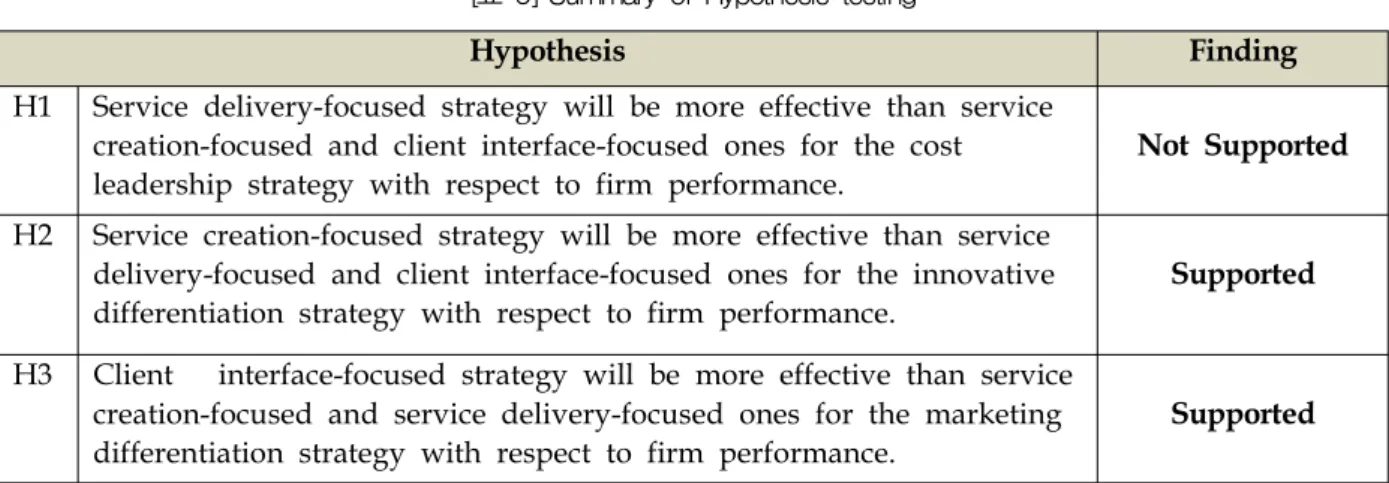
Hypothesis Finding H1 Service delivery-focused strategy will be more effective than service

creation-focused and client interface-focused ones for the cost leadership strategy with respect to firm performance.

Not Supported

H2 Service creation-focused strategy will be more effective than service delivery-focused and client interface-focused ones for the innovative differentiation strategy with respect to firm performance.

Supported

H3 Client interface-focused strategy will be more effective than service creation-focused and service delivery-focused ones for the marketing differentiation strategy with respect to firm performance.

Supported [표 5] Summary of Hypothesis testing

Table 5 summarizes the results of our hypothesis testing which indicates that our data provide strong support for the proposed hypotheses.

1. Discussion and implications

Based on the notion of the fit as the theoretical framework, we identified three dominant strategic combinations between three types of service innovation strategies and three basic business-level strategies (Miller, 1988). The results of our study indicated three congruent patterns “innovative differentiation service creation-focused”, “cost leadership service delivery-focused”, and

“marketing differentiation client interface-focused”

strategies as shown in Tables 4. Then, we showed that, of all strategic fit patterns, two patterns (i.e., innovative differentiation service creation-focused, and marketing differentiation client interface-focused) were capable of enhancing firm performance and that the strategic fit pattern of "cost leadership - service delivery-focused"

strategies could weaken firm performance. Our analysis provides partially support for this, as shown in Table 5.

The first implication of this study stems from the

fact that the alignment between business and service innovation strategies was significantly associated with firm’s economic performance. Hence, this study suggests that it is highly necessary to understand service innovation investment as combined with the business direction to improve firm performance. Furthermore, the second implication is related to the support for Hypotheses 2 and 3. It suggests that aligning service innovation strategy with business strategy should be viewed from the configurational perspective rather than the universalistic perspective, which means that specific strategies positively affect firm performance (Delery and Doty, 1996). However, the test for Hypotheses 1 shows the opposite result. The universalistic perspective is superior to the configurational perspective in explaining the fit between a cost leadership and a service delivery-focused strategy.

For example, while the individual service delivery-focused strategy and the cost leadership strategy have significant positive effects on firm performance from the universalistic perspective, the interaction effect between them has significant negative effects on firm performance from the configurational perspective.

Consistent with the previous study (Sabherwal

(18)

and Chan, 2001), we found a significant relationship between alignment and firm performance for cost leadership, innovative differentiation and marketing differentiation strategies. However, as proposed, the combination between innovative differentiation and service creation-focused strategy was found to yield the highest performance. Accordingly, service creation-focused strategy should be done with innovative differentiation strategy, resulting in the highest synergy with performance.

In addition, even though service firms could improve their efficiency of innovation process and involve cost reduction in “cost leadership service delivery-focused” pattern, the combination of cost leadership strategy which tends to locate and maintain existing markets and service delivery-focused strategy which stresses on increasing the efficiency and effectiveness of process results in stable cost structure of service firms, leading to the negative effects on firm performance.

However, “marketing differentiation service delivery-focused” pattern positively influences on firm performance. The efficiency and effectiveness of innovation process does not directly influence on firm performance, thus particular marketing strategy have to be accompanied with them. It means that it is imperative for service firms to align service delivery-focused strategy within marketing differentiation strategy, not within cost leadership strategy in order to create the firms’ benefits. These findings have valuable management implications that need to be further verified in the future.

Finally, the strategic patterns identified in this study provide service firms with a benchmark against which to compare their current alignments between business strategy and service innovation strategy. With the increasing attention being paid to

service innovation, it is imperative that service firms recognize the importance of the alignment between service innovation and business strategies.

This study emphasized the benefits of the fit patterns over misfit ones. Therefore, service firms with misfit patterns should seriously consider changing their current alignment to achieve better firm performance.

2. Limitations

Despite the above implication, there are some limitations associated with this study. First, we used financial performance, which was measured as total sales in 2010, to represent firm performance.

However, service innovation strategy directly affects the competitive advantage of firms and indirectly affects financial performance. Therefore, future research should utilize the competitive advantage of firms to represent the success of service innovation in addition to the financial performance used here.

Second, many service firms are not actually

innovative although they perceive themselves to be

so. For this reason, this study has a gap between

perception and representation that may result in the

overestimation of the service innovation effects on

firm performance. Future studies that can reduce

this gap may provide stronger results. Third, we

limited the study to only six service sectors,

namely, transport, communication, computer and

software, engineering and architecture, business

consulting, and design services. Therefore, the

findings may not be generalized to other service

sectors. Future research should extend the scope of

service sectors to explore more relevant service

innovation patterns. Finally, the results of this study

may not be completely generalizable since the

(19)

sample was restricted to Korea. While service firms in Korea is likely to have many characteristics that are similar to American and European service firms, the practice of service innovation and its socio-economic environment may indeed have played a distinctive role in the findings of this study. Hence, the results of this study must be carefully interpreted.

Ⅶ. Conclusions

Although an increasing number of service firms now look to service innovation to maintain their competitive advantage and improve their performance, service firms often lack adequate models for developing an appropriate alignment between business strategy and service innovation strategy. In spite of the limitations described above, this study sheds new light on service innovation study by identifying whether a certain service innovation strategy is more effective than others in a particular business strategy, and by exploring the way in which their effective alignments positively influence firm performance.

This study offers the requisite guidance to practitioners in their decisions on the alignment of service innovation with business strategy. Our findings suggest that the strategic fit patterns between business strategy and service innovation strategy (i.e., cost leadership, innovative differentiation, marketing differentiation, service creation-focused, service delivery-focused, and client interface-focused) appear to enhance firm performance. In addition, as this study is one of the earliest attempts to view the alignment between business and service innovation strategy and its effects on firm performance, the strategic fit

patterns identified in this study provide organizations with a benchmark against which to compare their current strategic fit patterns.

References

[1] Aiken, L. S. and West, S.G. (1991). Multiple regression: Testing and interpreting interactions.

Newbury Park, CA:Sage.

[2] Aldrich, H.E. and Auster, E. (1986). Even dwarfs started small: Liabilities of size and age and their strategic implications. In B.M. Staw and L.L.

Cummings(eds). Research in organizational bechavior, 8(1), 55-69.

[3] Anderson, C. R. and Paine, F. T. (1975). Managerial perceptions and strategic behavior. Academy of Management Journal, 18(4), 811-823.

[4] Baker, D. D. and Cullen, J. B. (1993).

Administrative reorganization and configurational context: The contingent effects of age, size, and change in size. Academy of Marketing, 51(1), 71-82.

[5] Bardhan, I. R., Demirkan, H., Kannan, P.K., Kauffman, R.J. and Sougstad, R. (2010). An interdisciplinary perspective on IT services management and service science. Journal of Management Information Systems, 26(4), 13-64.

[6] Berry, L.L., Shankar, V., Parish, J.T., Cadwallader, S. and Dotzel, T. (2006). Creating new markets through service innovation. MIT Sloan Management Review, 47(2), 56.

[7] Bowman, D. and Gatignon, H. (1996). Order of entry as a moderator of the effect of the marketing mix on market share. Marketing Science, 15(3), 222-242.

[8] Brady, M. and Fellenz, M. R. (2007). The service

paradox: Supporting service supply chains with

product-oriented ICT. In Proceedings of the HICSS,

수치

Table  4  summarizes  the  multiple  regression  results  of  our  hypothesis  tests  for  H1,  H2,  and  H3
Table  5  summarizes  the  results  of  our  hypothesis  testing  which  indicates  that  our  data  provide  strong  support  for  the  proposed  hypotheses.

참조

관련 문서

S.(2008), A study on the relationship between business plan components and corporate performance, International Journal of Entrepreneurship and Innovation Management,

segmentation; determining distribution, pricing and promotion strategies; developing a communications strategy; budgeting; and visioning long-term market

A business adopting the single target market strategy:. • Concentrates resources on

The intent of the Strategy is to design, foster and build synergies for activities and investments in geospatial information management in the United Nations

Basic aspects of AUTOSAR architecture and methodology Safety mechanisms supported by AUTOSAR.. Technical safety concepts supported by AUTOSAR Relationship to ISO

GDP impact of COVID-19 spread, public health response, and economic policies. Virus spread and public

Furthermore, it is necessary to provide support so that the innovation strategy of the GRIs is included in the goal and scenario to reach carbon neutrality by 2050 on

Research performed by ACCA and Eurosif (2013) concluded that “investors say: (a) a link is missing between current reporting, business strategy and risk, and we do not