서론 I.
, ,
.
, .
. Newton
(steepest descent)
.
(gradient)
(local solution)
.
.
Li (backpropagation)
[1],
Takenga , ,
decouple
[2]. Wang
* (Corresponding Author)
: 2011. 5. 20., : 2011. 6. 5., : 2011. 6. 20.
XOR , (parity) ,
, piecewise (approximation)
[3]. unscented [4]
[5,6].
, Choi simultaneous localization & map
building(SLAM) [7], Kramer
[8]. (recurrent)
. Rubio
[9], Choi equalizer
unscented [10]. Coelho
complex real time recurrent learning (RTRL) [11], Mirikitani ensemble
[12]. Wang
[13].
R Q
, R Q
.
,
.
-
Learning of Differential Neural Networks Based on Kalman-Bucy Filter Theory
*,
(Hyun Cheol Cho1 and Gwan Hyung Kim2)
1Ulsan College
2Tongmyong University
Abstract: Neural network technique is widely employed in the fields of signal processing, control systems, pattern recognition, etc. Learning of neural networks is an important procedure to accomplish dynamic system modeling. This paper presents a novel learning approach for differential neural network models based on the Kalman-Bucy filter theory. We construct an augmented state vector including original neural state and parameter vectors and derive a state estimation rule avoiding gradient function terms which involve to the conventional neural learning methods such as a back-propagation approach. We carry out numerical simulation to evaluate the proposed learning approach in nonlinear system modeling. By comparing to the well-known back-propagation approach and Kalman-Bucy filtering, its superiority is additionally proved under stochastic system environments.
Keywords: differential neural networks, Kalman-Bucy filter, learning, augmented state estimation
Copyright© ICROS 2011
. -
. -
.
augment -
.
- . 칼만 버쉬 필터 알고리즘
II. -
-
[14].
- .
.
(1)
∈ , ∈ ,
∈ , ∈ ,
∈ , →
→ .
- (1)
.
(2)
(3)
(4)
(covariance)
.
∈ × (5a)
∈ × (5b)
∈× (5c)
(5) (Jacobian)
.
미분 신경회로망 III.
[15].
1 .
(6)
∈ , ∈
, ∈ ∈
, ∈×, ∈×,
∈× , ∈×
→
. (6)
, ,
. ,
(mapping)
. 칼만 버쉬 필터링 기반 미분 신경회로망 학습
IV. -
-
, augment [16].
(7)
(6)
∈ (8)
1. .
Fig. 1. A differential neural networks model.
∈, ∈,
∈ . (6) (7)
.
(9)
∈× . (9)
.
(10)
- (9)
.
(11).
.
(12)
(13)
1
. (13)
.
(14a)
(14b)
2
.
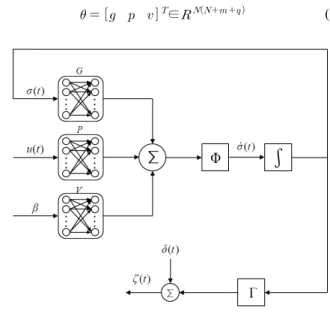
2. .
Fig. 2. A schematic diagram of the proposed differential neural network leaning algorithm.
컴퓨터 시뮬레이션 V.
-
- .
[15].
(15a)
(15b) .
(15)
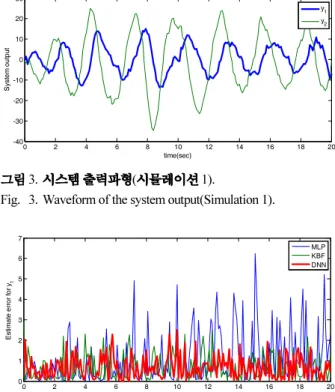
∼ ∼ (stationary) . 3
. 0
.
(6)
∈× ∈ ∈
. 35 .
20 0.1
200 .
0 2 4 6 8 10 12 14 16 18 20
-40 -30 -20 -10 0 10 20 30
time(sec) Sys
tem out put
y1 y2
3. ( 1).
Fig. 3. Waveform of the system output(Simulation 1).
0 2 4 6 8 10 12 14 16 18 20
0 1 2 3 4 5 6 7
time(sec) Est
imat e er ror f or y1
MLP KBF DNN
4. ( 1).
Fig. 4. Modeling error for the output(Simulation 1).
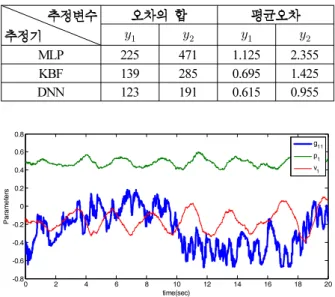
. 4 5 3 (MLP),
- (KBF)
(DNN)
,
. 4 5
-
. -
. 3
200 1
. 1
. 6
.
(generalization) [17]
. (15b)
1 2 (nonstationary)
7 .
(3)
3 .
1 2
. 3
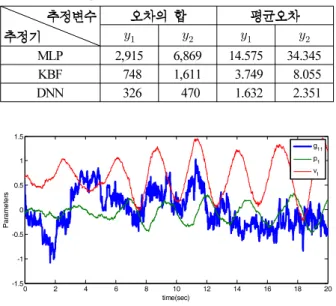
8 9 .
2 .
.
0 2 4 6 8 10 12 14 16 18 20
0 2 4 6 8 10 12
time(sec) Est
imat e er ror f or y2
MLP KBF DNN
5. ( 1).
Fig. 5. Modeling error for the output(Simulation 1).
1. 3 ( 1).
Table 1. Modeling error for the three estimators(Simulation 1).
MLP 225 471 1.125 2.355
KBF 139 285 0.695 1.425
DNN 123 191 0.615 0.955
0 2 4 6 8 10 12 14 16 18 20
-0.8 -0.6 -0.4 -0.2 0 0.2 0.4 0.6 0.8
time(sec) Par
am eter s
g11 p1 v1
6. ( 1).
Fig. 6. Partial parameters of the DNN(Simulation 1).
0 2 4 6 8 10 12 14 16 18 20
-100 -50 0 50 100 150
time(sec) Sys
tem out put
y1 y2
7. ( 2).
Fig. 7. Waveform of the system output(Simulation 2).
0 2 4 6 8 10 12 14 16 18 20
0 5 10 15 20 25 30 35 40
time(sec) Est
imat e er ror f or y1
MLP KBF DNN
8. ( 2).
Fig. 8. Modeling error for the output(Simulation 2).
0 2 4 6 8 10 12 14 16 18 20
0 10 20 30 40 50 60 70 80 90 100
time(sec) Est
imat e er ror f or y2
MLP KBF DNN
9. ( 2).
Fig. 9. Modeling error for the output(Simulation 2).
. -
. -
[4].
. 10
.
.
-
.
결론 VI.
-
. augment -
.
- .
.
, -
.
.
. 참고문헌
[1] S. Li, “Comparative analysis of backpropagation and extended Kalman filter in pattern and batch forms for training neural networks,” International Joint Conference on Neural Networks, Washington, DC. pp. 144-149, 2001.
[2] C. M. Takenga, K. R. Anne, K. Kyamakya, and J. C.
Chedjou, “Comparison of gradient descent method, Kalman filtering and decoupled Kalman in training neural networks used for fingerprint-based positioning,” Proc. of the IEEE Vehicular Technology Conference, pp.
4146-4150, 2004.
[3] K.-W. Wong, C.-S. Leung, and S.-J. Chang, “Use pf periodic and monotonic activation functions in multilayer feedforward neural networks trained by extended Kalman filter algorithm,” IEEE Image Signal Process, vol. 149, no. 4, pp. 217-224, 2002.
[4] S. J. Julier and J. K. Uhlmann, “Unscented filtering and nonlinear estimation,” Proc. of the IEEE, vol. 92, no. 3, pp. 401-422, 2004.
[5] B. Todorovic, M. Stankovic, and C. Moraga, “On-line learning in recurrent neural networks using nonlinear Kalman filters,” Proc. of the IEEE Int. Symposium on Signal Processing and Information Technology, pp.
802-805, 2003.
[6] R. Zhan and J. Wan, “Neural network-aided adaptive unscented Kalman filter for nonlinear state estimation,”
IEEE Signal Processing Letters, vol. 13, no. 7, pp.
445-448, 2006.
[7] M. Choi, R. Sakthivel, and W. K. Chung, “Neural network-aided extended Kalman filter for SLAM problem,” IEEE International Conference on Robotics &
Automation, Roma, Italy, pp. 1686-1690, 2007.
[8] K. A. Kramer and S. C. Stubberud, “Tracking of multiple target types with a single neural extended Kalman filter,” International Journal of Intelligent Systems, vol. 25, pp. 440-459, 2010.
2. 3 ( 2).
Table 2. Modeling error for the three estimators(Simulation 2).
MLP 2,915 6,869 14.575 34.345
KBF 748 1,611 3.749 8.055
DNN 326 470 1.632 2.351
0 2 4 6 8 10 12 14 16 18 20
-1.5 -1 -0.5 0 0.5 1 1.5
time(sec) Par
am eter s
g11 p1 v1
10. ( 2).
Fig. 10. Partial parameters of the DNN(Simulation 2).
[9] W. Yu and J. de J. Rubio, “Recurrent neural networks training with stable risk-sensitive Kalman filter algorithm,” Proc. of International Joint Conference on Neural Networks, Montreal, Canada, pp. 700-705, 2005.
[10] J. Choi, A. C. Lima, and S. Haykin, “Kalman filter-trained recurrent neural equalizers for time-varying channels,” IEEE Transaction on Communications, vol. 53, no. 3, pp. 472-480, 2005.
[11] P. H. G. Coelho and L. B. Neto, “Complex RTRL neural networks fast Kalman training,” International Conference in Intelligent Systems Design and Applications, pp.
573-577, 2007.
[12] D. T. Mirikitani and N. Nikolaev, “Dynamic modeling with ensemble Kalman filter trained recurrent neural networks,” International Conference on Machine Learning and Applications, pp. 843-848, 2008.
[13] X. Wang and Y. Huang, “Convergence study in extended Kalman filter-based training of recurrent neural networks,”
IEEE Transaction on Neural Networks, vol. 22, no. 4, pp. 588-600, 2011.
[14] J. M. Mendel, Lessons in Estimation Theory for Signal Processing, Communications and Control, New Jersey, Prentice Hall, 1995.
[15] A. S. Poznyak, E. N. Sancbez, and W. Yu, Differential Neural Networks for Robust Nonlinear Control, New Jersey, World Science, 2001.
[16] H. C. Cho, J. W. Lee, Y. J. Lee, and K. S. Lee,
“Online dynamic modeling of ubiquitous sensor based embedded robot systems using Kalman filter algorithm,”
Journal of Institute of Control, Robotics and Systems (in Korean), vol. 14, no. 8, pp. 779-784, 2008.
[17] S. Haykin, Neural Networks and Learning Machines, New Jersey, Prentice Hall, 2009.
조 현 철 1997 2
( ). 1999 2
( ). 2006
8
(Ph.D.). 2006 9 ~2009 2 .
2009 3 ~ .
, , .
김 관 형 2001 2
( ). 2000 3 ~
.
, ,
, .