Department of Bio-Environmental Chemistry, College of Agriculture and Life Sciences, Chungnam National University. Daejeon 305-764, Korea
The relative focus about phosphorus (P) which causes eutrophication characterized by increased growth of undesirable algae has increased in recent years. Phosphorus forms in soil and water include both organic and inorganic forms. There are also a large number of soil P determination methods that have been designed to account for various types of P and mechanisms controlling the chemistry of P in soil, water, and residual materials for environmentally relevant forms of P. However, phosphorus forms in soil, water, and residual materials are also difficult to standardize with any reasonable consensus, due to the number of different disciplines involved. Hence, it is essential to accurately define how P can be measured in soil, water, or residual material samples to avoid potential misinterpretations or inappropriate recommendations in determining amount and types of P. Therefore, we reviewed the testing methods which have appeared in the scientific literature to provide an overview of the soil test P most commonly used.
Key words: Phosphorus, Eutrophication, Algae
Received : July 19. 2011 Accepted : August 14. 2011
*Corresponding author : Phone: +82428216739 E-mail: [email protected]
Introduction
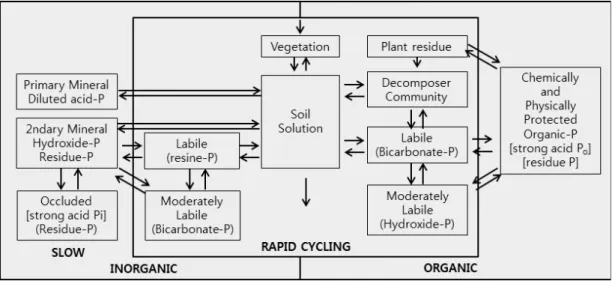
Phosphorus (P) which is an essential element for plant growth and microbial uptake exists mostly in organic and inorganic form in soil. Phosphorus forms in soil include both organic and inorganic forms (Tiessen et al. 1984).
These forms can be either rapidly or slowly cycling. The organic form exists mostly in humus and other organic materials. The inorganic P forms are primarily mixtures of aluminum (Al-p), iron (Fe-p), and calcium (Ca-P) phosphates. P availability is also controlled by environ- mental conditions such as soil moisture content and aeration which influence transformations of phosphorus by microbial activity and eventually P retention in soils.
Sediment-bound and dissolved forms of phosphorus, that is associated with minerals and organic matter, is lost from agricultural land to surface water bodies.
Dissolved P constitutes 10 to 40 percent of the P transported from cultivated soils to water bodies through runoff and seepage (Sharpley et al., 1992). Surface runoff from grassland, forest, and uncultivated soils carries little sediment and carries dominantly dissolved forms of
P which are readily bioavailable and result in the main cause of eutrophication. A concentration of P above 0.02 ppm in lake water that is much less than the P concentration in soil solution of cultivated soils generally accelerates eutrophication (Sharpley et al., 1999). Extractable P has been used to describe the amount of P in soil available for crop uptake and the probability of crop response to added P, while bioavailable P is often used to describe P available for uptake by algae or macrophytes in soil or sediment. Identifying and quantifying available P fractions in forest soils is however difficult. Therefore, selection of an appropriate soil test of P analysis is essential for understanding this relationship between concentration of P and eutrophication.
Many chemical solutions have been proposed to extract potential forms of P in soils. The environmentally relevant forms of P have increased the demand for information on methods of analysis of soil, water, and residual materials for P. The soil P extracted by water can be mainly P as dissolved forms and difficulties related to chemical analysis limit the use of water as an extractant. Therefore, a uniform set of testing methods is needed to enable comparison of results to identify the forms and accuracy of phosphorus found in soils and organic matter as a residue.
Fig. 1. Schematic overview of different phosphorus pools in soils (Tiessen et al. 1984).
Table 1. Test methods and Adapted range of soil properties.
Method Adapted range of soil properties
Morgan P content in acid soils with CECs of less than 20 cmolc kg-1
Bray P1 and P2 The solubilization effect of the H+ ions on soil P and the ability of the F- ion to lower the activity of Al3+ and, to a lesser extent, that of Ca2+and Fe3+ ions in the extraction system.
Mehlich No.1 P in sandy soils that have exchange capacities of less than 10 cmolc kg-1, are acid (pH less than 6.5) in reaction, and are relatively low(less than 5%) in organic matter content.
Olsen's NaHCO3 The use of carbon black to eliminate the color on the extract.
NH4HCO3-DTPA Highly correlated with the Olsen's NaHCO3 method for P
Mehlich No. 3 A wide range of soil properties ranging in reaction from acid to basic
0.01 M CaCl2 The metal concentration reflects the differences in binding strength and/or solubility among various soils
The purpose of this publication is to present and compare these methods which have appeared in the scientific literature by providing a set of uniform testing methods about P, that comparable methods may lead to improved understanding of this complex issue.
Soil Test Phosphorus: Principles and Methods Sims et al. (1998) stated that objectives of soil P testing have been to: (i) “index” the P supplying capacity of soils;
(ii) group soils based on their physical and chemical properties; and, (iii) to identify when soils are sufficiently excessive in P to contribute to nonpoint source pollution of surface waters. Several recent articles address the principles and practices involved in environmental soil testing for P (Sibbesen and Sharpley, 1997; Sims, 1993;
Sims, 1997; Sims, 1998; Sims et al., 2000).
As shown in Table 1, there are eight soil testing procedures in common use for determining soil P (Kovar and Pierzynski, 2009). The interpretation ranges for these various test methods applied to a soil vary considerably,
and sometimes the levels of extractable P do not correlate well among P soil test methods unless the soil charac- teristics are similar.
Selecting an Appropriate Test A large number of soil P extraction methods has been designed to account for various soil types and mechanisms controlling the chemistry of soil (Kovar and Pierzynski, 2009). When extracting solution is added to soil, there are four basic reactions by which P is removed from the solid phase:
1) dissolving action of acids, 2) anion replacement to enhance desorption, 3) complexing of cations binding P, and 4) hydrolysis of cations binding P. Therefore, the selection of a P soil test depends on the chemical forms of P in the soil.
Extraction of P by chemical extractants can be influenced by several soil properties including extractable Fe, Al and Mn oxides, clay content of the soil, CaCO3, organic matter, soil pH and P-sorption capacity of the soil (Bray and Kurtz. 1945). Chemical may lead to a difficulty in
Slightly acid to slightly
alkaline 6.0 to 7.2 Al-P, Fe-P, Mn-P,
Mg-P, and Ca-P
Bray 1, Mehlich 1, Mehlich 3, Olsen, Water, IIP, and AER
Alkaline-calcareous > 7.2 Ca-P and Mg-P Olsen, Water, IIP, and AER
Table 3. Extraction reagents used for P measurement.
Test method Extraction reagent Soil Extractant Shaking time
g mL min
Morgan 0.7 N NaC2H3O2 + 0.54NCH3COOH, pH 4.8 5 25 30
Bray P1 0.03N NH4F + 0.025N HCl 2 20 5
Bray P2 0.03N NH4F + 0.1N HCl 2 20 5
Mehlich No.1 0.05N HCl +0.025N H2SO4 5 25 5
Olsen 0.5N NaHCO3, pH 8.5 2.5 50 30
AB-DTPA 1M NH4HCO3 +0.0005M DTPA, pH 7.6 10 20 15
Mehlich No.3 0.2N CH3COOH + 0.015N NH4F + 0.25N NH4NO3 +
0.013N HNO3 + 0.000M EDTA 2.5 25 5
CaCl2 0.01M CaCl2․ ․ H2O 10 100 120
interpretation of the test result (Myers et al., 2005).
Standard extraction methods used in extracting organic P are time consuming as they require separate extraction periods. Mineral dynamic altered with ignition method as a result of high temperature may lead to a change in the level of extractable P in the soil (Soltanpour et al., 1987). The soil properties affecting selection of the appropriate P test and recommended methods are outlined in the Table 2.
Al- and Fe-phosphates are the primary source of P in acid and neutral soils. Either Bray 1 or Mehlich 3 can be used to successfully remove these minerals along with dissolved and adsorbed forms. Calcium phosphates are the main P minerals in alkaline and calcareous soils, whereas neutral and slightly acid soils (pH 6 to 7) may contain both Ca- and Al-phosphates. The NaHCO3
extractant (Olsen et al., 1954) can remove Ca-phosphates and phosphate adsorbed on surfaces of calcium and magnesium carbonates along with Al-phosphates and is considered the most suitable P test for these soils.
Extraction reagents vary in their composition depending on their application for extracting a particular form of P found in a soil as well as other soil properties (mainly pH) (Jones, 2001). A water extract removes dissolved forms of P but very little of the adsorbed and mineral forms. It is suitable for both acid and calcareous soils.
The amount of P extracted is small for most soils, and
may not reflect all forms of labile P. A P-sink in a water matrix can remove more P from soil than water extract alone. Dilute acids solubilize Ca-P, Al-P, and to a lesser degree Fe-P, and F is included to complex Al and prevent readsorption of P by Fe oxides. The chelate EDTA and the C2H3O2- and the SO42- anions serve somewhat the same function as the F- ion, although the two anions are less effective complexers as compared with F (Jones, 2001). The HCO3- based extraction reagents apply particularly to alkaline soils in which the major portion of P exists as Ca-P. The composition of the extraction reagent and the soil weight (volume), extractant volume, and shaking time are outlined in the Table 3 (Jones, 2001).
Extraction time is based on time necessary to quickly reach equilibrium on ease of mechanical handling for most acid extraction reagents. Long periods of contact between soil and extraction reagent, by overextending the extraction time or delaying separation by either filtration or centrifugation, allow P reabsorption to take place (Jones, 2001).
Methods of Phosphorus Determination The methods used to measure P concentrations for solid samples such as soils or by-products require that the P be contained in a liquid matrix by being brought into solution through a digestion procedure using acids or by extraction with
a liquid such as water, weak salt solutions, or weak acids. A number of analytical techniques for the analysis of inorganic phosphates have been reported. These methods include both gravimetric and titrimetric analyses (Grob and McNally, 1980), UV spectrophotometry (Umalia et al., 1995), inductively coupled plasma atomic emission spectroscopy (ICP-AES) (Sirok et al., 1987), 31p nuclear magnetic resonance (NMR) (Gurley and Ritchey, 1976) and ion chromatography (IC) (Quinna et al., 1986). The commonly used methods for P determination in soil extracts are by either ultraviolet-visible (UV-VIS) spectro- photometry or by plasma emission spectrometry (ICP- AES).
Combustion by the oxygen flask technique, extensively used for the determination of phosphorus in an organo- phosphorus compound, produces more than one phosphorus species (Umalia et al, 1995). In this technique, the sample is combusted in oxygen and the desired species are released from the sample matrix in the form of oxides which are then released in an appropriate absorbing solution. However, the problem of low recovery of phosphorus as orthophosphate following the combustion of an organophosphorus compound has been encountered by several workers (Binkowski and Rutkowski, 1986).
Busman et al. (1983) encountered the difficulty in suppressed IC and associated the problem with the formation during combustion of either some polyphosphates that were not detectable by IC or some insoluble metal phosphates.
Moorleghem et al., (2011) stated that dissolved organic phosphorus in water samples can be measured as the difference between total P measured with colorimetric method (CM) after digestion or ICP–and inorganic P (Pi) measured with CM or ion chromatography (IC).
They found that the average amounts of CM and IC measured respectively 95% and 77% of the total P (ICP). The difference in these results can be explained by the presence of colloidal P or P associated with Fe or Al, which in turn are part of an organic molecule.
UV-VIS procedures which are sensitive, reproducible and can accommodate water samples, digest solutions, and extracts are the mainstay of P analysis for all solution types (Murphy and Riley, 1962). Three UV-VIS spectro- photometric procedures, vanado- molybdophosphoric acid (Kuo, 1996), chlorostannous acid or ascorbic acid molybdenum- blue (Kuo, 1996), and malchite green (Novozamsky et al., 1993) can be used to determine P
concentration in an obtained extractant.
The use of inductively coupled plasma (ICP) spectro- photometry has increased as the use of multi-element soil extractants become more popular. The UV-VIS procedures measure P that can react with the color developing reagent, while ICP estimates the total amount of P in a solution. Pittman et al. (2005) compared ICP and colorimetric P determination in Mehlich-3 (M3) extracts of 6400 soil samples from Oklahoma. The results showed that ICP would measure greater P concen- trations than UV-VIS procedures because the high temperature environment of the plasma would allow the measurement of organic P compounds or other soluble P complexes that would not be measured colorimetrically.
Mallarino (2003) also found M3 results to be greater in Iowa soils when P was measured with ICP as compared to a colorimetric approach. Therefore, results from colorimetric analyses are not always directly comparable to those from ICP (de Boer et al., 1998).
31p NMR may be employed in the analysis of phosphates (Gurley and Ritchey, 1976) and has the advantage of specificity of defined chemical shifts of phosphorus nuclei. Its limitations, however, include inherent low sensitivity (Umalia et al, 1995). IC is used routinely for the determination of orthophosphate in the presence of other anions by both the suppressed and non-suppressed approaches (Umalia et al, 1995). When orthophosphate is present together with the other lower oxide~ of P such as phosphite (H3PO2-) and hypophosphite (H2PO2-) speciation may be achieved using conductivity detection in suppressed IC (Tanaka et al., 1983).
Conclusions
The environmentally relevant forms of P have increased the demand for information on methods of analysis of soil, water, and residual materials for P. There are eight common soil testing procedures in determining P in soil, water, and residual materials. However, the interpretation ranges for these various test methods to them vary considerably, and sometimes the levels of extractable P do not correlate well among P test methods unless the sample characteristics are similar. A uniform set of testing methods is needed to enable to identify the forms and accuracy of phosphorus found in soils and organic matter as a residue.
Technology Development Center under the Research Development Program (Yr 2011) and the authors would like to acknowledge for the assistance.
References
Binkowski J. and P. Rutkowski. 1986. Elemental analysis of organic phosphorus compounds. X. Schoeniger-flask method for phosphorus. Mikrochim. Acta. I:245-247.
Bray, R.H. and L.T. Kurtz. 1945. Determination of total, organic, and available forms of phosphorus in soils. Soil Sci. 59:39-45.
Busman, L.M., R.P. Dick, and M.A. Tabatabai. 1983. Determination of Total Sulfur and Chlorine in Plant Materials by Ion Chromatography. Soil Sci. Soc. of Am. J. 47:1167-1170.
Christoff Van-M., E. Smolders, F. Degryse, L. Six, E.
Vandamme, and R. Merckx. Comparison of colorimetric analysis, ion chromatography, ICP and DGT for model phosphorus solutions and natural water samples.
de Boer, J.L.M., U. Kohlmeyer, P.M. Breugem, and T. van der Velde-Koerts. 1998. Determination of total dissolved phosphorus in water samples by axial inductively coupled plasma emission spectrometry. J. Anal. Chem. 360:132-136.
Grob, R.L. and M.E.P. McNally. 1980. Use of the lead(II) cation as precipitating agent in quantitative determination of phosphorus in organophosphorus compounds. Study of the lead phosphate - lead EDTA system. Anal. Lett. 13:
219-231.
Gurley, T.W. and W.M. Ritchey. 1976. Analysis of organo- phosphorus compounds at the parts-per-million level by phosphorus-31 Fourier transform nuclear magnetic resonance spectroscopy Anal. Chem. 48:1137-1140.
Jones, Jr. J.B. 2001. Laboratory guide for conducting soil tests and plant analysis. CRC Press.
Kovar, J.L. and G.M. Pierzynski. 2009. Methods of Phosphorus Analysis for Soils, Sediments, Residuals, and Waters Second Edition. Southern Cooperative Series Bulletin No. 408.
Kuo, S. 1996. Phosphorus. p. 869-919. In D.L. Sparks. (ed.).
Methods of Soil Analysis: Part 3- Chemical Methods.
SSSA, Madison, WI.
Mallarino. A.P. 2003. Field calibration for corn of the Mehlich-3 soil phosphorus test with colorimetric and inductively coupled plasma emission spectroscopy determination methods. Soil Sci.
Soc. Am. J. 68:1928-1934.
Mehlich, A. 1984. Mehlich 3 soil test extractant: A modification of Mehlich 2 extractant. Comm. Soil Sci. Plant An. 15:
1409-1416.
Murphy J. and J.P. Riley. 1962. A modified single solution method for the determination of phosphate in natural waters.
Analytica Chimica Acta 27 (1962), pp. 31-36.
Novozamsky, I., D. van Dijk, J.J. van der Lee, and V.J.G.
Houba. 1993. Automated determination of trace amounts of phosphate in soil extracts using malachite green. Commun.
Soil Sci. Plant Anal., 24:10651076.
Olsen, S.R., C.V. Cole, F.S. Watanabe, and L.A. Dean. 1954.
Estimation of available phosphorus in soils by extraction with sodium bicarbonate. U.S. Dep. of Agric. Circ. 939.
Pittman, J.J., H. Zhang, J.L. Schroder, and M.E. Payton. 2005.
Differences of phosphorus in Mehlich 3 extracts determined by colorimetric and spectroscopic methods. Commun. Soil Sci. Plant Anal. 36:1641-1659.
Quinna, A.M., K.W.M. Siua, G.J. Gardnera, and S.S. Berman 1986, Determination of heteroatoms in organic compounds by ion chromatography after Schöniger flask decomposition.
Journal of Chromatography A. 370:203-205.
Sharpley, A.N., S.J. Smith, O.R. Jones, W.A. Berg, and G.A.
Coleman. 1992. The transport of bioavailable phosphorus in agricultural runoff. J. Environ. Qual. 21:30-35.
Sharpley, A.N., T. Daniel, T. Sims, J. Lemunyon, R. Stevens, and R. Parry. 1999. Agriculture phosphorus and eutrophication.
ARS-149, U.S. Dep. of Agric., Washington, D.C.
Sharpley, A.N. 2000. Bioavailable phosphorus in soil. pp.
38-43. In G.M. Pierzynski (ed.), Methods for phosphorus analysis for soils, sediments, residuals, and waters. Southern Cooperative Series Bull. XXX.
Sibbesen, E. and A.N. Sharpley. 1997. Setting and justifying upper critical limits for phosphorus in soils. p. 151-176.
In H. Tunney et al., (ed.) Phosphorus Loss from Soil to Water. CAB International, London.
Sims, J.T. 1993. Environmental soil testing for phosphorus.
J. Prod. Agric. 6:501-507.
Sims, J.T. and A.M. Wolf. 1995. Recommended soil testing procedures for the Northeastern United States. (2nd ed.).
Bull. No. 493. Univ. Delaware, Newark, DE.
Sims, J.T. 1997. Phosphorus soil testing: Innovations for water quality protection. p. 47-63. Proc. 5th Intl. Symp. Soil and Plant Analysis. Minneapolis, MN.
Sims, J.T. 1998. Soil testing for phosphorus: Environmental uses and implications. So. Coop. Series Bull. No. 389.
Univ. Delaware, Newark, DE.
Sims, J.T., S.C. Hodges, and J. Davis. 1998. Soil testing for phosphorus: Current status and uses in nutrient management programs. p.13-20. In Sims, J.T. (ed.) 1998. Soil testing for phosphorus: Environmental uses and implications. So. Coop.
Series Bull. No. 389. Univ. Delaware, Newark, DE.
Sims, J.T., A.C. Edwards, O.F. Schoumans, and R.R. Simard.
2000. Integrating soil phosphorus testing into environmentally based agricultural management practices. J. Environ. Qual.
29:60-71
Širokia, M., G. Vujičića, V. Miluna, Z. Hudovskya, and L.
Marić Determination of phosphorous in organic compounds and metal complexes by inductively-coupled plasma atomic
emission spectrometry Analytica Chimica Acta Volume 192, 1987, Pages 175-182.
Soltanpour P.N., R.L. Fox, and R.C. Jones. 1987. A quick method to extract organic phosphorus from soils. Soil Sci.
Soc. Am. J. 51:255-256.
Tanaka, T., K. Hiiro, A. Kawahara, and S. Wakida. 1983.
イオンクロマトグラフィーによる次亜リン酸,亜リン酸
及びリン酸イオンの定量. Bunseki Kagaku, 32:771-773.
Tiessen, H., J. W.B. Stweart, and C.V. Cole. 1984. Pathways of Phosphorus Transformations in Soils of Differing Pedogenesis.
Soil Science Society of America Journal 48:853-858.
Umalia, J.C., G.M. Morana, and P.R. Haddadb. 1995. Determination of phosphorus by sample combustion followed by non-suppressed ion chromatography. Journal of Chromatography A. 706:199-207.