서 론
어류의 길이-무게 데이터는 대상 어류의 영양상태를 평가 하거나 특정 지역의 생물자원량 평가에 활용되기도 하며, 더 나아가서는 서식처 적합성을 평가하는 데 활용되기도 한다 (Le Cren, 1951; Tesch, 1968; Froese, 2006). 국내에서 어류의 길이-무게 활용의 가장 대표적인 방법은 Keys(1928)가 제안 한 길이-무게 상관관계(Length-Weight relationships, LWRs) 와 Fulton(1904)의 비대지수(Condition factor, K)를 활용하
여 대상 어류의 영양상태를 평가하는 것이다(Han et al., 2007;
Seo and Kim, 2009; Ko et al., 2012; Lee et al., 2013). 하지만 LWRs와 비대지수는 어류의 영양상태를 평가함에 있어 명확 한 한계를 가지고 있으며(Froese, 2006), 이러한 한계에 대한 정확한 이해 없이 어류의 영양상태를 평가하는 것은 오류를 범할 가능성이 매우 높다.
LWRs(W=aLb; W, weight in gram; L, length in cm; a and b, parameters)는 지수함수이며 주어진 길이에 대응하는 무게를 산출하기 위해 고안되었다(Keys, 1928). 즉, LWRs는 본래 어 류의 영양상태를 평가하는 것이 아니라, 어류의 체형과 성장 양상(동형성장, 상대성장 등)을 고려하여 특정 길이에 해당하 는 무게를 예측하는 것이 목적이다. LWRs는 회귀분석을 통해 매개변수 a와 b값을 산출하며, 각각의 매개변수는 어류의 체
—55 — http://www.fishkorea.or.kr 저자 직위: 백승호((주)에코리서치 선임연구원, 충북대학교 환경공학과 박사과정),
박상현((주)에코리서치 선임연구원, 목포대학교 해양수산자원학과 박사과정), 김정희((주)에코리서치 대표이사)
* Corresponding author: Jeong-Hui Kim Tel: 82-41-853-3018, Fax: 82-41-853-3019, E-mail: [email protected]
ISSN: 1225-8598(Print), 2288-3371(Online). DOI: https://doi.org/10.35399/ISK.32.2.3
Accepted: March 30, 2020
한국 담수어류 10종의 상대 무게지수 (Relative weight index) 활용을 위한 표준 길이 -무게 상관관계 (Standard Length-Weight relationships) 산출
백승호1,2·박상현1,3·김정희1,
*
1(주)에코리서치, 2충북대학교 환경공학과, 3목포대학교 해양수산자원학과
Estimation of Standard Length-Weight Relationships of 10 Freshwater Fish in the South Korea for Application of Relative Weight Index by Seung-Ho Baek1,2, Sang-Hyeon Park1,3 and Jeong-Hui Kim1,* (1EcoResearch Incorporated, Gongju 32588, Republic of Korea; 2Department of Environmental Engineering, Chungbuk National University, Cheongju 28644, Republic of Korea; 3Department of Marine Fisheries Resources, Mokpo National University, Mokpo 58554, Republic of Korea)
ABSTRACT The Relative weight index is an index for evaluating nutritional condition of fish by calculating a ratio of observed weight to standard weight. The purpose of this study is estimating standard Length-Weight relationships(standard LWRs) to calculate standard weight for application of relative weight index and analyze frequency distribution of relative weight index of 10 freshwater fish in the South Korea. The standard LWRs for each species was calculated by the Length-Weight data sets from 798 times of captures at 141 sites. The correlation of determination(r2) for all species was over 0.9 and values of parameter b were within the expected range according to Froese(2006). We calculated in increments of 10 from 10 to 90 percentile of relative weight index for each species, and it could be used as a standard for quantitative assessment of nutritional condition of freshwater fish.
Key words: Condition factor, nutritional condition, standard weight, total length, relative weight index, length- weight relationships
형과 성장 양상을 해석하는 데 활용될 수 있다. 어류는 각 종 별로 특이적인 체형과 성장 양상을 가지기 때문에 매개변수 a 와 b는 종의 특성을 대변하는 수치로써 해석되며, 따라서 정 확한 LWRs를 산출하기 위해서는 다양한 지역과 시기를 포괄 하는 다수의 데이터를 포괄하여야만 한다(Froese, 2006). 반 면, 국내에서 LWRs은 특정 시기, 특정지역의 단편적인 LWRs 를 산출하여 대상 지역 어류의 영양상태를 평가하는 데 주로 활용하며, 매개변수 b값이 3.0을 기준으로 이보다 크면 양호, 작으면 불량하다고 평가한다(Han et al., 2007; Seo and Kim, 2009; Ko et al., 2012; Lee et al., 2013). 하지만 LWRs의 매개 변수 b는 종 특이적인 성장 양상에 따라 각 종별로 다양한 값 을 가지기 때문에 어류의 영양상태를 평가하기에 적합하지 않 으며(Hile, 1936), 동일 종 간의 영양상태를 비교한다고 하더 라도 a값을 고려하지 않은 평가는 오류를 범할 가능성이 크다 (Froese, 2006).
W
비대지수(K=100----; k, Condition factor; L, length in cm; W, L3
weight in g)는 어류의 길이와, 해당 길이에 대응하는 무게의 비율을 산출하는 함수이며, 같은 길이의 어류 중 무게가 더 무 거운 개체의 영양상태가 더 양호하다는 전제하에 만들어진 개 념이다(Fulton, 1904). 특정 어류 군집의 비대 지수가 전반적 으로 높게 나타난다면, 해당 어류 군집의 먹이 자원이 풍부하 며 서식하기에 양호한 상태로 해석하는 데 활용할 수 있다. 하 지만 비대지수는 산출된 값의 높고 낮음을 판단할 수 있는 기 준이 없기 때문에, 상대적인 평가만 가능할 뿐 절대적인 평가 는 불가능하다는 한계가 있다. 또한 어류의 개체 크기별 영 양상태가 동일하다고 하더라도, 해당 어종의 성장하는 방식 에 따라서 비대지수를 해석하는 데에 오류가 발생할 수 있다 (Hile, 1936). 예를 들면, 풀망둑(Synechogobius hasta)과 같이 음의 상대성장을 하는 경우 길이가 길어짐에 따라 무게가 증 가하는 비율이 작기 때문에, 각 개체의 크기별 비대지수를 산 출하여 비교하면 큰 개체들의 영양상태가 불량하다고 해석될 수 있으며, 이와 반대되는 양의 상대성장을 하는 종들은 큰 개 체들의 영양상태가 양호하다고 잘못 해석될 위험성이 있다. 즉, 비대지수는 어류의 종 특이적인 성장 양상과 어류의 고유 한 체형을 고려하지 못하기 때문에 크기가 다른 개체 간의 영 양상태 비교, 혹은 종 간 영양상태를 비교하는 데 적합하지 않 다(Le Cren, 1951).
국외에서는 이러한 문제점들을 극복하기 위해 상대 무게 지수(Relative weight index, Wr) 개념을 도입하였다(Le Cren, W
1951; Carlander, 1977). 상대 무게 지수(Wr=100 ---- ; Wr, Re- Ws
lative weight index; Ws, Standard weight; W, observed weight) 는 표준 무게와 실측 무게의 비율을 계산하며, 표준 무게는 어 류의 체형과 성장 양상을 고려하였을 때, 특정 길이에 대해 예 상되는 무게를 뜻한다. LWRs는 표준 무게와 완전히 부합하
는 개념으로, 표준 무게를 산출하기 위한 방법으로 활용되었 다(Le Cren, 1951). 하지만, LWRs은 회귀분석에 사용한 길이- 무게 데이터의 획득 지역 및 시기에 따라서 매개변수 a와 b값 이 달라지기 때문에(Le Cren, 1951), 이러한 변동을 포괄할 수 있는 LWRs(표준 LWRs)의 필요성이 대두되었으며(Carlander, 1977; Froese, 2006), 표준 LWRs를 산출하는 기술적인 방법에 대한 연구가 최근까지 지속되었다(Murphy et al., 1990, 1991;
Brown et al., 1995; Gerow et al., 2005). 그럼에도 불구하고 상 대 무게 지수는 어류의 영양상태에 대한 절대적인 평가가 가 능하기 때문에, 어류의 개체 간, 종 간, 개체군 간의 영양상태 를 비교할 수 있는 큰 장점이 있어 현재까지 북미지역에서 70 종 이상에 대한 표준 LWRs가 산출되어 있다(Froese, 2006).
하지만 국내에서는 표준 LWRs에 대한 연구가 전무한 실정 이다. 국내에서 수행된 LWRs 연구는 대부분 대상 지역의 영 양상태를 평가하거나(Han et al., 2007; Seo and Kim, 2009; Ko et al., 2012; Lee et al., 2013), 특정 지역의 LWRs에 대한 기초 자료를 제공하는 것을 목적으로 한다(Yoon and Choi, 2010;
Yoon et al., 2013; Yoon et al., 2014; Lee et al., 2015; Baek et al., 2015; Kim et al., 2015; Park et al., 2016; Kim et al., 2016).
이러한 연구들은 특정 시기, 특정 지역에 국한된 자료를 활용 하여 LWRs를 산출하였기 때문에, 표준 LWRs로써 활용될 수 없으며 상대 무게 지수를 산출하는 데 활용될 수 없다.
본 연구의 목적은, 첫째로, 상대 무게 지수를 활용하기 위해, 국내 다양한 환경에서 통용될 수 있는 표준 LWRs를 산출하는 것이다. 따라서 다양한 환경에서 채집된 담수어류를 대상으 로, 최대한 많은 길이-무게 데이터를 사용하여 표준 LWRs을 산출하고자 하였다. 이후, 본 연구를 통해 산출된 표준 LWRs 를 사용하여 산출된 상대 무게 지수의 빈도 분포(frequency distribution)를 제시하는 것이다. 이를 통해 향후 상대 무게 지 수를 활용하여 어류의 영양상태를 정량적으로 평가할 수 있는
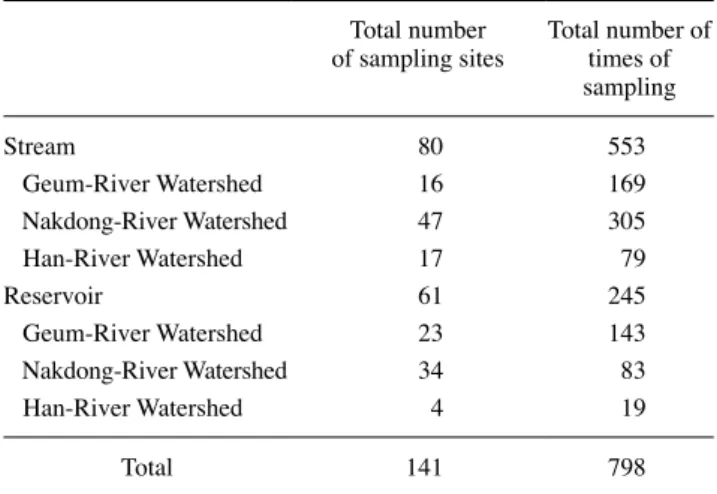
Table 1. Total number of sampling sites in South Korea from 2009 to 2019
Total number
of sampling sites Total number of times of sampling
Stream 80 553
Geum-River Watershed 16 169
Nakdong-River Watershed 47 305
Han-River Watershed 17 79
Reservoir 61 245
Geum-River Watershed 23 143
Nakdong-River Watershed 34 83
Han-River Watershed 4 19
Total 141 798
Acheilognathus lanceolata Carassius auratus Erythroculter erythropterus Hemibarbus labeo
Hemiculter eigenmanni Pseudogobio esocinus Squalidus chankaensis Zacco platypus
Opsariichthys uncirostris Lepomis macrochirus
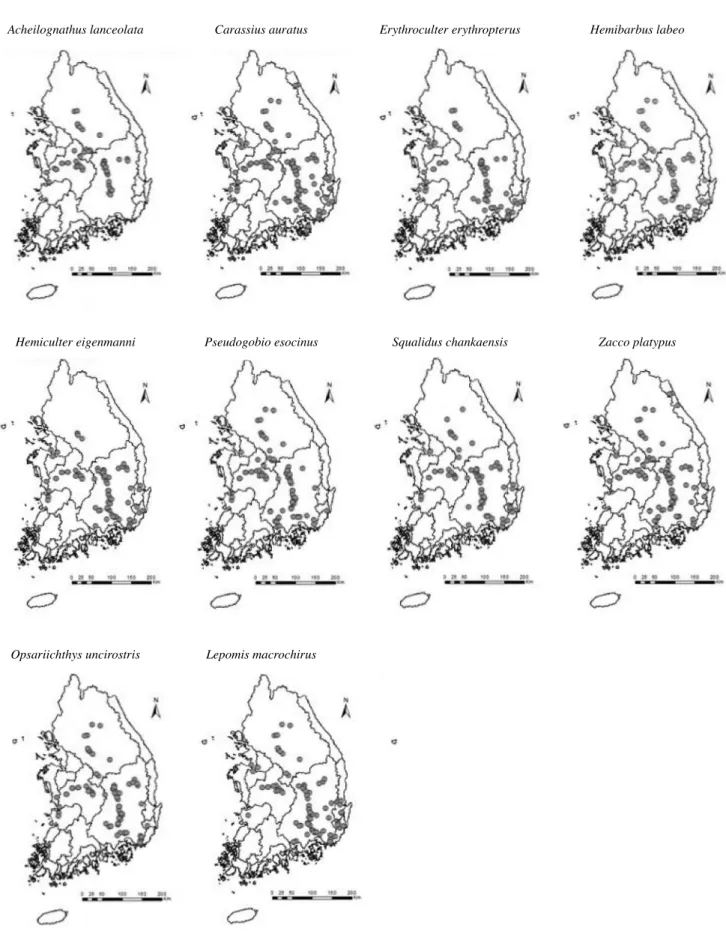
Fig. 1. Map showing the sampling sites for each species in South Korea from 2009 to 2019.
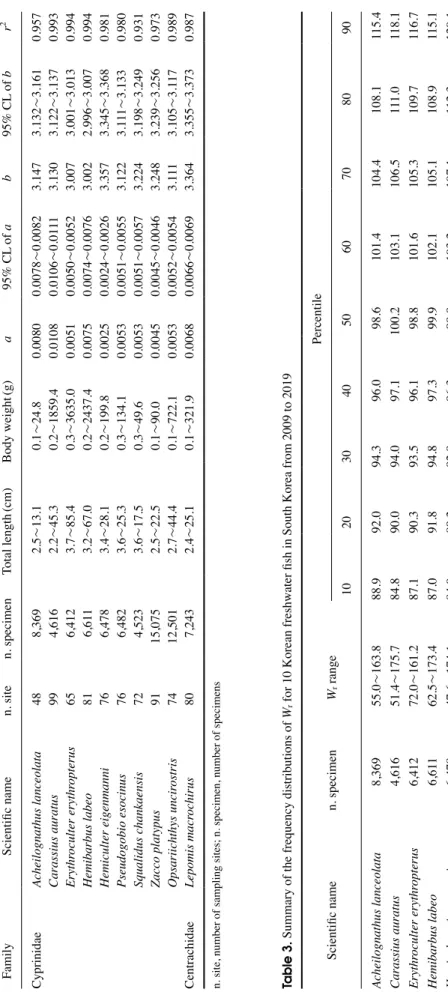
Table 2. Descriptive statistics and estimated parameters of the length-weight relationships in South Korea from 2009 to 2019 Family Scientific namen. siten. specimenTotal length(cm)Body weight(g) a 95% CL of a b95% CL of br2 CyprinidaeAcheilognathus lanceolata488,3692.5~13.10.1~24.80.00800.0078~0.00823.1473.132~3.1610.957 Carassius auratus994,6162.2~45.30.2~1859.40.01080.0106~0.01113.1303.122~3.1370.993 Erythroculter erythropterus656,4123.7~85.40.3~3635.00.00510.0050~0.00523.0073.001~3.0130.994 Hemibarbus labeo816,6113.2~67.00.2~2437.40.00750.0074~0.00763.0022.996~3.0070.994 Hemiculter eigenmanni766,4783.4~28.10.2~199.80.00250.0024~0.00263.3573.345~3.3680.981 Pseudogobio esocinus766,4823.6~25.30.3~134.10.00530.0051~0.00553.1223.111~3.1330.980 Squalidus chankaensis724,5233.6~17.50.3~49.60.00530.0051~0.00573.2243.198~3.2490.931 Zacco platypus9115,0752.5~22.50.1~90.00.00450.0045~0.00463.2483.239~3.2560.973 Opsariichthys uncirostris7412,5012.7~44.40.1~722.10.00530.0052~0.00543.1113.105~3.1170.989 CentrachidaeLepomis macrochirus807,2432.4~25.10.1~321.90.00680.0066~0.00693.3643.355~3.3730.987 n. site, number of sampling sites; n. specimen, number of specimens Table 3. Summary of the frequency distributions of Wr for 10 Korean freshwater fish in South Korea from 2009 to 2019 Scientific namen. specimen Wr rangePercentile 10203040 50 60 70 8090 Acheilognathus lanceolata8,36955.0~163.888.992.094.396.098.6101.4104.4108.1115.4 Carassius auratus4,61651.4~175.784.890.094.097.1100.2103.1106.5111.0118.1 Erythroculter erythropterus6,41272.0~161.287.190.393.596.198.8101.6105.3109.7116.7 Hemibarbus labeo6,61162.5~173.487.091.894.897.399.9102.1105.1108.9115.1 Hemiculter eigenmanni6,47847.6~174.184.089.292.996.399.9103.2107.1112.3120.1 Pseudogobio esocinus6,48273.3~151.286.490.994.097.099.8102.7105.8109.7115.6 Squalidus chankaensis4,52355.1~166.680.386.792.196.4100.6105.4109.6115.1123.0 Zacco platypus15,07543.8~172.482.087.691.795.699.9103.7108.6114.3122.2 Opsariichthys uncirostris12,50164.9~165.085.389.993.396.499.6102.4106.3110.7117.5 Lepomis macrochirus7,24355.6~171.582.889.193.396.7100.0103.4107.3112.5121.0 Average84.989.893.496.599.7102.9106.6111.2118.5 Standard deviation2.61.71.00.50.61.21.62.32.9 n. specimen, number of specimens
기준으로 활용될 수 있을 것으로 판단된다.
재료 및 방법
1. 어류 채집 및 계측
어류의 길이-무게 계측을 위한 어류 채집은 2009년 12월부
터 2019년 9월까지 수행되었다. 조사기간 동안 총 141개 지 점을 대상으로 총 798회의 어류 채집이 수행되었다(Table 1, Fig. 1). 한반도를 4대강 권역으로 구분하였을 때, 금강, 낙동 강, 한강 권역에서 조사가 수행되었으며, 서식처 유형별 구분 시 하천 80지점, 호소 61지점에서 조사가 수행되었다. 어류 의 채집은 투망(망목 7mm), 족대(망목 4mm), 삼중자망(6 절 50m; 12절 50m), 정치망(망목 4mm)을 사용하였으며, 채 집 지점의 환경에 따라 적합한 어구를 선별하여 사용하였다. 채집된 어류의 동정은 Kim and Park(2007)을 기준으로 하였 다. 어류의 길이와 무게의 계측은 채집 직후 현장에서 수행 되었으며 채집된 모든 어류를 대상으로 하였다. 길이는 전장 (total length, mm)을, 무게는 전자 저울(MW II-6000N, CAS) 을 사용하여 습중량(wet weight, 0.1g)을 측정하였다. 채집 된 모든 어류는 계측 이전에 0.1gL-1 ethyl 3-aminobenzoate methanesulfonate salt(Sigma-Aldrich, Munich, Germany) 로 마취하였으며, 계측이 끝난 후 회복실(recovery tank, 100×100×80cm)로 옮겨 충분한 회복 후 현장에 방류하였다.
2. 데이터 분석
총 798회의 현장조사를 통해 확보된 160종 어류의 길이-무 게 데이터 중, 샘플 수가 많은 순서로 상위 10종을 선별하였 다. 선별된 10종은 각 종별로 구분하여 Keys(1928)의 방법에 Zacco platypus
Opsariichthys uncirostris Acheilognathus lanceolata Lepomis macrochirus Hemibarbus labeo Pseudogobio esocinus Hemiculter eigenmanni Erythroculter erythropterus Carassius auratus Squalidus chankaensis Acheilognathus yamatsutae Squalidus japonicus Micropterus salmoides Squaliobarbus curriculus etc.
0 10000 20000 30000 40000 Number of specimen
Fig. 2. Number of specimen for each species in South Korea from 2009 to 2019.
Standard weight(g)
Total length(cm)
Total length(cm)
Total length(cm)
Total length(cm)
Total length(cm)
Total length(cm)
Total length(cm)
Total length(cm)
Total length(cm)
Total length(cm)
Standard weight(g) Standard weight(g) Standard weight(g)
Standard weight(g) Standard weight(g) Standard weight(g) Standard weight(g)
Standard weight(g) Standard weight(g)
Acheilognathus lanceolata Ws=0.0080L3.147
Hemiculter eigenmanni Ws=0.0025L3.357
Opsariichthys uncirostris Ws=0.0053L3.111
Carassius auratus Ws=0.0108L3.130
Pseudogobio esocinus Ws=0.0053L3.122
Lepomis macrochirus Ws=0.0068L3.364
Erythroculter erythropterus Ws=0.0051L3.007
Squalidus chankaensis Ws=0.0053L3.224
Hemibarbus labeo Ws=0.0075L3.002
Zacco platypus Ws=0.0045L3.248
Fig. 3. Standard LWRs for estimating standard weight of 10 Korean freshwater fish species in South Korea from 2009 to 2019(Ws, Standard weight; L, Total length).
따라 회귀 분석을 통해 LWRs를 산출하였다(Eqn 1). LWRs 회 귀분석에 앞서 길이-무게 데이터는 로그를 취하여 선형 회귀 분석을 통해 이상치(Outlier)를 제거하였다(Froese, 2006).
W=aLb (Eqn 1)
(W, weight in gram; L, length in cm; a and b, parameters) 위 방법으로 확보한 각 종별 LWRs 방정식을 통해 산출되는 무게를 해당 종의 표준 무게로 정의하고, 이상치(Outlier)가 제 거된 각 종별 길이-무게 데이터를 대상으로 상대 무게 지수를 산출하였다(Eqn 2). 이어서, 각 종별로 산출된 상대 무게 지수 의 빈도 분포(frequency distribution)를 분석하였다. 빈도 분포 분석은 10~90 백분위수(percentile)를 10단위로 구분하여 산 출하였다.
W
Wr=100--- (Eqn 2)
Ws
( Wr, Relative weight index; Ws, Standard weight; W, observed weight)
모든 종의 학명(scientific name) 및 과명(family name)은 2019 국가생물종목록(NIBR, 2020)을 기준으로 하였으며, 종 의 배열 순서는 Nelson(2006)의 분류체계를 따랐다.
결 과
조사기간 동안 확보한 어류의 길이-무게 자료는 총 130,479 개였으며, 이 중 가장 샘플수가 많은 10종은 피라미(Zacco platypus), 끄리(Opsariichthys uncirostris), 납자루(Acheil- ognathus lanceolata), 블루길(Lepomis macrochirus), 누치 (Hemibarbus labeo), 모래무지(Pseudogobio esocinus), 치리 (Hemiculter eigenmanni), 강준치(Erythroculter erythropterus), 붕어(Carassius auratus), 참몰개(Squalidus chankaensis)였다 (Fig. 2).
선정된 10종에 대한 표준 LWRs 산출 결과 Table 2와 Fig. 3 에 요약하였다. 채집 지점 수와 샘플 수는 각 종별로 제시하였 으며, 지점수는 최소 48지점, 샘플수는 최소 4,523개체였다. 각 종별 전장과 무게 범위 또한 제시하였으며, LWRs의 매개변수 인 a와 b값은 각각의 95% 신뢰 한계(95% confidence limits, 95% CL)와 함께 제시하였다. LWRs 회귀분석에 대한 결정계 수(Correlation of determination, r2)는 모두 0.9 이상으로 나타 났으며, 매개변수 b는 10종 모두 Froese(2006)의 예상 범위인 2.5~3.5 내에 포함되었다.
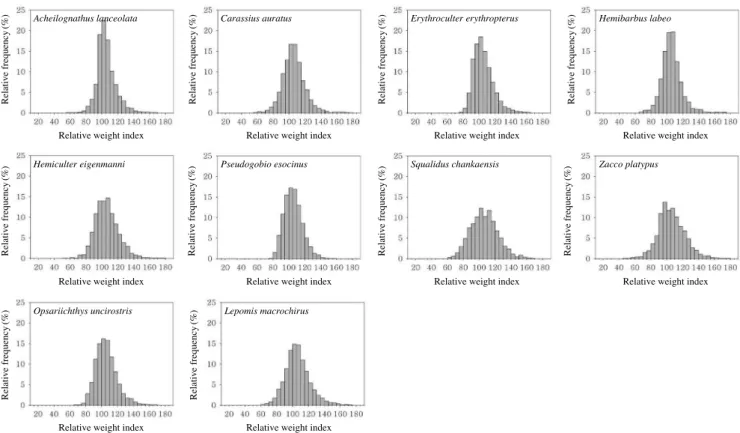
상대 무게 지수 산출 결과 및 빈도 분포 분석 결과는 Table 3과 Fig. 4와 같다. 각 종별 상대 무게 지수의 최소값과 최대값 을 범위로 제시하였으며, 10~90 백분위수를 10단위로 구분하
Relative weight index
Relative weight index
Relative weight index
Relative weight index
Relative weight index
Relative weight index
Relative weight index
Relative weight index
Relative weight index
Relative weight index
Relative frequency(%)Relative frequency(%) Relative frequency(%) Relative frequency(%) Relative frequency(%)
Relative frequency(%) Relative frequency(%)Relative frequency(%) Relative frequency(%) Relative frequency(%)Acheilognathus lanceolata
Hemiculter eigenmanni
Opsariichthys uncirostris
Carassius auratus
Pseudogobio esocinus
Lepomis macrochirus
Erythroculter erythropterus
Squalidus chankaensis
Hemibarbus labeo
Zacco platypus
Fig. 4. Relative frequency distribution of relative weight index of 10 Korean freshwater fish species in South Korea from 2009 to 2019.
여 제시하였다. 각 백분위수에 대한 종별 표준편차는 3.0 이내 로 나타났으며, 50 백분위수를 기준으로 양 극단에 가까울수 록 표준편차가 커지는 경향을 보였다. 80 백분위수에 대한 종 별 평균은 111.2±2.3로 확인되어 표준 무게보다 약 11.2% 이 상 무거운 개체들이 상위 20% 구간에 포함되는 것 나타났다.
20 백분위수에 대한 종별 평균은 89.8±1.7로 나타나, 표준 무 게와 비교하여 약 10.2% 이상 가벼운 개체들이 하위 20%에 포함되는 것으로 나타났다. 10 백분위수와 90 백분위수의 종 별 평균은 각각 84.9±2.6, 118.8±2.9로 나타났으며, 표준 무 게와 비교하여 약 15% 이상의 무게 차이를 보이는 개체들은 양 극단의 10%에 포함되는 것으로 나타났다.
고 찰
LWRs 산출 결과 10종 모두 매개변수 b값이 3보다 크게 나 타났다. 이는 어류가 양의 상대성장을 한다고 해석할 수도 있 겠지만(Froese, 2006), 본 연구에 포함된 10종 모두 길이 성장 에 따른 체형 변화는 보고된 바 없다. 따라서 이들이 성장함에 따라 체고(body height) 혹은 체폭(body width)의 성장 비율이 높아진다고 해석하기 보다는, 단순히 큰 개체가 더 비대해 지 는 경향이 있다고 해석하는 것이 타당할 것으로 판단된다. 본 연구에서는 특히 블루길(3.364)과 치리(3.357)의 b값이 높게 나타났으며, 누치(3.002)와 강준치(3.007)가 가장 3에 근접하 게 나타났다. 이러한 종별 차이는 어류의 생리학적 특성들과 연관이 있을 것으로 판단되나, 이와 관련된 연구가 매우 부족 한 실정이다.
현재까지 국내에서는 어류의 영양상태를 평가하기 위해 Keys(1928)가 제안한 길이-무게 상관관계와 Fulton(1904) 의 비대지수를 활용하고 있다(Han et al., 2007; Seo and Kim, 2009; Ko et al., 2012; Lee et al., 2013). 따라서 결과에 대한 해 석이 매우 제한적으로 이루어지고 있으며, 이는 국내에서 어 류의 영양상태를 평가하기 위한 연구가 매우 부족하기 때문이 다. 본 연구에서는 상대 무게 지수의 다양한 백분위수를 제시 하였다. 이는 향후 상대 무게 지수를 정량적으로 해석하기 위 한 기준으로 활용 가능할 것으로 판단된다.
미국에서는 상대 무게 지수를 활용하기 위해 표준 무게 산 출방법에 대한 연구들이 다수 수행되었다. 이는 기존에 제 안된 방법들로 산출되는 표준 무게의 대표성 문제가 제기 되고, 이를 지속적으로 개선해 나가는 일련의 과정이었다 (Carlander, 1977; Wege and Anderson, 1978; Murphy et al., 1990; Brown and Murphy, 1996; Gerow et al., 2005). 본 연구 에서 제시하는 표준 LWRs는 국내에서 처음으로 제안되는 것 이며, 실제 현장에서 적용된 사례가 없다. 따라서 해당 LWRs 의 대표성에 대한 검증이 이루어지지 않았으며, 이는 향후 연
구를 통해 반드시 보완되어야 한다. 어류의 무게는 시기와 지 역에 따라 달라질 수 있다(Le Cren, 1951). 서식처 유형, 수계, 하천의 규모에 따라 어류의 무게가 경향성을 가질 가능성이 있으며, 이러한 경향성을 반영하는 표준 무게 산출 방법에 대 한 추가 연구가 수행된다면, 국내 서식 어류의 표준 무게 대표 성 개선에 큰 도움이 될 것으로 판단된다.
요 약
상대 무게 지수(Relative weight index, Wr)는 어류의 표준 무게와 실측 무게의 비율을 산출하는 지수로써 영양상태를 평 가하는데 활용된다. 본 연구의 목적은 상대 무게 지수 활용을 위해 국내 담수어류 10종의 표준 무게 산출을 위한 길이-무게 상관관계(표준 LWRs)를 산출하는 것과, 상대 무게 지수 산출 결과에 대한 빈도 분포를 분석하는 것이다. 총 141개 조사 지 점에서 798회 어류 채집을 통해 확보한 어류의 길이-무게 데 이터를 활용하여 LWRs를 산출하였다. LWRs는 매개변수 a와 b값을 95% 신뢰한계(confidence limits)와 함께 제시하였으며, 모든 종에서 결정계수(r2)는 0.9 이상으로 산출되었고, b값은 Froese(2006)의 예상 범위에 포함되었다. 상대 무게 지수 산 출 결과에 대한 빈도 분포 분석은 각 종별로 10~90 백분위수 를 10 단위로 산출하여 제시하였으며, 이는 상대 무게 지수를 활용하여 어류의 영양상태를 정량적으로 평가하기 위한 기준 으로 활용될 수 있을 것으로 판단된다.
REFERENCES
Baek, S.H., M.H. Jang, J.D. Yoon, J.H. Kim, S.H. Park, J.W. Lee and M.S. Byeon. 2015. Length-weight relationships of 19 freshwater fishes from the Daechung reservoir in South Ko- rea. J. Appl. Ichthyol., 31: 937-938. https://doi.org/10.1111/
jai.12767.
Brown, M.L. and B.R. Murphy. 1996. M+anagement: Briefs selection of a minimum sample size for application of the Regres- sion-line-percentile technique. N. Am. J. Fish. Manage., 16: 427-432. https://doi.org/10.1577/1548-8675(1996)016
<0427:MBSOAM>2.3.CO;2.
Brown, M.L., Jr. F. Jaramillo, D.M. Gatlin III and B.R. Murphy.
1995. A revised standard weight(Ws) equation for channel catfish. J. Freshwater Ecol., 10: 295-302. https://doi.org/10.
1080/02705060.1995.9663448.
Carlander, K.D. 1977. Handbook of freshwater fishery biology, Vol.2.
The Iowa State University Press, Ames, U.S.A., 431pp.
Froese, R. 2006. Cube law, condition factor and weight-length re- lationships: history, meta-analysis and recommendations.
J. Appl. Ichthyol., 22: 241-253. https://doi.org/10.1111/
j.1439-0426.2006.00805.x.
Fulton, T.W. 1904. The rate of growth of fishes. Twenty-second an- nual report, 141-241.
Gerow, K.G., R.C. Anderson-Sprecher and W.A. Hubert. 2005. A new method to compute standard-weight equations that reduces length-related bias. N. Am. J. Fish. Manage., 25:
1288-1300. https://doi.org/10.1577/M04-196.1.
Han, S.C., H.Y. Lee, E.W. Seo, J.W. Sim and J.E. Lee. 2007. The influence of muddy water in Imha reservoir on the ichthy- ofauna and fish growth. J. Life Sci., 17: 1104-1110. https://
doi.org/10.5352/JLS.2007.17.8.1104.
Hile, R. 1936. Age and growth of the cisco, Leucichthys artedi(Le Sueur), in the lakes of the northeastern highlands, Wiscon- sin. Bull. U.S. Bureau Fish., 45: 211-317.
Keys, A.B. 1928. The weight-length relation in fishes. Natl. Acad.
Sci. U.S.A., 14: 922.
Kim, D.K., J.S. Gim, J.D. Yoon, Y. Do, G.J. Joo and H. Jo. 2016.
Length-weight relationships of 10 freshwater fishes from the Busan metropolitan city in South Korea. J. Appl. Ich- thyol., 32: 1365-1367. https://doi.org/10.1111/jai.13228.
Kim, I.S. and J.Y. Park. 2007. Freshwater fishes of Korea. Kyo-Hak Publishing Co. Ltd., Seoul, Korea, pp. 52-338.
Kim, J.H., J.D. Yoon, D.H. Won, M.S. Byeon and M.H. Jang. 2015.
Length-weight relationships of 19 fish species from the Saemangeum reservoir in South Korea. J. Appl. Ichthyol., 31: 951-953. https://doi.org/10.1111/jai.12825.
Ko, D.G., J.H. Han and K.G. An. 2012. Length-weight relations and condition factor(K) of Zacco platypus along trophic gradi- ents in reservoir ecosystems. Korean J. Limnol., 45: 174- 189.
Le Cren, E.D. 1951. The length-weight relationship and seasonal cycle in gonad weight and condition in the perch(Perca fluviatilis). J. Anim. Ecol., 20: 201-219. https://doi.org/
10.2307/1540.
Lee, J.W., J.D. Yoon, J.H. Kim, S.H. Park, S.H. Baek, J.J. Yu, M.H.
Jang and J.I. Min. 2015. Length-weight relationships for 18 freshwater fish species from the Nakdong river in South Korea. J. Appl. Ichthyol., 31: 576-577. https://doi.org/
10.1111/jai.12757.
Lee, S.R., S.K. Park and H.S. Joo. 2013. Length-weight relationship for Zacco koreanus in the national park of Korea-A case
of Sobaeksan, Songnisan and Gayasan. Korean J. Environ.
Biol., 31: 173-179.
Murphy, B.R., D.W. Willis and T.A. Springer. 1991. The relative weight index in fisheries management: status and needs.
Fisheries, 16: 30-38. https://doi.org/10.1577/1548-8446 (1991)016<0030:TRWIIF>2.0.CO;2.
Murphy, B.R., M.L. Brown and T.A. Springer. 1990. Evaluation of the relative weight(Wr) index, with new applications to walleye. N. Am. J. Fish. Manag., 10: 85-97. https://doi.
org/10.1577/1548-8675(1990)010<0085:EOTRWW>2.3.
CO;2.
NIBR(National Institute of Biological Resources). 2020. National list of species of Korea(2019). Retrieved from http://kbr.go.kr.
Nelson, J.S. 2006. Fishes of the world. 4th ed. John Wiley & Sons Inc., New Jersey, U.S.A., pp. 15-467.
Park, S.H., J.D. Yoon, J.H. Kim, J.W. Lee, S.H. Baek and M.H.
Jang. 2016. Length-weight relationships of fifteen endemic freshwater fishes in South Korea. J. Appl. Ichthyol., 32:
158-159. https://doi.org/10.1111/jai.12943.
Seo, J.W. and H.S. Kim. 2009. A study of fish community on up and downstream of Hwabuk Dam under construction in the upper Wie stream. Korean J. Ecol. Environ., 42: 260-269.
Tesch, F.W. 1968. Age and growth. In: Ricker, W.E.(ed.), Methods for assessment of fish production in fresh waters. Blackwell Scientific Publications, Oxford, U.K., pp. 93-123.
Wege, G.J. and R.O. Anderson. 1978. Relative weight(Wr): a new index of condition for largemouth bass. In: Novinger, G.
and J. Dillard(eds.), New approaches to the management of small impoundments. Amer. Fisheries Soc. Spec. Publ., 5:
79-91.
Yoon, H.S. and S.D. Choi. 2010. Length-weight relationships for 19 fish species in Sargassum beds of Gamak bay, Korea. Kore- an J. Fish. Aquat. Sci., 13: 254-256.
Yoon, H.S., Y.K. An, J.H. Hwang, H.S. Lim, W.K. Lee, K.H. Han, S.H. Lee and S.D. Choi. 2013. Length-weight relationships for 14 fish species of the Suer River estuary in southern Ko- rea. J. Appl. Ichthyol., 29: 468-469. https://doi.org/10.1111/
jai.12097.
Yoon, J.D., J.H. Kim, S.H. Baek, M.S. Byeon and M.H. Jang. 2014.
Length-weight relationships of eight cyprinid fishes from the Geum River in South Korea. J. Appl. Ichthyol., 30: 560- 561. https://doi.org/10.1111/jai.12386.