Copyright ⓒ 2014, The Microbiological Society of Korea
Establishment of a Selection System for the Site-Specific Incorporation of Unnatural Amino Acids into Protein
Dawood Salim Edan
1,2, Inkyung Choi
1, and Jungchan Park
1,2*
1
Department of Bioscience and Biotechnology, Hankuk University of Foreign Studies, Yongin 449-791, Republic of Korea
2
Protein Research Center for Bio-Industry, Hankuk University of Foreign Studies, Yongin 449-791, Republic of Korea
비천연 아미노산의 위치특이적 단백질 삽입을 위한 Amino Acyl-tRNA Synthetase 선별시스템 개발
다우드 살림 이단1,2․최인경1․박중찬1,2
*
1한국외국어대학교 생명공학과, 2한국외국어대학교 산업용단백질연구센터
(Received March 11, 2014 / Accepted March 19, 2014)
Site-specific incorporation of unnatural amino acids (SSIUA) into protein can be achieved in vivo by coexpression of an orthogonal pair of suppressor tRNA and engineered aminoacyl-tRNA synthetase (ARS) that specifically ligates an unnatural amino acid to the suppressor tRNA. As a step to develop the SSIUA technique in Escherichia coli, here we established a new 2-step screening system that can be used for selecting an ARS variant(s) that ligates an unnatural amino acid to a suppressor tRNA. A positive selection system consists of chloramphenicol acetyl transferase gene containing an amber mutation at the 27
thresidue, and efficiently concentrated amber suppressible ARS with a maximum enrichment factor of 9.0 × 10
5. On the other hand, a negative selection system was constructed by adding multiple amber codons in front of a lethal gene encoding the control of cell death B toxin (ccdB) which acts as an inhibitory protein of bacterial topoisomerase II. Amber suppression of ccdB by an orthogonal pair of Saccharomyces cerevisiae tyrosyl-tRNA synthetase (TyrRS) and an amber suppressor tRNA significantly inhibits bacterial growth. This selection system was also able to efficiently remove amber suppressible ARS which could ligate natural amino acids to the suppressor tRNA. Thus, sequential combination of these two selection systems might be able to function as a powerful tool for selecting an ARS variant that specifically ligates an unnatural amino acid to the suppressor tRNA from an ARS mutant pool.
Keywords: control of cell death B (ccdB), selection system, unnatural amino acid incorporation
*For correspondence. E-mail: [email protected]; Tel.: +82-31-330- 4355; Fax: +82-31-330-4566
Site-specific incorporation of unnatural amino acids (SSIUA) that are different from the 20 canonical amino acids into proteins is a promising method to generate novel proteins with expanded biological, chemical, or physical properties. As a possible strategy to achieve in vivo SSIUA, an orthogonal pair of suppressor tRNA and engineered aminoacyl-tRNA synthetase (ARS), which ligates an unnatural amino acid to the suppressor tRNA, has been used in diverse organisms (Pastrnak et al., 2000; Kowal et al., 2001; Wang
et al., 2001). The orthogonal suppressor tRNA should not be
aminoacylated by any of the host endogenous ARS. Similarly, the orthogonal synthetase also should not aminoacylate any of the host endogenous tRNA, but efficiently charges the orthogonal suppressortRNA. Several known orthogonal ARS and tRNA pairs functioning in E. coli include the Methanococcus janaschii TyrRS/tRNATyr
CUA pair (Wang et al., 2001), Saccharomyces cerevisiae TyrRS and a variant of E. coli initiator tRNA tRNA2fMet
(fMam tRNACUA) pair (Lee and RajBhandary, 1991; Kowal et al., 2001), and S. cerevisiae PheRS/ tRNAPhe CUA pair (Furter, 1998).
To alter the amino acid specificity of the orthogonal ARS so that it charges the orthogonal suppressor tRNA with a desired unnatural amino acid, a library of ARS mutants must be generated and screened (Wang et al., 2001, 2002, 2003; Chin et
al., 2002; Santoro et al., 2002). A general in vivo selection
strategy was developed that is based on the combination of a β -lactamase-based positive selection followed by a barnase-base negative selection (Liu and Schultz, 1999). In the positive selection, suppression of the amber codon introduced atnonessential position(s) of the β-lactamase gene will allow cells to survive under positive selection pressure. In the presence of both natural and unnatural amino acids, survivors thus encode active synthetase charging the orthogonal suppressor tRNA with either a natural or an unnatural amino acid. In the negative selection, those synthetases with specificities for natural amino acids charge the orthogonal tRNA with a natural amino acid, resulting in suppression of an amber codon in the negative marker, barnase gene, and cell death. Since no unnatural amino acid is added to the medium, synthetases with specificities only for the unnatural amino acids will survive. Survivors passing both selection processes therefore must encode synthetases charging the orthogonal tRNA with an unnatural amino acid (Wang et al., 2001; Chin et al., 2002).
Although previously reported positive and negative selection systems have shown successful selection of genetically modified ARSs charging unnatural amino acids onto suppressor tRNAs from a mutant ARS library (Wang et al., 2001, 2002, 2003; Chin et al., 2002), amber codons introduced at the inside of a negative selection marker gene might have a possibility to cause false negative results due to loss of function by incorporation of amino acids different from the original residue. In addition, β-lactamase used as the positive selection marker (Liu and Schultz, 1999) is known to be secreted into medium where it can hydrolyse all the ampicillin, thereby which can cause survival of false positive cells.
For the purpose of reducing these possibilities, we have established a new 2-step selection system consisting of a chloramphenicol acetyltransferase (CAT)-based positive selection and a CcdB-based negative selection. The positive selection construct containing an amber codon at the 27th residue of CAT gene was previously generated for amber suppression screening (Chow and RajBhandary, 1993). On the other hand, the negative selection construct was newly generated by adding multiple amber codons in front of N-terminal coding sequence of the control of cell death B toxin (ccdB), of which product can be lethal to E. coli by inhibiting DNA-gyrase (topoisomerase II) function (Bernard and Couturier, 1992; Bernard et al., 1993).
Coexpression of Sc TyrRS and amber suppressor fMam tRNA suppressed the amber codons and significantly inhibited bacterial growth. In combination with the positive selection, the newly generated negative selection construct may be able to effectively select an ARS variant that ligates an unnatural amino acid to the suppressor tRNA from an ARS mutant pool.
Materials and Methods E. coli
strains, culture media, and plasmidsE. coli strain TOP10 [F
- mcrA Δ(mrr-hsdRMS-mcrBC) Φ80lacZΔM15 Δ lacX74 deoR recA1 araD139 Δ(ara-leu)7697
galU galK rpsL (Str
R) endA1 nupG] (Invitrogen) was used in this study. LB and GMML media supplemented with antibiotics (100 μg/ml ampicillin and 20 μg/ml tetracyclin) and 0.2% arabinose (Sigma), if necessary, were used for bacterial culture. For positive selection assay, GMML medium was used.Concentrated M9 salt solution (5X) was prepared by dissolving 30 g Na2HPO4, 15 g KH2PO4, 2.5 g NaCl, 5 g NH4Cl in 1 L deionized water solution. GMML medium was prepared by adding 2 mM MgSO4, 0.1 mM CaCl2, 0.4% glucose, 1%
glycerol, 0.3 mM Leu to 1X M9 salt solution.
Sc TyrRS expression vector pKK-TyrRS (pKK-TyrRS*9)
and its empty vector pKK223-3 (Amersham) were described previously (Kowal et al., 2001). The pACamG encodes a CAT gene containing an amber mutation at the 27th residue and a suppressor tRNA derived from mutant E. coli initiator tRNA gene trnfMT2:A71/T35A36/G72 (fMam tRNACUA) (Chow and RajBhandary, 1993).Test for positive selection
To test chloramphenicol resistance by amber suppression of CAT amber gene, pACamG was cotransformed into TOP10 with either pKK223-3 or pKK-TyrRS by electroporation at 1.8 kV. Positive transformants were grown overnight in LB broth containing antibiotics ampicillin and tetracycline. After harvested by centrifugation, cells were resuspended in GMML medium and inoculated at 1/100 dilution into fresh GMML medium supplemented with 20 μg/ml tetracycline, 100 μg/ml ampicillin, and different concentrations of chloramphenicol from 0 to 200 μg/ml. After 72 h culture at 37℃, bacterial growth was estimated by measuring optical densities at 600 nm.
To test selection efficiency of the positive selection plasmid pACamG, electro-competent TOP10 cells harboring pACamG were prepared and transformed with the same amount of plasmid DNA (1 μg) from mixtures of pKK223.3 and pKK-TyrRS plasmids at a series of different ratios. After cell recovery, transformants were washed once with 500 µl of GMML medium and cultured in fresh GMML medium until saturation (usually 24–48 h). Plasmid DNA was harvested from cultures by using standard methods (QIAGEN Plasmid Extraction kit) and analysed for the presence of TyrRS gene by restriction digestions with PstІ and XmnІ. DNA band intensity was measured by a densitometry program of a gel documentation system.
Construction of a negative selection plasmid pAccdBam To generate an in vivo negative selection system, DNA fragment encoding CcdB (B subunit of control of cell death) and upstream linker region in pZero-2 (Invitorgen) was
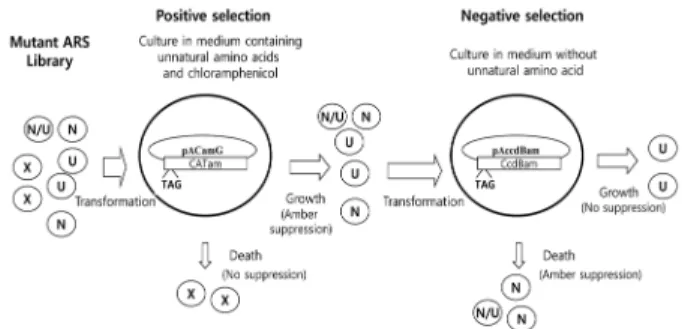
Fig. 1. A general selection process to isolate a mutant ARS(s) that ligates an unnatural amino acid to an orthogonal suppressor tRNA.
Abbreviations: N, ARS that charges natural amino acid; U, ARS that charges unnatural amino acid; N/U, ARS that charges both natural and unnatural amino acid; X, nonfunctional ARS.
amplified with primers containing single or double amber codon(s) in front of ccdB gene by PCR and cloned into pBAD/Myc-His A (Invitrogen) with XhoI and KpnI sites. The primer sequences used for this PCR are as follows: ccdBam-1, 5′-CACGCTCGAGAAGCCTATAGGTACGGCAGTTTAAG- 3′; ccdBam-2, 5′-CACGCTCGAGATAGCTATAGGTACGGC AGTTTAAG-3′; ccdB-R 5′-GGAGGTACCTCATTATATTCC CCAGAACATCAGG-3′. The positive clones were used as templates in order to amplify the DNA fragment encoding
araC-araBADpromoter-ccdBamber-rrnB with primers PNF
and PNR, of which sequences are 5′-CATCCCGGGAGCTGC ATGTGTCAGAGG-3′ and 5′-ATCGTCATGAACTAGTGGA TTTGTCCTACTCAGGAGAGC-3′, respectively. The amplified fragment was digested with SmaI and BspHI and cloned into pACamG by replacing NcoI/XmnI fragment containing CAT amber gene, thereby generating pAccdBam-1 and -2. The plasmid containing triple amber codons upstream of ccdB coding sequence, pAccdBam-3, was created by site-directed mutation from pAccdBam-2 with primer ccdBam-3, 5′-CCAT GGATCCGAGCTAGAGATAGCTATAGG-3′. Site-directed mutation was performed by using QuikChange Multi site-directed mutagenesis kit (Stratagene). The mutagenesis processes were carried out by the direction of manufacturer’s protocol and selected positive clones were then confirmed by DNA sequencing analysis.Amber suppression of
ccdB
gene and effect of arabinose concentrationTo test whether amber suppression of ccdB inhibits bacterial growth, the three pAccdBam plasmids were cotransformed into TOP10 with either pKK223-3 or pKK-TyrRS, and 50 µl of 1/10-diluted transformant was grown on the LB plate containing 30 μg/ml tetracycline, 100 μg/ml ampicillin and with or without 0.2% arabinose. After incubation at 37℃ for 30 h, colony formation was observed. To test the effect of ccdB amber suppression on bacterial growth in a liquid medium, a single clone selected from each plate was grown overnight in LB medium containing appropriate antibiotics without arabinose. The overnight seed culture was inoculated at 1/100 dilution into LB broth media containing the same antibiotics.
Bacterial growth was estimated by measuring an optical density at 600 nm.
To determine the optimal concentration of arabinose for negative selection, Top10 cells harboring pABccdBam3 and either pKK223-3 or pKK-TyrRS were inoculated at a cell density of approximately 6 × 10⁶ cells/ml into LB media containing 100 μg/ml of ampicillin and 30 μg/ml of tetracycline. After arabinose was added at concentrations ranging from 0.005% to 1%, cultures were grown at 30℃ for
12 h. Bacterial growth was determined by measuring optical density at 600 nm.
Negative selection efficiency by
ccdB
amber suppression Electro-competent TOP10 cells harboring pAccdBam-3 were prepared and transformed with the same amount of plasmid DNA (1 μg) from mixtures of pKK223-3 and pKK-TyrRS plasmids at a series of different ratios. The transformants were grown in LB media containing 30 μg/ml tetracycline, 100 μg/ml ampicillin, and 0.5% arabinose.Plasmid DNA was isolated from saturated cultures by using standard methods (QIAGEN Plasmid extraction kit) and analysed by restriction digestion with PstІ and XmnІ as described previously.
Results and Discussion
A general selection process for mutant ARSs that charge unnatural amino acids to a suppressor tRNA
In this study, we established a new general selection method for genetically modified ARSs that ligate unnatural amino acids to an orthogonal tRNA. This selection method consists of the combination of a positive selection and followed by a negative selection (Fig. 1). The positive selection conferred by suppression of CAT amber mutation was carried out in the medium containing both natural and unnatural amino acids and yields ARS variants that charge either a natural or unnatural amino acid or both. Those ARS variants pass through the negative selection process which is conferred by amber suppression of a lethal toxin gene ccdB. Since the negative selection is performed in the absence of unnatural amino acids, ARS variants that charge natural amino acids will be dead due to the expression of CcdB protein and synthetases with specificities only for the unnatural amino acids will survive.
Survivors passing both selection processes therefore must
Fig. 2. Chloramphenicol resistance of the positive selection. Growth inhibition of E. coli transformed with pACamG and pKK-TyrRS or empty vector was tested in GMML medium containing of increasing amounts of chloramphenicol as indicated.
Chloramphenicol (μg/ml)
Starting ratio of pKK-TyrRS/
pKK223-2
Ending ratio of pKK-TyrRS/
pKK223-2
Enrichment factor 20
20 20 20 20 40 40 40 40 40
1:10 1:10
21:10
31:10
41:10
61:10 1:10
21:10
31:10
41:10
61.7:1 2:1 1.7:1 1.6:1 0.7:1 2:1 3:1 2.5:1 2.9:1 1.1:1
17 200 1,700 160,000 7.1 × 10
520 300 2,500 290,000 9 × 10
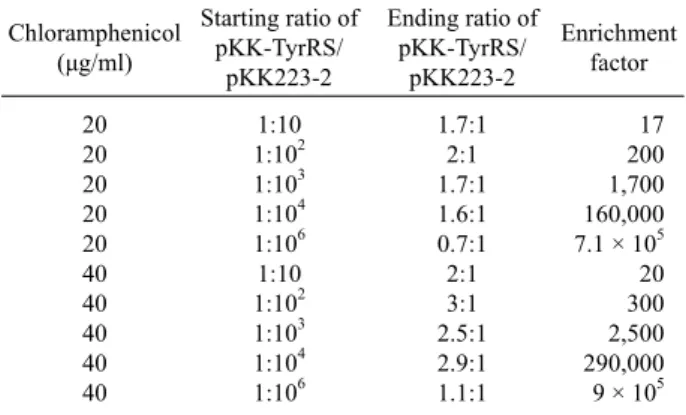
5Table 1. Enrichment of amber suppressive plasmids (functional TyrRS) by Positive selection
encode synthetases charging an unnatural amino acid to the orthogonal tRNA.
Positive selection: chloramphenicol resistance by CAT amber suppression and positive selection efficiency
To test the strength of CAT amber suppression activity by the orthogonal fMam tRNA/Sc TyrRS pair, pACamG was cotransformed into E. coli TOP10 with either pKK-TyrRS or an empty vector pKK223-3. Positive transformants were grown in GMML medium containing increasing concentrations of chloramphenicol. Growth was completely inhibited at low concentration of chloramphenicol (20 μg/ml) in cells harboring pACamG or pACamG plus pKK223-3, implying that the orthogonal fMam tRNA itself was not charged by any host-endogenous ARS. However, although there was gradual growth inhibition by chloramphenicol, cells harboring both pACamG and pKK-TyrRS could survive at high concentrations of chloramphenicol, indicating that coexpression of the orthogonal fMam tRNAand Sc TyrRS pair in E. coli resulted in aminoacylation of fMam tRNAand subsequently efficient CAT amber suppression (Fig. 2). Thus, pACamG construct can be used for positive selection at a good range of chloramphenicol concentrations (20–100 μg/ml).
To test efficiency of the positive selection, TOP10 competent cells harboring pACamG were transformed with a series of different combination ratios (1:10, 1:102, 1:10 3, 1:104, and 1:106 ) of two plamids, pKK-TyrRS and pKK223-3, and cultured in GMML medium containing chloramphenicol at concentrations of 20 µg/ml or 40 µg/ml. Upon saturation of the cultures, plasmid DNA was purified and the ratios of pKK-TyrRS to pKK223-3 were determined by restriction digestion and analyzed by gel electrophoresis (Table 1).
Maximum enrichment resulted from media supplemented with 40 µg/ml of chloramphenicol. Under this condition, pKK-TyrRS was enriched by the factor of 9 × 10⁵ (Table 1), which is better enrichment value than the previously described β-lactamase- based positive selection system (Liu and Schultz, 1999). Thus, this positive selection might be an effective method for the selection of functional synthetases from mixed populations of cells harboring functional or nonfunctional ARS expression plasmids. Significantly, the stringency of this positive selection may be tuned by varying the concentration of chloramphenicol added to the growth media.
CAT-based positive selection can provide more stable screening processes than the previously described β -lactamase-based one (Liu and Schultz, 1999). The β-lactamase is well-known to be secreted gradually in the growth medium in which it can destroy ampicillin. Particularly, since the positive selection process is performed in a minimal growth medium containing an unnatural amino acid, bacterial culture time is usually longer than 2–3 days. In this case, the selection condition can be easily deteriorated by secreted β-lactamase and consequently result in growth of false positive cells that do not harbor a desired plasmid. On the other hand, CAT is not secreted to the growth medium and rescue of false positive cells is not possible in CAT-based positive selection.
Generation of the negative selection construct pAccdBam and its growth-inhibitory effects by amber suppression
To establish a negative selection system, ccdB was chosen as an effector gene that will be lethal to bacteria after amber suppression. CcdB proteins has been shown both in vivo and in
vitro to inhibit bacterial DNA-gyrase (topoisomerase II), an
essential enzyme that catalyze the ATP-dependent negative supercoiling of DNA, by blocking its resealing of the double-strand nick in the DNA (Bernard and Couturier 1992;Bernard et al., 1993). Since the stringency of negative selection
(A) (B)
(C) (D)
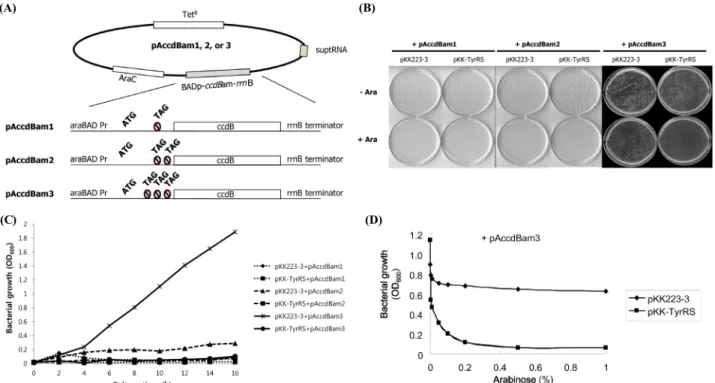
Fig. 3. Establishment of a negative selection system. (A) Diagram of pAccdBam1, 2, and 3 plasmids. Single, double, or triple amber codons were incorporated into upstream of ccdB coding sequence. The amber-mutated ccdB gene is under the control of the araBAD promoter. Thereby, its expression depends on the presence of arabinose in the medium. (B and C) Inhibition of bacterial growth by amber suppression of ccdB. One of the three pAccdBam plasmids was cotransformed to E. coli TOP10 with either pKK-TyrRS or an empty vector, and grown on the LB agar plates (B) and LB broth (C) containing arabinose as indicated. (D) Effect of arabinose concentration on the inhibition of bacterial growth. E. coli TOP10 containing pAccdBam3 and pKK-TyrRS or pKK223-3 was grown for 12 h in LB broth media containing different concentration of arabinose as indicated.
can be modulated by different numbers of amber codons in the effector gene, the ccdB encoding DNA fragment containing single, double, or triple amber codon(s) in front of its coding sequence was cloned into pBAD/Myc-His plasmid as described in ‘Materials and Methods’ and the cloned plasmids were designated as pAccdBam1, pAccdBam2, and pAccdBam3, respectively (Fig. 3A).
To test their possibility to act as a negative selection system, pAccdBam1, -2, and -3 plasmids were cotransformed into TOP10 with either pKK223-3 or pKK-TyrRS. Bacterial growth was tested on LB plate containing proper antibiotics with or without 0.2% arabinose (Fig. 3B). Among the three negative selection constructs, pAccdBam1 and 2 strongly inhibited bacterial growth even without TyrRS expression, implicating that leaky expression of CcdB in those two clones was sufficient for growth inhibition. However, in case of pAccdBam3 containing triple amber codons, cotransformation of pKK223-3 did not affect bacterial growth, whereas pKK-TyrRS cotransformation significantly inhibited bacterial growth on the culture plate containing 0.2% arabinose. The bacterial growth inhibition by TyrRS expression was not observed in the absence of arabinose, indicating that transcription of ccdB gene under the control of araBAD
promoter strictly depended on the inducer arabinose. The same results have been also observed in LB broth media containing 0.2% arabinose (Fig. 3C). The bacteria only harboring pAccdBam3 and pKK223-3 could continuously grow, whereas all other transformants were unable to grow. Taken together, these results indicate that pAccdBam3G is capable of effectively discriminating the amber suppression from none suppressive conditions, and also provide a promising expectation as a negative selection system.
Effect of arabinose concentration on the inhibition of bacterial growth by
ccdB
amber suppression and negative selection efficiencyThe negative selection system is based on the suppression of triple amber codons in front of ccdB coding sequence.
However, since transcription of the ccdB gene is under control of the araBAD promoter (PBAD) and the regulatory protein
araC, arabinose of appropriate concentration is necessary for
expression of CcdB. To optimize the selection condition, E.coli Top10 bearing pAccdBam3 and pKK-TyrRS or pKK223-3
was grown for 12 h in LB media containing different concentration of arabinose (Fig. 3D). Cells doubly transformed with pAccdBam3 and pKK223.3 (control vector) showedStarting ratio of pKK223-3 to
pKK-TyrRS
Ending ratio of pKK223-3 to
pKK-TyrRS
Enrichment factor 1:10
1:10
21:10
31:10
41:10
617:1 16:1 6.4:1 1:1 1:17
170 1,600 6.4 × 10
31.0 × 10
45.8 × 10
4Table 2. Enrichment of non-amber suppressive plasmids by the negative selection
slightly decreased the cell growth. On the other hand, in cells harboring both of pAccdBam3 and pKK-TyrRS, cell growth was dramatically decreased against increase of arabinose concentration, and the inhibitory effect by ccdB amber suppression was almost saturated at 0.2% of arabinose in LB culture medium. These results indicate that arabinose is essential for induction of growth inhibition.
To assess negative selection efficiency of pAccdBam3, pKK223-3, and pKK-TyrRS were mixed in ratios of 1:10, 1:102, 1:103, 1:104, or 1:106, and transformed to TOP10 cells harboring pAccdBam3. After grown in LB broth media containing proper antibiotics and 0.5% arabinose, plasmid DNA was isolated from saturated culture. The ending ratios of pKK223-3 and pKK-TyrRS were determined by restriction digestion and densitometry of gel electrophoresis results (Table 2). Under these conditions, nonfunctional plasmid pKK223-3 was enriched by factors ranging from 170 to 5.8 × 10⁴. As observed in the positive selection, higher level of enrichment was obtained with lower starting ratios of desired to undesired plasmids. These results demonstrate that the CcdB-based negative selection can effectively remove synthetases that ligate natural amino acid to the fMam tRNA and consequently select synthetases that are nonfunctional in the given culture medium where any unnatural amino acid is not included.
The previously reported barnase-based negative selection contains 2 or 3 amber codons in the internal coding sequence.
Although the three positions (Gln-2, Asp-44, and Gly-65) are predicted to be non-essential for the barnase activity based on an analysis of its three-dimensional structure (Liu and Schultz, 1999), it is not proven by any experimental test. On the other hand, the CcdB-based negative selection contains tandem repeated 3 amber codons in front of the ccdB coding sequence.
An analysis of the three-dimensional structure of CcdB reveals that the N-terminal region is not essential for its killer activity (Loris et al., 1999). Therefore, we expect that the CcdB-based negative selection may be more permissive to the incorporation of diverse amino acids than the previously reported barnase- based one.
In conclusion, we generated a new 2-step screening system
for selecting an ARS variant(s) that ligates an unnatural amino acid to a suppress tRNA. The CAT-based positive selection efficiently separated amber suppressible ARS from the mixture of unreactive ARS pool with a maximum enrichment factor of 9.0 × 10⁵. The CcdB-based negative selection was also able to efficiently remove ARS that has specificity to natural amino acids. Thus, by sequential combination of these two selection systems, an ARS variant with specificity to an unnatural amino acid can be efficiently selected from an ARS mutant pool.
적 요
생명체에서 비천연 아미노산을 단백질의 특정 위치에 삽입하 는 방법으로 orthogonal suppressor tRNA와 여기에 비천연 아미노 산을 특이적으로 결합시킬 수 있는 유전자 변형된 aminoacyl-tRNA synthetase (ARS)가 활용되고 있다. 이 기술개발을 위해서는 돌 연변이를 유발한 ARS library로부터 비천연 아미노산만을 특이 적으로 결합시킬 수 있는 변형된 ARS를 탐색하기 위한 선별시 스템이 필요하다. 본 논문에서는 대장균에서 작용하는 2단계로 구성된 새로운 선별시스템을 개발하였다. 먼저 양성선별 시스템 은 27번 잔기를 amber 코돈으로 치환한 Chloramphenicol acetyl transferase 유전자로 구성되어 있으며, 이유전자의 amber suppression 에 의해 chloramphenicol 배지에서 생존함에 따라 활성을 나타 내는 ARS를 최고 9.0 × 10⁵배로 농축할 수 있었다. 반면 음성선 별 시스템은 대장균의 Topoisomerase II의 기능을 억제하는 단 백질을 암호화하는 control of cell death B (ccdB) 유전자의 N- 말단 앞에 3개의 amber 코돈을 삽입하여 제작하였다. 이 음성선 별 시스템을 가진 대장균에 orthogonal pair인 Saccharomyces
cerevisiae tyrosyl-tRNA synthetase (Scc TyrRS)와 amber
suppressor tRNA를 형질전환하면 amber suppression으로 CcdB가 발현되어 대장균의 성장이 억제되는 것을 확인하였으 며, 천연 아미노산에 대한 특이성을 가진 ARS를 효과적으로 제 거하는 것을 관찰하였다. 따라서, 양성선별 및 음성선별 시스템 을 순차적으로 거침으로써 무작위적으로 아미노산에 대한 특이 성을 변형시킨 ARS 라이브러리로부터 비천연 아미노산을 suppressor tRNA에 특이적으로 결합하는 유전자 변형 ARS를 탐색하는데 유용하게 사용될 수 있을 것이다.Acknowledgements
The authors thank Dr. RajBhandary for the gifts of pACamG and pKK-TyrRS. This research was supported by the grant of Gyeonggi Regional Research Center (GRRC) 2013-2014.