355
비천연 아미노산의 단백질 내 도입
†윤 형 돈 영남대학교 생명공학부
(접수 : 2008. 7. 14., 게재승인 : 2008. 10. 15.)
Incorporation of Unnatural Amino Acids into Proteins
Hyungdon YUN†
School of Biotechnology, Youngnam University, Gyeongsan, Gyeongbuk, #712-749, Korea (Received : 2008. 7. 14., Accepted : 2008. 10. 15.)
Proteins carrying unnatural amino acids with novel side chains add a new dimension to studies of protein structure and function. This article provides an overview of the various strategies that have been developed to date for the synthesis of such proteins.
Key Words : unnatural amino acid, genetic code, protein chemistry
서 론
1)
DNA의 위치특이적 (point-specific) 뮤테이션은 지난 25년간 생물학 분야에서 가장 중요한 진보 중 하나이다(1). 단백질 내 에서 특정 아미노산을 다른 19개의 아미노산으로 치환하는 것이 가능해지면서, 단백질의 구조, 안정성, 접힘, 기능 등에 각각의 아미노산이 미치는 영향을 연구할 수 있게 되었다. 하지만 이 방법이 가져다 주는 많은 정보에도 불구하고 이 방법은 단지 자연계에 존재하는 19개의 아미노산으로 치환하는 것만 가능하다 는 단점이 있다. 단백질에 위치특이적으로 비천연 아미노산을 도입하는 것은 위치특이적 뮤테이션에 새로운 장을 열 것이다.
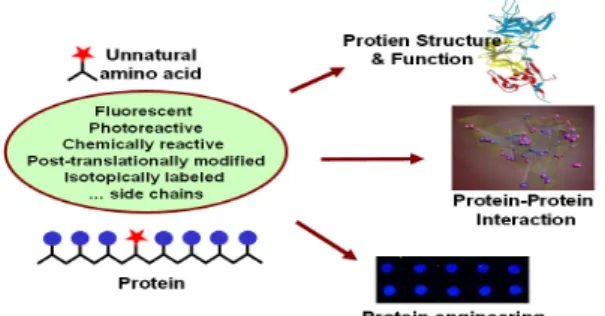
비천연 아미노산은 소수성, 친수성, 또는 다른 사슬 길이의 아미노산, 산 또는 염기성을 갖는 아미노산, 그리고 photoaffinity probe, fluorescent probe, spectroscopic probe, heavy atom label, chemically reactive side chain, phospho-amino acid 등의 아미노 산 유도체를 일 컷 는다(Fig. 1). 새로운 성질을 갖는 새로운 생물재료의 생산을 위한 방법을 제공할 뿐만 아니라, 비천연 아미 노산을 함유한 단백질은 단백질 결정학적 구조분석, spectroscopic 연구 등에 매우 유용할 것이다. 또한 단백질의 기능, 안정성, 접힘, 구조에 관한 연구 등에 유용하게 사용된다. Azido- 또는 keto-같은 화학적으로 반응성이 있는 기능기를 가진 아미노산을 함유한 단백질은 유도체가 가능하여 또 다른 기능을 단백질에 부여할
†Corresponding Author : School of Biotechnology, Yeungnam University, Gyeongsan, Gyeongbuk, # 712-749, Korea
Tel : +82-53-810-3032, Fax : +82-53-810-4769 E-mail : [email protected]
수 있다(2, 3). Photoactivatable한 비천연 아미노산을 함유한 단백질은 단백질-단백질 또는 단백질-membrane 상호작용을 연구 하기 위한 photocrosslinking에 사용될 수 있다(4). 이 연구방법 은 yeast two hybrid system, co-immunoprecipitation, co-affinity 등의 분리의 방법을 보완 또는 대체 할 수 있다(5). 유사하게 형광 (fluorescent) 아미노산을 함유한 단백질은 단백질의 세포내의 위치를 연구하는데 이용될 수 있다. 현재 사용되고 있는 green fluorescent protein fusion 단백질 그리고 직접 또는 간접적인 immunofluorescence의 방법을 대체할 수 있다(6). 특정 위치에 형광 아미노산을 함유하고 있는 단백질은 단백질의 접힘 연구에 사용될 수 있다(7). 부가적으로 서로 다른 형광 아미노산을 한 단백질 내에 도입된 경우 세포 내에서 단백질의 dynamic 또는 단백질의 conformation 연구를 위한 FRET 분석에 사용될 수 있다(8). 이와 같이 실제 응용되었거나 앞으로 응용 가능성이 매우 높은 단백질 내 비천연 아미노산을 도입하는 기술의 현황과 전망을 다루고자 한다.
Figure 1. Application of proteins carrying unnatural amino acids containing novel functional group.
Vol. 23, No. 5, 355-361(2008)
단백질 합성과 비천연 아미노산의 도입
단백질 합성 과정에서 tRNA는 mRNA에 있는 코돈과 코돈에 의해서 특이적으로 정해지는 아미노산 사이의 매게 역할을 한다. 단백질 내로 도입되기로 운명 지어진 아미노산은 먼저 tRNA와 결합하고 다시 aminoacyl-tRNA 형태로 리보솜에 운반 된다. 아미노산에 대한 코돈의 특이성은 각 각의 코돈이 특정 한 tRNA와 특이적인 코돈-안티코돈 상호작용을 한다는 사실 에 기인한다. 그리고 이 특정 tRNA는 단지 코돈에 의해 지정 되는 특정 아미노산 만을 운반할 수 있다. 일반적으로 64개의 코돈 중에서 61개의 코돈은 20개의 천연 아미노산으로 해독 되며, 3개의 종결코돈은 해당 tRNA가 존재하지 않기 때문에 해독되지 않는다. UAG, UAA, 그리고 UGA의 종결 코돈을 해독 할 수 있도록 한 tRNA의 안티코돈 뮤턴트를 각각 amber, ochre, opal suppressor tRNA라 한다(9). tRNA와 아미노산의 결합은 aminoacyl-tRNA synthetase라 불리는 효소에 의해 이루어 진다.
일반적으로 세포 내에는 20개의 서로 다른 aminoacyl-tRNA synthetase가 있으며 각각 20개 천연 아미노산 중 한 개에 특이 성이 있다. 세포 내에서 각각의 aminoacyl-tRNA synthetase는 tRNA와 아미노산에 매우 특이적이다.
비천연 아미노산을 도입하는 방법은 세포 내에 이미 존재 하는 translation system을 이용하는 것이다. 비천연 아미노산 의 단백질 내 도입은 비천연 아미노산으로 aminoacylation된 tRNA를 얻는 방법에 따라서 화학적인 방법, aminoacyl-tRNA synthetase를 이용하는 방법, ribozyme을 이용하는 방법으로 구별할 수 있다. “어떤 코돈-안티코돈 상호작용을 이용하는 가”에 따라 nonsense 코돈 (종결 코돈)을 이용하는 방법, 유기 체 안에서 거의 사용되지 않는 코돈을 이용한 4 또는 5개의 nucleotide 코돈을 이용하는 방법, 생체 내에 존재하지 않는 전혀 새로운 base pair를 만드는 방법, 마지막으로 sense 코돈을 reassign하는 방법으로 나룰 수 있다(10). Translation machinery 에 따라 in vivo translation system과 in vitro translation system 으로 구분할 수 있다(Fig. 2).
Figure 2. Summary of methods for the incorporation of unnatural amino acids into proteins.
비천연 아미노산의 in vitro 단백질 내 도입
위치 특이적으로 비천연 아미노산을 in vitro 단백질 내에 도입할 수 있는 방법은 여러 가지가 알려져 있다. 대표적으 로는 크게 (1) total chemical synthesis, (2) 다른 단백질 또는 펩타이드에 아미노산 유사체를 가지고 있는 합성 펩타이드
단편을 화학적 또는 효소적으로 ligation 시키는 semi-synthesis 그리고 (3) 단백질 내에 있는 cystein을 이용한 위치특이적인 modification 등을 들 수 있다(11-13). 각각의 특정한 경우에 유용성이 있음이 보고 되었음에도 불구하고 이 방법들은 범용 으로 이용되기에는 단백질 크기의 제한 또는 특정 잔기만을 이용할 수 있다는 점 등의 각각의 특정 한계를 가지고 있다(14).
Semisynthetic 접근 방법은 Muir와 그의 공동연구자에 의해 개발된 “Expressed protein ligation” 방법에 의해서 커다란 진전 이 있었다. 이 방법은 비천연 아미노산을 함유하고 있는 합성 펩타이드를 단백질의 splicing 반응을 이용하여 재조합단백질 의 N-말단 또는 C-말단에 연결시키는 방법이다(15-16). 이 접근 방법은 형광물질을 가지고 있는 비천연 아미노산을 단백질의 N-말단 또는 C-말단에 연결하는 연구를 포함한 다양한 연구에 활발이 사용되고 있다.
Figure 3. Strategy for site-specific incorporation of unnatural amino acids into proteins using nonsense suppression.
In vitro 단백질 합성을 통하여 비천연 아미노산을 단백질 내 도입할 수 있는 보다 일반적인 방법은Hecht와 그의 공동연구자 들에 의해 진행된 초기연구를 바탕으로 Schultz, Chamberlin 그리고 공동연구자들에 의해 개발되었다(17-19). 원하는 특정 위치에 amber 종결 코돈이 도입된 mRNA와 원하는 비천연 아미노산으로 aminoacylation된 suppressor tRNA를 이용한 suppression 방법이다(Fig. 3). 비천연 아미노산이 결합된 suppressor tRNA는 pCpA-amino acid dinucleotide의 5’말단과 pCpA 서열 이 없는 suppressor tRNA transcript의 3’말단에 연결하여 만든 다. 이 방법은 단백질 구조, 안정성과 기능, 세포내 소기관으로의 단백질 이동, 단백질-단백질 상호작용에 관한 in vitro 연구에 성공적으로 사용되었다(14, 20-23). in vitro transcription/translation system을 이용하여 목적 비천연 아미노산이 위치특이적으로 도입된 단백질을 생산한다. 이와 유사한 연구로 방사능 동위 원소를 포함하는 천연 아미노산을 aminoacyl-tRNA synthetase를 이용하여 아미노아실레이션된 suppressor tRNA얻고 이를 이용 하여 2H- 그리고 13C-을 포함하는 아미노산을 단백질내 in vitro 도입하고 이를 이용하여 photocycle 동안에 bacterioopsin 내에서 단일 아미노산들의 level이 구조에 미치는 영향에 대한 연구를 수행하였다(24). 이 방법은 특정 코돈이 미생물 내에서 아주 드물게 이용된다는 사실에 기반한 네 개의 nucleotides 로 이루어진 코돈을 이용한 방법으로 발전되기도 하였다(25).
현재 Benner, Chamberlin 그리고 공동연구자들은 새로운 수소
결합 패턴을 갖는 비천연 뉴클레오사이드 염기를 이용한 65번째 코돈-안티코돈 쌍을 통해서 새로운 유전자코드의 확장을 꾀 하고 있다. 이와 같은 방법들은 단백질의 구조 안정성 기능 그리고 단백질의 세포 소기관으로 이동연구 그리고 in vitro 단백질-단백질 상호작용을 위한 연구를 위해서 많은 그룹에 의해서 성공적으로 이용되었다(26). 하지만 이 방법은 in vitro translation system을 이용하기 때문에 in vivo 생합성 된 단백 질과 그 구조가 다를 수 있다는 단점과 비천연 아미노산으로 aminoacylation된 tRNA양의 제한과 in vivo translation system 의 한계로 인하여 비천연 아미노산을 함유하고 있는 단백질의 대량생산이 어렵다는 단점이 있다.
비천연 아미노산의 단백질 내에 in vivo 무작위 도입
Aminoacyl-tRNA synthetase는 해당 천연 아미노산과 비슷 한 구조를 가지고 있는 비천연 아미노산에 반응성이 있다.
예를 들면, 대장균 TryRS 와 5-hydorxytryptophan, ProRS 와 azetidine carboxylic acid, LeuRS와 azaleucine, PheRS와 fluorophenylalanine 등등이 있다(27, 28). 효율적으로 천연 아 미노산을 대신하여, 유사한 구조를 가지는 비천연 아미노산 을 단백질에 도입하기 위해, Cohen 그룹에서는 해당 천연 아 미노산을 생합성 할 수 없는 auxotroph를 이용하였다(14,29).
이 방법은 해당 천연 아미노산을 제거된 배지에 비천연 아미 노산을 넣고, 단백질의 발현을 유도한다. 그 결과로 해당 천 연 아미노산 대신 비천연 아미노산을 포함하는 단백질이 발 현된다(Fig. 4). Tirrell 그룹에서는 이 방법을 더욱 발전시켜 해당하는 aminoacyl-tRNA synthetase가 과발현 된 아미노산 auxotroph을 이용하여 거의 완벽하게 천연 아미노산을 비천연 아미노산으로 치환하는데 성공하였다(30). phenylalanine auxotroph 대장균을 이용하여 beta-galactosidase에 p-fluorophenylalanine 을 성공적으로 도입하였고, methionine auxotroph를 이용하여 같은 효소에 selenomethionine이 도입하였다(29-31). 현재는 이 방법으로 60 개 이상의 비천연 아미노산을 단백질에 도입 가능 함이 보고 되었다(14).
기본적으로 이 방법은 aminoacyl-tRNA synthetase의 기질 특이 성이 허용하는 범위 내에서 이루어 진다. aminoacyl-tRNA synthetase는 단백질 해독과정에서 아주 높은 fidelity를 보장 하기 위해서 두 가지 기능을 수행한다. 첫째는 20개 아미노산 중 해당 아미노산을 구별하여 tRNA에 aminoacylation하는 단계 이고, 둘째는 aminoacylation된 아미노산 중 잘못된 아미노산이 결합했을 경우 proofreading을 통하여 가수분해하는 기능이다.
따라서 aminoacyl-tRNA synthetase의 엄격히 통제되는 기질 특이성을 완화 하려는 연구가 활발히 진행 되고 있다. 예를 들면, 대장균의 phenylalanyl-tRNA synthetase의 Ala294를 Gly로 치환 할 경우 효소의 기질 binding pocket 크기가 증가되어 다양한 비천연 아미노산을 tRNA에 aminoacylation 할 수 있다. 이 효소 를 이용하여 pyridylalanine, p-azido-, p-ethynyl-, p-bromo-, p-iodo- 그리고 p-cyanophenlyalanine이 효과적으로 단백질 내에 도입 되었다(32-34). aminoacyl-tRNA synthetase의 proofreading 기능 을 약화 시키면 효과적으로 단백질에 비천연 아미노산을 도입 할 수 있다. 그 대표적인 예는 대장균의 valyl-tRNA synthetase
(ValRS)이다. ValRS는 해당 tRNA에 cystein과 threonine 또는 aminobutyrate로 misaminoacylation 한다. 이후 proofreading 기 능에 의해서 misaminoacylation된 아미노산을 제거 하는데 이 proofreading 기능이 잘못 된 변이효소를 이용하여 효과적으 로 aminobutyrate를 단백질 내에 도입하였다(35). Tirell 그룹 에서는 이후 Thr252가 Tyr252로 변경된 mutant ValRS를 이 용하여 서로 다른 6종류의 leucine 유사체를 단백질 내에 성 공적으로 도입하였다(36).
이 방법으로 도입된 새로운 기능기는 단백질을 계량할 수 있는 아주 중요한 도구가 되었다. 예를 들면 목적단백질의 phenylalanine을 electroactive한 3-thienylalanine으로 치환 하거나 methionine을 alkene 또는 alkyne 기능기를 가진 유사체로 치환 하였다(37, 38). methionine auxotroph를 이용하여 azidohomoalanine 을 단백질내 도입하고 다시 azido 기능기를 이용하여 Staudinger ligation에 의해서 triarylphophine으로 선택적으로 단백질을 modification 하거나(33), alkyne 기능기에 copper(I)-catalyzed cycloaddition 반응을 통하여 단백질을 modification 할 수 있 었다. 대장균의 PheRS 변이 효소를 이용하여 p-acetylphenylalanine 을 단백질 내 도입하고(39) 이 케톤 기능기를 순차적으로 생리 활성 조건에서 biotin hydrazide를 이용하여, 바이오틴을 단백 질에 conjugation할 수 있었다(40).
다양한 성공에도 불구하고 이 방법은 본질적으론 해당 천연 아미노산과 경쟁하면서 비천연 아미노산을 무작위 적으로 단 백질 내 도입하는 방법이다. 따라서 단백질의 특정 위치에 특정 비천연 아미노산을 도입하는 것에는 적절한 방법은 아 니다. 이 방법은 천연 아미노산의 유사체 만을 도입할 수 있 다는 한계와 결국 완벽하게 비천연 아미노산을 도입한다는 것은 그에 해당되는 천연 아미노산이 단백질 합성에 이용 될 수 없다는 제한이 있다.
Figure 4. Mutltiple substitution of phenylalanine by p-fluoreophenylalanine (p-F-Phe) using a phenylalanine auxotrophic strain (48).
비천연 아미노산의 단백질 내에 in vivo 위치특이적 도입
생물체 내에서 비천연 아미노산을 위치 특이적으로 단백질
내 도입할 수 있는 방법은 비천연 아미노산 mutagenesis의 능력과 scope를 매우 확장한다. 첫째, 다른 방법들과 달리 많은 양의 단백질을 생산할 수 있다. 둘째, 진핵생물을 숙주로 이 용한다면 단백질의 접힘 문제나 post-translational modification 과 관련된 잠재적 문제들이 해결될 수 있다. 세 번째로 in vivo system은 단백질-단백질 상호작용, 단백질 localization, 단백질 dynamic, signal transduction 등의 연구를 가능케 한다(3, 14).
기본적인 원리는 suppression 방법과 원리는 동일하다(Fig. 3).
단, in vitro translation system을대신하여 생체 내에서 (in vivo) 비천연 아미노산이 단백질 내 도입된다는 점이 다르다. 화학 적 방법으로 비천연 아미노산을 suppressor tRNA에 결합시키 는 것이 아니라 aminoacyl-tRNA synthetase에 의해서 비천연 아미노산이 tRNA에 aminoacylation된다. 이를 위해서는 천연 아미노산에는 활성이 없고 오직 비천연 아미노산에만 활성이 있는 aminoacyl-tRNA synthetase의 변이효소가 필요하다. 이를 위해서 전제 조건이 있다(Fig. 5). 첫째, suppressor tRNA 는 세포 내에 존재하는 aminoacyl-tRNA synthetase에 의해 aminoacylation 되지 않아야만 한다. 둘째, 새롭게 도입된 tRNA synthetase는 오직 suppressor tRNA와 반응을 하고 세포 내에 존재하는 tRNA와 반응을 하지 않아야만 한다. 모든 생물에는 20개의 아미노산에 각각 활성이 있는 20개의 aminoacyl-tRNA synthetase가 존재한다. 따라서 새롭게 도입된 aminoacyl-tRNA synthetase와 tRNA 짝을 21번째 synthetase-tRNA 또는 orthogonal tRNA/synthetase 짝이라 한다. 이렇게 확보된 21번째 synthetase와 tRNA짝을 이용하면 단백질 내 위치특이적으로 비천연 아미노산을 도입할 수 있다(41-43).
Figure 5. 21st aminoacyl-tRNA synthetase/suppressor tRNA pairs.
Orthogonal tRNA/synthetase pair를 확보하는 가장 일반적인 방법 은 대장균에 다른 유기체에서 유래된 heterologous tRNA/synthase pair를 발현하는 것이다. 그 중 고세균 유래의 tRAN/synthetase pair가 많이 쓰인다. 고세균의 aminoacyl-tRNA synthetase는 상동성과 tRNA recognition 요소 등이 원핵생물 보다는 진핵 생물에 더욱 유사성을 보이며, 대장균 내에서 발현이 잘 안 되는 진핵생물의 synthetase와 달리 고세균 유래의 synthetase는 대장균 내에서 활성 형태로 발현이 잘 되기 때문이다. 고세균 의 synthetase 유전자의 경우 인트론이 없기 때문에 발현하기 쉽다는 장점도 있다. 이렇게 확보된 tRNA의 엔티코돈을 amber 종결코돈을 인식할 수 있도록 변경된 suppressor tRNA를 제작
하여 원하는 위치에 비천연 아미노산을 도입할 수 있다. 가장 대표적인 예는 Methanococcus jannashi 유래의 tyrosyl-tRNA /synthetase 짝이다 (44-47).
Orthogonal suppressor tRNA/synthetase를 이용하여 비천연 아미노산을 단백질 내에 위치특이적으로 도입하기 위해서는, 돌연변이 그리고 선별을 통해서 천연 아미노산에는 활성이 없고 오직 목적 비천연 아미노산에만 활성이 있는 synthetase의 변이 효소를 확보해야 한다. 여러 성공적인 선별 방법이 Schultz PG 그룹에서 보고 되었다. 그 중 가장 대표적인 방법은 다음 과 같다. synthetase의 active site를 구성하고 아미노산 잔기에 random mutation을 도입하여 mutant library를 만든다. 원하는 변이 효소를 찾기 위해서는 positive 그리고 negative selection 방법이 필요하다. Positive selection 방법은 amber 종결 코돈 을 가지고 있는 chloramphenical acetyltransferase (CAT)의 유 전자를 이용한다. Chloramphenical과 목적 비천연 아미노산이 함유된 고체 배지에 mutant library를 배양할 경우 해당 비천연 또는/그리고 천연 아미노산에 활성이 있는 변이효소는 CAT 유전자의 amber 종결 코돈을 suppression 할 수 있다. 따라서 이 대장균은 chroamphenical을 포함하는 고체 배지 내에서 자랄 수 있다. 천연 아미노산에 활성이 있는 변이효소와 비천연 아미노산에 활성이 있는 변이효소를 구별하기 위한 negative selection 방법이 필요하다. positive selection에서 선별된 균주 를 비천연 아미노산과 항생제를 모두 포함하는 배지와 비천 연아미노산은 없고 항생제만을 포함하는 플레이트의 replica 를 통하여 쉽게 원하는 변이효소를 확보할 수 있다. 비천연 아미노산에만 활성이 있는 synthetase 변이효소를 발현하는 대장균은 오직 비천연 아미노산이 포함 된 배지 내에서 만 자랄 수 있다(45, 47, 48).
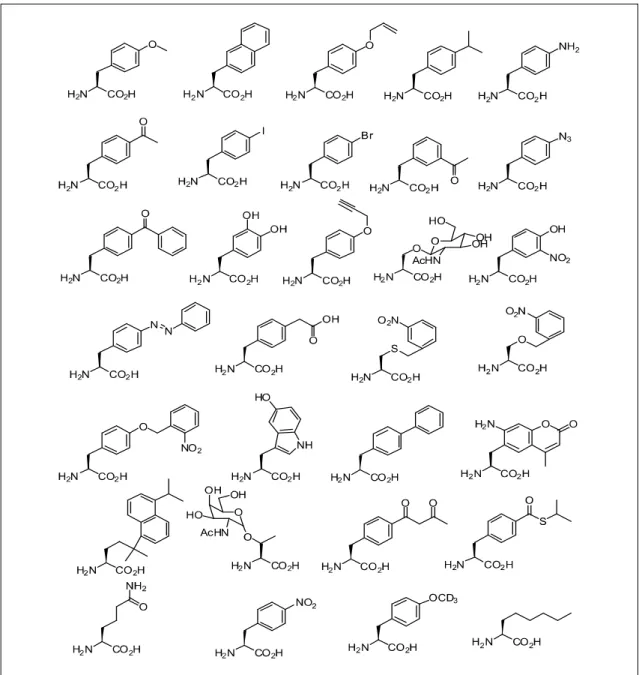
미국의 Scripps Research Institute에 있는 Schultz 그룹은 하나 의 종결코돈을 선택하고 그 코돈에 비천연 아미노산을 도입 하는 suppression 방법을 개발하였으며, Methanococcus jannashi 유래의 tyrosyl-tRNA sysnthetase 뮤턴트를 이용하여 대장균 내에서 아지도 (azido), 케톤, 요오드 등을 포함하는 50여 개 이상의 비천연 아미노산을 단백질 내 성공적으로 도입하였다 (Fig. 6). 이를 이용하여 단백질 구조분석, 단백질-단백질 상호 작용, 효소의 활성증대가 가능함 등을 증명하였다(49-62). 이와 유사한 원리를 이용하여 yeast 내에서 비천연 아미노산을 위치 특이적으로 도입하는 방법이 개발되었으며, yeast 숙주로 positive 그리고 negative 방법으로 선별된 비천연 아미노산에 활성이 있는 suppressor tRNA/mutant synthetase 짝은 동물세포에서도 사용될 수 있음을 보였다(63-65).
보통 위치 특이적 단백질 내에 비천연 아미노산의 도입하는 경우는 한 개의 종결코돈을 이용하여 한 개의 비천연 아미노산 을 도입한다. 이 방법은 이론적으로 종결 코돈 수의 제한으로 인하여, 서로 다른 비천연 아미노산을 최대 세 개까지만 도입 가능하다는 단점이 있다. 진핵생물에서는 nonsense mediated decay에 의해서 종결코돈을 포함하고 있는 mRNA가 분해되기 때문에 이를 극복할 수 있는 방법이 개발되어야 한다. 단백질 해독의 측면에서 보면, 리보솜에 suppressor tRNA와 단백질 해독을 종료시키는 release factor 사이의 경쟁이다. 어떻게 하면 suppression의 효율성을 높일 것인가에 대한 연구가 더욱 진행 되어야 한다.
Figure 6. Some sturucture of unnatural amino acids that have been added to the genetic code of E. coli (14).
결 론
비천연 아미노산을 단백질내 도입하는 방법은 단백질의 구 조 및 기능분석에 강력한 도구로 이용될 것이다. 또한 새로 운 성질을 갖는 단백질의 evolution이나rational design을 가능 케 할 것이다. 예를 들면 치료용 단백질을 homogeneous하게 glycosylation 하거나, PEG를 도입하여 의약적 효과를 증대시 킬 수 있다. 또한 작은 분자의 sensor로써 작동할 수 있도록 형광을 도입하는 것을 가능케 할 것이다. 세포 내에서(in vivo) 단백질-단백질 상호작용을 가능하게 할 것이며, 더 나 아가 완전히 새로운 단백질의 backbone을 만들 수도 있고 이 를 이용한 전혀 새로운 생물재료의 생산이 가능할 것이다.
더 나아가면 새로운 형태의 아미노산으로 이루어진 새로운 생명체를 만들거나, 현재 우리가 상상할 수 없는 일들이 이 기술을 통하여 미래에 벌어질 수 있을 것이다(14).
REFERENCES
1. Winter, G., Fersht, A. R., Wilkinson, A. J., Zoller, M., and M. Smith (1982), Redesigning enzyme structure by site-directed mutagenesis:
tyrosyl tRNA synthetase and ATP binding. Nature 299, 756-758.
2. Kiick, K. L., Saxon, E., Tirrell, D. A., and C. R. Bertozzi (2002), Incorporation of azides into recombinant proteins for chemoselective modification by the Staudinger ligation. Proc. Natl. Acad. Sci.
USA. 99, 19-24.
3. Cropp, T. A. and P. G. Schultz (2004), An expanding genetic code.
Trends Genet. 20, 625-30.
4. Eichler, J., Brunner, J., and W. Wickner (1997), The protease- protected 30 kDa domain of SecA is largely inaccessible to the membrane lipid phase. EMBO J. 16, 2188-2196.
5. Kumar, A., Agarwal, S., Heyman, J. A., Matson, S., Heidtman, M., Piccirillo, S., Umansky, L., Drawid, A., Jansen, R., Liu, Y., Cheung, K. H., Miller, P., Gerstein, M., Roeder, G. S., and M. Snyder (2002), Subcellular localization of the yeast proteome. Genes Dev. 16, 707-719.
6. Misteli, T. and D. L. Spector (1997), Applications of the green fluorescent protein in cell biology and biotechnology. Nat. Biotechnol.
15, 961-964.
7. Vu, D. M., Reid, K. L., Rodriguez, H. M., and L. M. Gregoret (2001), Examination of the folding of E. coli CspA through tryptophan substitutions. Protein Sci. 10, 2028-2036.
8. Zhang, J., Ma, Y., Taylor, S. S., and R. Y. Tsien (2001), Genetically encoded reporters of protein kinase A activity reveal impact of substrate tethering. Proc. Natl. Acad. Sci. USA. 98, 14997-5002.
9. Brenner, S., and J. R. Beckwith (1965), Ochre mutants, a new class of suppressible nonsense mutants. J. Mol. Biol. 13, 629-637.
10. Ibba, M., Francklyn, C., and S. Cusack. (2005), Aminoacyl-tRNA synthetases; Molecular Biology Intelligence Unit. Chapter 13.
Köhrer C and RajBhandary UL. Proteins with One or More Unnatural Amino Acids.
11. Wilken, J., and S. B. Kent (1998), Chemical protein synthesis.
Curr. Opin. Biotechnol. 9, 412-26.
12. Woods, A. C., Guillemette, J. G., Parrish, J. C., Smith, M., and C. J. Wallace (1996),Synergy in protein engineering. Mutagenic manipulation of protein structure to simplify semisynthesis. J. Biol.
Chem. 271, 32008-32015.
13. Chen, Y., Ebright, Y. W., and R. H. Ebright (1994), Identification of the target of a transcription activator protein by protein-protein photocrosslinking. Science 265, 90-92.
14. Wang, L. and P. G. Schultz (2005), Expanding the genetic code.
Angew. Chem. Int. Ed. Engl. 44, 34-66.
15. Muir, T. W., Sondhi, D., and P. A. (1998), Expressed protein ligation:
a general method for protein engineering. Proc. Natl. Acad. Sci.
USA. 95, 6705-6710.
16. Hofmann, R. M. and T. W. Muir (2002), Recent advances in the application of expressed protein ligation to protein engineering.
Curr. Opin. Biotechnol. 13, 297-303.
17. Noren, C. J., Anthony-Cahill, S. J., Griffith, M. C., and P. G.
Schultz (1989), A general method for site-specific incorporation of unnatural amino acids into proteins. Science 244, 182-188.
18. Bain, J. D., Diala, E. S., Glabe, C. G., Wacker, D. A., Lyttle, M. H., Dix TA, and A. R. Chamberlin (1991), Site-specific incorporation of nonnatural residues during in vitro protein biosynthesis with semisynthetic aminoacyl-tRNAs. Biochemistry 30, 5411-5421.
19. Heckler, T. G., Chang, L. H., Zama, Y., Naka, T., Chorghade, M. S., and S. M. Hecht (1984),T4 RNA ligase mediated preparation of novel “chemically misacylated” tRNAPheS. Biochemistry 23, 1468-1473.
20. Mendel, D., Ellman, J. A., Chang, Z., Veenstra, D. L., Kollman, P. A., and P. G. Schultz (1992), Probing protein stability with unnatural amino acids. Science 256, 1798-1802.
21. Mothes, W., Prehn, S., and T. A. Rapoport (1994), Systematic probing of the environment of a translocating secretory protein during translocation through the ER membrane. EMBO J. 13, 3973-3982.
22. Tuncer, A., Sergey, V. M., Natalia, V. M, and S. M. Hecht (1997), Structurally Modified Firefly Luciferase. Effects of AminoAcid Substitution at Position 286. J. Am. Chem. Soc. 119, 10877-10887.
23. Kohno, T., Kohda, D., Haruki, M ., Yokoyama, S., and T.
Miyazawa (1990), Nonprotein amino acid furanomycin, unlike isoleucine in chemical structure, is charged to isoleucine tRNA by isoleucyl-tRNA synthetase and incorporated into protein. J. Biol.
Chem. 265, 6931-6935.
24. Liu, X. M., Sonar, S., Lee, C. P., Coleman, M., RajBhandary, U. L., and K., J. Rothschild (1995), Site-directed isotope labeling and FTIR spectroscopy: assignment of tyrosine bands in the bR-->M difference spectrum of bacteriorhodopsin. Biophys. Chem. 56, 63-70.
25. Sisido, M. and T. Hohsaka (2001), Introduction of specialty functions by the position-specific incorporation of nonnatural amino acids into proteins through four-base codon/anticodon pairs. Appl.
Microbiol. Biotechnol. 57, 274-281.
26. Bain, J. D., Switzer, C., Chamberlin, A. R., and S. A. Benner (1992), Ribosome-mediated incorporation of a non-standard amino acid into a peptide through expansion of the genetic code. Nature 356, 537-539.
27. Ross, J. B., Senear, D. F., Waxman, E., Kombo, B. B., Rusinova, E., Huang, Y. T., Laws, W. R., and C. A. Hasselbacher (1992), Spectral enhancement of proteins: biological incorporation and fluorescence characterization of 5-hydroxytryptophan in bacteriophage lambda cI repressor. Proc. Natl. Acad. Sci. USA. 89, 12023-12027.
28. Hartman, M. C., Josephson, K., and J. W. Szostak (2006), Enzymatic aminoacylation of tRNA with unnatural amino acids.
Proc. Natl. Acad. Sci. USA. 103, 4356-4361.
29. Cohen, G. N., and R. Munier (1956), Incorporation of structural analogues of amino acids in bacterial proteins. Biochim. Biophys.
Acta. 21, 592-593.
30. Montclare, J. K., and D. A. Tirrell (2006), Evolving proteins of novel composition. Angew. Chem. Int. Ed. Engl. 45, 4518-4521.
31. Cowie, D. B., and G. N. Cohen (1957), Biosynthesis by Escherichia coli of active altered proteins containing selenium instead of sulfur. Biochim. Biophys. Acta. 26, 252-261.
32. Sharma, N., Furter, R., Kast, P., and D. A. Tirrell (2000), Efficient introduction of aryl bromide functionality into proteins in vivo.
FEBS Lett. 467, 37-40.
33. Kiick, K. L., Saxon, E., Tirrell, D. A., and C. R. Bertozzi (2002), Incorporation of azides into recombinant proteinsfor chemoselective modification by the Staudinger ligation. Proc. Natl. Acad. Sci. USA.
99, 19-24.
34. Kwon, I., Kirshenbaum, K., and D. A. Tirrell (2003), Breaking the degeneracy of the genetic code. J. Am. Chem. Soc. 125, 7512-7513.
35. Döring, V., Mootz, H. D., Nangle, L. A., Hendrickson, T. L., de Crécy-Lagard, V., Schimmel, P., and P Marlière (2001), Enlarging the amino acid set of Escherichia coli by infiltration of the valine coding pathway. Science 292, 501-504.
36. Tang, Y., and D. A. Tirrell (2002), Attenuation of the editing activity of the Escherichia coli leucyl-tRNA synthetase allows incorporation of novel amino acids into proteins in vivo. Biochemistry 41, 10635-10645.
37. Kothakota, S., Mason, T. L., David, A., Tirrell, D. A., amd M.
J. Fournier (1995), Biosynthesis of a Periodic Protein Containing 3-Thienylalanine: A Step Toward Genetically Engineered Conducting Polymers. J. Am. Che. Soc. 117, 536-537.
38. Kiick, K. L., van Hest, J. C., and D. A. Tirrell (2000), Expanding the Scope of Protein Biosynthesis by Altering the Methionyl-tRNA Synthetase Activity of a Bacterial Expression Host. Angew. Chem.
Int. Ed. Engl. 39, 2148-2152.
39. Link, A. J., and D. A. Tirrell (2003), Cell surface labeling of Escherichia coli via copper(I)-catalyzed [3+2] cycloaddition. J.
Am. Chem. Soc. 125, 11164-11165.
40. Datta, D., Wang, P., Carrico, I. S., Mayo, S. L., and D. A.
Tirrell (2002), A designed phenylalanyl-tRNA synthetase variant allows efficient in vivo incorporation of aryl ketone functionality into proteins. J. Am. Chem. Soc. 124, 5652-5653.
41. Liu, D. R., Magliery, T. J., Pastrnak, M., and P. G. Schultz (1997), Engineering a tRNA and aminoacyl-tRNA synthetase for the site-specific incorporation of unnatural amino acids into proteins in vivo. Proc. Natl. Acad. Sc.i USA. 94, 10092-10097.
42. Kowal, A. K., Kohrer, C., and U. L. RajBhandary (2001), Twenty-first aminoacyl-tRNA synthetase-suppressor tRNA pairs for possible use in site-specific incorporation of amino acid analogues into proteins in eukaryotes and in eubacteria. Proc. Natl. Acad. Sci.
USA. 98, 2268-2273.
43. Drabkin, H. J., Park, H. J., and U. L. RajBhandary (1996), Amber suppression in mammalian cells dependent upon expression of an Escherichia coli aminoacyl-tRNA synthetase gene. Mol. Cell. Biol.
16, 907-913.
44. Wang, L. and P. G. Schultz (2001), A general approach for the generation of orthogonal tRNAs. Chem. Biol. 8, 883-890.
45. Wang, L., Brock, A., Herberich, B., and P. G. Schultz (2001), Expanding the genetic code of Escherichia coli. Science 292, 498-500.
46. Chin, J. W., Martin, A. B., King, D. S., Wang, L., and P. G.
Schultz (2002), Addition of a photocrosslinking amino acid to the genetic code of Escherichia coli. Proc. Natl. Acad. Sci. USA. 99, 11020-11024.
47. Wang, L., Zhang, Z., Brock, A., and P. G. Schultz (2003), Addition of the keto functional group to the genetic code of Escherichia coli. Proc. Natl. Acad. Sci. USA. 100, 56-61.
48. Wang, L., Brock, A., and P. G. Schultz (2002), Adding L-3-(2-Naphthyl)alanine to the Genetic Code of E. coli. J. Am.
Chem. Soc. 124, 1836-1837.
49. Xu, R., Hanson, S. R., Zhang, Z., Yang, Y. Y., Schultz, P. G., and C. H. Wong (2004), Site-specific incorporation of the mucin-type N-acetylgalactosamine-alpha-O-threonine into protein in Escherichia coli. J. Am. Chem. Soc. 126, 15654-15655.
50. Wu, N., Deiters, A., Cropp, T. A., King, D., and P. G. Schultz (2004), A genetically encoded photocaged amino acid. J. Am.
Chem. Soc. 126, 14306-14307.
51. Deiters, A., Cropp, T. A., Summerer, D., Mukherji, M., and P. G. Schultz (2004), Site-specific PEGylation of proteins containing unnatural amino acids. Bioorg. Med. Chem. Lett. 14, 5743-5745.
52. Xie, J., Wang, L., Wu, N., Brock, A., Spraggon, G., and P. G.
Schultz (2004), The site-specific incorporation of p-iodo-L-phenylalanine into proteins for structure determination. Nat. Biotechnol. 22, 1297-12301.
53. Tsao, M. L., Tian, F., and P. G. Schultz (2005), Selective Staudinger modification of proteins containing p-azidophenylalanine. Chembiochem.
6, 2147-2149.
54. Xie, J., and P. G. Schultz (2005), Adding amino acids to the genetic repertoire. Curr. Opin. Chem. Biol. 9, 548-554.
55. Turner, J. M., Graziano, J., Spraggon, G., and P. G. Schultz (2005), Structural characterization of a p-acetylphenylalanyl aminoacyl-tRNA synthetase. J. Am. Chem. Soc. 127, 14976-14977.
56. Liu, C. C. and P. G. Schultz (2006), Recombinant expression of selectively sulfated proteins in Escherichia coli. Nat. Biotechnol.
24, 1436-1440.
57. Schultz, K. C., Supekova, L., Ryu, Y., Xie, J., Perera, R., and P. G. Schultz (2006), A genetically encoded infrared probe. J. Am.
Chem. Soc. 128, 13984-13985.
58. Xie, J., and P. G. Schultz (2006), A chemical toolkit for proteins-an expanded genetic code. Nat. Rev. Mol. Cell. Biol. 7, 775-782.
59. Summerer, D., Chen, S., Wu, N., Deiters, A., Chin, J. W., and P. G. Schultz (2006), A genetically encoded fluorescent amino acid.
Proc. Natl. Acad. Sci. USA. 103, 9785-9789.
60. Tippmann, E. M., Liu, W., Summerer, D., Mack, A. V., and P. G.
Schultz (2007), A genetically encoded diazirine photocrosslinker in Escherichia coli. Chembiochem. 8, 2210-2214.
61. Seyedsayamdost, M. R., Xie, J., Chan, C. T., Schultz, P. G., and J. Stubbe (2007), Site-specific insertion of 3-aminotyrosine into subunit alpha2 of E. coli ribonucleotide reductase: direct evidence for involvement of Y730 and Y731 in radical propagation. J. Am.
Chem. Soc. 129, 15060-15071.
62. Guo, J., Wang, J., Anderson, J. C., and P. G. Schultz (2008), Addition of an alpha-hydroxy acid to the genetic code of bacteria.
Angew Chem Int Ed Engl. 47, 722-725.
63. Chin, J. W., Cropp, T. A., Anderson, J. C., Mukherji, M., Zhang, Z., and P. G. Schultz (2003), An expanded eukaryotic genetic code. Science 301, 964-967.
64. Chin, J. W., Cropp, T. A., Chu, S., Meggers, E., and P. G. Schultz (2003), Progress toward an expanded eukaryotic genetic code. Chem Biol. 10, 511-519.
65. Zhang, Z., Alfonta, L., Tian, F., Bursulaya, B., Uryu, S., King, D. S., and P. G. Schultz (2004), Selective incorporation of 5-hydroxytryptophan into proteins in mammalian cells. Proc Natl Acad Sci USA. 101, 8882-8887.